Mitski is a singer-songwriter fresh off the release of her album, Puberty 2. The follow-up to 2014’s ‘Bury Me At Makeout Creek’, named after a Simpsons quote and hailed Best New Music by Pitchfork as “a complex 10-song story [containing] some of the most nuanced, complex and articulate music that’s come from the indiesphere in a while,” Puberty 2 picks up where its predecessor left off. “It’s kind of a two parter,” explains Mitski. “It’s similar in sound, but a direct growth [from] that record.” Musically, there are subtle evolutions: electronic drum machines pulse throughout beneath Pixies-ish guitars, while saxophone lights up its opening track. “I had a certain confidence this time. I knew what I wanted, knew what I was doing and wasn’t afraid to do things that some people may not like.”
This installment of the AEA Sessions video series features New York-based singer-songwriter, Mitski, as she performs three songs from her 2016 album, ‘Puberty 2’.
Alone with her guitar and washed in a warm, orange glow, Mitski delivers dynamic performances that explore a range of texture and tone. In ‘My Body Is Made Of Crushed Little Stars’, she sings of youthful restlessness while her guitar roars with energy and ferocity. In contrast, her words of somber sympathy in ‘I Bet On Losing Dogs’ ring most true atop her delicate finger-picked guitar playing.
“…so the lyrics and the vocal melody are king in my songs. they always come first.” Mitski’s approach to songwriting begins from the ground up, with a deliberate vocal melody that manifests the vivid imagery of her words. “The way I learned to write was just writing things down on paper and hearing it in my head and kind of hoping for the best.”
In these sessions, Mitski’s voice and guitar come together to create singular, evocative moments that linger in the mind.
To best capture these moments, we rely on the simple, but effective combination of the near-field N22 and far-field, stereo R88. Both Mitski’s vocal and guitar cab are recorded by the near-field NUVO N22, while the stereo R88 records the room. All tracks are without equalization or compression and the reverb is provided by a plate reverb unit.
In terms of message though, Mitski cuts the same defiant, feminist figure on Puberty 2 that won her acclaim last time around (her hero is MIA, for her politics as much as her music). Born in Japan, Mitski grew up surrounded by her father’s Smithsonian folk recordings and mother’s 1970s Japanese pop CDs in a family that moved frequently: she spent stints in the Democratic Republic of Congo, Malaysia, China and Turkey among other countries before coming to New York to study composition at SUNY Purchase.
Throwback rock quartet Greta Van Fleet made their Tonight Show debut on July 26th, playing their new single “When The Curtain Falls,” and eliciting a standing ovation from the studio audience.
And while their Tonight Show performance saw the band at the top of their game, a few days later the quartet was forced to cancel their performance at the Panorama Festival due to a persistent hand injury by drummer Daniel Wagner.
“Danny has been playing with injured fingers for the last two weeks, and they have not been able to heal properly,” the band wrote in an official statement. “It has now reached the point where we cannot pick up a drumstick because of it… There’s no greater joy than sharing music, and we are disappointed to miss time spent with you. We promise to make it up to our fans in NYC this year.”
The band is also clear in prioritizing Wagner’s recovery: “It is out top priority for Danny to heal from this injury and be able to play for all of you soon.” Watch the Michigan-based band perform “When The Curtain Falls” off their untitled sophomore album
Hull’s garage-rock outfit, The Black Delta Movement come in an aggravated form on their newest single “Let The Rain Come.” Eloquently washed in distortion, high pulsated guitar screeches, and heavy drums, “Let The Rain Come” is a raw styling of rock with a small social punch. Frontman Matt Burr explains, “I never really get too political in songs because I think it’s boring, however ‘Let The Rain Come’ was more a jab at people who DO get political,” cuing the opening line from the track, “Vultures circling the road and they’re all just watching as we pick at the bones.” Propelling this into motion, the track’s visual counterpart is equally as satisfying as the track.
Directed by Matt J. Molson, the video’s usage of a continuous one-shot pulls a viewer right into motion. Focusing on a distressed man, with what we can assume is being chased by someone or something, the video heightens his anxiety at the touch of the political jabs, being haunted by a self-inflicted force. The high propelled delivery of the track pairs perfectly with the video, as “Let The Rain Come” simply becomes a favorite all across the board. Taken from their debut album, Preservation, due for release August 3rd via Clubbed Thumb (distributed via Non Delux/Cargo) and “Let The Rain Come” will also be released on 7” on July 27th, 2018.
Garage Rock & Roll outfit from Kingston-Upon-Hull, England. Est. 2010.
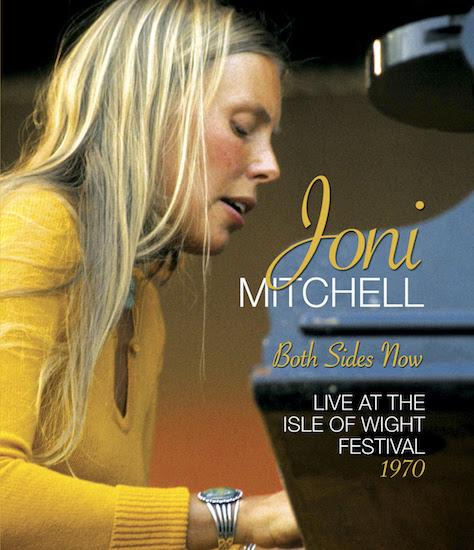
Joni Mitchell’s iconic appearance at the 1970 Isle of Wight Festival is the subject of a new concert movie, Both Sides Now.
Academy Award-Winning Director Murray Lerner creates a masterful addition to the Isle of Wight canon of films with Joni’s excellent performance. The concert/documentary film features Joni Mitchell in a modern interview, explaining the events and her reactions. The complete performance is also intercut with vintage footage from the festival attendees and the promoters to give better context to Joni’s personal recollections from the Isle of Wight in what is one of the most unique and memorable performances of the era.
The set will be released on multiple formats on September. 14th. It was directed by award-winning filmmaker Murray Lerner, who died soon after the project had been completed last year.
The festival was overshadowed by controversy after an estimated audience of 600,000 rebelled against the organizers, staging angry demonstrations and breaking down fences until it was impossible to continue charging for entry. During Mitchell’s set, a stage invader attempted to preach to the crowd before being dragged away, inspiring her to accuse attendees of “behaving like tourists, man” and demanding, “Give us some respect!” They did just that.
“There was this sense that the artists had all sold out,” Mitchell said in a later interview, which appears in the film. “It was the ‘hate the performer’ festival. … I said, ‘Have some respect,’ and they did. They were quiet!”
Isle Of Wight 1970 was the last of the three original festivals on the island off England’s south coast, and starred major British artists such as The Who, the Moody Blues, Free, Procol Harum, Jethro Tull, Emerson, Lake & Palmer and Ten Years After, as well as visiting North American notables including Mitchell, Jimi Hendrix, Sly & the Family Stone, the Doors, Miles Davis and Chicago.
The attendance at the event far exceeded the population of the entire island, leading to huge logistical difficulties, and Mitchell’s set (on Saturday 29 August) was especially challenging for the Canadian artist. It was interrupted on several occasions in a rancorous atmosphere, which later led her to say that “they fed me to the beast.”
In a press release, EagleVision called Mitchell’s performance a “an outstanding performance against all odds.” “It was a battle against the audience, as they tore down barriers and shouted obscenities,” the company notes. “She later commented, ‘It seemed like an appropriate time to flee … ’ but still the seemingly fragile folk-rock singer stood her ground. Instead she returned to her piano … continuing her set with ‘My Old Man,’ she won over the crowd and the atmosphere softened. In response, the front page of Melody Maker hailed her with the headline, ‘Joni triumphs!’”
You can see the track listing for Joni Mitchell Both Sides Now: Live at the Isle of Wight Festival below.
Joni Mitchell, ‘Both Sides Now: Live at the Isle of Wight Festival’
Track Listing:
1. “That Song About The Midway”
2. “Chelsea Morning”
3. “For Free”
4. “Woodstock”
5. “My Old Man”
6. “California”
7. “Big Yellow Taxi”
8. “Both Sides Now”
9. “Gallery”
10. “Hunter”
11. “A Case Of You”
Nottingham trio Kagoule announce their signing to Alcopop! Records with the lead single from their forthcoming album unveiled today. ‘Bad Saliva’ will feature on the MJ (Hookworms) produced, Tarek Musa (Spring King) mixed ‘Strange Entertainment’ full-length, out later this year.
Currently on tour with Drenge, the band say of the track that it is “a track about turning off the path you find yourself on; the temptation to make a change and the anxieties of then making it.”
Solemn, dreamlike 1971 Sea Of Joy documents a period of massive change for Sydney band Tully. For the previous two years, they had been arguably Australia’s most dynamic Folk rock group, renowned for their wild, largely improvised concerts. Their rise was meteoric, from Sydney house band for tribal love-rock musical Hair in 1969, to starring in six-part ABC TV series Fusions. By 1970, when they released their self-titled debut album, Tully were rock stars of a very rare order in Australian music, feted by highbrow critics and teenage groupies alike.
Within a year, however, almost everything changed. Showstopping drummer Robert Taylor departed the band, swiftly followed by vocalist Terry Wilson, and the remainder of Tully joined forces with members of gentle, exploratory folk group Extradition. Suddenly Tully were rockers no longer.
Flautist, clarinetist, saxophonist and de facto band leader Richard Lockwood had approached surfing director Paul Witzig after his now iconic 1969 film Evolution (for which Tully had contributed some music alongside Sydney colleagues Tamam Shud), offering to record an entire soundtrack to his next film. Witzig had agreed when Tully were a towering rock band, driven by Michael Carlos’ massive Hammond organ and Lockwood’s exploratory reeds, but by the time Sea Of Joy came to be recorded, they were a drummer-less, contemplative folk-psych outfit, dedicated to spiritual guru Meher Baba.
Although unexpected, the results were luminous. Sea Of Joy radiates a serene purity, miles removed from what people generally think of as surf music, but as Witzig wrote on the back cover, “Tully are not surfers, but there proved to be many things common to both our worlds: a feeling for peace, beauty, simplicity and freedom.”
New member Colin Campbell contributes I Feel the Sun, also recorded by Extradition for their lone, celebrated album Hush in 1971. The miraculous voice of Shayna Stewart is also heard for the first time in Tully on the Lockwood-penned title track. As an added bonus,
Humble, disarming and sublime, Sea Of Joy is a record like very few others
On 8th February 1969 the new band formed by Eric Clapton and Ginger Baker in the wake of Cream’s demise had intended to go into the studio to start recording, Steve Winwood replaced Jack Bruce. The NME carried the story and reported that the band had been rehearsing at Winwood’s Berkshire cottage and things had been going well. They also reported that the band was still seeking a bass player and that as yet they were unnamed.
Later Ginger said, “We got to Stevie’s cottage in the middle of a field, and I settled down at Jim Capaldi’s drum kit and we just played for hours. Musically, Stevie and I got along wonderfully. He was one of the greatest musicians I’ve ever worked with. What I didn’t know then was that Eric would probably rather have worked with Jim Capaldi. It’s a curious thing with me and Eric. I regard him as the nearest thing I’ve got to a brother, but we always found it difficult to talk about personal things. He never explained, for example, that he wanted it all to be a much more low-key affair than Cream had been.”
Initially at their rehearsals Winwood was playing the bass lines on his organ, but the need for a real bass player was paramount to give Steve the freedom to play more creatively. Clapton admired Rick Grech, bass player for Leicester art-rockers Family, since the days when that band was known as The Farinas. According to Winwood, “I knew he was a good singer and could play great, and that was the guy we wanted. We didn’t even consider any other bass players. Once Rick was around, and he seemed like a nice guy it was just very casually accepted that he was in the band.”
By March Eric told the NME that “We’re just jamming and we have no definite plans for the future.” After the postponement of the February recording sessions things got underway at Morgan Studios with Chris Blackwell producing, but he didn’t really work out so Jimmy Miller took over. Steve knew Jimmy well from his time producing Traffic’s first three albums. Apparently sessions were sometimes tough, as Ginger in particular was struggling with his demons. But all things considered, the Sessions that ran from 20th February to late June were relatively calm.
According to Winwood, “They were full of people hanging out, Eric had a lot of bohemian friends and liked to record with people around. The only thing I remember not being very pleased with was ‘Can’t Find My Way Home’. It was only when I heard it again later that I realised how good it was.”
When Blind Faith was finally chosen as the band’s name it seems to have been largely Eric’s idea with Steve Winwood feeling it had a somewhat negative vibe about it.
1969 was THE year of the festival – a stellar year by which all others have been judged. Across North America and Britain there seemed to be a festival happening somewhere almost every weekend of the summer. The first major festival of the year was in Canada, the Aldergrove Beach Rock Festival that bizarrely starred the New Vaudeville Band and Guitar Shorty. In Britain the first Hyde Park show starred Eric Clapton’s new band, Blind Faith in front of a crowd of around 120,000
It was on Saturday 7th June that Blind Faith headlined the free concert that was organized by Blackhill Enterprises. Peter Jenner and Andrew King who were stalwarts of the London underground scene, having helped start the UFO club in Tottenham Court Road, ran Blackhill. Jenner had been a lecturer at the London school of Economics, and Blackhill ran their five-person business out of a converted shop just off Ladbroke Grove.
Blackhill were principally agents, and it was their acts that gained most from the Hyde Park concerts, which gave them a higher profile than they would have expected from flogging around Britain laying low-key gigs. During 1968, when Blackhill first approached the Ministry of Public Building and Works about the possibility of staging concerts in Hyde Park they were met with a resounding ‘no’. However, their persistence paid off, and on 29th June 1968 Pink Floyd headlined, supported by Tyrannosaurus Rex, Jethro Tull and Roy Harper.
The Blind Faith concert was the first of four concerts scheduled for 1969. Opening the show was the Third Ear Band along with Richie Havens, Donovan and the Edgar Broughton Band (no festival seemed to be complete without them). The stage they all played on was somewhat makeshift in appearance and was only about a meter or so high.
It all kicked off about 2.30 and despite the crowd of 120,000 turning up on a really hot day it was barely reported by the national press and not much noticed by the pop press either. With the exception of Richie Havens, who as usual thrashed the living daylights out of his guitar, the bands never seemed to ignite the crowd. Perhaps they were anticipating guitar pyrotechnics from Eric Clapton, who along with Ginger Baker,Stevie Winwood and Rick Grech had formed Blind Faith, the new ‘supergroup’, a tag with which they had been saddled to describe the musicians’ pedigree.
Blind Faith took to the stage about 5pm kicked off with ‘Well All Right’ before going on to perform most of their debut album. It was a more bluesy set, closer to the kind of things Traffic had been playing than to Cream. According to Ginger Baker, “Eric had been doing amazing stuff, but at Hyde Park I kept on wondering when he was going to start playing. ” According to Clapton, “I came off stage shaking like a leaf because I felt that, once again, I’d let people down.”
Blind Faiths Setlist:
Well All Right , Sea Of Joy, Sleeping In The Ground, Under My Thumb, Can’t Find My Way Home , Do What You Like, In The Presence Of The Lord, Means To An End, Had To Cry Today.
“True, they weren’t as polished as Cream had been, but then again I don’t think there’s anything wrong in master-musicians playing a bit of a ‘woolly’ set. That’s what good rock’n’roll is all about. Play it a bit raw. Fluff up a bit here and there. Make mistakes. Who cares?”– Richard Evans, designer who later worked at Hipgnosis
Among the crowd were Mick Jagger and his girlfriend Marianne Faithfull. Having watched Blind Faith perform, soaked in the vibe and seen how many people there were watching, Mick decided that a free concert in Hyde Park to promote their new single and get them back in the public eye would be just the thing for the Rolling Stones. As a nod to Mick, who stood watching from the side stage, they played ‘Under My Thumb’.
Mick Jagger told the Melody Maker a few days later, “I thought they were very nice. I was right at the back of the stage and couldn’t see them, but I thought somehow they were very strained. I guess they’ll get more together and Ginger was fantastic. He’s a beautiful drummer – the best drummer I have ever heard.”
Meanwhile, the supergroup’s new album arrived just two months after the Hyde Park performance — and shot to No. 1 in the U.K., Canada and in America. Songs like “Presence of the Lord,” “Had to Cry Today” and “Can’t Find My Way Home” caught on in a big way, becoming fixtures on FM radio stations across the country.
Still, controversy loomed over the album’s risqué cover art, which featured a pre-pubescent girl holding a chrome airplane. To the band, it represented the dichotomy between innocence and scientific achievement. To record dealers, it was unsellable smut. Atlantic Records head Ahmet Ertegun stepped in to smooth things over. “We do not agree that the original sleeve is offensive,” he announced to the press. “But if any dealers do not want that cover, we will happily supply them with an alternative.”
Blind Faith was only together for this album, a debut concert in Hyde Park, a Scandinavia and USA tour and then broke up shortly afterwards. In the immediate aftermath, Clapton briefly joined Delaney and Bonnie, while Winwood, Baker and Grech decided to continue on in a new outfit named Ginger Baker’s Air Force — though that, too, came to an end just a year later. Clapton would memorably reunite with Baker for a series of 2005 Cream shows, while Grech subsequently became part of a reformulated version of Traffic with Winwood. Otherwise, a few chance meetings between Winwood and Clapton — notably over three sold-out 2008 shows in New York City — were as close as Blind Faith has ever come to a return engagement.
Also a celebrated visual artist, VanGaalen is widely renowned for his illustration and animation work. As with his previous albums – Infiniheart, Skelliconnection and the Polaris short-listed Soft Airplane, VanGaalen illustrated all of the art for Diaper Island – and is in the midst of animating a music video as well. He has animated music videos for folks like J Mascis, Guster, and Holy Fuck, and his videos have been collectively viewed well over a million times on YouTube.
VanGaalen has been quietly building a catalogue of songs that invite listeners to gently explore his distinctive creativity. Diaper Island extends the adventure into deeper territory, tapping into VanGaalen’s lifeblood and mining the richness of his mind with sharper tools.
As always, VanGaalen wrote, played, and produced all of the music on Light Information (save Ryan Bourne’s bass part on “Mystery Elementals” and vocals on “Static Shape” from his young daughters Ezzy and Pip), and designed the cover art. The product of six years’ work, going back even before 2014’s Shrink Dust, Light Information emerged from the experimental instruments that fill VanGaalen’s Calgary garage studio. Among them is a beloved Korg 770 monosynth, which VanGaalen coveted for years before fixing one up and devoting a lot of recent energy to recording “duets” with it. One of these, “Prep Piano and 770,” is the lone instrumental on Light Information, more atmosphere and chord bursts than the rest of the album’s hooky rock narrative.
‘Light Information’ Release date: September 8, 2017 on Sub Pop Records.
Escape these end times. Free yourself from mind control. Prepare to celebrate the new world order. ‘Columbia’, the debut album by The Blinders, is ready. Nominally, it’s the work of three young men living in Manchester by way of Doncaster. Spiritually, ‘Columbia’ is the beacon to show a better, freer life. Past cult leaders have promised spiritual awakening, true. But the way of The Blinders is more benign and relies only on possessing open ears to gain enlightenment.
You may well have already heard them on Radio 1, Radio X or 6 Music, who playlisted recent single ‘L’Etat C’est Moi.’ You may have seen The Blinders supporting Idles, The Charlatans or Cabbage, or at festivals including Reading And Leeds, Isle Of Wight, Kendall Calling, TRNSMT, Festival No 6 and Neighbourhood Weekender, where they drew a huge crowd to their headline slot at the new bands stage. They’re impossible to miss live, where singer/guitarist Thomas Haywood dons warpaint to assume the fearless persona of Johnny Dream, whose tribal gaze adorns the sleeve of ‘Columbia.’ “Once the warpaint is on, we become monsters, thunder riders,” says Haywood of his alter-ego. “As Johnny Dream, I can totally lose myself in the music and become a shamanic Jim Morrison character. We can do anything, be anyone.”
That shamanic, compelling mood is captured perfectly in ‘Columbia’. Ably produced by Gavin Monaghan (Editors, The Sherlocks, Goldblade), the album sees childhood friends Haywood, bassist/co-writer Charlie McGough and drummer Matt Neale follow Johnny Dream on his spiritual awakening, from the coruscating swagger of the opening ‘Gotta Get Through’ to the raw, beautiful and ultimately redemptive finale ‘Orbit (Salmon Of Alaska)’. Inspired as much by literary touchstones such as George Orwell and Jack Kerouac as much as Nick Cave, Kanye West and The Wytches, ‘Columbia’ is often as dark as you’d expect from an album named after the utopia Charles Manson promised his Family. But, as Haywood notes: “We didn’t want the album to be totally negative. We’re holding a mirror up to society, and there is good in society, so it was absolutely important to end on the optimism of Rat In A Cage and Orbit.”
The latter song was recorded after a schoolfriend of the trio committed suicide. “We’d been struggling to get the song right and were on the verge of abandoning it,” Haywood recalls. “But we read over the lyrics after what happened to our friend and realised we had to get it down. The vocals are one-take.”
Having grown up in Doncaster, The Blinders moved to Manchester to go to University Of Manchester after their A-Levels, though Haywood and Neale soon dropped out to leave McGough to complete his degree in politics and history this spring. “We’d been in bands before, but we’d only just started The Blinders when we finished sixth form,” the bassist recalls. “We felt there was something there, and Manchester was the perfect next step to live a more creative lifestyle. I don’t think it matters where we’re from, ultimately. We say we’re from Doncaster and we love the place, but the community spirit among bands in Manchester who’ve helped us out has been a godsend to us.”
McGough speaks fondly of university giving him both structure when The Blinders aren’t on tour, and of bringing fresh ideas to bring to his songwriting – he studied the Spanish Civil War as part of his degree, with Orwell’s writing a recurring influence on Columbia, not least the eerie campfire feel of ‘Ballad Of Winston Smith’. (“A song you could sing after the apocalypse,” notes Haywood.)
The album contains a reworked version of 2016 debut single ‘I Can’t Breathe Blues’, but daringly leaves off ‘Swine’, the appropriately infectious single which had critics raving. Early Blinders songs were inspired by specific outrages, with ‘I Can’t Breathe Blues’ written after the chilling recording of police brutality victim Eric Garner in New York was made public. The trio’s writing has since become broader in scope, without losing that feeling of rage. “We didn’t know when we started that there’d be such a theme to our songs,” admits McGough. “It was fascinating seeing that narrative come together once we’d recorded the album, realising that even early on in our songs we were expressing that yearning and that hope.”
McGough and Haywood share songwriting duties, with the latter noting: “If you listen closely, you can tell which songs are mine and which are Charlie’s. His songs are more poetic, while I’m always trying to slip a chorus in, but lyrically I’m more ambiguous and Charlie is straight to the point. The credits just list them as being written by the three of us: that equality is the philosophy we preach, and it was important to put that into practice in our own small way.”
Drily witty drummer Neale adds: “With two writers, you’re not defaulting to one vision. And it helps that we’re a trio, because if there are any arguments, it’s going to be two against one. So we’re always a democracy. The fact we’re so loud as a three-piece on stage? That’s partly down to the secret of reverb. But as a trio, you can’t have any unnecessary elements. If you take any one element out, it all collapses.”
Although there’s a timeless power to The Blinders’ songs, the trio are keenly aware of needing to express the malaise at the heart of Western society. “We try to write about the times we’re in, and we try to write daily,” says McGough. “We’re always going to want to get our songs out to the world as soon as possible, so that the events we’re inspired by aren’t out of date. Then again, the nature of social media and 24-hour news channels means the news cycle moves impossibly quickly.” That’s a frustration expressed in ‘Ballad Of Winston Smith’, where Haywood sings: ‘Forgotten stories on the news, a week or so and it’s adieu.’ “It’s one of the reasons we’ve moved slightly away from specific issues,” McGough nods. “We want justice in general, not just for specific topics.”
That sense of injustice is there in the title of ‘Columbia’, drawn from The Blinders’ fascination with cult leaders. Haywood explains: “The rise of populism here and in America means you can draw a line from Trump to Mussolini to Stalin, then through to cult leaders like Jim Jones and Charles Manson. Also, we’re a fan of one-word album titles, like ‘Humbug’ by Arctic Monkeys. One word can strike you, and you can draw so much from it.”
‘Columbia’ was recorded in a month at Gavin Monaghan’s studio Magic Garden in Wolverhampton, with Haywood enthusing: “Beautiful moments happen all the time with Gavin. He takes our ideas and makes them even more epic.” McGough continues: “We’re so hungry, we didn’t need anyone pushing us further than we push ourselves. Gavin was that calming influence on us that we needed.”
‘Columbia’ moves from the brutal brevity of ‘Free The Slave’ and ‘Et Tu’ to the seven-minute sprawling epic ‘Brutus’. “’Free The Slave’ and ‘Et Tu’ are short, sharp shocks,” says Haywood. “They say what they need to.” As for ‘Brutus’, Neale admits its initial inspiration is a mystery to the band too. “That song has changed so much, even we’ve no idea where it came from,” the drummer laughs. “Some of our older songs, we feel like we’re covering them when we play them. It’s the centrepiece of our shows, so it was important to get it right in the studio. It could have gone on for 25 minutes, let alone seven, but as with the other songs, it only says what it needs to say.” McGough admits ‘Brutus’ psychedelic atmosphere was initially tough to capture. “We’d just come off tour when we recorded it,” he recalls. “We went at ‘Brutus’ far too fast, and it sounded awful. The key to getting it right was slowing it down just enough.”
‘Columbia’ also features the powerful ‘Brave New World’, familiar from its use in a William Hill TV advert. “We thought about doing it for a long time and we were initially sceptical,” says Haywood. Adds Neale: “Ultimately, there are few quicker ways of getting your message out there than in a huge TV campaign. You can’t just preach to the converted and get your message out there to people who already support you. You need to reach out to people. That said, it’s a nightmare when the ad comes on when we’re back in Doncaster watching football with our mates. You have to go for a long piss during the ad breaks to avoid your mates ripping it out of you.”
It’s that feeling of being mates, united against the world, that helps the essentially hopeful message of The Blinders and ‘Columbia’. There’s a powerful gang mentality in danger of vanishing in an increasingly gentrified music society, but an elixir which The Blinders possess in abundance. They talk of wanting to move quickly in music, babbling excitedly about new songs they’ve written already since Columbia was recorded. “We’re very certain we’ll be even more ambitious, lyrically and musically,” vows Haywood.
For now, the next chapter will have to wait. Dive into ‘Columbia’. A tangible utopia awaits.
The Blinders live + signing
Wednesday, 26th September 2018 Rough Trade Nottingham