We The People were a garage rock supergroup from Orlando, Florida, formed from members of The Coachmen, the Nation Rocking Shadows, and The Offbeets. The band boasted two songwriters, Tommy Talton and Wayne Proctor. Talton’s ‘You Burn Me Up and Down’ is the second song from We The People featured on Nuggets. It was originally released as a b-side to their third single ‘He Doesn’t Go About It Right’. Note that the header art is taken from a later We The People single – it was the only hi-resolution artwork that I could find.
It’s commendable that the Nuggetscompilers sifted through the group’s b-sides for material, but ‘You Burn Me Up and Down’ is one of the lesser tracks I’ve encountered on Nuggets so far. It sounds inspired by Van Morrison’s Them, with a bluesy feel and authoritative lead vocal.
We The People never released a studio album, but did release enough singles to justify several compilations; notably 1983’s Declaration of Independence. Like The Band and The The, We The People’s Declaration of Independence is not an easy item to find on Google! In an interesting piece of timing, today’s post shares its date with the “We The People” inauguration concert, featuring Fall Out Boy, Carole King, Ben Harper, and James Taylor.
Proctor wrote most of We The People’s material, but it was Tommy Talton who went onto a professional music career. He was part of the country rock band Cowboy who played with the Allman Brothers and Bonnie Bramlett. Cowboy released a reunion album in 2018, titled 10’ll Getcha Twenty.
Nuggets: Original Artyfacts from the First Psychedelic Era is a compilation album of American psychedelic and garage rock singles released in the mid-to-late 1960s. It was assembled by Lenny Kaye, who at the time was a writer and clerk at the Village Oldies record shop in New York. He would later become the lead guitarist for the Patti Smith Group. Kaye worked on Nuggets under the supervision of Jac Holzman, founder of Elektra Records. Kaye initially conceived the project as a series of approximately eight individual LP installments, each focusing on US geographical regions, but Elektra convinced him that one 2-disc LP would be a more commercially viable format. The resulting double album was released on LP by Elektra in 1972 with liner notes by Kaye that contained one of the first uses of the term “punk rock”. It was reissued with a new cover design by Sire Records in 1976. In the 1980s Rhino Records issued Nuggets in a series of fifteen installments, and in 1998 as a 4-cd box set.
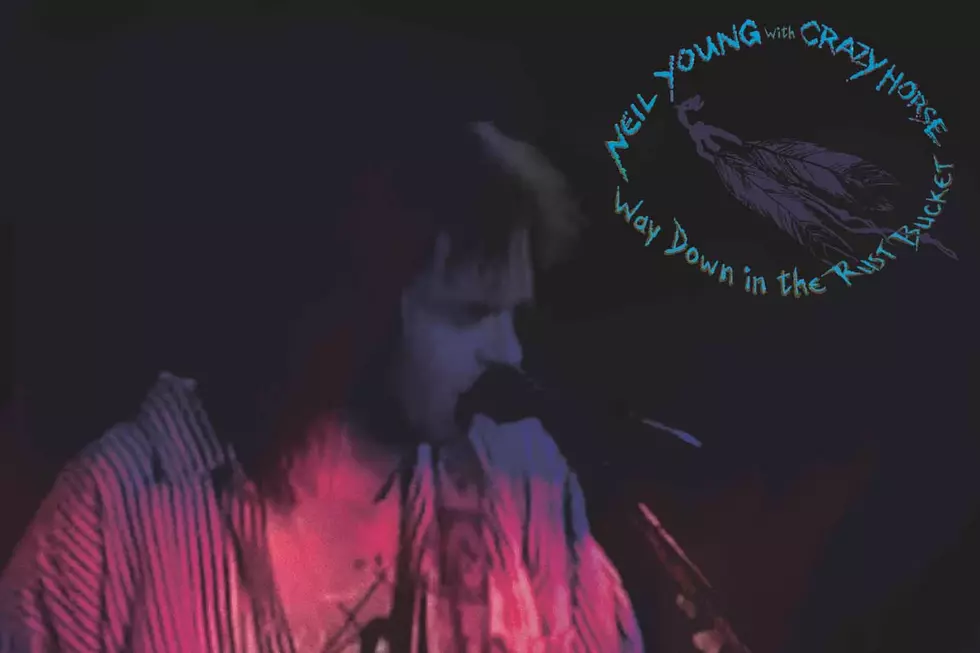
Neil Young was not kidding when he said he was going to start releasing archival material at a much faster rate this year. Just weeks after the release of the 10-disc set Archives Volume II 1972-1976 and the live album/film Return to Greendale, he has announced that “Way Down in the Rust Bucket”, a 1990 Crazy Horse club gig, will come out on February 26th as a film and double album. The show took place November 13th, 1990 in front of 800 lucky fans at the Catalyst in Santa Cruz, California, two months after the release of “Ragged Glory” and shortly before the start of a long arena tour with Sonic Youth and Social Distortion.
Recorded on November 13th 1990 in Santa Cruz, CA, where the band were rehearsing for their upcoming Weld tour, Neil Young and Crazy Horse played a club show at The Catalyst which is now released here for the first time. The show comprised three different sets along with a 12 minute encore of Cortez The Killer and all 3 sets including that encore are brought together here in over 2 hours of music.
The 20-song set ran more than three hours and is noted for being the first time Young ever played “Danger Bird,” a track from 1975’s “Zuma”, onstage. He also performed live for the first time six Ragged Glory songs – “Love to Burn,” “Farmer John,” “Over and Over,” “Fuckin’ Up,” “Mansion on the Hill” and “Love and Only Love” – and another obscurity, Re-ac-tor’s “Surfer Joe and Moe the Sleaze.”
Way Down in the Rust Bucket will be released as both a two-CD and four-LP set, with a Deluxe Edition that adds the video of that performance on DVD. The film was directed by Young using his Bernard Shakey pseudonym and contains a 13-minute performance of “Cowgirl in the Sand” that’s not available on the CD or vinyl versions.
You can check out a preview video of “Country Home” on the Neil Young Archives. “This show is one of my all-time Crazy Horse favourites,” Young wrote. “More songs will be added here before the official release. ”Way Down in the Rust Bucket” is the first in a long list of archival releases that Young is planning for 2021. There are no release dates at this point, but he’s plotting a third Archive Series box set, the 2019 Promise of the Real live album “Noise and Flowers”, the Eighties rarities collection “Road of Plenty”, and an extensive Bootleg Series that will spotlight fan-favourite shows like Carnegie Hall 1970, the Rainbow Theater 1973, and the Bottom Line 1974. Young hasn’t released a new album since 2019’s Colorado, but he recently said that new material is coming. “I have started a new album,” he wrote in response to a fan letter last month. “It’s solo. I’ve been waiting a long time.”
Way Down in the Rust Bucket—which is #11.5 in Neil Young’s Performance Series—is available in a number of variations. A numbered deluxe edition box set contains a DVD of the electrifying live concert—directed by Bernard Shakey and produced and directed for Shakey Pictures by LA Johnson—alongside four LPs and two CDs. The DVD contains one additional performance of “Cowgirl In The Sand” (13 minutes’ worth!), which does not appear on the vinyl or CD editions. The other versions released include a 4LP vinyl box set, a 2CD set and the DVD. Purchasers of Way Down in the Rust Bucket on CD or LP from the Greedy Hand Store
NEIL YOUNG & CRAZY HORSE
“WAY DOWN IN THE RUST BUCKET”
Live 1990
2CD, 4LP or Deluxe Box set ( 2CD/4LP/DVD )
Recorded on November 13th 1990 in Santa Cruz, CA, where the band were rehearsing for their upcoming Weld tour, Neil Young and Crazy Horse played a club show at The Catalyst which is now released here for the first time.
The show comprised three different sets along with a 12 minute encore of Cortez The Killer and all 3 sets including that encore are brought together here in over 2 hours of music.What It Is: Two months after Neil Young & Crazy Horse released their excellent “Ragged Glory” album in September 1990, they played a bar in Santa Cruz, Calif. For three hours and three sets, they tore through a career-spanning show.
What’s on It: Ragged Glory songs like “Over and Over” and “Love and Only Love” are here, but so are “Cinnamon Girl,” “Like a Hurricane” and “Cortez the Killer.” The set is filled with raw, sprawling versions of old and new cuts, some making their live debut.
Best Song You Know: This is a previously unreleased record from Young’s archives, so you haven’t heard any of these particular versions before. But the set includes some of his greatest songs played by his greatest backing band during one of their best eras.
Best Song You Don’t Know: “Country Home” opened the original Ragged Glory album, and it was the first song performed at the Catalyst on November. 13th, 1990. There’s no slow build for Young and the band: They start strong and don’t let up at all.
A couple months after Neil Young & Crazy Horse released their great 1990 album “Ragged Glory“, they hopped onstage at a small bar in Santa Cruz, Calif., and played songs from the record for the first time in front of an audience. The nearly two-and-a-half-hour performance includes older classics like “Cortez the Killer” and “Like a Hurricane,” but epic run-throughs of Glory cuts “Over and Over” and “Love and Only Love” fuel this live album, one of Young’s best concert documents.
Finn Wolfhard’s Band The Aubreys Team Up in collaboration with Atlanta rockers Lunar Vacation, the project takes a more psychedelic turn. The Aubreys is a duo consisting of Wolfhard and his fellow former Calpurnia member, drummer Malcolm Craig. Together with producer Lawrence Rothman, they recorded the track “Getting Better (otherwise)” for The Turning. According to Rothman, the song was influenced by Jay Reatard’s ’90s project The Reatards, which was “blasted” during breaks in their “chaotic 8 hour session.”
It was almost exactly a year ago that Finn Wolfhard revealed his debut track with his post-Calpurnia outfit The Aubreys for the original soundtrack to the Floria Sigismondi feature The Turning. With Calpurnia bandmate Malcolm Craig by his side. The Aubreys Team Up with Lunar Vacation for New Track “No Offerings” from the same session.
“The song pretty much wrote itself, which is real neat,” where the song premiered this afternoon. “The first two lines of the songs are from a text I got from our friend Ben while he was living in New York City for college—literal poetry. So with that, I just wrote the lyrics centred around a person who is trying to find their place in the world, as cliche as that sounds, and all the weird feelings you encounter when doing so. New places, people, things, and feelings—especially in a pandemic.”
“Getting Better (otherwise)” is the latest single released from The Turning OST following Courtney Love’s “Mother”, Soccer Mommy’s “Feed”, and Pale Waves’ “Skin Deep”. Take a listen to the first song from Wolfhard’s The Aubreys via the in-studio music video below.
Directed by Floria Sigismondi, The Turning opens in theatre’s January 24th. The soundtrack — which also features Warpaint, Kali Uchis, Alison Mosshart, Kim Gordon, Living Things with Sunflower Bean, Cherry Glazerr, and others
Lost Map Records, the Isle-of-Eigg based label ran by Pictish Trail’s Johnny Lynch, still seems to constantly find ways to make things a little bit better, via releases from the likes of Martha Ffion, Firestations, Savage Mansion and Alexia Avina. With plenty already in the pipelines for the year ahead, they’ve recently announced the signing of Sulka, “the lo-fi melodic scuzz-rock songwriting and recording project of Glasgow-based Lukas Clasen”, who will release his debut album, “Take Care“, at the end of this month.
DIY in the truest sense, Lukas played every instrument on Take Care, a record that explores a particular period in his life, the post break-up summer of 2019, when he was feeling, “lonely and a bit reckless”. The resultant record seems to be a beautifully explorative affair, channelling the genre mashing style of Alex G, the emotive intensity of Kane Strang and the bedroom exploration of Elvis Depressedly. Having previously supported the likes of Jeffrey Lewis and PAWS, Sulka looks well placed to make a delightfully lo-fi splash.
Stephen Fain Earle (born January 17th, 1955) an American rock, country and folk singer-songwriter, record producer, author and actor. Earle began his career as a songwriter in Nashville and released his first EP in 1982. He grew up near San Antonio, Texas, and began learning the guitar at age 11. His breakthrough album was the 1986 album “Guitar Town”. Since then Earle has released 16 other studio albums and received three Grammy awards. His songs have been recorded by Johnny Cash, Waylon Jennings, Travis Tritt, Vince Gill, Shawn Colvin and Emmylou Harris. He has appeared in film and television, and has written a novel, a play, and a book of short stories. These are the best interpretations we can find of Steve Earle singing Bob Dylan’s songs.
“Señor (Tales of Yankee Power)”
Steve Earle with Lucia Micarelli “One More Cup of Coffee (Valley Below)” possibily the best Bob Dylan cover ever, such passion and yearning in every line. When Dylan wrote ‘to the valley below’ it was deliberate, he took a prosaic sentence, one more cup of coffee before I go and changed it to a biblical epic with that line,
Steve Earle – guitar, vocal Lucia Micarelli – violin, vocal, From “Chimes of Freedom”: Songs of Bob Dylan Honouring 50 Years of Amnesty International –
“My Back Pages”
“It Takes a Lot to Laugh, It Takes a Train to Cry”,
Fantastic end to the 1996 live MTV show called “To Hell and Back” of Steve Earle performing with the best Dukes line up and the awesome Custer on drums. With a song written by Bob Dylan that was originally released on his seminal album “Highway 61 Revisited”, and also included on the compilation album Bob Dylan’s Greatest Hits 2 that was released in Europe.
“Masters of War” Musician Steve Earle sings Bob Dylan’s “Master’s of War.” Part of a reading from Voices of a People’s History of the United States (Howard Zinn and Anthony Arnove,) Berkeley, California on November 11th, 2006.
Steve Earle: “Was Townes Van Zandt Better Than Bob Dylan?…I’m kinda famous for something I said…I was asked for a sticker for a Townes record that came out in the 80s, I said, Townes Van Zandt is the best songwriter in the world and I’ll stand on Bob Dylan’s coffee table in my cowboy-boots and say that. It wasn’t that I thought that Townes was better than Bob Dylan. I just knew that Townes really needed the help more.”
Well, I love both Van Zandt and Dylan, and so does Steve Earle. He has done songs by both on several occasions, and he did an entire album with Townes Van Zandt songs. But Steve Earle is the perfect choice to sing any Dylan song.
New Order are one of the most unlikely success stories. When Joy Division frontman Ian Curtis committed suicide on May 18th, 1980 on the eve of their first U.S. tour, the three remaining members of the band — guitarist Bernard Sumner, bassist Peter Hook and drummer Stephen Morris — decided to carry on as New Order, drafting Morris’ girlfriend Gillian Gilbert on guitars and keyboards later that year. Though their first album, “Movement”, would be heavily indebted to Joy Division’s spectre, their interest in synthesizers — and their frequent trips to New York — would quickly change their sound. 1983’s landmark single “Blue Monday” -is still the best-selling 12″ single of all time — set them down a path as club hitmakers, and sunny synthpop tracks like “Bizarre Love Triangle” and “The Perfect Kiss” could not be any further away from Joy Division’s original stark, morose sound.
Through all this, New Order remained one of the most idiosyncratic bands of the ’80s, refusing to put singles on albums, shying away from press interviews and generally not appearing on camera in their music videos. They also never put away their rock band instruments and did more interesting things with guitar, bass and drums than most of their peers at the time. Their catalogue is robust and full of great songs — many of which easily could’ve been singles beyond the obvious ones that everyone knows.
With their 40th anniversary this year, Here are some of New Order’s best deep cuts, which are essential listening to anyone who already loves “Blue Monday,” “Love Vigilantes,” “Age of Consent,” “Ceremony,” “True Faith” or “Regret.” They range from indie-guitar pop, to club-ready bangers, and the kind of moody, introspective dance-rock hybrids that could’ve only be made by them.
“Power, Corruption & Lies” and “Low-Life” are just perfect albums, and Side 2 of “Technique” is up there too. I also stuck with the original 1980 – 1993 era of the band. The records from the 2000s-on, no non-single song from that era really seemed worthy of this list.
New Order — who are still an active band (though without Peter Hook since they reformed in 2011) — are a fantastic singles band, and everyone should own “Substance” there’s so much more beyond “Blue Monday.” –
“Dreams Never End” (1981)
New Order were still underneath the shadow of Joy Division in 1981, a hard shackle to shake. Unsure how to progress after the death of Ian Curtis, both guitarist Bernard Sumner and Peter Hook sing lead on New Order’s debut album, “Movement”, and both sound like they’re trying to mimic him. “Dreams Never End,” which features Hooky on vocals, is musically bright and sunny, with Hook, Sumner and Gilbert’s instruments swirling around Stephen Morris’ insistent, danceable beat. The Cure would crib liberally from this for their 1986 single “Inbetween Days.
“Procession” (1981)
Following their debut single, “Ceremony” (which had been played live with Joy Division), their next release was “Procession” which felt like a natural progression from Joy Division’s Closer, with glacial synths washing over a frantic rhythm section and Bernard Sumner’s brittle guitars. Recorded and released before Movement, “Procession” nonetheless feels past it, with Bernard Sumner coming into his own as lead vocalist. While a single, “Procession” didn’t make it on to the main track list for 1987’s Substance, but was instead relegated to the bonus disc of the CD. But it’s a pivotal song in their evolution.
“Turn the Heater On” (1982 John Peel Session)
Keith Hudson’s “Turn the Heater On” was Ian Curtis’ favorite reggae song, says Peter Hook in his Substance memoir, saying it was where Bernard Sumner “got the got the idea for using the melodica,” an instrument which would turn up in New Order songs like “Your Silent Face” and “Love Vigilantes.” Barney’s only playing guitar at the end, after he’s stopped singing,” adds Hook, only kinda joking that “That became the whole template for the band.”
“The Village” (1983)
Power, Corruption & Lies is a perfect record, and none of the songs were released as singles — “Blue Monday” was tacked onto the U.S. CD release — so every song could theoretically fit on this list. There are moments of sadness and desolation, but there are also songs of unabashed joy. In much the same spirit as “Age of Consent,” “The Village” bounces along like the first day of spring with Sumner singing “Our love is like the flowers / The rain, the sea and the hours.” The mid-section instrumental — with guitars, synthesizers and drum machines joining forces — remains one of New Order’s most magical moments.
“The synths are incredible from 1:45 so in your face but not overpowering … then they disappear – my whole taste in music seemed to change because of this song” – The Charlatan’s Tim Burgess on “The Village”
“Leave Me Alone” (1983)
Many of New Order’s most genius moments come from the interplay between Peter Hook’s bass — which is almost always played high up on the neck to where some mistake it for guitar — and Bernard Sumner’s guitar. Is there a more perfect example than on Power Corruption & Lies’ closing track? The bass hook opens the song, but it’s when the chiming guitar lead enters that “Leave Me Alone” truly blooms. (Gillian Gilbert adds further, crucial, counterpoint guitar lines.) A grey-hued portrait of loneliness (“On a thousand islands in the sea / I see a thousand people just like me”), it’s one of New Order’s crowning achievements, fading out with two more minutes of gorgeous instrumental melancholia.
“Thieves Like Us” (1984)
This is the big concession to the singles rule on this list. While “Thieves Like Us” went to No#18 in the UK in 1984, it does not have the stature of “Bizarre Love Triangle,” “Temptation,” “Blue Monday,” “Sub-Culture,” “True Faith” or even LP tracks like “Age of Consent” or “Love Vigilantes.” But it is one of New Order’s best, most deeply emotive songs — it’s Peter Hook’s favourite track — that needs all six minutes and 36 seconds to work its magic. Bernard Sumner’s vocals doesn’t even come in till two-and-a-half minutes into the song, long after we’ve been seduced by the song’s NYC hip-hop inspired rhythm section and majestic washes of synths. While the song works well as an instrumental — it plays over the “making the dress” montage in Pretty in Pink — Sumner gives a great delivery with a whole lot of “Loves,” in his signature, fragile style.
“Lonesome Tonight” (1984)
“Lonesome Tonight” is, according to Peter Hook, New Order’s ode to Elvis Presley. Bernard Sumner was apparently obsessed with a version of “Lonesome Tonight” (where The King can’t stop laughing) and suggested to the rest of New Order they try jamming it on stage one night. That bit of C-F chord improvisation became this song, which Hook calls “a glorious tune even though it’s nothing like Elvis’, given away in true fashion as a b-side.” (It’s the flip to “Thieves Like Us.”) New Order rarely needed more than two chords to create something amazing (see all of Power, Corruption and Lies), and when the synthesizers crest halfway through, it evokes Joy Division’s “Atmosphere.” If you’re wondering, that is Peter Hook clearing his sinuses at the four-minute mark. “When Barney heard me hocking up phlegm into a handkerchief he suggested we put it on at the end because the contrast between something so beautiful and something so awful might be interesting. He was absolutely right.”
“Murder” (1984)
New Order have always had a way with instrumentals and this one’s a real tour-de-force, a pounding goth nightmare powered by Stephen Morris’ propulsive drumming, a sinister bass line from Hook and Sumner’s three-note, cyclical guitar hook. The song also makes great, creepy use of movie samples of Hal in 2001: A Space Odyssey and Malcolm McDowell in infamous big-budget softcore film Caligula. “Murder,” which has been covered by The Charlatans and K-X-P, was originally only released as a single in Belgium, but later appeared on the second disc of the Substance two-CD set.
“Elegia” (full version) (1985)
An ode to Ennio Morricone’s spaghetti western scores, specifically the pocket watch scene from A Few Dollars More, “Elegia” opens side two of 1985’s highly underrated “Low-Life”. While the five-minute instrumental is carefully paced, exploding into full Sergio Leone glory in the last minute, the original 17-minute version is even better. “Dylan Jones – then editor at id magazine –asked us if we’d like to do some music for a short 15-20 min art film,” Stephen Morris says. “We went into a studio in Wembley and did a marathon all night session. The film never happened, but we liked ‘Elegia’ so much it got edited down to fit on the LP.” As Morris says, “Hooky’s bass melodies on ‘Elegia’ are majestic.”
“Elegia” is one of three New Order tracks to also appear in Pretty in Pink (“Thieves Like Us” and “Shellshock” which appears on the soundtrack album, are the others), and you may have also heard it in Stranger Things, and the trailer for video game “Metal Gear Solid 5: Phantom Pain.”
“Sooner Than You Think” (1985)
Like “Power, Corruption and Lies”, “Low-Life” is a near-perfect album and picking from the many great songs is difficult. Following “Blue Monday” and “Thieves Like Us,” New Order really came into their own as far as blending rock and club music. While the albums that follow would more often than not have songs that were either “rock” or “synth,” Low-Life let things intermingle in wonderful and surprising ways. After a building, minute-long intro that is mostly guitar, bass and drums, “Sooner Than You Think” shifts gears and lets the keyboards take over. “A very unusual tune, showing exactly why I used to love New Order,” says Peter Hook in his memoir. “We were so versatile.” As the lyrics describe, the song was actually written after “a party in [New Order’s] hotel” in Zurich in 1984. “I think some members of the Furious Five were there, no Grandmaster Flash,” recalls Stephen Morris. “There was a very loud blaster in a very small room – other hotel guests were not amused – complaints were made, maybe I dreamt the Furious Five bit? But not the Swiss police though.”
Here’s a cool live in the studio version with Bernard Sumner wearing some very ’80s shorts:
“Face Up” (1985)
This one should’ve been a single. “When we first wrote “Face up” in early 1984 we thought it was the best thing ever,” says Stephen Morris. “Face Up” is another New Order song where two disparate parts have been grafted together, with an an atmospheric intro (“inspired by Caligula” says Hook) that then drastically shifts gears into music that all but demands you bounce up and down. Sonically, “Face Up” is pure ebullience, the kind few besides New Order can do with guitars, but the lyrics — “Oh how I cannot bear the thought of you” — are a decided kiss-off from a spurned lover. “I couldn’t understand why some people didn’t get Face Up’s euphoria, but maybe you had to be playing the drums to fully get that,” adds Morris.
“Way of Life” (1986)
As the ’80s progressed, New Order became more and more known as a synth pop band, but they remained a clever, inventive rock band on album tracks, as is evidenced by the entire first side of 1986’s Brotherhood. “Way of Life” closes out Side A, beginning with another gloomy fake-out intro before blossoming into a wonderful pop song with a chorus so infectious it seems impossible they would bury it this deep into the album. Hook says “We were trying to emulate ‘Age of Consent’ so I just played the riff backwards, and voilà.
“Every Little Counts” (1986)
New Order were guilty a few times over the years of what Peter Hook calls “five o’clock in the morning lyrics.” Sometimes that meant something special, like “you caught me at a bad time, so why don’t you piss off” (Power, Corruption & Lies’ “Your Silent Face”) and sometimes it gives you the opening lines to Brotherhood’s closing track. “Every second counts when I am with you / I think you are a pig, you should be in a zoo,” which Bernard Sumner cannot get through without laughing. (He also didn’t feel a need to do another take.) And yet, “Every Second Counts” is still pure gold, making great use of orchestral samples, harmony and Sumner’s winning “do de do de dooh” chorus. “Every Little Counts” is also a perfect album-closer, with a massive, woozy swell from their Emulator sampling keyboard — “with Barney holding all the keys down at once, using both arms” — and then a great final joke that definitely freaked out some vinyl listeners at the time.
“1963” (1987)
Like “The Perfect Kiss,” this b-side to 1987 single “True Faith” is a story-song about a doomed relationship — and perhaps firearms — set to ultra-catchy crystalline synth pop. There’s a case to be made that it’s better than the A-side (which was one of New Order’s biggest hits and their first entry into the Billboard Top 40). For people like Peter Hook who wished more of Peter Hook’s distinctive bass stylings made it into the the final product (it doesn’t show up till right before the slow fade out), Arthur Baker’s sublime remix adds in more string instruments — bass and guitar — throughout.
“Vanishing Point” (1989)
Both Stephen Morris and Peter Hook’s favorite song on 1989’s Technique, “Vanishing Point” is one of New Order’s finest electronic dance songs (and it really should’ve been a single instead of either “Fine Time” or “Run”). Like “Thieves Like Us,” this one is in no hurry to get to vocals, with the 90 second lead-in playing like an overture, leading us through the major melodic points; when Sumner does begin with “Grow up children don’t you suffer / at the hands of one another” it’s a cinematic experience. “Vanishing Point” has the best chorus on the album and the best breakdown and “drop” (before they called them that), that was clearly influenced by the two months spent in Ibiza making the album (and spending a lot of time at the clubs).
“Dream Attack” (1989)
The dance and rock tracks on Technique mostly stay in their individual lanes, but the album closes with the glorious “Dream Attack” that brings the whole record together, mixing ragged guitar solos, windswept acoustic guitars, sampled orchestra hits, sequencers and live drums — plus another great chorus — all together as only New Order can do. Bernard Sumner apparently had The Eagles’ “Hotel California” in mind with the song’s two-minute jam outro which, in their hands, works. Gillian Gilbert, who played those wonderful acoustic guitars, says, “To me, Dream Attack’ sums up the whole album. It’s bright breezy and uplifting…a good song to walk off into the sunset to.”
“Special” (1993)
New Order were not especially getting along in the early-’90s, but got back together to make a new album, as they were low on funds after their label Factory Records (which went belly-up the year prior) and their troubled Manchester club, The Hacienda, depleted their bank accounts. “Republic” was, by all accounts, not the most pleasant recording experience with Bernard Sumner and Peter Hook butting heads constantly. There’s not much of Hook’s signature bass on the album, but there is some unfortunate rapping by Sumner. Republic does contain “Regret,” one of their best-ever singles (a Top 40 hit in the US), and some of the old magic can also be found tucked away near the end of Side 2 with the sultry, moody “Special,” which is driven by Hook’s bass and another great chorus. Lyrically the song is perhaps referencing the demise of Factory Records or the group itself: “It was always special, like water down the drain.” New Order went on an eight-year hiatus not long after its release.
Both New Order and Joy Division were among the most successful artists on the Factory Records label, run by Granada television personality Tony Wilson, and partnered with Factory in the financing of the Manchester club The Haçienda. Speaking in 2009, fellow synthpop musician Phil Oakey described New Order’s slow-burn career as cult musicians as being unusually prolonged and effective: “If you want to make a lot of money out of pop, be number 3 a lot. Like New Order did
Peter Hook suggested that the band should stop touring. In early May 2007, Hook was interviewed by British radio originally to talk about his contribution to the debut album of Jane’s Addiction singer Perry Farrell’s new band Satellite Party – and stated that “Me and Bernard aren’t working together.” Further complicating the news, a website with support from New Order management, reported that according to “a source close to the band”, “The news about the split is false… New Order still exists despite what [Hook] said … Peter Hook can leave the band, but this doesn’t mean the end of New Order.” However, Sumner revealed in 2009 that he no longer wished to make music as New Order.
Black Country, New Road are a band who seem to have been tipped for the top ever since they first emerged from a recording studio, pedalling their musical wares. Since first stumbling on their track Athen’s, France back at the start of 2019, I’ve been following their releases with admiration, although nothing has quite sparked my interest in the same way as that first track; that was until this week when the band shared their new single, Track X.
Formed out of the ashes of another band Nervous Conditions, seven-piece Black Country, New Road are one of today’s definitive dark and jazzy post-punk bands. Having released just two singles for Dan Carey’s buzzy Speedy Wunderground label (black midi, Kate Tempest), their surreal sound has already drawn praise from outlets, including Paste and Stereogum, and they were due to storm SXSW this year. While their amusing, slightly gothic debut single “Athen’s, France” dropped Phoebe Bridgers and Ariana Grande references, their nine-minute follow-up “Sunglasses” built to a shrieking horn-laden climax for the ages.
The latest track to be shared from the band’s upcoming album, For the first time, out next month on Ninja Tune, Track X was originally written back in 2018, before being shelved in favour of more immediate thrills suited to the live arena. During the sessions for their new album, the band resurrected the track, embracing the possibilities of the studio to create something expansive and ambitious, as the half-spoken vocals combine with flutters of guitar, stabs of saxophone and violin flourishes.
The music video for ‘Track X’ is about nostalgia for being a kid and happy times with family, stupid moments with friends like feeding Cheetos to a giant horde of birds in a Walmart parking lot, and for Tumblr and YouTube videos of cats. But at the same time balanced with this is a comment on the transience of the past, like with the shots of the abandoned houses, and a sense that maybe what we remember isn’t quite real, like the idealised stock footage. I wanted to combine all of those emotions and thoughts together and make a 2000s style American home video – Bart Price
This is a track that never seems to stand-still, always shape-shifting across its five minutes, whether its mellowing into the Fanfarlo-like chorus, or embracing their more idiosyncratic side in the almost jazzy flourishes of the slowly unwinding outro. Sometimes brilliant, always intriguing and destined for huge success in the year ahead, one thing is for certain; this isn’t the last you’ll hear of Black Country, New Road.
Taken from the album ‘For the first time’, is out February 5th via Ninja Tune Records.
Adeline Hotel is the New York-based psych-folk project led by Dan Knishkowy. Sharing his music with the world since back in 2014, Dan has this week announced his latest album, “Good Timing”, as well as sharing the first two pieces from it, Photographic Memory and I Have Found It. In many ways Good Timing is like an origin story for Adeline Hotel’s music, returning to the roots of Dan’s songwriting by recording, “ostensibly aimless music”. This is a world of improvisation and layering, just Dan at his guitar producing work that seems to tap into the middle ground of instrumental ambience and the American Primitive influence we’ve come to expect on his music.
Nodding to artists like Jim O’Rourke or William Tyler, on these first two tracks, without even uttering a word, Dan seems to have hit on something deeply personal, this music feels like an extension of himself, songs woven from the strings, delicate and beautiful spiders-webs of guitar. While beautiful, these are also deceptively simple, unadorned, never knowingly over-thought, the records are free from studio-trickery or any danger of overworking, tracks that are at once raw and fragile, a reminder that the roots of punk, folk and neo-classical composition all lie with a human at their core. Dan has suggested his process for Good Timing is, “the closest I’ve ever gotten to the source”, and as a result this feels like the most open, honest and quite possibly exciting he has ever sounded.
The most trivial encounters can lead to great songwriting observations. Years ago, ‘80s rock icon John Mellencamp was driving along Interstate 65, weaving his way through Indianapolis, when he spotted a black man holding a black cat while lounging on his front lawn. The juxtaposition of the man’s cool, calm demeanor and the interstate’s relentless traffic stood out to him. Mellencamp later put pen to paper to write “Pink Houses,” a hit single from his 1983 studio album, “Uh-Huh“.
“[The man] was sitting on his front lawn in front of a pink house in one of those shitty, cheap lawn chairs. I thought, ‘Wow, is this what life can lead to? Watching the fuckin’ cars go by on the interstate?,’. But it was much more than that.
He continued, “Then I imagined he wasn’t isolated, but he was happy. So, I went with that positive route when I wrote this song.”
Lyrically, the song takes a straightforward, literal approach. “There’s a black man with a black cat / Living in a black neighbourhood / He’s got an interstate running’ through his front yard,” he depicts. “You know, he thinks, he’s got it so good / And there’s a woman in the kitchen cleaning up evening slop / And he looks at her and says, ‘Hey darling, I can remember when you could stop a clock.”
The chipper hand claps and generally groovy tone is deceiving. In observing one man’s existence, he takes great issue with American life, at large. In fact, he has stated the song isn’t what many think it is. “This one has been misconstrued over the years because of the chorus – it sounds very rah-rah. But it’s really an anti-American song,” he said. “The American dream had pretty much proven itself as not working anymore. It was another way for me to sneak something in.”
The song’s meaning has long been misinterpreted. First, Ronald Reagan used the song in his 1984 reelection stops, and secondly, in 2008, Republican Senator John McCain used it for many of his political rallies and events. As he remembered it, in a 2009 interview with NPR, Mellencampcalled up his rep Bob Merlis. “What happened was that I called up my publicity guy. Bob said, ‘You know, McCain’s using your song.’ I said ‘Well, he can use it if he wants to, but you probably ought to write him a letter and say, ‘You know, not only that you guys are using it, but so is Barack Obama, so is John Edwards, so is Hillary Clinton, and you should understand that Mellencamp is very liberal, and do you really think that it’s pushing your agenda in the right direction? I mean, you’re just really falling in line with all the other liberal candidates. Maybe you guys should rethink using the song.’”
He added, “We didn’t tell him not to use it. We just wrote a letter that said, ‘You guys might want to rethink about using this song,’ and they quit using it.”
McCain immediately stopped using both “Pink Houses” and “Our Country” at his events.
Mellencamp admitted he wished he would have built a stronger, more meaningful third verse. “I’ll hear a song I wrote many years ago called ‘Pink Houses’ on the radio, and I’ll think, ‘Man, I wish I would have spent a little more time on the last verse,’” he articulated to American Songwriter in 2005. “I never really view my songs as done. I just think they’re abandoned. You think, ‘Okay, well, I’m in the studio now, and now it’s time to think about what the guitar player is going to do, and what the bass player is going to do, and what the drummer’s going to do.’
“So once you get to that point, the song is pretty much abandoned,” he said. “You’ve got to be able to roll with what these musicians try to do with the song.”






 The Fat Angel Sings