Clear your schedule because you’ll probably end up replaying this track so many times it becomes a feature length film. Fear Of Men are one of the most interesting bands in the UK right now. They released their second album Fall Forever earlier this year and it refines their artful balance of emotionally charged lyrics framed by metallic, almost cold sounding instrumentation. Their new video for “Sane”, is a perfect visual manifestation of that balance.
Beginning with front person Jessica Weiss climbing on top of a stone table strewn with a strange collection of objects, “Sane” plays on Fall Forever’s strong themes of passion and violence. Through a surreal narrative that looks a bit like Secret Garden meets Daisies, it deals with the forces of perception and control – taking the internal struggle of navigating a world that suddenly looks and feels different, and turning it inside out.
Give it a watch below, but make sure you have some time to spare because you’ll probably end up replaying it so many times.
I’m a monument to myself…half flesh, half stone… Sane is from the album Fall Forever available
‘Cahoots’ celebrates its 45th Anniversary!, This whole album is a masterpiece. Seems to be much more appreciated now than the initial fan reactions. Cahoots is the fourth studio album release by the American/Canadian rock group The Band . It was released in 1971 to mixed reviews, and was their last album of original material for four years. The album’s front cover was painted by New York artist/illustrator Gilbert Stone,
“Run away Run away” it’s the restless age, sings the Band at the beginning of Cahoots (Capitol SMAS 651) and they mean it. They also mean it when they sing of the endlessness of the river, admonishing the listener that “You can ride on it or drink it,/Poison it or dam it,/Fish in it and wash in it,/Swim in it and you can die in it, run you river run …” Cahoots is about finding a place for yourself in the restless age.
The mood of the album is filled with a “tinge of extinction.” As the chaos of the carnival is played off against the timelessness of the river, the Band mourns, always more in sorrow than in anger, the passing away of the things they have grown old with and the failure of anything of consequence to rise up in their place. “How you gonna replace human hands?” they ask us in “Last of the Blacksmiths.” And, “How can you sleep when the whistle don’t moan?” in “Where Do We Go From Here.” “Your neighborhood isn’t there anymore,” they jeer in “SmokeSignal.” “Run away Run away — it’s the restless age,” but, “the car broke down when we had just begun.”
Very complex song structures and features some of The Bands best vocals.
Allen Toussaint and Van Morrison. Where on The Band we were made to experience a mythical view of the past as a present reality, Cahoots is merely sometimes about the past, and then only insofar as the past can be made to comment in a direct way on the present. Unlike The Band, Cahoots endistances us from the past, constantly reminding us of what was then and what is now.
In Cahoots, the notion of the commentator is stressed over that of the participant. The narrator of these songs is most often observing others and in the process drawing explicit contrasts, comparisons, and morals. Instead of seeing phenomenon in motion, as they were being experienced, we see them as fixed entities to be described or dealt with: the process is now less important than the conclusions to be drawn about the process. At the same time, the orientation and musical texture is constantly changing so that we are left with the feeling of experiencing things through a stylistic kaleidoscope.
“4% Pantomime,” another song about performing, is named after the fact that the difference between Johnny Walker Black and Johnny Walker Red is 4%. It is also for the 4% of Mr. Van Morrison’s performance which had to be seen, not heard. Unlike “Stage Fright,” which analyzed the artist’s dilemma, “4% Pantomime” is simply about being a working artist. Many of the Band’s songs have been in the first person but none of them literal representations of themselves. This one even uses real names on the choruses, as two old fashioned juicers VanMorrison and Richard Manuel — coax as much feeling as they can out of each other.
“Last of the Blacksmiths” is a crucial song embodying more than any other the definition of the “tinge of extinction” and “isolated artist” themes of the album. Sung and played in a desperate style, the lyrics parallel the question of the blacksmith (“how can you replace human hands”) with the question of the musician: “frozen fingers at the keyboard, could this be the reward?” Unfortunately, the acuity of perception then trails off in a typical bit of over-writing and the rest of the song is sustained more by the excellence of the performance than by its lyrical content.
“Where Do We Go From Here” comes dangerously close to being merely topical. Cute rhymes like “Just one more victim of fate/Like California state” do nothing to add to what the song has. The music, while brilliantly put together, has a stiffness which makes it once again forbidding. Like every cut on the album there is something to recommend it: in this case, the opening lines of Rick Danko’s beautiful vocal.
“Shoot Out In Chinatown” is a fairly grim story that makes the point that things cannot be shoved under the rug, to wit: “Buddha has lost his smile/But swears that we will meet again/In just a little while.” The music has more momentum and freshness than most things on the album and the cut is sustained exceptionally well. One of the most enjoyable things on the record.
“Smoke Signal” is a light play on the extinction theme. In “Chinatown” Robertson is talking about deliberate actions of the state while on “Smoke Signal” the humorous allusions seem to be to the process by which people merely lose control, instead of being actively forced to surrender it. Musically, it is a powerful song with some brilliant lines that stick in the mind, especially: “When they’re torn out by the roots/Young brothers join in cahoots.”
If “Life In A Carnival” is an overture, The song features a lively Dixieland horn chart courtesy of AllenToussaint then “The River Hymn” was surely intended as a finale, a sort of ceremonial piece, and on it one’s ultimate impression of Cahoots must rest. It is surely the most ambitious thing the group has ever attempted. Lyrically, it is the culmination of Robertson’s growing style. It is so cinematic, that as it is heard the movie possibilities flash in front of you uncontrollably. Everything described is not only easy to visualize but is, in the listener’s mind, inevitably visualized.
“When I Paint My Masterpiece,” a Bob Dylan song making its recorded debut here as the second selection, is another welcome track, buoyed by mandolin and accordion in a charming arrangement appropriate to its tale of an odd trip to Europe.
Several of the songs’ lyrics come across as half-baked film scenarios, but they fail to be evocative, and they are paired to music lacking in structure. The failure is solely in the writing The Band sounds as good as ever playing the songs, with singers Richard Manuel Levon Helm and Rick Danko all performing effectively and primary instrumentalist Garth Hudson filling in the arrangements cleverly.
Rick Danko – bass, acoustic guitar, vocals
Levon Helm – drums, mandolin, upright bass, vocals
Garth Hudson – organ, piano, accordion, tenor and baritone saxophones
Richard Manuel – piano, drums, organ, slide guitar, vocals
Robbie Robertson – guitars, piano
Additional personnel
Allen Toussaint – brass arrangements on “Life Is a Carnival”
Van Morrison – vocals on “4% Pantomime”
Libby Titus – backing vocals on “The River Hymn”[6]
Mark Harman – engineer
One of my favourite CHEAP TRICK albums is Dream Police, it was released thirty-seven years ago today on September 21st, 1979. I knew it was 1979, Dream Police, befitting the name of the record label that released it, is epic. it was Cheap Trick’s fourth studio album, but also a big step forward in it’s sound and production. Filled with orchestration, and additional keyboards, Rick Nielsen’s riffs carry the tunes “The House is Rocking (With Domestic Problems)”, Robin Zander’s vocals are of course, stellar (“Voices), Bun E. Carlos’ drumming is efficient and swinging “Need Your Love” and the whole thing is anchored by Tom Petersson’s melodic and at times ominous 12-string bass guitar “Gonna Raise Hell”.
Dream Police was the instant, and perfect, follow-up to the band’s new-found success after the release of the LiveAt Budokan Album. In many ways, Dream Police just solidified every aspect of what Cheap Trick had been working towards since day one, and wove it all together into one perfectly simmered brew. The album’s title cut opens things up, and is so full of energy, excitement and flat-out fun, it was (and still is) irresistible. With a simple one-two snare drum intro, things are off and running directly toward sheer jubilation.
The title track was the big radio hit, and remains a staple of every Cheap Trick show to this day. Other highlights include the sheer pop brilliance of “Way of the World” (guaranteed to improve any mood), is one of the band’s great lost songs. Before they began pulling it into live shows over the last few years, the song seemed all but forgotten. It’s one of countless great rockers in the band’s catalog. Again, the strings add a certain excitement here, just some nice coloring, never flooding the gate or weighing down the rock action at hand. As is so often the case, vocalist extraordinaire Zander shows off those pipes — power and grace, truly one of the greatest singers in the history of rock ‘n’ roll.
Side two kicks in with the classic Cheap Trick sounds of “I’ll Be with You Tonight.” It’s a no-frills power pop item that dates back to 1974, with a big guitar hook that sets the scene. Everything falls into place from there. It’s the Raspberries, the Moveand the Beatles all rolled up into one perfect ball.
The aforementioned “Voices” – a beautiful ballad which should have been as big as “The Flame” was nine years later; “Need YourLove” is a killer, relentless jam, as is the mean, dark “Gonna Raise Hell.”
The album still sounds great today; the songs still hold up. Most Cheap Trick fans will rank this album as among the band’s best.
The release of the album was delayed for months because of the runaway success of the Live at Budokan album
That snapping snare drum sound on “Gonna Raise Hell” is augmented by 2×4’s slapping together
Steve Lukather played the solo on “Voices”
“Need Your Love” was first heard on the Live At Budokan album
Maybe it’s difficult to overstate the contributions to modern day music that began with a group of five young men with no clear frontman. But the Band which released its eponymous masterpiece 46 years ago this week — brought a swollen heart and a down-home groove to the rock n’ roll landscape that was unprecedented at its time. Not that surprising, considering the group was referred to as “the best damn band in the world” before they even settled on a name. The Band is the eponymous second studio album by The Band, released on September 22nd, 1969. It is also known as The Brown Album. According to Rob Bowman’s liner notes for the 2000 reissue, The Band has been viewed as a concept album, with the songs focusing on people, places and traditions associated with an older version of Americana. Thus, the songs on this album draw from historic themes for “The Night They Drove Old Dixie Down”,“King Harvest (Has Surely Come)” and Richard Manuel’s “Jawbone” (which was composed in the unusual 6/4 time signature.)
In the mid-sixties, four rag-tag kids from Canada were lured to the open road by Rockabilly legend Ronnie Hawkins and his teenage drummer, Levon Helm. Unlike the rest of his bandmates, Helm was the son of a cotton farmer from Turkey Scratch, Arkansas and brought the authenticity of Delta blues with him wherever he went.
He was eventually recognized by fans and friends alike as the heart of the group’s sound, sharing vocal responsibilities with bassist Rick Danko and multi-instrumentalist Richard Manuel. But it was Helm who took the reins in four of the songs on that self-titled release with his signature country drawl. Two of those songs became timeless Band favorites- “Up on Cripple Creek” and “The Night They Drove Old Dixie Down,” a hypothetical civil war tune overflowing with classic Americana.
It is a remarkable song, the rhythmic structure, the voice of Levon and the bass line with the drum accents and then the heavy close harmony of Levon, Rick and Richard Manuel in the theme, make it seem impossible that this isn’t some oral tradition material handed down from father to son straight from that winter of ’65 to today.
… I kept coming back and coming back until now I am prepared to say that, depending on one’s mood, these songs stand, each on its own, as equal sides of a twelve-faceted gem .
Just a month before its release, the Band took to the stage at Woodstock on the final night of the three-day festival, playing seven songs from their 1968 studio debut, Music From Big Pink. Along with generally favored reviews, this earlier record fell flat with certain critics, The album which would eventually be referred to adoringly as The Brown Album.
[The Beatles’] Abbey Road captivates me as might be expected, but The Band is even better, an A-plus record if I’ve ever rated one. That should come as no surprise to those of you — which I assume means most of you — who regarded Music From Big Pink as epochal. Though I somehow always managed to avoid saying so in print, I didn’t.
Except for Dylan, [guitarist Robbie Robertson] is the only American songwriter to write good fictional/dramatic songs… and the only one to master the semi-literate tone, in which grammatical barbarisms and colloquial ellipses transcend affectation to enrich and qualify a song’s meaning.
Months before recording the LP, Robertson, the group’s primary songwriter, had no idea just how iconic their work would become. Robbie was asked how seriously the group took their craft.
“Just seriously enough to satisfy us, enough so that we can smile at one another when we’re through playing.”
And you can feel it; that satisfaction especially in these songs. The musicianship between all five members on the album is electric, heartfelt, and casual. With the ping of every ride pattern, you can practically sense Helm’s broad, boyish grin behind that drum kit.
The Band released five more albums with the same lineup before Robertson’s departure, taking an overwhelming majority of disputed songwriting credits with him — an issue that left some of the remaining members bitter for decades. None of those records would come close to the success of The Brown Album.
Not bad for a few Canadian boys and a dusty farmer.
After unsuccessfully attempting sessions at a studio in New York, The Band set up shop in the pool house of a home the group rented in West Hollywood. The home, located at 8850 Evanview Drive, was once owned by Judy Garland, Wally Cox and, at the time the group worked there, Sammy Davis, Jr. According to Robbie Robertson, the location was chosen to give the songs a more Basement Tapes-like feel in what was termed “a clubhouse concept.” Work was later completed at The Hit Factory in New York City.
The album was also reissued in 2009 by Audio Fidelity as a limited edition gold CD. Remastered from a 1980s CD pressing, the album also included a single b-side “Get Up Jake” as a bonus track. originally it was dropped from the line-up at the last minute, either because the band felt it was too similar to another track on the album, or because there physically wasn’t enough room on the album.
The album includes many of The Band’s best-known and critically acclaimed songs, In 1998 Q magazine readers voted The Band the 76th greatest album of all time. Upon hearing the record one critic declared it better than Abbey Road, which had been released four days following, writing that The Band’s LP is an “A-plus record if I’ve ever rated one.” He ranked it as the fourth best album of the year in his ballot for Jazz & Pop magazine’s annual critics poll.
L.A. band Dawes return with their fifth album. “We’re All Gonna Die” was produced by Grammy nominated producer Blake Mills (Alabama Shakes) and includes backing vocals from Jim James of My Morning Jacket, Brittany Howard of The Alabama Shakes, Mandy Moore, Will Oldham, and Jess Wolfe and HollyLaessig of Lucius. Of the album, Taylor Goldsmith (guitar, vocals) explains, “Pretty much every song on this record explores a difficult situation and tries to find a way to find the good in it, or at least remind yourself that it’s not always that big of a deal. After all, as scary as it is, we are all gonna die.” “If last year’s All Your Favorite Bands was a sweet source of comfort-rock, We’re All Gonna Die is something of a wake-up call, with sharper sounds and harsher vibes, straight from the jarringly fuzzy note that opens its title track” .
The California band Dawes has released several albums of breezy Golden State guitar rock centered on TaylorGoldsmith’s emotionally loaded songs. Those songs are filled with statements that are irresistibly uplifting when heard in a crowd. (Think “anyone that’s making anything new only breaks something else” from “When My Time Comes.”)
Dawes’ fifth album has the true — but still unsettling — title We’re All Gonna Die. It represents a change in sound courtesy of producer Blake Mills, who recently got kudos for producing Alabama Shakes‘ latest album, Sound & Color, and who was also Goldsmith’s high-school bandmate. More touches of keyboards and more space are part of the band’s new approach.
Black Sabbath will release a 4-disc deluxe edition of their classic 2nd album Paranoid, featuring alternative mix and live tracks. Black Sabbath have announced a four-disc super deluxe edition of their 1970 second album Paranoid.
It’ll launch on November 11th and is being released to coincide with the band’s final run of live dates on their TheEnd tour, which is scheduled to wrap up in February with two dates in their hometown of Birmingham.
The Paranoid package will include the 2012 remaster of the original album, along with a rare 1974 stereo quad mix. In addition, the set will include two live performances from 1970 in Montreux and Brussels.
It’ll also feature a hardbound book with extensive liner notes, photos, memorabilia, a poster and a replica of the tour book sold during the Paranoid run of shows that year.
It’ll also include new interviews with Ozzy Osbourne, Tony Iommi, Geezer Butler and Bill Ward.
Initially released in 1970, Paranoid featured classic Black Sabbath tracks War Pigs, Iron Man, Electric Funeral, Fairies Wear Boots and the title track, which reached no.4 in the UK singles charts and no.61 on the Billboard Hot 100 in the US.
The Paranoid Super Deluxe Edition is available for pre-order via Amazon.
It may have been released 46 years ago, but Black Sabbath’s second album has lost none of its unearthly power
Rat Salad
By Sabbath standards, Rat Salad is little more than a throwaway instrumental, but by most other bands’ standards it’s pretty fucking great. 150 seconds of spiralling riffs and muscular oomph, it makes up the numbers on Paranoid to some degree, but still more than justifies its presence on this classic album by demonstrating just how fiery and exhilarating the young Brummies were by this point. Perhaps more interestingly, it has yet to be confirmed whether any of the band have ever actually eaten a rat salad. It doesn’t sound very appetising, but then they were out of their minds on drugs at the time and anything’s possible when the munchies kick in.
Paranoid
Dashed off as a last-minute filler for Sabbath’s second album, Paranoid may not have ever been intended as an immortal anthem for the ages, but that’s what it has indubitably become. As humble as its birth was, it’s a textbook example of a classic heavy rock song: short, to the point, laden with hooks and performed with the kind of urgency and vitality that only young bands with big dreams and tons of confidence can muster. The fact that it’s only the seventh best song on Paranoid is testament to the mind-bending quality of the rest of the album, rather than a criticism of the song itself. Everyone loves Paranoid.
Electric Funeral
It’s an obvious truth that he entire doom metal scene owes its collective arse to Black Sabbath, and to songs like Electric Funeral in particular. Crushing, sinister and wonderfully weird, this is a song that still sounds like the end of the world slithering towards us (and given the state of the planet at this point, we deserve nothing less). Lyrics like ‘Robot minds of robot slaves lead them to atomic rage’ and ‘Earth lies in death bed/Clouds cry water dead’ ensure that the apocalyptic vibe is virtually chewable throughout, and the way that Sabbath switch from debilitating dirge to bursts of nimble, mutant blues fury still has the power to take the breath away. May all our funerals be this electric.
Planet Caravan
They may have struck fear into the hearts of polite, Christian folk everywhere with their evil riffs and uncontrollable facial hair, but Black Sabbath were hippies at heart and Planet Caravan remains their finest ever attempt to tap into the woozy bliss of psychedelia. Satan only knows how much weed was smoked during the recording, but seldom has the notion of drifting blearily through the cosmos with one’s true love ever been so vividly evoked. And while Sabbath’s biggest and most seminal contribution to metal remains Tony Iommi’s riffs, the fact that Pantera covered this song on 1994’s Far Beyond Driven proves that Sabbath’s subtle side has had an undeniably enduring effect on the evolution of heavy music too.
Hand Of Doom
Another song that has been utterly essential in inspiring the doom metal legions, Hand Of Doom is obscenely heavy in every respect: the riffs, of course, are pulverising but it’s the lyrics that make this such a bruising seven-minute crawl through unimaginable horror. Inspired by the drug-ravaged disintegration of US soldiers returning from the Vietnam war, it’s a sustained litany of nightmarish observations set to one of the band’s most ingenious arrangements: ‘Push the needle in/Face death’s sickly grin/Holes are in your skin/Caused by deadly pin’… come on, it doesn’t get much better than that, does it? Extra points for the phrase ‘deadly pin’, which may well have saved a few people from dying in freak sewing accidents.
Fairies Wear Boots
Fairies don’t exist, so their footwear is hardly a matter for sensible discussion, but when you’re in the midst of Paranoid’s mesmerising closing track, it wouldn’t take much to make you believe and head straight for the nearest branch of Foot Locker to do some research on miniature clogs. That aside, Fairies Wear Boots is still a staple in Sabbath’s live sets, and with good reason: this song swings like a megalodon’s ballbag and deftly combines pounding blues rock vibes with a strong sense of pot-addled euphoria that reaches an almost comical peak when Ozzy sings ‘Smokin’ and trippin’ is all that you do!’, thus summing up Black Sabbath’s recreational itinerary with laudable precision. As an added bonus, this is one of the few heavy metal songs that features a dancing dwarf.
Iron Man
One of Tony Iommi’s greatest skills is to write riffs that are as easy to sing along with as the songs’ vocal parts. Whenever the band play Iron Man live, everyone goes apeshit, despite the fact that this is one of Sabbath’s heaviest, slowest and most unashamedly lumbering anthems. Geezer Butler’s lyrics were apparently inspired by Ozzy Osbourne’s observation that the song’s main riff sounded like “a big iron bloke walking about”, which is both brilliant and daft. However, there’s nothing daft about the timeless might of the band’s ensemble performance: this is the sound of heavy metal being forged in real time; immense, unstoppable, ageless and devastating.
War Pigs
46 years on, War Pigs is still one of the most ridiculously thrilling songs ever performed by human beings. You don’t have to be aware of all the noted artists and bands that have covered it – ranging from Faith No More’s straight but scintillating version from The Real Thing through to quirky art punks Alice Donut’s trombone-led demolition on 1990’s Revenge Fantasies Of The Impotent – to see how fundamental this epic and grandiose eruption of heavy, heavy thunder is to just about everything we hold dear in the metal world.
War Pigs is simply part of metal’s sonic DNA, from its bewildering succession of colossal riffs to Geezer Butler’s powerful anti-war lyrics, delivered with youthful aplomb by Ozzy Osbourne: it’s a towering template for intelligent, rampaging heaviness that still sends shivers down the spine of most sensible listeners. And yes, Geezer did rhyme ‘masses’ with ‘masses’, but so what? It’s War Pigs. It rules (and those words do rhyme, let’s face it).
Paranoid is the second studio album by English rock band Black Sabbath. Released in September 1970, it was the band’s only album release to top the UK Albums Chart until the release of 13 in 2013. Paranoid contains several of the band’s signature songs, , Paranoid the single was the band’s only Top 20 hit, reaching number 4 in the UK charts. It is often regarded as one of the most quintessential and influential albums in heavy metal history. Vertigo’s eagerness to capitalise on the success of Sabbath’s debut album, putting the band back in the studio for a follow-up. That record, initially titled War Pigs but changed at the last minute to Paranoid,
46 years ago today Black Sabbath released their single ‘Paranoid’ taken from their second studio album. The album features some of the band’s best-known signature songs, including the title track, ‘Iron Man’ and ‘WarPigs’. The album was originally titled War Pigs, but allegedly the record company changed it to Paranoid, fearing backlash from supporters of the ongoing Vietnam War. Watch Black Sabbath perform the iconic riff fueled/drum filled “Fairies Wear Boots” off Paranoid live in 1970.
Tony Iommi: The producer said, “We haven’t got enough songs. We need another three minutes.” So Paranoid was made up there and then. It was just a throwaway thing. While everybody popped out for a bite to eat, I came up with this riff.
Geezer Butler laughs as he tells the story of how he and Ozzy both refused to play the song Paranoid when Tony Iommi originally came up with the riff.
“It was right at the end of recording the second album, which was going to be called War Pigs,” he recalls. “We were short on material, and Tony just kind of came up with the riff on the spot. But Ozzy and I thought it was too close to Communication Breakdown by Led Zeppelin. We always loved Zeppelin in them days, sitting round on the floor smoking dope and listening to that first album.
“So when Tony came up with the riff to Paranoid me and Ozzy spotted it immediately and went: ‘Naw, we can’t do that!’ In fact we ended up having quite a big argument about it. Guess who was wrong? The fact that it became such a big hit for us – and is now probably our best known song
Ozzy Osbourne: I remember going home and I said to my then-wife, “I think we’ve written a single.” She said, “But you don’t write singles.” I said, “I know, but this has been driving me nuts on the train all the way back.”
Bill Ward: It was about 1:30 in the afternoon and Tony had the riffs. By 2:00 we had Paranoid exactly as you hear it on the record.
Recorded atRegent Sound Studios and Island Studios in, London
Black Sabbath have announced a four-disc super deluxe edition of their 1970 second album Paranoid.
It’ll launch on November 11th and is being released to coincide with the band’s final run of live dates on their The End tour, which is scheduled to wrap up in February with two dates in their hometown of Birmingham.
The Paranoid package will include the 2012 remaster of the original album, along with a rare 1974 stereo quad mix. In addition, the set will include two live performances from 1970 in Montreux and Brussels.
It’ll also feature a hardbound book with extensive liner notes, photos, memorabilia, a poster and a replica of the tour book sold during the Paranoid run of shows that year.
It’ll also include new interviews with Ozzy Osbourne, Tony Iommi, Geezer Butler and Bill Ward.
Initially released in 1970, Paranoid featured classic Black Sabbath tracks War Pigs, Iron Man, Electric Funeral,Fairies Wear Boots and the title track, which reached no.4 in the UK singles charts and no.61 on the Billboard Hot 100 in the US.
The Paranoid Super Deluxe Edition is available for pre-order via Amazon.
Toronto’s Twist was first conceived in late 2013 as a collaborative project between songwriter Laura Hermiston and Brian Borchedt of Holy Fuck. The pair met as Hermiston’s earlier band was dissolving and Borchedt was in a gap between releases with his other projects, and began with Borchedt working as a producer on a handful of Hermiston’s songs until, owing to their mutual enthusiasm for the early results, their creative relationship deepened into something more like a partnership. Working primarily out of Borchedt’s apartment the pair recorded and released a series of singles in late 2014 that garnered praise from VICE, Nylon, Brooklyn Vegan and Spin among others. Though touring briefly as a two guitar and drum machine driven duo, this early attention prompted a transition from a two-piece set up into a full live band, with Borchedt resuming a more behind-the-scenes role as the band hit the road more frequently.
Twist’s newest single, “Soaked,” is in part a result of the relationships forged during this period, as it features guitar work from Crocodiles member Charles Rowell. According to Hermiston the track came about as a result of her re-approaching some old recordings. “I was in the middle of mixing some tracks I’d worked on with Brian and I was struggling with re-mixing songs that were 2-3 years old to me and matching the vibe to newer songs, ” she says. “I felt a bit lost and alone and was worried I was wasting time re-mixing tracks that didn’t need to be touched. I wanted to write something about that feeling and I had spoken to Charlie about working on songs together, so I wrote Soaked keeping in mind wanting to collaborate with him. I recorded in my apartment and then sent Charlie the song and he sent back a lead guitar track. A few weeks later I went to NYC and connected with Jennie Vee and Richie Rose in their home-studio and showed them this song. Pretty much right then and there Richie added some more percussion, Jennie added bass and backup vocals, and Richie did a final mix. It all came together effortlessly, stress-free, and was chock full of good vibes collaborating with musicians I respect and admire.”
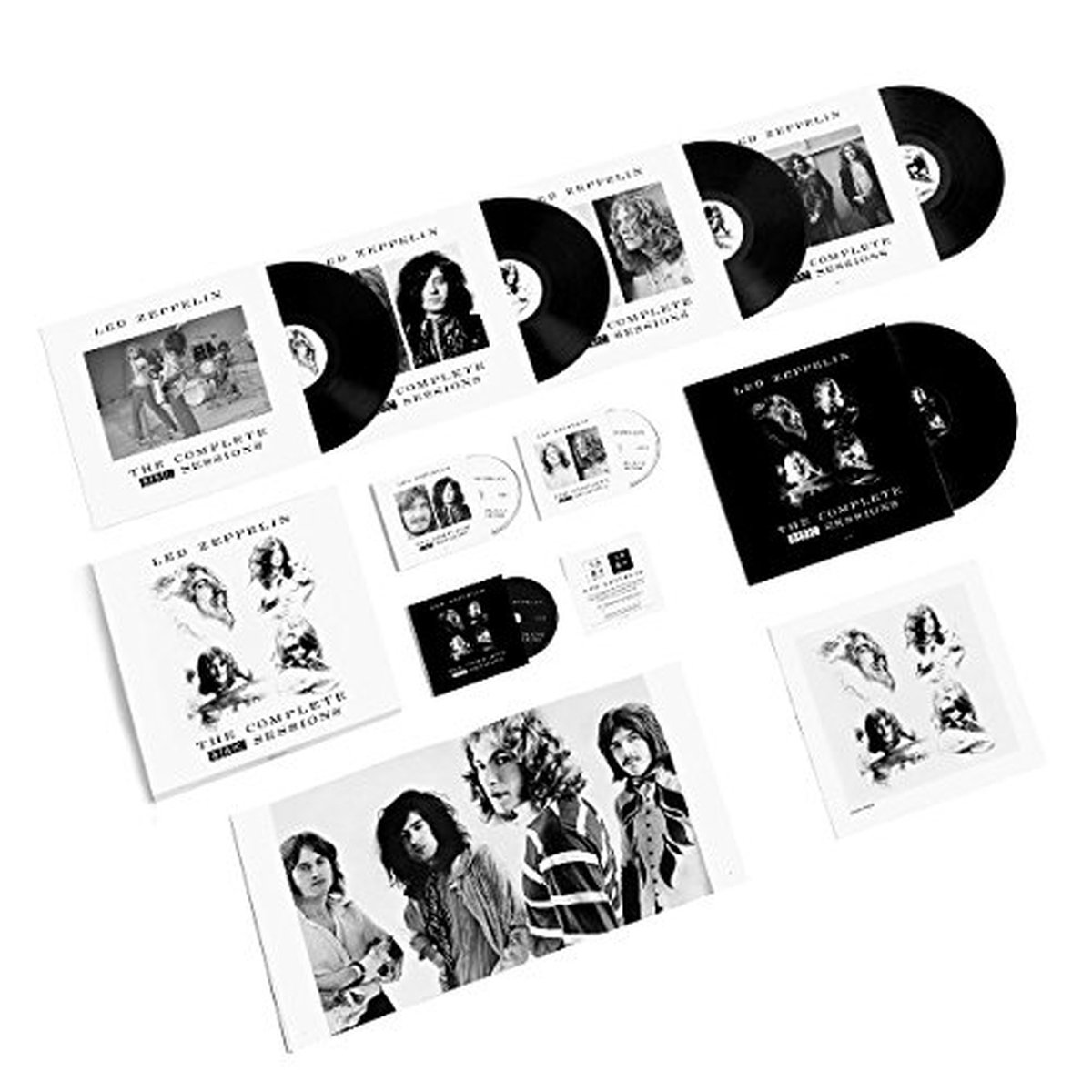
Fresh off after their win in the “Stairway To Heaven” infringement trial earlier this summer, Led Zeppelin are looking forward to dropping their edition of The Complete BBC Sessions at the end of this week. The collection includes eight updated, newly remastered versions of unreleased BBC recordings, including three rediscovered songs from the previously “lost” 1969 session recorded between their first two albums.
One of those three never-before-heard recordings is another version of “What Is And What Should Never Be” from Led Zeppelin II, and today it receives the visual treatment. Noisy, trippy black-and-white images are cut with footage of the band shredding the song.
Nearly 20 years ago, Led Zeppelin introduced BBC Sessions, a double-disc set of live recordings selected from the band’s appearances on BBC radio between 1969 and 1971. The Complete BBC Sessions is an updated version of the collection, newly remastered with supervision by Jimmy Page and expanded with eight unreleased BBC recordings, including three rescued from a previously “lost” session from 1969. Highlights include the debut of a long-lost radio session that has achieved near-mythic status among fans. Originally broadcast in April 1969, the session included three songs: “I Can’t Quit You Baby,” “You Shook Me,” and the only recorded performance of “Sunshine Woman.” Also included are two unreleased versions of both “Communication Breakdown” and “What Is And What Should Never Be.” Separated by two years, the performances vividly demonstrate the young band’s rapid evolution over a short period of time. [Deluxe box set containing both CD and vinyl formats also available.]
Led Zeppelin The Complete BBC Sessions is out 16th September
Like fellow Chicago rockers Twin Peaks’ latest release “Down in Heaven,” Flesh Panthers are taking a step back from brash garage energy in favor of something a little more “mature” (heavy emphasis on the quotes). With more atmospheric moodiness in the album lead-in and outro, “Willow’s Weep” is much more meticulous and coherent than straight garage rock assault, bringing to mind late-60s Rolling Stones more so than 70s punk. It surprises me every time I listen to it, not because I didn’t think they were capable (their live versions of some of my favorite songs by the likes of Velvet Underground and Bob Dylan showcase their tightness and versatility), but because they’ve made such a remarkable transition from their high-energy garage punk into these really beautiful, compelling rock songs.
I really love Flesh Panthers. They’re a brilliant inside secret of the Chicago rock scene that deserves far wider exposure. With “Willow’s Weep,” they’re proving they’re a force to be reckoned with beyond our city walls.