Archive for the ‘CLASSIC ALBUMS’ Category

Image result

He’s survived addiction, depression, heartbreak, homophobic abuse, and a HIV-positive diagnosis. With a typically candid third album , things are finally looking up for John Grant?

How is John Grant? “Well, you know, I’m not sure how I am.” It is perhaps a fair response to the standard how-are-you conversation opener. Grant’s thoroughly eventful life – one of addiction, depression and disease – is a matter of record. But when you ask the singer how he is, there’s something more immediate on his mind – or rather, his stomach. “I’ve just had some horse. For lunch.”

It is apparently a delicacy in Iceland, his home of four years, from where he speaks. “Horse. They just put it in front of me. It tasted fine, but I didn’t feel very comfortable.” Then, he deadpans: “Oh God, you’re not friends with Morrissey, are you?”

Approaching 50, sober for over a decade, safely ensconced in Iceland, he seems to be acquiring a somewhat calmer existence. His third solo album, is “a very positive record,” Grant insists, though it might occasionally suggest otherwise. The title, Grey Tickles, Black Pressure, comprises the rough English translations for ‘midlife crisis’ and ‘nightmare’ in Icelandic and Turkish, respectively.

“When people are weird and messed up, I’m just fine with that” – John Grant

For someone with such an unusually turbulent life, is significant. It might almost seem trite to recapitulate his past troubles, had he not himself offered them up so candidly through his music. They’re there in the brutally autobiographical 2010 song Jesus Hates Faggots, a devastating account of his homophobic father; and in 2013’s Ernest Borgnine, in which he sings of finally kicking his alcohol and drug addictions, only to learn he is HIV-positive.

It’s there throughout his first two albums, which both had a defining theme of heartbreak, two highly cathartic records about coping with the exit of a man he thought was The One. “There are one or two songs left over from that period. There’s one on this record called Guess How I Know, which I tried to do for the last one. It’s always going to be a part of me, but I don’t feel any of the pain any more. And that’s nice.”

Which is not to say that Grey Tickles, Black Pressures is without its darker moments or provocative edges. Grant’s shrewd lyricism immediately comes to the fore in track two, the title song, which offers this startling chorus: “There are children who have cancer, so all bets are off… I can’t compete with that.”

After baring his soul for two albums, is it a song about gaining perspective? “Every album that I do is about letting go and getting perspective. It’s about the need to stop trying to control the things that you can’t control and let go of them, and get perspective. Because somebody like me tends to think along the lines of: my problems don’t matter and I don’t matter. That’s not true.”


By any standard, Grant’s influences are multifarious. But broadly, you could say he follows a fairly unique dichotomy: between the slower, 1970s-influenced guitar-driven ballads that characterised his debut solo LP Queen of Denmark, and the poppier, 1980s-influenced electro-disco of follow-up Pale Green Ghosts. Grey Tickles, Black Pressure feels like a wondrous blend of them both.


When Philadelphian band Hurry expanded to a trio for 2014’ albums “Everything.Nothing”, there were two ways to view Matt Scottoline’s former solo project. A band making fuzzy, mid-fi indie rock. The other was as an offshoot of Everyone Everywhere who had released two truly outstanding albums .

Hurry’s third LP Guided Meditation sounds like a credibility bid for Scottoline’s fledgling new band. Their success is in their ability to be serious about frivolity, The difference is entirely present within a rerecorded version of “Shake It Off” which appeared on a stacked 2015 mini-Singles soundtrack for Philadelphia. Perhaps they figured since it would be associated with Taylor Swift anyways, “Shake It Off” removes anything that made the original sound bashful—the unnecessary feedback is sheared, the performance is significantly tightened, Scottoline’s vocals aren’t subject to the same fuzz as the guitars. And there you go: Hurry decided they’re really a power-pop band at heart, not indie rock.

http://

Regardless of how much Scottoline’s love of Yo La Tengo or Guided By Voices influenced the writing of Guided Meditation, there is more in the lineage of the Posies and Matthew Sweet, acts who would’ve been considered pure pop had they existed in a different decade.

Hurry doesn’t overcomplicate things musically—they abide by the Weezer Method that states all vocal melodies should sound good as guitar leads and that instant gratification can be replicable gratification.“Love is Elusive” cruises through six-and-a-half minutes of flanger clouds towards a sunburst of layered harmonies,

Guided Meditation can be accused of being too simplistic, too sweet and unengaged with the present. But, really: isn’t being dumb and in love the most uncomplicated state of being?  So when Scottoline sings, “I don’t even have to try when I’m with you/All the stupid things I say, you know they’re true,” it damn sure sounds like the truth.

The Ontario band Dirty Nil’s Higher Power offers punk with high-end production values meant for big stadiums. However antisocial they may get, the music here is intended to be a communal experience.
As the name suggests, the Ontario band Dirty Nil are profoundly aware of their emptiness and impurity, and the only thing that rouses Luke Bentham and Dave Nardi out of their self-loathing is despising someone else even more. They’re professed classic rock fans and gear snobs and it shows, as Higher Power is an album that sounds like it expects to be paid for. However antisocial Dirty Nil get, the music is intended to be a communal experience.

Dirty Nil released a 7” on skate-punk stronghold Fat Wreck Chords and played the Warped Tour—both tend to be a point of no return for bands deciding between a captive pop-punk audience and critical credibility. But it’s all rock’n’roll to Dirty Nil: They boast equal facility with PUP-style beer bongin’ with the devil (“No Weaknesses”), Dilly Dally’s knee-buckling dynamics (“Zombie Eyed”), and the hectoring sing-speak of tourmates Single Mothers and Greys. Higher Power serves as proof that the boundaries separating “indie,” “pop punk” and “alt-rock” have collapsed as they’ve been drawn into closer quarters, and to send this point home, they do all of the above just within the first four tracks.

There isn’t really an original note here, but the massive hooks of “No Weaknesses” and “Zombie Eyed” are delivered with enough conviction that they end up sounding fresh anyway. As Higher Power progresses, Dirty Nil continue to expand their range, yet the sequencing makes it sound like a retreat. The satisfying brutality of “Fugue State” starts a run of three songs crammed into less than five minutes; the highs of Side A were bound to make Higher Power sound frontloaded anyway, but Side B practically vanishes before get-in-the-van anthem “Bury Me at the Rodeo Show” ends the record with the closest thing to a Dirty Nil love song.

Even when the music intentionally plays dumb, Bentham and Nardi are clever lyricists, and Higher Power could almost be a narrative concept record about salvation if you play it out of order. Throughout the album, Dirty Nil search for redemption in the usual places: sex (“Wrestle Yu to Husker Du”), drugs (“Zombie Eyed”) and rock’n’roll. But they have too much fun with it all to even pretend that hitting rock bottom is actually a bad thing. “Friends in the Sky” aligns Bentham with Satan against Jesus, and it’s as close as he gets to divinity

Image result

Mewithoutyou’s relevance spans well over a decade. they’ve released musical masterpieces time and time again, and haven’t missed a beat with this one. while still not as energetic as their first three releases, it’s as good as hell and is a welcome addition to their discography. .

The ever-changing MewithoutYou never went away or stopped making good albums, but Pale Horses still felt like a comeback, or at least the beginning of a new life for the band. Their two best albums are 2004’s Catch For Us The Foxes and 2006’s Brother, Sister, albums that blended art rock and post-hardcore and quickly earned them a devoted following. They followed those with two albums that took a foray into whimsical indie folk, and great as they were, it’s nice to see them returning to the earlier style. This year they signed to an exciting new-ish label (Run For Cover Records), worked with the great producer many of that label’s bands work with (Will Yip), and toured with a crop of younger rock bands whose music fit right in with their own (Foxing, Pianos Become the Teeth, Restorations, etc). It wouldn’t be crazy to assume that some of those bands’ younger fans were hearing MewithoutYou for the first time, and thankfully Pale Horses is the kind of album that’s perfect for newcomers and longtime fans alike. It’s a return to their best era, but not an exact replica of it. Aaron Weiss often works in the more delicate singing style he developed on the last two albums, but he also saves plenty of time for his trademark speak-shouting. Over music that switches from hushed atmospheres to arty prog riffs to headbanging climaxes, he sounds compelling as ever.

http://

On her debut LP Beyond the Bloodhounds, this Nashville singer songwriter Adia Victoria makes it pretty immediately as clear as her music which has been described as “creepy,” a notion that barely scratches the surface of what she accomplishes. The album is often unsettling, yes, but that feeling is more a by product of her feelings which Adia explores on her gnarled songs than an end in itself. Even the record’s “prettiest” song, the wavy and fuzzy “Mortimer’s Blues,” revolves around her inescapable loneliness. She approaches love-song territory with “Horrible Weather,” but there, she sings about finding that person whose dark clouds and troubles match yours. Adia Victoria powers her songs with muscular, chugging guitars and plodding percussion. Her riffs crackle, snarl, and sneer with subtle country and blues signifiers, and keys alternately thrum and prick on the songs “ Dead Eyes” and “Howlin’ Shame.”

She has a knack for crafting drifting lyrical lines that inch under your skin and stay there. Sometimes, they sneak up on you, as in the spoken section that concludes “Invisible Hands.” The track begins with Victoria speculating what her fears look like, but when she arrives at “The choir sings Hallelujah from the ovens,” the song becomes outright chilling.

Beyond the Bloodhounds isn’t a blues record per se, but in the grand tradition of the blues, it creates space to look your demons in the eye and acknowledge their foul existence without necessarily doing much about them.

On “Stuck in the South,” Victoria reckons with feeling trapped on her home turf. She sings that she’s “dreamin’ of swingin’ from that old palmetto tree,” and notes that her skin color “give ‘em cause to take and take.” She promises to leave, but can’t, her ache is familiar for many native Southerners: The political and social dynamics of the South are complex and often ugly, as it’s been forever, but for some reason, you stay. Victoria recognition of her Southern identity goes beyond cloying “hey y’all” affectations. Instead, she weaves together her disgust, frustration, and uncertainty, building a frank look at how she feels about home. From there, closing the record with “Mexico Blues,” lilting as she sings, “You go your way, and I’ll go mine.” It sounds as though she’s still making up her mind about what her own way is, exactly. But with Beyond the Bloodhounds, she’s made a satisfying plunge into decadent darkness.

Adia Victoria “Dead Eyes”, from her debut album “Beyond The Bloodhounds”

2016 wasn’t good for much, but it’s been an absolutely fantastic year for indie rock (just like 2015, 2014 and 2013 were), and yet even amongst all the bands like Lvl Up and Sunflower Bean and Mitski and Big Thief and the Hotelier and Pity Sex going around I koved this tiny record by this Ann Arbor, Michigan band, and its pretty zippy hey-whatever guitar tunes  all nine of them in just 18 minutes. Singer-guitarist Fred Thomas was in the good Sixties-garage pop band Saturday Looks Good to Me. This is garage-y too but looser, with a vibe and a warmly small sound like it was recorded at the bottom of Ira Kaplan’s sweater drawer. They rock out a little on “8AM,” hit reedy harmonies on “Coke Floats” and bask in “the regular mundane anxiety” of whatever their life is like on “Ready for the Break.” Bassist-singer Anna Burch sings lead on the breakout drive-time bomb-drop of a focus track “Supermarket Scene,” where the guitars ring like tiny cathedral bells and she imagines the kind of meet-cute that takes years to unfold: “Maybe when we’re older/Maybe when we both get paid/We can find a place that feels like home.” . Anna Burch: Guitar & Vocals , Erin Davis: Bass Guitar ,Miles Haney: Drums ,Fred Thomas: Guitar & Vocals

http://

Pretenders – Alone

Chrissie Hynde returns with the first Pretenders album in eight years. Alone was recorded with the Black Keys‘ Dan Auerbach at his Easy Eye Studio in Nashville, and features Hynde on vocals and guitar joined by bassist Dave Roe (Johnny Cash, Loretta Lynn), pedal steel guitarist Russ Pahl (Blake Shelton), guitarist Kenny Vaughan (Lana Del Rey), keyboardist Leon Michels, and drummer Richard Swift.
106435

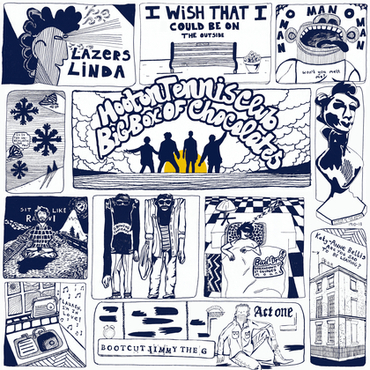
Hooton Tennis Club release their second album, Big Box Of Chocolates produced by Edwyn Collins at his Clashnarrow Studios in Helmsdale, Scotland. If their debut album, Highest Point In Cliff Town, released in August last year, was the band’s sprightly statement of intent, Big Box of Chocolates may well be their coming-of-age: a record that retains all the colour and invention of their debut, while being elevated by richer instrumentation and lyrics that hint at slightly heavier themes: love and loss, nihilism and the ‘non-spaces’ of Northern England, all delivered in the band’s typically laconic, bittersweet style, like a Mersey Beat Murakami. The dozen tracks continue the band’s knack of combining catchy off-kilter riffs with droll storytelling; album narrators – vocalists and guitarists Ryan Murphy and James Madden – seem to straddle optimism and uncertainty with their lyrics, whether singing about their internal worlds or commenting on a motley cast of characters (Bootcut Jimmy, BBC 6Music presenter Lauren Laverne, Lazers Linda…) who turn up across the album’s 41 minutes to amuse, tempt or torment them. Whether fictional (the awkward genius Jimmy ‘looking shifty in his new shoes’) or real (Ryan’s ex-housemate immortalised in first single Katy-Anne Bellis), each character shares an equal platform, all revered in Hooton’s own low-key way. Recorded over three weeks in Helmsdale, during which time they all grew beards, drank copious amounts of tea, became birdwatchers and whiskey tipplers, the album reflects the band’s relaxed approach to songwriting ; they tend not to labour over recording demos or strumming and beating the life out of songs in the practice room -instead, ideas are allowed to form spontaneously: melodies are hummed into phones or computers, lyrics batted back and forth between Murphy and Madden, songs worked out alone in the bedroom, or layered up from scratch together in the studio.

LP – Yellow Vinyl with Download.

106480

Big Star – Complete Third

The small but rabid cult of Big Star, composed initially of rock critics and hometown Memphis hipsters, coalesced around 1972’s ‘No#1 Record’, which supercharged the legacy of the Beatles and Byrds, and 1974’s ‘Radio City’, which brought additional attitude and poignancy to the recipe. The shimmering brilliance of Big Star’s sound and songs on those two LPs, along with its underdog allure, would have been sufficient to perpetuate the band’s legend. But there was a third album, and that strange beast of a record made all the difference for subsequent generations of fans – many of whom formed bands of their own – who turned each other on to this music as if it were a secret religion or a trippy new drug. After more than a decade of looking for additional music beyond the original album that is Big Star’s Third, the search is now over. While some demos and alternate versions of songs have dribbled out over the years across various compilations, all extant recordings made for the album are presented here for the first time in ‘Complete Third’. The collection boasts 69 total tracks, 28 of which are previously unheard session recordings, demos and alternate mixes made by producer Jim Dickinson and engineer John Fry. The set allows the listener to track the creation of the album from the original demos, through sessions to rough mixes made by Dickinson and Fry, to the final masters of each song. Besides the contextualizing main essay from writer / A&R man, Bud Scoppa, extensive notes from original participants and artists influenced by Big Star are also included: Mary Lindsay Dickinson, Mitch Easter, Adam Hill, Elizabeth A. Hoehn, Susanna Hoffs, Peter Holsapple, Gary Louris, Mike Mills, Cheryl Pawelski, Debbi Peterson, Pat Rainer, Danny Graflund, Jeff Rougvie, Pat Sansone, Chris Stamey, Jody Stephens, John Stirratt, Ken Stringfellow and Steve Wynn. Initially, the collection will be released in a 3-CD boxed set and with three separate double LPs to follow, each vinyl volume representing a CD in the boxed set.
V600 kd instigator 1600

Kevin Devine – Instigator

Produced by John Agnello (Sonic Youth, Dinosaur Jr.), Instigator is Kevin Devine’s ninth full-length album and comes on the heels of a busy few years: In addition to recording two albums with Bad Books (the indie-rock supergroup he formed with members of Manchester Orchestra), he released the Kickstarter-funded double-album collection Bubblegum and Bulldozer in 2013 along with the wildly ambitious 2015 Devinyl Splits 7” series with the likes of Brand New’s Jesse Lacey, Perfect Pussy’s Meredith Graves and Nada Surf’s Matthew Caws. Devine is a master storyteller, and he imbues Instigator – from the biting power-pop of Both Ways to the angular Guard Your Gates and gorgeously finger-picked No One Says You Have To – with intricate details and often-uncomfortable truths. Their meanings are personal, but their themes are universal. It’s a skill that makes both his albums and his live show so alluring: Even when Devine’s writing about the world at large, he’s pointing a mirror back at himself. When Devine’s past lives meet his present-day self on the career- defining I Was Alive Back Then, the beautiful duality of his art takes center stage: Life is never all peril or perfection, a country ripped apart by war and social injustice or the joy of holding your child for the first time. The extremes might be easier to define, but it’s in the middle where life really happens.

105694

Agnes Obel  –  Citizen of Glass

Highly anticipated stunning third album from Danish born singer- songwriter Agnes Obel, the follow up to her UK breakthrough record Aventine. Recorded, mixed and produced by Obel in Berlin, where she currently resides, Citizen Of Glass is a work of haunting beauty and an expansion of Obel’s mesmerising world. The title surfaced in Obel’s mind while touring Aventine and, inspired by modern composers, the album conceptually and thematically revolves around the leitmotif of transparency. On this record Obel experiments with her vocals in inventive new ways, in order to manipulate them into alternative versions of her own voice, as can be heard on first single Familiar. Obel also incorporates a number of different instruments, such as the Trautonium (an extremely rare instrument that possesses a glistening, glass-like sound), alongside vibraphone, cembalo, cellos and more.

Crocodiles  –  Dreamless

Comprised of best friends Brandon Welchez and Charles Rowell, Crocodiles have earned their place as one of the United States’ most engaging, hardworking and consistent rock and roll bands of the past few years. Dreamless is the pair’s sixth LP, their most exploratory and focused release. Crocodiles’ first two albums made their home within a stew of fuzzed-out psychedelia, and the following three albums explored pop sensibilities placed against whirring guitars and barbed production, but on this latest album the duo’s artistic departure places their guitars in the backseat in favor of a more spacious, synthesizer and piano-driven sound. The title of the album works levels: “I suffered insomnia throughout the whole session. I was literally dreamless,” explains Welchez. “The past two years had been fraught with difficulty for us—relationship troubles, career woes, financial catastrophe, health issues,” he continues. “It was easy to feel as if the dream was over.” Recorded in Mexico City once again by friend and occasional bandmate Martin Thulin (Exploded View), Dreamless keeps the exemplary production on Crocodiles’ previous releases and reconciles their realigned focus on keys by pairing down the instrumentation to allow lyrical sentiments and themes to cut through.

OMNI – ” Deluxe “

Posted: December 16, 2016 in CLASSIC ALBUMS, MUSIC
Tags: , , ,

tim111-omni-deluxe_1600x1600__11724-1463236421-1280-1280

Debut albums often connote a lack of experience, but in Omni’s case, a band consisting of former members of Deerhunter and Carnivores, the newness is simply in the combination of talent. With one of the strongest opening tracks of 2016 (“Afterlife”), Deluxe is an intensely satisfying blend of driving, lo-fi garage rock and non-standard melodies/progressions that show the band’s true capabilities. For as catchy and complete as this album is, it’s criminal it hasn’t received more attention. Fans of Television, Wire and the type of hooky, nuanced rock that ages incredibly well would do right to hastily add this their collection.

http://

Brainy, hooky, and energetic blend of Postcard pop, angular post-punk, and scrappy D.I.Y. punk by ex-members of Deerhunter and Carnivores.

Image result

House in the Tall Grass by Japanese psych-folk outfit Kikagaku Moyo could be seen as initially disappointing, for this release reins in the band’s experimental and challenging tendencies, replacing it with what could, at face value be perceived as a more straightforward down-the-middle psych rock album.

Yet, like all the best records, it’s slow to reveal its charms. It teases us before unveiling its delicate and fragile beauty that is as enchanting as it is beguiling. With heavy use of sitars – albeit in a subtle, non-clichéd manner – this is a record that is preoccupied with the gentle, exploring the edges of human emotions through delicate slow-building tracks that grow and envelope almost imperceptibly. Laced with an eloquent sadness and wistful longing, it revels in a lush quiet undercharged beauty that reminds that slow and suggestive can be as overwhelming as loud and heavy.

http://

Kikagaku Moyo will not disappoint you. With this new release, the band continues offering to their followers their trademark psychedelic sound. If you don’t know them, now it’s the time to rectify that mistake.

Hooton Tennis Club Tour Dates

Hooten Tennis Club’s follow up to last summer’s Highest Point In Cliff Town is extreamly impresive, and with Edwyn Collins on production duties they have realised their true pop potential. It has a looseness like the first album still evident on Big Box of Chocolates, but made shiny and new under Collins’ watchful eye.

With no difficult second album issues, Hooton Tennis Club made massive strides in short fourteen months since Cliff Town gigging constitenly. Live they’re more disciplined while retaining that engaging sense of fun, and on this album, lyricists Ryan Murphy and James Madden‘s always sideways observations of life, are as clever as ever. Each track on Big Box of Chocolates is a short story of sorts, emotions laid more honestly here than by its predecessor, showing a growing confidence .  Tales of friendships, the notion of an era at an end as a flatmate moves out in Katy-Anne Bellis carries a coming of age melancholia, a sense of innocence now passed.

Statue Of The Greatest Woman I Know presents us with a surf guitar surprise, and Lauren, I’m In Love! brings out the biggest smiles, a cute Happy Days love letter to the 6 Music presenter. O Man, Won’t You Melt Me?  touches the tenderest spot, and breaks our hearts. ‘I can tell that her man’s not me, it’s not me / Why would she change it all for me?’ Blimey, woman – whoever you are, give the lad a break, will you?

It’s only the final song on the record, the title track, on the album though feels like a slight hangover from  Highest Point In Cliff Town, dragging its feet in an effort to keep up. But the album  Big Box of Chocolates, for the most part, is proof Hooton Tennis Club are reaching maturity. This is a bloody good record.

Here’s the clip (as promised) for ‘O Man, Won’t You Melt Me?’, (apt title for 2016?) Watch us roll around and frolic in clusters of vivid autumnal coloured rotting leaves for near 4 minutes.
‘Oh, Man Won’t You Melt Me’ by Hooton Tennis Club from the album ‘Big Box of Chocolates.’ Out on Heavenly Recordings, produced by Edwyn Collins.