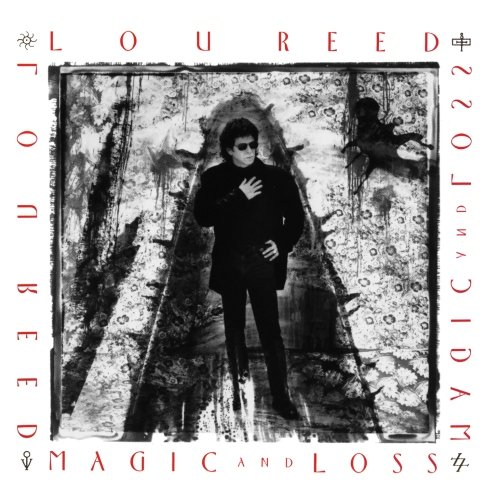
Lou Reed had been in mourning for the past few years at least when it came to his albums. In the late ’80s and early ’90s, the middle-aged rocker had delivered an epitaph for the Big Apple New York and a tribute to the late Andy Warhol “Songs For Drella”, created in collaboration with his old Velvets band mate John Cale.
When he began work on his 16th studio album in 1991, LouReed didn’t plan on continuing to sift his music through a black veil. But life or, perhaps, death had other plans.
“I was originally going to write an album about magic … the desire for magic in life … the magic of transformation … the idea of a man turning into a bird,” said Reed “But my two friends died during this time and I wrote ‘What’s Good’ and that started the other songs, not necessarily in order you find them on the album. It was painful to write, but it was obvious what it was about. All I had to do was look at that line, ‘What good is cancer in April,’ and I knew.”
As in “Power and Glory – The Situation,” on Lou’s “Magic and Loss” album, so is “Sword of Damocles,” which discusses how death can dangle precariously that determines life and death, due to treatments for cancer. Sometimes, what is intended to save can kill. Even miracles can be nothing more than crapshoots.
Lou took an ancient legend, and wove it into the gist of the song, in how a servant of the King was granted all the power of the kingdom for one day.
He could throw all the banquets,and parties he wanted, that included included extravagant pomp. He also had the power to grant life and death. Then he noticed that razor sharp sword hovering over his head, that was held in place with a single strand of horsehair. What if others craved his power and tried to take it away from him? All of a sudden, he saw the peril that power can bring . . . Such is the power of some treatments intended to save, and yes, they often do, but many times they don’t, because the “horsehair” snaps.
Most of it is about his dear friend Doc Pomus.
Who else inspired this song is up for debate? I used to think it was “Rotten Rita,” but found out it that is not a fact. Maybe he heard a rumour that she had passed. What’s really important though, is the theme addressed.
So the songwriter combined the two themes on “Magic and Loss”, eventually discovering a balance between the enchanting wonders of life and the fragile mortality of human beings. Or, as Reed intones on the final, title track, “There’s a bit of magic in everything and then some loss to even things out.”
Reed suggests loss in the lyrics of these dozen songs via hospital visits, tubes in arms and defunct phone numbers. The newly christened elder statesman draws on his familiar deadpan poetry to grieve for his friends: legendary songwriter Doc Pomus and Warhol “Factory” pal Rotten Rita. The music on Magic and Loss is often as unadorned as Reed’s delivery, riding chugging guitars and simple percussion, with a hint of magic to be found in bendy bass turns and the occasional, ragged freakout.
“I just hope it doesn’t start getting thought of as this terrible down death album, because that’s not at all what I mean by it,” the rock legend said. “I think of it as a really positive album, because the loss is transformed magically into something else. The way these two people face these things. They were giants throughout their lives and they were giants in these situations also, and a lot can be learned from them. I was very lucky to know them through all of it.”
Despite its perception as a difficult album, “Magic and Loss” became one of Reed’s most successful albums after it was released on January. 14th, 1992. Greeted with warm, even effusive, reviews from many rock writers, the record became his highest-charting U.K. LP (No. 6) and boasted the U.S. No. 1 Modern Rock Tracks single “What’s Good.” The praise and success shocked Reed.
“Astonished would cover it. It’s very strange,” said Lou after the album came out. “In a sense it’s my dream album, because everything finally came together to where the album is finally fully realized. I got it to do what I wanted it to do, but commercial thoughts never entered into it, so I’m just stunned.”
“Between two Aprils I lost two friends/Between two Aprils magic and loss…”.
The short inscription Lou Reed wrote in the liner notes to his 1992 album “Magic and Loss” is the backdrop to one of the most inspired albums of his career. At the end of the album credits he wrote: “This album is dedicated to Doc and especially to Rita”. While he preferred to keep the identity of Rita away from the public (“Rita wouldn’t have wanted to be known. I was a very lucky person to know her”), he was open about his recent friendship with legendary songwriter Doc Pomus who died in 1991. “Magic and Loss” captures the pain and emotions that Reed felt as his friends were dying. This is the story of the album, the musicians who influenced and created it and most importantly, the amazing songs Reed wrote as a healing process from the death of his friends.
Ever since its 2008 debut, Shovels & Rope has brandished a rare, raw brand of honesty through music that growls and spits, sweats and swings from verse to chorus to roaring solo. There’s always been something special about this duo, but never has that special thing been so as in their 2016 release Little Seeds. Plenty has been written already about the duo’s decision to get personal this time, their still-fresh, unexpected parenthood, their reckoning with the dementia of Michael Trent’s father. Here’s something Shovels & Rope’s Michael Trent and Cary Ann Hearst learned after unexpectedly getting pregnant: having a kid is a delicious hell nothing can prepare you for. The husband-and-wife team coped with the insanity by making their loudest record to date, Little Seeds, injecting their trademark country with a strain of distortion ripped right from the gospel according to the Jesus and Mary Chain.
All of those things are laid bare in this disc; but even if you didn’t know the backstory, the music is itself powerful, whether it’s riding a fuzzy guitar pedal or echoing off the upper registers of Cary Ann Hearst’s acoustic strings. Known for passionate harmonies, Shovels & Rope lapses just as frequently here into octave unison — their two sets of vocal cords ring like one voice echoing against itself. Stylistically, they hop from punk to folk to country, but you’d only know that if you listened very closely. The prevailing vibe of the record is a musical manifestation of Trent and wife/collaborator Hearst themselves.
Joe Cocker’s career took off after singing his his amazing interpretation of With a Little Help from My Friends at Woodstock Festival. But did you know that the rest of his Woodstock set remained unreleased? Here’s the whole set, for the first time: the Beatles tune; “Feelin’ Alright; Dear Landlord; Just Like a Woman; I Shall Be Released; I Don’t Need No Doctor” , and more!
It makes one wonder why it took so long for the “Live at Woodstock” series to emerge – maybe copyright issues, who knows. Joe Cocker rose to fame in the late 60s in part, at least, on the back of his performance at the Woodstock festival of August 1969. Until this album only the track “With a Little Help From My Friends”, off the Woodstock set, was released (on the first Woodstock album). Those who know, and like, that track will not be disappointed with this album. For those that don’t know Joe Cocker, his stlye is that of an extravagant front man covering songs of the time in an idiosyncratically soulful style.
This set is performed by a band who know what they are doing and are doing it well. It is a tight, well performed set of songs mostly from Cocker’s first album. This incarnation of the Grease Band is really good (really, really good). Like many “overnight” sucesses, that success is founded on years of hard slog. This performance catches a glimpse of Joe Cocker and his band at the top of their game and before drugs, fame and rock and roll have taken their toll.
Why did we have to wait 40 years for this fabulous album to be released? I have always thought Joe Cocker’s performance on the Woodstock film was one of so many highlights but to now be able to hear the full performance is an absolute treat.
It is a staggeringly good performance by Joe Cocker & the Grease Band. They are on absolutely peak form here in August 1969. Joe Cocker’s voice never sounded better than this. The sound is perfect. This is 77 minutes of some of the most powerful and raw rock and soul.
It takes quite a bit of confidence to record a debut album live, but when you have the raw power of MC5, you don’t worry about messing around. That’s especially true when you’re living the grit and grind of Detroit while the rest of the world is focused on the flower power movement out on the West Coast. Iggy Pop took his stage name after witnessing an MC5 show, which should tell you all you need to know: If it’s good enough to influence Iggy, it’s punk royalty. Between Rob Tyner’s screams and Wayne Kramer and Fred “Sonic” Smith’s guitars, the MC5 laid out a blueprint for blue-collar punks everywhere.
Forget flower-power, the crash-bang throttle of the first 10 minutes of the MC5’s debut made garage-rockers of the era sound weak and tentative by comparison. “I wanna hear some revolution out there,” unapologetically militant singer Rob Tyner, quoting Eldridge Cleaver, screams. And while not everyone was ready for revolution — writing for Rolling Stone in 1969, Lester Bangs said the Motor City 5 used noise and aggression to “conceal a paucity of ideas.” — history shows the album pushing underground rock towards an aggression precipice. It’s quaint to think of now, but the opening command — “Kick out the jams, motherfuckers!” so riled the band’s label, Elektra Records, that the company prepared both edited and unedited versions. Peter Doggett reports in his book There’s a Riot Going On: Revolutionaries, Rock Stars and the Rise and Fall of ’60s Counter-Culture that an unedited batch went to the retail chain Hudson’s. When they sent back the stock and refused to stock either version, the band had an even more choice message to them in a series of national ads: “Fuck Hudson’s!”
“Don’t you wonder sometimes, ‘Bout sound and vision”. On this day 40 years ago, David Bowie released ‘Low’.
Low is the eleventh studio album by David Bowie, released through RCA Records on 14th January 1977. Recorded following Bowie’s move to West Berlin and after a period of drug addiction and personal instability, Low became the first of three collaborations with musician Brian Eno and producer Tony Visconti who later termed the “BerlinTrilogy”. The album was in fact recorded largely in France, and marked a shift in Bowie’s musical style towards an Electronic approach that would be further explored on the subsequent albums “Heroes” and “Lodger”.
Though it was initially met with mixed critical reviews, Low has since become widely acclaimed as one of Bowie’s best and most influential works.
Low lies in the foundations by Bowie’s previous album “Station To Station” and in the music he recorded for the soundtrack to The Man Who Fell To Earth . Bowie presented his material for the film to Nick Roeg, but the director decided that it would not be suitable. Roeg preferred a more folksy sound. Elements from these pieces were incorporated into Low instead. The album’s cover, like Station to Station, is a still from the movie.
Following Bowie’s Thin White Duke period, he was eager to escape the drug culture of Los Angeles where he had developed a cocaine drug habit, He blamed his erratic behaviour around his Thin White Duke period on his addictions and precarious mental state, Bowie would move to Switzerland in the second half of 1976. Later that year, he, along with friend and singer Iggy Pop would retreat to the city of Berlin in a further attempt to kick his drug habit and escape the spotlight.
While sharing an apartment with Pop, Bowie would become interested in the German music scene, including acts like Kraftwerk and Neu . During the months of his recovery, he had also become interested in the minimal style of Brian Eno eventually meeting with him in 1976.
There might be plenty going wrong in this crazy old world we’re currently existing in, but the fact that a label like Omnivore Records is releasing a record like Conrad in 2016 should be a cause for some sort of celebration. Some are calling this a power pop record, but it seems to be a tad too sophisticated for that limiting tag and besides, we’re not exactly dealing with an Iggy and the Stooges type of instrumental attack here. No, this is more pretty pop than power pop – Andy Reed, Keith Klingensmith, and Chris Richards write songs that are gently pleasing and they harmonize like choirboys throughout.“Short Term Memory.” Mixing big guitars with big harmonies, their recorded output has one foot in the classic pop era of the 60’s and 70’s (Beatles, Beach Boys, Nilsson, Big Star) and one foot with the current era of classic pop (Nada Surf, The Autumn Defense.) The “Intro To” E.P. features a new song, “Anything”, from the upcoming Omnivore Recordings release “Conrad”,
The best songs of the batch seem to be tucked in the middle of the disc: the deceptively cheery-sounding “She Called Me to Say,” the self-deprecating “The CoolKid” and – especially Klingensmith’s lone songwriting credit, the sublime, Teenage Fanclub-influenced “Pull My String.”
As one-third of The Nerves alongside Paul Collins and Peter Case, Jack Lee ended up getting the short end of the stick, fame-wise, after the band split: Collins went on to form the Beat, Case founded the Plimsouls (both scored major label deals), and Lee…well, he had a few of his compositions recorded by well-known artists in the ‘70s and ‘80s (Blondie dressed up “Hanging on the Telephone” and Paul Young had a hit with “Come Back and Stay”), but he sadly faded into obscurity after that. There were rumors of all sorts of unsavory stuff, and his former bandmate Peter Case portrayed Lee in a less-than-flattering manner in a 1998 Plimsouls tune called “Playing with Jack.” (“Jack looks slick but he’s come unglued/since the Nerves broke up, all he does is brood.”) Still, despite his rumored shortcomings, Lee wrote some killer tunes back in the day, and Alive Records has collected 23 of ‘em on “Bigger Than Life”. The songs were originally released on two long-deleted LPs and have been unavailable for around 30 years, and even though they were originally conceived as demos, Lee’s winning way with a melody is on display throughout.
The first 11 numbers are from the Jack Lee’s Greatest Hits, Volume 1 LP (wishful thinking at its finest), and include Lee’s rough and tumble takes of the aforementioned “Come Back andStay” and “Hanging On the Telephone,” as well as snappy power pop ditties such as “Women,” “Give Me SomeTime” and “Good Times,” all sung in Lee’s edgy, soulful rasp. The rest of the tunes (save one b-side) are from Lee’s hyper-rare, self-titled 1985 album, originally released only in France. These range from the raging “Sex” (cut with the semi-legendary Rubber City Rebels) to a whole batch of slightly mellower songs that rely more on synthesizers than guitars. The best of these sound like could-have-been-hits: “Bird in a Cage,” the melancholy “From Time to Time,” “The Girl in the Picture” and “Time Machine,” a sadly sweet tale of longing that’s been begging to be heard by a wider audience for 30-plus years. Cool stuff, but man, some liner notes would have been nice
Ron Gallo is a rock and roll trio lead by a tall, big-haired weirdo of the same name. As the former frontman of ToySoldiers, Gallo spent a decade as a fixture in the burgeoning Philadelphia music scene. Now solo, Gallo is completing his second full-length record “Heavy Meta”. Embracing his love for fuzz, psych, garage, and early punk, Heavy Meta is a stark contrast to the “Harry Nilsson-meets-Father John Misty” sound of the previous record RONNY.
After undergoing a shattering year of love, loss, purging, and a musical reinvention, Gallo sought a change of scenery and a fresh start. Drawn to the rock ‘n’ roll music currently being made by his friends in back alleys of Tennessee’s “Music City,” Gallo and his very own record label American Diamond Recordings relocated to the Bordeaux neighborhood of Nashville on New Years Day 2016.
Throughout his career, Toy Soldiers and solo combined, Gallo has released three full length records and three EPs working with various small independent labels in Philadelphia and New York City. He has shared the stage with legends such as Wanda Jackson, Dr. Dog, Deer Tick, Dr. John, The Walkmen, J. Roddy Walston, among others. Gallo has previously been featured among USA Today’s “Bands to Watch,” Paste Magazine’s “Philly Bands You Should Listen to NOW” and has garnered appearances on PBS SUN Studio Special, Daytrotter, Audiotree, and many more.
On stage, Gallo is a force to be reckoned with. He is a true showman with a knack for grabbing the audience’s attention and leaving them in awe. He sings his ass off and thinks it’s important to laugh at yourself.
The Smiths were one of the U.K.’s brightest pop acts of the ’80s, with singer Morrissey setting his witty and emotionally honest lyrics against Johnny Marr’s serpentine, arpeggiated guitar lines. This tribute smartly avoids trying to mimic the band’s singular charm, aiming to redefine the songs as if they’d always been part of each performer’s catalog. Trespassers William slow down “There Is A Light That Never Goes Out” until it purrs with sweetness. Solvents turn “Is It Really So Strange” into a campfire clap-along. Elk City interprets “I Know It’s Over” as a skipping piece of Chamber pop. Belly’s Tanya Donelly finds an intimacy to “Shoplifters of the World Unite.” Kitten retains the firepower of “Panic” with a Eurodisco sound resembling Blondie. GregLaswell sits at the piano for a dramatic take on “Half A Person.” William Fitzsimmons whispers the lullaby “Please Please Please Let Me Get What I Want,” and the legendary Wedding Present adds a muscular power to “Hand in Glove.” It’s a worthwhile tribute that reinvents the songs while retaining The Smiths‘ glorious spirit.
“Morrissey and his (charming) men get the sweet-and-tender treatment from alt-pop types, including SixpenceNone the Richer and Mandy Moore pal Mike Viola, who classes up “How Soon Is Now?” with movie-score strings.”
“An outstanding and highly varied assortment of Smiths covers… listing every track’s merits would take too long — there’s hardly a dud among the two-disc set’s 20 tracks.”
Panic – Kitten
Stop Me If You Think You’ve Heard This One Before – The Rest
What Difference Does It Make? – Joy Zipper
Shoplifters of the World Unite – Tanya Donelly w/ Dylan in the Movies
Please Please Please Let Me Get What I Want – William Fitzsimmons
I Won’t Share You – Sixpence None the Richer
Well I Wonder – Sara Lov
Half a Person – Greg Laswell
Last Night I Dreamt That Somebody Loved Me – Dala
Some Girls Are Bigger Than Others – Chikita Violenta
Sheila Take A Bow – Telekinesis
Is It Really So Strange? – Solvents
Hand In Glove – The Wedding Present
How Soon Is Now? – Mike Viola and The Section Quartet
There Is a Light That Never Goes Out – Trespassers William
Rubber Ring – Girl in a Coma
I Know It’s Over – Elk City
What She Said – Katy Goodman (La Sera, Vivian Girls)
London – Cinerama
Reel Around the Fountain – Doug Martsch (Built To Spill)
The Ltd Ed 7″ Bronze Colored Vinyl Single was pressed in collaboration with our good friends at Turntable Kitchen as part of their Sounds Delicious series. Only 525 bronze colored copies were pressed, of which we have 100. Side A features Kitten covering “Panic”, and Doug Martsch (Built To Spill) covering “Reel Around TheFountain.” Side B features Katy Goodman (La Sera) covering “What She Said”, and Girl in a Coma covering “Rubber Ring.”
The final show by the Stooges until their reunion in 2003, Metallic K.O. is the only rock album I know where you can actually hear hurled beer bottles breaking against guitar strings.
Recorded 2/6/1974 at the Michigan Palace on a reel-to-reel tape machine by Michael Tipton, later obtained by Stooges guitarist James Williamson. Considering Williamson’s involvement, and the endorsement of Iggy, it was considered a “semi-official” bootleg, when released on the Skydog label in 1976.
The album is mostly composed of previously unreleased material. Studio demo and rehearsal recordings of some of the songs would later turn up on similarly semi-official posthumous Stooges compilations.
The album proved popular, due to its release in the first era of punk rock and The Stooges‘ growing legend as protopunks. Metallic K.O. outsold The Stooges‘ major label official releases, selling over 100,000 copies in America as an import in its first year alone
“You can throw every goddamn thing in the world,” brags Iggy Pop upon being pelted with beer bottles at the Stooges’ last-ever show, “and your girlfriend will still love me, you jealous cocksuckers!” Pop stars love to accuse their haters of being jealous. It absolves them of any role in the fact that they’re despised, making audience rejection into an affirmation of their greatness rather than an argument against it. In truth, jealousy is a lot of the reason we like pop stars.
You might wonder why anyone would want to listen to a recording of a gig that was disastrous by any stretch of the word. Metallic K.O. is famed for its hostile audience response; you can hear bottles break on the stage and bounce off the guitar strings, and Iggy responds by baiting the audience more mercilessly. The playing is sloppy, the sound quality more so. Why audiences like Metallic K.O. enough to merit a fourth reissue than why they didn’t like the Stooges’ performance at the time. There’s something inspiring about hearing the singer completely take over the stage, throwing both decorum and political correctness to the wind in order to harangue and harass the people who paid to see him. Being a drunk, stumbling rock star is the ultimate. You’re in the spotlight, but you have no obligation to entertain. You take up space by your mere presence, are paid just for showing up, and can propagate the self-destructive mythology central to most rock-star personality cults by making an ass of yourself. Then, you either die or, like Iggy Pop, become a meme because you somehow haven’t died yet.
Your response to Metallic K.O. depends on how much you buy into this myth. Your response to Metallic K.O. also depends on how much you’re willing to let Iggy get away with. He reserves his vitriol mostly for women. “Rich Bitch” is the Simple English version of “Like a Rolling Stone,” asking what the heroine is gonna do once she’s slept with enough guys that she won’t titillate anyone’s virgin fantasies anymore—least of all his, as he switches to first person halfway through and advises her to “keep your hands off me.” (He introduces the song with a dedication to “the Hebrew girls.”) There’s nothing here as execrable as what you hear in the average two-minute snippet off Lou Reed’s Take No Prisoners, a live album that deserves any content warning you care to name, but if you decide you want nothing to do with Iggy or the Stooges after hearing this album that’s totally reasonable and probably the correct moral stance.
But if your idea of the Stooges is of a nihilistic, self-destructive, primitive, out-of-control rock ‘n’ roll band, Metallic K.O. is definitive proof and thus the definitive Stooges recordings. Though the key line in any Stooges biography is “prefigured punk rock,” their approach to rock was fairly conservative, rooted more in the ‘50s than the psychedelic or progressive era. The “Louie Louie” that ends this set is a microcosm of the band’s approach, making something unmistakably obscene out of a song whose fruitless lyric investigation by the FBI epitomizes tight-laced pre-countercultural attitudes about rock. “She’s just a whore,” Iggy sneers, making explicit what was only hinted at in the original song just as “I’m gonna laugh at you, rich bitch!” sums up “Rolling Stone” more crudely than Bob Dylan might’ve liked. The Stooges often sound a bit compromised on record, which is not something that could be said of Metallic K.O.. We get the sense we’re bumping against an extreme, especially considering only two songs out of six appear on any Stooges album and that the profanity and poor audio quality of Metallic K.O. are not attributes of their records.
The Stooges’ strongest tie to rock ‘n’ roll is in their instrumentation, which often included a piano or a saxophone. Pianist Scott Thurston, who would later spend several decades as one of Tom Petty’s Heartbreakers, engages in the kind of playing here that hasn’t been popular in rock since Jerry Lee Lewis married his cousin. If you want to hear the most perverse piano glissando in all of rock, listen on “Louie Louie” after Iggy sings “her tits are bare” and the chorus repeats for the first time. Piano glissandos bear such a strong association with the relative innocence of the ‘50s that hearing it illustrate such a line is just as jarring as the celesta behind Iggy’s fuck-lust panting on “Penetration.” Thurston’s the only musician onstage playing with any kind of intent other than to piss the audience off. At one point during “Rich Bitch,” Iggy demands all musicians stop playing except the drummer, who’s one beat off. “Gimme just the drums!” Iggy screams. “It’s the only way you’re ever gonna get it right, take it down to the drums!” Not that anyone might’ve noticed or cared otherwise. The lack of any response between the audience and the performer is refreshing. Metallic K.O. is at least honest.
Side B of the first Stooges live album is, purportedly, one of the gnarliest rock shows ever recorded. For weeks before the February 1974 gig, Stooges frontman Iggy Pop had gleefully engaged in public beef with a motorcycle gang called the Scorpions. They showed up in droves, along with all kinds of objects with which to pelt the band — fruits and vegetables, bottles, yard tools. That hardly bothered Iggy, though his band was hungry, close to broke, and at the end of their rope. Sloppy on purpose, discordant and gut-churningly raw, the entire set-list is a big screw-you, down to the song selection. The non-album tracks “Rich Bitch” and “Cock in My Pocket” lead into the most gleefully, barely competent cover of “Louie Louie.” Here’s how little the band fretted about charming at this point. In his book Gimme Danger: The Story of Iggy Pop, Joe Ambrose reports this bit of Pop stage patter from the night: “Hands up, who hates the Stooges? We don’t hate you. We don’t even care
When Skydog Records first released this recording, it was presented as an “official bootleg” of the band’s February 9th, 1974 swansong at the Michigan Palace in Detroit, surreptitiously recorded by a fan and approved by the band. A 1988 reissue revealed that the original album is, in fact, cobbled together from the first half of a tamer show in 1973 and the last half of the 1974 gig. Perhaps the 1973 recordings were substituted for the 1974 ones because “Raw Power” is at least a recognizable Stooges song, while other 1974 cuts like “Heavy Liquid” and “I Got Nothin’” have never been released officially and exist in their definitive versions here. A 1998 double-CD release boasted both shows, and the full 1974 show is miles more entertaining than the truncated version that’s being reissued; here, you might wonder how the audience suddenly switched from admiration to throwing anything they could get their hands on at the stage. If you want the full Metallic K.O. experience, the 1998 CD reissue is easily available to stream, and as nothing in the recording is exactly enhanced by the improved audio quality afforded by a vinyl record, this reissue’s “metallic vinyl” won’t appeal to anyone beyond collectors. But it’s worth reflecting on this reissue and asking yourself why such an embarrassing show has such an enduring appeal and whether that fact has more to do with rock fandom or with rock ‘n’ roll itself.