“This live album, consisting mostly of late-career highlights, emphasizes what Sleater-Kinney does best: playing not just with urgent feeling, but in service of immense meaning. “Live in Paris” captures one of the greatest American rock bands at the top of their game.
Live in Paris is the first official record of Sleater-Kinney’s famously blistering stage performance. The thirteen track album, which features Carrie Brownstein, Corin Tucker, Janet Weiss, and touring member KatieHarkin, was captured on March 20th, 2015 at the Paris’s historic La Cigale venue, during the band’s sold-out, international tour in support of their acclaimed eighth album, 2015’s “No Cities to Love”.
Live in Paris includes songs from nearly every Sleater-Kinney album, including No Cities to Love, The Woods, One Beat, The Hot Rock, Dig Me Out, and Call the Doctor. The recording was mixed by John Goodmanson at Avast and mastered by Greg Calbi at Sterling Sound.
At The BBC is a 3 cd/1 dvd box set featuring all of Todd Rundgren’sBBC radio and television appearances between 1972 and 1982.
Remastered from the BBC master tapes, the set includes 30 unreleased performances, including two songs from the 1982 Old Grey Whistle Test performance that weren’t broadcast.
The years covered on this three-CD/one-DVD set are the peak years of Todd Rundgren’s stardom, when he was not only touring on his own but with his often bizarre arena-prog outfit Utopia. “Todd Rundgren at the BBC” tips heavily in favor of the Utopia period, with two of its CDs devoted to a BBC Radio One In Concert sessions from 1975 and 1977, while the DVD contains two Old Grey Whistle Test appearances with the band. There is some solo Todd, though, including a lengthy Old Grey Whistle Test from 1982 (several songs here were originally not broadcast) but the most interesting thing here is the earliest material, a BBC Radio One In Concert from 1972 that captures Todd alone at the piano. He’s joshing with the audience, particularly on “Piss Aaron,” where he spends time discussing the verses at length, and he takes the piss out of “Be Nice to Me,” claiming it’s a silly song. Silliness can be heard elsewhere, including a broadly campy version of “Something’s Coming” from West Side Story, and that helps lighten a load that winds up getting slightly leaden due to the long stretches of Utopia at their densest. This era of Todd remains divisive — some love it, while others will never warm to it — and that keeps this set from being a must for fanatics, yet there’s no denying that there’s plenty of endearing, enduring eccentricity from one of pop’s great madmen to be heard.
Julia Holter, is set to release her new album “In The Same Room” through the new Domino Documentsimprint, she has also shared a haunting re-working ofthe track ‘Horns Surrounding Me’.
The forthcoming live studio record kicks off a new start for both Holter and Domino Recordings, an arrangement sees a new irregular series of live studio recordings designed to capture the ever-evolving arrangements of our artists and their bands in high fidelity.
Taking its inspiration from classic BBC sessions, each Domino Documents release will be recorded in no more than a day or two at a studio in London – or at least that’s they plan. In The Same Room to be released March 31st 2017 – is named after a song from Julia Holter’s 2012 album “Ekstasis”, and this new career-spanning collection is the fruit of two days recording by Julia and her tremendous band at RAK Studios in the days after their main stage performance at Green Man Festival in Wales.
Julia Holter leads the way for the new Domino subsidiary
“I feel like this is the first record where I’ve actually been willing to talk about the lyrics and songs and where they come from. Honestly, I’m a pretty reserved person and pretty gun-shy about sharing my work with people,” quoted Surfer Blood’s John Paul Pitts . He’s reflecting on new album “Snowdonia” to be released February. 3rd on Joyful Noise, Its the band’s fourth full-length and first in a new era for the Florida foursome. Its eight jagged, adventurous songs embrace experimentation while bidding a reverent farewell to founding guitarist Thomas Fekete, who died in 2016 after battling cancer. Pitts has dared to post Snowdonia’s lyrics on Surfer Blood’s website, peeling back the layers of the glass onion of his creativity.
In past releases, he played his cards close to his chest, especially since his 2012 arrest on suspicion of domestic battery against his then-girlfriend. The charges were dropped once he completed an anger management program. The experience led to the vague 2013 album “Pythons”, which critics and even some fans held at arms’ length — for its possible references to the arrest and because it was seen as a sellout move when they signed to Warner Bros. Two LPs later,
“What can I say? 2016 was a pretty awful year. It started with my mom getting cancer, and somewhere in the middle, Thomas passed. Then we had the election,” he laments while discussing “Carrier Pigeon,” the album’s Monkees-meets-Wilco closer. But then he perks up. “My mom’s doing a lot better now. I’ve been able to spend a lot of time with her. It seems like things are really looking up for her. But it was really scary when I first heard that news.”
When Surfer Blood came on the scene with 2010’s Astro Coast, they wore their ’90s alternative fan badges with no shame. Those mighty detuned guitars have evolved on this fourth outing into multiple-act epics, reflections on aging and tweaking of common instruments like organs through vintage speakers to birth a new whole species of indie rock. Snowdonia is Pitts shedding his skin. The remnants of Astro Coast, Pythons and 1000 Palms are still there. Fekete’s memory is still there. The major-label trials and the tribulations with former lovers are still there. But there’s a new freedom and more agility to this version of Surfer Blood.
Father John Misty has obviously been hanging around with Ty Segall such is his prolific output of late. Following up his recent release ‘Two Wildly Different Perspectives’ FJM has added another track for contention of ‘song of the week’ with ‘Ballad of the Dying Man’.
The new track follows not only this week’s release but also lead cut from the new LP ‘Pure Comedy’ as well as a hefty essay and 25 min short film. All of which has been undoubtedly terrific. This track circles on the fear of ‘deathbed regret’ and is guided by keys and guitar until the emotional chorus is won by the luxurious choir at the end. Tillman wrote the majority of Pure Comedy throughout 2015 and recorded all the basic tracking and vocals live to tape (in no more than two takes each) at United Studios (fka the legendary Ocean Way Studios, favored by Frank Sinatra and The Beach Boys) in Los Angeles March 2016.
Pure Comedywas co-produced once again by Josh Tillman and long-time producer Jonathan Wilson; mixed by Tillman, Wilson and Trevor Spencer, and mastered by Bob Ludwig at Gateway Mastering Studios. The album features string, horn and choral arrangements from classical iconoclast Gavin Bryars (Jesus Blood Never Failed Me Yet, Sinking Of The Titanic), with additional contributions from Nico Muhly and Thomas Bartlett.
The Deluxe vinyl features two 12″ LPs on aluminum and copper colored vinyl, a die-cut customizable jacket with four interactive background sleeves, a fold out poster, exclusive holographic HA card, all encased in a clear slipcase.
PURE COMEDY IS RELEASED 7TH OF APRIL VIA BELLA UNION.
With a new singer, Grace Slick, who also happened to bring a pair of classic songs with her (“Somebody to Love” and “White Rabbit”), Jefferson Airplane’s second album in part defined the Summer of Love. The band was one of the best in San Francisco, whose scene helped shape an entire era. ‘Surrealistic Pillow,’ is a pinnacle of that period.
Surrealistic Pillow was the second album by the American psych rock band, released on February 1st, 1967, by RCA Victor. It is the first album by the band with vocalist Grace Slick and drummer Spencer Dryden.
Original drummer Alexander Skip Spence had left the band in mid-1966. He was soon replaced by Dryden, an experienced Los Angeles jazz drummer and the half-nephew of Charlie Chaplin. New female vocalist Slick, formerly with another San Francisco rock band The Great Society , joined the Airplane in the fall of 1966. Slick,Dryden, lead vocalist Marty Balin, guitarist-vocalist-songwriter Paul Kantner, lead guitarist (and occasional vocalist) Jorma Kaukonen , and bassist Jack Casady formed the core of the best-known line-up of the group, which remained stable until Dryden’s departure in early 1970.
Jefferson Airplane singer Grace Slick is also known for that powerhouse voice – responsible for classics like ‘White Rabbit’. At a time when studio production was limited and live concerts were almost always dominated by an incredibly loud band in direct competition with an even louder audience, it made it difficult to fully appreciate voices like Grace Slick’s; but it’s in this isolated vocal track from ‘White Rabbit’ that we’re able to finally concentrate on the star of the song .
The album is considered to be one of the quintessential works of the early psychedelic rock.
Cardinal Fuzz and Out Of Phase Frequencies are proud to announce a new release by Demian Castellanos of ambient and otherworldly music. The album is released on Black Vinyl in an edition of 250 and comes in a sumptuous Metallic Gold screen printed sleeve with full colour insert. Demian Castellanos is best known as the man behind the London psyche rock outfit The Oscillation.
Presented here is more fruits of Demian’s obsession for the infinite possibilities offered by an electric and 12 string acoustic guitar, some effects pedals (delay, fuzz,tremolo,phaser and flanger) and a 4 track Tascam Porta 3. Sharing touchstones with Pete Kember’s Soul Kiss Glide Divine and Kevin Shields sonic explorations, Demian has provided an aural equivalent of Brion Gysin’s Dream Machine. Like the Dream Machine, this music is best listened to with eyes closed so that listeners may experience increasingly bright and complex patterns of colour behind closed eyelids during which you may enter a hypnagogic state (apologies if you are about to enter such state and have to turn over the record).
Recorded in Cambridge 1995 Demian returned to the recordings in the winter of 2015 where the tapes were transferred and mixed at Xibalba Studios.
When the B52’s moved from Athens, Ga., to New York City in the late ’70s, one of the first bands that befriended the new wave quintet was David Byrne and Talking Heads. Although the groups had distinct approaches to their music, an alliance made sense, given their shared love of dance music and off-kilter humor. They also shared a manager in Gary Kurfirst (who also worked with the Ramones and Blondie).
The B-52s’ first two albums – 1979’s self-titled debut and 1980’s Wild Planet – used up all of the band’s pre-existing songs. Kurfirst knew the group needed an infusion of new material, although he didn’t expect much to change in regard to the B-52’s nervy, retro-go-go, surf-rock sound.
“I really do feel trapped,” guitarist Ricky Wilson near the end of 1980. “Gary was talking about our next album, and I mentioned that it might not be a dance record, and he was so shocked by that idea. It’s shocking to me that people really do expect that of us now.”
Perhaps seeing a way to soothe Ricky and the band’s frustrations while simultaneously pairing two of his clients together, Kurfirst advocated for Talking Heads frontman David Byrne to produce the next B-52’s album. He wanted Byrne and the B-52’s to begin the project right away, in 1981.
“Actually, we wanted to write more songs,” singer/multi-instrumentalist Kate Pierson recalled . “We weren’t really ready to put out this album, and Gary had suggested working with David Byrne, but we hadn’t written all the songs out. He said, ‘You gotta put another record out!’ He was one of those managers who was, ‘Ya gotta do this! Ya gotta do that!’ So he kind of forced us.”
Although the band – who were looking to do something new – and Byrne – who had become interested in production via Talking Heads’ work with Brian Eno were excited to work together, the situation in ’81 was far from ideal. As Pierson said, the B-52’s barely had enough material to record while the Talking Heads’ singer was working on his soundtrack for Twyla Tharp’s dance project The Catherine Wheel .
Bowing to pressure, each side made compromises. The band hastily readied the new songs and Byrne worked simultaneously on the projects – devoting time to The Catherine Wheel during the day and producing the B-52’s by night (and getting little sleep in the process). The match between these musicians seemed ideal, but the situation was far from it.
“‘Cake’ wasn’t really finished,” Pierson said. “‘Deep Sleep,’ I just kind of stuck that lyric on in the studio in one take. It was just not finished.”
Mesopotamia was the name given to the project, which found Byrne helping the B-52’s to broaden their sound by using a lot of elements familiar to the recent Talking Heads LPs: worldbeat, horn sections and densely layered synthesizers. Whether it was lack of sleep, material or artistic cohesion, the collaboration soon broke down. The sessions stopped, leaving Kurfirst in a difficult spot.
The manager had promised this new release with a high-profile partnership to the B-52’s record labels (Warner Bros. in the U.S., Island in the U.K.) and now might have nothing to show for it. Kurfirst arranged to put out a remix EP – Party Mix – to buy the band some time to assemble something from the Mesopotamia studio sessions.
Eventually, the band agreed that there was enough good material to deliver a 25-minute EP with six songs. Ironically, “Throw That Trash in the Garbage Can” made the final tracklist. Other songs were junked and some were refashioned/re-recorded for 1983’s Whammy.
Mesopotamia came out on January. 27th, 1982, followed by the B-52’s “Meso-American” tour to promote the record, including a guest spot on the daytime soap opera Guiding Light. But the difficulties didn’t end with the EP’s release.
In Island’s haste to get Mesopotamia printed and in stores, the label accidentally included longer rough mixes of “Cake,” “Loveland” and “Throw That Beat” upping the EP’s running time by more than seven minutes. The error was found and corrected, but the fans who got their hands on an initial version quickly dubbed the demo versions “David Byrne’s original mixes,” due to some funkier touches and denser sounds. Some listeners still prefer the rougher takes to the versions on the approved EP, which earned mostly mixed reviews from fans and critics.
Because of the project’s rushed nature, fizzled collaboration and (partially) botched release, Mesopotamia remains a controversial entry in the B-52’s catalog. Over the decades there have been rumors, and even some blunt talk from singer Fred Schneider, about expanding the EP into a fully realized album.
“We sometimes think, ‘Wow, if only we could go back and finish Mesopotamia’,” Pierson said.
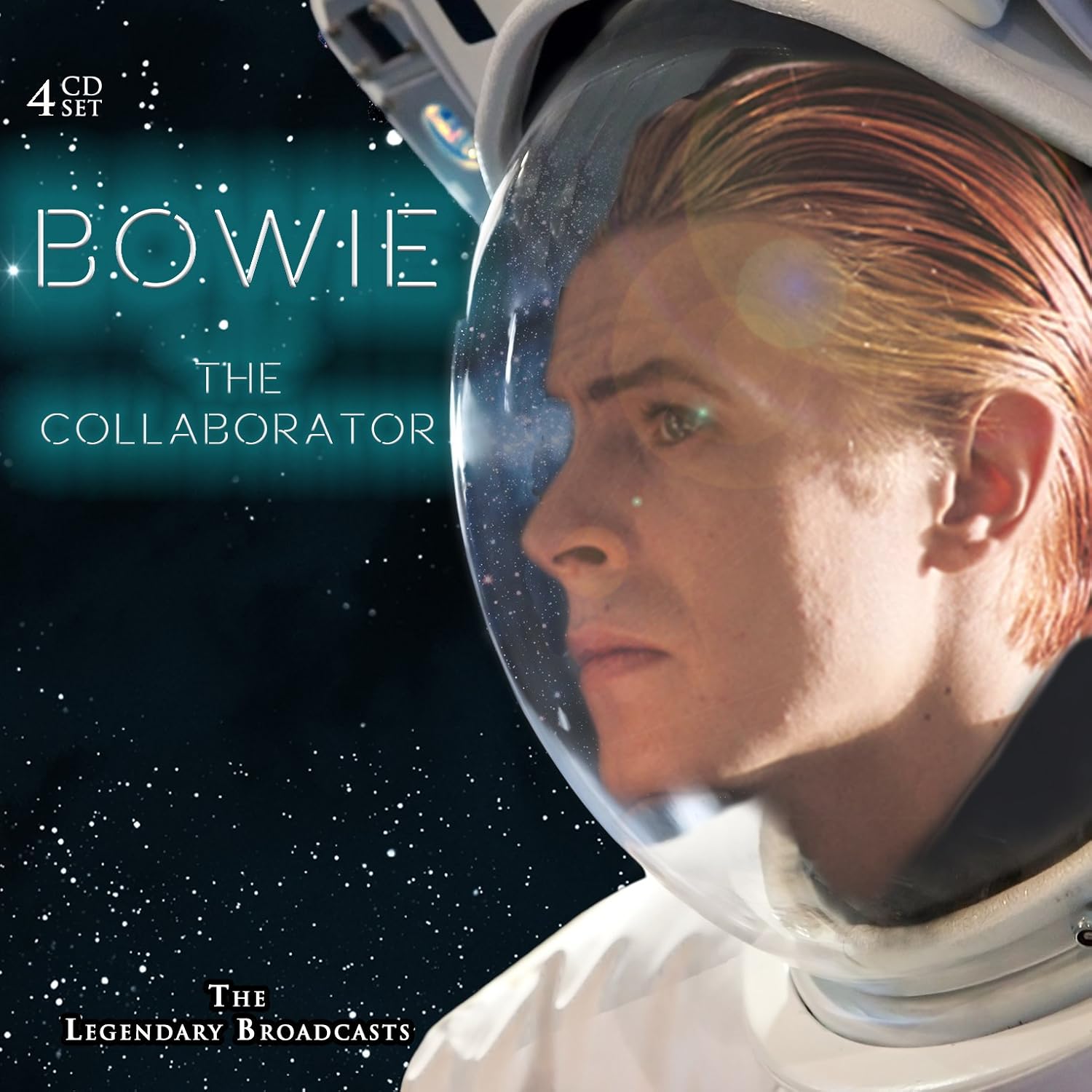
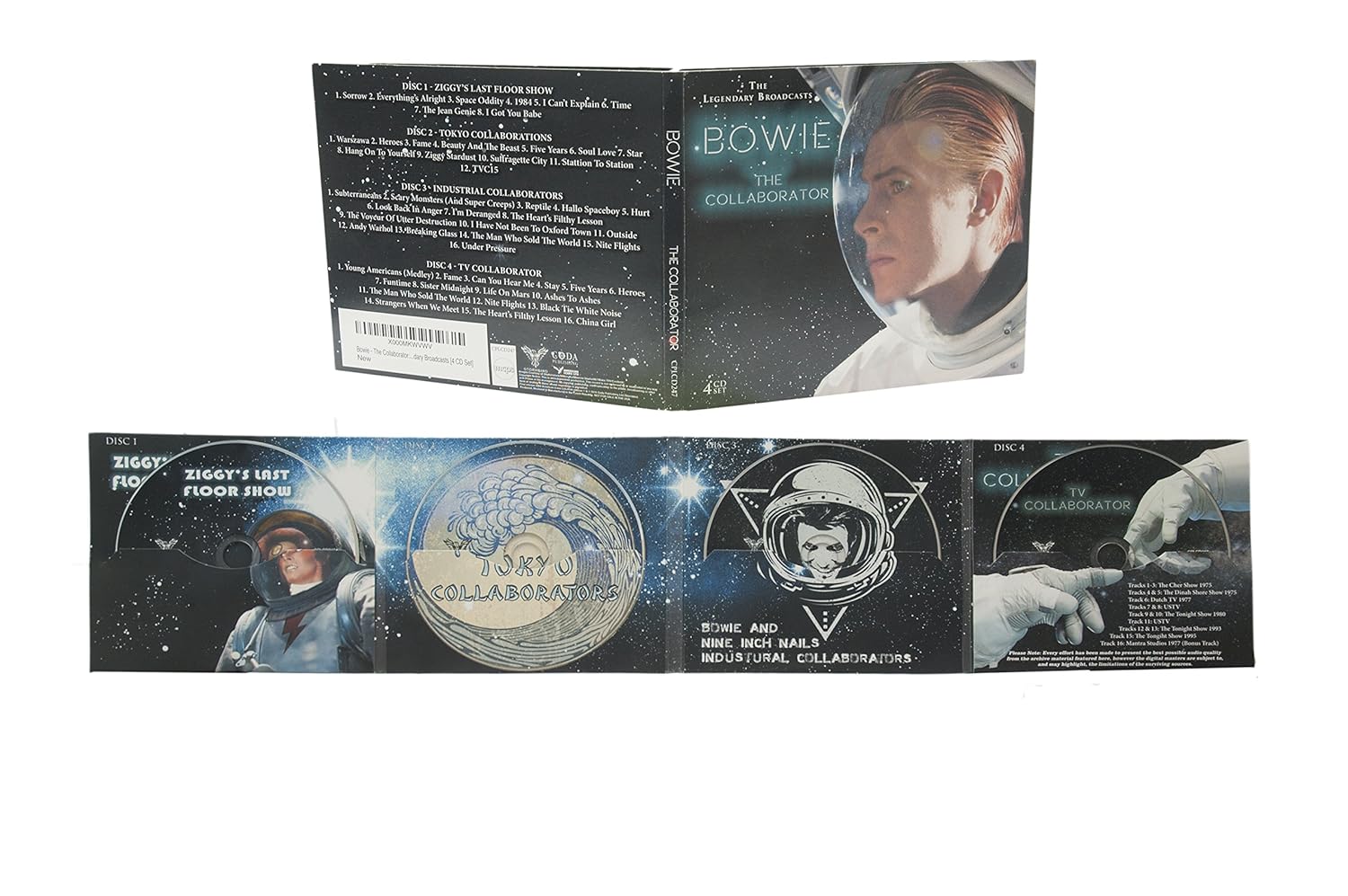
BOWIE – THE COLLABORATOR THE LEGENDARY BROADCASTS
4 CD SET
For Bowie fans who have all the available official releases already, this four CD set is a worthwhile purchase as an addition to the collection. As these types of recordings go, the sound quality is generally very good – three or four tracks on CD4 sound a little ‘muddy’.
Disc 1 features tracks from the 1980 Floor Show from October 1973, so post the last Ziggy show on July 3rd. It is very much the Ziggy era sound and, of course, the real curio here is the duet of ‘I Got You Babe. It’s also interesting for the live version of tracks from Pin Ups. The only sound fault I noted on this disc was a momentary drop in sound on ‘Time’ at about 2:29. Sadly it also fades 1984 before it gets to the ‘Dodo’ part and instead goes straight into ‘Can’t Explain’. The fade isn’t too messy but it would have been good to have the full 1984/Dodo.
disc 2 was of least interest as the 1978 live sound is already well represented by the Stage album. However, it’s a pleasant enough listen and it’s nice to have a live version of ‘Suffragette City’ from this period.
Disc 3 might also appear of less interest if, like me, you already have the Back in Anger double cd set of this gig with the Nine Inch Nails. The big advantage of the version included here is that, unlike Back in Anger, it doesn’t have the jumps on ‘Andy Warhol’ and ‘Breaking Glass’. It does still have some of the ‘clicking’ in the background on ‘Under Pressure’. Also you don’t get ‘We Prick You’, ‘Joe the Lion’ , ‘A Small Plot of Land’ and ‘Teenage Wildlife’ that are included on the Back in Anger album.
Disc 4 contains a set of tracks taken from various radio and TV broadcasts. It’s level of appeal is likely to depend on the Bowie era you favour – 5 of the 16 recordings from 1975. My main interest in this CD was this Young Americans era material – I have always had a soft spot for the medley with Cher because it is so cheesy. It helps if you are also an Iggy fan as tracks 7, 8 and 16 are him performing songs from The Idiot album. Bowie, of course, co-wrote these – I don’t know if this was sufficient for the compilers of this CD to include them or if Bowie is also playing keyboards as he did on Iggy’s tour at around this time. It’s a shame this final disc didn’t include some of the songs Bowie performed at his 50th birthday celebration with Lou Reed.
Disc 1 – The best of the legendary US broadcast entitled ‘The 1980 Floor Show’, which was actually produced in 1974. Notable collaborators include Marianne Faithfull, Trevor Bolder and Mick Ronson.
1. Sorrow
2. Everything’s Alright
3. Space Oddity
4. 1984
5. Can’t Explain
6. Time
7. The Jean Genie
8. I Got You Babe
Disc 2 – The live broadcast of the last night of The Isolar II World Tour from the NHK Hall in Japan on 12th December 1978. Collaborators include Adrian Belew, who would later join King Crimson, and violinist SimonHouse, who formerly played in Hawkwind.
1. Warszawa
2. Heroes
3. Fame
4. Beauty And The Beast
5. Five Years
6. Soul Love
7. Star
8. Hang On To Yourself
9. Ziggy Stardust
10. Suffragette City
11. Station To Station
12. TVC15
Disc 3 – The FM radio broadcast of Bowie’s Outside album tour live from St Louis on 11th October 1995, featuring Nine Inch Nails.
1. Subterraneans
2. Scary Monsters (And Super Creeps)
3. Reptile
4. Hallo Spaceboy
5. Hurt
6. Look Back In Anger
7. I’m Deranged
8. The Heart’s Filthy Lesson
9. The Voyeur Of Utter Destruction
I0. Have Not Been To Oxford Town
11. Outside
12. Andy Warhol
13. Breaking Glass
14. The Man Who Sold The World
15. Nite Flights
16. Under Pressure
Disc 4 – Stunning bonus disc featuring rare TV and Radio broadcasts, with notable collaborators from Cher to IggyPop.
1. Young Americans (Medley)
2. Fame
3. Can You Hear Me
4. Stay
5. Five Years
6. Heroes
7. Funtime
8. Sister Midnight
9. Life On Mars
10. Ashes To Ashes
11. The Man Who Sold The World
12. Nite Flights
13. Black Tie White Noise
14. Strangers When We Meet
15. The Heart’s Filthy Lesson
16. China Girl
Great Ytene are a band built upon deconstruction and reassembly. In order to create something that felt truly complete, they had to tear down everything that had come before. From their formative years as ‘Colours’, to their reemergence as Great Ytene (taking their name from an old term for the New Forest, which is where they all grew up), they replaced sounds, members and even their name before they felt truly comfortable in their collective skin.
So, it’s quite fitting that In 2015 Great Ytene lost a full album’s worth of material to a technological worm hole. It was just another clean slate. It was the best thing that could have happened. The band spent six months writing new songs, perfecting their shape, pulling them apart and piecing them back together until “Locus” was in exactly the right place.
Locus, Great Ytene’s first full length LP since their self- titled debut (via Bella Union) in 2014, sees the band moving forward to explore darker themes. The name ‘Locus’ refers to the attempt to pin-point exact moments in time when an event took place. This idea is explored lyrically throughout the album, even as the music loops and pushes back.
If you are looking for like-minded contemporary peers then look no further than the grey and black post-punk of the likes of Disappears and Preoccupations. At times waves of noise are underpinned by tight, rigid rhythms, at others they’re allowed to spill over the edges to create disquiet landscapes.