For Fans Of of Wolf Alice/The Pixies and with influences ranging from PJ Harvey to Sonic Youth, this awesome Belfast-based band New Pagans blend massive riffs and rare dynamics to challenge past and present issues surrounding relationships, equality, history, and gender; all wrapped up in their alternative, post-punk, indie rock style. Northern Ireland is about as punk as a locale can be. Decades of conflict and political turbulence has resulted in a cultural climate highly receptive to angst. New Pagans, a Belfast-based band fronted by Lyndsey McDougall, channels their country’s history into their propulsive debut album, The Seed, The Vessel, The Roots And All. It has a brooding, gothic palette, and is teeming with reference to saints and sinners, blood and tears, and various strains of nebulous wickedness.
UK indie/post-hardcore band New Pagans are releasing their new LP The Seed, The Vessel, The Roots and All on March 19th via Big Scary Monsters, and the first single is the soaring, fired-up “Christian Boys” which the band says is about a Christian leader that singer Lyndsey McDougall had been having an affair with before he married his virgin bride. “This is shocking but what is more disturbing is that it hadn’t been the first-time similar stories had emerged. When these men were confronted, they all stated that the women were to blame, it had been their fault, they were the sinners and had led the Christian men astray,” the band said.
With some fierce attitude, gritty pop-sensibilities alongside striking vocals, (not to mention a ‘Best Live Act’ at the NI Music Prize!), this band are definitely ones to watch and luckily you don’t have to wait very long to hear some new music!
Taken from the LP The Seed, The Vessel, The Roots and All Out digitally on Friday 19th March 2021 but you can hear the fantastic new single “Christian Boys“
If you like your post-punk extra post-punk-y, then Moaning is maybe the band for you. The synths have just the right amount of glide, the guitars stab in all right parts (I will not use the term “angular,” thank you very much), and the vocals have the requisite sense of dispassionate detachment. This criminally underrated Los Angeles trio led by frontman Sean Solomon has been producing good music for years and “Uneasy Laughter” has mostly flown under the radar in 2020, but ignore this album at your own peril. Few bands have mastered the beguiling rock mixture of analogue and synthetic quite like Moaning.
What happens when an abrasive rock trio trades guitars for synths, cranks up the beats and leans into the everyday anxieties of simply being a functioning human in the 21st century? The answer is Uneasy Laughter, the sensational second Sub Pop Records release from Los Angeles-based Moaning.
Vocalist/guitarist Sean Solomon, bassist/keyboardist Pascal Stevenson and drummer Andrew MacKelvie have been friends and co-conspirators amid the fertile L.A. DIY scene for more than a decade. They are also immersed in other mediums and creative pursuits — Solomon is a noted illustrator, art director and animator, while Stevenson and MacKelvie have played or worked behind the boards with acts such as Cherry Glazerr, Sasami and Surf Curse. On Uneasy Laughter, they’ve tackled challenges both personal and universal the only way they know how: by talking about how they’re feeling and channelling those emotions directly into their music.
“Ego” from Moaning’s album Uneasy Laughter (Release Date: March 20th, 2020) Sub Pop Records.
Over the last eight years, the Goodbye Party has remained a hidden gem to devoted fans. The music of Michael Cantor, the Philadelphia-based musician behind the project, has been a well-kept secret that holds the sacredness of loss close to the heart through classic pop ballads, atmospheric soundscapes, cassette tape noise, swirling guitars, and an affinity for staying present in the dark corners of our minds. On October 9th, 2020, the Goodbye Party released their sophomore album, “Beautiful Motors”, on Double Double Whammy Records, with which Cantor is ready to be fully unearthed.
Beautiful Motors is a culmination of Cantor’s previous releases, showcasing a full bloom of profound and haunted narrative song writing. He’s always had a knack for vividly portraying the auditory flight of spectre’s and feelings of loss and surrender, except this time he’s leaned into the grief of growing older while also looking back on the rock sounds of his youth. The songs inhabit you as the appearance of a ghost does; they remain long after the encounter, running through your brain like an omnipotent refrain.
The Goodbye Party has shared “No Reason” a gentle power-pop number his upcoming album “Beautiful Motors”. it “nails a balance between warm, summery melodies and autumnal melancholy — the perfect kind of song to drop on the first official day of fall.”
Of the song, Cantor says “this song deals with a couple of themes. One is how people you no longer keep in your life can show up in some of your favourite memories. It’s also about the experience of passing through the same place across different tours and seeing decay creep along, seeing cascading effects from hurricanes, and recognizing that slow change in yourself. My friend Emi Knight from Strawberry Runners sings on this song. She, along with a handful of local songwriters, held monthly salons where we would demo and critique each other’s songs. Having that space helped me focus, write, and rewrite songs for this record.”
Recorded in Philadelphia with Kyle Gilbride (Swearin’) at Wherever Audio, Beautiful Motors was engineered between December 2018 and November 2019. The year-long timeline resulted in plenty of opportunities for refining, rewriting and arranging at home and during studio sessions. Cantor is joined by friends and musicians new and old to the Goodbye Party lineup, including Gilbride, Cook-Parrott, Maryn Jones (Yowler), Joey Doubek (Pinkwash, Speedy Ortiz), Emi Knight (Strawberry Runners), and pedal steel guitarist Zena Kay.
Beautiful Motorsis available everywhere October 9th. The Goodbye Party
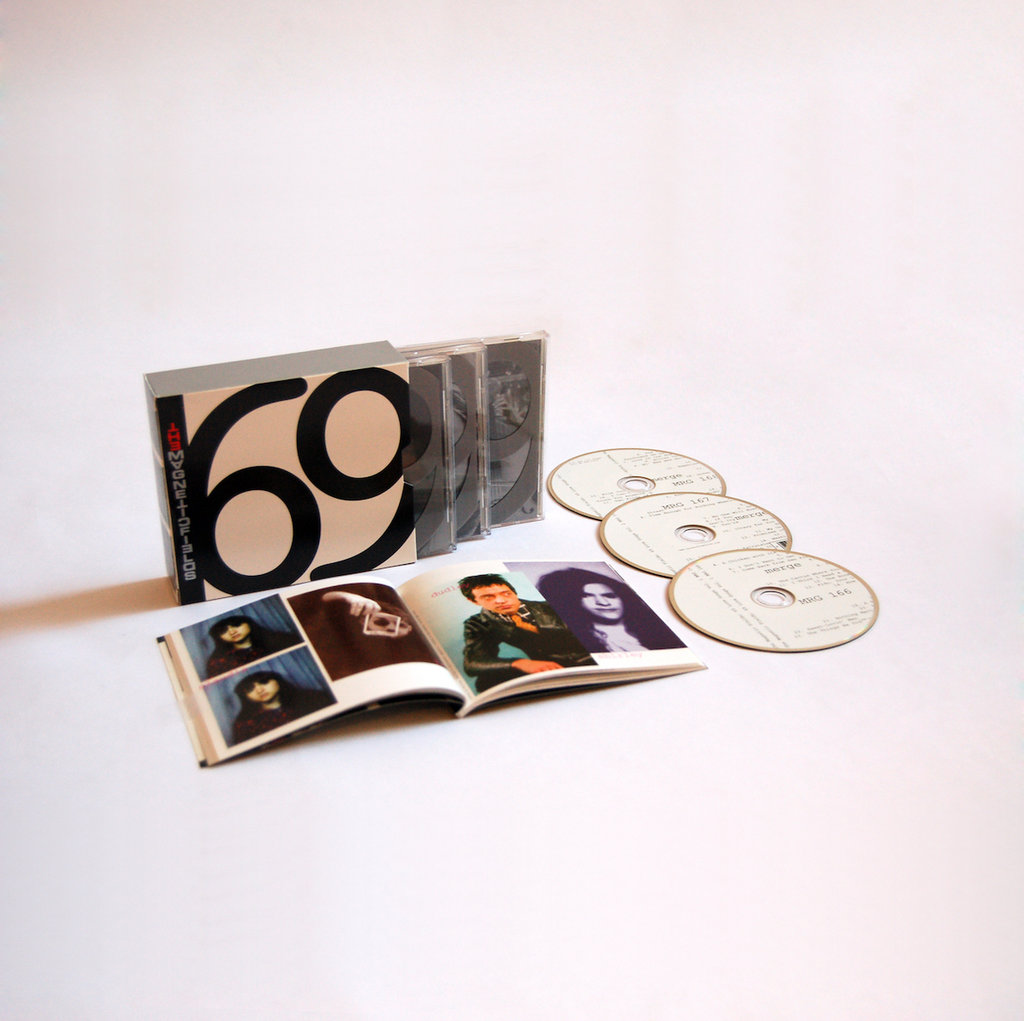
By 1999, The Magnetic Fields had long been darlings of the college radio circuit. The band, led by Stephin Merritt, emerged from Boston in 1991 with the single “100,000 Fireflies” on Harriet Records a small indie pop label that would itself enjoy a cult following during that decade, followed by the self-released full-length Distant Plastic Trees. In the years that followed, Merritt balanced a steady stream of Magnetic Fields releases with several side projects—The Sixths, The Gothic Archies, and Future Bible Heroes—all of which positioned him as one of the era’s most well-regarded songwriters. So, when “69 Love Songs”, a triple-CD collection that served as The Magnetic Fields sixth album, dropped on September 7th, 1999, it was an event. In fact, its release was supported by a two-night stint in New York, where the band played every song off the album, in order.
In a recent podcast, Merrit and author Daniel Handler, aka Lemony Snicket—who was a collaborator on “69 Love Songs”—discussed whether or not it was the last great album of the 20th century or first of the 2000s. (Merritt explained that there was greater demand than there were copies pressed for the initial release, so many listeners couldn’t get the album until early in 2000.) Ultimately, 69 Love Songs bridges both decades and millennia. It was a culmination of the work Merritt and The Magnetic Fields had been building until that point, and it set the stage for what would come in the next two decades.
In many ways, 69 Love Songs was a novelty: a behemoth collection of cross-genre tunes, united under a broad theme and cheeky album title. But it definitely didn’t seem out of character for Merritt. Part of his appeal as a songwriter is Merritt’s knack for writing vivid, emotionally complicated love songs, well apparent on earlier releases like “100,000 Fireflies” and the previous year’s single “I Don’t Believe You” (later released on their 2004 album, I).
The album catapulted the band out of the college radio and indie circle at a time when the music industry was changing. They would remain a cult sensation—but one that got significant recognition. In 1999, 69 Love Songs was included on multiple year-end best of lists. Over the years, 69 Love Songs has spawned fan sites and a number of critical reassessments. In 2006, it got its own book in the 33 1/3 series, by LD Beghtol, also a collaborator on the album.
Meanwhile, four Magnetic Fields albums that followed—“i, Distortion, Realism”, and “Love at the Bottom”—all hit the USA Charts. Merritt himself branched out into other projects, including writing the music and lyrics for the off-Broadway adaptation of Neil Gaiman’s Coraline, which earned him an Obie. In 2017, The Magnetic Fields released another massive concept album, 50 Song Memoir, which essentially serves as Merritt’s autobiography. we offer 10 tunes from “69 Love Songs” to draw you into this now-classic collection.
“The Book of Love”
Beghtol’s 33 1/3 book notes that, in 1999, “The Book of Love” was voted number two in a 69 Love Songs “top 10” poll for the stephinsongs.com mailing list. By 2006, it had risen to the top spot. Both the book and Merritt’s recent Talkhouse podcast note that the song has been performed at multiple weddings by multiple members of the band. Clearly, it’s a fan favourite. It’s also popular amongst musicians, having been covered by a wide range of artists, including Peter Gabriel and The Airborne Toxic Event. Gabriel’s version was particularly successful; it appeared on the soundtrack of the film Shall We Dance? in 2004.
“The Book of Love” says a lot about amour, but it also says a lot about this album; Merritt himself described it as a manifesto. “The book of love has music in it / In fact that’s where music comes from,” he sings in the second verse. “Some of it is just transcendental / Some of it is just really dumb.”
“Sweet-Lovin’ Man”
According to Merritt, per Beghtol’s 33 1/3 book, “Sweet-Lovin’ Man” began its life as a synth-pop song originally intended for The Magnetic Fields’ 1992 sophomore album, The Wayward Bus. It didn’t make the cut, and was reworked. Claudia Gonson, who sings lead here, said in the same book that she had hoped that “Sweet-Lovin’ Man” would go on to become “a major alt-country hit.”
Somewhere in between its synth-pop beginnings and alt-country ambitions, The Magnetic Fields hit a sweet spot. It’s a lyrically straight-forward song; Gonson’s vocals have a sense of hopefulness to them, which is juxtaposed with dense production that combines actual strings with synth ones. “Sweet-Lovin’ Man” is an example of a bunch of the multitude of influences for 69 Love Songs coming together into one piece that defies clear categorization.
“When My Boy Walks Down the Street”
In “When My Boy Walks Down the Street,” the exuberance of new love is apparent already in the opening line, “Grand pianos crash together / When my own walks down the street.” This feeling of overwhelming attraction grows with each sharp, beautifully hyperbolic line.
“When My Boy Walks Down the Street” plays with the tropes of giddy ’60s love pop in a way that was radical for 1999. Merritt, who handles vocals here, subverts ideas of gender with the line, “and he’s going to be my wife.” He’s also introducing marriage as an inevitable end-goal five years before the first U.S. state legalized same-sex marriage. That he does this with one fragment of a sentence, so casually dropped in the chorus, is a powerful statement.
“Grand Canyon”
If electronic Americana were a genre, “Grand Canyon” could be the defining song. Merritt’s references here are distinctly drawn from U.S. geography and lore. “If I was the Grand Canyon / I’d echo everything you say,” he sings, followed in the second verse by, “If I was Paul Bunyan / I’d carry you so far away.” It’s written as a folk song meant for a night around a campfire, with voices joining in as the song progresses. Yet, it’s also heavily a synth song.
In “Grand Canyon,” the hooks are so strong, and Merritt’s delivery is so incredibly forlorn, that it practically demands repeated listens. What becomes more interesting after the first play, though, are the small details in the production, like subtle fuzz that gives the impression of through dusty vinyl, and the echo on Merritt’s own vocals that emphasize the Grand Canyon metaphor.
“If You Don’t Cry”
A synth-pop gem with Gonson on vocals, “If You Don’t Cry” taps into the nightlife ritual of hitting the bar and dancefloor to try and keep the tears at bay. At 139 BPM, its tempo is closer to what you would hear at a ’80s electronic night where DJs are dropping tracks by the likes of Ultravox and Soft Cell. Lyrically, it directly references that experience of nursing your broken heart with booze and lonesome dancing.
Then there’s the chorus, “If you don’t cry, it isn’t love / If you don’t cry, then you just don’t feel it deep enough,” a theme revisited throughout the album. 69 Love Songsis full of so many deeply tender moments that it can be an absolute tear-jerker. Listen with a box of tissues.
“Long-Forgotten Fairytale”
The Magnetic Fields had already made a fair share of songs that could be considered synth-pop, but “Long-Forgotten Fairytale” is perhaps their most unapologetically ’80s of these gems. The Pet Shop Boys are an obvious influence on the cut—Merritt mentions this in the 33 1/3 book—but listen closely and you’ll hear strains of others as well, perhaps a little ABC or (fittingly) Book of Love. Dudley Klute, who sang with Belgian synth outfit Kid Montana back in the ’80s, handles lead vocals on this track.
In 1999, using ’80s synthpop as a point of reference was far from hip and, with “Long-Forgotten Fairytale,” The Magnetic Fields were among very few in the indie world to mine a sound that wouldn’t come back into vogue for another few years. It may be a bit of a throwback, but “Long-Forgotten Fairytale” also foreshadowed the sound of the early 2000s.
“Papa Was a Rodeo”
Another fan favourite, “Papa Was a Rodeo,” was voted number one in the stephinsongs.com poll back in ’99. The country-tinged number with Merritt on lead and Shirley Simms dropping in for the final chorus, is narrative-driven with a twist that might bring a happy tear to even the most hardened cynics.
“Papa Was a Rodeo” begins with the assumption that this affair will go nowhere. Our narrator warns that long-term love isn’t an option for someone who “never stuck around long enough for a one night stand.” Flash forward, though “and now it’s 55 years later / We’ve had the romance of the century.” A romance flick condensed into a pop song, “Papa Was a Rodeo” gives listeners a well-deserved happy ending.
“Swedish reggae” is the descriptive used for “It’s a Crime” in the 69 Love Songs 33 1/3 book, but the mellow cut with Klute on vocals has more of a new wave vibe. In fact, if there’s one song that sounds like a true predecessor to “It’s a Crime,” it’s Blondie’s version of “The Tide Is High,” at least at first listen.
Tune in a little deeper and you’ll hear the killer dub bassline bubbling underneath the vocals and electronic squiggles. It’s what gives “It’s a Crime” strength, an indicator that The Magnetic Fields were both studied in their approach to covering multiple genres and willing to have fun with it.
“The Death of Ferdinand De Saussure”
“The Death of Ferdinand De Saussure” is, on the surface, one of the most confusing entries on 69 Love Songs. Other narratives in this collection are very clearly about falling in and out of love. This one depicts a meeting with the pioneering linguist, who explains, “So we don’t know anything. You don’t know anything. I don’t know anything about love. But we are nothing. You are nothing. I am nothing without love.”
Then our protagonist shoots the academic and makes the proclamation, “It’s well and kosher to say you don’t understand, but this is for Holland-Dozier-Holland.”
The song writing team of brothers Eddie and Brian Holland and Lamont Dozier helped define the Motown sound—and thus wrote some of the most memorable love songs of the 1960s and early ’70s. Amongst their credits: “Baby Love,” “How Sweet It Is (To Be Loved By You),” and “Stop! In the Name of Love.” They also wrote heartbreakers like “My World Is Empty Without You,”“You Keep Me Hangin’ On” and “Band of Gold.” If anyone knows anything about love, it’s Holland-Dozier-Holland.
In a sense, “The Death of Ferdinand De Saussure” is about the power of love songs. Can you really argue that humans don’t know about love after listening to The Supremes?
“I Can’t Touch You Anymore”
“I Can’t Touch You Anymore” might be one of the more quintessentially ’90s tracks on 69 Love Songs—check out that sped-up trip-hop beat that comes to a gloomy grind at the conclusion. It wouldn’t sound out of place in a mix alongside Garbage and Blur. Despite the acclaim that 69 Love Songs received upon its release, this song’s potential as an indie dance song was perhaps overlooked.
What’s also interesting about “I Can’t Touch You Anymore” is the way the production mirrors the lyrics. There’s a sexy groove throughout that’s put on hold at several points within it, mimicking a second thought about returning to a lover who’s bad for you. With the refrain of “I love you, I can’t touch you anymore,” that’s all too perfect.
Rather than existing at odds with the disturbing energy of the pandemic, and the eerie silences that accompanied the quarantine, Woods feel profoundly present. Their balmy psychedelia reckons with the world rather than seeking to escape it. Reflecting on and reasoning with death, they ask, “I see old friends when I sleep…Where do you go when you dream?” In a momentary flash, we see children age and gardens grow. Woods is one of those low-key prolific bands, seemingly guaranteed to produce an album each year (a rate of production even more impressive considering frontman Jeremy Earl also runs Woodsist Records, one of the best indie labels around.) Some albums — like 2010’s At Echo Lake — are paragons of psych folk rock, while others tend to fade into the background without much fanfare.
“Strange to Explain” is their strongest effort in years, with Earl’s high-pitched howls providing immediacy on an album filled with moss-covered vignettes, including highlight cuts like the title track and the mesmeric “Where Do You Go When You Dream.”
Second single from the new Woods album out May 22nd, 2020 on Woodsist Records.
Sad surf honey tries to ride the biggest wave in the Midwest, Born in a tsunami off the coast of Kahoolawe, BeachBunny was raised as a sea critter till the time her paws were strong enough to swim. By 1961 she had learned how to speak the language of every ocean and trekked from Rainbow Falls to Eastern California where she was exposed to the reverb-drenched surf culture of Orange County. Bunny became hypnotized by the exotic noise and by 1968 found herself singing the Sunset Strip alongside psychedelic west coasters and teen dropouts. Bunny released her first EP “Animalism” the following year, and is currently swimming the Gulf of Mexico in pursuit of positive vibes and new music.
Riding high after their debut Honeymoon was featured on all the crucial Album of the Year listings, Chicago indie pop band Beach Bunny now continue their rapid rise to the top with new EP Blame Game. Featuring the single “Good Girls (Don’t Get Used)”, Blame Game explores the dark territories where relationships turn toxic, as singer Lili explains; “As a veteran of engaging with emotionally unavailable people, I wanted to create a sassy song that calls out players by talking down to them as if they were children, showing that poor communication skills and mind games are immature.”
“It shifts the blame to the person that was acting disrespectful, instead of myself. The song also hammers home the point that I know my worth; I’m not afraid to call out players on their stupid behaviour, and I’m not going to tolerate being thrown around emotionally.” – Lili Trifilio
Beach Bunny album ‘Honeymoon’ was included in Best Albums of 2020 at The New York Times, Rolling Stone Magazine, Los Angeles Times & more!
“World on the Ground” is the fifth studio album by American singer–songwriter and I’m with Her member Sarah Jarosz. Produced by John Leventhal , the album was released on June 5th, 2020. The fourth track on the album, “Johnny,” a song with chord progressions reminiscent of the 1990 Nirvana song, “ Polly ,”
“Johnny’s on the back porch drinking red wine/He knows that it could be the very last time/He raises the glass up to his lips and wonders.” This is the opening line to “Johnny,” the lead single from Sarah Jarosz’ fifth studio album “World on the Ground”. Jarosz didn’t do a great deal of press for the album – for obvious reasons, of course – and so there isn’t a great deal of information as to whether the story told in the song is real.
The titular Johnny is staring down the barrel as he prepares to go in for open heart surgery – one fast move and he’s gone. It’s a moment filled with drama and suspense, and its unresolved nature only drives the intrigue even further. Did Johnny make it? Where is Johnny now? Is he even real to begin with?
Who cares if Johnny is real? “Johnny” is no less authentic because of it. It’s a striking, harmonious and emotive slice of Americana. Its lines trace around a bright octave mandolin, Levon Helm-esque drumming and rustic close harmonies that tie well into Jarosz’s bluegrass background. It’s certainly poppier than her earliest alt-country work, but that too doesn’t make it any less authentic. Any less real. From the second its tape-loop drone guides you in to the second its strummed mandolin lick guides you out, everything in “Johnny” is as real as it gets.
If you have kept an eye on the career of Sarah Jarosz, you’ll be fully aware that she doesn’t limit the influences in her musical universe to just folk and bluegrass. From funky rootsy Prince covers to nailing a definitive version of a Tom Waits classic, it has been clear that she trusts her muse instinctively and puts her music and art in the driving seat. Very much like the character Eve sketched out in the opening tune on this album, Sarah keeps “following the sound”. It is certainly an opening number that sets its table neatly, preparing for the delights that are about to unfold for the listener. A small-town girl with a sense of wonder opens her heart and mind to the possibilities over the other side of the wilderness.
As the music swoons and soothes, Eve locks in her resolve and thickens her skin to protect against the world that will try to muddy her insides and corrupt the good inside. This theme is touched upon again on the second tune, the title track that is illustrated on the minimal yet arresting cover art depicting a brace of birds. “When the world on the ground is going to swallow you down, sometimes you’ve got to pay it no mind”.
Her stories are carved like a craftsman’s antique furniture, with an attention to detail and capacity for nuance lending these sketches a depth and realism that ensures repeated listening is a rewarding experience. And Sarah is far from simplistic in weaving these threads of escape and adventure, she knows that reality or tragedy is more than likely going to bite at some stage. Like the character on track three, who ends up back in her hometown with dreams that have been frazzled away. That song, ‘Hometown’, has the timbre of a classic Springsteen ballad, “on the verge of a breakdown, back in her hometown, never thought she’d settle down in a place like this”. There’s a theme of escape from the suburban backwaters, chasing dreams that have a habit of meeting a head-on collision with the harsher side of the real world, a solid touchstone for the Boss.
Something in the creation and execution of these songs seems to state that this a musical talent on an upward trajectory. The songs are memorable, they are instant, they have thoughtful details and they overflow with drama, emotion and heart. Most of all they are little earworms and you will want to play them loud and singalong. It is that kind of album, stick it on while you’re cooking the dinner or sit down and listen properly. It works either way, Sarah Jarosz is pulling off that age-old musical trick here of being very, very good. I am going to be following her from here on in with high expectations.
Miel Breduow never had to explain that she wasn’t kidding. Under regular circumstances, a person best known for doing comedy has to clarify what’s sincere and what isn’t, there are countless examples of comics moving into earnest territory. Bredouw isn’t all that different. She goofed around on Vine at its peak, ending up on countless compilations and keeping the dream of Keisza’s “Hideaway” alive. She moved over to podcasting and found a new cult following as she punched up countless jams, both with friends and on her own. She is, as Streisand would say, a funny girl.
When “Must Be Fine” came out, Miel never had to explain that she wasn’t kidding. The answer is two-fold. The first is a reflection on the kind of person Bredouw is – or, at the very least, a reflection on the public persona fans and listeners have come to know through her work. Even when making ridiculous jokes or shriek-laughing at more of Chris Fleming‘s escapades, she comes across as entirely genuine. The kind of person who means what they say, who wouldn’t be laughing if they didn’t find it funny and the kind of person who sees honesty as the best policy.
More pertinent to the song itself, though, is that secondly there’s basically no other read you can give on “Must Be Fine.” It’s a cutting song – it’s sharp, and goes surprisingly deep for a two-and-a-half-minute song with two verses, two choruses and a bridge. A bridge that doesn’t lead anywhere, either – which is surprising on the first listen, but once you’re intimately familiar with your surrounds it clicks and begins to make sense. This isn’t a story with a definitive conclusion. There are no heroes and villains. It’s a time-lapse of a flower withering beneath a descending California sunset. It’s beauty and loss and tragedy within a sunburnt city landscape.
Miel’s work has always released tension. It’s interesting, then, that her work that achieved this in the most accomplished of ways was not centred on laughter. And she never had to explain that she wasn’t kidding. She went through a break-up and wrote an album about it.
Fleet Foxes have shared a new video for “I’m Not My Season” off their latest album “Shore”, which was released digitally last fall via Anti-Records and will be released on all physical formats on February 5th, 2021.
Shot at St. Ann & the Holy Trinity Church in Brooklyn, NY, the performance was filmed as part of ‘A Very Lonely Solstice Livestream’ in December 2020 and the video was directed by longtime Fleet Foxes collaborator and frontman Robin Pecknold’s brother Sean Pecknold.
Fleet Foxes’ Robin Pecknold will commemorate the release of Shore on vinyl & CD at independent record stores with a virtual in-store performance, streaming on Wednesday, February 10th at 6pm PT / 9pm ET. Fans can get access to the mini solo set by pre-ordering the album now at their local indie retailer, or by purchasing ‘Shore’ in the store or curbside on the weekend of its release, ‘Shore’ is available on an exclusive crystal clear 2LP vinyl set at independent record stores only. A limited edition Fleet Foxes art print is also available by Bailey Elder.
Praised by critics upon release, “Shore” topped year-end lists placing on numerous lists including The New Yorker, NPR, Pitchfork, USA Today, Stereogum, Rolling Stone, and more stateside.
Adult Mom will release their third studio album “Driver” on March 5 via Epitaph Recordings. In celebration of the announcement, they have shared the new single “Sober.” The track examines how people’s perceptions of each other change and deteriorate over time, especially in the wake of a relationship gone sour.
On Driver, co-produced by Stevie Knipe and Kyle Pulley (Shamir, Diet Cig, Kississippi), Knipe delves into the emotional space just beyond a coming-of-age, where the bills start to pile up and memories of college dorms are closer than those of high school parking lots. Ultimately seeking the answer to the age-old question posed by every twenty-something; what now?
Over the course of 10 tracks, Knipe sets out to soundtrack the queer rom-com they’ve been dreaming of since 2015. Driver incorporates an expert weaving of sonic textures ranging from synths and shakers to ’00s-inspired guitar tones which convey a loving attention to detail. Lyrically, Knipe radiates an unmistakable honesty mixed with a level of wit and a sense of humour producing intimate yet relatable indie pop songs.
Adult Mom began as the solo project of Stevie Knipe at Purchase College. Adult Mom now falls between the playful spectrum of solo project and collaborative band with beloved friends and musicians Olivia Battell and Allegra Eidinger. Since forming in 2012, Adult Mom has released five EPs and two full-length albums; Momentary Lapse of Happily (2015), and Soft Spots (2017). Knipe writes clever and intimate indie pop songs that offer a glimpse into the journey of a gender-weird queer navigating through heartache, trauma and subsequent growth.
Rhythm Guitar, Keys, Vocals, and Songwriting by Stevie Knipe Drums and Percussion by Olivia Battell Lead Guitar by Allegra Eidinger Bass by Kyle Pulley











 The Fat Angel Sings