Life After Youth is the first Land of Talk album since 2010’s Cloak and Cipher. After taking a few months off after Cloak and Cipher’s touring cycle, frontwoman Elizabeth Powell got back to work on a followup. Instead, a series of mishaps – post-tour fatigue, a crashed hard drive with new demos, and her father’s stroke in 2013 – turned “a few months” into “a few years”.
While caring for her father, Elizabeth fell under the spell of classical, ambient, and Japanese tonkori music, whose meditative quality aided his recovery. Immersing herself in those sounds would change her entire approach to music making; she started writing songs without her trusty guitar, instead building tracks up from synth beds and programmed loops. Life After Youth’s centerpiece track, “Inner Lover,” presents the most radical results of those experiments. It’s an audio Rorschach test of a song: key in on the incessant synth pulse underpinning Elizabeth’s pleading vocal (“take care of me!”) and the track assumes an ominous intensity. But when you surrender to the relaxed drum counter-rhythm and subliminal harmonies, “Inner Lover” projects a graceful serenity.
Even the songs built atop more traditional rock foundations exist in that liminal space between dreaming and waking life, confidence and doubt, raw feelings and soothing sounds. “Yes You Were” opens the record with a cold-start surge that’s overwhelming in its immediacy, with Elizabeth’s furiously strummed guitar jangle and wistful lyricism bearing all the adrenalized excitement and nervous energy of seeing old friends (or, in her case, fans) for the first time in ages. And as its title suggests, “Heartcore” is a collision of soft-focus sonics and emotional intensity, with Elizabeth’s crystalline vocals hovering above a taut, relentless backbeat and disorienting synth squiggles. Even the turn-a-new-leaf optimism of “This Time” is presented less as a triumphant comeback statement than a warm reassuring embrace—its beautifully dazed ‘n’ confused psych-pop swirl acts as a calming force as you hurtle toward life’s great unknown.
Fitting for a song about reconnecting with the world, “This Time” was the product of another fortuitous reunion—between Elizabeth and her old friend Sharon Van Etten, who lent her songwriting smarts and heavenly harmonies to that track, as well as “Heartcore” and the Fleetwood Mac-worthy “Loving.” And Van Etten is just one member of a veritable indie-rock dream team Elizabeth recruited to complete the album: the moonlit ballad “In Florida” was recorded by producer John Agnello (Dinosaur Jr., Kurt Vile) in his New Jersey studio, with Elizabeth backed by former Sonic Youth drummer Steve Shelley and Roxy Music/Sparks bassist Sal Maida. To paraphrase the late David Bowie, it’s been seven years, and Elizabeth’s brain hurt a lot. But she stands today as the patient-zero case study for Life After Youth’s therapeutic powers. These are the songs that got her through the tough times. And now, they can do the same for you.
released May 19th2017
This Time – from Land Of Talk’s album ‘Life After Youth’ OUT NOW
It’s been a dozen years since Alec Ounsworth became an Internet sensation, as his band Clap Your Hands Say Yeah bypassed the label system to become internationally known through support from music blogs. But as that support waned with subsequent releases, and as the power of Internet buzz grew more diffuse, Ounsworth found a way to endure. Now on its fifth full-length album — plus side projects for various band members and a 2009 solo record for Ounsworth himself — Clap Your Hands Say Yeah returns with The Tourist, which shimmers, seethes and twitches in appealing new ways.
Still, The Tourist picks up where 2014’s Only Run left off: by deepening and expanding the Talking Heads-esque template of CYHSY’s early work. No matter how distressed and disconcerted Ounsworth appears across these 10 songs, his voice is swaddled in approachable sounds — synths, effects, harmonicas, acoustic guitars — that shine welcome light on his darkest mumbled ruminations.
Ounsworth, who used to so frequently draw comparisons to David Byrne, now sings with the wry, wordplay-intensive twistiness of The New Pornographers’ Dan Bejar. Like its mastermind, The Tourist can get intense, even dark. But it also captures a sense of creative mischief with a sort of live-wire creativity .
Alex Cameron is a duo from Sydney, Australia featuring bandleader Cameron and saxophone player RoyMolloy. Frontman Alex comes with a ratty River Phoenix look and an ear for great pop music usually found on stage in an empty bar.
’Runnin’ Outta Luck’ from the album ‘Forced Witness’ out September 8th on Secretly Canadian
“Young Mopes,” a record full of witchy, Stevie Nicks-esque gestures, Go-Go’s-inspired harmonies and chiming guitars. The “madman” of the opening track “make-believes that everything’s just fine.”…the album’s 10 songs thread the needle between darkness and light, evoking the hazy twilight world between waking and dreaming. “Young Mopes”embraces this existential crisis and addresses them through beautiful, glittering new-wave.
“Her demeanour at once relaxed and commanding, Burns effortlessly glided through her set, laughing with her band in between songs, bantering with the crowd and consistently delivering rich, velvety vocals. She swayed with her eyes shut as she strummed her low-slung bass, looking out steadily at the room on “Who’s the Madman,” a gorgeous and dreamily infectious cut from her new record.
“Young Mopes is her sharpest collection of songs, and one that finds her expanding on the scope of her ’80s-inspired goth pop to include such disparate influences as country music and the sitar.
“Rage takes many forms in the new songs of Neil Young. If, by chance, you don’t connect with the relatively even-tempered opening track “Already Great” which celebrates the US as “the promised land” & “the helping hand,” perhaps something in the key of caustic sarcasm suits you better? That would be track two, & the bone-rattling, inspired-by-Funkadelic groove “Fly By Night Deal.” On it, Young alternates between the role of a pipeline project manager barking orders like “Move those animals out of here” & an outraged citizen who screams “No more” & laments “no one sees what’s getting lost…”
Sometimes the 72-year-old NeilYoung is tender and philosophical about the developments that anger him. Consider “Almost Always.” One minute he’s musing allegorically about birds; the next he’s castigating the sitting U.S. president as a “game show host who has to brag and has to boast about tearing down the things that I hold dear.”
Sometimes Young lets the music do the snarling: Though “When Bad Got Good” has a refrain borrowed straight from Donald Trump’s 2016 campaign – “Lock him up!” – Young doesn’t lean too heavily on it. He often mutters the chant under his breath, like a wily old sage, while he and the musicians of Promise of the Real work out the fine points of a swamp-rock groove that distills rage into delicious high-octane sonic abrasion. And sometimes, particularly on the pasted-together production number “Children Of Destiny,” Young disguises his rage behind the bright sing-song cadences of animated Disney films.
It’s followed by a comically grandiose fanfare played by a 56-piece orchestra, and that’s followed by a large mixed chorus singing flag-waving phrases like “Stand up for what you believe.” Those who thrilled to Young’s 2003 rock opera Greendale will find much to love here.
“Children Of Destiny” is the only overwrought and over-thought moment on The Visitor, Young’s 39th studio album — the album he’s using to launch his exhaustive online archive. The remaining nine tracks offer laments, fervent exhortations and heated diatribes about the rapidly changed world in the aftermath of the last U.S. presidential election. Young has always been quick to indignation, but on The Visitor he is careful to vary his tone, if not the target of his ire. (The quietly competent, and open-minded, musicians of Promise of the Real, now in their third collaboration with Young, help greatly with this.)
Viewed one way, the album amounts to a diverse compendium of tactics an artist might employ to express complex emotions (disbelief, fear, betrayal) upon discovering, as Young puts it on “Stand Tall,” that one’s way of life has been “turned upside down.” In the months since the election, pop culture pundits have talked about the response to Trump from the arts, usually in the form of general questions like “Where are the protest songs?” Neil Young weaves the rhetoric of protest into the stanzas of The Visitor — “Already Great” ends with the galvanizing chant “Whose streets? Our streets!” — and a few songs about man’s stewardship of nature certainly meet the basic definition of protest music.
Official Music Video For Neil Young + Promise of The Real’s “Almost Always” from the new album ‘The Visitor’
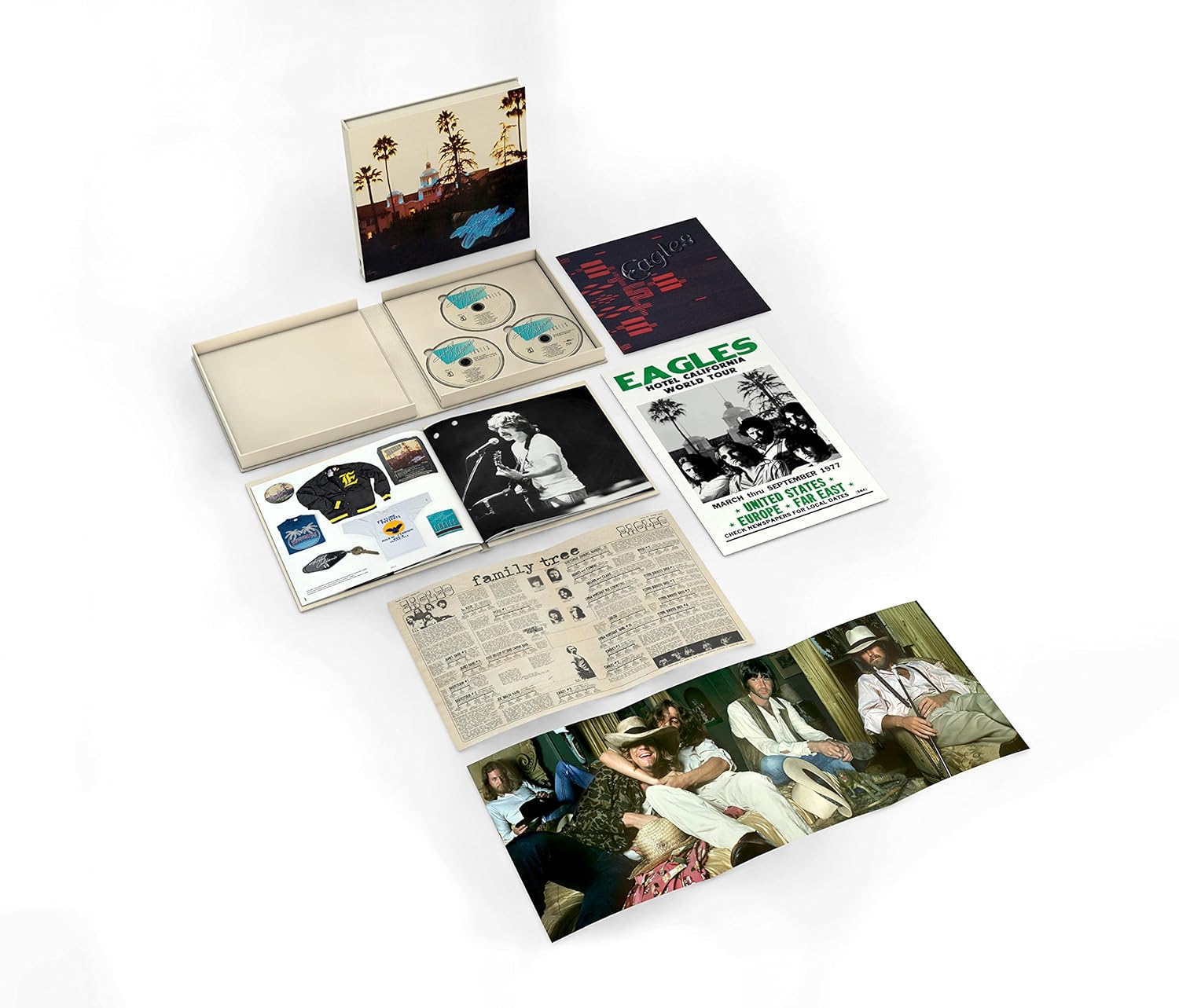
By the second half the Seventies, The Eagles’ “Peaceful Easy Feeling” seemed like a distant memory, a pleasantly stoned dream rudely interrupted by the pressures of business and fame. A deep malaise had set in, one which couldn’t be soothed by money, sex or drugs. It tightened its grasp on the band, the music industry and the country at large. Everything about Hotel California, the late-1976 album by The Eagles, was larger than life – beginning with the epic title track. Upon its release, its stature grew as mighty as the music within its grooves. It yielded two U.S. No. 1 singles, was certified platinum within a week of release, and sold over 17 million copies in the U.S. alone as of 2013 – a number that grew to over 32 million worldwide, and counting. Over forty years after its initial release, the most famous Eagles album has arrived in expanded form the band’s very first album to receive such a treatment. The 2-CD/1-BD deluxe box set edition (Elektra/Asylum/Rhino R2 562944) adds a disc of live concert highlights on CD and high-resolution stereo and surround mixes on Blu-ray, for a compelling and immersive trip back to the Hotel California. (A 2-CD edition has the original album and concert, while a single-CD edition has just the core album.)
With “Hotel California”, the Eagles sought to capture the excesses and self-destructive behavior that had become status quo in the rock world. It was a scene they were uniquely qualified to address. Their previous album, 1975’s One of These Nights, had spawned three Top 10 singles, and their greatest-hits album sold in such stratospheric numbers on its way to becoming the best-selling album of the 20th century in the United States – that the RIAA had to invent to platinum certification. “We were under the microscope,” Glenn Frey said of the time. “Everybody was going to look at the next record we made and pass judgment. Don [Henley] and I were going, ‘Man, this better be good.'”
Their efforts would create a song cycle that succeeded on nearly every level. Hotel California drew heroic sales figures and critical plaudits in equal measure, and affirmed the band’s shift from laid-back country-tinged pop act to major players in the rock & roll fast lane. The rich lyrics – both introspective and allegorical – had fans pondering their true meaning for decades to come. Was Hotel California about a mental institution? Drug addiction? A feud with Steely Dan? Satanism?
“The concept had to do with taking a look at all the band had gone through, personally and professionally, while it was still happening to them,” Henley told author Marc Eliot. “We were getting an extensive education, in life, in love, in business. Beverly Hills was still a mythical place to us. In that sense, it became something of a symbol and the ‘Hotel’ the locus of all that L.A. had come to mean for us. In a sentence, I’d sum it up as the end of the innocence, round one.”
On guitar, Joe Walsh and his arena-ready heft had replaced Bernie Leadon and his country-fried lilt. With Walsh trading licks with Don Felder, and Don Henley not only holding down the beat on his drum kit but taking an increasingly assertive role as the band’s “voice,” Eagles were taking flight to rock. Randy Meisner was as locked-in as ever on bass, as Glenn Frey added texture on keyboards and guitar. The impressionistic “Hotel California,” composed by Felder, Henley and Frey, was the band’s finest and most hard-hitting meditation on their preferred themes of excess, greed, and hedonism. The lyrics’ first-person narrative lent a personal feel to these big concepts, adorned with unforgettable images conjuring a vividly eerie experience. The music, anchored by Walsh and Felder on guitar, was as blazingly intense and atmospheric as the words.
In honor of Hotel California’s 40th anniversary,
The working title of “Hotel California” was “Mexican Reggae.” Though it’s since become synonymous with the dark, sinister underside of Los Angeles, the album’s title track took shape in a surprisingly idyllic setting. Don Felder had rented a beach house in Malibu, and was in the midst of taking in the ocean breeze as he leisurely strummed his guitar. “I remember sitting in the living room on a spectacular July day with the doors wide open, I had a bathing suit on and was sitting on this couch, soaking wet, thinking the world is a wonderful place to be. I had this acoustic 12-string and started tinkling around with it, and those ‘Hotel California’ chords just kind of oozed out.”
After completing the basic melody, he fetched his TEAC 4-track tape recorder to preserve his latest composition, which he embellished with bass and drum-machine overdubs. “I knew it was unique but didn’t know if it was appropriate for the Eagles,” he admitted. “It was kind of reggae, almost an abstract guitar part for what was on the radio back then.”
When the Eagles reconvened in the spring of 1976 to begin work on what was to be their fifth album, Felder assembled cassettes of his instrumental demos for his bandmates to mine for song ideas. Despite his initial reticence, the reggae-flavored tune made the cut.
Felder had submitted a cassette tape containing about half a dozen different pieces of music,” Henley said None of them moved me until I got to that one. It was a simple demo – a progression of arpeggiated guitar chords, along with some hornlike sustained note lines, all over a simple 4/4 drum-machine pattern. There may have been some Latin-style percussion in there too. I think I was driving down Benedict Canyon Drive at night, or maybe even North Crescent Drive (adjacent to the Beverly Hills Hotel) the first time I heard the piece, and I remember thinking, ‘This has potential; I think we can make something interesting out of this.'”
Glenn Frey was equally impressed. “We said this is electric Mexican reggae. Wow. What a nice synthesis of styles,” he said in 1992 . “Mexican Reggae” ultimately became the song’s working title during early sessions before the lyrics were finalized.
Black Sabbath were recording in the studio next door, and the noise disrupted The Eagles’ sessions.
To oversee the new sessions, the Eagles turned to veteran producer Bill Szymczyk, who had worked on their previous album, One of These Nights. Szymczyk was happy to return, but he had one condition: He wanted to record at Miami’s legendary Criteria Studios, far from the band’s standard base of operations at L.A.’s Record Plant.
His reasoning went beyond the technical. A recent earthquake had sent him “off the bed onto the floor,” instilling in him an intense fear of living on a fault line. “The day the earthquake happened was the day I became an independent producer,” he later joked . To avoid the earthquake zone, he insisted that the band record in Miami. Eventually a compromise was reached, and they would split time between both favored studios. “Every time we were at Criteria, the guys were actually quite happy to be out of L.A. and away from all of the partying and the hangers-on,” said Szymczyk.
They were joined at Criteria by Black Sabbath, holed up in the adjacent studio working on their Technical Ecstasy album. “The Eagles were recording next door, but we were too loud for them,” Tony Iommi told Uncut in 2014. “We kept hearing them through the wall into our sessions.” Hotel California’s delicate closing ballad, “The Last Resort,” had to be re-recorded multiple times to due to noise leakage.
Sabbath may have been louder, but the Eagles held their own when it came to partying. Sabbath bassist Geezer Butler recalled venturing into a studio recently vacated by the band: “Before we could start recording we had to scrape all the cocaine out of the mixing board. I think they’d left about a pound of cocaine in the board.”
When it came time to record “Hotel California,” Felder forgot what he’d written.
By the time the Eagles settled into Criteria Studios to lay down tracks for “Hotel California,” more than a year had elapsed since Felder first recorded his initial tape of the song. When he and Joe Walsh began to work out the extended guitar fade, Henley felt that something was missing.
“Joe and I started jamming, and Don said, ‘No, no, stop! It’s not right,'”said Felder in 2012. “I said, ‘What do you mean it’s not right?’ And he said, ‘No, no, you’ve got to play it just like the demo.’ Only problem was, I did that demo a year earlier; I couldn’t even remember what was on it.” Further complicating matters was the fact that the tape in question was at the other end of the country in Los Angeles. So the band was forced to improvise.
“We had to call my housekeeper in Malibu, who took the cassette, put it in a blaster and played it with the phone held up to the blaster,” he says. In the end, the results were deemed satisfactory. “It was close enough to the demo to make Don happy.”
Ian Anderson of Jethro Tull believed “Hotel California” sounded suspiciously like one of his songs.
In the Eagles‘ defense, the tour took place two years before Felder, the song’s primary composer, officially joined the band in 1974 – though he was a friend of founding guitarist Bernie Leadon at the time and could have conceivably attended one of the performances. Felder himself later denied having ever heard “We Used to Know” at the time he wrote the song, and claimed to know little about Jethro Tull other than that they featured a flautist.
Whatever the case, Anderson takes a magnanimous view of the incident. “It’s just the same chord sequence,” he continues. “It’s in a different time signature, different key, different context. And it’s a very, very fine song that they wrote, so I can’t feel anything other than a sense of happiness for their sake. … There’s certainly no bitterness or any sense of plagiarism attached to my view on it – although I do sometimes allude, in a joking way, to accepting it as a kind of tribute.”
The cautionary tale of “Life in the Fast Lane,” built around Joe Walsh’s famous central riff, once more commented on the high life with which the band was so closely associated. “Life in the Fast Lane” was inspired by a conversation with Glenn Frey’s drug dealer at 90 miles an hour. The Eagles‘ success made them, by their own admission, well versed in most forms of debauchery: illicit pharmaceuticals, hotel destruction and elaborate forms of sex play. Some of these late nights yielded memorable lyrics. One of the album’s standout tracks was inspired by Glenn Frey’s particularly harrowing car ride with his bagman.
“I was riding shotgun in a Corvette with a drug dealer on the way to a poker game,” he recalled in 2013 documentary The History of the Eagles. “The next thing I know we’re doing 90. Holding! Big Time! I say, ‘Hey, man!’ He grins and goes, ‘Life in the fast lane!’ I thought, ‘Now there’s a song title.'”
He held onto the phrase for months, until a hard-hitting riff spilled out of Joe Walsh’s guitar during a band rehearsal. The lick stopped Frey in his tracks. He asked Walsh to repeat it, and soon realized that he was hearing the sound of life in the fast lane. From there, the song began to take root.
The final track brought Frey uncomfortably close to the drug-fueled reality that surrounded the band. “I could hardly listen to [‘Life in the Fast Lane’] when we were recording it because I was getting high a lot at the time and the song made me ill,” he has said . “We were trying to paint a picture that cocaine wasn’t that great. It turns on you. It messed up my back muscles, it messed up my nerves, it messed up my stomach, and made me paranoid.”
Don Felder was originally slated to sing “Victim of Love.” The searing tale of a “Victim of Love,” penned by Felder, Frey, Henley, and “honorary Eagle” J.D. Souther, soared with the twin-guitar approach from Walsh on slide and Felder on lead.
“New Kid in Town,” co-written by Frey, Henley, and. Souther, revisited the band’s lush and languid country-rock sound, with its ruefully yearning lead expressively provided by Frey in his only lead of the album. The group’s trademark harmonies also shone here. Randy Meisner’s “Try and Love Again” also was in this vein, returning the band to its roots. The heart of the album may belong, however, to the heartbreaking Frey/Henley soul ballad “Wasted Time.” It closed Side One of the original album and opened Side Two in an instrumental reprise, which like the original track, showcased Jim Ed Norman’s majestic string arrangement. The Walsh-led “Pretty Maids All in a Row” (co-written by the guitarist and Joe Vitale) complements “Wasted Time” in its conversational reflection on a past relationship.
In addition to the title track, Felder’s primary contribution to Hotel California was the relentless “Victim of Love,” which showcased a rougher sound for the band. “We were trying to move in a heavier direction, away from country rock,” “And so I wrote 16 or 17 song ideas, kind of in a more rock & roll direction, and ‘Victim of Love’ was one of those songs. I remember we went in the studio and we recorded it live with five guys playing. The only thing that wasn’t played in a live session was the lead vocal and harmony on the choruses. Everything else was recorded live.”
In tribute to the song’s genesis, the phrase “V.O.L. is a five piece live” was proudly inscribed on the album’s run-out groove – signaling that “Victim of Love” was recorded live by the five Eagles. The message, etched by BillSzymczyk, served as a middle finger to critics who accused them of being too clinical and soulless in the studio.
Felder himself provided lead vocals on the initial takes of the songs, but some of his bandmates were not pleased with the results. “Don Felder, for all of his talents as a guitar player, was not a singer,” Frey said in The History of the Eagles. Henley echoed the sentiment. “He sang it dozens of times over the space of a week, over and over. It simply did not come up to band standards.”
The Eagles‘ manager Irving Azoff was given the task of breaking the news to him over dinner, while Henley recorded the lead part back at the studio. “It was a little bit of a bitter pill to swallow. I felt like Don was taking that song from me,” Felder said in the documentary. “But there was no way to argue with my vocal versus Don Henley’s vocal.”
Don Henley brought his own mattress to each hotel during the Hotel California tour.
To combat grueling tour schedules, many bands go to great lengths to approximate the comforts of home while on the road. The Eagles were no exception, even chartering an elaborate private jet for their travels. But the band’s head electrician, Joe Berry, recalls Henley’s special request for the Hotel California tour. “He insisted on having a king-size bed and mattress available at all times, which the crew had to drag around everywhere,” he told Marc Eliot in To the Limit: The Untold Story of the Eagles. “The tour seamstress made a special cover for it, with handles, to make it easier to pack it in the truck every night. It was Don’s bed, it went everywhere.”
Henley defends this apparent extravagance by chalking it up to excruciating back pain exacerbated by the nightly performances. “I used to have to hold my body in such a position that my spine got out of alignment,” he explained to Modern Drummer. “Between playing the drums and keeping my mouth in front of the microphone, it really twisted my whole body. I got to a point in the Seventies where I literally could not sleep.”
The discomfort wasn’t helped by the poor quality bedding at their accommodations. “Hotel mattresses are awful – the worst goddamn thing in the room,” he told Eliot. “So I brought my own mattresses and had it trucked around with the equipment.” Unfortunately, the concierges were less sympathetic to Henley’s bad back. According to Berry, the mattress “never once got used, because no hotel would allow us to bring it in.”
The cover was shot by the man behind the Beatles’ Abbey Roadand the Who’s Who’s Next and it almost got the band sued.
He scouted locations with photographer David Alexander, and assembled a shortlist of suitable venues. The Beverley Hills Hotel on Sunset Boulevard was quickly agreed upon as the favorite, but erasing all traces of the building’s bright and airy resort-like appearance would prove to be a serious technical challenge.
“To get the perfect picture, David and I had perched nervously atop a 60-foot cherry picker dangling over Sunset Boulevard in the rush hour, shooting blindly into the sun,” says Kosh. “Both of us brought our Nikons up in the basket and we took turns shooting, ducking and reloading. We used high-speed Ektachrome film as the light began to fade. This film gave us the remarkable graininess of the final shot.”
The chosen shot, captured at the so-called “golden hour” just before sunset, would become one of the most recognizable album covers in rock history. Ironically, most failed to recognize the supremely famous hotel in the photo. When word finally got out about the building’s identity, representatives for the luxurious establishment were less than pleased. “As the sales of Hotel California went through the roof, lawyers for the Beverly Hills Hotel threatened me with a ‘cease and desist’ action,” says Kosh, “until it was gently pointed out by my attorney that the hotel’s requests for bookings had tripled since the release of the album.”
The band blew off the Grammys, instead watching their win from band practice. The Eagles were nominated for several Grammy awards in January 1978, including the prestigious Record of the Year for “Hotel California,” but Irving Azoff didn’t buy the “It’s an honor to be nominated!” line. Despite their meteoric sales, the band’s image had taken a beating in the popular music press, and he was unwilling to subject them to any kind of PR humiliation. So when Grammy producer Pierre Cossette asked the Eagles to perform during the 20th annual ceremony, Azoff reportedly refused. The only way the band would play – or even attend – was if they were guaranteed that “Hotel California” would nab the prize.
Rigging the awards was obviously out of the question, so Azoff suggested hiding the band in a secret dressing room, where they would emerge only if their name was called for Record of the Year. This scheme was rejected, as was the request that another artist accept the award on their behalf (Jackson Browne and Linda Ronstadt were mentioned as possible surrogates).
When the Eagles‘ ultimately won, host Andy Williams was left standing expectantly, haplessly waiting for someone to come forward and accept the honor. Azoff hastily put out a release saying that the band was in Miami working on their new album, ending the statement with a dismissive “That’s the future, this is the past.” Guitarist Timothy B.Schmit later said they watched the telecast in the midst of their band rehearsal. If they were disappointed that they weren’t there to accept the award in person, they didn’t show it. “The whole idea of a contest to see who is ‘best’ just doesn’t appeal to us,” Henley told The L.A. Times.
Ten tracks have been culled from the band’s concerts of October 20th-22th, 1976 at the Los Angeles Forum, during which the album (released on December 8th, 1976) was previewed with performances of its two songs which would go to No. 1 on the U.S. Pop chart: “New Kid in Town” and “Hotel California.” J.D. Souther joined in on vocals for “New Kid in Town.” Live at the Los Angeles Forum also has the band reaching back to its first album for “Witchy Woman” and an appropriately breezy “Take It Easy,” plus other highlights like the On the Border pair of “James Dean” and “Good Day in Hell,” and the One of These Nights duo of “Take It to the Limit” (with Jim Ed Norman conducting the orchestra) and, of course, “One of These Nights.” Joe Walsh’s JamesGang favorite “Funk No. 49” also is aired here. It’s hard to fathom why the band – in top, edgy form, playing off the audience’s energy – didn’t opt to include an entire concert here, or highlights from the Forum run, replicating a full, roughly 20-song setlist. (Five tracks from the Forum shows were included on 1980’s EaglesLive including “New Kid in Town” and “Take It to the Limit.”) But the ten songs selected and expertly sequenced are choice, indeed, with tracks like “James Dean” and “Good Day in Hell” echoing the themes of Hotel California. Sound, too, is uniformly crisp and excellent on the live recordings. The Eagles have taken the “leave ’em wanting more” adage to heart.
The producer behind Taxi Driver and Close Encounters of the Third Kind wanted to turn “Hotel California” into a movie. “When we thought of this song ‘Hotel California,’ we started thinking that it would be very cinematic to do it sort of like The Twilight Zone,” Frey once reflected in a BBC 2 radio interview. “One line says there’s a guy on the highway and the next line says there’s a hotel in the distance. Then there’s a woman there. Then he walks in. … So it’s one-shots all sort of strung together, and you sort of draw your own conclusions from it.”
The song’s cinematic quality drew the attention of Julia Phillips, who made history in 1974 by becoming the first female producer to win an Academy Award for the Paul Newman and Robert Redford caper The Sting. A string of blockbusters followed, including Taxi Driver and Close Encounters of the Third Kind, and by the end of the decade she set her sights on adapting the Eagles’ smash. An initial meeting with Azoff led to a tentative predevelopment deal, but relations became frosty when she quizzed him on the particulars of the song’s copyright lawsuit that the band initiated against their former manager, David Geffen, and Warner Bros. Records.
Henley and Frey accompanied Azoff to the next meeting, which, by all accounts, was unpleasant. In her infamous tell-all memoir, You’ll Never Eat Lunch in This Town Again, Phillips portrays the rock stars as arrogant and difficult, with a weakness for white powder. However, Henley disputes this description in To the Limit. “Glenn and I remember that day quite vividly. We had gone to her house reluctantly. … We sat there, polite but not terribly friendly. We were too wary to be friendly. In an effort to loosen us up, and to create some kind of camaraderie, she dragged out this huge ashtray filled with a mound of coke. … She offered us some, and we said no; we didn’t know her that well, and it was a business meeting. It was a little early in the day for us. She looked nonplussed at that.”
Whatever the truth, the movie deal was dead in the water. Like their Grammy no-show, the band was not particularly distressed over it. “They didn’t really want to see ‘Hotel California’ made into a movie,” one band associate admitted to Eliot. “They were suspicious of the film business. After all, that was what ‘Hotel California’ was all about. I remember from the first day, Henley seemed really reluctant about it. Being the control freak that he is, he sensed he’d never be able to control the making of a film and was afraid of seeing what he considered his finest, most personal work reduced to the level of a sitcom.”
Hotel California is housed in a sturdy flip-top box containing a minimum of swag (a replica tour poster; a foldout photo; and an Eagles family tree reprinted from the April 23, 1977 issue of Sounds magazine delineating the band’s connections to The James Gang, Rick Nelson’s Stone Canyon Band, The Byrds, Dillard and Clark, and more) and two booklets. The first is a reprint of the Eagles tour program, and the second is a linen-bound hardcover. Buskin’s liner notes offer new commentary from producer Szymczyk, while the remainder of the handsomely-designed book is filled with memorabilia reproductions and photos, all of which are captioned in detail. Many of these items are fascinating, such as an advertisement for Rock’s Superbowl II (featuring Eagles, Hall and Oates, Jimmy Buffett, and Andrew Gold!) in Orlando, 1976, or the ticket stub for Summer Pop ’78 with a ticket price of $12.50 for Section A – General Admission!
Demos • Outtakes • Peel Sessions • Steven Wilson 5.1 mix • Expensive
500-only of the super deluxe with Bryan Ferry SIGNED print
After years of hints, rumours and speculation, Universal Music have announced today that Roxy Music‘s eponymous 1972 debut album will be reissued as 3CD+DVD super deluxe edition in February 2018.
This four-disc anniversary set consists of the original album on CD 1 (which interestingly uses the 1999 Bob Ludwig remaster), a further disc of demos and outtakes, a CD devoted to BBC radio sessions (including the January ’72 Peel Sessions that featured the unsigned Roxy Music with David O’List on guitar) and a DVD that includes a brand new Steven Wilson 5.1 surround sound mix, along with rare video footage of TV appearances and live performance.
All the discs are presented in a large-format 12″ x 12″ 136-page hardcover bookwhich features some fantastic notes by author and journalist Richard Williams, who first wrote about Roxy Music in Melody Maker back in 1971! The book also delivers an incredible array of rare photos, including many outtakes from the famous Karl Stoecker cover shot of model Kari-Ann Muller (each disc in the set uses a variant from the session). The band’s penchant for glamour was showcased both in the lyrics and in the 1950s-style album cover. The photographer Karl Stoecker shot the cover, featuring model Kari-Ann Muller, who later married Chris Jagger, brother of Mick Jagger (a stylised portrait of Kari-Ann Muller also graces the cover of Mott the Hoople’s 1974 album The Hoople). The album was dedicated to Susie, a drummer who auditioned for Roxy Music in the early days
The second disc in this set is an incredible insight into this era, with four demos recorded (on Brian Eno’s Ferrograph reel-to-reel tape recorder at his flat in Camberwell) just over a year before the album came out. At this point in time, the band had played no gigs at all and included Roger Bunn on guitar and Dexter Lloyd on drums.
Band member Andy Mackay said “The drumming and guitar playing were quite noodley, quiet and fiddly. And interestingly, by the time we got Paul [Thompson] and Phil [Manzanera] in, the Roxy sound was much stronger – it had that rock ‘n’ roll element, which I always thought was absolutely crucial to our continued success… that tipped us across from being just an art-school experimental band, to a proper pop group.”
Outtakes from the actual album sessions (which lasted just over two weeks) are also included. Every track is represented in some form or another and there’s the odd snippet of studio chatter and laughter to really take you back to Command Studios in Piccadilly, in London where the album was recorded, in March/April 1972. Non-album single Virginia Plain also features on this disc (the song was included on the album when issued in America and on some later pressings).
Two Peel Sessions (from January ’72 and May ’72) feature on CD 3 along with five tracks (including the then new single Virginia Plain) for a BBC In Concert broadcast in August of the same year.
Finally the DVD features Steven Wilson’s ‘new’ 5.1 mix (it was actually created back in 2012) in DTS 96/24 and Dolby AC3 Sound. For some reason, there isn’t a hi-res stereo version on the DVD (something that was promised for 2012’s Complete Studio Recordings box set, but eventually not delivered (without explanation). Steven Wilson has noted this omission too. Commenting on Facebook today, about this reissue, he says “Back in 2012 I also remixed the album and several out-takes in stereo, and 2 years ago 2 of these mixes were released on a record store day 10 inch single, including an extended version of Ladytron. However, please note that none of these stereo mixes are included in this new deluxe set, so hang on to that 10 inch if you have it!”
This DVD also has video content, including the band performing Ladytron on The Old Grey Whistle Test, their first Top Of The Pops appearance doing Virginia Plain(according to Phil Manzanera, Brian Eno was “really pissed off that all you could see was his gloved hand”) and rare footage of Roxy Music at the Bataclan Club in Paris in November 1972, apparently “the only surviving visual document of this line up live on stage”.
There is also a two-CD deluxe edition of Roxy Music, but the record companies know what they are doing and they haven’t included any of the demos or the outtakes on this edition. Disc 2 is the BBC Sessions disc (disc three on the super deluxe edition). The packaging does look very nice though – you can see a photo of the hardcover casebound book package above, which comes with a 24-page booklet. The album is also being reissued on 180g vinyl LP.
We must address the issue of pricing. Amazon in the UK currently have a pre-order price of £172, which is insane. This price will inevitably come down to at least the £130 mark before the release date (Amazon France currently have a price equivalent of around £137). That is still very, very high of course and you wonder if the executives at Universal have been chatting with Scott Rodger and Paul McCartney about price points. Worth it? Only you can decide, but the content is excellent and presentation looks very good.
Olden Yolk is a New York-based group whose penchant for dystopian folk, abstract poeticism, and motorik rhythms have enveloped them in a sound uniquely of-the-moment yet simultaneously time-tested. The project is currently led by songwriters, vocalists, and multi- instrumentalists Shane Butler and Caity Shaffer, whose interlaced vocals are found guiding each composition on their enlivening self-titled debut. The project was initially conceived in 2012 by Butler as an outlet for one-off songs and visual art while touring and releasing albums with the band Quilt (Mexican Summer). Following the release of a split-record with Weyes Blood in 2014, Olden Yolk became a collaborative entity.
Olden Yolk’s debut ruminates on questions surrounding love, self-doubt, and locating autonomy amidst burgeoning unrest. Wrought with hazy melancholy and halcyon joy, Butler and Shaffer’s lilting vocals play off one another through a devotional dialogue, taking form in haunting choral melodies and candid rock n’ roll. These songs are ecstatic odes to the life of the city; to the subway platforms, kiosks, and monuments which enliven and encompass our collectivity, elevating into an urban-psychedelia.
On the album, Butler and Shaffer are joined by drummerDan Drohan (Tei Shi, Uni Ika Ai) and guitarist JesseDeFrancesco who round out the studio sessions and live-band. Drohan’s deep passion for jazz, hip-hop, and experimental percussion come to fore while Defrancesco’s minimal yet powerful guitar ambiences are heard swelling in the peripheries of each song. The album was recorded at Gary’s Electric in NYC by (Woods)Jarvis Taveniere with co-production, electronics, and mixing by Jon Nellen (Ginla, Terrible Records). Other guests, such as multi-instrumentalist John Andrews (Woods, Quilt, The Yawns) and violinist Jake Falby (Mutual Benefit, Julie Byrne), add to the mercurial nature of the record, creating a landscape tinged with beatific songwriting and transgressive underpinnings.
Olden Yolk is:
Shane Butler:
vocals, acoustic guitar, electric guitar, fx, keys, bass, production
Caity Shaffer:
vocals, piano, keys, bass, percussion
Dan Drohan:
drums, percussion
Jesse Defrancesco:
electric guitar, keys
When I hear they are a band from Portland I can always get more excited than those from anywhere else these days. Probably because there are more of them to be excited about. Mo Tropper apparently is both a person and a band. His/Their new album combines psychedelia and power pop in a similar way that jellyfish did. I am also reminded of the Return of the Frog Queen by Jeremy Enigk, Cardinal, Kay Kay and his Weathered Underground and the Beach Boys. This album is in technicolor. Its a well crafted slice of power pop where every song has it’s place and no tune overstays it’s welcome. More people should be striving to write the kind of timeless and insanely catchy music this guy seems to throw out like it’s as easy and automatic as putting his pants on in the morning.
In the bands short years so far Patsy’s Rats have been very productive when it comes to putting out singles on various labels all over this globe. You should of course track down all of them, collect them and play them when you are DJing at your favorite club, someone’s birthday party or when you are day drunk on weekends. Singles are great! I know that – and you know that. But SINGLES COMPILATIONS are great too! Expecially if the singles have a constant high level like those released from Patsy’s Rats – and you don’t have to stop dancing to flip the sides or put on another 45!
“Rock n Roll Friend” and “Hard Time Karen” appear on their first record, released in summer 2016 on La-Ti-Da Records. “It’s Gonna Hurt” was intended to be on the single as well but there was not enough space on the vinyl… “Burning Honey” and “Nowhere Close” appear on the second single, which was released on Dig! Records in fall 2016. “Empty Bottle” and “Let’s Stay Up All Night” were recorded in the same session and appeared on a limited square hand cut record released by Super Fan 99 Records. All above songs also appeared on a cassette on Burger Records.
“More Than This” is a Roxy Music cover, it appeared on a digital only compilation on Super Fan 99 Records in summer 2017, it’s a collection of covers that derive from Sofia Coppola films. “Rounding Up” and “Little Rat Charm” were released on Dirtnap Records, “It’s Alright?” and “Givin’ Up” were released on Wink and Spit Records, both in the summer of 2017.
This is not only a collection of singles, this is infact a perfect powerpop album you’ve been waiting for.
All songs written by Patsy Gelb and Christian Blunda.