Sophie Allison, is the 20-year-old songwriter who releases lo-fi love songs as Soccer Mommy. Sophie has giant brown eyes, today made up impeccably with bright lavender eyeshadow. Her stick-straight brown hair hangs evenly over a hooded sweatshirt with a heavy-metal-style logo, which she stole from her younger brother, who she just remembered is turning 18 in two days. It’s the tail end of 2017 and we’re at The Bean, a coffee shop near New York University, the school from which she is currently on leave. “Now I don’t wanna go back to school at all,” she says when I ask about her decision to take the year off to tour and make music. “School is so not fun in comparison.”
Sophie has known she wanted to make music since age 6, when she first picked up a guitar. But it wasn’t until several years later, after climbing over a hump of insecurity, that she actually started doing it. In high school she dated a boy in a punk band and hung around the “outskirts” of the Nashville rock scene — but she was nervous to tell anyone she wanted to be a musician herself. “I thought it would be weird for me to say that, out of the blue,” she remembers. “It felt like it would be too big of a deal.” With a little bit of distance, Sophie realizes that her youthful insecurity stemmed, at least partly, from the way the scene operated like a boys’ club: “It was the little things — not being asked to jam, or not being considered for this new band,” she remembers. “Sometimes you have to say, ‘Hey, I’m here and I do this. Check my shit out.’”
The summer before she left for college, Sophie started uploading her own misty and faraway-sounding guitar songs to the internet. Sophie’s compositions are hinged on the kind of angsty, melodic directness. In 2016, Sophie’s album For Young Hearts was released on cassette by Orchid Tapes, the little label behind early projects from other home-recording artists like Ricky Eat Acid, Yohuna, and (Sandy) Alex G. And last year she assembled Collection, an album-length compendium of new songs and re-recorded old ones, something like an understated primer to Soccer Mommy’s bedroom-rock universe.
This March, Sophie will release Clean, a new Soccer Mommy full-length that she says is about yearning to change yourself but ultimately realizing that’s not really how the cookie crumbles. On “Cool,” a power-pop stand-out with a wiggling hook that reminds me of “Teenage Dirtbag,” Sophie admires the moxie of a stoner girl who’ll “break you down and eat you whole.” There’s also a Liz Phair-esque unrequited-love song called “Skin” that nails the experience of irrationally trying to get to know someone’s insides before you’ve come to terms with your own: “I’m clawing at your skin trying to see your bones … I’m just a puzzle piece trying to fit just right.”
And then there’s “Scorpio Rising,” the record’s slow-building centerpiece. “You’re made from the stars / That we watched from your car,” Sophie sings, her voice crescendoing in tandem with her radiant guitars. “I’m just a victim of changing planets / A Scorpio rising and my parents.” It’s a perfect shout-along lyric, one that feels both timeless and extremely of-the-moment. Sophie calls it the most personal track on the record, and I say that makes it the wisest.
Taken from Soccer Mommy’s upcoming debut ‘Clean’, out March 2nd on Fat Possum Records
Nathaniel Rateliff & The Night Sweats have announced the release of their new album Tearing at the Seams through Memphis’ legendary Stax Records on 9th March. The record’s anthemic lead single ‘You Worry Me’ is premiering worldwide today.
The highly-anticipated new record follows the band’s critically and commercially lauded self-titled debut album, which has now sold over a million records worldwide and is which is certified Gold in the U.S., Belgium, Switzerland and the Netherlands, Platinum in Canada and Silver in the U.K.
In addition to the 12-track standard edition, Tearing At The Seams will be available in a 14-track deluxe edition that features two bonus tracks and exclusive photos. Vinyl editions include the (2-disc, 180-g) 12-track standard edition and the (2-disc, 180-g) 14-track deluxe edition, which features an exclusive photo book and special 7” single.
The band finished recording with producer Richard Swift who has helmed records by The Shins and Foxygen in addition to The Night Sweats’ debut, collectively creating a group of songs that capture the band’s emotion and intensity. The group dynamic is pivotal to the Night Sweats; initial writing and recording sessions for Tearing at the Seams took place in Rodeo, New Mexico where Rateliff & the band re-established their writing and recording process.
“For the first record, I demo’ed everything up and created most of the parts,” says Rateliff. “This time, I felt like we’ve all spent so much time on the road that we should all go off somewhere together. We should all have that experience together.”
Rateliff reflects, “I want – and I need – everybody to feel like they’re a part of this band. I want them to feel like they’re contributing artistically and emotionally to the experience of writing and creating this music. We’ve all had to make sacrifices to be in The Night Sweats and I want them all to know that it’s worth something.”
This group mentality and approach to the record is no more evident than on opener ‘Shoe Boot’ a five minute, funk infused jam and ‘Intro’ (track 7), the raucous jam used to open the band’s sets over the last few years. The album closer and title track however is perhaps the most moving, lyrically tackling the huge challenges and sacrifices faced along the way by a band who are constantly away from home on the road. Tearing At The Seams is a deeply personal yet always accessible record for any situation.
Nathaniel Rateliff & The Night Sweats headline three night at London’s Shepherd’s Bush Empire on 11th, 12th and 13th April as part of an extensive European tour. Tearing At The Seams will be released on 9th March.
Lead song from the forthcoming EP ‘A Little Something More From’ and Deluxe version of the s/t Nathaniel Rateliff & The Night Sweats album
Fifty years on from the release of his debut album with The Mothers Of Invention, Frank Zappa’s work remains the subject of fascination. With many archival releases already celebrating his vast body of work, on 9th December Zappa Records/UMe will release five of FrankZappa’s most ambitious outings on 180g vinyl, spanning a decade’s worth of innovation.
Earlier in the year, the 3CD Lumpy Money Project/Object release offered an unprecedented look at the making of two of Zappa’s classics, his debut solo album, Lumpy Gravy, and his acerbic, hippie-baiting third album with The Mothers, We’re Only In It For The Money. Released in 1967, the first marked Zappa’s first foray into modern classical, mixing musique concrète with pioneering tape-editing techniques, and combining the 50-piece Abnuceals Emuukha Electric Symphony Orchestra with LA’s famed Wrecking Crew to create a truly unique sound. Following a year later, … “Money” gleefully took both the counter-culture and mainstream to task in a politically charged, no-hold-barred attack on contemporary politics. No less potent in today’s charged political landscape, it remains a high point in a career stuffed with them.
The trio of 60s reissues in this batch closes with 1968’s Cruising With Reuben And The Jets, in which Zappa and The Mothers revisited their beloved 50s doo-wop and R&B. Not that this was straight homage: despite sounding like an uncharacteristically straight attempt to capture the music, keen-eared listeners will hear nods to Igor Stravinsky in the music, while Zappa used the concept to both send up the doo-wop scene, even as he celebrated it.
Zappa called time on his original Mothers line-up in 1970, the same year that Weasels Ripped My Flesh was released. Pieced together from sessions that took place across 1967 and ’69, its mix of live and studio recordings shone a light on the wide-ranging influences that helped The Mothers of Invention become one of the most diverse groups of their generation. Featuring future Little Feat mainman Lowell George on guitar, and including everything from a cover of Little Richard (‘Directly From My Heart To You’) to an uncompromising barrage of feedback (the title track), it’s one of the most varied – but most insightful – albums in Zappa’s oeuvre.
Zappa’s confrontational streak only grew throughout the 70s. By the time he conceived of the three-act Joe’s Garage, which is here reissued as a 3LP set, the album surfaced at the height of punk and the new wave, and sees Zappa in as anarchic a mood as any of the young upstarts coming up beneath him. Envisioning a world where the government is trying to suppress music, Joe’s Garage is one of Zappa’s most successful satires, tackling religion, censorship and the government – and emerging as a typically wide-ranging release from a man for whom there were no boundaries.
Lumpy Gravy, We’re Only In It For The Money, Cruising With Reuben And The Jets, Weasels Ripped My Flesh and the 3LP Joe’s Garage are all due for release on 9th December.
Formed in 2016 by guitarist/singer Betsy Wright (Ex Hex) and drummer Betsy Wright (Flesh Wounds, Speed Stick), the duo specialize in prescription-strength shred and churn meant to stiffen the upper lip and crack the third-eye. Slick and sick visions channeled from the midnight mirror world. Acid-soaked hard-rock to thrill the living and raise dead. first pressing of Bat Fangs is already running low in our web-store!! 🦇 All the more reason to go find it IRL
The band began just as Wright’s other gig, Ex Hex, settled down for an extended breather. After two years touring as a bassist, she was eager to reconnect with the electric guitar and to push her pop-songwriting skills toward a slightly darker zone. She sent a few demos to King, who signed on to play drums. Together, they pushed the music into a deeper and more otherworldly place.
Bryde is Pembrokeshire-born, London-based Sarah Howells and an electric guitar, singing fierce and fragile songs about entangling and unravelling. Earning comparisons to Sharon Van Etten, PJ Harvey and Jeff Buckley, her powerful vocals, sharp, evocative lyricism and searing guitar tones have won plaudits.
“Wait” and “Help Yourself” from her debut EP were lauded by blogs and supported by Radio 1, BBC Introducing in Wales.
Summer 2016 saw Bryde perform at a number of UK festivals, including Green Man, Dot to Dot and How The Light Gets In, as well as embark on a whistle-stop tour of the US, taking in New York, Nashville and LA.
Whilst in LA she recorded a song for EP2 with Rufus Wainwright’s producer Chris Sorem. She then completed the EP recording three songs with Bill Ryder-Jones at Parr Street Studios in Liverpool. Its two singles, ‘Honey’, and Wouldn’t That Make You Feel Good? have already seen radio support from BBC 6music,
“Bryde’s first offering is a tender, wiry piece of tearjerk folk-pop. The swirling, swollen textures and rippling electric guitars “..atmosphere builds, and twinkling teardrops of light appear – an electronic sound that somehow feels totally organic. If this is Bryde’s early work, there’s plenty to look forward to”.
The Moonlandingz – comprised of members of the Eccentronic Research Council and Fat White Family – are Hale-Bopping their way into our consciousness with this blistering debut: a sonic rollercoaster that ricochets somewhere between Earl Brutus and The Cramps, the nihilistic vocal stylings of Nick Cave and a swaggering zombie Elvis. The band have just released a MOONLANDINGZ DELUXE version of this acclaimed album.
The Moonlandingz—the outer space troupe featuring members of the Fat White Family and Eccentronic Research Council—have readied this special edition of their lauded debut full-length, Interplanetary Class Classics.
The Sean Lennon-produced LP was picked on BBC 6Music’s top albums of the year,
Out January. 26th, the deluxe version features the original 11 compositions, plus 20 bonus songs. These tracks include b-sides from all the EPs, remixes, unheard demos, and more.
Special guests include Philip Oakey of The Human League, Yoko Ono, and Randy Jones of the Village People.
The band’s Adrian Flanagan says, “It’s nice to have all these tracks in one place, so to draw a line under what’s gone and make way for our future, next to the greats. We may not be there when you want us but we will be there when you truly need us. Till then, we are observing your earth!”
A new version of “Sweet Saturn Mine,” featuring Philip Oakey of the Human League.
Among the eerie swirling synthesizers and infectious singalong melodies is a well-crafted opus of total cosmic bedlam. It also features guest vocals from Yoko Ono, Phil Oakey, Rebecca Taylor of Slow Club and RandyJones aka the Cowboy from The Village People. Expertly crafted, Interplanetary Class Classics exists truly in a class of its own.Absolutely fucking mental. Really the review could be that first sentence and still be entirely encapsulating of what is an incredible album. Unrestrained and entirely liberated The Moonlandingz take on everything and everyone in this LP.
While there are some more ‘dance floor ready’ tracks (Sweet Saturn Mine is a particular favourite), it also features that enigmatic swashbuckler Johnny Rocket (Lias Saoudi of FWF) getting all croony. This album calrifies The Moonlandingz as the supergroup they’ve always professed to be. ‘The Strangle Of Anna’, might be the best track of the year too.
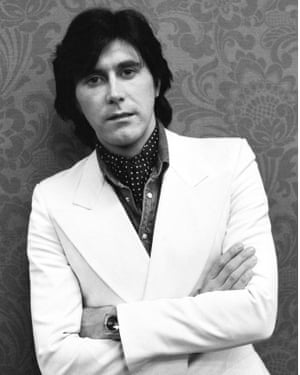
With their thrillingly strange 1972 debut, Roxy Music announced themselves as a band that were unlike anyone else. The singer looks back at how they created a new kind of music – out of Stax, oboes and Marilyn Monroe.
ore than 45 years ago, a new group released their first album. They didn’t wear denim, nor had they, apparently, paid their dues. Indeed, their heavily stylised presentation – a model posed archly on the cover in a 1950s pastiche, the musicians inside clad in leopardskin and leather with styled quiffs – could not have been more opposed to the rock modes of the day. “Is this a recording session or a cocktail party?” inquired Ferry’s friend Simon Puxley in the liner notes. Before you even got to the music, the record cover was a gauntlet thrown down – an explosion of glamour in a wasteland of faded blue cotton.
“The clothes we were wearing at that time would have put off quite a large chunk of people,” reflects Bryan Ferry. “What I liked about the American bands, the Stax label and Motown, they were into presentation and show business, mohair suits, quite slick. And the cover art, I thought of all the American pop culture icons, Marilyn Monroe: selling cigarettes or beer with a glamorous image. But it was a bit off-kilter as well; there was something a bit strange about it, futuristic as well as retro. All that, instead of a picture of the band, in a dreary street, looking rather sullen. Which was the norm.”
The music inside lived up to the cover’s challenge: a collage of pop-culture nostalgia, hard-rock guitar, piano-driven melodies, stylised high vocals, strange musical structures and experimental sound pictures. Roxy Music’s eponymous album sounded like nothing else in 1971 and 1972 – and like nothing else the group would ever attempt again. Recorded in the first full flush of inspiration, songs such as Ladytron, The Bob (Medley), and Sea Breezes exist outside of their time: a radical synthesis that mapped the future at the same time as it plundered the past.
“We were definitely trying to show our versatility,” says Ferry now. “I had lots of musical influences, plus what the band brought to the table.” Lead guitarist Phil Manzanera, he says, “had this Latin heritage, being born in South America”. Saxophone and oboe player Andy Mackay was classically trained. “[Brian] Eno with his deep interest in experimental music. They were specialists in their field. Paul Thompson brought a lot, with his very powerful, earthy drumming, which was one of the features of the Velvet Underground.”
Ferry is talking in his west-London studio. We walk past repeated Warhol Marilyns and sit under a large print of Jerry Hall on the north coast of Anglesey, the cover for Roxy Music’s fifth album, Siren. Wearing a blue jacket, V-neck pullover and tie, Ferry is measured, at once diffident and supremely assured. At 72, he looks great. “The only bit I don’t like is analysing it,” he says of his work. “I do sometimes envy the people who don’t ever have to describe what they’re doing.”
Despite its age and apparent familiarity, Roxy Music’s debut remains thrillingly strange. A new reissue, eight years in the making, traces the development of this revolutionary record that seemingly arrived out of nowhere in June 1972. Combined with the group’s first, 1971 demos, three 1972 John Peel sessions and album outtakes, the songs that would populate Roxy Music come into focus as the bold, honed culmination of lifelong fixations.
Growing up in Washington, County Durham during the monochrome 1950s, Ferry found a lifeline and an inspiration: “I loved American music,” he says. ““From the age of about 10, every week you’d discover somebody new. I was very much into jazz. You know how English people are; there’s a certain amount of musical snobbery. I mean, I loved Little Richard and Fats Domino, but when I heard Charlie Parker for the first time, this was something I really loved, and nobody else who I knew knew anything about him. It’s good to have your private obsessions.”
As a paperboy delivering newspapers and weekly music magazines, Ferry read about more music than he could actually hear. “There wasn’t a great deal of jazz on radio. Radio Luxembourg was very important for emerging pop and soul. The BBC had one or two programmes. When the skiffle thing happened, that was when you started hearing Leadbelly and Big Bill Broonzy. That intensity of feeling; that’s what I got, hearing Leadbelly with a 12-string guitar, that yearning in his voice, it struck such a magical chord in me.”
He had similar revelations from hearing Lotte Lenya singing the songs of her husband Kurt Weill and the German soprano Elizabeth Schwarzkopf singing Richard Strauss’s Four Last Songs, He loved the beat poets, TS Eliot and American show tunes. “I liked Fred Astaire, Cole Porter, and I’d hear those songs played by Charlie Parker, Lester Young, Billie Holiday. There was a music store in Newcastle where you could go into a booth and listen to stuff. I lived in there.”
While in the sixth form at Washington Grammar, Ferry joined a group called the Banshees, who played R&B in the local clubs – including the famous Club A Go Go that had provided the launch pad for the Animals. In autumn 1964, he entered the fine art department of Newcastle University, where he was inspired by the British pop-artist Richard Hamilton and Warhol associate Mark Lancaster. After completing his degree, Ferry moved to London, where he supported himself by teaching art and ceramics at a Hammersmith school.
Roxy Music began in the late 1960s, after this move to the capital. Having sung R&B and soul with groups such as the Gas Board and the City Blues, he began to pursue the idea of striking out on his own. “In my college band, I had been imitating whichever song I was singing. We used to do quite obscure covers – Bobby Bland, BB King – but by the time I was writing my own songs, I didn’t want to sound too American. At the time, most English bands tried to sound American. Except for people like King Crimson. They had an English voice, which was quite interesting.”
He was convinced that he could start his own band. “First of all, [it was] just me and Graham [Simpson], the bass player. He had been in my college band. He was a very cool guy, into the beat poets, had a huge jazz collection, all those Blue Note records. He was one of the most interesting people in the band, actually. Sardonic sense of humour. Then Mackay, next, then Eno.”
Each new addition brought an element that enabled the new group’s individuality. “The oboe was Andy Mackay’s first instrument, his main thing, although he developed into a great sax player. I met Andy because he had a synthesiser. So Andy brought a) the synthesiser and b) the oboe. Eno, of course, manipulated the synth in the band as soon as he joined, really. Those textures: the oboe is very precise, and the synth sounds were washes, colours, textures, mood enhancers, and so on. So, yes, it was a key part of the sound.”
Together with first guitarist Roger Bunn and drummer Dexter Lloyd, Roxy Music recorded their first demos in May 1971, early versions of The Bob (Medley), Grey Lagoons, 2HB, Chance Meeting and Ladytron. “They were all done in Eno’s flat in Camberwell, which is where we ended up doing a lot of rehearsals. There was a derelict house off Portobello Road where we went as well. That’s when it started. I thought of nothing else, I was quite driven to make it all happen. I would carry the tape around to record labels on my days off from teaching.”
A key early supporter was Richard Williams, who featured the group in Melody Maker during August 1971 before they had any whiff of record company interest. Williams had written glowing and informed reviews of, among other things, the recently reissued first three Velvet Underground albums, which piqued Ferry’s attention. “I always seemed to agree with his taste. So I thought, if anyone is going to like my music, it’s going to be this guy, so I sent him the tape. And he phoned me the same day to say how much he liked it.”
Slowly Roxy Music came into their time. With their Velvet Underground influence, they were tapping into similar sources to David Bowie. But the connections went deeper, into the Warholian fusion of pop and art – an approach prompted by Ferry’s friendship with Lancaster, who had worked in the Factory as a screen-printer in the mid-60s. “He was a really influential guy for me. He was the link between us and Richard Hamilton. All of those people were very influential, working with pop imagery.”
It was Roxy Music’s explicit intention to dissolve the boundaries between high and low. As Michael Bracewell writes in Re-make/Re-model, his account of the group’s founding years, “they chose to inhabit the point where fine art and the avant garde met the vivacity of pop and fashion as an almost elemental force in modern society”.
Produced by King Crimson lyricist Pete Sinfield, Roxy Music came together over two weeks in March 1972. The range of material is extraordinary: almost every song contains sudden twists and turns, like the galloping Joe Meek-style descent that comes out of nowhere in Ladytron. The opener, Re-Make/Re-Model, begins in party noises and breaks into brief, emblematic solos from each instrument. In Sea Breezes, synthesiser washes introduce a heartfelt torch song, which then segues into a strangulated guitar part: next up is the cocktail doo-wop of the tart album closer Bitters End.
“A lot of the first album is first or second take,” Ferry remembers. “Thinking about the songs, some of them are collage-like, with different sounds and moods within them – they will change abruptly into something else. For instance, Sea Breezes is a slow song, and suddenly moves into this angular, quite opposite mood. I found that interesting, and this band was perfect for that; they were game for anything. We were constantly fiddling around, changing things. I was still trying to find my voice. I [now] think sometimes I’m singing too high, or I should have had another go at that.”
It would have been easy to write Roxy Music off as pastiche – as a few die-hard hippies did at the time – but the feeling is authentic: the love, loss and regret in songs such as If There is Something, Sea Breezes and The Bob (Medley). It’s an album of chance encounters and wistful, evasive memories. “On one hand, you try to shape the emotion, but you’ve got to feel it,” says Ferry, “you don’t analyse as you’re doing it.”
Released in the same week as Ziggy Stardust and the Spiders From Mars, Roxy Music entered the UK album charts in late July 1972. Within a month, the group’s first single, Virginia Plain, which wasn’t on the album, was on its way to the Top 10 (it reached No 4). Referencing an art college painting by Ferry, it distilled Roxy’s art-pop manifesto, “what’s real and what’s make-believe”. “It is much more confident,” Ferry says. “We’d made an album and we knew how to do it – sort of. Everyone was featured. It had oboe, the synth, the drums are powerful, and the lyrics were much more assured. I was still finding my feet as a songwriter.”
Roxy Music had no sense that the album would reach a mainstream audience. “We thought art students; people like us; limited interest; underground. Coming overground was … interesting.” When did he realised Roxy Music were really taking off? “I suppose when I heard Virginia Plain on midday radio. When the record came out, we were still playing tiny places – driving up to Scarborough or somewhere to play in a club. Hearing Virginia Plain on daytime radio, that felt like … something. Or seeing this album filling the record store window in King’s Road, which is where we went to the manager’s HQ. That was quite moving for me. Walking past, at night, and they’d just filled the window, I couldn’t believe it. It was so great, seeing the image repeated.”
Like a Warhol, you mean? “Exactly, yeah.”
Roxy Music: 45th Anniversary Super Deluxe Edition is out now on Universal (£130). A 2-CD version is also available (£20)
Jesse Marchant, used to be better known by his stage name JBM, this Canadian singer-songwriter.
JBM’s music has been desribed as instilling a “unique depth of emotion and feeling.” American Songwriter magazine wrote that there was a “level of peace and of stillness unique to a church” in Marchant’s debut album and that his music “feels like one man’s soft, musical prayer for hope in a world that too often has too little,” and she compared his style to Thom Yorke and Neil Young. JBM’s song “Ambitions & War” was described as a “honey-of-a-song” in Future Sounds magazine, with lyrics about a person who is losing their mind in Los Angeles.
His songs are “mostly acoustic venture” with atmospheric arrangements, lyrical purity and unaffected baritone.” with heartfelt compositions reflecting “a meticulous and carefully crafted sound.
Somber, melancholy, moody, dark, sad. Pick a descriptor and it easily fits on Jesse Marchant‘s new album, Illusion of Love. Even the album’s title, which suggests love is merely an illusion gives you the idea that rainbows never appear after the storms in these songs. Marchant has always been adept at tugging audiences’ heartstrings going back as far as when we knew him just as JBM.
Though it is his fourth album, Jesse Marchant’s Illusion of Lovemay end up being a dazzling introduction to his work for many new listeners. This is first and foremost because after you’ve heard it, you simply cannot forget it. But it’s also because there’s something emergent about this record, like Marchant is coming out of his shell for the first time. And while you’ll hear remnants of Jim James in Marchant’s hauntingly beautiful vocals,
“Illusion Of Love” opens up with the plaintive All These Kids I Never Knew, a tune that see Marchant sitting alone at a piano recalling the recent atrocities. It is a heavy tune and a beautiful tune. Also a bold choice on how to open the album but it works.
Jesse Marchant’s voice reminds me of Jim James on the track and another reserved track, I’ve Got Friends. The track has a tasty understated guitar lick and is surrounded by synths and strings as Marchant examines our need to share every last facet of our lives on social media.
That’s not to say that the album doesn’t get the blood flowing either. Tunes like 6&5, Nightships and the lead single all boogie with guitar riffs that range in inspiration. Illusion Of Love is Jesse Marchant’s 4th album, This album’s genesis was a nasty bike accident in Brooklyn, that Marchant termed as an awakening.
Ty Segall has been all over our radar recently, but that’s only because the man seriously rocks. The multi-instrumentalist from Laguna Beach, California., made his Jimmy Kimmel Live! debut last night, joined by his Freedom Band: Mikal Cronin, Charles Moothart, Emmett Kelly and Ben Boye. Segall played two songs on JimmyKimmel, a cover of Hot Chocolate’s Every 1’s a Winner” and a web-exclusive performance of “Despoiler Of Cadaver,” off his new album Freedom’s Goblin.
Freedom’s Goblin’s release was last Friday, the album “a testament not only to the vision of Ty Segall, but to the work he’s put in over the past 10 years.” The album has already been cited as among the best for this year of 2018.
Segall will go on an extensive would tour with the Freedom Band in support of his new album. The group will make their way through Japan before starting their month-long tour of North America in beautiful Honolulu, Hawaii, ending their stay in North America at Berkley, Calif.’s UC Theatre. New dates have been added to the band’s tour, taking them through Europe and the U.K.—find their full tour slate below. You can stream Freedom’s Goblin via Apple Music here and purchase the new album, out now through Drag City Records, here.
Watch Segall perform “Every 1’s a Winner” and “Despoiler Of Cadaver” on Jimmy Kimmel Live!