Bear’s Den announce third album with two new tracks “Fuel on the Fire” and “Blankets of Sorrow”. London-based duoBear’s Denreturn with their first new material in over two years, after 2016’s “Berlin” single, and their 2016 sophomore record Red Earth & Pouring Rain. Bear’s Den’s third album So that you might hear me, which was recorded across multiple studios in Seattle with the help of producer Phil Ek (The Shins, Fleet Foxes, Father John Misty), and mixing master Craig Silvey (Arcade Fire, Metronomy).
We wanted to let you know that we’ve been working on a podcast with our friend Danny Carissimi, where we discuss our new album and our experiences recording it in some depth.
Man are a rock band from South Wales whose style is a mixture of American West coast psychedelia, progressive rock, and blues. Formed in November 1968 as a reincarnation of Welsh rock harmony group ‘The Bystanders’, Man are renowned for the extended jams in their live performances
Man evolved out of The Bystanders, formed in 1962 The Bystanders included Owen Money, then known as Gerry Braden,but he was replaced by Vic Oakley, giving the classic line-up of Vic Oakley (vocals), Micky Jones (guitar), Clive John aka Clint Space (keyboards), Ray Williams (bass) and Jeff Jones (drums). By 1968 the other members wanted to change musical direction to a more psychedelic/American west-coast guitar sound, so Oakley left, to be replaced by Deke Leonard and the band changed its name to Man.
With the tribulations of the 20-odd musicians who have at various times been through Man, and dissections of their 13 official studio albums (or around 45 if you include compilations and live recordings). Not too long ago it was calculated that their had been 17 different lineups had played 7,601 gigs, travelled 1,200,000 miles, blown 161 amplifiers, crossed 330 borders in and out of 17 countries, slept with 4,163 women, smoked 16,000 packets of Rizla papers and stayed in 6,424 hotels – and had been ejected from only 32 of those. They also managed to spend more than £200 on clothes.
Until recently the one strand of consistency in this tale was lead guitarist Micky Jones, who played in every line-up of Man. Besides a tendency for members to leave and persistently return, what makes Man’s history more unique still is that the responsibility of leadership has been rotated, and at least three of their members have assumed creative control, with others standing aside or departing – and sometimes coming back. For the first few albums it fell to keyboard player/guitarist Clive John to galvanise the band, before the baton was passed on to Deke Leonard, and it is now in the hands of Martin Ace.
Man were initially signed to Pye Records, for whom they recorded their first two albums with John Schroeder producing Revelation (January 1969) and Man wanted to name their follow-up Spunk Rock, but the label flatly refused, so it was entitled 2 Ozs of Plastic with a Hole in the Middle (September 1969). Whilst mixing the second album, DekeLeonard left, and was replaced by Martin Ace.
Their manager, Barrie Marshall, obtained a new record contract with Andrew Lauder of United Artists Records, for whom the band recorded the eponymous Man (March 1971) album, which received mixed reviews. Their media break came when outperforming Soft Machine, Yes and Family at a concert in Berlin, Having appeared on the United Artists double sampler album, All Good Clean Fun (1971).
The band’s breakthrough record was Do You Like It Here Now, Are You Settling In? For all their upward mobility, a laidback attitude remained. Martin Ace can be heard slurping from a can of cider during the song Manillo, recorded at Rockfield Studios it received good reviews. Constant touring was creating internal pressures, and in January 1972, keyboardist Clive John left the band, to form ‘Iowerth Pritchardand the Neutrons‘ with Phil Ryan and Will Youatt (1950-2017).
The new four piece supported Hawkwind and Brinsley Schwarz at a charity gig at The Roundhouse on 13th February 1972, recorded and issued as “Greasy Truckers Party” (with other artists, April 1972), a limited edition double album which rapidly became a collectors’ item.United Artists’ A&R man, Andrew Lauder, persuaded them to follow this up with a live album. Live at the Padget Rooms, Penarth was recorded on 8th April 1972. It was sold at a reduced price and only 8000 copies were pressed, which sold out in a week, making it No 1 in the “budget” album chart.
The band then tried to write a new studio album, but lacked inspiration. Bassist Martin Ace left, to form ‘The Flying Aces’, with his wife George, so Micky Jones and Terry Williams sacked Leonard, and keyboardist Clive John rejoined together with his new band members, Ryan (keyboards) and Youatt (bass). The new band recorded the first of Man’s three Peel Sessions on 29th August 1972, (the others being 18th September 1973 & 31st October 1974).
They then recorded Be Good to Yourself at Least Once a Day (November 1972) which received good reviews. A party on 19th December 1972, with Dave Edmunds, Help Yourself, The Flying Aces and others, was issued as Christmas at the Patti (July 1973), a double 10″ album, which again topped the “budget” album chart, but on tour keyboardist Clive John fell out with guitarist Micky Jones, and left the band again.
The four-piece started to record Back into the Future (September 1973), but felt the need for a second guitarist, so Alan “Tweke” Lewis joined from Clive Bunker’s ‘Wild Turkey’. On 24 June 1973 they recorded the live half of this double album at Man’s spiritual London home, The Roundhouse, backed by the Gwalia Male Choir, who had previously sung with Man at The Oval, when they supported Frank Zappa. The album initially sold well, and again, this was tipped to be album that would make the band, but pressing was restricted by a lack of plastic during the oil crisis. The follow-up tour had Deke Leonard’s ‘Iceberg’ as support. During the tour, Micky Jones and Leonard discussed a new Man line-up, so when Ryan and Youatt left to form ‘The Neutrons’ in December 1973, Leonard disbanded his band Iceberg and rejoined Man along with two former members of Help Yourself; Malcolm Morley (keyboards) and Ken Whaley (bass).
Leonard was back again for 1974’s next album Rhinos, Winos and Lunatics (May 1974) was produced by Roy Thomas Baker, noted for his work with Queen, and spent 4 weeks in the UK album chart, Morley left the day before recording started on the next album Slow Motion (October 1974). Before the album was released, the band toured the UK (again with Badfinger). Leonard: “Each time we gained momentum, a break-up seemed to be just around the corner. Barry [Marshall, manager] always used to dread calls from some ghastly place in Germany saying it had happened again. But he gave us enough rope to hang ourselves – and we duly obliged on a regular basis.”
The constant line-up changes and a strong internal rivalry were also hindrances. “I’ve been sacked by every member of the Man band at some point,” Leonard volunteers cheerily, “but they always found out that they couldn’t do it without me and had to invite me back.”
Pruned to a four-piece by the departure of guitarist/keyboard player Malcolm Morley for the self-produced Slow Motion album, the band were rejoined by Ace midway through a US tour with English folkies The Strawbs. It was during this trip that they met their hero John Cipollina, the (now long-deceased) guitarist with vintage San Francisco acid-rockers Quicksilver Messenger Service, who agreed to join Man for a tour of Britain.
They returned to the US in March 1975, but the tour collapsed on the first night. A new US tour, with REO Speedwagon and Blue Öyster Cult broke up two-thirds of the way through. Additional dates were arranged, but most were cancelled when MickyJones developed pneumonia, so the final gigs were to be at the San Francisco Winterland. These were a great success, and promoter Bill Graham paid them a bonus, and rebooked them, but bassist Ken Whaley had had enough, and left. Martin Ace flew out as a stand in, and the band met and rehearsed with JohnCipollina of Quicksilver Messenger Service, who played with them at Winterland, and agreed to play a UK tour.
On this tour, the Roundhouse gig was recorded for commercial release, and although Buckley and Ellingham state that it is rumoured that Micky Jones had to over-dub Cipollina’s guitar,it was only the track “Bananas” on which his playing was replaced: “Everything on Maximum Darkness which sounds like Cipollina is Cipollina“, per Deke Leonard.The album Maximum Darkness (September 1975) Martin Ace continued as “stand in” bassist, until the end of a French tour, with Hawkwind, Gong and Magma, when he returned to the ‘Flying Aces’.
The band changed label to MCA Records, Phil Ryan rejoined on keyboards, but as no bass players they knew were available, the band had to audition for the first time in their history. Auditions went badly, until the final audition, of John McKenzie of Global Village Trucking Company, who was immediately offered the job.
They then recorded The Welsh Connection (March 1976). With Ace departing again and just two songs finished Man were in the shit. Oddly enough, given that Leonard and keyboard player Phil Ryan were jostling for control, the record ended up being a concise and reigned-in collection of songs. It was only when Ryan “threw his piano” at Leonard while preparing a follow-up that the band realised they’d run aground. “I wasn’t in the band back then, but my understanding is that everyone thought they could do a better job than everyone else,” Ace offers. During the US tour differences arose again, and on the subsequent European tour keyboardist Phil Ryan and bassist John McKenzie announced they would be leaving, and the rest of the band agreed to call it a day. The MCA record deal, however, was for three albums, but nobody was willing to contribute new material, and their attempts at covers were poor, so MCA eventually agreed to a live farewell album. All’s Well That Ends Well (November 1977) was recorded at the Roundhouse on 11th–13th December.
“We’d spent seven years either on the road or in the studio. The weight of it all had been building up,” Leonard says. On his reason for leaving Man in the spring of 2004 to revive Iceberg, Leonard deadpans simply: “I felt the need to make a futile gesture.” A frequent broadcaster on Radio Wales, his uproariously funny novels Rhinos,Winos & Lunatics and Maybe I Should’ve Stayed In Bed have both received rave reviews. The first two albums represent space rock at its best, and the latter one shows a more structured approach yet some of their finest songwriting is on that album. However, space rock fiends cannot go wrong with their original 1969-1977 run of albums.
“In Search of the Miraculous” is the third album from much-loved indie goth dreamboats Desperate Journalist and follows the bands critically acclaimed album Grow Up. If the title conveys a sense of wide- eyed ambition then the music on In Search Of The Miraculous fits the plot perfectly, featuring ten tracks fizzing with creative passion, giant choruses, heroic solos and poetic intensity.
Warning: this album contains love songs, anti-love songs and other songs wandering about, lost in an in-between-daze. It’s a bit complicated. Boasting one of the most inspired band names of recent times, the quartet take their moniker from a 1979 John Peel Session track by The Cure. If you ever wondered what Harriet Wheeler from the Sundays would sound like fronting a rawer version of the Smiths or the Cocteau Twins with energy and a shimmering indie edge, then Desperate Journalist is a must hear.
‘Satellite’ is the second single taken from the LP ‘In Search of the Miraculous’, out on 22nd February 2019 on Fierce Panda Records
Band Members
Jo Bevan – Vocals,
Simon Drowner – Bass,
Rob Hardy – Guitar,
Caz Hellbent – Drums
I have followed the chameleon like career of Beth Jeans Houghton with great interest ever since seeing her Hooves Of Destiny shows at the Musician in Leicester few years ago. Since then after the Hooves of Destiny and, more recently, comes the Du Blonde moniker – complete with an altogether heavier, grittier sound.
Du Blonde may sound like a band, but in fact it is, and always has been, the work of just one person. Beth Jeans Houghton. Her new album “Lung Bread For Daddy” delves even deeper into self sufficiency, seeing Beth take the reigns on production, instrumentation, album artwork and direction of music videos. This project is entirely her own. Lung Bread For Daddy sees a meeting in which Beth’s previous two albums, 2015’s Welcome Back To Milk and her debut Yours Truly, Cellophane Nose, take a seat at the table and make amends. Veering wildly between proto-punk, psych rock and the wholesome song writing of the 1970’s, taking the listener on a journey through the landscape of her past. It is an honest and often uncomfortable look into the life of a person who’s experiences have been touched by a myriad of characters, homes across continents, periods of extreme loneliness, mental illness and a search for an understanding of personal identity. Houghton’s insatiable thirst for creation on her own terms has seen her take charge of every aspect of Lung Bread For Daddy including the brutal self portrait that adorns the cover of this record. Painted from a photograph taken during one of her lowest points, the image depicts Beth devoid not only of makeup, but self worth and confidence.
She will be releasing her second album as Du Blonde titled Lung Bread For Daddy via Moshi Moshi Records on the 22nd February, and it is described as a meeting in which her previous two albums, 2015’s Welcome Back To Milkand her debutYours Truly, Cellophane Nose, take a seat at the table and make amends.
The first single is the autobiographical Angel, referencing the end of a relationship with someone who promises a lot, but delivers very little. Angel by Du Blonde (aka Beth Jeans Houghton). Taken from her new album ‘Lung Bread For Daddy’ out on Moshi Moshi on 22nd February
Coming up on February 22nd! The Flamin’ Groovies: “Gonna Rock Tonite!”The Complete Recordings 1969-71 is a 3CD clamshell box set reissue of three peerless albums – ‘Supersnazz’, ‘Flamingo’ and ‘Teenage Head’ – taken from the original master tapes and embellished with bonus outtakes, alternative versions and single mixes!
Irrespective of musical direction, sales figures or personnel changes, The Flamin’ Groovies have always had greatness attached to their name. Cyril Jordan’s mid-Seventies revamp of the band was certainly a huge influence on entire generations of skinny-tied power poppers, but the Groovies took their first tentative steps on the long and winding road to cult stardom back in the late Sixties, when lead singer, original band leader and rock’n’roll aficionado Roy Loney battled for the upper hand with young pup and Beatles obsessive Jordan.
After the tentative, privately-issued 10” mini-album debut Sneakers, TheGroovies made the transition from San Francisco also-rans to genuine contenders with a trio of peerless albums – Supersnazz, Flamingo and the particularly magnificent Teenage Head – for major labels (Columbia’s Epic imprint and Buddah subsidiary Kama Sutra). Bolstered by sundry outtakes, alternative versions and single mixes, those three albums now appear under one roof for the first time with Gonna Rock Tonite!, a complete anthology of the band’s studio work during the pivotal 1969-71 timeframe: halcyon days that ended in late 1971 when Loney abruptly quit the group he’d formed just a few short years earlier.
Bursting with creative tension, wilful diversity and absurdist wit, Gonna Rock Tonite!climaxes with the classic albumTeenage Head, a brazen attempt to out-Stone the Stones that saw one critic describe it at the time of its mid-1971 appearance as “close to being the best hard rock album ever released by an American group”. The definitive issue of these definitive recordings, Gonna Rock Tonite! is a 3-CD set taken from the masters and housed in a striking clamshell box. It includes a 20-page booklet that also features a new 7,500 word essay on the band.
In January 1983, David Bowie invited Stevie Ray Vaughan to record guitar for six new tracks he’d written for his upcoming album, “Let s Dance”. Vaughan’s powerful and unique guitar work brought a fresh sound to Bowie’s music, most famously on songs like China Girl and the record s title track. With the album a success, Bowie was keen for Vaughan to join his group for the subsequent “Serious Moonlight Tour”. However, with Vaughan reluctant to leave his own band Double Trouble (who had just finished recording their debut album, “Texas Flood”), David’s management offered to let the group open the show on select tour dates. However, just four days before the tour began, Bowie’s team reneged, telling Vaughan’s manager, Chesley Millikin,that the band would not be included and, furthermore, Vaughan wasn’t allowed to talk about the group or its new record in interviews. With the offer pulled, Milikin understandably took Vaughan off the tour. And although both artists still achieved huge critical and commercial success during the 1980s, what they might have gone on to do together remains one of rock’s great “What Ifs”. No video footage of Bowie and Vaughan performing together is known to exist. However, rehearsals for the tour, which took place at the Las Colinas Soundstage in Dallas – Stevie Ray’s hometown – on 26th April 1983, were not only recorded but broadcast on local radio too, thus allowing these legendary sessions to be heard again today.
This is interesting to hear the clever musical arrangements particularly the crisp horn sounds and backing vocals. Stevie Ray Vaughan played guitar here and was due to be a part of the touring band. His contributions are pretty much what you’d expect rather than anything fiery or super- inventive. Bowie and the backing singers make some mistakes particularly Life on Mars, Golden Years and Red Sails, on which Bowie seems to be trying to find the correct voice.
It’s a must-have for fans but please be aware that 132 minutes were broadcast.
Stevie Ray Vaughan and David Bowie live 1983 rehearsal broadcast for the Serious Moonlight Tour! From An FM Radio Broadcast Recorded At The Las Calinas Soundstage, Dallas, TX, 26th April 1983. 19 tracks total including China Girland Let’s Dance.
Lily and Madeleine Jurkiewicz create candid music with deep emotional and personal resonance. The sisters, who record under the moniker Lily and Madeleine, boldly explore what it means to be women in the 21st century, and aren’t afraid to use their music to call out injustice or double standards. This fearless approach has permeated their three albums, which are full of insightful lyrics and thoughtful indie-pop. But with their fourth studio album, Canterbury Girls – named after Canterbury Park, located in their hometown of Indianapolis – the sisters are coming into their own as women and musicians.
Using an eclectic playlist of songs as sonic inspirations – soul tunes and waltzes, as well as cuts from Midlake, ABBA and Nancy Wilson – Lily and Madeleine worked quickly, recording Canterbury Girls in just 10 days. Although the record contains plenty of Lily and Madeleine’s usual ornate music—including the languid Analog Love, on which twangy guitars curl around like a kite twisting in the wind – the album also finds the siblings exploring new sonic vistas. Supernatural Sadness is an irresistible slice of bubbly, easy-going disco-pop; the urgent Pachinko Song hews toward interstellar synth-pop with driving rhythms, and Can’t Help The Way I Feel is an effervescent, Motown-inflected number. Vocally, the sisters also take giant leaps forward. The dreamy waltz Self Care is a rich, piano-heavy track on which their voices intertwine for soulful harmonies, while the meticulous Just Do It has a throwback, ‘70s R&B vibe.
From the new album ‘Canterbury Girls,’ available February 22nd, 2019:
R. Stevie moore is the curmudgeonly, misanthropic pioneer of lo-fi and DIY music. His prolificacy puts the likes of Robert Pollard to shame with over 200 self-released albums and 30-odd official releases. He has been working away at his craft, mostly unnoticed, for over 50 years.
Since R Stevie Moore can’t make a decent living on his music, he’s trying to accomplish the task in the Afterlife. This album is an upgrade from the lo-fi, damaged-equipment home recording process for which RSM has become legendary. With a career-long sweep, R Stevie took some of his best home-recorded lo-fi songs and re-recorded them with full-studio sparkle. All recordings were made in the past 15 years, with tracks captured in five U.S. states. Some compositions date from the 1970s to the 1990s, and there’s a few newer tunes. The album lacks one thing: filler. Afterlife is R Stevie’s Loaded—an album full of hits. He’s walking away with a cane, a bum knee, and cataracts.
Afterlife was compiled and produced by Irwin Chusid (who oversees the musical estates of Sun Ra, Raymond Scott, and others). Chusid, a WFMU DJ since 1975, has been a compatriot of RSM since they met in 1978 after R. Stevie relocated to New Jersey from his native Nashville (to which he returned in 2010). It’s often been pointed out that RSM’s daddy Bob played bass with Elvis. But we won’t dwell on that here. Afterlife features sideman work by Ariel Pink, Jason Falkner, Lane Steinberg, and Chusid. It was mastered by veteran producer-musician Kramer (who has previously recorded with RSM).
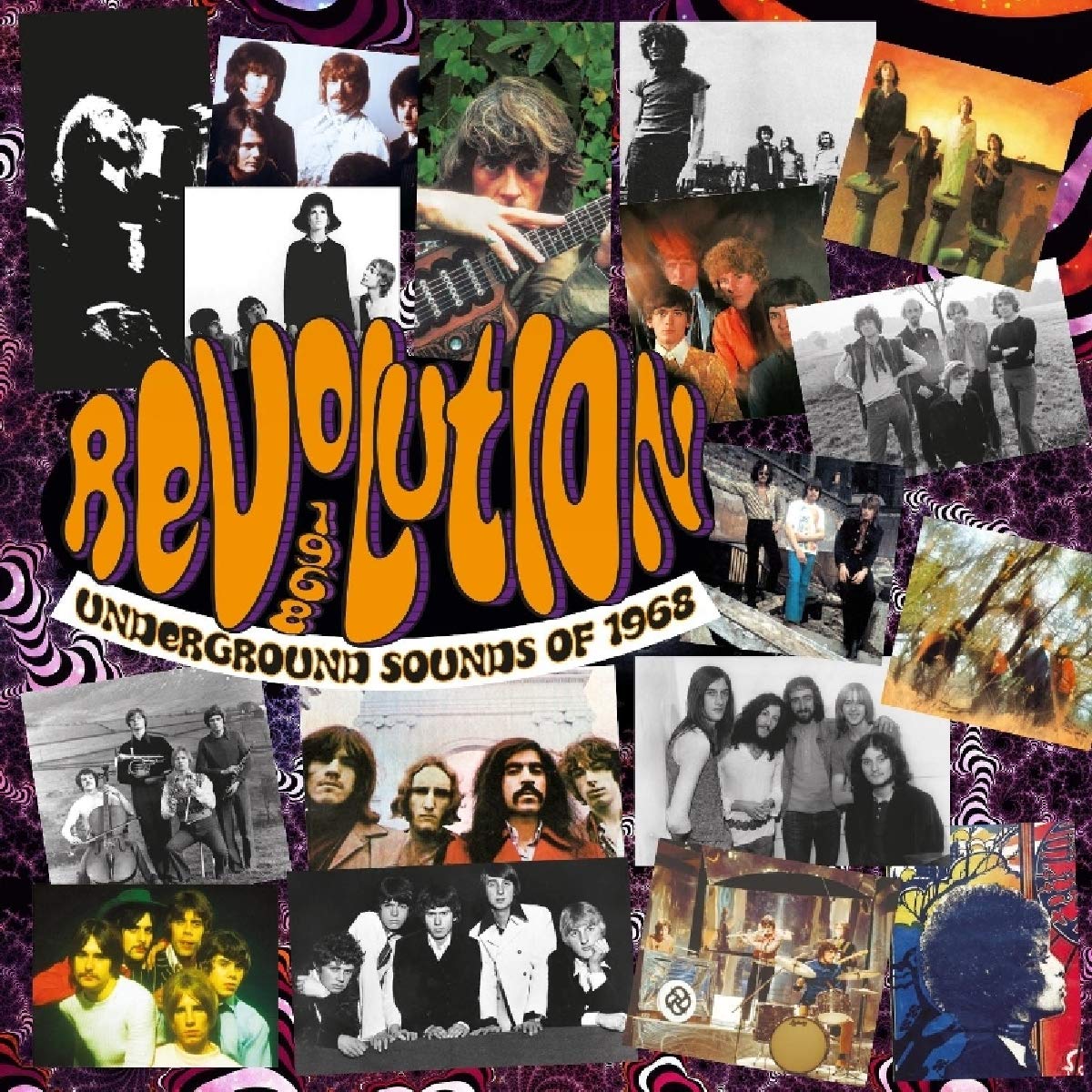
This new 3 CD Re-Mastered Box Set Celebrating The Musical sounds of the so called British “UNDERGROUND” Rock Music Of 1968. featuring tracks by Deep Purple, Jethro Tull, Barclay James Harvest, Julie Driscoll, Brain Auger & The Trinity, Spooky Tooth, Traffic, The Move, Crazy World Of Arthur Brown, Van Der Graaf Generator, Procul Harum, Genesis, Caravan, Jeff Beck, Pretty Things, The Incredible String Band, Tomorrow.
Esoteric Recordings are pleased to announce the release of “Revolution – Underground Sounds of 1968”, a 3CD clamshell boxed set celebrating the so-called “underground” rock music 1968, a year that saw huge changes, both musical and social. 1968 was a pivotal year for creativity in British rock, beginning with some influences of psychedelia still present in work by ground-breaking artists such as Pretty Things, Tomorrow, Incredible String Band, Idle Race, Traffic and The Move, but gradually giving way to styles influenced by jazz, blues, folk and more that would eventually become termed as “progressive”, “folk-rock” and “hard” rock, all of which championed by “underground” figures of the day such as DJ John Peel on his BBC Radio One show Top Gear and by publications such as International Times and Oz.The common thread among all of these artists was an emphasis on experimentation and a desire to push the perceived boundaries of popular music. It was also a year that would see the very first record releases by bands that would go on to achieve success and influence in the 1970s such as Deep Purple, Jethro Tull, Barclay James Harvest, Genesis, Status Quo, Van Der Graaf Generator and Caravan. Aside from featuring better known acts such as Crazy World of Arthur Brown, Procol Harum and Pentangle, this compilation also features lesser known acts.
The common thread among all of these artists was an emphasis on experimentation and a desire to push the perceived boundaries of popular music. It was also a year that would see the very first record releases by bands that would go on to achieve success and influence in the 1970s such as Deep Purple, Jethro Tull, Barclay James Harvest,Genesis, Status Quo, Van Der Graaf Generator and Caravan. Aside from featuring better known acts such as Crazy World of Arthur Brown, Procol Harum and Pentangle, this compilation also features lesser known acts that produced work of a wide breadth such as Eyes of Blue, Love Sculpture, The Action, Dantalian’s Chariot,Elmer Gantry’s Velvet Opera, Gun, Second Hand, The Moles and Blonde on Blonde.
This collection celebrates a creative period when rock music was evolving into something altogether more serious, moving away from the single as medium to give way to the dominance of the album. Feed your head with Revolution – Underground Sounds of 1968.
More stunning live material to come out of the vaults...Ian Curtis, Peter Hook and company recorded this live at the legendary Les Bains Douches in Paris on December 18th, 1979. Containing great versions of Love Will Tear Us Apart, Shadowplay, Atmosphere, Transmission, and more, this is one of the most classic live sets of the group’s storied career.
In January of 1980 Joy Division kicked off a tour of The Netherlands, Belgium, and Germany with a show at the legendary Paradiso Club in Amsterdam. Little did anyone know that in less than 6 months, Ian Curtis would be dead, and the brief, brilliant run of the group would be over. This is a particularly heavy and deep set, with the band performing at their angular best, and Curtis in top form vocally. Essential live broadcast for any fan of Joy Division.
If you are not already acquainted with this gig at Paradiso in Amsterdam in 1980. Here’s some info from a blog. “The local support didn’t want to play so Joy Division stood in for them. They played two completely different sets for the price of one.” And how it was described in a fanzine at the time: ‘When I arrived at the Paradiso, it appeared that most of the regular visitors had decided to stay at home.
So the JOY DIVISION played for a handful of people only, two long sets, together around 70 minutes of excellent music. At that time only the first album and two singles had been released, so they played a lot of new songs that went down well with the small audience. The gig was (along with the PIL-gig in Bruxelles) the best I have ever seen. Fantastic bass playing by Peter Hook and a strained Ian Curtis. The Paradiso management had lowered the ceiling to make things more intimate. It was a good idea. Shame to all the people who stayed at home’ SJC This is the most bootlegged live Joy Division show, but I’m not sure any of the bootlegs have sound this good. If they do, I certainly want to snag a copy.
Check the intensity on the live versions of tracks like “Transmission,” “Digital,” and “Disorder,” plus “A Means To An End,” “These Days,” and the timeless “Love Will Tear Us Apart.”
The British group Joy Division wrote and recorded 43 songs and played over 120 shows in just 29 months between 1978 and 1980.