The Baseball Project ((Steve Wynn, Mike Mills, Scott McCaughey, Linda Pittmon) performed The Kinks ‘Lola’ as part of the Wild Honey Orchestra performing ‘The Kinks Are The Village Green Appreciation Society’ album & other Kinks classics at the Alex Theatre in Glendale, CA, alongside many other guests.
R.E.M. were known to cover Kinks songs such as ‘Tired Of Waiting For You’ back in the day….
Wynn and drummer Linda Pitmon came to Portland for the sessions, by which point they’d written 16 baseball songs between them. That’s when they reached out to R.E.M. guitarist Peter Buck. He and McCaughey have shared a lot of history these past few decades.
Buck has been a fairly steady member of McCaughey’sthe Minus 5 since 1993. And McCaughey was an R.E.M. sideman from 1994 until the breakup in 2011, playing on every R.E.M. release from “New Adventures in Hi-Fi” to “Collapse into Now.”
“We drafted Peter because Peter likes to make music,” McCaughey says. “He didn’t care about the baseball thing so much. But he likes to make records, so he got in on it. We didn’t really think it was gonna be a band at that point. We just thought we were making a record about baseball.” That record was the Baseball Project’s first release, “Volume 1: Frozen Ropes and Dying Quails.”
And as McCaughey recalls, “We had such a good time with it, we turned into a band. And we’ve kind of kept going since then with no end in sight, although it’s been a long time since our last record. We’ve been kind of dawdling.”
They’ve recorded three albums and taken on another famous member, R.E.M. bassist Mike Mills.
“Mike came in as kind of a pinch hitter because Peter couldn’t do some tours that we had planned,” McCaughey says. “So Mike started playing bass on the live shows and then he just became a full-on band guy so we swelled our ranks to a five-man team.”
The Wild Honey Foundation Presents A benefit for the Autism Think Tank The Wild Honey Orchestra performs The Kinks Are The Village Green Preservation Society.
The Wild Honey Orchestra & Friends Play THE KINKS ARE THE VILLAGE GREEN PRESERVATION album in its entirety & bonus songs from the same era. Hosted by writer Chris Morris, the event, which will benefit the Autism Think Tank, will take place Saturday, February 23rd, 2019 at 8 p.m., at the historic Alex Theatre, 216 N. Brand Blvd. in downtown Glendale, Calif.
Led by acclaimed musical director Rob Laufer (whose credits include George Martin’s Hollywood Bowl tribute to Sgt. Pepper), Wild Honey Orchestra and Friends will present a full and faithful recreation 1968’s masterpiece THE KINKS ARE THE VILLAGE GREEN PRESERVATION SOCIETY, with an additional full set of Kinks songs from the pre-1973 era to augment and paint the full picture of this masterpiece .
All of the album’s fifteen songs will be performed with exacting detail – every oboe, Mellotron, vintage acoustic twelve-string, harpsichord and cello will be represented by the real instruments – by musicians and vocalists dedicated to and in love with this music. The Wild Honey Orchestra players have backed up everyone from Brian Wilson to Arthur Lee, and have earned international respect for bringing tricky studio creations to the live stage.
In a 2018 essay, Pete Townshend describes Village Green as “a pop masterpiece.” The Sydney Morning Herald recently declared: “it’s impossible to imagine British pop without The Kinks’ Village Green. The album was a flop in ’68, but the conscious preservation of English voices and characters was upheld by countless Kinks fans from Bowie to the Clash, XTC, the Jam, Madness and the ’90s Britpop of Blur, Pulp and Oasis.” In the tradition of Wild Honey’s previous benefit events (Buffalo Springfield, the Band, Beach Boys 67-77, Big Star, and three Beatles shows), Wild Honey Orchestra & Friends will passionately celebrate every musical nuance of Kinks‘ brilliant material from this era with full instrumentation (strings, horns, and more).
Current members of the Wild Honey Orchestra include a who’s who of respected L.A. recording artists: musical director Rob Laufer, guitar, vocals; Elliot Easton of the Cars, Jim Laspesa (Brian Wilson/Dave Davies); David Goodstein, drums/vocals; Derrick Anderson (The Bangles) and Robby Scharf, bass guitar; Chris Price (Emitt Rhodes) and Willie Aron, keyboards, vocals; Jordan Summers (Jakob Dylan), Danny McGough (Tom Waits and more), keyboards; Dan Rothchild, bass; guitarists Andrew Sandoval & Rob Bonfiglio: Nelson Bragg, percussion; Probyn Gregory, Kaitlin Wolfberg (L.A. String Explosion) and Lyn Bertles, strings.
After performing at the 2015 Wild Honey White Album show, Chris Collingwood of Fountains of Wayne declared the Wild Honey Orchestra to be “just about the most cracking backup band I’ve ever heard. I told my friends that playing with that many amazing musicians behind me felt like piloting a 747.”
As with last year’s sold-out tribute to The Buffalo Springfield with Richie Furay at the Alex, the concert will benefit the Autism Think Tank. This non-profit organization brings together a team of top autism specialists, via an Internet medical conference, to tackle the medical and psychological problems faced by children and young adults with autism.
Mark Hollis, frontman of ’80s hitmakers and post-rock innovators Talk Talk, has died. The news was confirmed by Hollis’ longtime manager, Keith Aspden, who told BBC News on Tuesday (February. 25th), “Sadly, it’s true. Mark has died after a short illness from which he never recovered.” Aspden did not offer any further details on the cause of death. Hollis was 64.
Born in London in 1955, Hollis abandoned his collegiate plans in his late teens to become a songwriter, eventually forming the band The Reaction in the late ’70s. The group disbanded after just one single, and Hollis shifted his attention to new band Talk Talk, taking its name from a demo (“Talk Talk Talk Talk”) Hollis had penned for his previous group.
That song, also shortened to “Talk Talk” and released as the lead single to debut album The Party’s Over, became Hollis‘ breakthrough hit with his new group, a fiery synth-pop in 1982. The group’s greatest commercial success would come with the anthemic title track to its second LP, It’s My Life, enduring as one of the most iconic singles of the new wave era, also receiving a hit cover from ’80s acolytes No Doubt in 2003.
While Talk Talk’s commercial success largely stalled in the U.S. after “It’s My Life,” they grew more popular in their native Britian, with 1986’s The Colour of Spring and the top 20 of the singles chart with lead single “Life’s What You Make It.” The album also marked the beginning of Talk Talk’s transition from a singles-focused new wave group to a more experimental, LP-geared, sonically amorphous outfit.
That evolution culminated with their next two albums, 1988’s Spirit of Eden and 1991’s Laughing Stock, which received a muted commercial response and mixed reviews. But the sets’ languorous, almost jazzy feel and soulful, naturalistic songwriting led to them being considered today as formative texts in the genre that would come to be known as post-rock, and proving influential on next-generation artists ranging from M83 to Death Cab for Cutie. (Many critics have also noted how the group’s evolution from contemporary hitmakers to genre-shifting album artists was paralleled a decade later by Radiohead, to even greater success.)
Talk Talk broke up following Laughing Stock, and Hollis released a lone solo album, 1998’s well-received self-titled effort, before retiring from the music industry altogether. “I don’t believe that a family and tours can go together,” he said in a 1998 interview explaining his decision. “Therefore, it was an easy choice for me, and a final one.” Hollis’ presence in the public sphere afterwards was sporadic at best, though he did compose the instrumental piece “ARB Section 1” for the Starz TV drama Boss in 2012.
“Mark Hollis was a genius, nobody made music that sounded like his… this one hurts. badly.”
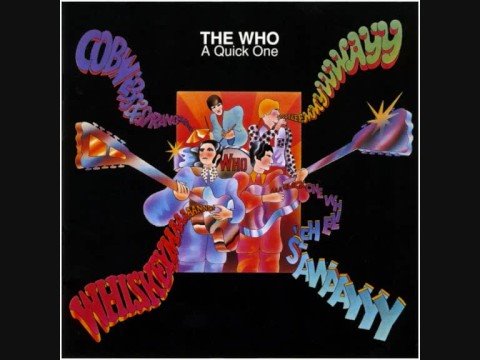
The inarguable beating heart of The Who’s discography is the run from “The Who Sell Out” (1967) through The Who By Numbers (1975). Across five albums—including “Tommy” (1969), “Who’s Next” (1971), and “Quadrophenia” (1973)—the group built an inimitable sound while pushing rock & roll to its aesthetic and conceptual limits. The album that comes just before that incredible run – the album that we’re celebrating today —is pretty often forgotten. It isn’t their barnstorming debut, it isn’t part of their iconic period, and it’s not part of their tragic decline. It’s just… there. “A Quick One” (1966) both foreshadows the band’s illustrious career and represents an alternate universe where they fizzle out on novelties and competent but not world-changing music.
When I first saw The Who perform on “The Kids Are Alright” movie soundtrack. The performance was electric. I liked the studio version but the live versions they push the song a little harder. The song didn’t chart being so long. The album “A Quick One” peaked at Number 4 in the UK charts. The hit song of that album was “Happy Jack”. “A Quick One” finds the song writing burden distributed throughout the band. This experiment might be the reason that this is not the band’s strongest record; some of the non-PeteTownshend tracks (particularly Keith Moon’s “I Need You” and John Entwistle’s two songs) could carry some more heft. “Boris the Spider” is fun, but Entwistle did much better later on. Still, stretching the band’s sound away from Maximum R&B through this song writing experiment helped set the stage for later work.
Speaking of experiments: “A Quick One While He’s Away” is a monster. It’s the one standout from “AQuick One”, the song that we can definitively say had a meaningful influence on The Who’s direction. A nine-minute track comprised of several shorter songs, the narrative experimentations that defined the band got a trial run here. Townshend found rock music capable of delivering something narrative and cerebral. You can also sense Townshend’s talents for combining seemingly disparate movements together, which would be perfected on “Quadrophenia”, in the abrupt-yet-satisfying transitions of “A Quick One While He’s Away.”
Of course, the definitive version of the song is not the recording on “A Quick One”, but rather the unhinged reading from “The Kids Are Alright” (1979), recorded in 1968 at the Rolling Stones Rock and RollCircus. Still, the studio version represents a massive leap forward for Townshend and a stepping stone toward the band’s career-defining experiments.
The Who had 10 minutes left to fill on the album. Kit Lambert, The Who’s manager, suggested to Pete Townshend that he write “something linear… perhaps a 10-minute song.” Townshend responded by saying that rock songs are “2:50 by tradition!” Lambert then told Townshend that he should write a 10-minute story comprised of 2:50 songs.
The song was a “mini-opera,” paving the way for the other mini-opera “Rael” and eventually full-length rock operas Tommy and Quadrophenia.
The plot of the story is simple. A girl is sad that her boyfriend is away. Her friends suggest that she take a substitute lover, Ivor The Engine Driver. When the boyfriend returns, she confesses her infidelity and is forgiven.
The Who performed this on the Rolling Stones Rock And Roll Circus, which was going to be a TV special. It never aired on television but it was released on VHS in 1996 and DVD in 2004. The Who’s performance of this was included in The Kids Are Alright, a 1979 film about The Who.
According to legend, Rock And Roll Circus didn’t air because the Rolling Stones felt that they were showed up by The Who. Jethro Tull, Taj Mahal, Marianne Faithful, John Lennon, Eric Clapton, and Mitch Mitchell all appeared on Rock And Roll Circus.
A live version of this song appears on Live At Leeds and the soundtrack for The Kids Are Alright.
The Who wanted to put Cellos on the track but Kit Lambert said they couldn’t afford it. So they sang “cello, cello, cello, cello,” where the Who thought they should go. >>
There are two other shining lights on “A Quick One”The first is “So Sad About Us,” a rollicking song that doesn’t sag momentum-wise like a lot of tracks elsewhere on the album. Here, The Who lean into that “Maximum R&B” sound that made them distinct from other blue-eyed soul acts like The Rolling Stones.
The song’s peak is a daring key change in the final seconds of the bridge, which creates massive tension right before a resolution in a final, joyous chorus. There’s not a lot of joy in The Who’s catalogue and finding it on a song called “So Sad About Us” makes it unpredictable and exhilarating. Criminally underrated, this track deserves to be thought of as one of the group’s early masterpieces, along with “I Can’t Explain” and “I Can See For Miles.”
The other crowning achievement is Keith Moon. We know that Moon is a standout drummer.
Happy 55th Anniversary to The Who’s second studio album “A Quick One”, originally released December 9th, 1966
Kevin Morby has announced his fifth solo record, “Oh My God”. The double album is out April 26th via Dead Oceans. Today, he’s also sharing the album’s lead single “No Halo” accompanied by a video directed by Chris Good. Watch the video below,
“Oh My God” marks Kevin Morby’s first album since 2017’s City Music. “This one feels full circle, my most realized record yet,” Morby said in a statement. “It’s one of those marks of a life: this is why I slept on floors for seven years. I’ve now gotten the keys to my own little kingdom, and I’m devoting so much of my life to music that I just want to keep it interesting.”
Morby’s last album was 2017’s City Music, which followed 2016’s Singing Saw. Earlier this year, he teamed with Waxahatchee to cover a pair of Jason Molina songs.
Spencer Berger The Los Angeles based artist performed all the vocals and instruments on The First Music, his second LP releasing on January 27th. “The album is a hunt for answers to unanswerable questions,” explains Berger. “Most of them are questions I’ve had my entire life. Some make me sad to think about, some bring me joy, some terrify me, and some stir emotions within me I don’t have a name for.”
The First Music is a fifteen song masterwork that is both thoughtful and catchy.
There are ill-starred outfits… and then was Badfinger. They were the first band signed to The Beatles’ Apple label, but financial mismanagement and industry pressures proved their (tragic) undoing.
Talk about your bad mojo. It would be hard to find a band with as tragic a back-story as Badfinger, not one of whom, but two, of its original members hanged themselves. And this despite a string of at least five timeless tunes, and plenty of other good songs to boot. The problem is that corrupt management—in the form of the New York mob-connected Stan Polley who made off with the bulk of the band’s profits, leaving Badfinger’s members practically penniless. It proved to be too much for the band’s songwriting team, Pete Ham and Tom Evans, leaving Badfinger to be remembered as much for its morbid history as its status as a great power pop band, They were England’s answer to The Raspberries.
The quartet formed in Swansea, Wales in 1961 as The Iveys. After much struggling they found themselves part of Apple Records’ stable of artists and hit pay dirt with “Come and Get It,” a Paul McCartney written and produced record, at which juncture they changed their name to Badfinger, supposedly after an early iteration of “With a Little Help From My Friends” entitled “Bad Finger Boogie,” so named because an injured McCartney was reduced to using one finger. They then proceeded to produce a number of hits, but saw no money.
But what a legacy they left behind! It’s not all here on Timeless… The Musical Legacy (you owe it to yourself to also check out 1990’s The Best of Badfinger, Vol. 2, which includes such great tunes as “Just a Chance” and “Shine On”) but it’s a powerhouse record nonetheless, and convincing proof that Badfinger was more, and much more, than the band that brought us the delectable “Day After Day.”
Speaking of “Day After Day,” has there ever been a song so luscious, from its wonderful melody to its great guitar line to the dual slide guitars—played by Ham and George Harrison, whom the band joined at Harrison’s 1971 Concert for Bangladesh? It’s so lovely it’s easy to forget how sad it is. Meanwhile, the band proffers a low-key version of its “Without You” which Harry Nilsson turned into a megahit—but the vocals on the choruses are to die for, as is the lovely melody. And the organ is great. “Rock of All Ages” is an anomaly; a full-scale rocker that reminds one—no matter how much Badfinger hated the inevitable Beatles comparisons—like nothing so much as a Paul McCartney screamer. The guitar solo is raunchy, some honky-tonk piano comes in and out—and the boys shout out the lyrics like the Fab Four in full rock mode. .
I’m not a fan of “Dear Angie”; it’s slow and sounds like an atavistic throwback to a prior time, and the guitars are too polite, the vocals too perfect. In short it’s too neat a package for my tastes, right down to the strings that end it. As for “Come and Get It,” it’s power pop perfection; the joint vocals are great, the drumming is wonderful, and the story is that the band wanted to do their own take on it but that Paul McCartney, the song’s producer, laid down the law, saying in effect it’s my way or the highway. We’ll never know what Badfinger would have done with it, but I have no doubt that Mac was right on this one. I dislike “Maybe Tomorrow” for many of the same reasons I dislike “Dear Angie”—it’s far too treacly, and the strings are too distracting and conservative, and I’d love to hear this one stripped down, because the vocals show signs of life, and without the accoutrements they might have saved the song.
“No Matter What” may be my favorite Badfinger tune, from its raucous guitar to its great group vocals (“Knock down the old grey wall/Be a part of it all”) to the stagger step the band takes toward the end. “Baby Blue” is also a miracle of songwriting, especially in its transition from slow opening to mid-tempo middle. Then there’s the guitar-heavy interlude followed by a brief solo, and once again some fabulous group vocals, leading to the needle-sharp guitar note that ends the tune. “Believe Me” reminds me of the Beatles—there, I said it—chiefly because the vocals remind me of John Lennon, but the band’s sudden shift from soft to loud is so, so cool. As are the dueling guitars, and the piano, and like they say, imitation is the sincerest form of flattery, and I like this one regardless of whether it’s mildly derivative.
“Name of The Game” is a lovely ballad with great lead and backing vocals, a comely piano, and a chorus guaranteed to move you. What wonderful vocals! I may prefer The Raspberries because they provided more big guitar riffs, but I’ll go with Badfinger when it comes to vocals any day, the great Eric Carmen be damned. Meanwhile that piano rides atop the rest of the band to the end of the song, and it’s luvverly. “I’ll Be the One” offers up more great vocals, but this tune mixes them with a tune that is largely Beatles and a guitar that is country honk-era Stones. Somehow, the mix not only works, but is sublime.
“Apple of My Eye” is a ballad and I’m not wild about it, despite the wonderful harmonies and the big transcendent choruses, which add some crunch to the apple. Oh, hell, I guess I do like it, or as much as the odd “Suitcase” anyway. This one’s heavy on the slide guitar—it may indeed be the only Badfinger song where the guitar is more prominent than the vocals—as well as the organ, but the vocals are still cool, and this is probably the furthest they ever got from power pop. LP closer “Timeless” is a bit too “Renaissance Festival” for my liking, what with the flute and the madrigal-like vocals. But then the piano comes in, followed by some big guitars that have George Harrison written all over them. I like the extended guitar solo, which is followed by some heavy-duty power chords, but then they return to the vocals, which just don’t do it for me.
In early 1970, The Beatles released their final album Let It Be. Closing with the rockin’ ‘Get Back’, the group’s sound was rather distinct, leaving it almost impossible for anyone to mix up the band with anyone else.
Unfortunately, late 1970 also happened to see fellow Englishman Badfinger release their third album, No Dice. Released on The Beatles’ Apple Records and featuring the single ‘No Matter What’, listeners began to wonder if this was the Fab Four reunited, or if it was a solo project by one of them.
To make things more confusing, Badfinger actually took their name from a working title of a Beatles song, and guitarist Pete Ham played a Gibson SG which was given to him by none other than George Harrison, making it almost seem as if they were trying to mess with us at some point.
Badfinger is almost certainly the most screwed-over band in rock history; for sure no other group got ripped off to the extent that two of its four members opted to end their lives. And beyond being a tragedy, it’s a pity, because there is nothing to suggest that Badfinger didn’t have more great music in them. We were all betrayed by the band’s shady manager, who died in 2009 and is hopefully rotting in Hell. I can’t listen to “Come and Get It” and “No Matter What” without wondering what might have been. They could have been more than contenders. They could have been more than that band that sounded so much like the Beatles.
Jen Cloher is a highly respected recording and performing artist and co-founder of Milk!Records.
From the artwork of the album down to the songs themselves everything about this album is soaked in drama, What makes “Dead Wood Falls” so fantastic is its simplicity. It combines honesty and minimal folk styling’s to explode a wonderful collection of songs that showcase a very disciplined artist. Every song is carefully crafted and placed on this album to give a continuity that is vital to helping you the listener connect to all of the stories being expressed.
..it’s hard to believe this album was released back in 2006, but then again a classic album is by definition timeless. There’s a certain simplicity to this album – despite all the bluesy, country and rock touches, it is Jen Cloher’s sombre and poignant vocals that pierces the blackness that hold the listener enthralled…”
The albums seventh track “Rain” is a highlight and an example of the Jen Cloher magic. The song itself flirts with that storytelling tradition but the song doesn’t slip into the cliché’s that often come along with that creative template. There is still a healthy dose of fiction acting as the safe place for the real hurt of this piece of communication to be buried so that you get the perfect mix of personal pain and metaphors. Regardless of all this scientific dissection the fact remains that the song “Rain” has a powerful dialogue capable of cutting you deep and hitting you directly. When you hear those lyrics you know that Jen lived every inch of them and like all of the classic songwriters of our time it connects to your story and helps give light to both the confusion and conclusion needed to discover that brand new start.
Mitski Miyawaki was born in Japan to an American father and Japanese mother. She studied at Purchase College’s Conservatory of Music, during which she self-released her first two albums, and served a short stint as a vocalist in a prog-metal band. She’s probably too creative and eccentric for mainstream success but she’s been steadily been building a profile; Iggy Pop has cited her as “probably the most advanced American songwriter that I know”, while her latest album “Be The Cowboy” cracked the top ten on many year end lists everywhere.
Be The Cowboy is Mitski’s fifth studio album. Her first two albums were genteel, based around her piano. They were followed by two albums of noisy guitar. Be The Cowboy captures the sweet spot between the two approaches; sometimes it features outbursts of noisy guitar, like on ‘A Pearl’.
But sometimes Mitski opts for a pop-oriented approach; the chunky guitars of ‘Why Didn’t You Stop Me’ are juxtaposed against a peppy synth line. ‘Me and My Husband’ is weirdly futuristic pop-soul with piano, synths, and horns all competing for attention.
The 14 songs of Be The Cowboy run just over half an hour, with individual songs often clocking in under two minutes. Three or four minute songs are usually the building blocks of pop albums, so these short pieces are refreshing. The overall effect is like that of a movie, especially when there are clear themes running through these songs.
Mitski has been protective of her personal life, so it’s difficult to tell what’s fiction and what’s autobiographical here, but there are themes of isolation and repression within a relationship on Be The Cowboy The album’s second single song, ‘Nobody’, opens with the lyrics “My God, I’m so lonely/So I open the window/To hear sounds of people”.
Be The Cowboy is a phenomenally strong album, balancing creative textures and themes with an unerring pop sense that makes it an easy record to access. It’s among my favourite album’s of 2018 that I’ve covered to date, and a contender for the top ten of the decade for sure.
Craft Recordings is continuing the 50th anniversary celebration of Creedence Clearwater Revival. In 1968, John Fogerty, Tom Fogerty, Doug Clifford, and Stu Cook released their first album together, providing the perfect soundtrack for a tumultuous period in American history. Over just seven albums issued between 1968 and 1972, the band’s rootsy rock-and-roll sensibility yielded such all-time classic hits as “Proud Mary,” “Bad Moon Rising,” “GreenRiver,” “Down on the Corner,” “Who’ll Stop the Rain,” and “Have You Ever Seen the Rain.” Last November, Craft Recordings released a deluxe box set containing CCR’s complete seven-album studio discography in new half-speed masterings by Miles Showell at Abbey Road Studios. On March 15th, those new 180-gram, half-speed mastered editions of the first two albums –“Creedence Clearwater Revival” and “Bayou Country” – will receive stand-alone LP releases.
In its press release for the box, Craft described the mastering procedure for these albums: “Using high-res transfers from the original analog tapes, the half-speed mastering process involves playing back audio at half its recorded speed while the cutting lathe is turned at half the desired playback speed. The technique allows more time to cut a micro-precise groove, allowing more accuracy with frequency extremes and dynamic contrasts.” Miles Showell offers further insight into his own approach: “I’ve tried to be as authentic as I could, and just make it sound like music. Not over-hyped, not over-processed. Up until now a lot of processing has been done on these recordings, so my approach was to strip them right back and just expose them for what they are – because what they are is great music.”
Released in the summer of 1968 — a year after the summer of love, but still in the thick of the Age of Aquarius Creedence Clearwater Revival’s self-titled debut album was gloriously out-of-step with the times, teeming with John Fogerty’s Americana fascinations. While many of Fogerty’s obsessions and CCR’s signatures are in place weird blues (“I Put a Spell on You”), Stax R&B (Wilson Pickett’s “Ninety-Nine and a Half”), rockabilly (“Susie Q”), winding instrumental interplay, the swamp sound, and songs for “The Working Man” — the band was still finding their way. Out of all their records (discounting Mardi Gras), this is the one that sounds the most like its era, thanks to the wordless vocal harmonies toward the end of “Susie Q,” the backward guitars on “Gloomy” and the directionless, awkward jamming that concludes “Walking on the Water” Still, the band’s sound is vibrant, with gutsy arrangements that borrow equally from Sun, Stax, and the swamp.
Fogerty’s songwriting is a little tentative. Not for nothing were two of the three singles pulled from the album covers (Dale Hawkins’ “Susie Q,” Screamin’ Jay Hawkins’ “I Put a Spell on You”) — he wasn’t an accomplished tunesmith yet. Though “The Working Man” isn’t bad, the true exception is that third single, “Porterville” an exceptional song with great hooks, an underlying sense of menace, and the first inkling of the working-class rage that fueled such landmarks as “Fortunate Son.” It’s the song that points the way to the breakthrough of Bayou Country, but the rest of the album shouldn’t be dismissed, because judged simply against the rock & roll of its time, it rises above its peers.
Opening slowly with the dark, swampy “Born on the Bayou,” Bayou Country reveals an assured Creedence Clearwater Revival, a band that has found its voice between their first and second album. It’s not just that “Born on the Bayou” announces that CCR has discovered its sound — it reveals the extent of John Fogerty’s myth-making. With this song, he sketches out his persona; it makes him sound as if he crawled out of the backwoods of Louisiana instead of being a native San Franciscan. He carries this illusion throughout the record, through the ominous meanderings of “Graveyard Train” through the stoked cover of “Good Golly Miss Molly” to “Keep on Chooglin'” which rides out a southern-fried groove for nearly eight minutes. At the heart of Bayou Country, as well as Fogerty’s myth and Creedence’s entire career, is “Proud Mary.” A riverboat tale where the narrator leaves a good job in the city for a life rolling down the river, the song is filled with details that ring so true that it feels autobiographical. The lyric is married to music that is utterly unique yet curiously timeless, blending rockabilly, country, and Stax R&B into something utterly distinctive and addictive. “Proud Mary” is the emotional fulcrum at the center of Fogerty’s seductive imaginary Americana, and while it’s the best song here, his other songs are no slouch, either. “Born on the Bayou” is a magnificent piece of swamp-rock, “Penthouse Pauper” is a first-rate rocker with the angry undertow apparent on “Porterville” and “Bootleg” is a minor masterpiece, thanks to its tough acoustic foundation, sterling guitar work, and clever story. All the songs add up to a superb statement of purpose, a record that captures Creedence Clearwater Revival’s muscular, spare, deceptively simple sound as an evocative portrait of America.
Despite the personal and professional tensions that plagued the band, CCR’s joyous brand of Americana keeps on chooglin’. The Rock and Roll Hall of Famers are still active today, with John Fogerty headlining his own solo shows, and Cook and Clifford performing as Creedence Clearwater Revisited. (Tom Fogerty died in 1990.)
The timeless Creedence Clearwater Revival and Bayou Country are due from Craft Recordings on March 15th. (Note that Amazon is currently showing a March 29th release date.)