
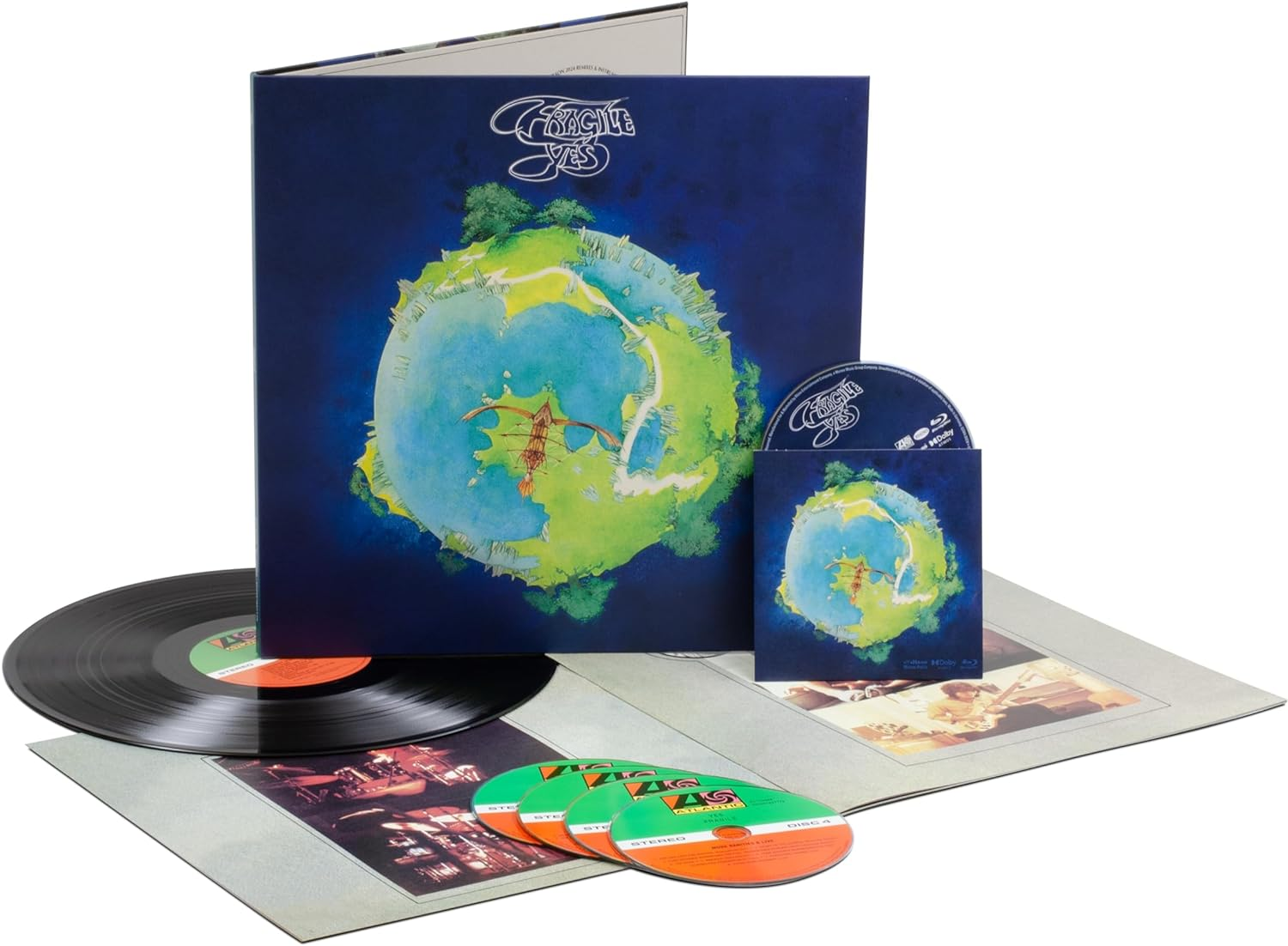
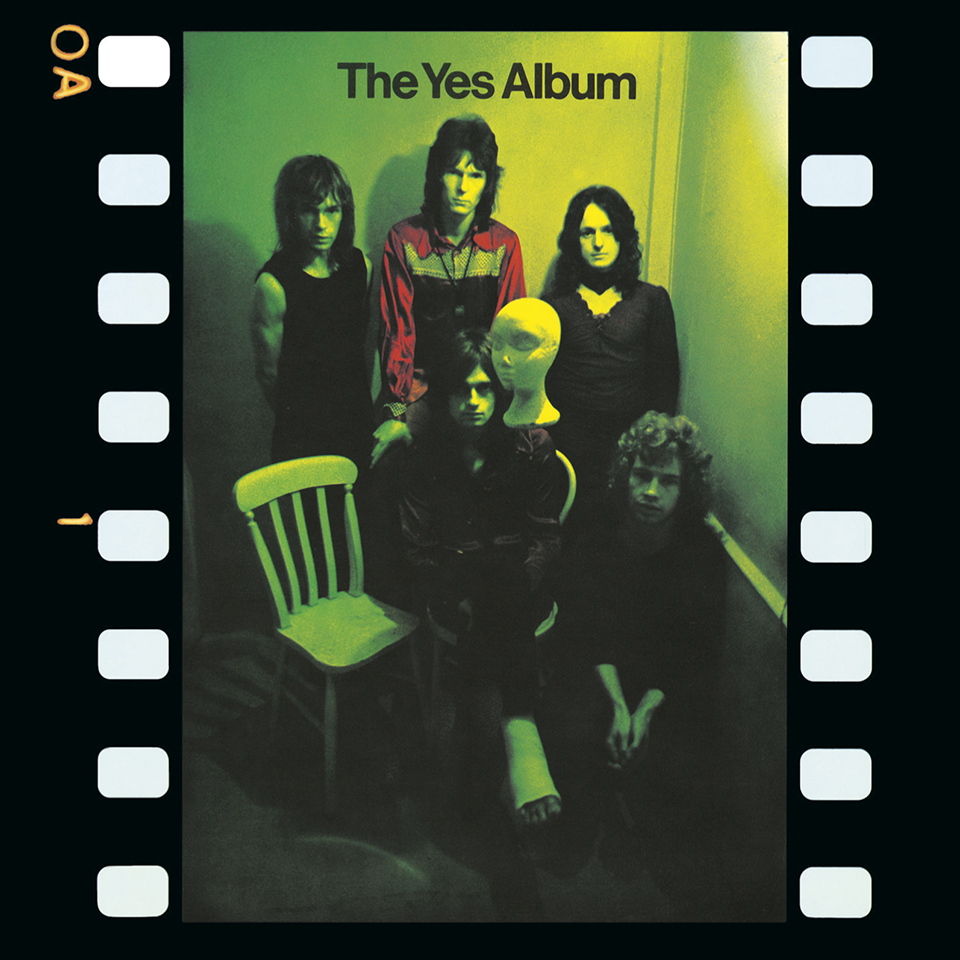
Formed by singer Jon Anderson, bassist Chris Squire, keyboardist Tony Kaye, guitarist Peter Banks and drummer Bill Bruford in 1968, they released two LPs on Atlantic Records before Banks was out and Steve Howe in for “The Yes Album”, their breakthrough disc, in early 1971. Yes intended to produce their follow-up with the same musicians, but Kaye reportedly balked at expanding the keyboard sound beyond his comfort zone (Hammond B-3 organ and piano), and the more adventurous Rick Wakeman was recruited after they’d already started work on the album that became their second big hit, “Fragile”.
Wakeman had done stellar work as a member of the folk-rock group Strawbs, and was a go-to session man who had to turn down an offer to join David Bowie’s band in order to throw in with Yes. Classically trained, Wakeman was excited by the Moog and ARP synthesizers, Mellotron and electric piano he’d added to his keyboard arsenal.
For the 45th anniversary of the remarkably durable breakthrough album by the progressive rockers YES which has turned out to be anything but “Fragile”. I’m not sure why the memory of walking home in the snow from the record store the first week of 1972 with the new Yes album under my arm.
Indeed, the original idea of producing a double-LP combining live and studio tracks was ditched, and recording with Atlantic’s Tom Dowd in Miami didn’t pan out either. Instead, Yes hunkered down in London during the summer of 1971, using Advision Studios and their familiar engineer Eddie Offord as co-producer.
For their follow up, Yes had chosen to augment their line up of Jon Anderson on vocals, the late Chris Squire bass/harmony vocals, Steve Howe guitar/harmony vocals, and the incomparable Bill Bruford on drums with ex-Strawbs electronic keyboard wizard Rick Wakeman for such rock classics as “Roundabout”, ”Long Distance Runaround”, ”Heart of the Sunrise”, and “South Side of the Sky”. Both Anderson and Wakeman join us “In The Studio” for this first of several interviews ramping up to April’s Rock Hall induction
“Fragile” eventually included a number of “solo” pieces, with each member responsible for helming a short contribution. Even after the LP—released in November 1971 in the U.K. was a hit, Squire told journalist David Hughes, “I’d agree with people who knocked us for the solo pieces, but in a way you’ve got to appreciate the circumstances. We had to get another album out quickly from a purely financial point of view. We have a lot of mouths to feed, Rick had to buy a vast amount of new equipment when he joined, and it all costs much more money than people seem to imagine.”
Particularly as we had already spent so much time and effort on [11-minute track] ‘Heart of the Sunrise’. So we opted for the solos, which were easier to rehearse and record.”
Swapping out the fully competent Tony Kaye for keyboard virtuoso Rick Wakeman put Yes on an completely new level; by the time they recorded “Fragile” the group had a veritable genius on each instrument. More indulgent than “The Yes Album“, as each member gets their own solo showcase (with mixed results), the high points on this one are among the best things Yes ever did. While “Roundabout” functions as a seminal prog-rock touchstone, it’s the other extended tracks that make “Fragile” far greater than the sum of its parts. “South Side of the Sky” provides ample evidence for why the Wakeman upgrade was obligatory, and “Heart of the Sunrise” remains the most purely distilled product of this band’s considerable powers.
“Fragile” begins with the phantasmagoric “Roundabout,” which became one of Yes’ signature tunes. The full 8:30 is a travelogue of intriguing musical ideas, so expansive it seems impossible only five musicians perform it all. Based on Howe’s original instrumental “guitar suite,” Anderson worked it into a real song, with joyous lyrics that tantalize with trippy imagery: “In and around the lake/Mountains come out of the sky and they stand there/One mile over we’ll be there and we’ll see you/Ten true summers we’ll be there and laughing too.”
The dramatic intro features two pianos played backwards and Howe’s expert flamenco stylings. (He’s one of the few great electric guitarists who don’t lose anything switching to acoustic.) Squire plays what amounts to a propulsive “lead bass,” and Wakeman colours with a rushing swirl of keyboards, background and foreground in the deeply layered mix. Time signatures change, Bruford never falters on basic kit or expanded percussion, and complex multi-tracked vocals are captured expertly by Offord. The slow interlude at five minutes is magical, and yields to an aggressive Hammond B-3 workout from Wakeman, and another series of snaking electric guitar parts that somehow combine Wes Montgomery and Jimi Hendrix. Howe favored hollow-bodied electric guitars like the Gibson ES-175 and ES-5 Switchmaster, giving him a jazzier sonic signature.
Each member contributes at the top of their virtuosity, from Bruford’s ever-surprising offbeats, Wakeman’s authoritative grand piano, and the stacked Anderson-Squire-Howe vocals. At 5:30, a muscular, pounding section with Howe’s electric juxtaposed with Anderson’s high keen is a Led Zep-level cruncher. Howe’s concluding solo is one of his best. It fades into the sound of (synth) wind that began the track, ending side one.
Side two of the original LP begins with a very quick Bruford-penned intro titled “Five Per Cent for Nothing” before another Yes classic, “Long Distance Runaround,” kicks in. Although it might not be obvious, Anderson told a journalist he wrote the lyrics as both a critique of religion and a commentary on the shooting of students at Kent State: “I still remember the dream there/I still remember the time you said goodbye/Did we really tell lies/Letting in the sunshine” and “Cold summer listening/Hot colour melting the anger to stone” are perhaps the lines that gesture in that direction.
“Long Distance Runaround” is quintessential Yes, combining delicate effects with powerful counter-streams. Howe’s jazzy dual-guitar figures open the track, quickly joined by Squire’s dominating bass. Listen to how masterfully Bruford takes his punctuation cues from both of them, finding a middle ground of support. The tempo and atmosphere change with Anderson’s entry at forty-five seconds in, as the track becomes positively poppy, and Wakeman’s piano provides a deceptively simple doo-wop accompaniment.
Howe’s concluding Echoplex effect leads into Squire’s piece “The Fish (Schindleria Praematurus),” an Afro-funky one-man jam with a dazzling array of interlocking effects, with (as the album credits note) “each riff, rhythm and melody” produced by Squire on sonically manipulated basses.
The album cover was the first produced for Yes by Roger Dean, who would design their logo, stage sets and posters for decades.
“Fragile” is the definitive versions of Classic Yes Albums, joining “Close To The Edge”, “The Yes Album” & “Relayer” Remixed by Steven Wilson in 5.1 & Stereo




 Cheech & Chong, Up In Smoke (40th Anniversary Picture Disc) (Rhino)
 Miles Davis, Rubberband EP (Warner Bros.)
 Fleetwood Mac, The Alternate Tango In The Night (Warner Bros.)
 Madonna, The First Album and You Can Dance (Sire)
 Prince, 1999 (Warner Bros.)




 The Fat Angel Sings