“The True Story of Bananagun” in the form of “The Master, Regarding the track, bandleader Nick van Bakel stated: “The Master is kind of about evacuating yourself from the absurd but typical life of working your arse into the ground for someone else and how no matter where you’re working or how high up the ladder you are in that world, there’s always a person up higher bossing you around or someone you’re trying to please. I just hate when people flex too much and don’t respect people; that’s what the majority of people deal with their whole life. It’s miserable and there’s no room for stuff to blossom. The trash that’s suggested in school, movies, and everything; have all your milestones planned out. You wanna make god laugh tell him you’ve got your life planned!”
The track is out now on streaming services alongside previous singles “Out Of Reach” and the BBC 6 Music-playlisted “People Talk Too Much.”
Melbourne 5 piece who dress like Os Mutantes and dance like Bobby Gillespie, but their grooves are impeccable. Let the sunshine in.” – MOJO, Jun 2020
Taken from “The True Story of Bananagun” out 26th June
Alex Lahey has surprised fans today with the release of a new EP. The Melbourne artist has today shared “Between The Kitchen & The Living Room” which sees her reimagine some of her best-known tracks, including “Every Day’s The Weekend, Let’s Go Out, I Haven’t Been Taking Care Of Myself,” Unspoken History and Wes Anderson.
“A few weeks ago, I found myself with all my plans taken away from me in exchange for more time than I knew what to do with. Looking forward felt too daunting, which made me flustered and upset. So, I decided to look back,” explained Lahey.
“Between the Kitchen and the Living Roomis a small collection of songs I have already released and played hundreds of times around the world, but through a new lens. In light of having to cancel my US tour, which is supposed to be under way this very moment, I decided to bring these songs home and let them find new parts of themselves.
“I engineered and produced all of these recordings within a week in a small room in my mother’s house – which is where I have been living since I didn’t continue renting in anticipation of touring for most of the year. Funnily enough, said room also happens to be the exact place many of these songs were written some years ago.
“As much as I can’t wait to go back to all the things I love doing under regular circumstances, it has been nice to embrace the boundaries. Really nice. And I hope you like what I made within them.”
“Let’s Go Out” has taken on a different meaning , with Alex taking a fan favourite sing along party tune into a chilled out moody piano ballad.
Performed By: Alex Lahey
Stonefox’s “Time” acoustic video invites us to dwell in a moment of hopelessness and hurt, fracture and fragility. There are numerous ways to create intimacy through music, and Stonefox know them all very well. The Melbourne indie pop trio have been creating safe spaces full of sonic and emotional depth for years now, and their latest release is only the icing on the cake: Raw, vulnerable, and stripped-down.
Stonefox’s new song “Time,” originally released April 9th via Seeking Blue Records. The latest single off the band’s forthcoming EP (due to release in early August), “Time” finds the Australian indie band in a particularly contemplative headspace – waxing philosophical over purpose, place, and meaning, the group wonder aloud in a sea of “what it’s all about” and “why we’re here“. They’re classic questions, for which there are no answers; and yet, these topics never go stale.
Nuance and poignance have long been a part of Stonefox’s ethos: Their very first single, 2014’s “All I Want,” introduced Jenna Russo, Monica Spasaro, and Tim Carroll as a minimalist, introspective musical project along the same vein as The xx and Daughter. Six years after their debut, Stonefox retain that intimate composure and minimalist edge that makes so much of their earlier work as compelling as they are engulfed in feeling.
“Time” is, in all respects, a quintessential Stonefox song. “’Time’ is about looking at a difficult time in your life from an outside perspective,” Stonefox’s lead singer Jenna Russo “It describes the second stage of being hurt, feeling hopeless and defeated. One of the more philosophical moments on the record, it’s about feeling so low that everything you do in life seems like wasted time. Like looking at the night sky and feeling insignificant in the scale of it all. It’s about realising that everyday life can be exhausting and wanting to have someone alongside you to go through the motions with.”
The “Time” acoustic video marks a special moment for the band, as it is drummer Monica Spasaro’s first time on lead vocals. “It’s something I’ve wanted to do for a little while now but the right moment hadn’t really ever presented itself,” Spasaro explains. “When we had the idea to make the acoustic video we were all sitting around our home studio deciding the best way to pull it off, and there was this moment we all looked at each other, a little smirk on Tim and Jenna’s face. If I was ever going to try my hand in backing vocals this was it. It was nice that there wasn’t ever any pressure, Tim and Jen gave me lots of great pointers and were always encouraging about it all, and practising and singing three part harmonies with them just seemed to work.
All of that hard work paid off for Spasaro and her bandmates, as she so beautifully wraps listeners in waves of haunting emotion. Stonefox tap into a moment of a raw clarity in their chorus, as Spasaro bears her soul:
Shot at Princes Pier in Port Melbourne by Dan Parish (The Hybrid Minds), Stonefox’s acoustic performance is truly a knockout. Stonefox have completely transformed their song without tampering with its core – it’s as pained and aching as its more dressed-up, electric alternate.
“The song is all about looking at the bigger picture and coming at things from an outside perspective during difficult moments. We wanted the setting to be vast, moody and capture the message behind the song,” Russo says of the video concept. “As songwriters we draw a lot of inspiration from the ocean and there are a lot of references to it throughout the EP.”
Melbourne four-piece Jade Imagine have returned with their brand new single, “Coastal Pines”. The track is their follow-up to their debut album Basic Love and last year’s tour that included support slots with Pond across the U.K.
“Coastal Pines” is perfectly timed to release during the emerging summer months, with a groovy psych-infused jam that just radiates a cool sun-soaked warmth and free-spirited imagery.
Talking about the single, frontwoman Jade McInally describes Coastal Pines to be:
A song about the head verses the heart. For me, it’s the never ending struggle between the city and the ocean pulling in two different directions.”
Originally starting as The DIY home recording project of Angus Lord and Claudia Serfaty, The Stroppies have now evolved into what some might call a “proper band”. Following on from their 2017 demo cassette and a sling of singles, 2019 saw the release of their debut LP Whoosh!, a studio-based affair that evolved The Stroppies sound, underpinned with a newly discovered melodic classicism. Look Alive!, their latest effort which was recorded only months after the bands return to Australia after their second European tour of 2019, represents a marriage of the two different styles of Stroppies recordings and rounds out an incredibly productive twelve months for the group.
Look Alive! Is the sound of The Stroppies honing their craft under new and unfamiliar conditions. Written mainly on the road then finished and recorded at home with whatever was on hand with only three of the four members present, it is according to the band’s singer/guitarist Angus Lord, “an EP forged in circumstance. A sum total of fleeting vignettes on scraps of paper, voice memos and iPhone notepads all collated between soundchecks and long stretches in a tour van pieced together over weekly jams. We didn’t want to waste much time when we got home so we opted to record it ourselves”. For a band who began with the initial idea to create “open-ended music, collaged quickly and pieced haphazardly together”, it is in some sense a return to their true self.
Lead single ‘Holes In Everything’ presents the band at its pop best: “If I could disappear into the atmosphere, I would be around you all the time” sings Lord, before swiftly throwing shade on the sentiment in the chorus, “It’s always frightening what I think”. It’s this penchant for push and pull of light and dark splashed against the backdrop of trepidation and humour that make The Stroppies records so endearing and open-ended. Though undeniably pop structure orientated, the bands propensity for re-inventing and re-appropriating their recording and writing process ensures that nothing starts to fossilize. Indeed, Look Alive! is that most intriguing of records precisely because it represents two ideas at the same time – the sound of a band in flux, but also the sound of a band becoming more sure footed as they walk their crooked line.
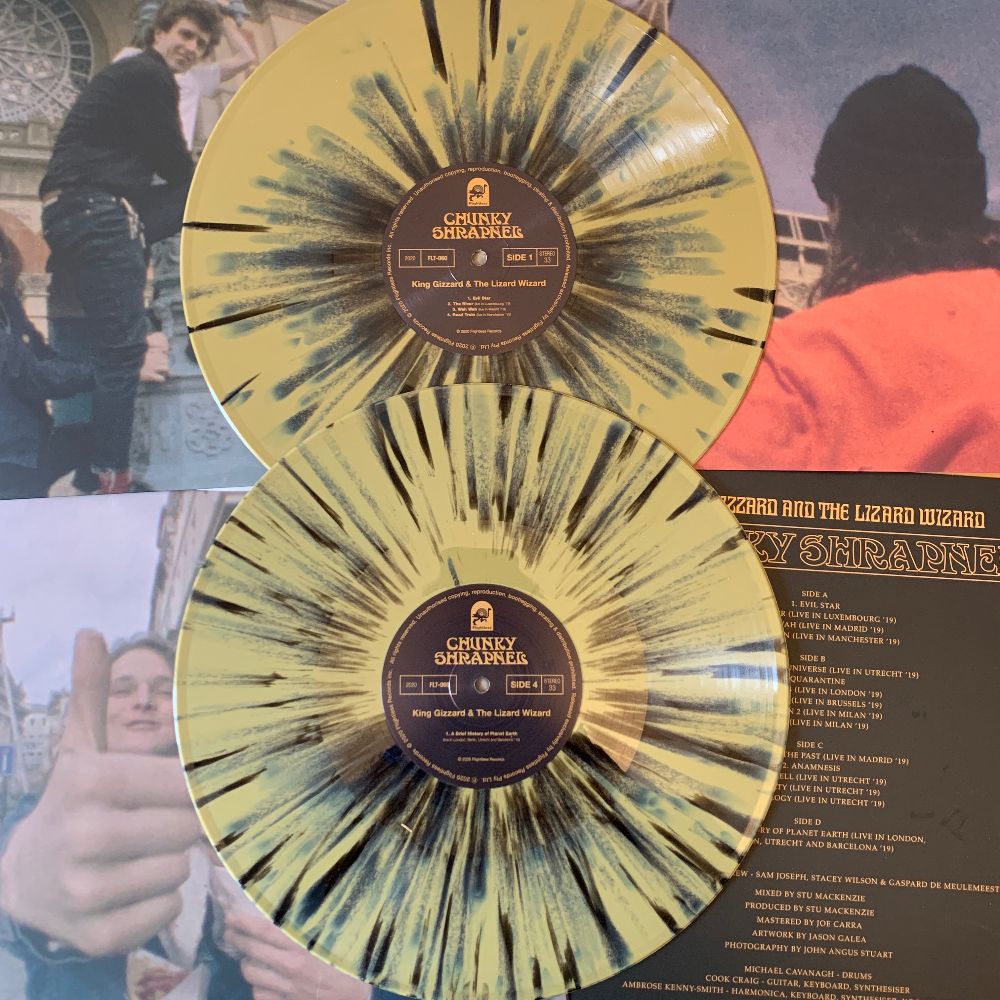
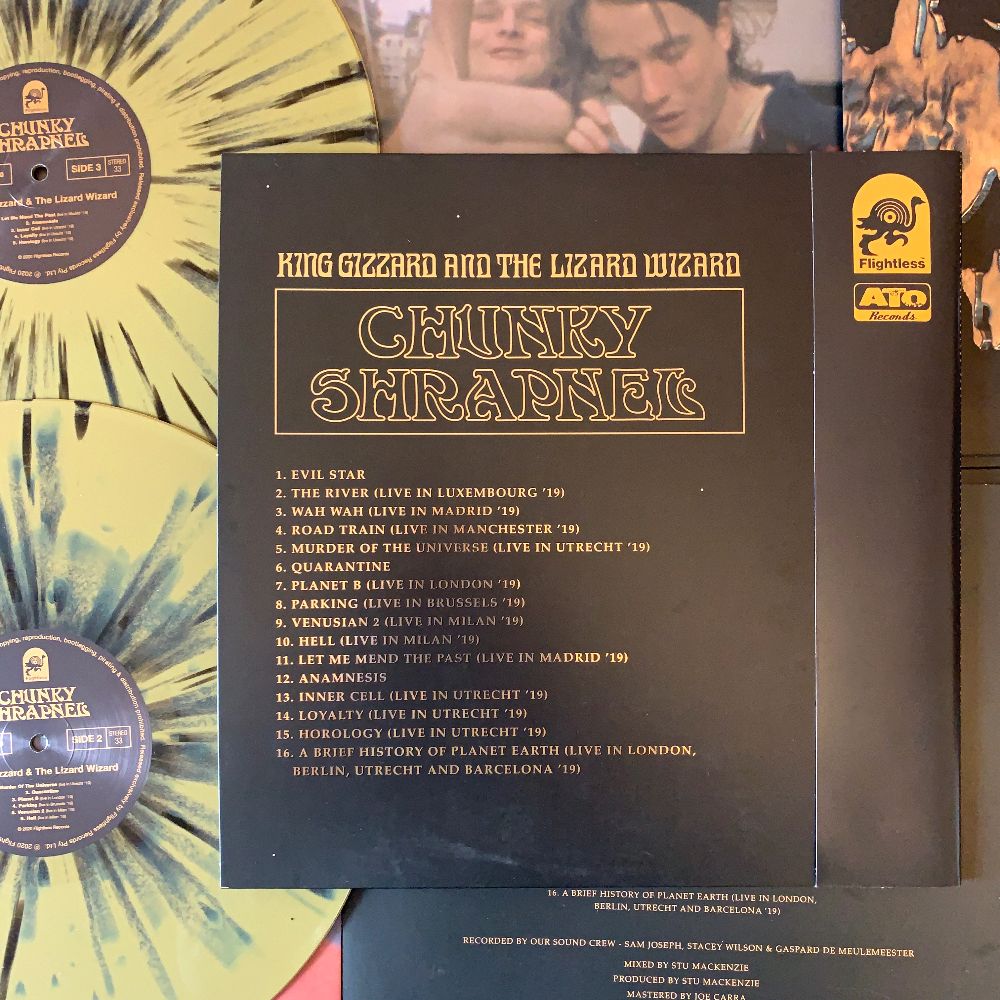
Much to the excitement of myself and ‘Gizzheads’ around the world, King Gizzard and The Lizard Wizard’s first ever feature-length music documentary is finally here. Bought to you by PHC Films and Flightless Records, “Chunky Shrapnal” is a ‘musical road movie dipped in turpentine’ filmed during the band’s 2019 tour across Europe and the UK.
Concerned about the self-congratulatory behaviour around creating a ‘behind the scenes’ film centred on themselves, the band were initially hesitant. Luckily for their humble souls, having their dear friend John Angus Stewart direct Chunky Shrapnal assured the film was authentic Gizz from start to finish. Having worked closely with the band on music videos for ‘Planet B’, ‘Self Immmolate’ and ‘Organ Farmer’, John says the film was a natural evolution of their work together, and I was lucky enough to ask ask him some questions about shooting the film entirely on 16mm, picking perfect moments, and more.
The Movie Chunky Shrapnel, It’s from a lyric from the Gizzard song, ‘Murder of the Universe’. It means vomit.reminded me why I love the band so much; The atmosphere at their concerts. the awesome community and of course the excellent music! . There is nothing quite like 16mm. First of all, I knew I wanted certain types of colours and highlights that are impossible to achieve digitally. Another reason was the practical restrictions. There’s a far better atmosphere backstage when you can’t shoot forever, you gotta pick the right moments. It’s like playing Russian roulette but you want the bullet. And having a single camera was also an import call for us. The normal four-camera set up thing for live music just doesn’t work for Gizz. You have to be on stage with them, it’s the only way. And plus, normal on stage coverage is like watching paint dry.
This album is the phenomenal soundtrack to it. No Paper Maché, sadly, they did record a few songs at the show in Cologne but they’re absent from the album.
Hailing from Melbourne, but with a sound stretching from 60s and 70s afrobeat and exotica to Fela Kuti-esque repetition, the proto-garage rhythmic fury of The Monks and the grooves of Os Mutantes, there’s an enticing lost world exoticism to the music of Bananagun. It’s the sort of stuff that could’ve come from a dusty record crate of hidden gems; yet as the punchy, colourfully vibrant pair of singles Do Yeah and Out of Reach have proven over the past 12 months, the band are no revivalists. On debut album The True Story of Bananagun, they make a giant leap forward with their outward-looking blend of global tropicalia.
The True Story of Bananagun marks Bananagun’s first full foray into writing and recording as a complete band, having originally germinated in the bedroom ideas and demos of guitarist, vocalist and flautist Nick van Bakel. The multi-instrumentalist grew up on skate videos, absorbing the hip-hop beats that soundtracked them – taking on touchstones like Self Core label founder Mr. Dibbs and other early 90’s turntablists.
That love of the groove underpins Bananagun – even if the rhythms now traverse far beyond those fledgling influences. “We didn’t want to do what everyone else was doing,” the band’s founder says. “We wanted it to be vibrant, colourful and have depth like the jungle. Like an ode to nature.”
Van Bakel was joined first by cousin Jimi Gregg on drums – the pair’s shared love of the Jungle Book apparently made him a natural fit – and the rest of the group are friends first and foremost, put together as a band because of a shared emphasis on keeping things fun. Jack Crook (guitar/vocals), Charlotte Tobin (djembe/percussion) and Josh Dans (bass) complete the five-piece and between them there’s a freshness and playful spontaneity to The True Story of Bananagun, borne out of late night practice jams and hangs at producer John Lee’s Phaedra Studios.
“We were playing a lot leading up to recording so we’re all over it live”, van Bakel fondly recalls of the sessions that became more like a communal hang out, with Zoe Fox and Miles Bedford there too to add extra vocals and saxophone. “It was a good time, meeting there every night, using proper gear [rather than my bedroom setups.] It felt like everyone had a bit of a buzz going on.”
Tracks like The Master and People Talk Too Much bounce around atop hybrid percussion that fuses West African high life with Brazilian tropicalia; the likes of She Now hark to a more westernised early rhythm ‘n’ blues beat, remoulded and refreshed in the group’s own inimitable summery style. Freak Machine is perhaps the closest to those early 90’s beats, but even then the group add layers and layers of bright guitars, harmonic flower-pop vocals and other sounds to transmute the source material to an entirely new plain. Elsewhere there’s a 90 second track called Bird Up! that cut and pastes kookaburra and parrot calls as an homage to the wildlife surrounding van Bakel’s home 80 kilometres from Melbourne.
Oh, and there are hooks galore too – try and stop yourself from humming along to Out of Reach’s swooping vocal melody.
Bananagun are first and foremost a band enthused with the joy of living and The True Story of Bananagun is a ebullient listen; van Bakel – as the main songwriter – is keen not to let any lyrical themes overpower that. There’s more to this record than blissed out grooves and tripped out fuzz though: The Master is about learning to be your own master and resisting the urge to compare yourself to others; She Now addresses gender identity and extolls the importance of people being able to identify how they feel. Then there’s closing track Taking The Present For Granted, which perhaps sums up the band’s ethos on life, trying to take in the world around you and appreciating the here and now.
A keen meditator, van Bakel says of the track: “so often people are having a shit time stuck in their own existential crisis, but if you get outside you head and participate in life and appreciate how beautiful it all is you can have a better time.”
Even the band’s seemingly innocuous name has an underlying message of connectivity that matches the universality of the music. “It’s like non-violent combat! Or the guy who does a stick up, but it’s just a banana, not a gun, and he tells the authorities not to take themselves too seriously.”
The True Story ofBananagun then is perhaps a tale of finding beauty in even these most turbulent of times.
The Band:
Nick Van Bakel – guitar, voice, flute, trumpet, harpsichord, percussion
Jack Crook – guitar, voice
Charlotte Tobin – percussion
Josh Dans – bass guitar
Jimi Gregg – drums
Pierce Morton – alto saxophone
Miles Bedford – tenor saxophone
Zoe Fox – voiceSongs written by Nick Van Bakel.
After enough time away from home, even the familiar starts to feel foreign. For guitar-pop five-piece Rolling Blackouts Coastal Fever, returning to Melbourne after long stretches looking out at the world through the windows of airplanes and tour vans lead to dislocation, like being the knot in the middle of a game of tug-o-war. Their second record, Sideways to New Italy (Sub Pop Records), sees the band interrogate their individual pasts and the places that inform them. In clicking the scattered pieces back into place, they have crafted for themselves a new totem of home to carry with them no matter where they end up.
Lead by singer-songwriter-guitarists Tom Russo, Joe White and Fran Keaney (and rounded out by bassist Joe Russo and drummer Marcel Tussie), the band began grasping for something reliable after emerging from relentlessly touring their critically regarded debut Hope Downs. “Sideways to New Italy” on June 5th via the fine folks at Sub Pop. Everything they have released has been awesome.
Home, for Russo, manifests in different ways: there’s Melbourne, where he and brother Joe grew up, but also Southern Italy where the forebears of their family originated. The album is inspired by New Italy – a village near New South Wales’s Northern Rivers – the area Tussie is from. A blink-and-you’ll-miss-it pit-stop of a place with fewer than 200 residents, it was founded by Venetian immigrants in the late-1800s and now serves as something of a living monument to Italians’ contribution to Australia, with replica Roman statues dotted like souvenirs on the otherwise rural landscape. As members of the band individually visited the Mediterranean and returned home to Melbourne’s inner-north, where waves of European migrants forged a sense of home since the 1950s, they realized the emotional distance between the two was minuscule. The prominent and romantic Greco-Roman statues that sit outside tidy brick homes in Brunswick represent, for Russo, an attempt to “build a utopia of where your heart’s from.”
“I wanted to write songs that I could use as some sort of bedrock of hopefulness to stand on, something to be proud of,” says Keaney. “A lot of the songs on the new record are reaching forward and trying to imagine an idyll of home and love.” This is the bulk of Sideways to New Italy, which boasts love songs, and familiar voices and characters, grounding the band’s stories in their personal histories.
The same can be said of this record, where White’s early attempts at writing big, high-concept songs were abandoned in favor of love songs (“She’s There,” “The Only One”), and familiar voices and characters filter in and out, grounding the band’s stories in their personal histories. On “Second of the First” the voice of a close friend joins White’s partner in delivering a spoken word passage; the chorus from “Cool Change” began its life in a song the trio played in an early band, over a decade ago; the chords from “Cameo” were once in an eventually abandoned song called “Hope Downs”; an early version of “Falling Thunder” featured a reference that only their friends would recognize.
“Sideways to New Italy” on June 5th via the fine folks at Sub Pop Records. Everything they have released has been awesome to date.
Cable Ties, a trio from Melbourne, blasts a coruscating onslaught of punk mayhem, guitar scrambling madly in a scrubby, discordant fury, drums banging, bass pumping pick-driven clangor into the mix and, above it all, Jennie McKechnie wailing in an exposed nerve kind of way about apathy, sexism, LGBTQ acceptance, income inequality and activist politics. The sound is supercharged, ear-ringing, tight; the fast chug of the bass line in stellar “Tell Them Where to Go,” has a nearly tactile force, while the guitar howls like careening sirens. The easy thing would be to compare McKechnie’s vibrato-zinging vocals with those of Sleater-Kinney’s Corin Tucker or her verbal agility to Courtney Barnett, but the blunt force and agile violence of the music, brings to mind post-punk bands like the Wipers, Protomartyr and Eddy Current.
Cable Ties formed in the mid-teens and has one self-titled and a clutch of singles and splits in its catalogue so far. Far Enough is the first of this band’s albums to get a wide U.S. release, and it’s a doozy, no question. McKechnie may be the band’s focal point, but bassist Nick Brown defines Cable Ties’ ragged power. The rough-sawed churn of “Lani” starts and finishes with his abrasive, insistent bass playing that boils like magma under urgent, trilling vocals. Drummer Shauna Boyle is pretty great, too, banging out aggressive beats, that are passionate not sloppy, trance-like but never tuned out.
Band members are active advocates for women’s and LGBTQ rights. McKechnie co-founded Wet Lips, a Melbourne festival focused on inclusion of female, gay and non-binary musicians, and both she and Boyle volunteer for Girls Rock, an organization that promotes opportunity for women, trans and gender diverse musicians. Far Enough engages in these issues through the lyrics, especially in “Tell Them Where to Go,” where between murderous bass and clanging guitar chords, McKechnie sings about empowerment. “Are you stuck in your bedroom? With your stereo on? Thinking you’ll never play that way cos you’re too weird or too young/Why don’t you walk out your bedroom/and steal your brother’s guitar/ Go see the folks who took rock back from blokes and who get who you really are,” she wails, and you can see a hundred kids squaring their shoulders and heading out there.
Later, “Self-Made Man” launches an incendiary blow at the rich, skewering people who “work hard and don’t share,” in a hard bumping, intricately lyric’d song that vibrates with rage, and elsewhere “Sandcastles” pokes a rusty nailed prod at the politics that strangle otherwise well-meaning activist organizations. (“You don’t do anything because you know that people like you they just don’t do anything but tear each other down”). And right at the beginning in “Hope,” the band addresses boomer complacency on climate change, as McKechnie warbles, “My uncle Pete’s he’s complaining about the greenies, he says they’ve gone too far, I say Pete, they don’t go far enough.”
And yet while not a moment on this album fails to engage in issues, the vibe is brash, celebratory, undeniably a gas. This is no over-earnest diatribe. It’s a series of party anthems about stuff that matters. One drum flattening call to arms insists that “Anger’s Not Enough,” and that’s right, there’s a lot more here. But it’s a really good place to start.
Fronted by the ferocious Jenny McKechnie, Cable Ties are a three-piece from Melbourne who have built themselves a reputation as the saviours of contemporary Australian punk.
With a razor-sharp edge, they deconstruct the ragged aggression of stadium rock bands like AC/DC, the minimalism of post-punk pioneers Au Pairs, and synthesise them into bellowing anthems of discontent that are distinctly their own. Jenny screeches like a bogan banshee (or Siouxsie), Shauna pounds the drums like they owe her money (they do), and the Verlaine-thin bassist NickBrown boogies like he’s hearing Blondie for the first time.
This simultaneously bright-eyed and jadedly anti-capitalist approach is the first thing you’ll notice on their new record Far Enough. From the way early single ‘Tell Them Where to Go’ harkens back to the cover of Sonic Youth’s Goo: ‘Are you stuck in your bedroom with your stereo on? Why don’t walk out your bedroom? And steal your brother’s guitar!?’ To the way ‘Sandcastles’ jumps back and forth like a fever dream, Far Enough is a stunning sophomore effort.
‘Sandcastles’ is the most concise song I’ve heard from you guys. Given you’re mainly known for stretching out punk songs beyond their limits, that’s a pretty big deal. How come it’s so much more concise?
Cable Ties are preparing to unleash their towering wall of ’70s hard rock and proto-punk to the world with the release of their second album (and Merge debut!) Far Enough on March 27th. As a final preview to the record, the Melbourne trio recently shared “Hope,” the opening song and lyrical centerpiece of Far Enough.
Singer-guitarist Jenny McKechnie says “Hope” serves as the record’s mission statement of sorts, touching on environmental, feminist, and anti-colonist themes explored in greater depth on “Sandcastles,” “Self-Made Man,” “Tell Them Where to Go,” and the rest of Far Enough.
We wrote that song when we had a weekend away writing, and we spent the whole time doing something which never ended up on the album. It was one of those weekends where it got too convoluted, and we had to start again. And right at the end of the weekend, we had two hours where we wrote ‘Sandcastles’ pretty much in one go. We just had a really good crack at it where… it felt like it was what it needed to be. It was straight to the point. Focussed. Like, when we write a song we start with a riff and if we can’t play that same riff over and over again for like half an hour, and enjoy it and really sink into it, sort of like feel it in our bodies in this cathartic way, we don’t think it’s worth making into a song.
On ‘Pillow’ you sing about feeling like you’ve fucked up and can’t go back. How do you cope with that feeling?
That feeling is something that I struggle with in music a lot, to be honest. Like, I did my undergrad arts degree in politics, and then I tried to go to Law School like, ‘I better do something that’ll get me a job,’ and I dropped out. Then I tried to do honours, and dropped that too. That feeling is me being like, ‘Why do I think that I’m so special that I can spend all my time playing music?’ And really beating myself up about it, which I would never do to anyone else, but for some reason, I still do it to myself. It’s still in my head that art’s a waste of time and that I should do something useful. So, that song was me convincing myself that it’s ok, what I’m doing. And that the voices in my head telling me that I’ve fucked up aren’t actually mine, in a way.
On ‘Tell Them Where to Go’ you sing about the aspirational component of being in a band. Is that your narrative? Are you singing to yourself?
That song was actually written when we were going to play at Girls Rock in Melbourne. It’s this program that gets young girls between 12 and 18 and puts them in bands. And they have to write an original song in one week and then perform it, and we were like ‘that is amazing.’ We were thinking about our own writing process like, it takes us months, we would never be able to do that! So we were like, ‘righto, we’re playing girls rock, let’s write a song for it. If they can do it then we should be able to.’ So that song is written for those kids. And also thinking about myself, and how much I would’ve loved to have something like that when I was growing up.
You sing very unapologetically. Was there any insecurity involved in finding your voice when you first started singing?
I first started playing music in [giggles] folk bands! So the stuff that I used to do was really quiet and sweet and I didn’t think that I could project my voice at all. But then when we started rehearsing we were really loud and I couldn’t get my voice over the sound of the amp. So the way that I’m singing was just a result of me really trying to be heard over the sound of everything. By the time that we were playing in venues where I could actually hear myself, I realised that I was doing this thing with my voice that I’d never thought I could do. Actually projecting and singing loud and high and just going for it. Cutting loose
At the end of ‘Anger’s not enough’ there’s a sound that sounds like a rooster. Is it a rooster?
Ha! I wish it was. But no, it’s not. I’m very glad that you can hear that though. The sound at the end of ‘Anger’s Not Enough’ is me with two guitar amps, and – I hate to get all spinal tap on this – they’re both turned all the way up to 10 and just pushed into overdrive. I also had this pedal from Newcastle called ‘when the sun explodes’—it’s like a reverb pedal where you can also get some really interesting feedback things going on. So its that looped over and over—I guess about three different tracks of me just messing with the guitar making crazy sounds. So if you can hear a rooster in there, I’m happy.





 The Fat Angel Sings