Posts Tagged ‘Matador Records’

Image may contain: 1 person, shoes

Steve Gunn has announced a new album, The Unseen In Between, with the arrival of its lead single “New Moon.” The Unseen in Between is Gunn’s first album since 2016’s Eyes on the Lines. “New Moon” grows gradually, layering instruments as it wanders toward its pinnacle: the final minute and a half-or-so of the track. Enlisting an upright bass and tremolo-heavy guitars, the track feels as though it’s meandering—with intention—instrumentally. This theme is present lyrically, as well, with the lines, “I see a glimmer / Across the wall / Through the mirror / Out past the streets / Beyond weather / To that place / No one seems to know.” Tony Garnier, musical director for Bob Dylan, provides the bass on the track and serves as a frequent collaborator on the album along with Meg Baird, who provides harmonies.

From Steve Gunn’s new album ‘The Unseen In Between’ out January 18th, 2019 on Matador Records.

Kurt Vile kicks back in the Catskills before the release of his seventh solo album, 'Bottle It In.'

Kurt Vile an American singer, songwriter, multi-instrumentalist and record producer. He is known for his solo work and as the former lead guitarist of the rock band The War on Drugs, both in the studio and during live performances, Vile is now accompanied by his backing band, The Violators, which currently includes Jesse Trbovich (bass, guitar, saxophone), Rob Laakso (guitar, bass) and Kyle Spence (drums).

Influenced by bands like Pavement, Neil Young, Tom Petty, and John Fahey.  Kurt Vile began his musical career creating lo-fi home recordings with frequent collaborator Adam Granduciel in Philadelphia, with whom he has participated in early work by The War on Drugs as well as various solo projects. Focusing on his solo career, Vile released two albums, “Constant Hitmaker” (2008) and “God Is Saying This to You..”. (2009), compiling various home recordings dating back to 2003. Vile signed to Matador Records in 2009, and released his third album, “Childish Prodigy”, that same year. The album was his first recorded in a studio and with the full participation of The Violators.  “I’ve always been prolific,” he says. “It just took me until I was 29 for someone to actually put my music out.”

In 2011, Vile released his fourth studio album, Smoke Ring for My Halo, which significantly increased his exposure. His fifth studio album, Wakin on a Pretty Daze, was released in 2013, with Laakso replacing Granduciel in his backing band. In 2015, Vile released his sixth studio album, b’lieve I’m goin down…. The lead single from the album was, “Pretty Pimpin”Vile’s best performing song to date,  His project in 2017 saw him release “Lotta Sea Lice”, a collaboration with Australian singer and guitarist songwriter Courtney Barnett.

22072

The War on Drugs (2003–2008)

In 2003, after staying in “Boston” for two years, Vile moved back to Philadelphia and began collaborating with musician and songwriter Adam Granduciel The duo subsequently formed the Indie rock band “The War on Drugs  in 2005. Regarding his friendship with Granduciel, Vile noted, “We’re essentially best friends. He was backing me up in my band when he started working on his own music, so I thought I’d return the favor.” Granduciel and Vile released their debut studio album, “Wagonwheel Blues” in 2008 and embarked on a tour in support of its release.

Constanthitmaker.jpg

Constant Hitmaker (2008)

At this time, Vile’s debut solo album,“Constant Hitmaker” (2008), released on “Gulcher Records” Vile subsequently decided to leave The War on Drugs to concentrate on his solo career. The album was compiled from various home recordings and one studio recording of the song “Freeway”. In 2009, Vile noted, The War On Drugs got put out on a bigger label first, so, in the some claim that The War on Drugs was my first, main band. But that’s just the way it looks. I’ve made more music than Adam has, and have been doing my Kurt Vile thing for a little bit longer. And Constant Hitmaker came out around that same time. Right when that [War on Drugs] record came out, I went to Europe with them, and also opened as Kurt Vile. That was right when I decided I wanted to concentrate on doing my own thing. Despite Vile’s departure, Granduciel remained a member of his backing band, The Violators, with Granduciel noting, “There was never, despite what lazy journalists have assumed, any sort of falling out, or resentment.

Constant Hitmaker the debut studio album by American musician“Kurt Vile” released in 2008 on Gulcher Records”  and Woodsist. Self-produced, and recorded between 2003 and 2007, the album is primarily composed of lo-fi home recordings that Vile had previously issued on “CD-R”

Following the album’s release, Vile stated that Constant Hitmaker is “like a Best-of, sort of, but leaning toward the “Psychedelic pop”stuff, kind of my later material.”

Godissayingthistoyou.jpg

God Is Saying This to You. (2009)

In April 2009, Mexican Summer released “God Is Saying This to You..”.; a collection of Vile’s home recordings dating back to 2003 on vinyl only. Upon its release, Vile had already recorded a studio album, Childish Prodigy, which Vile described as “definitely not as lo-fi” as his previous releases, After shopping the record to various labels, Vile signed with Matador Records in May 2009. Vile noted, “It’s a perfect fit. They were my number one choice. I don’t really consider my music indie rock or think that Matador cater only to indie rock, but I still feel I can relate most to Matador, more than any other label. Not to mention the fact that they are way on top of their shit.”

33870


Childish Prodigy (2009)

Recorded with backing band The Violators, “Childish Prodigy” was released on October 6th, 2009, and increased Vile’s exposure significantly. Support slots with Dinosaur Jr, Thurston Moore and Fucked Up followed the album’s release. Regarding his new position, Vile stated, “Obviously there’s more touring, more press and more hype which I won’t say is not deserved. There’s like a faction of people, too, who like to talk shit, which is kind of new. When I was more independent, there were people who got really excited and there still are but once I got more press people started to comment on blogs. People like to talk shit. […] It’s like climbing a ladder. I like to climb it really slowly. I could probably get really professional right away, but I like to take baby steps and find my own way.”

Philadelphia guitarist / vocalist Kurt Vile first came to music enthusiasts’ attention with the release of 2008’s ‘Constant Hitmaker’ on the gulcher imprint. the homemade hitmaker (also reissued on vinyl through woodsist) was a psych pop gem. his debut Matador album, ‘Childish Prodigy’ ups the fidelity only a little. this absorbing, addictive and richly detailed album covers an immense amount of ground compared to its predecessor, from the pounding stomp of ‘Hunchback’ and the hypnotic beat of ‘Freak Train’ to the unexpected, soaring trumpet in ‘Amplifier.’

56382

Smoke Ring For My Halo (2011)

Vile released his fourth studio album, “Smoke Ring for My Halo”, in 2011. The album peaked midway in the charts and was placed highly on many end-of-year lists, and in 2013 it was named at number 475 in NME’s ‘500 Greatest Albums of All Time’  Later in 2011, Vile released a companion EP, So Outta Reach, and appeared on his former band The War on Drugs‘ second studio album, Slave Ambient. Shortly after the release of Smoke Ring for My Halo, longtime Violators guitarist Adam Granduciel departed from the band to fully focus on The War on Drugs, with Vile noting, “Adam, he plays in The War on Drugs, his record came out a little after mine did, so at first he toured, and now he’s obviously busy with that and now he’s working on his new record.

The deluxe double cd version of ‘Smoke Ring for My Halo’ comes with a new colour cover. the deluxe cd includes the ‘So Outta Reach’ ep on a second disc. the ep contains 5 original songs initially recorded during the sessions for ‘Smoke Ring for My Halo’ album but not used , which were reworked with producer John Agnello this summer. in addition, the ep contains a cover of Springsteen’s ‘Downbound Train.’ the Philadelphia singer / songwriter  returns with his second proper album (2008’s ‘Childish Prodigy’ was a compendium of sorts). It’s a gorgeously layered record. ranging from the tender breezy folk in ‘Jesus Fever’ to the tuff urban guitar riff of ‘Puppet to the Man’ Vile’s distinctive philly-accented vocal ties together a sweeping and evocative project – a true american psychedelic folk album. this is no pastoral listening experience however – when Vile sings, ‘society is my friend: he makes me lie down in a cool bloodbath’ he sounds both exhausted and distanced from the ringing harmonics of his guitar and Mike Zanghi’s pounding drums. even the gentler songs, such as ‘On Tour’ and ‘Baby’s Arms’ have a distinctly dark lyrical tone. the closest that Vile gets to some kind of acceptance is in the central track, the rueful ‘in my time’ “i know when we get older, i’m dying, but i got everything i need here now, and that’s fine, now… that’s fine. recorded at the Magic Shop , the album is a massive step forward for one of the country’s most beloved (not least by other musicians) rock songwriters.

71253

Wakin On A Pretty Daze (2013)

“Wakin on a Pretty Daze” was released on April 9th, 2013. Regarding the current line-up of his backing band, Vile noted, “I’m playing with Jesse [Trbovich] and Rob [Laakso]. […] Rob Laakso is the newest member and Jesse has been a member forever. They’re steady members. Our drummer is no longer with us, but other than that, different friends played drums on the record and we’re doing rehearsals with that right now. But other than that, the Violators are me, Jesse, and Rob and we’ll see how it evolves.” Priestess drummer Vince Nudo subsequently joined the band on drums and percussion, after performing on two of Wakin on a Pretty Dazes tracks.

Steve Gunn joined the band as an “auxiliary Violator“, during the band’s May 2013 tour dates, with Vile noting, “It’s impossible to just talk about Steve. He’s too good! He’s so good; just listen to him. What can I even say about him that touches that? I just want to listen to him.”

On September 24th, 2013, Vile announced the release of a new EP, “It’s a Big World Out There (And I Am Scared)”, and also a deluxe edition of “Wakin on a Pretty Daze”.

Kurt Vile is slowly, quietly becoming one of the great American guitarists and songwriters, of our time. This 69-minute double album is comprised of sweeping, expansive songs that are both very intimate and conversational. Wakin On A Pretty Daze is a timeless record that would have sounded great 30 years ago, sounds great today, and will still sound great in another 30 years’ from now. Beautifully produced by John Agnello, the record is filled with hazy, swooning guitar lines and dreamy, beatific, and occasionally sardonic vocals. It is summed up by the staggeringly gorgeous 9-minute opener, Wakin On A Pretty Day. The record has other connections to Kurt’s home town. Steve Powers (ESPO), the renowned Philly street artist, painted the cover mural on an abandoned building near the Northern Liberties. The album is being announced via a mini-doc of Powers creating the mural with Kurt’s commentary, and the two of them talking about Philadelphian music and visual arts. The mural will be re-created in London, Los Angeles and New York. First edition CD housed in a mini-gatefold like the LP cover,
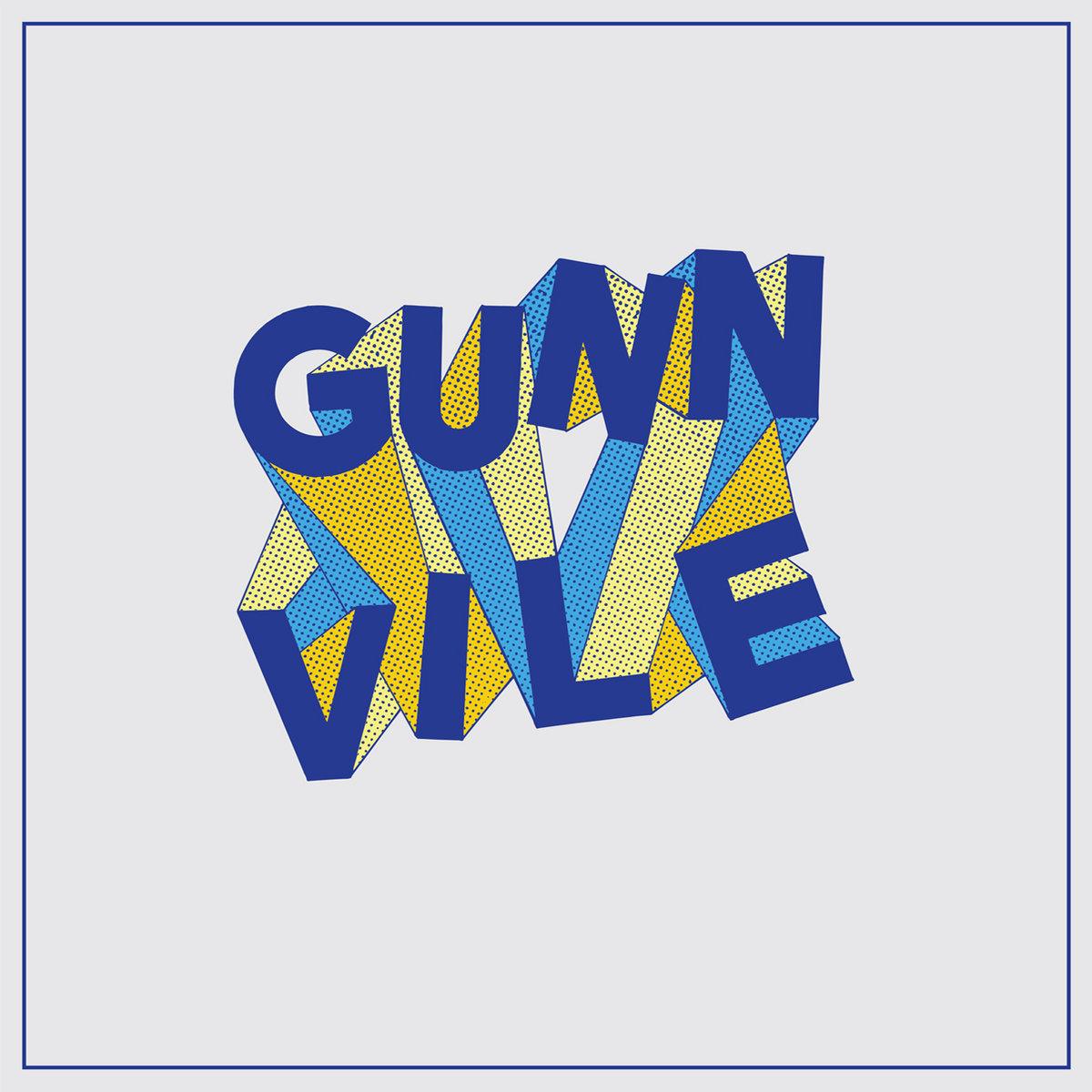
Kurt Vile | Steve Gunn (Released July 14th 2017)

Kurt Vile and Steve Gunn collaborated for their contributions to Three Lobed Recording’s Parallelogram series. The two artists, originally connected by mutual friends and geographic proximity, have long pushed the other’s continued artistic development. Despite sharing many live stages over the years, this installation of Parallelogram represents the first time that the two have worked together in the studio. Vile’s side sees him recast tracks by John Prine (“Way Back When”) and Randy Newman (“Pretty Boys,” featuring some truly electric guitar flourishes from Gunn) as if they were KV originals. The theme of reinvention continues with Vile tearing through a solo banjo rendition of his “Red Apples” (originally from his “God Is Saying This To You…” LP), retitled here as “Red Apples For Tom Scharpling.” Gunn takes on a late period Nico track, “60/40,” and pulls a lysergic rocker out of the track’s goth-ish roots. The bulk of Gunn’s contribution is the epically winding “Spring Garden,” a track in the vein of some of his other long-form guitar excursions. Featuring signature contributions from Vile and Mary Lattimore, this hypnotizing cut is unmistakably a new classic in Gunn’s catalog.

96046

b’lieve i’m goin down… (2015–2017)

On March 6th, 2015, Vile announced that he was working on his sixth studio album, with recording taking place across different locations in the United States. “b’lieve i’m goin down..”. was released September 25th, 2015, on Matador Records. Vile has described it as “All over the place. Everything you can imagine I’ve done… That’s where I’m at now, that I can sort of tap into every world and make it cohesive.

Cbkv packshot fin%283000x3000%29

Whole Lotta Sea Lice with Courtney Barnett

The new album’s writing and recording stretched out over many months, during which time he also made another full-length LP with his friend Courtney Barnett (2017’s delightful Whole Lotta Sea Lice) and attempted to finish a film score he’s since abandoned. About a year ago, feeling overwhelmed by all the demands on his time, Vile delayed the release of Bottle It In from spring 2018 to October 12th. If he hadn’t, he says, “I was prepared to have a serious breakdown. Pretty normal.”

Image001

Bottle It In  (2018)

On Bottle It In, Vile does his best to come back to earth. If his last solo record was a dark, lonely night of the soul, this one feels more like a friendly jam session with his longtime backing band, the Violators (multi-instrumentalists Rob Laakso and Jesse Trbovich, plus drummer Kyle Spence). Beneath the easygoing charm of its surface, though, Bottle It In is an album with serious ambitions. On highlights like “One Trick Ponies” and “Loading Zones,” he sounds like he’s simultaneously swinging for another modern-rock hit and searching for an inner peace that’s just beyond his grasp. Among the songs Vile recorded with Everett is Bottle It In‘s nine-minute-plus centerpiece, “Bassackwards,” a slow-burn psychedelic dream with an undercurrent of dread. In part, he tells me, it’s a song about his fears for the future in a time of global warming and skyrocketing hate. “The world is backwards as fuck right now,” he says.

Vile is also featured on the song “Let Me Get There” and Hope Sandoval & The Warm Inventions” released in 2016.

Vile sings lead vocals on The Sadies song “It’s Easy (Like Walking)” on their 2017 album Northern Passages.

In 2017, Vile and Courtney Barnett recorded the collaborative album “Lotta Sea Lice” , released on October 13th. The lead single “Over Everything” was released on August 30th, 2017 accompanied by the music video directed by Danny Cohen.

In 2018, Vile announced his seventh solo studio album, “Bottle It In”, due for release on October 12th, 2018.

Check out the these EP’s
The Hunchback
Square Shells
So Outta Reach
It’s a Big World Out There (And I Am Scared)

Image001

Kurt Vile has become known for his unmistakable nasal drawl and classic rock and folk sensibilities, but his musical origins leaned on a more lo-fi, psychedelic sound with record releases like 2008’s Constant Hitmaker and 2009’s Childish Prodigy. Now, a decade later, Vile says there’s another clear distinction in his mind between then and now. “The one big difference now is my religion is literally ‘Don’t force it,’” he says.

His latest album, “Bottle It In”, certainly doesn’t sound forced as it’s got plenty of breathing space. The tracks that make up the album’s hour and 20 minute length are chill, melodic and perpetually locked into a head-bobbing groove. Mind you there’s still distorted and twangy riffs on tracks like “Loading Zones” and his Charlie Rich cover, “Rollin With The Flow,” and these riffs often interact with his measured grooves, but the grooves humbly take center stage, and it doesn’t take very long for them to become fixed into your mind, body and soul.

The Philadelphia rocker Kurt Vile is back alongside his band, The Violators, for his seventh solo album and his first since 2015’s “b’lieve I’m goin down”. Two tracks have already been released: “Bassackwards” is a sprawling, hypnotic foot-tapper, and “Loading Zones” is a distorted guitar assault with a playful lyrical ode to the humdrum exercise of parking. Across the album’s hour and 20 minutes, the record captures the bare bones beauty of Smoke Ring For My Halo, the guitar prowess of b’lieve I’m goin down and the lyrical transparency of Childish Prodigy. Vile doesn’t shy away from eight- to 11-minute track lengths, and he creates enthralling grooves at the center of each track as other instruments weave in and out, creating a dreamy, sonic transcendence.

Four tracks fall around the eight-to-10-minute range and unlike many songs that long, Vile evades bombastic, over-indulgent territory. Rather, on tracks like “Bassackwards,” “Check Baby” and the title track, he leads these seemingly simple grooves that sneakily weave their way into the listener’s consciousness and lull you into a misty dream with each additional musical element snaking in and out of the song’s strong melodic foundation. “I’ve always had a soft spot for repetition,” sings Kurt Vile on the compassionate “One Trick Ponies,” and these songs reflect that with their hypnotic, circling instrumental interplay.

Vile says he wasn’t concerned about the length of the tracks as he’s got a pretty good feel for when to pull the plug. “I know when not to cut something down if I’m still bobbing my head into the track,” he says. “As opposed to all of a sudden thinking about something else and not paying attention anymore—that’s when I know you gotta cut it out or try again.”

‘Loading Zones’ is the newest single by Kurt Vile, out now on Matador Records.

There’s a whole album’s worth of outtakes. They didn’t fit on the record, but there’s still contenders for another album or EP. I would say the one song that maybe I didn’t expect would make the record because I recorded it a little later was ‘Come Again,’ the banjo song. That’s a lot of people’s favorite.”

In addition to his backing band, The Violators, this album is chock full of guest musicians: Kim Gordon, Warpaint’s Stella Mozgawa, Mary Lattimore, Lucius and Cass McCombs. Gordon, who’s become a good friend of Vile’s, contributes ephemeral guitar feedback on the outro of “Mutinies.” “I went to see my friend Steve Gunn who happened to be playing at the Echo in Los Angeles,” recalls Vile. “So I went and saw him. Mary Lattimore was actually opening up. I saw Kim in the audience and we were hanging. I told her what I was about to do and she said, ‘Let me know if you want some acoustic guitar feedback,’ which was her words. It came together nicely for sure.”

While Lucius contributes backing vocals to “Come Again,” the other three musicians all guest on the album’s centerpiece and title track. “Bottle It In” includes drums from Mozgawa, harp from Lattimore and vocals from McCombs. The nearly 11-minute track is the album’s most striking cut with its simple yet breathtaking keyboard riff that mingles with Lattimore’s harp for a divine, melancholy effect.

“That’s one of my favorite tracks,” says Vile. “I wrote it on this weird keyboard at my house. The same keyboard I wrote ‘Cold Was The Wind’ on. You can hear it’s really kind of scratchy and weird. I prerecorded the basic track, which was 11 minutes long and I definitely thought I would cut it down. We listened back and it was very hypnotic and beautiful, just the right amount of all the things—a little bit sad, a little bit beautiful—sort of a song about rejection. A song about getting your feelings hurt a little bit. Normal human emotions.”

“It’s only a few chords really. It’s sort of open to reacting melodically, vocally, all those things, as long as you don’t overplay, as long as you’re in the groove. That’s basically why it’s the title track because I don’t want it to go unnoticed or I don’t want it to be taken too lightly like, ‘Oh this is a weird, minimal orchestral song.’ It’s so much more than that. That’s definitely a different type of song for me. Not out of left-field really but something special.”

The lyrics on this album are up in the clouds—sometimes literally (“Hysteria”) and other times metaphorically. The album is a generous, thoughtful dialogue with himself as he reaches for both abstract musings and level-headed professions. While the bittersweetness and ruminative nature of his predecessor, b’lieve i’m goin down, still lingers, Vile’s playful side is still apparent, most visibly on the lead single, “Loading Zones”—perhaps the most epic rock ’n’ roll song about the humdrum exercise of parking. In fact, the song was actually written during the b’lieve sessions, but Vile felt he wasn’t ready to release it yet.

“It was just I’ve been more one with playing it on the guitar,” he says. “It came off more confident. I had the basic chords written but you know how the words spew—it’s pretty psychedelic and humorous—definitely not absurd, it’s just a little weird. I didn’t think I earned the right to put out such a weird song. I don’t think it would’ve made sense. I’m glad I waited and put out ‘Pretty Pimpin’ or something that people would connect with more.”

The album was written and recorded over roughly a two-and-a-half year period at multiple studios, mostly between touring and family vacations. It features a clown car of guest musicians and producers and it also includes a plethora of instrumental elements: various keyboards and synths, banjo and harp. To the non-musician, it sounds like a steep task to make a cohesive body of work in such conditions, but Vile wouldn’t have it any other way. “I’ve really always been doing that,” he says. “That’s just me having a little experience to take it a little further,” he explains. “Even in the old days, I was at least recording at different people’s houses and various studios. You’d be surprised. I think things would sound weirder if you recorded all in one spot. I think it’s better to record all over the place because you get all kinds of different dimensions and perspectives as opposed to just the same sound of the same room. The same exact guitar and drum sound. That’s not really me.”

Vile’s guitar playing on this record truly runs the gamut. On “Loading Zones,” he uses the same wah-wah pedal as Sonic Youth on their 1995 single, “The Diamond Sea.” “Bassackwards” sounds straight out of Kevin Shields’ playbook. “Yeah Bones” has a cascading, acoustic country jangle. And on “Rollin With The Flow,” Vile’s guitar cries out and reverberates with flare. “I’m kinda like a space cadet,” he says. “I’ll usually never fully master a pedal use it to its full possibilities, but I’m definitely into them. I like filters, warm, analog, weird synthy kind of tones. Vintage guitars for sure—the more beat up the better. Tremolo bars. Anything that kind of bends but in a really dreamy, melodic way. I like vibrato a lot too.”

Though Vile doesn’t consider himself a gear head, he has a certain level of appreciation for vintage instruments. “I’m into old synths that look cool or keyboards that sound fucked up and guitars, weird amps and old pedals—vintage things. Of course they have to sound good, but they also have to look cool. You have to be drawn to them,” he says.

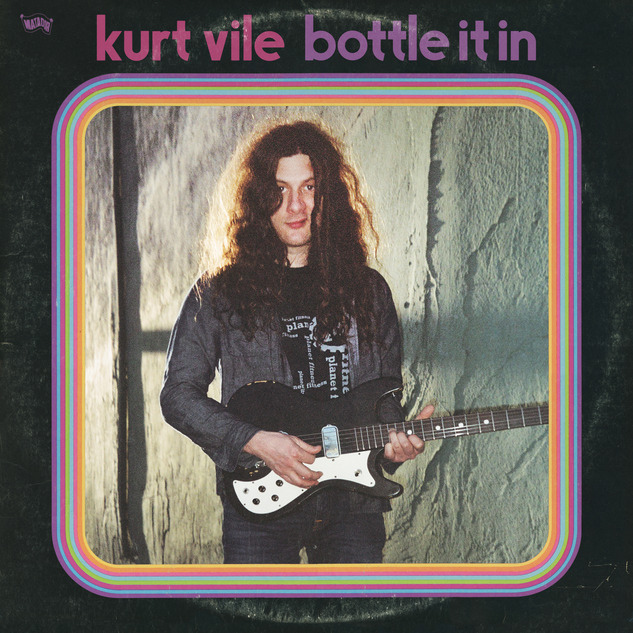
The album artwork for Bottle It In also reflects Vile’s love for all things vintage. The cover features a worn-in black background, a square rainbow border, ’60s typography and a photo of Vile with an Elvis lip curl—though Vile’s retro vibe is, hilariously, nearly sabotaged by his Planet Fitness t-shirt. “You’re dealing with modern fonts,” says Vile, “I always thought like a real typewriter looks better or something beaten up a little. I basically found an old record that I liked and had it morphed and used the wear of that record. I wanted it to look used and worn in. I always think things look a little strange, when they’re super crisp and modern.”

Some artists consider their earlier work immature and are quick to run away from their previous sound, but Vile doesn’t align with those sentiments. Like his lo-fi beginnings, he’s planning to go back to home recording some time in the future and he’s not fearful of repeating himself. “I’m in a super nostalgic phase right now,” he says. “I’m listening to a lot of things that I love in the ’90s like Drag City music and stuff like that. I think that I’m always trying nostalgically to get to my roots. I think I’d be really into this record as a teenager because I’m just trying to sound like what I was into in my teens. Ideally, I think I’m always gonna evolve and fine-tune my craft, but it’s always going to sound like me.

From Kurt Vile’s new album, ‘Bottle It In’ available October 12, 2018 via Matador Records.

Last fall, Kurt Vile teamed up with Courtney Barnett for the collaborative album Lotta Sea Lice. Now, he’s about to launch his upcoming seventh solo album — his first solo effort since 2015’s b’lieve i’m goin down, which became highest charting Billboard 200 release . Judging by the instrumentally intricate and lyrically humorous lead single “Loading Zones,” Bottle It In picks up where Vile left off with few detours: His brand of twangy slack-rock is unmistakably him, and this new project will fit seamlessly into Vile’s quickly growing catalog.

Kurt Vile has now shared a third single off his new album Bottle It In, which comes out next week (10/12) via Matador Records. Like the previous singles, “One Trick Ponies” has that laid-back, trademark Kurt Vile feel but manages to sound like something new for KV too. He’s joined by Warpaint’s Stella Mozgawa and Beachwood Sparks’ Farmer Dave Scher on the harmony-fueled chorus, and KV also shows off his harmonica playing on this one.

Kurt Vile also has several tour dates coming up, including a run with the great Jessica Pratt

BottleItInPackshot.jpg

Last month, Kurt Vile released his first new single since 2015, “Loading Zones,” and now he’s giving the people what they want by wheeling out a new album. Bottle It In, due out on October. 12th via Matador Records, It will be Vile’s first LP since 2015’s b’lieve i’m goin down…., and the Philly singer-songwriter has shared another new song alongside today’s announcement, the gorgeous, nine-plus-minute epic “Bassackwards.”

Vile recorded “Bassackwards” with engineer and producer Shawn Everett at The Beer Hole in Los Angeles, and his Bottle It In bio describes the track as “the album’s beating heart and Vile’s most compelling evocation of how he sees the world.” Vile is of two minds—and sometimes none at all—on the song, singing, “I was on the beach but / I was thinking about the bay / got to the bay but by then I was far away,” over dreamy backmasked guitars and gentle acoustic strums. The polarized instrumentation fits perfectly with the song’s refusal to settle on one direction ”Bassackwards” moves two ways at once, leaving us wondering which way is true North, or if there even is one.

Listen to “Bassackwards” below

boygenius packshot.jpg

The good people at Matador Records have finally pulled back the curtain on their new supergroup made up of songwriters Lucy Dacus, Julien Baker and Phoebe Bridgers. The all-star trio’s self-titled, six-track EP Boygenius is coming out on November. 9th via Matador, but you can hear the project’s first three singles now.

Dacus, Baker and Bridgers’ mysterious and much-anticipated team-up first made waves in early August when Bridgers confirmed its existence at an NPR Music event. Soon after, a media outlet received a photo of the group, accompanied only by the word “boygenius” and the Matador logo. We now know that to be the name of both the trio and their forthcoming release, previewed via lead singles “Me & My Dog,” “Bite The Hand” and “Stay Down.”

Bridgers takes point on the affectionate, yet anxiety-ridden “Me & My Dog,” singing over steady electric guitar strums, “I had a fever / until I met you / Now you make me cool / but sometimes I still do / something embarrassing,” her gossamer vocals giving way to delicate banjo notes and droning synths. Baker’s voice bolsters Bridgers’ as the chorus-less song crescendos, pushing through the fears that obstruct desire. “I dream about it and I wake up from it,” the duo conclude, their voices drowned out by a rising tide of reverb.

Second single “Bite The Hand” is Dacus’ chance to shine, an unflinching declaration of independence that would have fit right in on Historian. What sets it apart from her solo work, however, is its choruses, on which Dacus, Baker and Bridgers harmonize to drop-dead gorgeous and increasingly powerful effect, warning an unwanted partner, “I can’t love you how you want me to.” The song closes on their voices, with nothing but bare conviction against the silence.

The devastating “Stay Down,” meanwhile, is all Baker, her trademark reverb-steeped guitars and emotive vocals expanded upon with scattershot percussion and moving strings. Her lyrics are shot through with heart-rending resignation: “I wasn’t a fighter till somebody told me / I had better learn to lean into the punch / so it don’t hurt as bad when they leave / There you were, turning your cheek,” Baker begins, later demanding, “Push me down into the water like a sinner, roll me under / and I’ll never come up again / I’ll just stay down.” Fuck us up, boygenius.


Dacus, Baker and Bridgers head out on tour together this November, though they won’t do so as a trio—rather, they’ll each be performing their own solo sets. But who knows? Judging by the unpredictable way in which their boygenius team-up has come to light, perhaps the collaborators will see their way to delivering some surprises live, as well.

Julien Baker, Phoebe Bridgers, and Lucy Dacus formed Boygenius after booking a tour together, but the trio had subconsciously been in the works for longer than that. Through a series of tours and performances together, and chance encounters that led to friendships – including Bridgers’ and Dacus’ first in-person meeting backstage at a Philadelphia festival, greenroom hangouts that felt instantly comfortable and compatible, a couple of long email chains and even a secret handshake between Baker and Dacus – the lyrically and musically arresting singer-songwriters and kindred spirits got to know each other on their own terms.

“When we met, Lucy and Phoebe and I were in similar places in our lives and our musical endeavors, but also had similar attitudes toward music that engendered an immediate affinity,” Baker explains. “Lucy and Phoebe are incredibly gifted performers, and I am fans of their art outside of being their friends, but they are also both very wise, discerning and kind people whom I look up to in character as much as in talent.”

Listen to boygenius’ EP “Me & My Dog,” “Bite The Hand” and “Stay Down”.

For their sixth album,”Marauder, Interpol come out swinging. English-American singer and bassist Paul Banks, lead guitarist Daniel Kessler and drummer Sam Fogarino have been playing together now for 21-years, about the age they each were when the band formed back in 1997. The recording for this record began in 2016 with a 15th anniversary tour of the band’s first and classic album Turn On The Bright Lights sandwiched in between the recording session. The band took on famed producer Dave Fridmann, known for his band Mercury Rev but also for producing music by Flaming Lips, Weezer, Sleater-Kinney and many more, just to give an idea of his visceral aesthetic.

For a sense of Marauder, Paul Banks here dives into detail and unveils some of the thoughts that went into this record.

1. “If You Really Love Nothing”

One of the swing jams. Sam is rocking a shuffle and the rhythmic poise is uncommon for us.

The song has some of my favorite lyrics: “If you really love nothing, everybody’s made up, everybody’s losing.” It’s a similar sentiment as expressed by “Stella.” “The building fronts are just fronts.” Both songs, I suppose, center around a narrator who is perplexed by a woman with unwieldy psychological pathologies involving paranoia and dissociation. This song, like “Stella,” suggests the narrator gives up on this woman ultimately. The choruses feature the best guitar interplay on the record.

2. “The Rover”

“The Rover” was one of the first songs we got cooking. Daniel introduced the riff and the rest came very quickly — bass, drums and vocals.

I wanted to keep the bass and guitar simple in the verses. I felt that the counterpoint of a drone against Daniel’s poppy, sharp progression would provide a bottled-up energy that we release when the chorus arrives and the bass and guitars diverge.

The lyrics are about a seductive, charismatic cult leader who has no trouble amassing young followers. His message is one of inclusion, obedience, hedonism, and salvation. The end is nigh, so come and see me.

3. “Complications”

Another swinger. Sam really stretching out and having fun. One of my favorite songs. I feel that the “The Rover” and “Complications” exist in the same world — in the same movie. If “The Rover” were walking through the desert on an acid trip, then “Complications” is the song playing in the jukebox of the dive bar where he winds up — the come-down at sundown.

4. “Flight of Fancy”

This song has a very strange chord progression from Daniel. I think in my mind it begins on the 5th chord of the melody and then plays out like: 5, 1, 2, 3, 4. But if you ask Daniel, the order of the chords is as you hear them: 1, 2, 3, 4, 5. Basically I think he’s starting his melody in the “wrong” place. And he thinks I’m nuts. We are probably both right.

But that difference of orientation lent itself to a fun and fluid arrangement between bass and two guitars. I think it would be difficult for someone else to learn the song because it doesn’t really seem to follow any rules. To play it correctly, I first had to memorize my bass pattern before I could feel it.

Lyrically the song begins as a lover’s lament — much like “NYSMAW” — the idea is, why can’t I know you?

Then the chorus opens into a defiant assertion. A claiming of agency. My thoughts are my own. And I am my thoughts. It suggests in the feel and tone (and in my mind) that one day we will not just be defending our right to privacy and free-speech. But we may some day find ourselves defending our freedom of thought. It’s another song, like “Surveillance,” that thematically is akin to an episode of Black Mirror. I just like the idea of reclaiming the right to free thought.

5. “Stay In Touch”

Our gothic jam. Daniel loved the simple ominous descending bassline and never let me change it. 🙂 His riff has always struck us — it has a beautiful hollow, woody timber — hooky but vague. Moody and distant, but sticky and inviting. Producer Dave Fridmann loved it immediately for how it invited his ear. It’s amorphous. We slaved to make it hold together as a song while maintaining the nebulous quality of Daniel’s languid shifts. The third verse features a cool Eastern or African sounding guitar part from Daniel. Very sparse but filled with kinetic energy. It inspired my second best riff on the record, lovingly referred to as “Cuban Bill Gates.”

Sam brought the flavor on this one.

6. “Mountain Child”

In my mind the narrator is perhaps the same character from the “Rover” — a dusty man. Here, he’s in love with a girl who is in love with nature. She is a social outcast by choice. She prefers the wild. But the narrator can see her — knows the ilk of her spirit and chooses to follow her.

In the third verse he is bitten by a venomous snake. And as the song proceeds, his consciousness breaks down as the toxin invades his senses. He becomes nonsensical, fevered: “My mountain child is strange and I’m a kind of hero. We used to rule back then. What did we used to rule back then?” [These] are his last thoughts before he perishes.

The outro features my fourth favorite riff, but it’s really just an inversion of what Daniel is playing.

7. “NYSMAW”

Just an easy breezy pop rocker. Dancing, punchy energy. Daniel coordinated the snare accents to emphasize his stabbing, off-kilter guitar hits. Lyrically the song is about wanting to understand more of one’s partner. It’s the frustration that we cannot know all and the frustration that she in fact may know all of me.

8. “Surveillance”

Sam and Daniel often championed this song’s disco beat and high-energy propulsion. Harmonically it’s a strange journey. Daniel’s chord pattern begins as a four-chord pattern, then he adds a chord to his sequence, making it five-chords. Then he adds a sixth chord. It’s like a round that acquires a new facet with each pass. It gives an illusion that there is no clear anchor to the verses, but there is always the four-chord nested pattern. [It] never rests.

Sam brings a special energy on this track. Signature Sam dance style. The bass and drum interplay here was something we worked on diligently. If it came out correctly we should be flamming. This song features my third best guitar riff, nicknamed “Bill Gates.”

(It appears in the outro.)

9. “Number 10”

This song was destined to be a B-side. I had written a fun surfy baseline that jived well with the drums but I was never super stoked on the song. In the studio we just recorded it because we had some time. But there was no second guitar and no vocals.

When we tracked it, it came out really explosive and fun. The additional guitars and vocals were written in a few hours over two afternoons. No fuss no muss.

The lyrics are about an office drama. The narrator is tired of his supervisor, Ella breathing down his neck. She’s a tough boss. But there is also a love there, a secret attraction. A mutual secret attraction. But alas, business is business and their desire is never sated. I think that feeling of frustration and desire suits the temperment of the music. The flighty intensity. Pent up lust.

I love this song. It’s the loosest, most spontaneous and unpolished track on the record, and I’m proud of its garage feel and grit.

10. “Party’s Over”

Popping pills and masturbating to Instagram. (Fiction!) Also an anarchist call to arms.

11. “Probably Matters”

It’s like an impressionist/surrealist film about a defunct relationship — the remorse, guilt, and shame that can nag us through the haze of afterthought.

Interpol’s new album Marauder out on Matador Records on August 24th.

Image may contain: one or more people, people sitting, table and indoor

Earlier this month, Interpol hosted a press conference in Mexico City to announce their new album Marauder. The band answered questions and smiled for photos, and the press conference was pretty par for the course. Well, that is, until a man interrupted the panel to massage frontman Paul Banks’s head, without a single word of explanation.

Turns out, Interpol don’t need to beef up their security after all: The stunt was for their music video for “The Rover,” the first single off their new record. The mystery man in question is actor Ebon Moss-Bachrach (Girls, The Punisher) playing the song’s title character, a cult guru in the making.

The music video introduces us to The Rover on the brink of a breakdown inside a van carrying the band. After throwing himself out of a moving vehicle, he acquires his first followers and romps his way across the city to reunite with Interpol at the press conference.

“It’s the origin story of the character described in the song, the birth of a cult leader,” says Banks. “When we meet him, he is partly unhinged. He’s a man on the verge, an artist subjected to great pressures, and beset with existential frustrations. A distracted hipster who enjoys psychedelics, let’s say.”

Director Gerardo Naranjo (Narcos, The Walking Dead) filmed the Rover’s trippy adventures on-location in Mexico City for four days straight, resulting in a music video that blurs the line between reality and fantasy.

‘If You Really Love Nothing’ is the latest single from Interpol’s new album Marauder out on Matador Records due out in August

Marauder isn’t due out until August. 24th, on Matador Records

Image may contain: one or more people, indoor and text

Body/Head is the experimental noise project of Kim Gordon and Bill Nace, who make eerie and satisfying sounds together. The duo’s new album, The Switch, is out July 13 via Matador. “You Don’t Need,” the record’s first single, is a hint at the dissonance to come. Clocking in at five minutes, “You Don’t Need” is dark and expansive, featuring pulsing synths, battling guitars and Gordon’s wailing, buried vocals. The track is an unsettling, yet oddly soothing experience.

Together, Gordon and musician Bill Nace mine beauty from minimalist depths with sonically abstract compositions that may barely run 60 seconds or evolve with molasses precision over the course of 17 minutes. Following Body/Head’s 2013 debut, Coming Apart, and the 2016 live album, No Waves, the two have united once more for The Switch.

Clocking in at 40 minutes in all, Body/Head’s latest record continues the band’s narrative of melodic, heavy meditations, underscored by Gordon’s vocals and two guitars locked in rousing dialogue. While some might see the lack of percussion as an obstacle to be conquered, Gordon and Nace instead find their particular arrangement invigorating.

“We don’t see it as limited,” Gordon says. “We make rhythms with our guitars.”

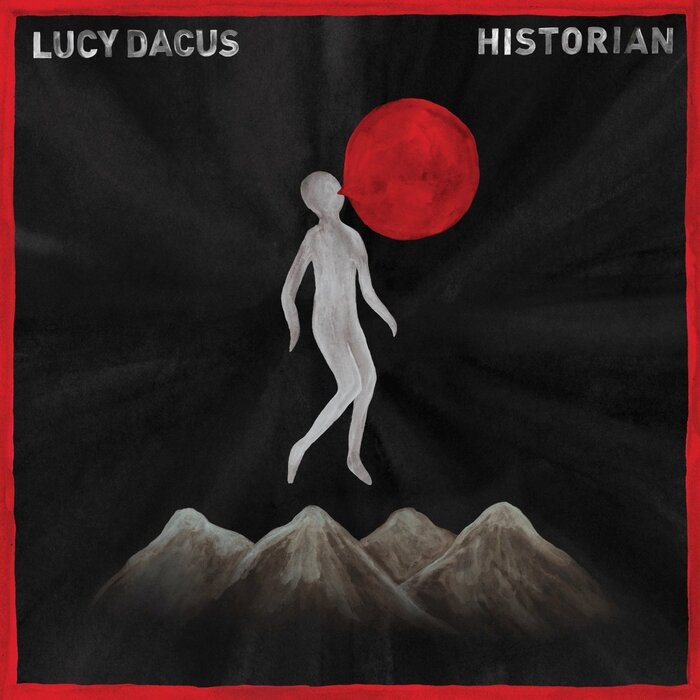
Lucy Dacus, Historian

A long and hectic, albeit fruitful, year is just getting going for 22-year-old Lucy Dacus, following the March 2nd release of what is decidedly her breakthrough LP, Historian, on Matador Records. Where her first LP, No Burden showcased her talent for embedding meditative lyrics inside approachable rock songs, Historian is a major artistic stride.

If you’ve ever picked a scab and felt pacified watching the slow bleeding, you’ll know the strange satisfaction of revisiting wounds that won’t heal. I began listening to Lucy Dacus’ Historian while mourning a relationship that was long dead. Its painful dissolution symbolized something more difficult: a loss of youthful idealism, a growing weariness with the world around me. The 22-year-old Dacus has a knack for distilling feelings that, while universal, feel denser at this age. Her evocative, tightly-wound lines unravel the messiness of human emotion: “I feel no need to forgive, but I might as well / Let me kiss your lips, so I know how it felt,” she sings on “Night Shift,” her sweet voice cleaving cleanly through the complexities she’s laid bare. It’s an album that allows you to surrender to your most vulnerable self, sober and unguarded