Posts Tagged ‘Lou Reed’

Lou Reed’s latest collection, ‘Rock and Roll Heart’ wasn’t a showcase for the usual diverse aspects of Lou Reed’s musical outpouring, moreover, it was a shower of bullets, shot at any given interested targets. Unfortunately for Reed, most of the shots missed, but we can be certain that the gun was loaded, what with, is up for countless debate. His Boston show from October 1976 at the Orpheum Theater drew the usual suspects with a snapshot of young punks and nearly crossed the line at missing out a performance of Heroin which when played, differed remarkably from the more familiar versions rolled out on stage since the early days with Nico et al and Transformer. WBCN-FM’s presence warranted expectation that maybe Lou Reed didn’t necessarily want or respect, but Reed’s vision is rarely blurred. The familiar resolute figure took the stage with the singular demeanour he was authorised to parade, but with the quiet seduction and subdued authority that always set him apart.

Echoes proudly presents the entire original WBCN-FM broadcast of Lou Reed’s astonishing performance at the Orpheum Theater, Boston, Massachusetts on 29th October 1976. Professionally re-mastered original FM recording with background liners and rare archival photos.

Lou Reed’s momentary departure into pop with the mould-breaking New Sensations is naturally made with bold intentions and with dark wit intact, but ironic? no, simply pop in the hands of a master craftsman. As well as marking Lou Reed’s fourteenth solo studio album, New Sensations was also a statement of intent whilst similarly bearing the trademark parallels of transgressive wit and intelligence that accompany his historic path to solo artist. The album was a potent mix of anxious pop that found little room for the distorted, exotic mongo that guitarist Robert Quine honed in previous works with Reed. Accompanied by Fernando Saunders on bass, Peter Wood on keyboards and the return of drummer Fred Maher, Reed’s perverse new structure in steroid sound was taken on the road including a midday show at the Agora Ballroom in Cleveland, Ohio Klondike proudly celebrates the posthumous performing career of the late Lou Reed with the entire WMMS-FM broadcast from his Coffee-Break performance at the Agora Ballroom on 3rd October 1984.

One of the better “bootleg” releases that we’ve seen Lou Reed shuffled off from this mortal. with a great band and Lou is pretty upbeat. The liner notes suck the writer doesn’t even know his topic. A lot of tracks from New Sensation album era.

Agora Ballroom, Cleveland, Ohio
10/03/1984

01 00:00 (DJ Intro) 0:42
02 00:42 Sweet Jane 4:08
03 04:50 Waiting for the Man 3:41
04 08.32 Martial Law 5:04
05 13:36 Legendary Hearts 3:42
06 17:18 Turn out the Lights 4:25
07 21:43 (Interview) 1:25
08 23:09 Sally can’t Dance 5:06
09 28:15 Walk on the Wild Side 5:18
10 33:33 Satellite of Love 6:25
11 39:59 (interview / Band Introduction) 1:23
12 41:22 My Red Joystick 5:10
13 46:33 New Sensations 7:11
14 53:44 Turn to Me 4:44
15 58:28 I Love You Suzanne / (DJ outro) 3:38

Lou Reed Band
Robert Quine (guitar)
Fernando Saunders (bass)
Peter Wood (keyboards)
Lenny Ferarri (drums)

Lou Reed, buoyed & rejuvenated by the response to the urban apocalypse suite of the just released New York album, hits the road…..Chronicling his grotesque & rotten home town ‘Big Apple’, whilst taking no prisoners, offers up wry & fragile hope among the decaying ruins. Does he succeed? Listen & hear……Tracklist includes

01/ Dirty Blvd. 02/ Endless Cycle 03/ Last Great American Whale 04/ Beginning Of A Great Adventure 05/ Busload Of Faith 06/ I Love You, Suzanne 07/ One For My Baby (And One More For The Road) 08/ Doin’ The Things That We Want To 09/ Rock ‘N’ Roll 10/ Video Violence 11/ The Original Wrapper 12/ Sweet Jane

The broadcast recordings included on this release showcases Lou Reed’s eighth solo album, Street Hassle , which was issued in February 1978, during the most prolific period of the man’s recording career. Lou Reed had embarked as a solo artist in the early 1970’s, following his departure from the extraordinarily influential Velvet Underground – a group he had led since its inception in late 1965. As Brian Eno so memorably claimed, “The first Velvet Underground album only (originally) sold 10,000 copies, but everyone who bought it formed a band.” Every one of the four Velvet Underground albums recorded during Lou Reed’s tenure with the group is included in ‘Rolling Stone’ magazine’s list of ‘The 500 Greatest Albums of All Time’. As critic Paul Nelson said of Lou in 1975: “Had he accomplished nothing else, his work with the Velvet Underground in the late Sixties would assure him a place in anyone’s rock & roll pantheon; those remarkable songs still serve as an articulate aural nightmare of men and women caught in the beauty and terror of sexual, street and drug paranoia, unwilling or unable to move.” Lou’s own versions of two of the most commercially successful tracks from the fourth VU album, ‘Loaded’ are included here. Rock And Roll is the semi-autobiographical tale of how music saved the life of a young radio-listener, invoking memories of Reed’s earliest musical endeavors as a salaried songwriter for Pickwick Records in New York in the early 1960’s. Sweet Jane, is another hook-laden delight riding a stone-cold classic riff that has been widely covered by a diversity of artists across the years, including Mott The Hoople, Cowboy Junkies, the Red Hot Chili Peppers and Metallica. After leaving the Velvets during the recording of ‘Loaded’ in August 1970, Lou moved to RCA Records and issued his first eponymously entitled solo album the following year. Well-crafted and featuring several songs originally written for the Velvet Underground, the album was well-received though not commercially successful. The follow-up, ‘Transformer’ (released in December 1972) and co-produced by David Bowie and Mick Ronson was a different matter entirely. It boasted an insistently memorable hit single in the shape of the marvelously affectionate tribute to the Warhol/Factory era, Walk On The Wild Side, a song that Lou reprises here, together with the glorious ballad Satellite Of Love – surely two of the most widely known and best-loved songs in the entire Lou Reed solo canon. The album was a triumph and really served to establish Lou Reed as a solo artist of considerable stature internationally. Never one to rest on his laurels, Lou quickly followed up with the much darker-hued and heavily orchestrated rock opera ‘Berlin’ and what became his highest-charting album, ‘Sally Can’t Dance’, which reached the Top 10 in the USA (both albums were released in 1974). Also out the same year was Reed’s classic live album, ‘Rock n Roll Animal’ which memorably featured an absolute orgy of hard-rock guitar from Dick Wagner and Steve Hunter. Subsequent records ‘Metal Machine Music’ (a collage of electronic feedback and effects) and the more accessible ‘Coney Island Baby’ (a lengthy reworking of the title tracks is included herein) and ‘Rock And Roll Heart’ were not as well-received, before 1978’s ‘Street Hassle‘ marked a strong return to form. There are live versions of five of the album’s eight tracks here: Gimme Some Good Times, Dirt, Street Hassle, I Wanna Be Black and Leave Me Alone. The studio version of Street Hassle notably included a spoken piece by an uncredited Bruce Springsteen. AllMusic’s Mark Deming described the record as “among the most powerful and compelling albums he released during the 1970s, and too personal and affecting to ignore.”

01 – Gimmie Gimmie Some Good Times
02 – Satellite of Love
03 – Leave Me Alone
04 – Walk on the Wild Side
05 – Coney Island Baby
06 – Dirt
07 – Street Hassle
08 – Sweet Jane
09 – Rock ‘n Roll

Lou Reed was touring in support of “Rock and Roll Heart”, when he rolled into L.A.’s Roxy and played a set that was recorded for later radio broadcast. Lou Reed and his road band (which included Michael Fonfara on keys and Marty Fogel on sax) sound like they’re having a fine time, and with free jazz legend Don Cherry sitting in, the band’s frequent jams give this an exploratory feel that sets it apart from some of Reed’s other live sets of the period.

Lou Reed himself is in a loose and playful mood (at least by his standards), occasionally goofing on the lyrics, and reveling the opportunity to make noises with a new guitar synthesizer. The set does include two lesser-known tunes from Rock and Roll Heart, ‘You Wear It So Well’ and ‘I Believe in Love,’ and the extended improvisations will make this worth a listen for serious Lou Reed fans!!, Available now from Amazon on
LP – 140 Gram Double transparent vinyls (White and Blue)

The Velvet Underground Share Unissued Single Version of “Rock & Roll”

The Velvet Underground announced a 45th-anniversary reissue of 1970’s album Loaded. Today, they’ve shared one of the six-disc set’s many rarities. “Rock & Roll” (Mono Single Cotillion 45-44133), from the second disc, is the mono mix featured on an unissued “Rock & Roll” single.

That final blast of the spectacular is Loaded; this latest Velvets birthday installment nicely broadens the landscape of their most straight-ahead studio disc. It’s also arguably their most influential LP, with much of their tenure as a legit cult act deriving from its merger of no-nonsense rock riffing, Tin Pan Alley-descended songwriting, and proto-glam moves. Really, any creeping fatigue over the VU reissue apparatus is easily eradicated by pondering just how influential they’ve been; for evidence,

loaded

Looking back on the circumstances around his departure from the Velvet Underground, Lou Reed had this to say in 1972: “I gave them an album loaded with hits to the point where the rest of the people showed their colours. So I left them to their album full of hits that I made.” The recording of Loaded was clearly an emotional time for Reed. The period between the March 1969 release of The Velvet Underground and the start of Loaded’s principal recording sessions in April 1970 was especially fraught for the group. They began work on a fourth studio album in May, 1969. But by August, the band had parted company with MGM – new MD Mike Curb envisaged a more wholesome direction for the label, and suspecting how that might pan out the for his charges, manager Steve Sesnick extricated the group from their contract. By November, the album had disappeared. Lou Reed, meanwhile, was having problems of his own. His long-running affair with Shelley Corwin, his muse, was in a slow decline. Increasingly disturbed by the effects of long-term drug use on close friends including Factory compatriot Billy Name, Reed responded by getting even more out of it. “Lou went out of his skull and ended up with a warped sense of time and space that lasted several weeks,”

At the start of 1970, the Velvet Underground signed to Atlantic Records, while still $30,000 in debut to MGM. Moe Tucker, meanwhile, took maternity leave in March; her stand-in was Doug Yule’s younger brother, Billy. Existing frictions between Reed and Sterling Morrison continued. “I had hardly spoken to Lou in months,” Morrison admitted to NME’s Mary Harron in 1981. “Maybe I never forgave him for wanting Cale out of the band. I was so mad at him, for real or imaginary offences, and I just didn’t want to talk. I was zero psychological assistance to Lou.” Elsewhere, other equally toxic dramas were being played out. Writing in The Velvet Underground fanzine in 1996, Doug Yule revealed, “Sesnick, always looking for the advantage, was driving wedges between everyone, trying to keep the bickering going and the communication between us shut off.”

By the time the Velvets convene to record Loaded, you could be forgiven for wondering whether they’d actually finish the album, or simply combust in the studio. The April to July sessions at Atlantic Studios, New York overlapped with a ten-week homecoming residency at Max’s Kansas City. Reed, worried about his straining his voice, ceded four lead vocals to Doug Yule. “The sessions for Loaded were extremely different than those which produced the third album,” Yule wrote. “Many of the songs had been played live, but the recorded versions were very different than the road versions. The emphasis was on air time. Every song was looked at with the understanding that there was a need to produce some kind of mainstream hit… Songs were built intellectually rather than by the processes that live performances brought to bear, instinct and trial and error.”

The songs – including their roll call of ladies: Jane, Ginny, Miss Linda Lee, Polly May and Joanna Love – represent a refinement of the band’s aesthetic – a healthy middle ground between the avant garde stylings of the first two albums and Reed’s Top 40 sensibilities. And such variety! From jaunty, Monkees style pop (“Who Loves The Sun”) to freewheeling rave-ups (“Oh, Sweet Nuthin’”). And then there’s “Sweet Jane” and “Rock & Roll”. The former, with its sensational ‘D-A-G-Bm-A’ hook, finds Reed on familiar territory, “Standing on the corner / Suitcase in my hand”, watching Jack and Jane, two straights: a banker and a clerk. Reed describes the differences between male and female, conservative and liberated, old and new, shifting perspectives as the song progresses, double backing on himself, wrong-footing the listener. It’s an immense and highly complex piece of narrative songwriting, followed by “Rock & Roll” – one of the great songs about the transformative power of music. Possibly autobiographical, it’s about five-year old Jenny, who “one fine morning turns on a New York station and she doesn’t believe what she heard at all.” Her “life is saved by rock and roll” and she is elevated to the ultimate Reed condition: “It was alright”.

“Cool It Down” is more up-tempo pop, this time with a Stonesy barroom piano, before “New Age” – another example of Reed’s next level song writing on this album. A love song of sorts – delivered by Yule – full of tender nostalgia for a “fat blond actress… over the hill now / And you’re looking for love”. But the real thing here is the song’s audacious three-act structure, beginning with the verses, rising at 3:08 to what you assume is the outro and then slipping in a majestic middle eight at 3:32 to lead you out of the song across the next minute and a half. “Head Held High” is a fun stomping boogie followed by the almost comically jaunty “Lonesome Cowboy Bill” and the beautiful “I Found A Reason” which walks a line between the doo wop so beloved by the young Reed and the stoned balladry of “Pale Blue Eyes”. The pace quickens with “Train Round The Bend” draped in eerie swathes of tremolo, before we reach the album’s hymnal-like closer, “Oh, Sweet Nuthin’”. Step forward Sterling Morrison, who delivers some fine intuitive guitar playing here opposite Reed: whatever issues they might otherwise have had, they operated entirely in synch here as Morrison’s loose, rolling guitar chords sit perfectly against Reed’s wide-ranging solos. Credit, though, is also due to Doug Yule: an accomplished multi-instrumentalist, whose work here – on bass, piano, guitar and vocals – provides a consistently solid bedrock for Reed’s flourishing songwriting.

Lou Reed left the Velvet Underground on August 28, 1970 after the final show at Max’s, leaving New York for his parents’ home in Freeport, Long Island. The strain had become too much for him. In his absence, Sesnick meddled with Loaded: he cut the “wine and roses” bridge section from “Sweet Jane”, trimmed back the ending to “New Age” and messed with Reed’s intended sequencing. Further, he shunted Reed’s name below Yule and Morrison on the band line-up for the album’s original pressing, and attributed the songwriting credits as: “All selections are by The Velvet Underground”. It took a subsequent court case to restore Reed’s full rights to all the material.

While Reed spent 1970 and 1971 in exile, Yule ploughed on with the Velvet Underground, fulfilling dates in Europe. It was a dismal end – their explosive promise fizzing out in European backwaters during the early Seventies, the corpse growing cold somewhere between Kingston Polytechnic and Northamptonshire Cricket Club. A fifth album, Squeeze, appeared in February, 1973 although this was ostensibly a Doug Yule solo record (with, curiously, Deep Purple’s Ian Paice on drums).

None of this, though, can diminish the power and brilliance of Loaded. As Reed himself observed, “Despite all the amputations, you know you could just go out and dance to a rock and roll station.” The power of rock and roll conquers all. It was alright.

Velvet Underground Unreleased

The Velvet Underground releases “The Complete Matrix Tapes” collects recordings made at San Francisco club the Matrix on November 26th and 27th, 1969. As previously reported, the four-disc box set will be released November 20th via Polydor/Universal Music Enterprises.
Including a previously unreleased recording of “We’re Gonna Have a Real Good Time Together”.

By September 1968, Lou Reed was hell-bent on kicking John Cale out of the Velvet Underground. Reed and Cale started the band, but after two albums, Lou was no longer interested in working with the Welsh musician.

It’s always been unclear as to why Lou Reed felt this way, but the most plausible reason is that he sought to make the Velvets more accessible, while John Cale wanted to keep one foot in the avant-garde. Regardless, in late September, after what would turn out to be Cale’s final concerts with the group, Reed met with drummer Maureen Tucker and guitarist Sterling Morrison and gave them an ultimatum: Either Cale goes or the band is finished. Reluctantly, Tucker and Morrison agreed to sack Cale. But with Cale’s exit and upcoming concerts scheduled for the first week of October, a replacement needed to be found—and fast. Doug Yule, a Boston musician who was friendly with the band, was quickly brought into the fold. Yule would have to swiftly learn a set of songs, many of which he hadn’t heard before because they hadn’t been released yet. He made his way to New York City to rehearse for shows booked at a small venue in Cleveland called La Cave. Yule’s first gig with the Velvets is usually cited as having taken place on October 2nd, though in his exhaustive book, White Light/White Heat: The Velvet Underground Day-by-Day, author Richie Unterberger writes that Yule’s debut was October 4th. Either way, the band’s new member had little time to prepare.

John Cale and Lou Reed

The Velvet Underground played two sets that first night in Cleveland with Yule, and thanks to recordings which were subsequently bootlegged, we can hear what they sounded like during this historic show. Incredibly, Yule already appears to be a good fit. He’s obviously up for the task, coming up with interesting bass lines—even singing background harmonies—on songs that he had just learned. His harmony vocal gelling perfectly with Reed’s during a lovely version of “Jesus” is just one of many cool moments. Reed’s guitar work is also noteworthy, like during the wild and weird middle section of “I Can’t Stand It,” but it’s the track that opens the first set that takes the cake.

“What Goes On” was one of many numbers played that first night that Yule barely had time to acquaint himself with (the tune would be included on their next album, The Velvet Underground, which came out the following year). There’s nothing all that interesting happening here at first (though Yule once again contributes some mighty fine harmonizing); that is, until Reed kicks off the initial solo with a fierce blast of noise. He follows up with melodic lines that resemble what would be heard on the now-familiar album take, but while the guitar tone on the LP version is psychedelic, here it’s all about volume and distortion. During the second and final solo, after a similar melodic passage, Lou lets it rip. At around the 4:52 mark, he goes into hyperactive overdrive, whipping up an atypically riotous, face melter of a solo that’s downright giddy in execution. It’s the sound of a man set free.

This joyfully savage version of “What Goes On” would appear decades later on Peel Slowly and See, VU’s 1995 boxed set, and to date it’s the only track from the Cleveland concerts to be officially released. In his liner notes for the box, David Fricke is suitably inspired by the rendition, writing that it’s “rich with pyro-fuzzbox spew and climaxes with a staccato rush of tonal destruction over Sterling Morrison’s implacable, syncopated rhythm clang.”

The Velvet Underground

As first-rate as Doug Yule is during his debut outing with the Velvet Underground, it’s Lou Reed who makes the performances extraordinary. His solos during “What Goes On” sound like they’re coming from a man who is positively euphoric. No matter what his motives were behind getting rid of John Cale, it’s undeniable when listening to him play how he felt about the end result. “What goes on in your mind?” I think we all know the answer here.

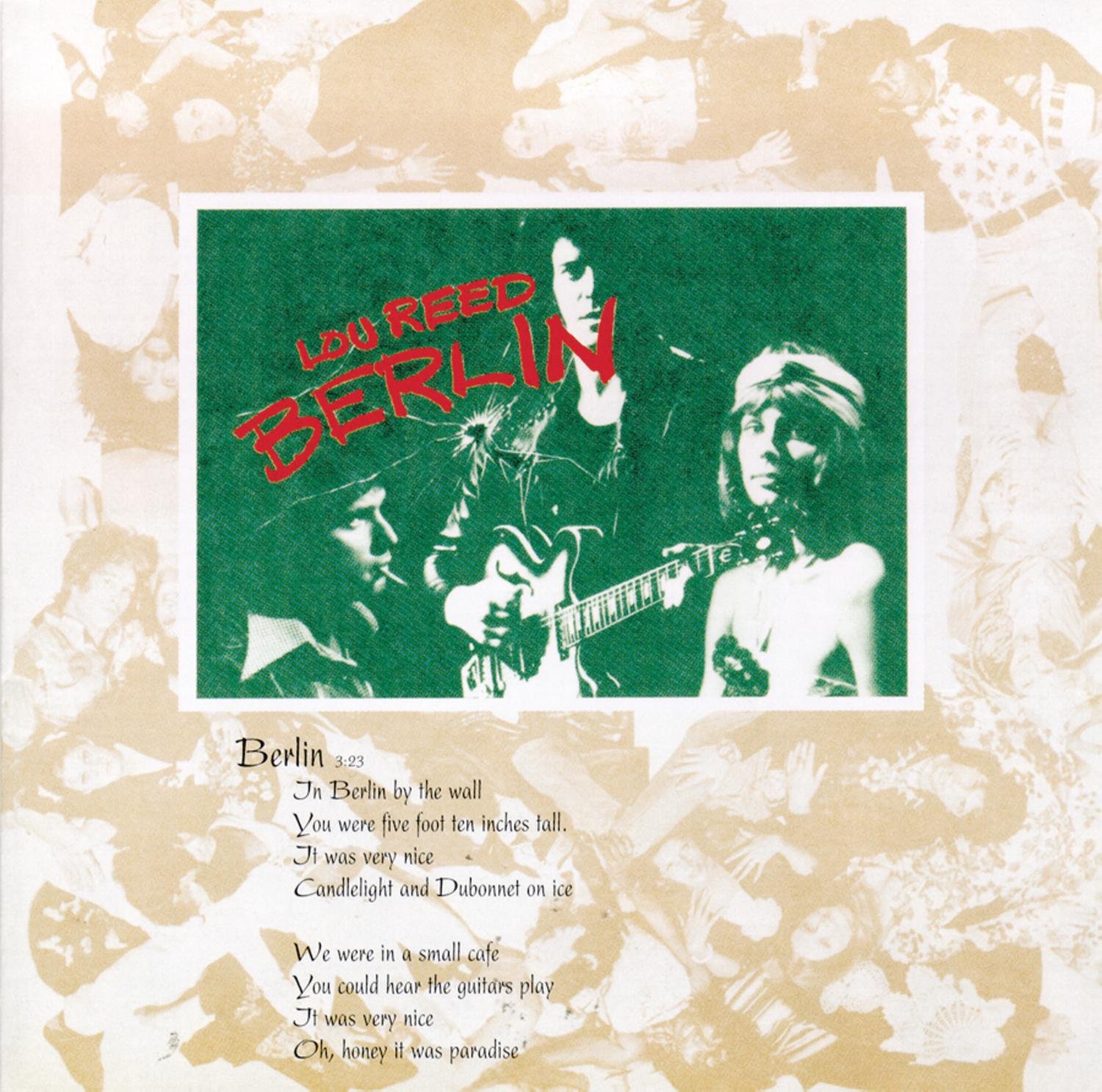
42 years ago “Berlin” by Lou Reed is released on  14th October 1973,  Berlin may be a great album, it’s just not an easy one to listen to. It’s intensely dark in its lyrical content, charting the doomed relationship of Caroline and Jim following them through drug addiction, domestic violence and suicide. Not the cheeriest of subjects for a concept album.  First released in 1973, it was a commercial failure but became a cult classic. Berlin came hot on the heels of Lou Reed’s glam rock masterpiece Transformer. Anyone expecting a commercial follow-up was non-plussed to say the least.

The album is a tragic Rock Opera about a doomed couple, Jim and Caroline, and addresses themes of drug use, prostitution,depression, domestic violence, and suicide.

“The Kids” tells of Caroline having her children taken from her by the authorities, and features the sounds of children crying for their mother. The UK group The Waterboys takes its name from a line in this song

Musically, Berlin differs greatly from the bulk of Reed’s work, due to the use of heavy orchestral arrangements, horns, and top session musicians. Instrumentally, Reed himself only contributes acoustic guitar.

As with Reed’s previous two studio albums, Berlin re-drafts several songs that had been written and recorded previously. The title track first appeared on Reeds Solo Debut album, only here it is simplified, the key changed, and re-arranged for solo piano. “Oh, Jim” makes use of the Velvet Underground outtake “Oh, Gin”.

Lou Reed has never been the most melodious of singers, but his gravelly, nasal, mumble-y singing suits the subject matter perfectly. His voice sounds like he has been there, done that, and adds an air of jaded, cynical depression to the tracks. Who else could carry off lyrics like, ‘Caroline says as she gets up off the floor/You can hit me all you want to, but I don’t love you anymore/ Caroline says while biting her lip/ Life is meant to be more than this, and this is a bum trip’?

“Caroline Says (II)” is a rewrite of “Stephanie Says” from the album VU. The Velvet Underground had also recorded an alternate demo of “Sad Song”, which had much milder lyrics in its original form. “Men of Good Fortune” had also been played by the Velvets as early as 1966; an archival CD featuring live performances of the band playing at Andy Warhols Factory provides the evidence of the song’s age. The CD featuring the early performance of “Men of Good Fortune” is not for sale and can only be heard at the Andy Warhol Museum in Pittsburgh, Pennsylvania.

’The Bed’’ sounds like a love song, but is instead about Caroline’s suicide. The words are filled with regret and the soft acoustic sounds help you picture her drifting into unconsciousness.

Berlin is definitely a challenge, and is about as far away from pop, or dinner party music as you can get. But thanks to Ezrin’s production it has a rich, lush sound with the string and horn sections, and backing choir (and occasional cracking guitar solo), showcased best on ‘’Sad Song’’.

Caroline Says II” has been covered by several artists: the Soft Boys, Human Drama, Suede and Siouxsie Sioux in 1993, Mercury Rev and Antony and the Johnsons. Marc Almond also covered the song with his band Marc and the Mambas on the 1982 album Untitled.

Originally recorded in 1983 for the album “Infidels”,Foot Of Pride” had been dropped from that album because neither Dylan nor the album’s producer, Mark Knopfler, seemed particularly happy with it, even though they’d recorded more than a half-dozen takes of it. Perhaps their dissatisfaction with it had to do with the song’s lyrics, which were a stern warning, couched in religious terms, to a woman who was full of the sin of pride, and/or with the way the song was performed, which was rather restrained, even disinterested (the harmonica solos were especially weak).
According to his “Great Lyrics and Jukebox Hits” list, on which he’d placed Dylan’s “Foot of Pride,” Lou said that he found the song “fucking funny” because “there’s a lot of anger” in it. And there is indeed a lot of anger in it, at least on the part of the song’s narrator (and presumably its author, too). But isn’t this seeing the finger that points instead of what the finger is pointing to? What about those who have let “the foot of pride” come upon them? Lou himself could certainly be accused of taking a great deal of pride in himself and his accomplishments. “My week beats your year,” he’d boasted in the liner notes to Metal Machine Music. “My bullshit is worth more than other’s people’s diamonds,” he’d told Lester Bangs. And so, when Lou Reed got onstage to sing “Foot of Pride,” it was more than not obvious and more than a little anomalous. Performed at the Bob Dylan Tribute Concert, Madison Square Garden, NYC, 16 10 1992
His version of the song was not a careful handling of a fragile museum piece. In fact, he made a couple of important changes to it. He changed “when your foot of pride comes down” to “when the foot of pride comes down,” which shifted not only the agent of this action, but also its meaning: instead of it being the woman who was taking a step full of pride, it was now God who was crushing her underneath His foot. And he changed the sound of the music: instead of being a restrained piece of folk rock, with a harmonica taking the solos, it was now a forceful rocker, with snarling guitars boiling and soloing.
But the biggest change – the thing that made Lou’s version unforgettable – was his singing. More than just animated or even agitated, it was ferocious, and not just in the choruses, when he sang “Hey, hey, hey, hey,” but also in the verses and especially in the second half of the song. When he thundered “No!” in answer to the question “Will they teach you how to enter into the gates of Paradise?” – when he broke up the line “Struck down by the strength of the will” into “Struck! Down! By! The! Strength! Of the will!” – he didn’t sound like a self-righteous rock singer or a preacher hypocritically predicting ruin for some other person. He sounded like God himself.

Today marks One year since the incredible musician Lou Reed passed away, In tribute to the founding member of the Velvet Underground, John Cale has taken this song from 1982 and made a video as a fitting tribute, with thoughts to Andy, Nico and Sterling a fitting tribute from John Cale.