Posts Tagged ‘Eric Clapton’

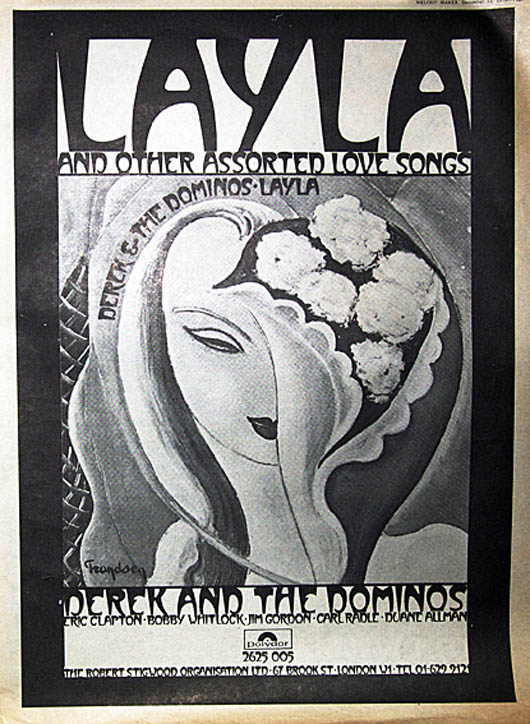
Derek & The Dominos: Layla And Other Assorted Love Songs: 50th Anniversary Edition Box Set

From The Roosters to the Yardbirds, John Mayall’s Bluesbreakers, CreamBlind Faith and Delaney and Bonnie; Eric Clapton had certainly been around over the previous 8 years, prior to forming his new band in early summer 1970. When this new band played their first gig at London’s Lyceum in the Strand on Sunday 14 June they hadn’t quite got around to giving themselves a name, that is until just before being introduced on stage but Derek and the Dominoes it all had a certain ring to it.

The other three members of the band, Bobby Whitlock on keyboards, guitar and vocals, bass player, Carl Radle and drummer and occasional pianist, Jim Gordon had all played together in Delaney and Bonnie’s band and all are on the album, Delaney and Bonnie On Tour With Eric Clapton that was recorded in South London in December 1969 and released in March 1970.

All four musicians also worked with George Harrison on his All Things Must Pass album and earlier in the day of their debut concert they were at Abbey Road for a Harrison session when they cut ‘Tell The Truth’ that became Derek and The Dominoes first single release in September 1970. The b-side of this single was ‘Roll It Over’, another recorded at an ATMP session and this included the former Beatle and Dave Mason of Traffic on guitar and vocals.

Following their London debut the band spent time rehearsing before embarking on a U.K. tour that opened at The Village Blues club in Dagenham Essex, not one of Britain’s most prestigious venues. For the next 22 days they criss-crossed the country playing 18 gigs, ranging from London’s Speakeasy Club to The Black Prince Pub in Bexley Kent and The Penthouse in Scarborough in Yorkshire; there was even a side trip to Biot in France for a lone cross-channel gig.

During July and while the band was touring, Robert Stigwood, the band’s manager, was busy arranging the band’s recording for their debut album. He called Tom Dowd who was working on The Allman Brothers sessions for Idlewild South and told him that the band wanted to come to Florida to record at Criteria Studios in Miami.

Less than a week after their last gig in Plymouth’s Van Dike Club, Clapton, Radle, Whitlock and Gordon were in studio A at Criteria ready to get down to business. On the evening of 26 August Clapton and the others had been invited to an Allman Brothers concert at Miami Beach Convention Center; as Clapton watched Duane play for the first time was hooked. After the gig the two bands headed back to Criteria and jammed for hours.

On Friday 28 August the sessions for Layla and Other Assorted Love songs began in earnest, joining the other four musicians for the next week or so of recording was Duane Allman who was thrilled to be playing with Clapton. The first song they recorded was Clapton and Whitlock’s, ‘Tell The Truth’ – a far more assured version than their earlier effort; it became the opening track of the first side of the second record on the double album that came out in November 1970.

There was no recording on Saturday, but on Sunday and for the next five nights there was some intense activity, intense because on 4th September Duane had a gig in Milwaukee with the Allmans. On Sunday night the session was under way, and despite Tom Dowd’s orders to keep the tapes running at all times, someone had screwed up and it was only Dowd rushing back into the control booth from the men’s room shouting, “Turn the faders up” that preserved the brilliance of the cover on Big Bill Broonzy’s, ‘Key to The Highway’. If anyone asks you if white men can play the blues, point them in the direction of this track.

Monday produced ‘Nobody Knows When You’re Down and Out’ and ‘Why Does Love Got To Be So Sad’. On Tuesday Clapton and Whitlock’s, ‘Keep On Growing’ was laid down. Wednesday, I’ Looked Away’, ‘Bell Bottom Blues’ and a cover of a Billy Myles song, made famous by Freddie King, ‘Have You Ever Loved A Woman’; King was one of Clapton’s favourite blues guitarists.
Layla
Thursday was the last day of Duane Allman being available and the band nailed, ‘I Am Yours’, ‘Anyday’ and another by the man they called, ‘The King of the Stroll’, Chuck Wills’s, ‘It’s Too Late’. On Friday and Saturday, with Duane away, the rest of the guys concentrated on overdubs for everything they had so far recorded, barring ‘Key to The Highway’ and ‘Nobody Knows When You’re Down and Out’.

After the Allman Brothers Milwaukee gig they played another at Jolly’s Place in Des Moines on 6th September after which Duane flew back to Miami so that the last few songs could be completed. On Wednesday 9th September there was also overdubs to be done and the five musicians, who by this time were all in the proverbial zone, together tackled ‘Little Wing’ and ‘Layla’.

‘Little Wing’ is the band’s tribute to Jimi Hendrix who recorded it on his Axis: Bold Is Love album in 1967. It is a monumental; record, the playing so tight, which belies the fact that Whitlock later recalled he had never heard the song before they cut it and had the words laid out on top of his organ so he could sing them. Nine days later Hendrix died at the Samarkand Hotel, in London’s Notting Hill.

And then there’s ‘Layla’. Clapton was inspired to write the first part of the song having been given a copy of the Persian classical poet, Nizami Ganjavi’s book, The Story of Layla and Majnun. As we now know it is Clapton’s love song to Pattie Boyd, who at that time was married to George Harrison; she later married Clapton in 1979. It is also a song of two halves.

The first half recorded by the band on sixteen tracks including multi layered guitars by Clapton and a single track of Allman’s solos. After laying down his song Clapton returned to the studio to hear Jim Gordon playing a piano piece that he immediately loved and decided he wanted to add it to ‘Layla’ to complete the track; it proved to be an inspired decision of a happy coincidence. The composing credits on the song are Eric Clapton and Jim Gordon, but Gordon had in fact borrowed the melody from his former girlfriend.

According to Bobby Whitlock, “Jim took that piano melody from his ex-girlfriend Rita Coolidge. I know because in the D&B days I lived in John Garfield’s old house in the Hollywood Hills and there was a guesthouse with an upright piano in it. Rita and Jim were up there in the guesthouse and invited me to join in on writing this song with them called ‘Time.’ Her sister Priscilla wound up recording it with Booker T. Jones; Jim took the melody from Rita’s song and didn’t give her credit for writing it. Her boyfriend ripped her off.”

For the last session for the album it seems somehow appropriate that it should be the delicate, ‘Thorn Tree In The Garden’ a Bobby Whitlock song, which he also sings, that is poignant and such a fitting closer. It’s like the morning after the party when there is peace and quiet imbued with a reflective air that is perfection.

After wrapping up the sessions Clapton, Whitlock, Radle and Gordon headed back to the UK to begin an extensive bout of touring beginning at Croydon’s Fairfield Halls, in South London on 20th September. Between then and 28th September they played eight UK dates and another in Paris. However, according to the tape boxes for the Layla sessions there were sessions in Miami at Criteria on 1 October where they overdubbed ‘Layla’ and ‘It’s Too Late’ and on the following day Clapton, Allman and Gordoncut a version of little Walter Jacob’s ‘Mean Old World’. October 1st was a Thursday and on that day Derek and The Dominos, were 4,400 odd miles away from Florida in the south of England playing a gig at Swindon Town Hall. So what is the story here? Could it be that they flew to Miami during their two days off on 29th and 30th September and the boxes were labelled a day or so later?

We are continuing our investigations with the help of Bill Levenson who produced the 40th anniversary reissue of Layla And Other Assorted Love Songs.   

Thanks to UDiscover.
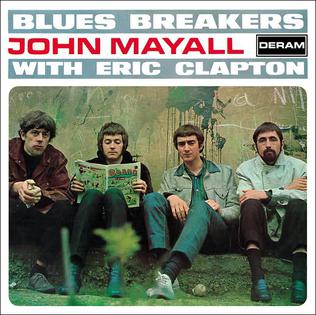
July 22nd 1966 saw the release of what has become the greatest British blues albums of them all, John Mayall Blues Breakers with Eric Clapton. It was the first studio album and the second overall credited to John Mayall, who teamed up for the first time in a studio release with the ex- Yardbirds Eric Clapton.

It is also known as The Beano Album because of its cover photograph showing Clapton reading The Beano a British children’s comic. Clapton stated in his autobiography that he was reading The Beano on the cover because he felt like being “uncooperative” during the photo shoot

The album set the benchmark for all blues albums that followed, cemented by Clapton’s explosive guitar tone thanks to the majestic bonding between a Gibson guitar and a Marshall amplifier. Not only is it the greatest British blues album but it’s also one of the great albums of all time, period. Recorded April 1966 at Decca Studios West Hampstead, London.

The guitar that Eric Clapton used during these sessions was a sunburst 1960 Gibson Les Paul Standard with two PAF humbucking Pickups . This guitar (which was stolen in 1966; its whereabouts remain unknown) is also called the “Blues Breaker” or “Beano” Les Paul and a replica of which was reissued by Gibson in 2012. 

The band on this album includes Mayall on piano, Hammond organ, harmonica and most vocals; bassist John McVie drummer Hughie Flint and Clapton. Augmenting the band on this album was a horn section added during post-production.

The album opens with the Otis Rush number “All Your Love”, a cracking way to begin. The song manages to capture everything great about the Bluesbreakers from John Mayall’s unique vocals, Clapton’s explosive guitar, McVie’s pounding bass and Flint’s driving rhythm that is the back bone of the entire song. It’s followed by “Hideaway” which has arguably become the standard version of the song, the original of course being by the late great Freddie King who Clapton was hugely influenced by at the time. Even though it’s a song largely dominated by Clapton’s guitar, the entire band shine brightly and showcase their abilities as Britain’s premier and best British blues band. The first Mayall penned track comes next in “Little Girl”. Apart from Mayall’s vocals, Clapton again takes centre stage with a blistering guitar solo over the ruthless rhythm section of John McVie and Hugh Flint, both of which really take this song to another level. “Another Man” is pure Mayall drenched with some of the best harmonica playing you’ll ever hear.

Things then slow down a tad with “Double Crossing Time”a fantastic number written by Mayall and Clapton. It’s a wonderful slow blues which clocks in at just over three minutes in length which is the only downside as you feel it deserves to go on for at least another few minutes. The opening riff of “What’d I Say”, originally by Ray Charles, is next and this particular version remains one of the most exciting ever recorded. Mayall gives one of his best vocal performances and it’s the first time on the album so far where you’re able to bask in the magnificence of Hugh Flint’s drumming, as he plays a superb solo section halfway through the song. The rest of the band then return with a Day Tripper-esque riff to bring the song to a close. Next up is “Key To Love” which is another Mayall original. Flint is an abs0lute force of nature with some of the best drumming you’ll ever hear, and Clapton returns for another ear drum attacking guitar solo.

Released: July 1966 (mono) / December 1969 (stereo)

John Mayall: Lead vocals, piano, organ, harmonica

Eric Clapton: Guitar, lead vocals on “Ramblin’ on My Mind”, John McVie: Bass guitar, Hughie Flint: Drums, Plus: Alan Skidmore: Tenor saxophone, Johnny Almond: Baritone saxophone, Derek Healey: Trumpet

The great “Parchman Farm” comes next which was originally recorded by Bukka White in 1940 and then covered by a host of musicians including Mose Allison, Johnny Winter, Bobbie Gentry and Hot Tuna to name just a few. Mayall is a man possessed on harmonica here, arguably giving his finest musical performance of the entire album. The slow blues number “Have You Heard” then takes things in a slower direction, at least at first. When it comes to electric guitar solos this song certainly contains one of the finest ever recorded with Clapton showing exactly why the nickname “God” was so fitting. The things he managed to do with a guitar during this song are second to none in my opinion, firmly placing him as the greatest British blues guitarist of all time.

“Ramblin’ On My Mind” remains to this day as one of Robert Johnson’s most well known songs, helped by the legendary status of this version featuring Clapton on lead vocals. And it’s the fact that Clapton took lead vocal duties on this song that made it so legendary, after all this is the first time he ever sang lead on a song. Even though he used to sing backing vocals with The Yardbirds it’s a strong vocal performance with guitar accompaniment including a tasty solo, backed up by Mayall on piano. It’s probably the most pure blues song of the whole album and a song that opened up Clapton both vocally and musically, as he would go on to call Robert Johnson one of his main influences and as a eventually record Me & Mr. Johnson, a tribute album to his idol, in 2004. “Steppin’ Out” is the second guitar lead instrumental after Hideaway and a song Clapton would continue playing with Cream up until their final active year in 1968. It’s a superb number with Clapton yet again showcasing his guitar abilities fantastically. The final song is “It Ain’t Right” which sees the album end on a wonderful note. Originally recorded by Little Walter, Mayall lays down some fine harmonica while the rest of the band hit hard like a freight train. A perfect way to end the album.

Original album

Side one

  1. All Your Love” (Otis Rush) – 3:38
  2. Hideaway” (Freddie King/Sonny Thompson) – 3:17
  3. “Little Girl” (Mayall) – 2:36
  4. “Another Man” (Mayall) – 1:47
  5. “Double Crossing Time” (Clapton/Mayall) – 3:04
  6. What’d I Say” (Ray Charles) – 4:28

Side two

  1. “Key to Love” (Mayall) – 2:08
  2. Parchman Farm” (Mose Allison) – 2:22
  3. “Have You Heard” (Mayall) – 5:56
  4. Ramblin’ on My Mind” (Robert Johnson) – 3:08
  5. Steppin’ Out” (L. C. Frazier) – 2:30
  6. It Ain’t Right” (Little Walter) – 2:45

Overall it’s a faultless album, A considerd Classic album. Not only do you get to witness the evolution of Eric Clapton but you get to listen to British blues at it’s very finest. The band as a whole were fantastic. John Mayall, Eric Clapton, John McVie, Hugh Flint.

Cream Say ‘Goodbye’

Cream may have had all too short a lifespan as far as their millions of admirers around the world were concerned — but at least they had the chance to say ‘Goodbye’ to each other. That, of course, was the title of the trio’s fourth and final studio album, released a few weeks after they announced that they would soon be splitting. The album made its American chart debut 47 years ago exactly, on February 15, 1969.

It had been an eventful few months for Eric Clapton, Jack Bruce and Ginger Baker, who had only released the preceding album, ‘Wheels Of Fire,’ the previous July in the UK. Then came the announcement that Cream would call it quits after a farewell tour that autumn.

With a shortage of material available, ‘Goodbye’ was something of a mixed bag. Just as ‘Wheels Of Fire’ had (in its double LP version) been one disc of studio recordings and another of live performances, the final album was another 50-50 split. Three of its six tracks were recorded at the Forum in Los Angeles on that last tour. 19th October 1968 . The other tracks recorded October 1968 at IBC Studios in London, UK.

But the record did boast a very fresh and newsworthy studio number, and one written by Clapton with George Harrison, no less: ‘Badge’ featured George, or “L’Angelo Mysterioso” as he had to be credited for contractual reasons, on rhythm guitar. The song became, in many eyes, the last classic Cream number, and went on to reach the UK top 20 as a single.

Badge was written by Eric Clapton and George Harrison. In Georges handwritten lyrics he wrote the word “Bridge” as in bridge of a song and Clapton thought that it was “Badge” so they named the song that.

It appeared on Cream’s final album “Goodbye.”Ringo Star threw in a line also.

George Harrison on writing Badge with Clapton

I helped Eric write “Badge” you know. Each of them had to come up with a song for that Goodbye Cream album and Eric didn’t have his written. We were working across from each other and I was writing the lyrics down and we came to the middle part so I wrote ‘Bridge.’ Eric read it upside down and cracked up laughing – ‘What’s BADGE?’ he said. After that, Ringo [Starr] walked in drunk and gave us that line about the swans living in the park

I like when a band does something different. After blitzing audiences with Crossroads, Whiteroom, Sunshine of Your Love, and Strange Brew…out comes this song. It’s not my favorite Cream song…that would be Badge but this one always makes me smile.

The song was written by Eric Clapton and Martin Sharp for the movie “Savage Seven.” Unfortunately, this was nearing the end of Cream’s run.

Cream appeared on the Smothers Brothers and mimed this song. Who the hell knows what it means but when I heard “And the elephants are dancing on the graves of squealing mice. Anyone for tennis, wouldn’t that be nice?” I was hooked. It’s hard to get it out of your head once you listen to it.

‘Goodbye’ made its US chart entry on Billboard’s Top LPs chart, as it was called at the time, at No. 107, as ‘The Beatles’ moved back to No. 1. In a 26-week chart run, it spent two weeks at No. 2 in March, held off the top spot by Glen Campbell’s ‘Wichita Lineman.’

cream-box-set

10 x 7” singles from the original rock power trio. Cream blazed an indelible trail through the latter half of the ‘60s with their challenging and exquisite mélange of blues, pop and psychedelia. These tracks offered a window to the wilder, widescreen adventures of their long players and here they are in glorious mono with specially designed picture sleeves; a fitting tribute to the skills of the three players, and especially to Jack Bruce, who left us in October 2014.

• Original mono versions, deleted since 60s. 10 x 7” singles, picked from Reaction, Atco and Polydor labels.

• Each 7” single comes complete with a brand new exclusively designed picture sleeve.

• Housed in a rigid ‘lid-and-tray’ box, full colour and matt lamination.

• Standard weight, classic dinked vinyl.

• Cream collectors dream!

Cream Wrap Up The Charts

Did you know that ‘Wrapping Paper’ was Cream’s very first single? If you didn’t, and you’ve never heard it we think you may be more than a little shocked. The band that became the model for just about every heavy rock band that followed in the immediate wake, sound anything but a rock band. Even allowing for the kind of off the wall reviews that appeared in 1960s pop papers this one is surprisingly accurate. This is the very first review of any Cream release, anywhere in the world.

cream review
Released by Reaction Records in the UK early October 1966 this piece of whimsical jazz influenced pop was written by Jack Bruce and Pete Brown (Pete co-wrote ‘I Feel Free’, ‘White Room’ and ‘SWLABR’ with Jack and ‘Sunshine of Your Love’. With Eric Clapton). ‘Wrapping Paper’ does feature a guitar solo, but it’s far from a trademark blistering blues outing. According to Ginger Baker, “‘Wrapping Paper’ is the most appalling piece of shit I’ve ever heard in my life! I was totally against it, right from the start... Eric and I didn’t like it”

‘Wrapping Paper’ made the UK singles chart on 22 October 1966 and eventually staggered to No.34, but no higher. The b-side is ‘Cat’s Squirrel’, a song made popular by bluesman Doctor Ross, that was also the opening track on side 2 of Fresh Cream the band’s debut album that was released in early December 1966. Unsurprisingly given Ginger’s views it did not include ‘Wrapping Paper’: Fresh Cream did come out in Sweden with ‘Wrapping Paper’ included.

The very first advert for any Cream release…

661014 first cream ad sm

Single 1: Reaction 591007
Wrapping Paper 2.24
Cat’s Squirrel 2.59

Single 2: Reaction 591011
I Feel Free 2.48
NSU 2.43

Single 3: Atco 6522
Spoonful – Part I 2.25
Spoonful – Part II 2.28

Single 4: Reaction 591015
Strange Brew 2.45
Tales Of Brave Ulysses 2.50

Single 5: Polydor 56258
Anyone For Tennis 2.37
Pressed Rat And Warthog 3.12

Single 6: Polydor 56286
Sunshine Of Your Love 4.11
SWLABR 2.30

Single 7: Polydor 56300
White Room 4.58
Those Were The Days 2.52

Single 8: Atco 6646
Crossroads 4.16
Passing The Time 4.31

Single 9: Polydor 56315
Badge 2.43
What A Bringdown 3.56

Single 10: Atco 6708
Lawdy Mama 2.47
Sweet Wine 3.16

Arguably the supergroup to beat them all, Cream were formed during that incredible summer of 1966 amidst a period of huge artistic upheaval in British rock, with psychedelia beginning to infiltrate the mainstream. Eric Clapton, Jack Bruce and the estimable Ginger Baker pooled their talents, bringing skills perfected in the Yardbirds, John Mayall & The Bluesbreakers and the Graham Bond Organisation. It’s impossible to overstate the goodwill and praise heaped upon them by press and public alike and from the outset their studio music and live performances became a byword for excellence, enabling them to rival the The Who and The Rolling Stones as one of the most fruitful periods in British rock history started to make England swing.

Their albums and singles successes include – well everything. Consider that their third disc, Wheels of Fire, was Britain’s first Platinum selling double album. So they had impeccable progressive integrity. Yet they also knocked out wah-wah driven hits  ‘Sunshine of Your Love’, ‘I Feel Free’, ‘White Room’ and the sublime ‘Badge’, that featured George Harrison and kick-started another new chapter in the music business. They were also fashion icons, post-mod dandies of the underground. They were all over the scene.

Cream’s musical dexterity Eric Clapton’s epic guitar playing, Bruce’s jazz sculpted bass and impeccable vocals, and Ginger Baker’s virtuosity around his drum kit foreshadow the arrival of Led Zeppelin, The Jeff Beck Group and the whole second British Invasion of the late 1960s in America. Cream pioneered that. Considering they were only really together for just over two years they were incredibly prolific and became such a legend that their reunion dates in 2005 were as eagerly anticipated as those of Led Zep.

Rock and Roll Hall of Famers, individually and collectively, creators of seven Top 40 UK hits, holders of six consecutive Gold selling albums  Cream’s achievements are many and their legacy is to be a lasting influence on power trios, the beginnings of heavy metal and classic British blues rock – modern music full stop.

Eric Clapton’s presence as the pre-eminent British guitar player of his day meant that when he quit the Yardbirds there were already signs of the graffiti ‘Clapton is God’ adorning London walls. His friendship with Jack Bruce and Ginger Baker stemmed back to nights sitting in with the Graham Bond Organisation and at Baker’s instigation the trio was formed and readily named as a semi-jocular reference to their ‘cream of the crop’ reputations. In reality Cream also endured a long period of internal friction. Baker’s view that Cream might become a jazz-rock hybrid wasn’t really shared by the others who preferred to wander into psych or white blues and soul. That tension only made them sound better. After playing a club date and headlining the Windsor Jazz and Blues Festival, Cream were joined for an on-stage jam by Jimi Hendrix and suitably energised by his endorsement, the band began to get down to serious song writing.

670520-Cream-gig-copy

The debut Fresh Cream was recorded in London in the late summer of ’66 during a period of intense national euphoria following the England team’s victory at the World Cup Final and released at Christmas. Musically, Fresh Cream is a pointer to things to come. It combines elastic pop tunes like ‘N.S.U.’ with exploratory blues affairs: you can hear the participants sizing each other up on ‘Spoonful’ and ‘Toad’.That sense of boundaries being pushed is significant, since most other records of the time were based around some kind of democratic structure. Cream sounded like they were about to break out and go nuts.

Cream_edited-1-copy

This they did on Disraeli Gears (1967), a fully-fledged psychedelic and hard rock masterpiece knocked out in short order in New York’s Atlantic Studio during May ’67. Pulsating tracks ‘Sunshine of Your Love’ and ‘Strange Brew’ were epic enough when heard on the radio, but takes of ‘Tales of Brave Ulysses’, Baker’s ‘Blue Condition’ and ‘Outside Woman Blues’ continued to break down barriers. Bruce had brought the lyricist Peter Brown into the fold so while they continued to mine traditional material and give it a fresh Cream slant they also had a poetic slant to contemplate now. ‘Strange Brew’ was actually a co-write between Eric and the American husband and wife team of Felix Pappalardi and Gail Collins (they also penned ‘World of Pain’). While the trio combined to grand effect on the harmonised ‘Mother’s Lament’. A calm before the storm?

Disraeli Gears would go Platinum, as would their third album Wheels of Fire. This double is half-studio (London, August ‘67) and half-live from the West Coast (March ’68), where the San Francisco elite (the Dead and Airplane included) feted Cream. Pappalardi was now brought in to produce and he extracted marvellous performances. The first part of the pact includes such revered neo-metal items as ‘White Room’ and ‘Politician’ (Bruce and Brown in tandem) while the second album allows listeners to hear Cream in their expanded pomp, jamming around ‘Crossroads’, ‘Spoonful’, ‘Traintime’ and ‘Toad’. Each band member gets ample room to shine and this is generally considered to be one of the most inspired and vital recordings of this or any other epoch. It is totally recommended.

Wouldn’t you know it; just as their star burns brightest, Cream decided to disband. But that was the spirit of the era. Musicians were restless and keen to explore new ground. Even so they left behind a generous farewell gift, the album Goodbye (1969). Having given their notice of a slightly protracted farewell tour, Cream played at the Royal Albert Hall and the Forum in Los Angeles, amongst other venues. Three of the songs on the disc are taken from a show at the Forum, making a seamless transition from the previous set.

690000-Cream-Farewell1-copy-2

The luscious ‘Badge’ which features some of Clapton’s most thrilling guitar work also has a rhythm guitar and vocal cameo from George Harrison, and the poignantly titled ‘What a Bringdown’ bring this chapter to a close. Goodbye is a very esoteric set indeed.

But that’s by no means the end . Live Cream Volume 1 and Live Cream Volume 2 compile their Fillmore West, Winterland and Oakland Coliseum shows from the American 1968 tour, but with some subtle differences that make them both hugely worthwhile. The first disc features ‘Hey Lawdy Mama’ done after the style of Buddy Guy and Junior Wells, and a precursor to ‘Strange Brew’, while the re-mastered editions allow one to explore ‘Deserted Cities of the Heart’ and the strung out version of James Bracken’s ‘Steppin’ Out’.
680314-Cream-concert-copy

just as invaluable is the superb BBC Cream Sessions (recorded between 1966-1968) since this captures them in a neutral environment, often showcasing their material for the first time to fans. The first five tracks are taken from a November ’66 performance at the Playhouse on Lower Regent Street, and were aired on radio even before the debut album Fresh Cream became available. There are also pieces from Top Gear, the rare Guitar Club take on ‘Crossroads’ (done for the Home Service) and three live in the studio recordings made for the World Service. A most unusual and desirable artifact – this 26-track disc is a valuable historical document.

The Very Best of Cream and Those Were The Days are a classic compilation and a classic compilation plus. The second collection is a 4-CD marvel stuffed full of rarities, demos, unreleased material and single B-sides. We’re digging on the long form ‘Toad’, freaking out to the version of ‘Sunshine of Your Love’ they cut for the Glen Campbell Show in 1968, the demo on ‘Weird of Hermiston’ and the flipside track ‘Anyone for Tennis’. There’s so much to discover here. As a supplementary, we also have The Cream of Clapton, a more than nifty run through Eric’s work as a solo artist, founder of Derek and the Dominos and axe man incarnate with the Cream boys.

Original-Layla-Ad_edited-1

The story of Derek and the Dominos, “Layla and Other Assorted Love Songs “ is not all it seems. Neither the album, whose title is taken from the track ‘Layla’, nor the outstanding single, that is now considered one of rock’s greatest love songs, do nearly as well when they were originally released as many of us imagine.

The album came out in November 1970, and in America made the charts later that month entering at 195, going on to peak at No.16, probably not as high a chart placing as many would guess, if asked. In the UK Layla and Other Assorted Love Songs failed to chart at all, no that’s not quite true. It finally made No.68 on the album charts in 2011 when it was reissued.

Despite Layla and other Assorted Love Songs being recognised as a blues rock classic, Eric Clapton’s debut release while in a band was initially a massive flop. The album’s failure, coupled with the various personal and band tragedies caused Derek and the Dominos to disband after only a year. We’re forever grateful for timeless classic ‘Layla’ and also this forgotten beauty…

The review in Britain’s Melody Maker was somewhat reserved in its praise for the album, stating that “If you do judge Derek and the Dominos by Cream standards you’ll be disappointed.” It has as the years have rolled by become increasingly popular and many now regard this as Eric Clapton’s masterpiece. Layla and Other Assorted Love Songs has been inducted into the Grammy Hall of Fame, and Rolling Stone Magazine its list of “The 500 Greatest Albums of All Time”.

But what about Layla as a single? In the US it was released as an edited 45rpm in March 1971 and made No.51 in the charts: ‘Bell Bottom Blues’ was the lead single from the album. A year later a longer version was issued in the US and it fared a lot better, reaching No.10 on the Billboard charts. In the UK it was not released at all until 1st August 1972, and only then in the shortened version (barely 2 and three quarter minutes long). It made No.7 on the charts in 1972 and a decade later it charted again, making No.4 in 1982.

The Melody Maker’s July 1972 review of Layla

720729-Layla-review_edited-1


Alternate version of Brown Sugar by The Rolling Stones, recorded in the Sticky Fingers sessions. The Stones have been unleashing alternate versions of tracks off their classic 1971 LP Sticky Fingers before the album’s deluxe remastered reissue . This time, the Stones have shared a looser take on the opening track “Brown Sugar” that features the band rocking out with Eric Clapton. This oft-bootlegged rendition, recorded during Keith Richards and Bobby Keys’ birthday party in December 1970, is cleaned up for the reissue, allowing Clapton’s excellent slide guitar work to shine.

The playful, freewheeling take also features Al Kooper on piano in place of Ian Stewart, whose work appears on the Sticky Fingers version.

Ronnie Wood in 20 Songs

Ronald David Wood, artist, songwriter, and one of Britain’s finest, and possibly most underrated, guitar players was born on 1st June 1947. His is a musical family: Ronnie’s older brother Art formed the Artwoods, who included Jon Lord, later to a co-founder of Deep Purple, and drummer Keef Hartley, who played with John Mayall and later had his own band.

Ronnie Wood’s first group was a West London R & B outfit that he co-founded as a 16-year-old. The Birds released a string of singles, with much of their material written by Ronnie, but by 1967 he had joined The Jeff Beck Group, as the bass player, along with singer Rod Stewart and Micky Waller on drums. The Beck group recorded two classic albums, and ‘Plynth (Water Down The Drain)’ is a track from their second, Beck-Ola. He also briefly played with The Creation, a band formed by ex-Bird Kim Gardner.

641214 Birds-Howlin Wolf ad
In 1969 Art Wood formed Quiet Melon, with Ronnie, Rod Stewart, Ronnie Lane, Kenney Jones, Ian McLagan and Kim Gardner. They cut four songs for Fontana but they went unreleased and soon after the band split with the two Ronnies, Rod, Kenney and Ian going on to form The Faces. Ronnie Lane, Ian and Kenney had of course played together in the Small Faces.

Just prior to the Faces forming, Rod Stewart got a solo contract with Vertigo Records and recorded An Old Raincoat Won’t Ever Let You Downon which Ronnie played guitar and bass, as well as harmonica on ‘Dirty Old Town.’

A month later, The Faces released their debut album and it featured several Ronnie Wood co-written songs, including ‘Around The Plynth’ which showcases Ronnie’s excellent slide guitar playing. The album “Long Player”which followed in 1971, included ‘Sweet Lady Mary’;A Nod Is As Good As a Wink… To A Blind Horse, later that same year, included the Faces anthem ‘Stay With Me’, again co-written by Ronnie. The Faces swansong was 1973’s “Ooh La La” , which had another of Ronnie’s songs, written with Ian McLagan and Rod Stewart, ‘Cindy Incidentally’.

Faces
In between making the Faces records, Rod Stewart also recorded his own solo albums, with the second, Gasoline Alley in 1970, breaking through into the UK album chart, with its title song coming from the pens of Rod and Ronnie; it again features Ronnie Wood’s by now trademark slide. 1971’s Every Picture Tells A Story was the big one for Rod Stewart, topping the charts in both Britain and America. Once again the title song is a Ronnie and Rod co-write. In 1972 “Never a Dull Moment” came out, which included Ronnie’s co-write,‘True Blue’ as its opening track. Rod and Ronnie’s last collaboration was on “Smiler” (1974). ‘Sailor’ comes from this album and it’s so typical of their recording together.

In late 1973, the seeds of Ronnie Wood’s future career were sown when, along with Mick Jagger, David Bowie as backing singer, Willie Weeks on bass and Kenney Jones on drums, they recorded the basic track that became ‘It’s Only Rock ‘N Roll (But I Like It)’ in the studio at Wood’s house, “The Wick” in Richmond, London. In 1974 both Jagger and Keith Richards played on Ronnie’s first solo album, “I’ve Got My Own Album to Do”.

After Mick Taylor quit the Rolling Stones in December 1974, Ronnie helped with the recording of their album “Black and Blue” in the spring of 1975. From this album comes ‘Hey Negrita,’ on which Wood plays lead and is credited on the album as ‘inspiring’ the song. Two days before Ronnie’s 28th birthday he played his first live gig with the Stones on their 1975 Tour of the Americas…and he’s been with them ever since.

From 1980’s “Emotional Rescue” the title track, which features Ronnie’s distinctive ‘lead bass playing’. A year later from “Tattoo You” is ‘Black Limousine,’ a co-write from Ronnie Wood with Mick Jagger and Keith Richard. According to Ronnie, “‘Black Limousine’ came about from a slide guitar riff that was inspired in part by some Hop Wilson licks from a record that I once owned… And there was another guy called Big Moose, who I’ve never heard of before or since…he was an old slide guitar guy who had one particular lick that he would bring in every now and again. I thought, ‘That’s really good, I’m going to apply that’ – and so subconsciously I wrote the whole song around that one little lick, building on it, resolving it and taking it round again.” It’s an outstanding song

From the same year we’ve included one of Ronnie’s songs from his solo album,”1234″. ‘Fountain of Love’ shows Wood’s love for R&B; the album also featured Bobby Womack on guitar.

With the Rolling Stones hiatus in the 1980s, Ronnie worked with Keith Richard as the New Barbarians and collaborated with others including, including Prince, Bob Dylan, David Bowie, Eric Clapton,Ringo Starr and Aretha Franklin. By 1990 when the Rolling Stones were back on the road with their Steel Wheels/Urban Jungle tour, Ronnie Wood’s guitar was integral to both their live shows and their albums recorded over the last two decades.

The Rolling Stones’ 1995 “Stripped” project features Ronnie’s deft slide guitar on ‘Love In Vain,’ the song had been included on the album “Let It Bleed”. When Ronnie’s slide guitar comes in about half way through the number, it turns it into one of the finest readings of this classic blues tune. We’ve also featured ‘Happy’ from Live Licks, which Keith Richard sings but Ronnie Wood helps to make such a great song with his excellent slide playing.

ron-wood-i-feel-like-playing
In 2010 Ronnie released “I Feel Like Playing”, his seventh studio album; naturally, he did the cover art, and it is a great record. It features a string of guests and opens with Ronnie’s song, ‘Why You Wanna Go And Do A Thing Like That For’ which shows his love for Dylan but also his skill as a songwriter. It sounds like a song that must have been recorded by everyone and deserves to be more widely heard: a 21st century classic.

We finish our Ronnie Wood In 20 Songs with ‘Forever’, the closer from I Feel Like Playing, which features Slash on second guitar and we thought it the best way to go out. Get the low down on Ronnie’s exciting new book from the man himself. To pre-order a copy head over to Genesis Publications here:http://bit.ly/1QIJhLT

With his new book launch ‘How Can it Be? A Rock & Roll Diary’. The book is a deluxe reproduction of his ‘lost’ 1965 diary that chronicles a pivotal year in his life, playing in his first band The Birds and includes encounters with Jeff Beck, The Who, and Eric Clapton to name just a few.

Annie Nightingale & Bob Harris joined Ronnie on stage sharing in the stories and memories as everyone was treated to some great insight into the year that shaped his future. Also, on hand was Ali McKenzie, lead singer of The Birds, who was swapping tales of rehearsing in shop windows, gigs in Ealing and most importantly getting paid.

Ronnie Wood also previewed his new single, ‘How Can It Be?’, as well giving the audience a first look into some of the diary pages and the exclusive artwork he created for the book. Hats off to Ron’s mum for keeping the diary in the back of a drawer for all these years and the guys at Genesis Publications for creating a wonderful keepsake of an important part of rock history.

We hope Ronnie Wood plays forever, and continues to gather plaudits for his playing, just as he is on the latest Stones tour, on which his guitar playing has been described as “Awesome”. That’ll be seconded by all

Happy birthday, Ronnie.

Pete Townshend Solo Goes Digital

Pete Townshend’s solo work is almost as prodigious as his work with The Who, The 11  album releases cover “Who Came First”, his 1972 album and his first away from The Who. The album is a collection of music dedicated to Meher Baba, Townshend’s spiritual master and includes fellow Baba followers, including Ronnie Lane and Billy Nicholls.

Townshend’s first proper solo album (following two tribute albums to his spiritual adviser Meher Baba) features demos he recorded for the Who’s ‘Lifehouse’ project, which turned into 1971’s ‘Who’s Next.’ Songs from the earlier solo records — which were collaboration LPs with limited distribution — are also included. Before the various ‘Scoop’ albums and the expanded versions of Who LPs that include early sketches of songs, ‘Who Came First’ was the closest peek inside Townshend’s songwriting process.

In “Rough Mix”, he teamed up with Ronnie Lane on what is a fine record that features Eric Clapton, John Entwistle and Charlie Watts that includes material written by Townshend and Lane. Among the standout tracks is the beautiful, ‘Heart To Hang Onto.’ Co-credited to Ronnie Lane, the Small Faces bassist who earlier had worked with Townshend on the 1970 Meher Baba tribute LP ‘Happy Birthday,’ ‘Rough Mix’ started as a Lane solo album that was supposed to be produced by Townshend. They eventually found themselves in a full collaborative project that also includes help from friends . The result is more of a folk-rock record by the two vets used to more aggressive forms of rock ‘n’ roll. A curious but enjoyable detour.

Empty Glass included ‘Let My Love Open The Door’ as well as ‘Rough Boys’, ‘Empty Glass’ and ‘A Little Is Enough’Townshend was going through a lot when ‘Empty Glass’ was released in 1980: the death of Who bandmate Keith Moon, a fractured marriage, a drinking problem and the fact that punk was making groups like the Who obsolete. He pours it all out on his best solo album, the first to include all new material written specifically for a project. He confronts all of his demons here; he came out with scars and a Top 10 single with “Let My Love Open the Door.” His best work since the Who’s 1973 LP ‘Quadrophenia’ and his most personal ever.

1982’s All The Best Cowboys Have Chinese Eyes includes ‘Face Dances pt 2’ and ‘Uniforms (Corps D’Espirit)’ and a companion promotional video featuring seven of the tracks was made for the fledgling MTV Network. Between 1980’s ‘Empty Glass’ solo outing and this LP, the Who released ‘Face Dances’ and were wrapping up work on one final album (before a reunion LP nearly a quarter century later) and then mounted a farewell tour (that turned out not to be). So Townshend, working as a solo artist with few band commitments to weigh him down, made a record that indulged in his winding wordplay and his sometimes impenetrable cultural theories and criticisms. It’s every bit as heavy-handed as you would expect from a guy whose rock ‘n’ roll dissections often went over the heads of the average Who fan.

Townshend solo
For White City, Pete returned to the concept based song cycle that had utilised in The Who. The album tells the story of life on a working class council estate in Pete Townshend’s old West London stomping ground. The songs deal with lost love, racial tension and broken dreams.  this one based on a real-life London district from his childhood. He doesn’t paint a pleasant picture: brewing race wars and crushed dreams are commonplace. David Gilmour adds some bite with his guitar, but ‘White City’ doesn’t have a whole lot to say, and sorta just spins in place once it gets moving. Like many Townshend solo LPs, the music seems like an afterthought to the narrative.

The Iron Man is Pete’s version of the Ted Hughes story of the same name. Townshend’s Who bandmates Roger Daltrey and John Entwistle join him on two songs from this musical adaptation of Ted Hughes’ 1968 sci-fi novel. Released in 1989 Pete had met Hughes when he was working at the publishing house Faber and Faber. The album features contributions from music luminaries Nina Simone and John Lee Hooker (who performs as the eponymous ‘Iron Man’).

1993’s Psychoderelict is a multi-layered concept album featuring dialogue harking back to his ‘Lifehouse’ project. It’s another concept album by Townshend, ‘Psychoderelict’ centers on a washed-up rock star who returns to the spotlight after a press-grabbing controversy is cynically hatched. Like ‘Empty Glass,’ the album digs deep into Townshend’s personal life, but the story is kind of a mess — which led to a new version of the album to be released without the interlocking dialogue pieces. Characters here would resurface on the Who’s 2006 album ‘Endless Wire.’The resulting tour featured actors performing alongside the live band.

The critically acclaimed “Scoop” series of albums gives the listener a privileged peek behind the scenes of one of popular music’s greatest songwriters. The albums showcase Pete’s demos for both The Who and his solo recordings. Scoop, was released in 1983 and includes versions of Who classics such as ‘So Sad About Us’, ‘Squeeze Box’, ‘Circles’, ‘Behind Blue Eyes’ and ‘Love Reign O’er Me’. Another Scoop followed in 1987 and includes demos of ‘Pinball Wizard’, ‘Substitute’, ‘You Better You Bet’ and ‘Pictures of Lily’. Scoop 3’ surfaced in 2001 and included Pete Townshend’s initial versions of the classics ‘The Real Me’, ‘ Sea and Sand’ and ‘Eminence Front’.

In February 1985 Pete performed two charity shows at London’s Brixton Academy. The sold out shows benefitted the ‘Double O’ charity, which was formed by The Who in the 1970s. The band, performing under the banner ‘Deep End’, featured Pink Floyd guitarist David Gilmour. They performed ‘I Put A Spell On You’ and ‘Barefooting’ as well as more contemporary songs like The Beat’s ‘Save It For Later’ as well as classics such as ‘Pinball Wizard’ and ‘Behind Blue Eyes’ also make an appearance on the album, Deep End Live.

Live In Iowa City, Iowa on June 7, 2013. Richard Thompson thinks of music as a spiritual act and as soon as he picks up a guitar you don’t doubt him. There is a great deal more than flesh and blood and bone about his fingers. Thompson, always the dark horse in those Rolling Stone polls to determine the greatest guitarist of all time, who John Peel liked to call the “best-kept secret in the world of music”, is one of the few artists who derives inspiration from both Sufi mysticism and the back catalogue of George Formby. He has taken lately to playing on stage a not-quite random shuffle from the greatest hits of the past 1,000 years: he channels multitudes.