The Complete 1978 Radio Broadcasts (15CD Box Set)
by Bruce Springsteen & The E-Street Band
• 15 CDs • Over 200 tracks
• 24 page full colour booklet with rare photos and detailed liner notes
• The entire original KMET, WMMS, WNEW, KSAN and over twenty more, FM radio broadcasts from explosive 1978 live performances at The Roxy Theater on July 7th, The Agora Ballroom on August 9th, The Capitol Theater on September 19th, The Fox Theater on September 30th and The Winterland Ballroom on December 15th.
• Professionally re-mastered with background liners and rare archival photos.
By the time Darkness On The Edge Of Town was released in June 1978, Bruce Springsteen was firmly established as America’s most exhilarating rock performer. He and the E Street Band relentlessly toured the country from May of that year until January 1st 1979, playing 115 intense shows that have become the stuff of legend. This incendiary new 15-disc set gathers five exceptional performances that were broadcast on FM radio between July and December, and finds the Boss at the peak of his powers, tackling a huge range of material with unstinting energy and passion. Presented with copious background notes and images, it’s an essential addition to any serious Springsteen collection.
Is it possible that Born in the U.S.A. is actually Bruce Springsteen’s best album? The sound might have catapulted The Boss into megastardom some 31 years ago, but it seemed to more commercial to his past work, his lyrical outlook, what we knew of him as a person…was it his pop record, But in terms of songwriting – and this is something I’m starting to come around too decades after first hearing the album but listening to those songs so many times –Bruce was so on point on that record,
Take away all those 80s production trappings and just listen to the music and the lyrics – like in the haunting, Nebraska-esque version of the title song found on Tracks,, or the plethora of versions of “I’m On Fire”…or Lancaster based duo Sympathy and the Lion’s brand new version of “Glory Days”
Sympathy’s John Shavel and Michael Burke take the song down to a moving piano and harmonica, and without the bouncy big band pop, you get to focus on the lyrics – where Springsteen candidly details the psychic trials of aging, of splintering off from old friends, of watching your dreams fade and watching yourself fall from your youthful heights, even if you used to be at the top of the pack. It’s a beautiful, appreciate-what-you-got song, and Sympathy really makes it their own: and makes me appreciate it anew.
Sympathy and the Lion play a set tonight at World Cafe Live when they open for Red Wanting Blue at World CafeLive.
Bruce Springsteen and the E.Street Band 10-night stand at Madison Square Garden was supposed to be a victory lap to close out his 1999-2000 reunion tour with the E Street Band. But on June 8, 2000, four days before the first show, the president of the New York City Police Department Patrolmen’s Benevolent Association called for a boycott of Springsteen’s shows because of a new song, “American Skin (41 Shots).”
The song, which had its world premiere in Atlanta on June 4th, was written in response to the February 1999 killing of Amadou Diallo by four New York police officers. Diallo, an immigrant from Guinea, was stopped at the front door of his Bronx apartment building because, the officers said, he resembled a serial rapist. He reached into his jacket pocket to grab his wallet, but the officers thought it was a gun and fired 41 bullets at Diallo, 19 of which struck him. A year later, all four men were acquitted on charges of second-degree murder and reckless endangerment.
As word of the new song spread, PBA President Patrick J. Lynch wrote a letter to the association’s members. “The title seems to suggests that the shooting of Amadou Diallo was a case of racial profiling — which keeps repeating the phrase, ‘Forty-one shots,’ it read. “I consider it an outrage that he would be trying to fatten his wallet by reopening the wounds of this tragic case at a time when police officers and community members are in a healing period.” He also “strongly urge[d]” that officers neither attend the concert nor moonlight as security at any of his shows.
Lynch wasn’t the only one upset. New York Mayor Rudy Giuliani and Police Commissioner Howard Safir alsocondemned Springsteen, while Bob Lucente, the president of the New York chapter of the Fraternal Order of Police, took things a stp further by referring to the singer as a “dirtbag” and a “floating f–.”
But had the police listened to “American Skin (41 Shots)” before making their judgment, they might have realized that Springsteen showed a degree of empathy with the policemen. In the chorus — “Is it a gun? / Is it a knife? / Is it a wallet? / This is your life” — Springsteen acknowledges the difficulty officers face in having to make split-second decisions.
Springsteen played “American Skin (41 Shots)” at all 10 of the Madison Square Garden concerts with a noticeable portion of the crowd booing. One of the performances was released on the Live in New York City album and video the following year (you can watch it above). The song has remained an occasional presence at his concerts, notably on March 23, 2012, in Tampa, only a month after the shooting of Trayvon Martin by George Zimmerman in nearby Sanford, Fla. Following Zimmerman’s acquittal in July 2013, Springsteen dedicated the song to Martin at a show in Limerick, Ireland.
Bruce Springsteen – Freehold at Summerville Theatre in Summerville, Boston MA on February 19, 2003
Growin’ Up. I’m not gonna do that again. But uh, [chuckles], Growin’ Up was uh, that was pretty, pretty straight ahead, that was just sort of the youth that I imagined for myself that I probably didn’t really have, except on occasion, you know. It was just one of those things once again just sort of a, an imagined youth I suppose, you know? But it, it, it caught something in it, maybe it was just a sense of fun, fun I was having with the words and, and uh, uh, the freeness I was having with language at the time just made me feel young, right? When you back to those songs they still feel fresh, you know? And those are the ones I always thought, would say, “Man, I didn’t listen to that record for long time after I made it,” you know. And I thought like I’d used up all the words and that was it, I wouldn’t ever, [chuckles] I was done now. But uh, uh, that whole song once again, that one line, from Growin’ Up was uh, “key to the universe, find the key to the engine of an old parked car.” That was the line for me that, that, that, that, that made the song a success It meant that if you try hard enough, you can find it anywhere, you know. If you’re, if you’re willful enough, you can find it anywhere. And so that was, that was that song. That was a song I wrote when I was about 22 years old, now I am going right to a song covering the same territory that I wrote when I was about 50 [chuckles]. And uh… this is the same, the same territory that, that song covered with about 30 years extra, you know. Let’s see what I have, see how I did, alright, let’s see, alright. I was going back to my, my Catholic school when they were… they needed help, they’re building uh… uh… they had a building project that was going on and I, I felt I’d held a grudge long enough, you know what I mean [chuckles – cheers] Now I was gonna, I was gonna let it go. So uh… so I said “alright,” and I went back and I played in the school gym and uh… and all the nuns and the, and the priests where there, and there was even a couple of them that came back from wherever they go when they’re done to that night, you know, and everything was pretty merry, but uh… I wrote this song for dedication, for, to cover the things that were wrong. Here we go.
“Born in the U.S.A.” was the seventh studio album by Bruce Springsteen, it was released on June 4, 1984. A critical and commercial triumph, it found Springsteen marking a departure in his sound.
30 years ago Wednesday, Bruce Springsteen’s “Born In The U.S.A.” was released. the album had 7 hit singles which was an unheard of feat for a rock album, and this was released during the wake of Michael Jackson’s “Thriller” video,it went on to win a whole new generation of fans . During the span of their 17 month tour in 1984 and ’85, Bruce Springsteen and The E Street Band sold out Giant’s Stadium 6 times, and could have doubled that. For a decade they had the reputation as the best live band, now millions were seeing it.
Just about every song on the album was a chart topper and 10 million copies later most are still live staples to this day. For example the title track “Born In The U.S.A.”, which President Reagan infamously manipulated during his ’84 presidential campaign obviously without having a clue as to what the song was even about. Also “Glory Days”, “Dancing In The Dark”, and personal favorites “I’m on Fire” and “No Surrender”, which almost didn’t make the cut until guitarist Steve Van Zandt convinced Bruce otherwise. He brought American heartland rock to the mainstream which allowed greater success for artists such as John Mellencamp, Tom Petty, and Bob Seger.
“Born In The USA” was a departure from his normal book-like story albums with more of a grab bag of songs, some recorded during “The River” sessions and some, like Born In The USA, during the “Nebraska” sessions (that version can be heard on the box set Tracks and album 18 Tracks).”Born” was a follow up to “Nebraska”, a dark acoustic solo album built on snapshots of middle America
As for that iconic cover, some people thought it depicted Springsteen urinating on the flag. According to his book Songs denied it: “That was unintentional. We took a lot of different types of pictures, and in the end, the picture of my butt looked better than the picture of my face, that’s what went on the cover. I didn’t have any secret message. I don’t do that very much.”
Truth is with “Born In The U.S.A. he became a pop culture institution, with people still dressing up as 80’s Bruce for Halloween. But he has remained as true to himself as a musician of that caliber could be, I mean he’s still playing with the same group of friends he did with in the 70’s and 80’s and that’s saying something. Still pushing himself andthe E Street Band lyrically and music wise, is still gaining popularity around the world and continues to put out as Steve Van Zandt said “unnecessarily high quality” albums and songs.
As of yet there has been no announcement for a deluxe reissue as with previous albums, but “Born In The U.S.A.Live: London 2013″ was released as a bonus DVD with High Hopes on Amazon.
While the predecessor, the dark and acoustic “Nebraska” featured songs of pessimism and isolation, Born in the U.S.A.’s lyrics expressed signs of hope in the daily fight of the standard American in following the American Dream, a new feeling complemented by synthesized arrangements and a pop-flavored, radio-oriented sound that helped Springsteen to extend his popularity and appeal to mainstream audiences.
Ronald Reagan, during his 1984 re-election campaign, tried to coast on the rising popularity of Bruce Springsteen and Born in the U.S.A. :
“America’s future rests in a thousand dreams inside our hearts,” Reagan said at a stump speech in Hammonton, New Jersey. “It rests in the message of hope in the songs of a man so many young Americans admire: New Jersey’s own Bruce Springsteen.”
Has a song ever been so misunderstood? Maybe if he heard the following version he would have hesitated…
Born in the U.S.A. is not so different from Nebraska, it told stories of the same struggle, but this time it was set to a faster rhythm and accompanied by electric guitars (and The E-Street Band in top form). I played it a lot when it came out, bought all the singles (7 of them reached top 10!). Got the Maxi- single vinyl box and then the CD. These days I’m streaming the album on Spotify but the music is the same and it reminds me of 1984 every time I play it. Maybe it’s the production (those terribly sharp drums) or maybe it’s just a strong 1984 reference for me.
It took a while before I understood the seriousness of the lyrics, the songs where so happy or anthemic. I understand why Reagen made his mistake.
I still like the album, . When I do put in on the record player it always amazes me, the strong songs, the playing and the full force rock’n roll. Live , the songs shine even brighter!
They have been lifted up and sound thunderous in concert. Springsteen has embraced their anthemic nature and their happy feel in his live shows. He is not ashamed to give us a good time and to let us shout along.
Bruce Springsteen The Boss was a singer songwriter signed to Columbia records in the early seventies. Having recorded two critically well received albums Greetings From Asbury Park and The Wild the Innocent and the E Street Shuffle he broke through commercially worldwide with the album Born To Run which was released on the 25th August 1975. Whilst the album broke Bruce his relationship with his manager had soured to the extent that he was subsequently embroiled in litigation for two years and unable to record for over twelve months. This gave Bruce and the band the opportunity to hone their craft by playing extensively across the USA and also a well-documented appearance in the UK. This recording is the complete performance from a stint at The Roxy in Los Angeles in October 1975. The set was broadcast on radio and is considered to be one of the great live performances featuring songs from the recently released Born To Run album and also key songs from his previous two albums alongside some covers which he made his own in new arrangements. This album contains a radio performance of Bruce Springsteen and The E Street Band from The Roxy Los Angeles. Includes complete Performance from the early Show at The Roxy. Proven Sales Record for Live Bruce Springsteen material. Rarely Seen Photographs. Liner notes by Broadcaster/Author Jon Kirkman. Line Up – Bruce Springsteen – Guitar, vocals, Miami Steve Van Zandt Guitar, Vocals, Roy Bittan Piano, Keyboards, Vocals, Clarence Clemmons Saxophone, Percussion, Vocals, Danny Federici Organ, Piano, Vocals, Gary Tallent Bass, Vocals, Max Weinberg Drums, Vocals. Recorded at The Roxy Los Angeles October 17th 1975
Bespectacled percussionist Max Weinberg answered New Jersey singer/songwriter Bruce Springsteen’s 1974 “Village Voice” classified, looking for a new drummer. But “no junior Ginger Bakers.” Auditioning, Max Weinberg did well enough on the lone Springsteen tune he knew, “4th of July, Asbury Park (Sandy)” off “The Wild, The Innocent and The E Street Shuffle” LP, and a Fats Domino cover, to get the job. Six credits shy of graduating from Seton Hall University, Max Weinberg quit school to accept the $110-a-week Springsteen gig.
So read the now-famous Village Voice ad that Bruce Springsteenplaced in late summer 1974, seeking a replacement for departed E Street Band drummer Ernest “Boom” Carter. As the ad made clear, Springsteen sought someone who could play with power and economy rather than showy style — and he found what he was looking for in Max Weinberg, who earned his spot after an August audition that ended with a new $110-a-week gig for the young drummer, starting a new chapter in rock ‘n’ roll history in the bargain.
Bruce Springsteen was already a recording artist, with a Columbia Records contract and a pair of albums ‘Greetings from Asbury Park, N.J.’ and ‘The Wild, the Innocent & the E Street Shuffle,’ both released in 1973 under his belt, and the band had already started tracking what would eventually become 1975′s classic ‘Born to Run’ LP; in fact, as one of his last acts as a member of the E Street Band, Carter tracked drums for the title cut. But if he wasn’t a founding member, Max Weinberg quickly became such a fixture in the lineup that, to many fans, he may as well have been there from the beginning.
“The ad in the Village Voice caught my eye because it said that the band had a Columbia Records contract. That was more than I had,” he laughed in a 2012 interview with theJewish Daily Forward. “To get to the audition, I had to climb up four long flights of steps with my drum. After I arrived tired and sweaty, Springsteen greeted me: ‘How are you doing? Let’s play.’ I knew halfway through the audition that we clicked.”
Max Weinberg held the chair throughout Springsteen and the E Street Band’s glory years, anchoring the Boss’ sound on a string of best selling LPs that included the bulk of ‘Born to Run’ and stretched from 1978′s ‘Darkness on the Edge of Town’ through 1987′s ‘Tunnel of Love.’ Although not every recording during that period utilized the band on a consistent basis — 1982′s ‘Nebraska’ was a solo effort in the true sense of the term, and ‘Tunnel’ found Springsteen using E Streeters on a piecemeal basis to augment his solo tracks — it still came as a shock when he disbanded the group in 1989, beginning a period in which he’d enlist session ringers (as he did for 1992′s ‘Human Touch’ and ‘Lucky Town’) or strip his sound down to bare essentials (1995′s ‘The Ghost of Tom Joad’).
They found their way back together in 1995, recording new songs for a best-of compilation, followed by the full-fledged 1999 reunion that presaged 2002′s well-received ‘The Rising’ LP. In the interim, Weinberg spent some time wandering between unsatisfying career choices, briefly contemplating law school and running a label before working his way back behind the kit — and despite his pedigree, he resumed his music career slowly, taking odd low-paying gigs like playing bar mitzvahsand working as an understudy on the ‘Tommy’ Broadway show.
Eventually, Max Weinberg found a new starring role as the bandleader for the Max Weinberg 7, the musical combo relied upon by Conan O’Brien for accompaniment of all kinds during his 16-year run as the host of NBC’s ‘Late Night’ program, as well as his brief stint as host of ‘The Tonight Show.’ When original sidekick Andy Richter departed ‘Late Night’ in 2000, Weinberg assumed his role in a sense, taking on more responsibility and contributing to more comedy sketches, but drumming remained his first love, and when O’Brien started the ‘Conan’ show for the TBS network in 2010, he didn’t follow, choosing instead to focus on the E Street Band and his 15-piece Max Weinberg Big Band.
Although there don’t seem to be any recordings of Mighty Max Weinberg’s first show with Bruce Springsteen at the E Street Band, which took place Sept. 19, 1974, at the Main Point in Bryn Mawr, Pa., we’ve included at the top what’s been billed as “the earliest known recording” of the band with Weinberg and his fellow new addition, keyboard player Roy Bittan, taped at Kean College in Union, N.J. on Sept. 22 that year.
You say you don’t like it, but I know you’re a liar/ ’Cause when we listen to this cover of the Bruce Springsteen song “Fire” by AnnaCalvi… fire the Calvi’s cover of the 1977 Boss track is the B-side to her new “Suddenly” 7-inch; “Suddenly” is also the first song on “One Breath”, her recent sophomore effort for Domino Reords. Feel the smoldering cover here,
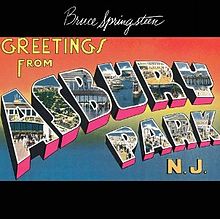
“Greetings from Asbury Park NJ” is the first studio album by Bruce Springsteen, released in 1973. It only sold about 25,000 copies in the first year of its release, but had significant critical impact. It was ranked at #379 by Rolling Stone on its list of 500 greatest albums of all time. Released 6th January 1973 on Columbia/CBS Records recorded between July and September 1972 at Sound Studios in Blauvelt New York City and produced by Mike Appel and Jim Cretecos,
I think it’s an album brimming with potential. It has many great songs but I think it sounds under produced. I like the record, but I just think that it should have been so much better given the material.The best things about it are the lyrics, the humour and the promise of things to come.
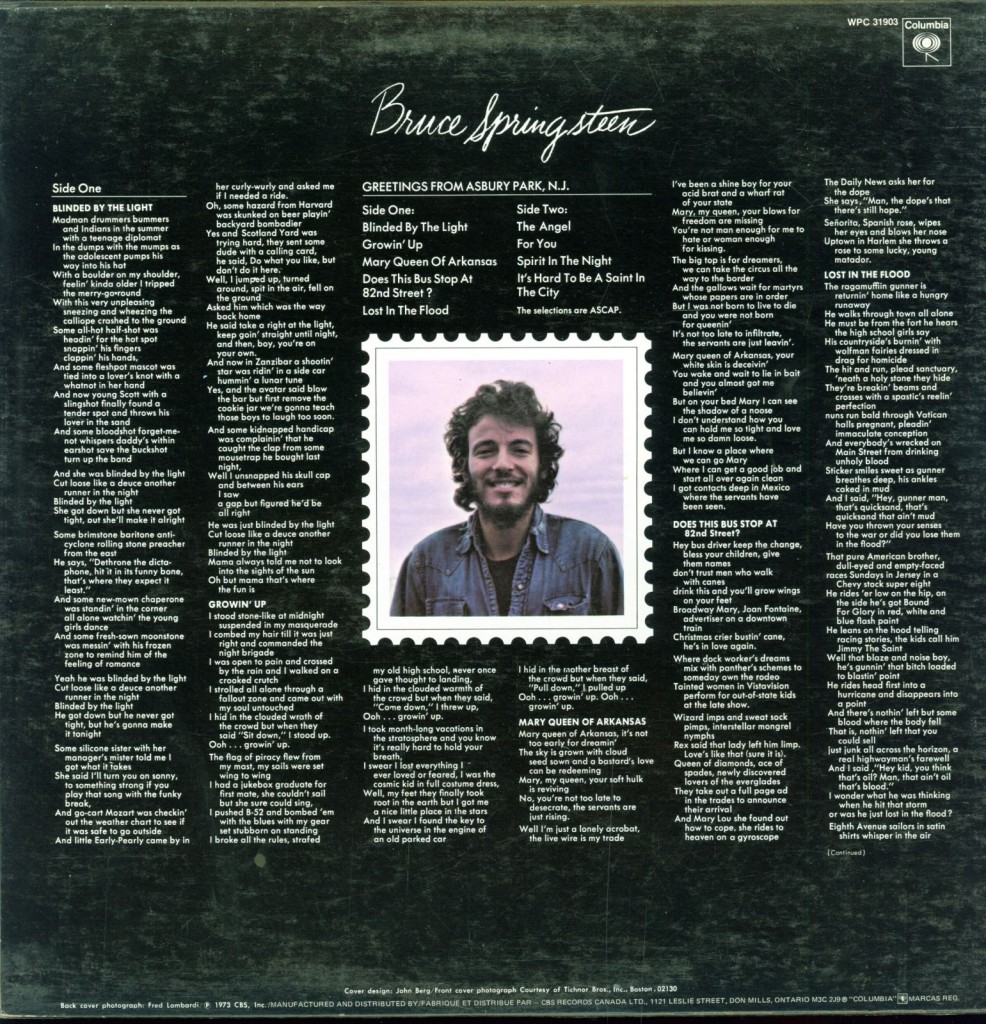
Springsteen and his first manager Mike Appel decided to record the album at the low-priced, out-of-the-way 914 Sound Studios to save as much as possible of the Columbia Recordsadvance and cut most of the songs in a single week. There was a dispute not long after the record was recorded—Appel and John Hammond preferred the solo tracks, while Springsteen preferred the band songs. As such, a compromise was reached—the album was to have five songs with the band (“For You”, “Growin’ Up”, “Does This Bus Stop at 82nd Street?” “It’s Hard to be a Saint in the City”, and “Lost in the Flood”) and five solo songs (“Mary Queen of Arkansas”, “The Angel”, “Jazz Musician”, “Arabian Nights”, and “Visitation at Fort Horn”
However, when Columbia Records president Clive Davis heard the album, he felt that it lacked a hit single. As such, Springsteen wrote and recorded “Blinded by the Light” and “Spirit in the Night“. Because pianist David Sancious and bassist Garry Tallent were unavailable to record these songs, a three man band was used—Vini Lopez on drums, Springsteen on guitar, bass, and piano, and the previously missing Clarence Clemons on saxophone
These two songs bumped “Jazz Musician”, “Arabian Nights”, and “Visitation at Fort Horn”, leaving a total of seven band songs and two solo songs. The album was originally slated to be released in the fall of 1972, but it was moved back to early 1973 to avoid the pre-Christmas crush.
Bruce Springsteen attends the 2014 Kennedy Center Honors Gala Dinner at the U.S. Department of State on December 6, 2014 in Washington, D.C.Every year, the Kennedy Center in Washington, D.C. honors five artists who have made significant contributions to American culture. On December 7th, 2014, the Center celebrated the work of Tom Hanks, Lily Tomlin, ballerina Patricia McBride, Al Green and Sting. And this week, CBS finally broadcast the event, which featured an especially moving tribute to Sting led by Bruce Springsteen, who performed “I Hung My Head” with the help of a gospel choir. The song first appeared on Sting’s 1996 album “Mercury Falling” and was later covered by Johnny Cash on his American IV album
It’s fitting that The Boss showed up to honor the former Police frontman, since Sting performed Bruce’s “TheRising” when Springsteen was honored at the 2009 Kennedy Center ceremony. In case you missed the CBS broadcast, Springsteen’s performance has managed to find its way to YouTube. Check it out below. It’s a stunner.
“The Kennedy Center celebrates…extraordinary individuals who have spent their lives elevating the cultural vibrancy of our nation and the world,” said Kennedy Center Chairman David M. Rubenstein. “Al Green’s iconic voice stirs our souls in a style that is all his own [and] Sting’s unique voice and memorable songwriting have entertained audiences for decades.”
Sting and Green join past honorees Billy Joel, Carlos Santana, Led Zeppelin, Neil Diamond, Paul McCartney, Merle Haggard, The Who, Brian Wilson, Elton John, Paul Simon and James Brown (to name but a few) in the rarefied realm of The Kennedy Center’s pantheon.



 The Fat Angel Sings