In a world that seems to be increasingly unreliable, The KVB remain a band to count on. The British coldwave duo have unleashed a string of unfuckwithable singles dating back through the past decade, and today, just as the temperatures begin their descent in our corner of the world, deliver an embracing tune of mechanical beauty in “Unité”.
The track will be featured on The KVB’s forthcoming new album, Unity, out November 26th on Invada Records. It was produced and mixed by Andy Savours, known for his work with My Bloody Valentine and The Horrors.
The KVB have also released a visual for the track, which serves as “a homage to our time living in Berlin, with the pounding kick drum and grinding electronics,” the duo declare. Dive in
It features 10 brand new tracks produced by Andy Savours (My Bloody Valentine, Black Country New Road, The Horrors)Available on Limited edition blue & grey marbled vinyl (with deluxe booklet option), black vinyl and CD.
Taken from the new album ‘Unity’, released on 26th November 2021 via Invada Records
At this point, there’s no telling the heights Gang of Youths are set to climb. But as they continue to rise, their music is firmly rooted in where they’ve been. The Australian-born, London-based rock band seem to be filling an interesting void between pop-rock and indie, and after dropping the total serene EP earlier this year, are back with another lower-case, bigger-sound single called “the man himself.”
The track finds Gang of Youths singer Dave Le’aupepe meditating on the loss of his father, using his memory as a foundation to power forward and heal. “the man himself” is about grieving and loss, but also provides a compass on how to reflect the past in our future. “If I ever have kids,” Le’aupepe says, “I’m not really sure how to raise them without my dad helping me out.”
This anthemic, almost-hymnal track is a pretty good start. here is ‘the man himself’, a tune from our upcoming record. we love this track. listen out for ‘Imenetuki Mangaia’ at the song’s core, recorded by the wonderful David Fanshawe on the island of Mangaia a lifetime ago. the magnificent indigenous performers are the stars of the song, we can’t thank them enough
Lost Horizons, the dream-pop project from Cocteau Twins’ Simon Raymonde and Richie Thomas of Dif Juz, have this week shared a new video for standalone single “Florida.” It features vocals from KookieLou, otherwise known as Lily Wolter from Penelope Isles.
It was about a year ago when we first learned of the duo, as they teamed with Porridge Radio’s Dana Margolin for a rumbling tune of retrospection that set the tone for February’s sophomore album In Quiet Moments, released via Raymonde’s label BellaUnion. Here on “Florida,” the collaborators weave an atmospheric sound that floats across grace and sincerity.
Here’s what Wolter has to say about it: “Like most videos my brother Jack [Wolter, also of Penelope Isles] and I make, this one was most certainly trial and error. A lot of the time we find ourselves surrounded in a jungle of paints, flowers, glitter, string, lava lamps and makeshift green screens and say, ‘what have we gotten ourselves into?’ Despite the hours of drawings and the former attempts to make something that suited the trance-like, flowing, softness of the song, we got there in the end!”
She adds: “The lyrics are about a time I spent on tour in America a few years back. We wanted to show an abstract journey overlooking all sorts of weird and wonderful views. I’ve always wanted to go up in a hot air balloon, but I reckon it would be pretty damn scary. Big thanks to our mum for assisting with the paper-mâché balloons, to our dear friend Josh for the helping hand, and to Lost Horizons for wanting me to sing on their music, I’m once again, truly honoured.”
“Florida” by Lost Horizons is out now on Bella UnionRecords.
Over the past few years, Anjimile remained one of the most captivating performers and artists in the New England music community. Now relocated to North Carolina, Anjimile is becoming the world’s to share, and he’s sharing a lot from the inside on an introspective new single titled “Stranger,” out today (October 19th).
The stand-alone single, the first new, original music from Anjimile since acclaimed 2020 debut album, “Giver Taker”, is a delicate folk-pop composition about his trans identity and the changes sustained in his recent years taking testosterone. It was recorded with producer/pianist Thomas Bartlett and songwriter/producer Gabe Goodman.
And it also marks Anjimile’s signing to legendary record label 4AD Records, current home to Big Thief, Dry Cleaning, Helado Negro, and others.
“Stranger’ is something of a confrontation between my past and present selves in relationship to my trans identity,” Anjimile says.”I started testosterone about 3 or 4 years ago, and It’s been simultaneously liberating and alarming to note the changes to my mind and body over the years. ‘Stranger’ is an admission to myself that, while I welcome all of those changes — especially the deepening effect of testosterone on my singing and speaking voice — it’s still scary and there is a degree of internal ambivalence to my transition. In transitioning I lost, or gave up, a part of myself. And that is hard to reconcile. ‘Stranger’ is an attempt at some semblance of reconciliation, I guess.”
The follow-up to “Giver Taker” is currently in the works, but in the meantime, float freely with the gorgeous “Stranger” .
Parquet Courts will host an early celebration of the band’s new album, “Sympathy For Life”, with the premiere of the “Feel Free”visualizer on Wednesday. The project will feature special guest and NBA legend Bill Walton ahead of the album’s release on Friday via Rough Trade Records.
Following the ecstatic post-punk of the excellent ‘Wide Awake!’ was not going to be an easy task, but the New York outfit have smashed expectations once again by upping the variety of influences, creating tracks which would have suited the esoteric dancefloors of 80s NYC. Afrobeat, punk-funk, alternative dance, and 60s garage rock creep into the mix here, supporting their usual wry and abstract storytelling nicely.
In a teaser for the “Feel Free – Sympathy For Life, Visualized” project shared on Monday, the band leans hard on the improvisational approach that birthed its seventh studio album. The opening shot of the clip prominently displays a photo of Jerry Garcia. Beyond that, fans are dropped straight into the lengthy studio jams that co-frontman Austin Brown said Parquet Courts chopped up, sampled, and spliced together to create the cohesive songs found on “Sympathy For Life“.
“Most of the songs were created by taking long improvisations and molding them through our own editing,” Brown said in the initial album announcement. “The biggest asset we have as artists is the band. After ten years together, our greatest instrument is each other. The purest expression of Parquet Courts is when we are improvising.”
Parquet Courts have shared details of a new album, A Sympathy For Life, and previewed it with the lead single, “Plant Life”.
“Plant Life”, comes in the form of an extended mix that would lend itself perfectly to any dance party. Built around a simple backbeat, the song carries on past the 10-minute mark as the trance-like structure continues effortlessly like a never-ending dream.
“’Plant Life’ the song is my story of rediscovering my passion for music through New York City dance floors,” singer/guitarist Austin Brown said in a statement. “It’s a distillation from a 40 plus minute improvisation prompted by producer Rodaidh McDonald, and every way we’ve sliced it up illustrates a different mood of the same perspective of ecstasy and aspiration to not only grow, but form roots outside of our own barriers.”
Who better to help further bolster that jam-friendly approach than Bill Walton, a man whose name carries just as much weight in the world of basketball as it does in that of the Grateful Dead. Also on hand for the premiere is comedian Joe Pera, host of Adult Swim‘s Joe Pera “Talks To You”.
Check out the teaser for Parquet Courts’ Feel Free – “Sympathy For Life”,
He was a brilliant songwriter who built his own legend but couldn’t outrun the darkness that came with it. Earle’s wife, friends and collaborators recall his magnetic personality, the real-life stories behind his songs, and his heart breaking final days
In the decade spanning from 2008 to 2018 Justin Townes Earle released 8 LPs and 1 EP?
That’s an album each year, with the exception of 2013 (in 2014 he released ‘Single Mothers,’ the first of a double album partnered with ‘Absent Fathers’ released in 2015) and 2016, before releasing ‘Kids in the Street’ in 2017. Thats 93 songs.
One day in the spring of 2018, Jenn Marie Earle was washing dishes in her Portland, Oregon, home, when her husband, Justin Townes Earle, walked into the kitchen with his guitar to play her a song he’d just written.
As Justin started singing, Jenn Marie began to cry. On its surface, “Ahi Esta Mi Nina” was the tale of a Puerto Rican father attempting to reconnect with his estranged daughter after a long prison stint. But Jenn Marie realized that the song was ultimately about her husband’s pain. His career had levelled off in recent years, and a sense of isolation had set in as he became increasingly worried about being able to provide for his wife and baby daughter. Justin was locking himself inside a dark room off the basement for hours to write, communicating with Jenn Marie through a grate connected to the kitchen upstairs. “If you need me,” Justin would shout, “just stomp your hoof, my little dear.”
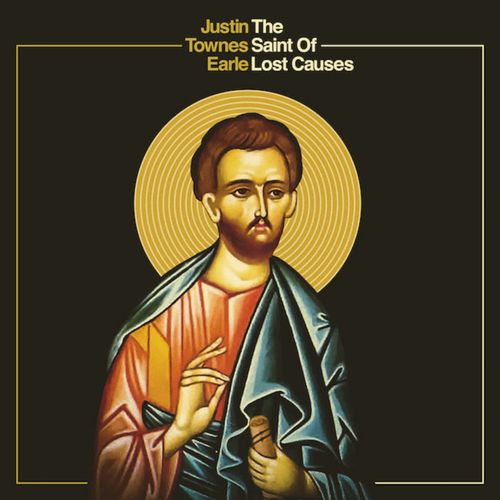
“I’d seen him starting to become more distant, in many ways,” Jenn Marie says. “That song, to me, was an admittance, of choosing the fate of being locked away from what means the most to you.” The album Justin was writing in that unlit basement study, the last album released while he was alive, would be called The Saint of Lost Causes. “I think he was admitting that he was defeated, in a lot of ways,” Jenn Marie says.
Justin effortlessly reels off an engaging series of blues-infused americana ballads about the state of the USA.
‘The Saint Of Lost Causes” is the eighth album from the american roots troubadour. Earle’s album finds a song writer and artist who is unflinching and unequivocal in his truth. when writing this album, Earle focused on a different america – the disenfranchised and the downtrodden, the oppressed and the oppressors, the hopeful and the hopeless. these are individuals and communities in every corner of the country, struggling through the ordinary – and sometimes extraordinary – circumstances of everyday life.
It had been less than a decade since Earle released his breakthrough, 2010’s “Harlem River Blues”, which set songs about subway conductors, addiction, and cramped Brooklyn apartments to old-time gospel, folk, and country-blues styles. By that point, he was transcending omnipresent comparisons to his father, country hitmaker turned folkie Steve Earle, and was poised to become the first solo superstar in the genre of commercial roots music that had come to be known as Americana.
Onstage, Earle was an electrifying presence: six-foot-four, dressed in vintage suits, playing in a fiery style of finger-picking he’d picked up listening to the bluesman Mance Lipscomb. He assumed the public persona of a world-weary troubadour, one worthy of his cursed namesake, the self-destructive country-folk genius Townes Van Zandt, a friend of his father. He could be Old Testament-intense one moment, sardonically witty the next, bantering with hecklers and tossing off one-liners like, “I haven’t swayed from Bruce Springsteen’s formula of girls, cars, and sex,” before adding, “Oh, and Mama.”
Earle was funny, caring, and obsessed with esoterica involving antique Rolexes and baseball history. His magnetic persona left a permanent impression on those who knew him. “He lived the life that you would read about some other country legend living,” says early tour mate James Felice of the Felice Brothers. The son of an entertainer who understood showbiz better than most, Earle embraced and solidified his own legend on and off the stage, sharing tragicomic stories about his adolescent heroin overdoses and bar fights that cost him teeth.
But that persona also masked problems that only worsened as Earle’s career plateaued. He wrestled with mental-health struggles and self-doubt, and like his father, he struggled with addiction. “The fact that I survived my twenties is a miracle,” he once said, “and I believe that wholeheartedly.”
As the years passed, Earle’s insecurities grew. “There was a huge part of Justin that didn’t believe in himself,” says Jenn Marie. “He saw the music business changing. . . . When his [2014 and 2015 albums, “Single Mothers” and “Absent Fathers“] came out, he was disappointed they didn’t do so well. I think that’s where a lot of his darkness, his struggles with substance abuse and addiction, started to come to the surface in the last few years: him feeling like he wasn’t good enough.”
These songs of lonely lives & broken hearts ease into a spectral, middle-of-the-night sound, backed by a low-key 3-piece band & mournful pedal steel guitar.
The spare, often stark surfaces of the arrangements & production on ‘Single Mothers’ make a set of sad songs sound all the more downbeat, & Earle’s reputation for hurtin’ songs isn’t about to change when folks hear this album; ‘Picture In A Drawer’ & ‘White Gardenias’ are abject tales of romantic rejection, ‘My Baby Drives’ is a witty number with a painful subtext, ‘Worried ‘bout The Weather’ uses an oncoming storm as a striking metaphor for unrequited love, & the title track about busted marriages & the emotional toll on everyone involved is all the more difficult to hear when one knows how much it mirrors Earle’s own life experiences.
After writing the songs for “The Saint of Lost Causes” in 2018, Earle entered rehab, a process he’d been through more than a dozen times, then headed directly for the studio. The unusually vulnerable album seemed like an occasion for a career turnaround, and executives at his label, New West Records, were thrilled. But by the time Earle hit the road in the fall of 2019, he was drinking again, so much that bandmates wondered if they’d be able to finish the tour.
In January 2020, Jenn Marie helped Earle rent an apartment in Nashville, where he could temporarily live alone and focus on a flurry of musical projects. He embarked on a solo tour in March, only to shut it after one show, as the pandemic halted concerts nationwide. Forced to quarantine in Nashville, Earle floundered. “He needed an audience,” says friend and producer Steve Poulton. “He was used to having one: putting that energy out, and getting it back.”
Earle in the studio while recording his final album, “The Saint of Lost Causes.”
Earle considered producing a Nashville hip-hop act and contemplated several future albums, including a Billie Holiday tribute with the Preservation Hall Jazz Band and a record of duets with artists like Yasiin Bey (the rapper formerly known as Mos Def) and Brian Fallon of Gaslight Anthem. Earle, with his manager and close confidant, Larry Kusters, began planning a livestream series in which he would perform with guests and expound on his favourite topics — baseball, the Delta blues, Civil War battles. The working title for the show was “Justin Townes Earle: Misbehaving”.
But according to friends and family, Earle continued to struggle with addiction. Though he was only 38, two decades of chemical dependency had taken a toll on his body. On July 21st, he was admitted to a Nashville hospital for pneumonia and underwent a serious lung surgery that, according to Jenn Marie, was a result of the long-term effects of his drug and alcohol use. By the time he left the hospital on August 2nd, his doctor warned him that his body would not be able to keep up if he kept drinking. “We thought that would be a wake-up call,” says Jenn Marie.
Justin felt otherwise. “He always used to say to me, ‘The Earles don’t die, we’re invincible,’ ” says Kusters, who visited Earle after he left the hospital. A few weeks later, on Thursday, August 20th, Kusters spoke with an upbeat, if restless, Earle over the phone. “He was getting a little bit antsy: ‘When can we go out on the road?’ ” says Kusters. According to The New York Times, that same day Justin called his father, who told his son, “Do not make me bury you.” “I won’t,” Justin replied.
Then, no one heard from him. When the Nashville Police Department performed a welfare check Sunday evening, they found Earle dead in his apartment. A toxicology report determined he died of an accidental overdose due to a combination of alcohol and cocaine that was laced with fentanyl.
Earle became yet another victim of the opioid crisis, a topic he wrote about on his last album and had been discussing in stark terms onstage for years. “We have for so long looked at people who had addiction problems … we ask them the wrong questions,” he said in 2018. “We say, ‘What is wrong with you?’ The problem is, they hurt. So you don’t ask them, ‘What’s wrong with you.’ You ask them, ‘Why do you hurt?’”
Earle’s death caused an outpouring among fans like Stephen King and Billy Bragg. Steve Earle paid tribute with “J.T.”, an album of his son’s songs. “The record is called J.T. because Justin was never called anything else until he was nearly grown,” Earle, who declined to speak for this article, said in a statement. “For better or worse, right or wrong, I loved Justin Townes Earle more than anything else on this Earth.”
“Justin shaped so much of the broader, younger perspective of what Americana music was,” says Earle’s former manager Nick Bobetsky. Earle’s primary musical partner, Adam Bednarik, says, “He changed the lives of a lot of other people around him for the better.”
Fellow singer-songwriter Jessica Lea Mayfield, who frequently toured with Earle, described his gift more simply: “He was able to explain trouble better than most.”
In the late Seventies, Steve Earle met Carol Ann Hunter at a Nashville bar where she worked. They married in 1981, and Hunter gave birth to Justin a year later. By the time Justin was four, in 1986, his parents had separated; that year, Steve Earle became an unlikely country star with his debut, “Guitar Town“. One song, “Little Rock ’n’ Roller,” was a touring musician’s promise to his son: “One of these days when you’re a little older,” Steve sang, “you can ride the big bus and everything will be alright.”
Justin spent his early childhood with his mother in a then-rough neighbourhood in South Nashville, where he was exposed to drugs and dropped out of school in eighth grade. “I had the shaved head and the rat tail and wore the Jams and Air Jordans,” Justin said in 2009.
When Justin dropped out of school, he began to see more of his father, touring with him as a guitar tech and later doing odd jobs for his dad’s label. By the mid-Nineties, Steve was sober, having been forced to kick a heroin addiction while briefly serving time in prison on drug charges in 1994.
In the late Nineties, Justin joined his first real band, the Swindlers, a collection of kids whose fathers were successful Nashville songwriters and musicians — “Music Row brats,” as one of them, Dustin Welch, puts it. The Swindlers’ headquarters was a backyard studio on Welch’s family property known as the Chicken Shack, a dusty shed full of recording gear, where Earle and Welch lived on and off as teenagers. The boys spent their nights partying and obsessing over their fathers’ blues records, putting their fingers on the spinning vinyl to slow them down and study the instrumental parts.
By the time he was a teenager, Justin was writing profoundly adult meditations on loneliness and despair like “Rogers Park” and “Down on the Lower East Side.” It soon became clear the Swindlers would serve as a vessel for his blossoming song-writing. “He was this force of nature,” says another Swindler, Skylar Wilson, who produced several of Earle’s early records. “Everybody was trying to keep up.”
Even when the band members worked to break free of their fathers’ influence, it loomed over them. On the Swindlers’ first tour, in Oklahoma City, they panicked when they realized it was Father’s Day. Each bandmate began frantically calling his dad. “Dumbass,” Welch remembers Steve Earle telling Justin, “that’s next month.”
As a budding songwriter, Justin was eager for his father’s approval, which didn’t come easily early in Justin’s career. “Steve knew how incredible of a writer [his son] was — he let me know that — but he couldn’t always let Justin know that,” says Welch. Once, after the Swindlers ended a show with a newly written original named “Maria,” Steve asked Justin about the Elvis Costello song he had closed with. More than a decade later, Justin was still proud of the unintentional compliment.
As Justin grew into his own as an artist, Steve increasingly became one of his son’s biggest public cheerleaders, but privately Justin still hungered for his father’s approval. “I don’t know if he ever listened to Harlem River Blues,” Justin told a journalist in 2012. “I’ve gone over [to Steve’s house] a few times and still found the same, wrapped copy of it sitting on the countertop. My dad means well, but he gets all over the place sometimes. He’s just like me, scattered as shit.”
One of the first of many times Justin would mythologize his complicated relationship with his father in song was on “Decimation of a Southern Gentleman,” a frighteningly personal unreleased Swindlers-era tune that Earle soon abandoned: “You ever get the feeling you were gonna die in the streets that you were raised in? Doing the same things your daddy done?”
Eventually, the Swindlers grew apart, and Justin began focusing on his own music. In 2006, Earle and a friend, the singer-songwriter and photographer Joshua Black Wilkins, decided to embark on a joint solo tour. Wilkins suggested that Earle use his middle name, Townes, on the road. Earle agreed, and took the idea a step further, getting “Townes” tattooed below his throat.
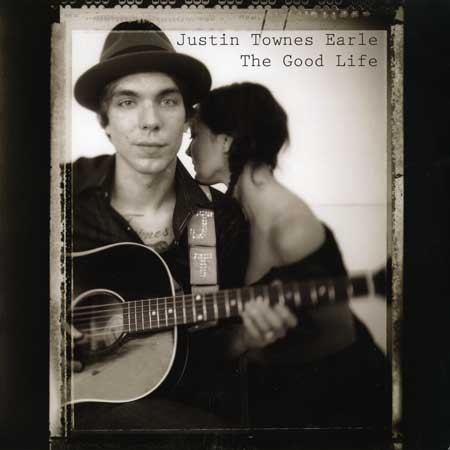
Justin’s debut album “The Good Life” Justin’s voice is sweeter and clearer, and his clear fondness for old-school country gives The Good Life a pleasing feeling of understatement that’s significantly different from Steve’s tougher, more rock-oriented work. But if Justin is reaching back to the glory days of the Grand Ole Opry on numbers like “What Do You Do When You’reLonesome,” “Hard Livin’,” and the title tune, he also reveals a more contemplative side on thoughtful, no-frills singer/songwriter pieces such as the confessional “Who Am I to Say,” the period gunman’s saga of “Lone Pine Hill,” and “Turn out My Lights,” a plaintive meditation on loneliness and heartbreak.
‘Lone Pine Hill,’ from Justin’s first full length album, ‘The Good Life’ this clip recorded Live in Sydney, Australia at the Annandale, 2008.‘Lone Pine Hill’ is a haunting Civil War ballad that also resonates as a modern parable about the costs of war.
Justin said, “Those were study songs (‘Lone Pine Hill’ and ‘Ghost of VA’), stories that I made up, but I’m a big Civil War buff, so when it comes to story songs usually those are based on historic things, but not historical fact.”
Of this recorded 2008 performance, “Earle comprehensively showed the Annandale tonight that he has the talent to carry the weight of his name and doesn’t take it for granted. You can see the respect he has for the history and evolution of the strands of Americana that he studies, yet in a live setting he performs with an intense showman attitude and isn’t afraid to show the raw and real honesty that is often missing from contemporary music.”
On the latter songs, Justin’s music more closely resembles Steve’s, but while the themes and approaches are similar, Justin isn’t afraid to sound vulnerable, and the youthful modesty of both the songs and the performances works in their favour; this doesn’t suggest the work of someone following Steve Earle’s template but of a song-writer who has dealt with a set of similar demons and has a corresponding but distinct perspective on how they’ve impacted his life. The simple arrangements and hands-off production add to the gentle but decisive impact of “The Good Life”, and the result is a fine calling card for a young singer/songwriter who may not have worked out every last detail of his sound but clearly knows where he’s going, and it happens to be a place worth visiting.
Earle was proud to be a working artist in an industry that seldom valued actual musicians. On one of his first tours, he became enraged when a stranger insulted a street busker. “We walked past a street musician, and the guy wasn’t very good,” remembers Poulton. “Somebody said under their breath, ‘Get a job,’ and that just incensed Justin. He was like, ‘Don’t you ever talk to that guy like that. If you tried half as hard as that motherfucker is trying, you’d really have something.’”
For all his prodigious gifts, Justin was never free of the shadow of his father. Their complicated relationship ended up becoming one of his most enduring themes as a songwriter, from 2009’s “Mama’s Eyes” (“I am my father’s son”) to 2012’s “Am I That Lonely Tonight?” (“Hear my father on the radio”) to his 2015 album, Absent Fathers. Justin wasn’t concerned with his parents hearing his songs that addressed them bluntly: “I always had to deal with it in a public format,” he said. “Why shouldn’t they?”
In the early days of Justin’s career, father and son enjoyed exchanging playful jabs in public. “The . . . advantage Justin has is he can’t fucking do anything else,” his father told the Nashville Scene in 2008. “So he knows he better make it work.” Performing at an intimate record-store gig in 2010, Justin was interrupted by a phone ringing at the side of the stage. When he looked up, his father was answering a call from his wife. “We’ll just wait till he’s done,” Justin joked to the crowd.
“Everything Justin ever learned, he learned from his dad,” says Wilkins. As time went by, Justin often seemed to empathize with his father. “I can’t really blame him all that much,” Justin said of Steve in 2012. “I’m turning out to be more like him than I ever thought I would.”
Justin with his father, Steve Earle, on the subway in New York City in 2011.
By the time Earle released his first album, in 2008, he was 26 and enjoying the first sustained period of sobriety of his adult life. He slowly built a rabid fan base playing several hundred shows a year as an acoustic duo with his former Swindlers bandmate Cory Younts. The two logged tens of thousands of miles in a Ford pickup, with Earle often driving so outrageously fast that one time in Florida the duo feared for their lives when the gas pedal got stuck to the floor. Spending so much time together led to tension; Younts remembers the time they pulled over to the side of a highway in Arizona, stepped outside the car, “swung at each other for a while,” got back in, and kept driving.
When he wasn’t swinging his fists at his bandmates, Earle endeared himself to those in his orbit, rehashing larger-than-life tall tales about his past: how he was regularly smoking weed by age 11; the time he said a polite hello to Andy Griffith in a hotel lobby, to which Griffith replied, “Fuck you, son.” “He had a canon of stories and jokes that sort of explained himself,” says tourmate Samantha Crain. “It was like, ‘I want you to know so much where I’m coming from.’ He really just wanted to connect with people.” Earle’s one-liners were an art form: “He once told me I was so skinny that I could hang glide on a Dorito,” says Mayfield. “It was impossible not to be smiling or laughing when you’re around him.”
Earle dished out worldly knowledge on everything from the wonders of LSD to what constitutes authentic Mexican cooking to where to find the best roadside antique shops. “Justin would tell these fantastical stories, and after the session I’d go home and Google what he said and I’d be like, ‘Holy shit, he’s right,’ ” says Mike Mogis, who produced one of Earle’s albums. “It’d sound like bullshit coming out of his mouth, but it’s not.”
Sometimes, it was bullshit. Jenn Marie laughs recalling the time Earle, who played soccer as a child, tried to explain to her friend, a professional soccer player, the intricacies of the sport. “That happened all the time,” she says. “He really did study everything. He would stay up so late at night, reading books and watching interviews.”
Earle’s former agent Andrew Colvin remembers going tubing with Earle on the Gulf Coast. “I have a vivid memory of Justin on that tube, tattoos all over him, smiling as big as a human can smile,” he says. At the same time, Earle’s congeniality may have served as a useful way to avoid sharing his private thoughts. “We spent every day together for three years,” says bandmate BrynDavies. “On one hand, I felt like he would give me the shirt off his back. On the other hand, I never had any idea what he was thinking.”
“Justin was like a big floppy-footed puppy dog that’s, like, really pretty dangerous and doesn’t know his potential, but also knows it very well and is kind of a giant. But also kind of a puppy,” says singer-songwriter Jonny Fritz, one of his former opening acts.
Earle relished mentoring younger artists, giving advice that often seemed like it was intended for himself as much as anyone else. When teenage singer-songwriter Sammy Brue joined Earle for his first national tour, Earle gave him regular lectures on drugs. “He rammed it in my head that I shouldn’t touch this stuff,” says Brue. “He wanted to protect me.”
Earle was often exceedingly generous. He would give his opening acts and bandmates extra cash while on tour. When Earle heard that Fritz had lost a favourite shirt, originally purchased at a Virginia gas station, Earle tracked down the identical shirt for him.
That sense of loyalty helped place Earle at the center of a quickly growing roots-music revival based in East Nashville. When Earle recorded Harlem River Blues, everyone from Jason Isbell to Old Crow Medicine Show’s Ketch Secor to up-and-coming songwriters like Caitlin Rose showed up to play or sing on the record. “He was my hero,” says Rose. “I remember getting into Justin’s [first] records and thinking, ‘I didn’t know that people could still do this.’ ”
It may have taken him three albums, but “Harlem River Blues” delivers in spades what his earlier offerings only hinted at. With co-production by Earle and Skylar Wilson and the backing of a killer, intuitive band, the songwriter drops 11 weighty originals steeped in American musical tradition yet bearing his own inimitable lyric and stylistic signature. The title track is an electrifying rockabilly-cum-truck-driving shuffle adorned by slapping bass, guitars, snare and cymbal, and a Hammond B-3.
Despite the upbeat tempo and finger-popping rhythmic thrust, Earle’s lyrics reveal the protagonist’s intention to commit suicide by drowning. With a country gospel vocal chorus complete with handclaps on the refrains, the lyrics and music are intriguingly at odds; somehow the sense of near gleeful purpose in the protagonist’s view — revealing a sense of relief at the prospect of release from this plane of existence — makes the tune gell. On the breezy summertime groove of “One More Night in Brooklyn,” the Tennessee backwoods meets the urban street corner, led by guitars, a skeletal drum kit, Wilson’s vibes, and a popping upright bass. “Move Over Mama” is a scorching rockabilly-and-reverb number, full of erotic bravado à la Warren Smith or Billy Lee Riley. (And does that bass ever get slapped!) “Wanderin'” captures the spirit of early Bob Dylan under the influence of Cisco Houston and Woody Guthrie, but the lyrics and sense of necessity and acceptance of the situation at hand are pure Earle.
With a country fiddle added to the mix, you can also hear traces of early string bands and even the ghostly presence of A.P. Carter in the refrains. The horns on “Slippin’ and Slidin’ marry the late Eddie Hinton’s brand of Muscle Shoals R&B to laid-back country rockabilly. The narrative love song “Christchurch Woman” is among the moving things here; Earle’s vocal is underscored by a female backing chorus and organic instrumentation that also includes beautifully arranged horns were filtered through Memphis R&B early-’60s country. “Ain’t Waitin'” is a rockabilly blues, so skeletal it could be played on the back porch. Anyway you cut it, “Harlem River Blues” is utterly balanced, skillfully crafted, and exquisitely written and produced. Earle proves that he is a force to be reckoned with; in these grooves he embodies the history, mystery, and promise of American roots music.
Written during a period of relative sobriety, “Harlem River Blues” added gospel, R&B, and soul textures to Earle’s fast-improving song-writing. It proved to be his breakthrough, though Earle seemed to sabotage its rollout. Two days after its release, he was arrested in Indianapolis and charged with battery, public intoxication, and resisting law enforcement after trashing a dressing room and allegedly hitting the club owner’s daughter. (Earle denied the charges, which were eventually dropped.)
Within 10 days of releasing the album, Earle was back in rehab, postponing the most high-profile tour of his career. “Harlem River Blues” nonetheless became his biggest-selling record, leading to surging Bonnaroo crowds and Letterman appearances. “Between the lineage and the name and his fashion and the bad-boy reputation, Justin had the makings of someone where you think, ‘If everything works out, this guy could be a fucking icon,’ ” says Justin Eshak, his manager from 2010 to 2012. “He reminded me a lot of Amy Winehouse, in a weird way . . . I thought, ‘This is a guy who could be on posters on people’s walls.’ ”
Earle appeared outwardly unflappable throughout this turbulent period, with one notable exception. In the summer of 2010, shortly before the release of “Harlem River Blues”, one of Earle’s heroes, Levon Helm, asked to join him onstage to sing a verse of “The Weight.” “It was the most excited I ever saw him” says Lauren Spratlin, Earle’s former road manager and ex-girlfriend, “I remember being on the road with him and him obsessively playing [the song] over and over. He was like, ‘I can’t fuck this up.’’’
After yet another rehab stint, Earle was prescribed Suboxone, a drug given to patients fending off opioid addictions. By the time he appeared on Letterman for the second time, in February 2012, he looked and sounded like a different singer than the one who’d appeared on the show just one year earlier: “Mama, I’m hurting,” he sing-shouted, “in the worst way.”
Around this time, Earle burned many of his closest personal and professional connections. Long time bandmates like Younts and Davies had stopped touring with Earle, causing the singer to lash out, as he often did when he felt he was being abandoned. When Spratlin signed on to tour-manage Jason Isbell after breaking up with Earle in 2013, the singer erupted at both her and Isbell.
“For us, it was the end of a really good era,” says Wilson, who worked on Earle’s first four records, “but at that point, it had already run its course.”
“I was expecting the wheels to come off,” says Earle’s longtime friend and former Swindlers member, Andy Moore, of this time. “And quite the opposite happened.”
That same year, he began dating Jenn Marie Maynard, a teenage acquaintance he reconnected with at a show in her hometown of Salt Lake City. Earle was smitten with Jenn Marie, a former athlete who owned a yoga studio and was almost as tall and lanky as him. “ ‘I’m over the moon about her,’ ” Moore recalls Earle telling him at the time. “ ‘And want to know the best part? I don’t have to bend down to kiss her.’ ” In October 2013, Justin and Jenn got married — just the two of them and an officiant — in blue jeans in the woods above Lake Tahoe. “To see a grown man just sobbing in happiness, it was really special,” says Jenn Marie.
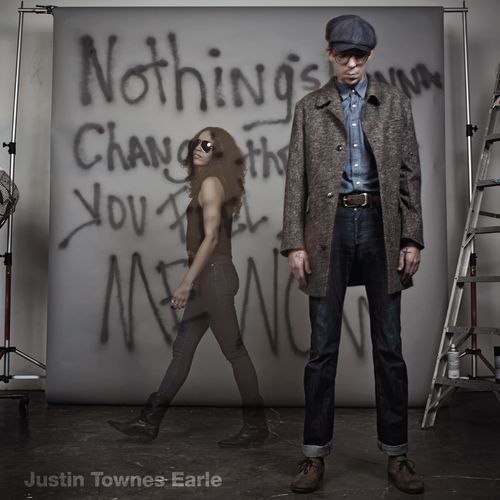
At the time, Earle’s career was at a crossroads. His deal with his supportive first label, Chicago’s Bloodshot Records, expired after he released his midnight-soul record “Nothing’s Gonna Change the Way You Feel About Me Now“, in 2012. In late 2013, he got into a public spat with a label he’d briefly signed with, co-owned by Mumford & Sons’ Ben Lovett. “I have now learned that you can never trust a bunch of babies that ain’t worked a day in their lives,” Earle tweeted of the label, which he departed before releasing any music. “Just found out I won’t be making a record for a while due to a bunch of pussies in an office.”
Earle’s 4th studio album leans away from traditional country & more toward Memphis Soul, with a touch of folk & americana.
Recorded completely live, with many of the same players involved as on ‘Harlem River Blues’, but with the addition of AmandaShires’ fiddle. the new musical direction compliments Earle’s deceptively simple & earnest song writing. “Earle still maintains his ability for compelling, simple storytelling. here, muted trumpets & laid-back rhythms soften the southern gentleman’s snarled approach” – consequence of sound. “an album of melancholy & heartbreak that’s at its best when the songs fall between all-out country rock ballads & bare bones ballads”
Around that time, Earle recorded a double album, but ended up releasing the material as two separate records: “Single Mothers” and “AbsentFathers“. Both received notably less attention than his previous few albums.
Meanwhile, Justin and Jenn Marie were getting tired of Nashville, the only city in the world where a moderately well-known singer-songwriter with the last name “Earle” might get stopped everywhere he went. “He was so sick of being Justin TownesEarle,” says Jenn Marie. The couple moved to a remote area on the Northern California coast, which Earle described as “a town of skittish hillbillies that all grow marijuana.” At first, Earle seemed to thrive out West. In California, he devoured books on the Civil War and spent his mornings walking the couple’s dog on the rocky beach and gathering rusted objects that had washed ashore to display in the yard.
“I am my father’s son/ I’ve never known when to shut up/I ain’t foolin’ no one/I am my father’s son.” These words lead off the fourth song on Justin Townes Earle’s second album, “Midnight at the Movies“, and given that many people still know him as the son of iconic singer/songwriter Steve Earle, it’s a brave and startling statement. But at the same time, much like his 2008 debut “The Good Life”, Earle’s second album works because he seems determined not be his father’s son; the tone and the feel of this music owes precious little to the family line, and Earle sounds appreciably more relaxed, confident, and in control here than he did on his fine debut. Earle’s music has one toe tangled in hillbilly tradition on the folk ballad pastiche “They Killed JohnHenry,” the uptempo string band number “Black Eyed Suzy,” and the honky tonk swing of “Poor Fool,” but he can write about love and life with a clear and unaffected eye that’s effortlessly timeless.
The title song is a musical snapshot that gets its Nighthawks details just right, “Someday I’ll Be Forgiven for This” and “Here We Go Again” are painfully intimate examinations of what can happen between people who care for each other, and while “PoorFool” and “Walk Out” sound jaunty, they have a weight behind them that’s telling. And while Earle doesn’t sound like a guy who should be covering the Replacements, his version of “Can’t Hardly Wait” finds a sweet heartache at the core that PaulWesterberg was afraid to show in his recording. “Midnight at the Movies” plays more like a subtle step forward for Justin TownesEarle than a quantum leap, but if the “The Good Life” suggested he was a talent to watch, this record confirms that he’s a new writer to be reckoned with who doesn’t need to trade on his family name.
In the early years of their marriage, Jenn Marie toured with Justin, and the couple spent free time on the road scouring down antique shops. Earle was a voracious spender, accumulating enough old maps, rugs, vintage Rolexes, and $500 gold-plated lighters to require several storage spaces in Nashville. “I remember him yelling at his business manager, demanding the extra money for this fucking gold lighter,” says Jenn Marie. “He always had an admiration for old things that told stories.” Earle’s free-spending ways concerned his various managers. “I’d have to have conversations with him where I’d be like, ‘Dude…’” says Bobetsky. “It was definitely intense to manage.”
Jenn Marie grew accustomed to Earle’s eccentric habits. He spent his time in the green room before shows transfixed by full-game replays of the 1967 World Series. “There would be blunts everywhere, and he’d be pacing around the room watching this game that he’s seen 100 times,” says Jenn Marie.
Earle still electrified crowds, but offstage, he was struggling with various mental-health problems. Jenn Marie is reticent to go into detail but wants the world to know that as much as Earle’s addictions tended to be romanticized, his day-to-day existence, sober or not, was often full of deep, unglamorous suffering. “A lot of famous people who are charismatic and handsome and stylish and talented, they struggle with mental illness, too,” says Jenn Marie. “I wish people knew how much he did struggle with what they couldn’t see, and what he didn’t write about.”
Earle had long been prescribed medication to help with mental-health issues (“He was on medication morning, noon, and night,” says Jenn Marie). But he had trouble stabilizing his treatment, cycling through doctors on the road who gave differing diagnoses and often prescribed medication over the phone. In California, Earle stopped taking Suboxone. “That was around the time his other addictions started coming back,” says Jenn Marie. Earle smoked medical-grade weed, and according to Jenn, he’d often be “high from the time you wake up until you go to sleep. That’s how he functioned.”
A few years later, Earle would tell Jenn Marie that their seemingly idyllic tenure in California had actually been a particularly isolating period. He was removed from old friends and struggled to write songs without the din of city life. “He was always going to feel lonely, to some degree, even when he was surrounded [by love],” says Jenn Marie. “He was really attracted to the stories and damage of things, and he didn’t write happy songs. There’s a certain level of staying in a deep, more depressed state of mental health if you are constantly only surrounding yourself with stories and shows and thoughts that are dark and deep. He wasn’t really giving himself a chance to be surrounded by positivity. He didn’t open the door, fully, to that. It was just cracked.”
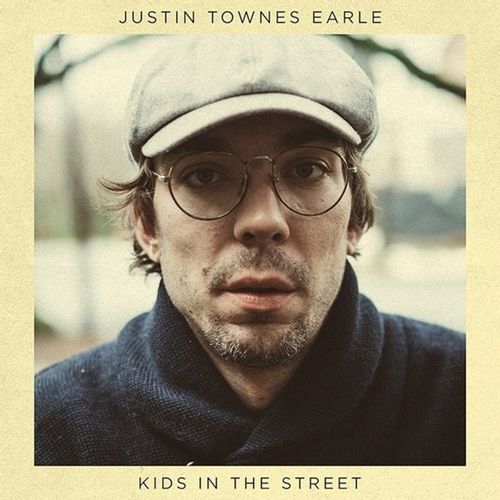
On the West Coast, old friends had a hard time reaching Earle. “He’s probably lost 30 iPhones in the past 10 years,” says Wilkins. When Omaha-based musician Mike Mogis was enlisted to produce 2017’s Kids in the Street, he tried calling Earle 10 times before finally getting him on the phone. Before one of those scheduled calls, Earle informed Mogis he couldn’t speak because he was at Chicago’s Wrigley Field, watching his favourite team, the Cubs, play in the World Series.
Blending a diverse range of sounds from Cash and Springsteen through to Randy Newman, this a record that really moves – a jubilant album that packs a huge americanan boogie. His 7th and latest album from american roots troubadour, he made a conscious decision to work with a producer for the first time in his now decade-long career. Earle made the trip to Omaha,Nebraska to work with Mike Mogis (first aid kit, m.ward, connor oberst) at Arc Studios. together, they hand-picked musicians to create a new sound and environment for the songs that speaks to Justin’s roots, musically and personally. this creative collaboration, paired with Justin’s long time guitarist Paul Niehaus, resulted in an album that takes a big step forward.
When Earle made it to Omaha to record, he learned he was going to become a father. He immediately called his own dad. The prospects of fatherhood loomed large for Justin, who would later ponder aloud, before his daughter, Etta, was born, that if she ever wanted to become an artist of any sort, she could drop her “Earle” surname and go by her first and middle names if she preferred.
Once Etta was born, Earle was overjoyed. “Etta says bye-bye in the sweetest little voice,” he wrote on Instagram when his daughter was a year old. By then, Justin and Jenn Marie had relocated to Portland, Oregon. “It was so not the person people want to think he was,” says Andy Moore. “He was over the fucking moon about [Jenn], over the fucking moon about the baby. There is a well-adjusted Justin that I know to have had some of the deepest and most heartfelt conversations, where we talked about the shortcomings of our own families and our paternal lines: ‘How are we going to be better than this?’ ”
Becoming a dad helped Justin feel closer to his own father. “We’ve been talking more lately, it’s kinda weird,” Steve told Justin on Steve’s SiriusXM show shortly before Etta was born. “You started calling me all of a sudden in the last few months.”
But even as he grew closer to his father, Justin still battled feelings of inferiority. In the last few years of his life, he confided to his guitarist Paul Niehaus that, because his own song-writing was so personal, he thought his father, who alternated between autobiography and literary character sketches, was the superior songwriter.
“At certain moments of time, I don’t think that he felt he was loved enough,” says Kusters. “Onstage, Justin never had a second of a doubt that his music and lyrics were loved. But in a hotel room or tour bus at two in the morning, he would question that: ‘How good am I as a musician?’ How good am I as a person?’”
Now in his mid-to-late thirties, Earle admitted to those closest to him that he wasn’t yet ready to fully deal with his deeper struggles. “He said to me a couple of years ago that his demons were snipping at his heels, and he was ready to face it,” says Jenn Marie. “But that immediately came with him deciding that he wasn’t ready to face it.”
In his last few years, Earle reconnected with many of his old friends. When Welch surprised Justin at one of his gigs in 2018, in Austin, Earle sprinted out of the green room and jumped on his old Chicken Shack roommate, wrapping his arms and legs around him. After nearly a decade of not playing together, he invited his old collaborator Cory Younts to play on “The Saint of LostCauses”. This past spring, he reconnected with several old Nashville friends, including Skylar Wilson.
Earle often disguised his most revealing moments in old-time blues and honky-tonk styles that made it seem like he couldn’t possibly be singing about himself. But on the very last song of “The Saint of Lost Causes“, the introspective country confessional “Talking to Myself,” he was as blunt as he’d ever be: “I’m in a lot of pain and I need some help/I don’t dare tell nobody else.”
“It’s really sad thinking about that being his last album,” Bobetsky, Earle’s former manager, says through tears, “because the writing’s on the wall.”
In Nashville, during his final eight months, Justin spent more time than he had in ages with his mother, Carol Ann, with whom he remained close. Earle had helped buy her a house earlier in his career. “She was always just worried about him, and loved him to death,” says Welch.
Jenn Marie and Etta, whom Justin had taken to calling Etta-belle, visited Justin on several occasions throughout 2020. The last time the family was together, a few days before Justin’s death, Jenn and Justin revisited their favourite antique shops and took Etta to parks Justin had played in as a child, including his sentimental favourite: Nashville’s Dragon Park, named for its sea-serpent sculpture, where Earle played soccer as a kid. When, at the end of their trip, Jenn Marie and Etta got into their car to go to the airport, they rolled down the windows. Justin screamed, “I love you,” at them, and they screamed it back.
“Fucking heartbreaking,” Jenn Marie says, thinking back on that moment. “I wish I could’ve just grabbed him and said, ‘You’re coming home. Fuck business. Fuck convenience.’ But he wouldn’t have come, anyway. He would’ve figured out some kind of excuse to be alone, because he was like that.”
Yeah, he’s Steve Earle’s kid, but you have to give the young man, whose father named him after one of the greatest songwriters ever, credit for cutting his own path through musical styles to find his own voice. “Single Mothers” finds Earle and band in a comfortable groove that sounds a little slithery and funky like Alabama soul.
Nashville-based Americana pioneer Justin Townes Earle has followed a meandering route of reinvention on each of his five full-length albums and lone EP. He’s moved from the classic honky tonk of 2008’s “The Good Life” through phases of country, rockabilly and soul along the way to 2012’s near perfect Memphis Horns-inspired “Nothing’s Gonna Change The Way You Feel About Me Now”. And yet, in some ways, Single Mothers feels like a continuation of “Nothing’s Gonna Change The Way You Feel About Me Now”. The mournful pedal steel (courtesy of returning guitarist Paul Niehaus) and smooth production sonically link the two records. But rather than a reinvention of his song, Single Mothers represents a renewal of self for Earle.
“Single Mothers” is Earle’s first record for Vagrant Records, his first as a sober man and a married man. “Single Mothers” is not an overtly happy record, though, as indicated by the title. Rather, it illustrates a shift in perspective in how Earle reconciles with his past—from his famous father’s abandonment to his own parallel substance abuse.
He addresses his own upbringing on the title track with such poignancy as, “Absent father, oh, never offers, even a dollar / He doesn’t seem to be bothered / By the fact that he’s forfeited his right to his own, now / Absent father, is long gone now.” But Earle also digs back to his youth of listening to Billie Holiday, telling her story in his own heartbroken way on lead single “White Gardenias.” Most surprisingly, Earle seems to transform parts of his past into positive, up-tempo fun on “My Baby Drives.” While the familiar ache still haunts “Single Mothers”, Earle treats it with new wisdom, choosing instead to ramble forward, rather than perseverate and drift waywardly back.
We think the folks over at PopMatters nailed it when they concluded that “Single Mothers” is perhaps the record on which the younger Earle has finally found his own voice.
Of course, that doesn’t keep him from flirting with the darkness with which his father has always done lyrical battle. In “Picture in a Drawer,” he is looking at a picture of a lost lover on a rainy day when his mom calls. “Mama, if you don’t mind, can we talk about something else?” he sings. “Mama, please don’t come over. This ain’t nothin’ you can help / You’ll be the first to know when I start to come around / I’m not drowning / I’m just seeing how long I can stay down.”
The former Cocteau Twins guitarist’s shimmering powers are still in full effect in the first of what he says are few new records due in the coming months, The term “shoegaze” may have been coined in reference to ’90s band Moose, but there’s a good argument that Robin Guthrie helped actually invent the genre. His shimmering, delay-and-chorus-soaked guitar style is as key to Cocteau Twins‘ sound as Elizabeth Fraser’s angelic vocals, and we wouldn’t have groups like Slowdive, Lush, Moose and Ride without it. As with My Bloody Valentine’s Kevin Shields, countless guitarists over the last 40 years have tried to mimic Guthrie, but he remains a peerless original 24 years after the Cocteaus broke up.
Look no further than the gorgeous work on this new EP, one of a few he has planned for the coming months via his own Soleil Après Minuit label. While you may long for vocals on these four tracks, there is no denying the sheer beauty he’s still more than capable of.
Ride’s Andy Bell unleashes his electronic alter-ego on this blissed-out double album debut, When Andy Bell isn’t being a shoegaze legend in Ride, making cool solo albums, and avoiding the Hurricane #1 comeback, he’s making blissed-out electronic dance music as GLOK. Clearly inspired by folks like the late great Andrew Weatherall and collaborator Pye Corner Audio, Bell says ““GLOK is all about the push and pull between electronic and psych in my music.” Following a few singles and EPs, not to mention remixes of tracks by Ride, Ganser, bdrmm and his own solo work,
Bell has just put out the first full-length album as GLOK. “Pattern Recognition” is a loose concept record which imagines “a week of life, from weekend to weekend” with each side of the double album “capturing different mindstates across that transition.”
“Pattern Recognition” isn’t purely electronic. There is plenty of guitar and bass on the album, but it seems more influenced by Bell’s years in Oasis and Hurricane #1, laying bluesy psych leads to fly over the album’s trancey beats. Bell drops us in the deep end right out of the gate with “Dirty Hugs,” a 20-minute one-chord blast of strobed sunshine, with ripping leads atop rolling synth bass and a four-on-the-floor beat that peaks, drops, and peaks again like primetime at a rave.
There are a few guests on the rest of the album:“Maintaining the Machine” features poet Sinead O’Brien on whispery vocals and Primal Scream’s Simone Marie Butler on bass, while Shiarra provides vocals for the dark, alluring “That Time of Night.” There are also tracks that veer into post-rock territory (“Kintsugi,” “Day Three”), and GLOK achieves balearic euphoria on “Closer,” the album’s most purely enjoyable six minutes.
Although usually renowned for purveying the finest quality jangle, drone and general guitar-based magic, Bell’s foray into dance music should come as less of a surprise than immediately meets the eye. There are parallels between the genres within the sonically-deep layers, hypnotic sound and trance-like headspaces or as he puts it more succinctly: “GLOK is all about the push and pull between electronic and psych in my music.”
The album ends with another epic, “Invocation,” that feels like a little bit of everything Bell’s done, all in one impressive 15-minute finale. By the end, you’ve probably forgotten about the album’s concept, and that’s ok: Bell mainly wants you to get lost in the groove.
Although not a full-blown concept album, ‘Pattern Recognition’ has a loose thread which takes in a week of life, from weekend to weekend, with each of the vinyl’s four sides capturing different mindstates across that transition. Each side has a distinct feel that’s different to the last but inherently cohesive – much like the changes an individual goes through over 7 days.
All tracks written and produced by Andy Bell except:
That Time of Night (Andy Bell/Shiarra Bell) featuring Shiarra Bell on vocals Process (Andy Bell/Shamon Cassette) featuring Shamon Cassette on vocals Maintaining the Machine (Andy Bell/Sinead O’Brien) featuring Sinead O’Brien on vocals and Simone Marie Butler on bass Entanglement (Andy Bell/C.A.R.) featuring C.A.R. on vocals
London based groove experimentalists return lighter and funkier, with a more convivial and danceable atmosphere, on their third album
I described Vanishing Twin‘s excellent 2019 album “Age of Immunology” (there was a prophetic title) as “like being washed ashore on an inviting but mysterious tropical island where the rules of time and space do not apply.” The band are still on that isle, but new album “Ookii Gekkou” emerges from the heart of the rainforest and into the wondrous Big Moonlight (the album title is Japanese translation of that). There are still plenty of fantastical creatures (like the cover art’s giant Eye Monster) and sights to be seen and heard, but if Age of Immunology was an invitation, this is the party.
“Ookii Gekkou” opens with “Big Moonlight Ookii Gekkou,” which lands somewhere between Brubeck’s Take Five and Stereolab’s Dots and Loops and is a perfect addition to your playlist. From there the joint really starts jumping, with bassist Susumu Mukai laying down serious grooves all over the places. The featherlight “Phase One Million” dabbles in Afrobeat by way of Esquivel, and “Light Vessel” treks along a gorgeous coastline with a vocoder in tow. Elsewhere, they put Chaucer’s words to ethereal backing on “Wider Than Itself,” which features Sterelolab’s Laetitia Sadier on guitar, and they indulge their komische side on the delightful 10-minute freakout “Zuum / The Organism” that makes great use of vibraphone.
The album ends with its most effervescent track, appropriately titled “The Lift.” Sporting a majorly funky rhythm section and futuristic synths providing an alien hook, Vanishing Twin dance free on the breeze they sing “High and low pressure / Hustling together / I am a dizzy wind,” inviting all of us to float along with them.








:format(jpeg):mode_rgb():quality(90)/discogs-images/R-3916364-1495996694-5738.jpeg.jpg)