In 1971, Island Records released a double sampler album called El Pea. This compilation cost the princely sum of £1.99 and featured many fledging artists who would go on to become household names,this album was a revelation, and changed my attitude to music forever.

Island Records started out with a catalogue of Jamaican music but the charismatic founder, Chris Blackwell, soon diversified into an eclectic stable of contemporary acts. Some didn’t make it, some did, but all of them appeared on one or other of the samplers Island Records released in the early 1970s.

The appeal of the samplers was clear. Punters got a chance to hear some of the best new music at a heavily discounted price, whilst the record company got to promote music that did not readily lend itself to radio or TV airplay. Some of the compilations were classic recordings in their own right, and Island Records probably came out with the classiest.

El Pea was released in the UK in 1971, but it has an enduring appeal. This was probably the folkiest of the Island samplers, with the inevitable influence of Joe Boyd. However it had its heavier moments, a touch of prog and a little reggae to make for a heady brew. The album cover was hardly arresting and probably played too much on the pun in its name – a long-playing double LP called… El Pea,  However the slapdash artwork disguises a classic album. They couldn’t even get the track listing right – you might be pleased to see Nick Drake on the album but the track listed as “One Of These Things First”, is actually the even better, astonishing, “Northern Sky”. Another track worth the purchase price is by McDonald and Giles, previously of King Crimson fame, and the album from which the track comes is one of those forgotten gems you won’t regret checking out.

You can’t get El Pea on CD, but all of the tracks are available on subsequently released CDs. Additionally a number of compilation CDs have come out over the years to reprise the glorious days of the Island sampler.

With selections ranging from much-anticipated new albums by superstars Traffic, Free, and Cat Stevens; cult demigods Mott the Hoople and Quintessence; and a handful of names that might well have been new to the average browser: Mike Heron, slipping out of the Incredible String Band with his Smiling Men With Bad Reputations debut; Nick Drake, still laboring away in absolute obscurity; and so on.

There was also a spotlight shone on Emerson, Lake & Palmer, the so-called supergroup whose own eponymous debut was still awaited with baited breath, and the choice of the virtuoso “Knife Edge” over any of the album’s more accessible tracks further confirms El Pea’s validity. Any other label would have gone for “Lucky Man,” knowing that no one could resist its plaintive charms. “Knife Edge” let the ingenue know precisely what to expect from Emerson, Lake & Palmer.

And so it goes on — from Jethro Tull to Blodwyn Pig, from Fairport Convention to Sandy Denny, 21 tracks spread across four sides of vinyl serve up one of the most generous and alluring label samplers you will ever lay your hands on

Side A

A 1 – Traffic – Empty Pages
A2 – Sandy Denny – Late November
A3 – Alan Bown – Thru The Night
A4 – John And Beverley Martyn – Auntie Aviator
A5 – Fairport Convention – Lord Marlborough

Side B
B1 – Jethro Tull – Mother Goose
B2 – Quintessence – Dive Deep
B3 – Amazing Blondel – Spring Season
B4 – McDonald & Giles – Extract From Tomorrow’s People – The Children Of Today
B5 – Tir Na Nog – Our Love Will Not Decay
B6 – Mountain – Don’t Look Around

Side C
C1 – Free – Highway Song
C2 – Incredible String Band – Waiting For You
C3 – Cat Stevens – Wild World
C4 – Bronco – Sudden Street
C5 – Mike Heron – Feast Of Stephen

Side D
D1 – Emerson Lake & Palmer – Knife Edge
D2 – Nick Drake – Northern Sky
D3 – Mott The Hoople – Original Mixed-Up Kid
D4 – Jimmy Cliff – Can’t Stop Worrying, Can’t Stop Loving
D5 – Mick Abrahams – Greyhound Bus

Neil Young - on-the-beach

On the Beach is the fifth studio album by Neil Young, released in 1974. It was unavailable on compact disc until it was released as a HDCD-encoded remastered version on August 19th, 2003 as part of his Archives Digital Masterpiece Series.

Recorded after (but released before) Tonight’s the Night, On the Beach shares some of that album’s bleakness and crude production—which came as a shock to fans and critics alike, as this was the long-awaited studio follow-up to the commercially and critically successful Harvest—but also included hints pointing towards a more subtle outlook, particularly on the opener, “Walk On”.

While the original Rolling Stone review described it as “One of the most despairing albums of the decade”, later critics used the benefit of hindsight to conclude that Young “[w]as saying goodbye to despair, not being overwhelmed by it”. The despair of Tonight’s the Night, communicated through intentional underproduction and lyrical pessimism, gives way to a more polished album that is still pessimistic but to a lesser degree. Much like Tonight’s the Night, On the Beach was not a commercial success at the time of its release but over time It’s attained a high regard from fans and critics alike. The album was recorded in a haphazard manner, with Young utilizing a variety of session musicians, and often changing their instruments while offering only bare-bones arrangements for them to follow (in a similar style to Tonight’s the Night). He also would opt for rough, monitor mixes of songs rather than a more polished sound, alienating his sound engineers in the process.

[The best song on the album…] Ambulance Blues:

“Ambulance Blues” closes the album. The melody ‘unintentionally’ quotes Bert Jansch’s “Needle of Death”. In a 1992 interview for the French “Guitare & Claviers” magazine, Young discussed Jansch’ influence:

“As for acoustic guitar, Bert Jansch is on the same level as Jimi (Hendrix). That first record of his is epic. It came from England, and I was especially taken by “Needle of Death”, such a beautiful and angry song. That guy was so good. And years later, on On the Beach, I wrote the melody of “Ambulance Blues” by styling the guitar part completely on “Do You Hear Me Now?”. I wasn’t even aware of it, and someone else drew my attention to it.”

The second side of On the Beach ends with “Ambulance Blues,” it’s a stunningly brilliant, stream-of-conscious epic that ranks as one of Neil Young’s greatest lyrical achievements, taking on everything from Richard Nixon (“I never knew a man could tell so many lies”) to the sad state of Crosby, Stills and Nash (“You’re all just pissin’ in the wind/You don’t know it but you are.”) But it begins in a better place, looking back on the “old folky days” when “the air was magic when we played.” But time made that magic fade away, and sorrow mixed with pity quickly seeps into the verses. The song sat dormant for a good many years, but in 1998 he made a shocking return at the Bridge School Benefit and then he played it every night on the 2007-’08 theater tour.

If there’s any doubt that Neil Young was super bummed out when he made On The Beach in early 1974, listen no further to the title track that kicks off the second side of the LP. “The world is turnin’,” he sings in the opening lines. “I hope it don’t turn away.” It only gets worse from there as he contends with a radio interview where he winds up “alone at the microphone” before he decides to simply get out of town. “I head for the sticks with my bus and friends,” he sings. “I follow the road, though I don’t know where it ends.” The road took him to a disastrous CSNY reunion tour later that year that did little to lighten his mood, though by the end of the year he met future wife Pegi Morton and things turned around. He played “On the Beach” at a bunch of 1974 CSNY shows, though it’s a super rarity this days. Since 1975 he’s only played it twice: at a 1999 solo acoustic show in Chicago and in 2003 at a Greendale acoustic show in Hamburg, Germany.

“Good times are coming, I hear it everywhere I go,” Neil Young sings on 1974’s “Vampire Blues.” “Good times are coming, but they sure are coming slow.” Featuring guitarist George Whitsell (who played with Crazy Horse in their 1960s band the Rockets) and bassist Tim Drummond scraping a credit card on his beard for a cool sound effect, “Vampire Blues” is a typically bummed-out On the Beach song where Young compares himself to a vampire bat seeking out “high octane” blood. The only time he ever played it live was at an Eagles show in 1974, though it has been rehearsed for his upcoming summer tour.

David Crosby got roped into playing guitar on this creepy On the Beach tune, but the tale of a Charles Manson-like figure freaked him out and to this day he says he doesn’t care for the song. It’s certainly hard to imagine the former Byrd writing a song from the perspective of a murderous psychopath with lines like, “Well, I hear that Laurel Canyon is full of famous stars/But I hate them worse than lepers and I’ll kill them in their cars.” But it was a reflection of the difficult time when the (supposedly) peaceful 1960s had given way to the violent, coked-out 1970s. Young hasn’t touched the song since a one-off Crazy Horse gig in 1987.

Personnel:

  • Neil Young – guitar on 1 3 5 6 7 8, vocal, Wurlitzer electric piano on 2, banjo on 4, harmonica on 7 8
  • Ben Keith – slide guitar on 1, vocal on 1 4, steel guitar on 2, Dobro on 4, Wurlitzer electric piano on 3, organ on 5, hand drums on 6, bass on 7 8
  • Tim Drummond – bass on 2 5 6, percussion on 5
  • Ralph Molina – drums on 1 5 6, vocal on 1, hand drums on 7 8

Additional personnel

  • Billy Talbot – bass on 1
  • Levon Helm – drums on 2 3
  • Joe Yankee – harp on 2, electric tambourine on 8
  • David Crosby – guitar on 3
  • Rick Danko – bass on 3
  • George Whitsell – guitar on 5
  • Graham Nash – Wurlitzer electric piano on 6
  • Rusty Kershaw – slide guitar on 7, fiddle on 8

On the Beach was savage and, ultimately, triumphant. “I’m a vampire, babe,” Young sang, and he proceeded to take bites out of various subjects: threatening the lives of the stars who lived in L.A.’s Laurel Canyon (“Revolution Blues”); answering back to Lynyrd Skynyrd, whose “Sweet Home Alabama” had taken him to task for his criticisms of the South in “Southern Man” and “Alabama” (“Walk On”); and rejecting the critics (“Ambulance Blues”). But the barbs were mixed with humor and even affection, as Young seemed to be emerging from the grief and self-abuse that had plagued him for two years. But the album was so spare and under-produced, its lyrics so harrowing, that it was easy to miss Young’s conclusion: he was saying goodbye to despair, not being overwhelmed by it.

Image  —  Posted: January 25, 2018 in MUSIC
Tags:

Developing its musical roots in Philadelphia, Mt. Joy ,one of the new class of bands set to release its self-titled debut album on March 2nd. Founding members Matt Quinn (vocals/guitar) and Sam Cooper (guitar) have been making music since the early 2000s. However, it wasn’t until several years ago that the two came together and began to write songs that would form the foundation of their debut album. Mt. Joy combines old-school classic rock and touches of rootsy acoustic music with vibrant, well-crafted songs that overflow with hooks, tenderness and singalong moments.

http://

In the wistful and nostalgic “Jenny Jenkins,” from Mt. Joy’s forthcoming debut, Quinn’s emotional phrasing leaves him pleading and quivering with desire. While not a rendition of the traditional folk song of the same name, Mt. Joy’s tune does have a connection to the cover of it by Jerry Garcia and David Grisman.

“‘Jenny Jenkins’ is a song I wrote about moving to Los Angeles,” Quinn writes via email. “Growing up in the Philadelphia area, I feel like I was exposed to a lot of ‘real’ grounded people. L.A. was kind of a culture shock — a lot of people offering meetings that don’t materialize and just a general culture of false promises. I even found out the palm trees were imported, and was just feeling pretty down on myself and the city. The song was put together as a song of appreciation for my girlfriend, who was my only real ally in the city at that time. As a tip of the cap to some of my heroes, I used the name of one of my favorite folk songs from a record my dad always used to play by Jerry Garcia and David Grisman, ‘Jenny Jenkins.'”

Mt. Joy – Jenny Jenkins Recorded Live: 1/16/2018 – Paste Studios – New York, NY

King Gizzard and The Lizard Wizard leads the second announcement of artists to perform at Green Man festival 2018.

King Gizzard’s reward for putting out a quite ridiculous five full studio albums in 2017 comes in the shape of their first ever festival headline slot for the band. The Aussie psych gods will join the likes of The War On Drugs, Fleet Foxes, John Grant, Grizzly Bear, Public Service Broadcasting, Dirty Projectors and Mount Kimbie who were previously announced by the festival.

Image  —  Posted: January 25, 2018 in FESTIVALS, MUSIC
Tags: , ,

The National tickets at Victoria Park in London

Image  —  Posted: January 25, 2018 in FESTIVALS, MUSIC
Tags: , ,

Day tickets on sale NOW.

One giant leap for bluedot 2018. The Chemical Brothers, Flaming Lips, Future Islands, Blue Planet in Concert performed by The Hallé* and more launch into Jodrell Bank.
19.20.21.22 July 2018.

We’re excited to announce that we’re adding the Thursday at bluedot, welcoming the phenomenal, once in a lifetime performance of Blue Planet in Concert performed by The Hallé. For those who choose to extend their Bluedot festival experience and join us early, this spectacular headline show will be available for just £29 for weekend campers and £35 as a stand-alone ticket. Car parking and campsites will open at 12 noon, with entertainment from 6pm until 11pm.*Requires additional Thursday ticket to weekend ticket, subject to license.

Weekend tickets on sale at 12PM from £159

Image  —  Posted: January 25, 2018 in FESTIVALS, MUSIC
Tags: , ,

Image may contain: 2 people

Haunting dream goth. The group’s sound is characterized by its surreal lyrics, lush vocals, edgy post–punk, psychedelic andprogressive influences and use of sonic experimentation. 

Established in 1999, Craig plays drums and bass. Clara plays guitar and sings. They both are dedicated to writing ethereal melodies and poetic lyrics which give the music its unique foundation and soundscape

Band Members
Clara Bell Efrona and Craig Camp

http://

Genesis Revelation WO AC

On January 24th, 1975, Genesis performed at Los Angeles’ Shrine Auditorium during their Lamb Lies Down on Broadway tour. The band knew it would be their last tour with front man Peter Gabriel; the audience didn’t. Just a few months later, drummer Phil Collins took over as lead singer, making this L.A. performance surprisingly historic. This recording which includes hit single “The Carpet Crawlers,” marks the last professional recording with then vocalist Peter Gabriel.

Gabriel’s departure threatened Genesis’ very existence as a band. After all, he was more than the front man; he interpreted the band’s proggy flights of fancy in literal and visual ways. Collins, who had sung backup to that point, didn’t have the same flair, but he did have the pipes. He reluctantly became the group’s lead singer, and as Genesis gradually transitioned from artful eccentrics to more reliable pop purveyors, his natural stage presence and ability to sing complex songs while drumming made the transition a smooth one.

Setlist :

0:34 The Lamb Lies Down On Broadway 5:36 Fly On A Windshield 8:41 Broadway Melody Of 1974 10:58 Cuckoo Cocoon 13:31 In The Cage 21:12 The Grand Parade Of Lifeless Packaging 25:48 Back In NYC 32:01 Hairless Heart 34:23 Counting Out Time 38:22 Carpet Crawlers 44:07 The Chamber Of 32 Doors 50:55 Lilywhite Lilith 53:56 The Waiting Room 1:00:10 Anyway 1:04:58 Here Comes The Supernatural Anaesthetist 1:08:43 The Lamia 1:15:56 Silent Sorrow In Empty Boats 1:19:10 Colony Of Slippermen 1:28:00 Ravine 1:29:38 The Light Dies Down On Broadway 1:33:16 Riding The Scree 1:37:49 In The Rapids 1:40:12 It 1:45:50 Watcher Of The Skies 1:54:35 The Musical Box

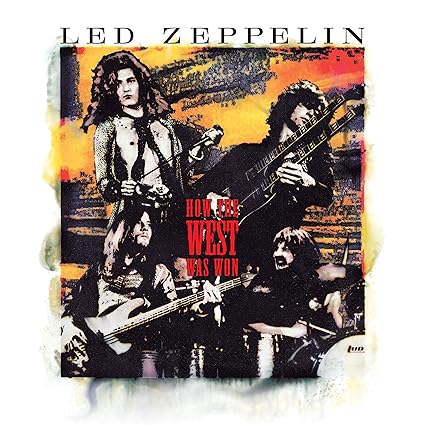
How The West Was Won (3CD/4LP/1DVD)

Led Zeppelin are undoubtedly one of the greatest live acts of the 1970s, but their only live album from the era — the soundtrack to 1976’s The Song Remains The Same — captured them on a rather limp night. This situation was finally resolved in 2003 when Jimmy Page combed through hours of tapes from the band’s 1972 tour and cobbled together this killer 18 track set. There are tons of Zeppelin bootlegs floating around, but none of them sound this crisp and alive, even though they occasionally cheated and combined multiple versions of a song into one. Highlights include a ferocious “Immigrant Song,” a 25-minute “Dazed and Confused” and a 23-minute “Whole Lotta Love” jam. “It’s Zeppelin at its best,” Page said in 2003. “Every single member of the band is in tip-top form. It’s the magic point where it takes on a fifth element.”

Fifteen years ago, Led Zeppelin issued How the West Was Won, premiering performances from the band’s June 25th and 27th, 1972 concerts at the Los Angeles Forum and Long Beach Arena.  Now, those seminal tracks have been newly remastered under the supervision of Jimmy Page for a surprise addition to the band’s Super Deluxe library – as well as in a variety of formats, all of which are due from Atlantic/Swan Song on March 23rd including the first-ever Blu-ray Audio and vinyl editions.  The remastered How the West Was Won arrives in advance of the band’s official 50th anniversary celebration, which will kick off this September.

How the West Was Won (a No. 1 album in the U.S. and a No. 5 in the U.K.) sequenced material from the Los Angeles and Long Beach concerts to replicate a single concert from start to finish as the band introduced songs from its then-unreleased fifth album, Houses of the Holy (which would be released nine months later), and looked back on its already-storied catalogue.  Among its 18 tracks are a 25-minute version of “Dazed and Confused,” a 21-minute blues medley built around “Whole Lotta Love,” and fiery takes on “Rock and Roll,” “Moby Dick,” “Immigrant Song,” “Black Dog,” and of course, “Stairway to Heaven.”

The remastered How the West Was Won will be available in the following versions:

  • CD – Remastered audio on three CDs;
  • Vinyl – Remastered audio on four 180-gram vinyl LPs;
  • Blu-Ray Audio – 96kHz/24 bit 5.1 (DTS-HD Master Audio Surround) and stereo mixes (PCM Stereo and DTS-HD Master Audio Stereo);
  • Streaming & Digital Download – Remastered audio; and
  • Super Deluxe Boxed Set:

o Remastered audio on three CDs and four 180-gram vinyl LPs.
o DVD of album in Dolby Digital 5.1 Surround and PCM Stereo, plus photo gallery.
o High-def download card of all stereo audio content at 96kHz/24 bit.
o A book filled with rare and previously unpublished photos of the band at each of the concert locations, plus memorabilia and ephemera.
o High-quality print of the original album cover, the first 30,000 of which will be individually numbered.

Look for all formats from Atlantic/Swan Song on March 23rd, and watch this space for information on further Led Zeppelin releases as the band’s  50th anniversary approaches!

Led Zeppelin, How the West Was Won (Atlantic/Swan Song 83587-2, 2003 – reissued 2018)