Posts Tagged ‘Emerson’

L-R: Keith Emerson, Greg Lake and Carl Palmer, 1970 - Michael Ochs Archives/Getty Images

Keith Emerson, Greg Lake and Carl Palmer,

Few bands embodied the excess and grandeur of prog rock like Emerson, Lake & Palmer. Combining Keith Emerson’s virtuoso keyboards, Greg Lake’s soaring voice, and Carl Palmer’s thunderous drumming, ELP filled stadiums in the early ’70s and sold millions of albums. Their shows featured giant synthesizers, exploding gongs, and even Emerson using knives to sustain organ notes.

At their peak, they were bigger than Yes or Genesis – yet they’ve aged poorly. While Yes and Genesis retained a degree of cool thanks to their songwriting and reinvention, ELP are often remembered as the poster children of prog’s overindulgence. Punk critics targeted them mercilessly.

Still, ‘Welcome Back My Friends to the Show That Never Ends’ remains a perfect slogan for their maximalist legacy: both awe-inspiring and absurd.

The second live ELP album (after “Pictures at an Exhibition“) was recorded in February 1974 at the Anaheim Convention Center on the Wally Heider 24-track mobile unit. The program begins with a trio of performances from classical repertoire, Keith Emerson’s usual way of signaling serious intent: reimagined versions of Aaron Copland’s “Hoedown,” Alberto Ginastera’s “Toccata” and Charles Parry’s setting of William Blake’s poem “Jerusalem.” The setlist continues with extended performances of almost the entire smash “Brain Salad Surgery” album, the half-hour “Tarkus” suite (with Greg Lake’s King Crimson co-write “Epitaph” inserted), and a medley of “Take a Pebble/Lucky Man” from their debut LP.

Many praised the album for presenting what was played on the night, without the post-show editing and overdubbing that had become ubiquitous for most live albums of the period.

ELP fans drove it to become their highest U.S. chart position to date (#4 in Billboard), but over time it became the target for anti-prog-rock forces who argued that even if the raw musicianship was top notch, it was applied to material that was overblown, faux classical and just plain exhausting to hear.

In 1971, Island Records released a double sampler album called El Pea. This compilation cost the princely sum of £1.99 and featured many fledging artists who would go on to become household names,this album was a revelation, and changed my attitude to music forever.

Island Records started out with a catalogue of Jamaican music but the charismatic founder, Chris Blackwell, soon diversified into an eclectic stable of contemporary acts. Some didn’t make it, some did, but all of them appeared on one or other of the samplers Island Records released in the early 1970s.

The appeal of the samplers was clear. Punters got a chance to hear some of the best new music at a heavily discounted price, whilst the record company got to promote music that did not readily lend itself to radio or TV airplay. Some of the compilations were classic recordings in their own right, and Island Records probably came out with the classiest.

El Pea was released in the UK in 1971, but it has an enduring appeal. This was probably the folkiest of the Island samplers, with the inevitable influence of Joe Boyd. However it had its heavier moments, a touch of prog and a little reggae to make for a heady brew. The album cover was hardly arresting and probably played too much on the pun in its name – a long-playing double LP called… El Pea,  However the slapdash artwork disguises a classic album. They couldn’t even get the track listing right – you might be pleased to see Nick Drake on the album but the track listed as “One Of These Things First”, is actually the even better, astonishing, “Northern Sky”. Another track worth the purchase price is by McDonald and Giles, previously of King Crimson fame, and the album from which the track comes is one of those forgotten gems you won’t regret checking out.

You can’t get El Pea on CD, but all of the tracks are available on subsequently released CDs. Additionally a number of compilation CDs have come out over the years to reprise the glorious days of the Island sampler.

With selections ranging from much-anticipated new albums by superstars Traffic, Free, and Cat Stevens; cult demigods Mott the Hoople and Quintessence; and a handful of names that might well have been new to the average browser: Mike Heron, slipping out of the Incredible String Band with his Smiling Men With Bad Reputations debut; Nick Drake, still laboring away in absolute obscurity; and so on.

There was also a spotlight shone on Emerson, Lake & Palmer, the so-called supergroup whose own eponymous debut was still awaited with baited breath, and the choice of the virtuoso “Knife Edge” over any of the album’s more accessible tracks further confirms El Pea’s validity. Any other label would have gone for “Lucky Man,” knowing that no one could resist its plaintive charms. “Knife Edge” let the ingenue know precisely what to expect from Emerson, Lake & Palmer.

And so it goes on — from Jethro Tull to Blodwyn Pig, from Fairport Convention to Sandy Denny, 21 tracks spread across four sides of vinyl serve up one of the most generous and alluring label samplers you will ever lay your hands on

Side A

A 1 – Traffic – Empty Pages
A2 – Sandy Denny – Late November
A3 – Alan Bown – Thru The Night
A4 – John And Beverley Martyn – Auntie Aviator
A5 – Fairport Convention – Lord Marlborough

Side B
B1 – Jethro Tull – Mother Goose
B2 – Quintessence – Dive Deep
B3 – Amazing Blondel – Spring Season
B4 – McDonald & Giles – Extract From Tomorrow’s People – The Children Of Today
B5 – Tir Na Nog – Our Love Will Not Decay
B6 – Mountain – Don’t Look Around

Side C
C1 – Free – Highway Song
C2 – Incredible String Band – Waiting For You
C3 – Cat Stevens – Wild World
C4 – Bronco – Sudden Street
C5 – Mike Heron – Feast Of Stephen

Side D
D1 – Emerson Lake & Palmer – Knife Edge
D2 – Nick Drake – Northern Sky
D3 – Mott The Hoople – Original Mixed-Up Kid
D4 – Jimmy Cliff – Can’t Stop Worrying, Can’t Stop Loving
D5 – Mick Abrahams – Greyhound Bus

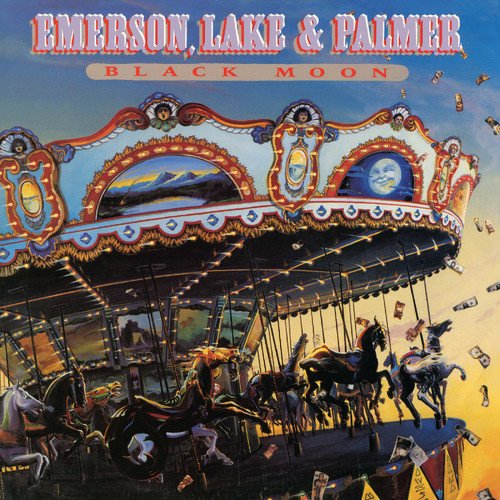
BMG Records adds two more expanded titles to its collection of Emerson, Lake and Palmer reissues.  Black Moon, on 2 CDs, has the remastered, original 1992 album on Disc One with four bonus single edits, while the second disc has a remastered version of Live at the Royal Albert Hall.  1994’s In the Hot Seat, the trio’s final album, adds three bonus tracks to its remaster on Disc One, and Disc Two presents a dozen live performances originally issued on 1998’s Then and Now.  Both albums are available, sans bonus tracks, in 140-gram vinyl editions.

This double CD comprises all ten tracks from the ‘Black Moon’ album, remastered from the original tapes. These are featured on CD Disc 1 together with four bonus items, edited single versions of the songs ‘Black Moon,’ ‘Affairs Of The Heart,’ ‘Paper Blood’ and Prokofiev’s ‘Romeo And Juliet’. ‘Black Moon’ was ELP’s first studio album since 1978’s ‘Love Beach’ and marked the reunion of the three original members after a 14-year hiatus. First released in May 1992, it was produced by Mark Mancina and engineered by Steve Kempster, who achieved a powerful, updated sound. The title track was inspired by TV images of oil fields set ablaze in 1991 during the first Gulf War. Greg Lake recalls in the liner notes: “It really was a well-made, well-conceived record and all the new material was specifically written for the album”. During a British tour, ELP played two concerts at London’s Royal Albert Hall, on October 2nd and 3rd 1992, introduced by BBC Radio DJ Alan Freeman. The shows were expertly recorded and released as ‘Live At The Royal Albert Hall’ in January 1993. A re-mastered version of the album is heard in its entirety on Disc 2 presenting dynamic ELP classics ‘Karn Evil No.9 1st Impression,’ ‘Tarkus,’ ‘Knife Edge,’ ‘Lucky Man’ and ‘Pirates.’ A grand finale medley includes old favourites ‘Fanfare For The Common Man,’ ‘America’ and ‘Rondo.’