To be fair.. I was so wasted
I was dancing recklessly.. oh, I was so dizzy
But now you’re on your own and your savior’s gone
As you trip down every virtue that you’ve ever known
For the last four years, Conner Youngblood has been putting out the sort of self-produced, nuanced electronic music that generally qualifies as “bedroom pop,” except he absolutely refuses to stay indoors. One of the first songs I ever heard by Youngblood was a track entitled “Monsters” way back in 2010, and I was fascinated and struck by the way he interpolated a banjo riff with some bombastic bass dubstep production.
Now 24, the native Texan is currently based out of Nashville. Before that, he attended Yale, He was a wrestler for tha Ivy League Team before venturing into the music industry. Then a deal with a label fell through in 2013, He stepped back and refocused and continued to make fiercely independent music house, folk, and indie pop. He self-released the Confidence EP in 2014. But is now following that up with a new, completely self-produced EP called The Generation Of Lift.
Me and Bobby McGee turned into Joplin’s signature song. The song was on her last album Pearl. this was a slightly different vocal for Janis. There is more control in her voice in this one. The producer Paul A. Rothchild was working with Janis to use her voice more efficiently so she could continue to sing later on in her career. Unfortunately, she never got a chance.
This was Janis Joplin’s only top ten hit although her songs are still played today.
This was released after Joplin died of a heroin overdose. Her death gave the album a lot of attention, and Pearl went to #1 in the Billboard Album Chart in 1971. It was the second song to hit #1 in the US after the artist had died…”Dock Of The Bay” by Otis Redding was the first.
The song was written by Kris Kristofferson:“I had just gone to work for Combine Music. Fred Foster, the owner, called me and said, ‘I’ve got a title for you: ‘Me and Bobbie McKee,’ and I thought he said ‘McGee.’ I thought there was no way I could ever write that, and it took me months hiding from him because I can’t write on assignment. But it must have stuck in the back of my head. One day I was driving between Morgan City and New Orleans. It was raining and the windshield wipers were going. I took an old experience with another girl in another country. I had it finished by the time I got to Nashville.”
If this song was good enough for Janis it’s good enough for us! ‘Me And Bobby McGee’ is an American classic, originally performed by Roger Miller and later covered by Janis Joplin in 1970, a few days before her death. October 4, 1970 (aged 27) inHollywood, California, Unfortunately, the song she’s best known for is one that we never got to see her perform live. Lucky for us though, Janis Joplin’s rendition of ‘Me And Bobby McGee’ was included on her 1971 posthumous release, “Pearl”.
This was written by Kris Kristofferson, who has written hundreds of songs for a wide variety of artists. Kristofferson would become a successful solo artist and appear in several movies, but it was Janis Joplin’s hit cover of this song that brought his career to the next level. “‘Bobby McGee’ was the song that made the difference for me,” he told Performing Songwriter in 2015. “Every time I sing it, I still think of Janis.”
The founder of Kristofferson’s record label, Fred Foster, rang him just as the struggling musician was about to leave Nashville for his helicopter pilot sideline job. He said that he had a song title for the songwriter – “Me And Bobby McKee.” Kristofferson recalled in Mojo magazine March 2008 that his label boss suggested: “‘You could make this thing about them traveling around, the hook is that he turns out to be a she.'”
Kristofferson was not sure at first. “I hid from Fred for a while but I was trying to write that song all the time I was flying around Baton Rouge and New Orleans. I had the rhythm of a Mickey Newbury song going in the back of my mind, ‘Why You Been Gone So Long,’ and I developed this story of these guys who went around the country kind of like Anthony Quinn and Giuletta Masina in (Fellini’s) La Strada. At one point, like he did, he drove off and left her there. That was ‘Somewhere near Salinas, I let her slip away.’ Later in the film he (Quinn) hears a woman hanging out her clothes, singing the melody she (Masina) used to play on the trombone, and she told him, ‘Oh, she died.’ So he goes out, gets drunk, gets into a fight in a bar and ends up on the beach, howling at the stars. And that was where ‘Freedom’s just another word for nothing left to lose’ came from, because he was free from her, and I guess he would have traded all his tomorrows for another day with her.”
The song’s final defining image came to Kristofferson as he was driving in heavy rain to the airport for the flight home. “I went, ‘With them windshield wipers slapping time and Bobby clapping hands we finally sang up every song the driver knew.’ And that was it.”
Fred Foster used a secretary’s name as inspiration for the title. Her name was actually Bobbi McKee. By naming the character in the song “Bobby,” it made sure a female singer could sing it without changing the name, since “Bobby” could refer to a man or woman.
This was first recorded in 1969 by a country singer named Roger Miller, who is known for his hit “King Of The Road.”
Kris Kristofferson released this in 1970 on his first album, Kristofferson. A year later, when it became a hit for Joplin, Kristofferson’s album was re-released as Me And Bobby McGee to take advantage of the song’s new popularity.
The lyrics tell the story of two young lovers who travel together, but break up so they can discover the world on their own. The characters in the song were a lot like Joplin, who was known as a free spirit.
In the March 2006 issue of Esquire magazine, Kristofferson was asked where he was when he came up with the line, “Freedom is just another word for nothing left to lose.” His reply: “I was working the Gulf of Mexico on oil rigs, flying helicopters. I’d lost my family to my years of failing as a songwriter. All I had were bills, child support, and grief. And I was about to get fired for not letting 24 hours go between the throttle and the bottle. It looked like I’d trashed my act. But there was something liberating about it. By not having to live up to people’s expectations, I was somehow free.”
The line, “I pulled my Harpoon from my dirty red bandana” can be interpreted two ways. The more sanitized version considers the “Harpoon” as a slang word for harmonica. The second interpretation considers it a hypodermic needle, since a bandana was often used to tie off the arm before an addict shot up.
The version on Joplin’s 1995 Greatest Hits album 18 Essential Songs contains an alternate version recorded as a demo.
Jerry Lee Lewis covered this in more of a country style several months after Joplin’s version was released. His version hit #40 in the US.
This was Joplin’s only Top 10 hit. She was a very influential and well-known singer, but her bluesy sound kept most of her songs off the pop charts.
The same year Joplin’s version was issued, Kris Kristofferson released The Silver Tongued Devil and I, which was a successful album and finally solidified his place as a singer/songwriter.
Kristofferson performed an acoustic version of this song when Joplin was honored with a star on the Hollywood Walk of Fame in 2013. Kristofferson, who had a brief affair with Joplin, recalled hearing her rendition on the day of her death. He explained to Rolling Stone magazine: “Her producer gave me the record and it was pretty hard to listen to. I was listening to it at my publisher’s office where we used to hang out, there was nobody there and I was playing it over and over again just so I could hear it without breaking up.” >>
The B-side of the single was a song called “Half Moon,” which also appeared on the Pearl album. That song was written by John Hall and his wife Johanna. It was the first song they wrote together, and a huge break for the couple, who were able to buy a buy a house and a sailboat with the royalties. John Hall got a lot of credibility in the rock realm from co-writing it, and his career took off. A few years later, he formed the group Orleans, which had hits with two songs he wrote: “Still The One” and “Dance With Me.”
Did you know…That this was Janis Joplin’s only top 10 hit? The greatest white female rock singer of the 1960s, Janis Joplin was also a great blues singer, making her material her own with her wailing, raspy, supercharged emotional delivery.
Janis Joplin’s signature bluesy style always kept her off of the pop charts. After her death in October 1970, ‘Me And Bobby McGee’ immediately shot to the #1 spot on U.S. music charts!.
Janis Joplin charted five singles, and other popular songs from her four-year career include “Down On Me”, “Bye, Bye Baby”, “Coo Coo”, “Summertime”, “Piece of My Heart”, “Turtle Blues”, “Ball ‘n’ Chain”, “Try (Just A Little Bit Harder)”, “Maybe”, “To Love Somebody”, “Kozmic Blues”, “Work Me, Lord”, “Move Over”, “Cry Baby”, “A Woman Left Lonely”, “Get It While You Can”, “My Baby”, “Trust Me”, “Mercedes Benz”, “One Night Stand”, “Raise Your Hand” and her only number one hit, “Me and Bobby McGee”.
Joplin was well-known for her performing abilities, and her fans referred to her stage presence as “electric”. At the height of her career, she was known as “The Queen of Rock and Roll” as well as “The Queen of Psychedelic Soul”, and became known as Pearl amongst her friends. She was also a painter, dancer and music arranger.
Ever the trendsetter even in death, this feat made hers the second ever song to reach the #1 spot after the artist died. While it’s sad that her talent wasn’t fully realized while she was still here to enjoy it, I think that her death is what made people really sit up and pay attention to this lonely girl from Port Arthur, Texas with a big voice and an even bigger heart!
“What stands out about Holy Wave is the sonic textures they apply to make their sound pierce through the smoke-filled haze that engulfs most psych bands.
El Paso, Texas five-piece Holy Wave makes no bones about its love affair with reverb. The group’s second full-length, Relax, is awash in bouncy, hazy songs played at various paces with foggy vocals bleeding in, out and over cheeky melodies. It’s a garage-rock lover’s garage-rock album, unabashedly embracing of Zombies-like slacker psalms and clunky guitar manipulations.
Droning surf progressions and organ come together in “Night Tripper,” the album’s first inkling of any real dynamic outside of their loyalty toward seminal psychedelic forefathers. Relax as a title for this collection is almost too-fitting, with heavy-lidded tunes like “Sol Love” expounding such rudimentary lyrical fodder as “Look at the sun/look at the people” before all sense of cadence or phrasing is lost in a garbled wave of groovy UV white noise.
The album’s first single, “Star Stamp,” singes in an Iron Butterfly bass-and-organ style progression, and guitars are finally freed up for some sorely needed snaky leads. A Ronettes-like fade-in to the enchanting “Shamania” marks a smart, sharp turn for the LP, and it drives home the notion that above all, Holy Wave is a band at total war with contemporary ideas of audio fidelity. That these allegiances are steeped in such stupefying repetition and in such drowse-inducing lengths is regrettable for wide swaths of Relax until some writhing guitar squall comes out of nowhere to bring you back in. 00:00 – Do You Feel It 3:34 – Psychological Thriller 6:13 – Night Tripper 11:15 – Sol Love 13:45 – Star Stamp 17:18 – Son of Sound 21:59 – Shamania 26:52 – Change your Head/Ecstatic Moment 31:55 – Surfin Mta 35:54 – Mouth Mountain 40:13 – Wet & Wild
Leon Bridges is an American gospel and soul singer from Fort Worth, Texas. He is best known for his song “Coming Home” which received regular airplay and was also a Top 10 Most Viral Track on the net and Spotify Bridges music style is soul and gospel resembling 1960s rhythm and blues, with The Wall Street Journal describing him as a “throwback to ’60s-soul a la Otis Redding and Sam Cooke.” Bridges performs in vintage clothing describing him as someone whose “music sounds like he looks.Because he will be at the Franklin’s BBQ of SXSW—the lines will be long and everyone that waits will swear it was worth it. But if a recent run of spot-on Austin shows is an indication (and it should be), they’ll be right: Live, where you can hear pin drop when he belts out the big ballads, the hype on this 25-year-old soul-thowback proves itself worth believing. And this early Mother’s Day card, only the third piece of recorded evidence to surface so far, is as stirring as it is gorgeous.
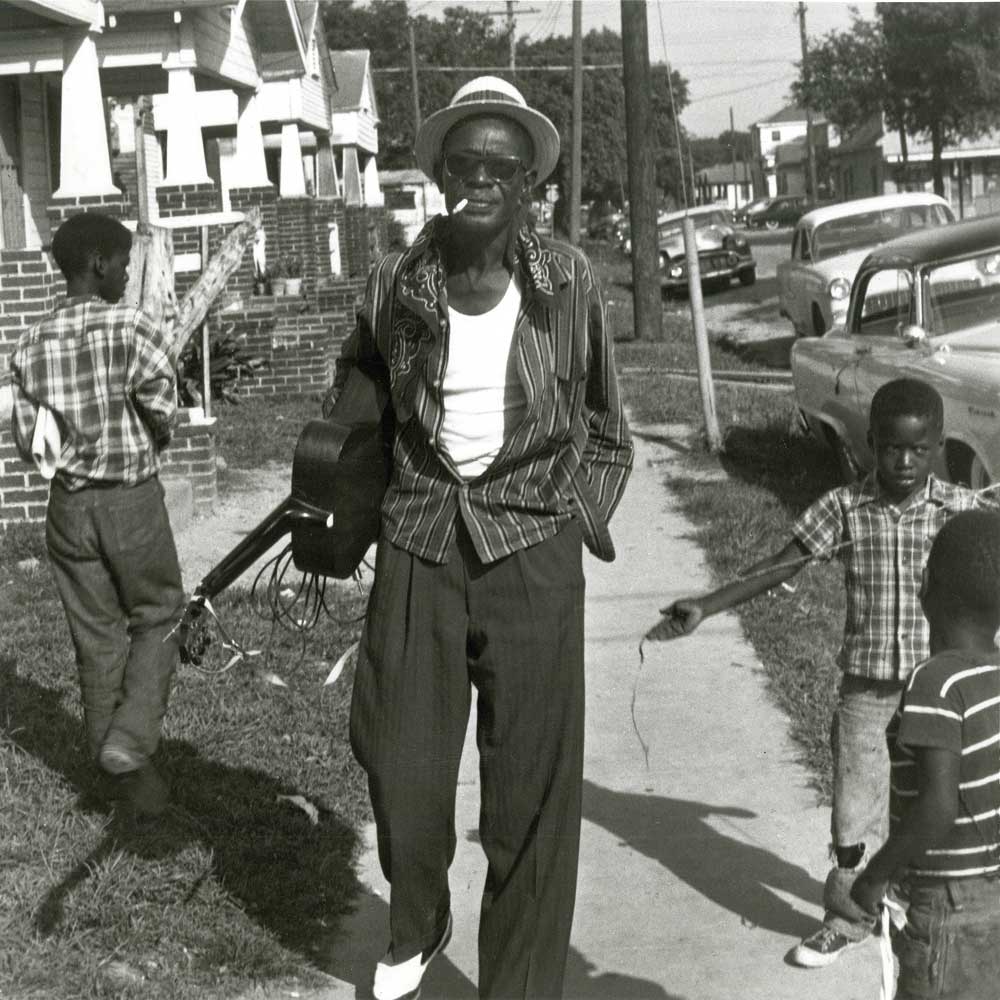
Sam John Hopkins (March 15, 1912 – January 30, 1982), better known as Lightnin’ Hopkins, was an American country blues singer, songwriter, guitarist and occasional pianist, from Houston, Texas. Rolling Stone magazine included Hopkins at number 71 on their list of the 100 greatest guitarists of all time. Lightnin’ Hopkins I was expecting something ancient, something old, but Hopkins sounds modern and his guitar playing is just out of this world! Hopkins’ style was born from spending many hours playing informally without a backing band. His distinctive fingerstyle playing often included playing, in effect, bass, rhythm, lead, percussion, and vocals, all at the same time. He played both “alternating” and “monotonic” bass styles incorporating imaginative, often chromatic turnarounds and single-note lead lines. Tapping or slapping the body of his guitar added rhythmic accompaniment.
Much of Hopkins’ music follows the standard 12-bar blues template but his phrasing was very free and loose. Many of his songs were in the talking blues style, but he was a powerful and confident singer.[citation needed] Lyrically his songs chronicled the problems of life in the segregated south, bad luck in love and other usual subjects of the blues idiom. He did however deal with these subjects with humor and good nature. Many of his songs are filled with double entendres and he was known for his humorous introductions
Born Sam John Hopkins in Centerville, Texas, Hopkins’ childhood was immersed in the sounds of the blues and he developed a deeper appreciation at the age of 8 when he met Blind Lemon Jefferson at a church picnic in Buffalo, Texas. That day, Hopkins felt the blues was “in him” and went on to learn from his older (somewhat distant) cousin, country blues singer Alger “Texas” Alexander. Hopkins had another cousin, the Texas electric blues guitarist Frankie Lee Sims, with whom he later recorded. Hopkins began accompanying Blind Lemon Jefferson on guitar in informal church gatherings. Jefferson supposedly never let anyone play with him except for young Hopkins, who learned much from and was influenced greatly by Blind Lemon Jefferson thanks to these gatherings. In the late 1930s, Hopkins moved to Houston with Alexander in an unsuccessful attempt to break into the music scene there. By the early 1940s, he was back in Centerville working as a farm hand.
Hopkins took a further atempt at Houston in 1946. While singing on Dowling St. in Houston’s Third Ward (which would become his home base), he was discovered by Lola Anne Cullum from the Los Angeles-based record label Aladdin Records. She convinced Hopkins to travel to Los Angeles, where he accompanied pianist Wilson Smith. The duo recorded twelve tracks in their first sessions in 1946. An Aladdin Records executive decided the pair needed more dynamism in their names and dubbed Hopkins “Lightnin’” and Wilson “Thunder”.
Hopkins recorded more sides for Aladdin in 1947. He returned to Houston and began recording for the Gold Star Records label. During the late 1940s and 1950s Hopkins rarely performed outside Texas. He occasionally travelled to the Mid-West and Eastern United States for recording sessions and concert appearances. It has been estimated that he recorded between 800 and 1000 songs during his career. He performed regularly at clubs in and around Houston, particularly in Dowling St. where he had first been discovered. He recorded his hits “T-Model Blues” and “Tim Moore’s Farm” at SugarHill Recording Studios in Houston. By the mid to late 1950s, his prodigious output of quality recordings had gained him a following among African Americans and blues musicaficionados.
In 1959, Hopkins was contacted by Mack McCormick, who hoped to bring him to the attention of the broader musical audience, which was caught up in the folk revival. McCormack presented Hopkins to integrated audiences first in Houston and then in California. Hopkins debuted at Carnegie Hall on October 14, 1960, appearing alongside Joan Baez and Pete Seeger performing the spiritual “Mary Don’t You Weep”. In 1960, he signed to Tradition Records. The recordings which followed included his song “Mojo Hand” in 1960.
In 1968, Lightning Hopkins recorded the album Free Form Patterns backed by the rhythm section of psychedelic rock band the 13th Floor Elevators. Through the 1960s and into the 1970s, Hopkins released one or sometimes two albums a year and toured, playing at major folk festivals and at folk clubs and on college campuses in the U.S. and internationally. He toured extensively in the United States and played a six-city tour of Japan in 1978.
Hopkins died of esophageal cancer in Houston on January 30, 1982, at the age of 69. His New York Times obituary named him as “one of the great country blues and perhaps the greatest single influence on rock guitar players.”
its safe to say thatLeon Bridges hasn’t been garnering attention because his sound and song structure are terribly original. To say that he’s merely channeling his influences, though, wouldn’t be true. Sure, his music is heavily reminiscent of the soul greats, but his melodies and swagger are all his own.
Even so, there’s something to be said about the fact that his songs feel like they came from decades ago – creating a modern classic is no easy feat, and he seems to thrive in that space. Take any opportunity you can to see him during SXSW, because after a summer of festivals and an album release, you won’t be able to catch him in any reasonably sized venue.
Firmly a phenomenon in their home country of Iceland, the four-piece band Kaleo is set to descend upon foreign shores in 2015, bringing their gorgeous blend of folk, blues, country, and rock to a wider mainstream audience in America. Their isolated heritage inspires a unique take on familiar sonic elements, resulting in diversity and freedom on each and every breathtaking track.
Best friends since attending elementary school in the small town of Mosfellsbaer outside of Reykjavik, bandleader JJ Juliusson, drummer David Antonsson, and bassist Danny Kristjansson began playing cover songs together at the age of 18. Honing their skills with the songs of others, they began writing their own music and gigged around the nation’s capital for a few years, playing countless shows before adding guitarist Rubin Pollock to the mix in 2012. They named the band Kaleo, which means “the sound” in Hawaiian, and started their career in earnest with a handful of well-received shows at the 2012 Iceland Airwaves music festival.
They recorded their first pair of original songs in early 2013, the fiery “Rock N Roller” and laid-back, bluesy “Pour Sugar On Me,” which earned Kaleo some radio airplay and press in Iceland. Then, that spring, their cover of the traditional Icelandic ballad “Vor í vaglaskógi” during a live radio show was videotaped and posted to YouTube, where it quickly went viral. The band recorded a studio version of the song in June, which went straight to Number One in virtually every radio station in the country. “It’s a different kind of cover, more dramatic and the tempo is taken down,” says JJ. “We had played it for friends and people seemed to react to it. I always liked the old song; somehow it spoke to me.” The buzz for Kaleo had begun; in fact, the video’s views now number greater than the entire population of Iceland.
The band signed to Iceland’s largest record label, Sena, in the fall of 2013 and recorded their full-length debut, Kaleo, in just six short weeks. Five singles would reach Number One and the album would go Gold, receiving high praise and sending the band to shows and festivals in Europe over the next year, including an appearance on the biggest stage in their home country, Culture Night, where they played to 100,000 people and reached 90 percent of Iceland’s population in broadcast. Then, in the spring of 2014, Kaleo recorded the lush, introspective song “All the Pretty Girls” and in one night their destiny to outgrow their small, island nation was cemented.
“It’s different from the others, a very delicate song. It seemed to speak to a lot of people,” says JJ. “From there everything started to happen. We got contacted from other places: managers, labels, publishers—they all went crazy over one night.” Drawn to Kaleo’s multi-layered dynamics, their ability to play different genres with equal skill, the vocals and mood reminiscent of everything from Bon Iver and Iron & Wine to Coldplay and David Gray, and wise-beyond-their-years songwriting, the world came calling.
Now, signed to Atlantic Records in the US, Kaleo has moved to Austin, Texas, and will begin recording new material with producer Mike Crossey (Arctic Monkeys, Jake Bugg) in London for an EP due this year. Get ready for the sound.
The first single off of Gal Pals’ debut LP “Velvet Rut” available 2/24/2015 GAL PALS are Jillian Talley (drums) and Lauren Mikus (guitar), a Los Angeles-via-Texas duo aiming to create pop gold on their self-titled, debut full-length album due out this fall. GAL PALS released two 7” singles in 2013, touring Texas, playing SXSW and garnering some excellent praise from media. Bleach said, “Gal Pals sound of spunk, of yellow-filtered memories, and the desperate need of an attitude adjustment.” In early 2014, Talley and Mikus packed up their bags and headed out west with their record in hand. The duo plan to spend much of the fall on the road.
Any number of bands cite 60’s Texas psych as an influence, but rarely does a group actually capture what made those bands special. Following their debut EP also on Trouble In Mind, The Night Beats have expanded on the bedroom immediacy of their first recordings to create an LP that perfectly captures and modernizes the hallucinogenic and exhilaratingly demonic aura of bands like The 13th Floor Elevators and Golden Dawn. With blazing guitar work and a razor sharp rhythm section Danny Lee Blackwell and company mutate conventional chords & progressions into a mind-blowing sonic sprawl. The record reels you in with 2-3 minute pop songs like ‘Ain’t Dumbo’ and ‘Dial 666′, forging a landscape that then throws you into a chaotic journey of jams a’la ‘Dewayne’s Drone’ and ‘Little War in the Midwest’ that bend and meander but never overstay their welcome. Tune in, turn on, & drop that needle on this record.




 The Fat Angel Sings