During rehearsals, I draw up set lists on big canvases, putting down the songs and the keys they’re in. We hang these set lists on the rehearsal room walls so we know where we’ve been and where we’re going.’ – Ronnie Wood
Over the last two decades, each song the Rolling Stones have played in rehearsals has been recorded by Ronnie Wood in a series of hand-painted set lists. The result is a unique collection of canvases that document sell-out tours across the globe, such as the band’s landmark 50 & Counting tour, historic concerts such as 2016’s performance in Havana, as well as closed-door sessions for their latest album, Blue & Lonesome.
Now for Genesis subscribers and for all fans of the Rolling Stones, we are delighted to present Ronnie Wood’s painted set lists for the first time. Choose from three new limited editions, each signed by Ronnie Wood.
I illustrate the band’s set lists, sometimes Keith and Mick add little doodles, and they become works of art in their own right.’ – Ronnie Wood
Ronnie Wood has chosen nearly 100 painted set lists to be published for the first time. Presented in chronological order, the collection follows the group’s travels to foreign rehearsal locations that were kept secret at the time. They reveal the songs rehearsed for historic performances, such as the Rolling Stones‘ 2014 inaugural concert in Israel, as well as documenting the shows as eventually played. The colourful hand-lettering recalls Wood’s early art school days when he worked as a sign writer. The set lists are visually eye catching and filled with fascinating details. Wood’s calligraphy is interspersed with his own illustrations, doodles by fellow band members, and jotted notes that all add up to paint a picture of life on the road with the Rolling Stones.
‘It could be somebody coming in at the wrong moment, or forgetting the arrangement and suddenly going to the middle eight, when you can see Keith mouthing, “What the hell is he doing?” It’s all part of what keeps the band vibrant.’ – Ronnie Wood
In a new manuscript spanning 212 pages, Wood offers a glimpse behind the scenes of one of the most famous rock bands in the world. Through Wood’s artwork and his personal reflections, the reader is given an insight into the band’s touring over the years.
Throughout the book, Ronnie Wood brings the story of the set lists to life, as he discusses the band’s creative process, learning up to 80 songs per tour; personal highlights, such as Valentine’s Day 2014, when a small group of fans were invited into rehearsals; collaborations with fellow musicians such as The Black Keys, Eric Clapton, Florence Welch and Jeff Beck; and the band’s various reunions with former Rolling Stones Bill Wyman and Mick Taylor.
The Set Pieces book is limited to only 1,000 numbered copies, each signed by Ronnie Wood.
Presented in a cloth-bound slipcase, the 212-page volume is quarter bound in burgundy leather with purple and gold screen-printed covers – emblazoned with the lizards that feature on one of Ronnie’s custom-made guitar straps. Ronnie Wood’s large format Set Piecesbook (page size: 297mm x 420mm / 11 ¾” x 16 ½”) is hand-finished with gilt page edging and tooling.
When vocalist Steve Marriott left to form Humble Pie, his three Small Faces bandmates regrouped with JeffBeck Group axeman Ron Wood and singer Rod Stewart. With the name shortened to Faces, the U.K. quintet made an auspicious debut in 1970 with the album release “FIRST STEP”, a title that made sly reference to the beginner’s guide to guitar that Wood holds in the cover photo.
First Step was the first album by the then British group re named Faces, released in early 1970. The album was released only a few months after the Faces had formed from the ashes of the Small Faces (from which Ronnie Lane, Kenney Jones and Ian McLagan hailed) and The Jeff Beck Group (from which Rod Stewart and Ronnie Wood hailed.) The album is credited to the Small Faces on the cover , The album cover shows Ronnie Wood holding a copy of Geoffrey Sisley’s seminal guitar tutorial First Step: How to Play the Guitar Plectrum Style.
But there was nothing inexperienced about any of these musicians, and their chemistry and superb performances are evident on each of the 10 tracks. After an ace cover of Dylan’s “Wicked Messenger” the material is all original, with songwriting duties spread fairly evenly among the members; with a pair of instrumentals and such fine tracks as “Around the Plynth” Other highlights include Ronnie Lane’s folksy “Stone”, the hard-rocking “Shake, Shudder, Shiver”, “Three Button Hand Me Down” (on which both Lane and Wood play the bassline, affording the track a unique sonic quality in the Faces catalogue), and the soulful “Flying”.
it’s a consistently enjoyable collection. Faces were inducted into the Rock and Roll Hall of Fame in 2012, and the journey that brought them there begins with FIRST STEP.
In August 2015, the album was reissued in a remastered and expanded form, including two previously-unreleased bonus tracks recorded shortly after the album’s release, “Behind the Sun” and “Mona the Blues” (although the latter was remade by Lane and Wood in 1972 for their Mahoney’s Last Stand film soundtrack).
This week in 1974: The Rolling Stones scored their 5th US chart topping album with their 12th British & 14th American studio release, ‘It’s Only Rock ‘N Roll’, released on Rolling Stones Records (it peaked at #2 in the UK); the LP’s success was fueled largely by its two main singles the title track & a cover of the 1966 Motown hit for The Temptations, “Ain’t Too Proud to Beg” it was the first album that Keith Richards & Mick Jagger produced together for the band, under their adopted moniker of ‘The Glimmer Twins’…
Recorded in the 1970s, ‘It’s Only Rock ‘n Roll (But I Like It)’ is as iconic a Rolling Stones song as any that the band cut in the 1960s. It is a song with a tangled web of a history having first been recorded on 24th July 1973, not in a traditional studio but at The Wick, Ronnie Wood’s home in Richmond. According to Bill Wyman, who admittedly wasn’t there, “On Tuesday 24th July, Mick and Keith went to Ronnie Wood’s house, the Wick in Richmond, and recorded a version of ‘It’s Only Rock and Roll’, with Ronnie, Kenney Jones, and IanMcLagan.” Ronnie, Jones and McLagan were all in The Faces along with Ronnie Lane and Rod Stewart. Other reports have David Bowie at Ronnie’s house, but that Keith was not there.
Whatever the truth that has been long forgotten, as to who was there and who wasn’t, this was the genesis of the song. Sometime later in the year Willie Weeks, an American session musician who worked with both GeorgeHarrison and David Bowie around this time, added bass to the song. In April 1974 the basic track that was recorded at Ronnie’s house was used to finish the song, at this time Ian Stewart added his distinctive piano to the track.
According to Mick, “The idea of the song has to do with our public persona at the time. I was getting a bit tired of people having a go, all that, ‘oh, it’s not as good as their last one’ business. The single sleeve had a picture of me with a pen digging into me as if it were a sword. It was a light hearted, anti-journalistic sort of thing.”
The song became the title track for their 1974 album and was released as a single on 26th July 1974, three months before the LP came out. But the record company at the time were not sure it was a single, According to Keith there was opposition to it, but as he said at the time, “That song is a classic. The title alone is a classic and that’s the whole thing about it.”
The Rolling Stones‘ official promo video for ‘It’s Only Rock ‘N’ Roll (But I Like It)’. The track is the title single from the album It’s Only Rock and Roll (1974). Written by Mick Jagger and Keith Richards, and produced by the Glimmer Twins, the song went straight to number one in the US charts when it was released.
The video features Mick Jagger, Keith Richards, Charlie Watts, Bill Wyman and Mick Taylor dressed in sailor suits performing in a circus tent that fills with bubbles that features the band in sailor suits, playing in a tent which gradually filled with bubbles. The froth was detergent and the reason they wore the sailor suits was because none of them wanted to ruin their own clothes. According to Keith, “Poor old Charlie nearly drowned… because we forgot he was sitting down.”
The video was directed by filmmaker Michael Lindsay-Hogg, who also directed the promo videos “Neighbours”,“Jumping Jack Flash” and “Child Of The Moon”. Lindsay-Hogg also directed promos for the Beatles and the Who.
It went top 20 in both America and the UK and has been played at just about every live show ever since.
There are very few albums which are indispensable. The Beatles Revolver, Stones Exile on Maine Street and the like. For me, truly great records capture a moment.
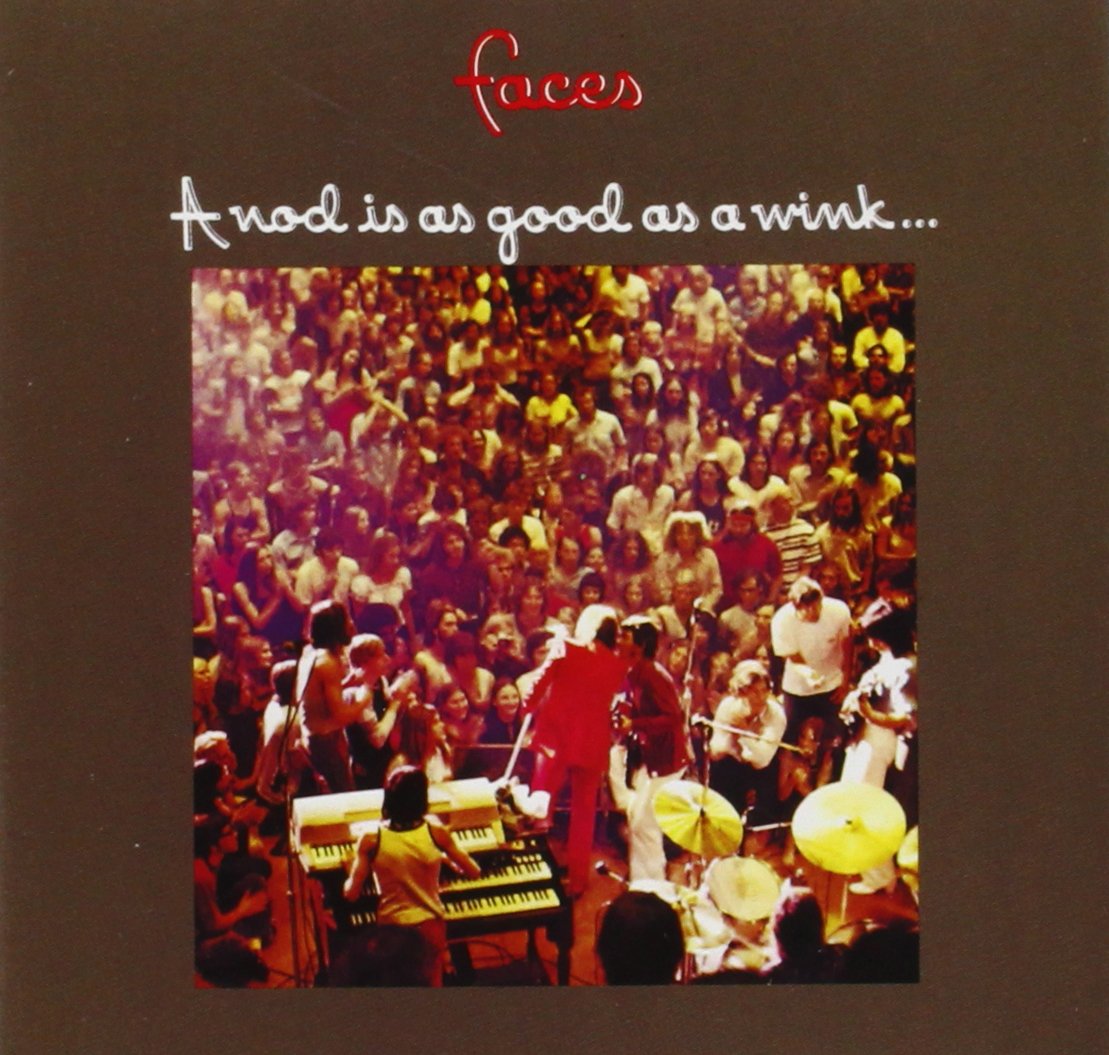
The Faces‘ third album from 1971, came in the middle of a whirlwind year for singer RodStewart. In the mere months that separated the album “Long Player” and “A Nod Is As Good As A Wink”Stewart had a huge hit with “Maggie May” and his first No. 1 solo album (‘Every Picture Tells a Story’) his third solo album was something that would soon irreparably damage the band, but at the time it was mere good fortune, helping bring them some collateral success that they deserved. Certainly, it didn’t change the character of the album itself, which is the tightest record the band ever made. Granted that may be a relative term, since sloppiness is at the heart of this band, but this doesn’t feel cobbled together, (which the otherwise excellent Long Player did).
‘A Nod Is as Good as a Wink .finally gave the group their long-awaited hit single in “Stay with Me,” . Loose, bluesy and boozy, rock ‘n’ roll doesn’t get more natural than this. The Faces and solo Rod Stewart were never as good as this before or since. From the opening ‘Miss Judy’s Farm’ which is awesome, the songs just get better and better. Their interpretation of Chuck Berry’s Memphis Tenessee followed by ‘Too Bad’ will make you feel grateful that you’re alive. Ending with the rampaging good times of “That’s All YouNeed.” In between, Ronnie Lane serves up dirty jokes the exquisitely funny “You’re So Rude” and heartbreaking ballads (the absolutely beautiful “Debris” , and generally serves up a nonstop party. There are few records that feel like a never-ending party like this seventies album , the slow moments are for slow dancing, and as soon as it’s over, it’s hard not to want to do it all over again. It’s another classic –
They were helped in that respect by new co-producer Glyn Johns, who came in as an impartial outside set of ears while helping to wrangle the unruly band members into recording shape. It couldn’t have been the easiest gig, but it’s easy to understand why Johns was attracted to it — aside from Stewart’s formidable vocals, the group boasted the prodigious talents of keyboardist Ian McLagan , drummer Kenney Jones and perpetually underrated bassist and great songwriter Ronnie Lane .
With Johns helping the Faces were brought more attentively to bear on some of their finest material. While public perception was increasingly focused on Stewart, the new album titled A Nod Is As Good As a Wink … to a Blind Horse — presented the band at their creatively democratic best. Of the eight originals they lined up for the LP, the majority were co-written, with Lane, McLagan, Stewart and Wood all having a hand in the record’s compositional makeup. As Lane recalled in the years after its release, Nod captured a group firing on all cylinders.
Side One
1. “Miss Judy’s Farm” (Rod Stewart, Ronnie Wood) – 3:42
2. “You’re So Rude” (Ronnie Lane, Ian McLagan) – 3:46
3. “Love Lives Here” (Lane, Stewart, Wood) – 3:09
4. “Last Orders Please” (Lane) – 2:38
5. “Stay with Me” (Stewart, Wood) – 4:42
Side Two
1. “Debris” (Lane) 4:39
2. “Memphis, Tennessee” Incorrectly titled on original US pressings of the album as simply “Memphis” (Chuck Berry) – 5:31
3. “Too Bad” (Stewart, Wood) – 3:16
4. “That’s All You Need” (Stewart, Wood) – 5:05
PERSONNEL –
ROD STEWART – vocals
RONNIE LANE – bass, acoustic guitar, percussion, vocals
RONNIE WOOD – lead, slide, acoustic and pedal steel guitars, backing vocals on “Too Bad”, harmonica
IAN McLAGAN – piano, organ, backing vocals “Too Bad”
KENNEY JONES – drums, percussion
HARRY FOWLER – steel drums on “That’s All You Need”
GLYN JOHNS – co-producer, engineer
PRODUCED BY FACES AND GLYN JOHNS
How to stay relevant. It’s a question we all face at some point in life. Mick Jagger was thinking about staying relevant. It was 1983. Punk had come and gone. New Wave was still a thing. Electronica and the New Romantics were still fashionable. Where did a rock ‘n’ roll band like the Stones fit into the mix? Jagger was going through what Keith Richards called “Lead Vocalist Syndrome.” The point where a band’s singer thinks he/she is bigger, better, and more important than the rest of the group.
Richards had quit heroin. He was clean. After years of fucking around, Richards was back and wanted to take up his fair share of the burden After being busted in Toronto for heroin possession, the Stones guitarist luckily avoided jail time and cleaned himself up (for the most part). With his cookies relatively un-fazed, Richards soon realized the amount of control that Mick Jagger now had over the band. But Jagger had control of the Rolling Stones and wasn’t going to give Keith an inch. A great deal of the tension during the recording of the album stemmed from the fact that Richards had emerged (to an extent) from his destructive lifestyle of the previous decade, and thus sought a more active role in the creative direction of the band.
To keep relevant, Jagger was checking out the competition. He wanted to know what Bowie was doing, what RodStewart was doing, what was the latest tune played on the dancefloor at Studio 54, and which bands were snapping at their heels. Jagger and Richards had written their first song on a kitchen table. They didn’t care what other people thought or who they sounded like, it was their song—that was all that mattered. Now, the relationship between Jagger and Richards was fractious. It was falling apart. Jagger had control and he was taking the Stones where he wanted.
Yet, checking out the opposition, chasing the trends meant sometimes Jagger got it right. He was and still is a shrewd businessman—let’s not forget, he had been a student at the London School of Economics. He had also been very successful in taking the Stones in unlikely directions, like that time he pulled them into disco music with “MissYou.” But sometimes his ideas were not as popular, Jagger was always open to suggestions, always looking for something new, always wanting to be at the front of the crowd.
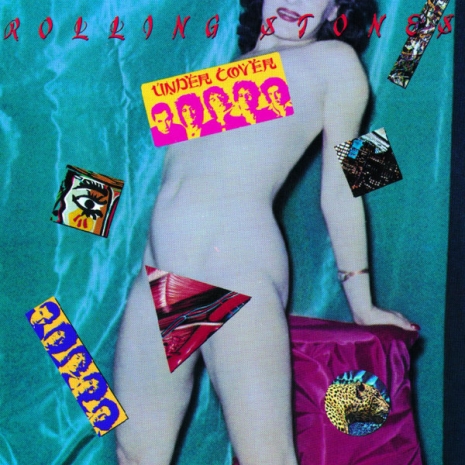
Undercover is the 17th British and 19th American studio album by The Rolling Stones, released in 1983. After their preceding studio album, Tattoo You (1981), which was mostly patched together from a selection of outtakes, Undercover was their first release of all new recordings in the 1980s. The making of Undercover was an arduous process, largely because Jagger and Richards’ famous mid-1980s row began during these sessions.
The lyrics on Undercover are among Jagger’s with much grisly imagery to be found in the lead single and top 10 hit “Undercover of the Night”, a rare political track about Central America, as well as “Tie You Up (The Pain of Love)” Though it’s meant as a critique of ‘80s culture, “Too Much Blood” contains the most convulsive imagery on the entire record; it’s also its highlight. Featuring another mutant disco beat from Watts and Dunbar, alongside a bed of rhythm guitars, Mick delivers a half-rap that references The Texas Chainsaw Massacre and details the horrifying true story of Issei Sagawa, a Japanese man who murdered his date, then devoured her body piece by piece. Over the oddly alluring horns and slick, reverb-ed overproduction, he yelps, “I can feel it in the air, feel it up above/Feel the tension everywhere, there’s too much blood!” (The single also featured a disturbing video, as Richards and Wood chase after Jagger with chainsaws.) It’s undoubtedly one of the strangest songs in the Stones’ catalouge, a warped look at a pop-culture landscape that’s only gotten more perverse as time drags on.
With Jagger’s attempt to incorporate contemporary trends in dance music. Musically, Undercover appears to duel between hard rock, reggae and new wave, reflecting the leadership tug of war between Jagger and Richards at the time. “Pretty Beat Up” is largely a Ronnie Wood composition, and Jagger and Richards were both reportedly reluctant to include it on the album.
Undercover continues to divide . Although it was largely praised on release, many fans came to regard it as among the Rolling Stones‘ weaker releases, a view echoed by Jagger himself in later interviews. While some critics tend to blame the then-contemporary production and eclecticism, a large part of the album was done in a hard-rock style (“She Was Hot”, “Too Tough”, “All The Way Down”, and “It Must Be Hell”), leading many to fault the generally inconsistent material.
Written and sung by Keith, “Wanna Hold You” the song takes the standard pop conceit of a poor man who can only promise his woman love, and creates a dazzling positivity, It’s a simple pop song, but it inverts the dour, blood-and-guts feeling that pervades the record, giving it a much-needed break.
Jagger had read William Burroughs’ book Cities of the Red Night. It was the book everyone was supposed to be reading. It had received, at that point, the best reviews of Burroughs’ career. Which shows weird only lasts as long as it’s something new.
Burroughs was the starting point for Jagger writing the song “Undercover of the Night” in Paris around late 1982. As he later explained in the liner notes for The Stones’ compilation Jump Back, “Undercover of the Night” was “heavily influenced by William Burroughs’ Cities Of The Red Night, a free-wheeling novel about political and sexual repression. It combines a number of different references to what was going down in Argentina and Chile.”
“Undercover of the Night” is a classic Stones’ track. A brilliant vocal, a great guitar riff, and a memorable hook. It was Jagger’s song, as Richards later recalled: “Mick had this one all mapped out, I just played on it. There were a lot more overlays on the track because there was a lot more separation in the way we were recording at the time.”
“Undercover Of The Night” was the album’s opener and first single. Listening to the fiery funk beat, it’s clear that this is mostly Jagger’s composition. Though the lyrics deal with the political corruption of South America, an important element from Jamaica drives the song: the rhythm section of Sly Dunbar and Robbie Shakespeare. Shakespeare replaces Bill Wyman here on bass, but his sporadic playing suits the paranoid feel. Among other percussionists, Watts’ driving backbeat is mixed with the dub-echo of Dunbar’s electronic drums, giving the track an interesting, though very period, soundscape.
When it came to making the promo for the song, the Stones approached Julien Temple who was the hip, young director with a fine resume of work with the Sex Pistols, the UK Subs (Punk Can Take It) and the promo for “Come on Eileen” by Dexy’s Midnight Runners. He had also famously directed the Pistols big screen adventure The Great Rock ‘n’ Roll Swindle. Temple soon discovered how difficult the relationship between Jagger and Richards had become:
“I wrote an extreme treatment about being in the middle of an urban revolution and dramatized the notion of Keith and Mick really not liking each other by having Keith kill Mick in the video. I never thought they would do it. Of course, they loved it. I went to Paris to meet with the band. Keith was looking particularly unhappy. He was glowering with menace and eventually said, ‘Come downstairs with me.’ My producer and I went down to the men’s room. Keith had a walking stick and suddenly he pulled it apart. The next thing I know he’s holding a swordstick to my throat. He said, ‘I want to be in the video more than I am.’ So we wrote up his part a bit more. That was Keith’s idea of collaboration!”
The promo opens on a hotel complex. American tourists are having a good time grooving to the Stones’ music while militiamen patrol the rooftops and streets. Jagger as the journalist (white knight in a Panama hat and very bad stick-on mustache) watches as Keith and his gang of masked vigilantes or maybe revolutionaries or maybe death squad or maybe just a rock ‘n’ roll group on the spur of some internal wranglings (take your pick) sneak into the hotel and kidnap one of the hotel guests or rather kidnap Mick Jagger watching Mick Jagger on TV. Journo Mick watches kidnapped Mick being spirited away by Keith and co. who all drive off in what looks like a military vehicle straight past a bunch of soldiers kicking the shit out of people down on their luck.
Journo Mick makes his way to kidnapped Mick’s hotel room where he finds a woman hiding under the bed covers (ya see what they did there?). Anyway, one thing leads to another, and journo Mick and his girl under the covers watch an execution and then go off (via the police department) to rescue kidnapped Mick. A shoot-out ensues in a candle-lit church—nothing worse than what any five-year-old could see on The A-Team—and kidnapped Mick is saved. Poor old journo Mick dies from a bullet wound.
What it’s saying, what it’s actually about, is none too clear. It’s a dilettante’s take on Burroughs and the criminal activities of government’s and hoodlums in South America. At worst, it might make a viewer go, “Wow, South America looks a fun place to have a party.” At best, it would get the kids talking about politics and shit.
Jagger has sometimes been accused of being a dilettante. Maybe. To be fair, he’s more, as Richards said in his autobiography, “a sponge” who soaks up whatever’s going on and filters it through his music. Just what every good artist does.
The subject matter of the song and its accompanying promo was a rare outing into politics for the Stones. It was over fifteen years since “Street Fighting Man” but “Undercover of the Night” chimed neatly with the edgy political songs released by bands like The Jam or specifically the Clash and their album Sandinista! from 1980, which similarly dealt with the political turmoil in Chile and Nicaragua. The promo was banned by the BBC or rather the Corporation said they weren’t going to screen it, while the Independent Broadcasting Authority (IBA) were nervous over its perceived violence. MTV was also angsty. It’s difficult to see why the sequences of so-called “violence” caused such concern, as both the BBC and the Independent Television Channels in the UK screened far worse with war films and westerns and TV detective series at peak times. It was more likely the political content—the suggestion that America was in some way sponsoring murderous dictatorships in South America—rather than any bang-bang, shoot-shoot, made “Undercover of the Night” unpalatable. But getting “banned” kept the Stones relevant in a wholly different way.
In 1983 Mick Jagger and director Julien Temple appeared via TV link-up on The Tube to promote the single and defend the video’s politics and violence. They were interviewed by a young presenter called Muriel Gray.
The Rolling Stones are working on a blues-themed studio album, and we know for sure that Eric Clapton will be making a guest appearance on the disc.
Clapton “dropped by for a couple of numbers,” Richards told BBC 6 Music, adding that the recording sessions were lke “like old times down in Richmond.”No, he’s not talking about Richmond, Virginia; he means the CrawdaddyClub in Richmond, Surrey, England, where the Stones and Clapton’s old band, the Yardbirds, used to perform in the early to mid-Sixties.
The Rolling Stones confirmed that they were working on a new album at the launch of Exhibitionism, a career retrospective at London’s Saatchi Gallery, earlier this year. The sessions have included new material and several blues covers, including tunes by Howlin’ Wolf and Little Walter. Richards said the album would include “lots of Chicago blues” and would be released sometime “in the autumn.”
The Stones have circled back to the blues, with “Blue & Lonesome”, a (mostly) live-in-the-studio collection of 12 songs originally performed by the likes of Little Walter, Jimmy Reed and, again, Howlin’ Wolf. It’s the first Rolling Stones album to have zero Jagger-Richards originals; even their debut had a couple of attempts at songwriting. Recording Blue & Lonesome was easy – it took all of three days. “It made itself,” says Richards. As Ronnie Wood points out, however, it’s also the product of “a lifetime’s research, really.”
The freakiest thing about “Blue & Lonesome” is the extent to which Jagger and Richards agree on it. both are genuinely excited about the roots revival. The project might, from the outside, seem more like a Richards thing, the kind of retro move he’d favor, while Jagger The frontman says the stereotype isn’t all wrong, but that in this case, “we were all equally into it. I was as into it as anyone.”
“This is the best record Mick Jagger has ever made,” says Richards, always a fan of Jagger’s emotive harmonica playing, which flourishes on the new LP. “It was just watching the guy enjoying doing what he really can do better than anybody else.” He pauses. “And also, the band ain’t too shabby.”
Even after their early flurry of covers subsided, the Stones have never stopped playing old blues tunes, both onstage and, especially, in rehearsals. The 200 hours of Exile on Main Street sessions, for instance, were punctuated by repeated attempts at covers, meant to clear the air between the midwifing of new songs. Two of them Slim Harpo’s “Shake Your Hips” and Robert Johnson’s “Stop Breakin’ Down Blues” – made the 1972 album.
Jagger is finally ready to concede that the Rolling Stones have something to add to this music. “The thing about the blues,” he says, “is it changes in very small increments. People reinterpret what they know – Elmore James reinterpreted Robert Johnson licks, as did Muddy Waters. So I’m not saying we’re making the jumps that they made, but we can’t help but reinterpret these songs.
This past December, the Rolling Stones gathered in Mark Knopfler’s British Grove Studios in West London to begin work on a batch of original songs. Jagger is deliberately vague on the nature of those tunes. “I hope it’s gonna be a very eclectic album,” he says. “I hope some of it’s gonna be recognizable Stones and some of it’s gonna be some Stones you never heard before, maybe.”
Knopfler’s studio is gorgeous, equipped with an ideal mix of vintage and modern equipment, with high ceilings and gleaming blond-wood floors. It was also a totally alien environment for the Stones. says Richards. “I know that recording new music in a room they’re not familiar with, there’s sometimes going to be weeks before the room breaks in.” So Richards told fellow Stones guitarist Ronnie Wood to learn Little Walter’s apocalyptically mournful 1965 B side “Blue and Lonesome” as a potential icebreaker (Wood remembers this suggestion coming in by fax, well before the sessions).
By the second day at British Grove, Richards felt his prediction coming true. “The room is fighting me,” he recalls thinking. “It’s fighting the band. The sound is not coming.” He suggested “Blue and Lonesome,” Jagger dug up a harmonica in the right key, and the band barreled through two quick takes. “Suddenly,” says Richards, “the room is obeying and there’s something happening – a sound is happening and it was so good.”
One of those two takes ended up on the album, and it’s extraordinary, with Wood playing frantic lead; Richards hitting huge, doom-y chords; Watts nailing the original track’s regally restrained drum part; and Jagger digging deep on his harp when he’s not delivering one of the least-mannered vocals of his career. “Baby, please, come back to me,” he pleads. Afterwards, Jagger – who says he had already been pondering a Stones blues album – surprised everyone by calling for more covers. That night, he went to his MP3 collection, returning the next day with more song ideas.
And in keeping with the serendipity of the endeavor, a special guest showed up. On the first day, Eric Clapton happened to be mixing an album of his own at British Grove when he poked his head into the Stones‘ live room. The guitarist, who had seen the RollingStones playing blues gigs when he was still in his teens, was taken aback. “Eric walked in, and he had the same reaction that any fan would have,” says Was. “He was just gobsmacked at being that close to something that iconic and powerful. There was this great look on his face.” They asked Clapton to jam on two songs, and he ended up picking up one of Richards‘ guitars, a semihollow Gibson, instead of the Strats he’s mostly played post-1970 – which helped him reclaim the fat tone of his Bluesbreakers days: You can hear the band applauding him at the end of “I Can’t Quit You Baby.”
It all happened so quickly and naturally that the band never really discussed what it was doing, or even acknowledged it was making an album. “I didn’t even have time to change my guitar,” says Wood. “They were coming so thick and fast. It was like, ‘OK, let’s do it – this one, that one.’ Some of the harder riffs were making my fingers bleed, and Mick was going, ‘Come, let’s do it again, then!’ And we’ll go, ‘Hang on! My fingers!’ It was real hard work, but I love it.”
For Jagger, it was a chance to indulge his blues-harp habit, a subject that arouses an incongruously geeky enthusiasm in him. “If I had known I was gonna have to do this,” he says, “I would have spent a few days practicing, because sometimes I do that, sit at home and play. It’s quite easy, really; I mean, you just put on whatever, a whole bunch of Muddy Waters records.” (Muddy “Mississippi” Waters – Live, a 1979 LP featuring Johnny Winter, is one of Jagger’s favorites for this purpose.)
Jagger’s vocals are also striking in their authority. The camp he once brought to the genre is gone, replaced by something darker and deeper, perhaps reflecting the weight of real-life losses. “You can put yourselves inside the songs as a 70-year-old,” says Was, “in a way that you couldn’t when you were 21, because you hadn’t experienced the stuff.”
“On some of these, I sound quite old,” Jagger counters, “and on some of them, I don’t. Some of it sounds like when I was in my twenties doing this stuff. I didn’t really mean it to sound like that. I was supposed to be more mature!”
In October, as the Stones stepped onto the Desert Trip stage in Indio, California, some thoughts crossed MickJagger’s mind. “It was 30 meters wider than our normal stage,” says Jagger, “which is quite wide, by the way, which I usually run. And I heard that nobody else went out there, apart from me.
Though Jagger blames the dusty field for a recent bout of laryngitis – and he originally questioned the idea of a festival of “old, over-70 white English people playing all the same music” – the band had a good time at Desert Trip, treating it as a sort of boomer-rock class reunion.
The Stones are discussing more shows next year, and they really do intend to work on that album of originals. “There’s about 10 or 12 new songs that Mick actually has been cooking up,” says Wood, “and Keith’s got the odd one, too.” Richards suggests that at least some of the songs might be unfinished compositions that date back 15 years or more. Keith Richards is trying to persuade them to do some recording, which may be a stretch. Jagger is positive they’ll finish that album, “but I don’t know when, because you want it to be really good and everything.”
At 75, Watts is the oldest band member, and also happens to have the most physically demanding job. Understandably, he struggles with back pain, according to Wood. It’s unclear what the Rolling Stones would do without him, and that’s a prospect Richards refuses to contemplate. “Charlie Watts will never die or retire,” Richards says. “I forbid him to.” Richards knows exactly how he’d like to go, and he’s sure that doctors will want to have “a good look at the liver” when he does. “I’d like to croak magnificently,” he says, savoring the prospect. “Onstage.”
Blue & Lonesome sees the Rolling Stones tipping their hats to their early days as a blues band when they played the music of Jimmy Reed, Willie Dixon, Eddie Taylor, Little Walter and Howlin’ Wolf – artists whose songs are featured on this album.
The tracks are – ‘Just Your Fool’, ‘Commit A Crime’, ‘Blue And Lonesome’, ‘All Of Your Love’, ‘I Gotta Go’, ‘Everybody Knows About My Good Thing’, ‘Ride ‘Em On Down’, ‘Hate To See You Go’, ‘Hoo Doo Blues’, ‘Little Rain’, ‘Just Like I Treat You’, ‘I Can’t Quit You Baby’.
What a great track “Ooh La La” is a song from The Faces. The song was written by Ronnie Lane and Ronnie Wood and sung by RonnieWood. That is strange because The Faces had one of the best lead singers around at the time…Rod Stewart. Stewart by this time was soaring as a solo artist and his interest in the Faces was waning. He claimed the song was not in his key to sing. He did do vocals for it then and Lane but Wood ended up singing the released version. Rod Stewart and the Faces seem to sound better with each passing year. You realise there’ll never be another band quite like them. It’s almost as if they were so busy having a good time that they didn’t even realise just how great and lasting their music really was. There was nothing intellectual about the Faces, but they sure knew how to play it from the heart. There’s something so English about them and yet a lot of their influences were so obviously American, especially Rod’s love of Soul legend Sam Cooke. Ron Wood’s guitar playing from ths period is so unique, just listen to his work on a track like “Just Another Honky” from Ooh La La. There’s so much great music on the Faces and early Rod albums (which usually feature most if not all of the band). The title song of “Ooh La La” actually has Ron Wood handling the lead vocal and has been one of my favourite songs for a long time. There’s something so down home and relaxed (but not laid back) about it. Try finding some bootlegs of Faces live shows. They overflow with good times. May their music live on forever.
The Faces had one big hit…”Stay With Me” but this song is their greatest song to me. Rod Stewart finally covered the song in 1998 for a tribute to Ronnie Lane. Ronnie Lane did his own version with his band Slim Chance. Ronnie Wood also does it live in solo shows. A song between Granddad and Son about the ways of love. The song never ages because the subject matter never changes and it is continually passed along. The song creates an atmosphere and Wood not known for his singing ability did a great job on this one.
This week in 1973: The Faces scored their first UK #1 album with their final studio release, ‘Ooh La La’, released on Warner Bros. Records; with his career in the stratosphere due to the success of his solo albums, Rod Stewart had became increasingly distanced from his bandmates by the time of this recording; produced by Glyn Johns, highlights included “Silicone Grown”, “Cindy Incidentally” & the raucous yet bittersweet album closer “Ooh La La”, featuring the only-ever Faces lead vocal from guitarist Ronnie Wood; the album cover is a photo of Gastone’, a stage character of 1920s Italian comedian Ettore Petrolini, originally designed in such a way that when the top edge was pressed down Gastone’s eyes would discolour & move to the side, while his jaw dropped into a leering smile…
1. Silicone Grown 0:00
2. Cindy Incidentally 3:06
3. Flags And Banners 5:43
4. My Fault 7:45
5. Borstal Boys 10:54
6. Fly In The Onitment 13:48
7. If I’m On The Late Side 17:39
8. Glad And 20:19
9. Just Another Honky 23:23
10. Ooh La La 27:00
The complete Faces album released in 1973 including many of their best songs. I would say it’s their best studio album.
Ronald David Wood, artist, songwriter, and one of Britain’s finest, and possibly most underrated, guitar players was born on 1st June 1947. His is a musical family: Ronnie’s older brother Art formed the Artwoods, who included Jon Lord, later to a co-founder of Deep Purple, and drummer Keef Hartley, who played with John Mayalland later had his own band.
Ronnie Wood’s first group was a West London R & B outfit that he co-founded as a 16-year-old. The Birds released a string of singles, with much of their material written by Ronnie, but by 1967 he had joined The Jeff Beck Group, as the bass player, along with singer Rod Stewart and Micky Waller on drums. The Beck group recorded two classic albums, and ‘Plynth (Water Down The Drain)’ is a track from their second, Beck-Ola. He also briefly played with The Creation, a band formed by ex-Bird Kim Gardner.
In 1969 Art Wood formed Quiet Melon, with Ronnie, Rod Stewart, Ronnie Lane, Kenney Jones, Ian McLagan and Kim Gardner. They cut four songs for Fontana but they went unreleased and soon after the band split with the two Ronnies, Rod, Kenney and Ian going on to form The Faces. Ronnie Lane, Ian and Kenney had of course played together in the Small Faces.
Just prior to the Faces forming, Rod Stewart got a solo contract with Vertigo Records and recorded An Old Raincoat Won’t Ever Let You Down, on which Ronnie played guitar and bass, as well as harmonica on ‘Dirty Old Town.’
A month later, The Faces released their debut album and it featured several Ronnie Wood co-written songs, including ‘Around The Plynth’ which showcases Ronnie’s excellent slide guitar playing. The album “LongPlayer”, which followed in 1971, included ‘Sweet Lady Mary’;A Nod Is As Good As a Wink… To A Blind Horse, later that same year, included the Faces anthem ‘Stay With Me’, again co-written by Ronnie. The Faces swansong was 1973’s “Ooh La La” , which had another of Ronnie’s songs, written with Ian McLagan and Rod Stewart, ‘Cindy Incidentally’.
In between making the Faces records, Rod Stewart also recorded his own solo albums, with the second, Gasoline Alley in 1970, breaking through into the UK album chart, with its title song coming from the pens of Rod and Ronnie; it again features Ronnie Wood’s by now trademark slide. 1971’s Every Picture Tells A Story was the big one for RodStewart, topping the charts in both Britain and America. Once again the title song is a Ronnie and Rod co-write. In 1972 “Never a Dull Moment” came out, which included Ronnie’s co-write,‘True Blue’ as its opening track. Rod and Ronnie’s last collaboration was on “Smiler” (1974). ‘Sailor’ comes from this album and it’s so typical of their recording together.
In late 1973, the seeds of Ronnie Wood’s future career were sown when, along with Mick Jagger, David Bowie as backing singer, Willie Weeks on bass and Kenney Jones on drums, they recorded the basic track that became ‘It’s Only Rock ‘N Roll (But I Like It)’ in the studio at Wood’s house, “The Wick” in Richmond, London. In 1974 both Jagger and Keith Richards played on Ronnie’s first solo album, “I’ve Got My Own Album to Do”.
After Mick Taylor quit the Rolling Stones in December 1974, Ronnie helped with the recording of their album “Black and Blue” in the spring of 1975. From this album comes ‘Hey Negrita,’ on which Wood plays lead and is credited on the album as ‘inspiring’ the song. Two days before Ronnie’s 28th birthday he played his first live gig with the Stones on their 1975 Tour of the Americas…and he’s been with them ever since.
From 1980’s “Emotional Rescue” the title track, which features Ronnie’s distinctive ‘lead bass playing’. A year later from “Tattoo You” is ‘Black Limousine,’ a co-write from Ronnie Wood with Mick Jagger and Keith Richard. According to Ronnie, “‘Black Limousine’ came about from a slide guitar riff that was inspired in part by some Hop Wilson licks from a record that I once owned… And there was another guy called Big Moose, who I’ve never heard of before or since…he was an old slide guitar guy who had one particular lick that he would bring in every now and again. I thought, ‘That’s really good, I’m going to apply that’ – and so subconsciously I wrote the whole song around that one little lick, building on it, resolving it and taking it round again.” It’s an outstanding song
From the same year we’ve included one of Ronnie’s songs from his solo album,”1234″.‘Fountain of Love’ shows Wood’s love for R&B; the album also featured Bobby Womack on guitar.
With the Rolling Stones hiatus in the 1980s, Ronnie worked with Keith Richard as the New Barbarians and collaborated with others including, including Prince, Bob Dylan, David Bowie, Eric Clapton,Ringo Starr and Aretha Franklin. By 1990 when the Rolling Stones were back on the road with their Steel Wheels/Urban Jungle tour, Ronnie Wood’s guitar was integral to both their live shows and their albums recorded over the last two decades.
The Rolling Stones’ 1995 “Stripped” project features Ronnie’s deft slide guitar on ‘Love In Vain,’ the song had been included on the album “Let It Bleed”. When Ronnie’s slide guitar comes in about half way through the number, it turns it into one of the finest readings of this classic blues tune. We’ve also featured ‘Happy’ from Live Licks, which Keith Richard sings but Ronnie Wood helps to make such a great song with his excellent slide playing.
In 2010 Ronnie released “I Feel Like Playing”, his seventh studio album; naturally, he did the cover art, and it is a great record. It features a string of guests and opens with Ronnie’s song, ‘Why You Wanna Go And Do A Thing Like That For’ which shows his love for Dylan but also his skill as a songwriter. It sounds like a song that must have been recorded by everyone and deserves to be more widely heard: a 21st century classic.
We finish our Ronnie Wood In 20 Songs with ‘Forever’, the closer from I Feel Like Playing, which features Slash on second guitar and we thought it the best way to go out. Get the low down on Ronnie’s exciting new book from the man himself. To pre-order a copy head over to Genesis Publications here:http://bit.ly/1QIJhLT
With his new book launch ‘How Can it Be? A Rock & Roll Diary’. The book is a deluxe reproduction of his ‘lost’ 1965 diary that chronicles a pivotal year in his life, playing in his first band The Birds and includes encounters with Jeff Beck, The Who, and Eric Clapton to name just a few.
Annie Nightingale & Bob Harris joined Ronnie on stage sharing in the stories and memories as everyone was treated to some great insight into the year that shaped his future. Also, on hand was Ali McKenzie, lead singer of The Birds, who was swapping tales of rehearsing in shop windows, gigs in Ealing and most importantly getting paid.
Ronnie Wood also previewed his new single, ‘How Can It Be?’, as well giving the audience a first look into some of the diary pages and the exclusive artwork he created for the book. Hats off to Ron’s mum for keeping the diary in the back of a drawer for all these years and the guys at Genesis Publications for creating a wonderful keepsake of an important part of rock history.
We hope Ronnie Wood plays forever, and continues to gather plaudits for his playing, just as he is on the latest Stones tour, on which his guitar playing has been described as “Awesome”. That’ll be seconded by all
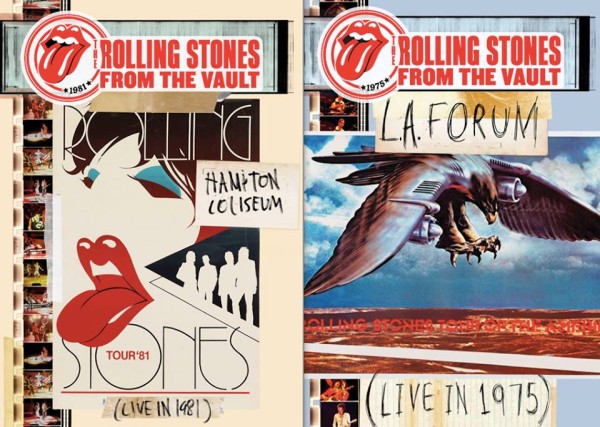
From the new Rolling Stones concert Archive series “From The Vault” of Live DVD’s this is from the L.A Forum Show in 1975, the Tour of America’s was the first time with Ronnie Wood joining the band, The band performed a five night run at the L.A Forum from July 9th- 13th with remixed sound and restored footage the DVD is out at the end of this month. Also out this month is the Hampton Coliseum show from 1981,
The legendary LA Forum Friday Tapes recorded in 1975 finally gets its official release on DVD due to be made available on 17th November, The bands first tour with new guitarist Ronnie Wood, with a huge promotion for the Tour Of America’s the band played “Brown Sugar” on a flatbed truck in New York City the band performed 44 dates between 3rd June to the 8th August, moving to the LA Forum for a five night slot July 9th-13th the sound has been newly remixed by Bob Clearmountain





 The Fat Angel Sings