This Incredible performance, “Live from the Fillmore West”. Includes the entire KFOG-FM broadcast plus five bonus tracks from John Peel’s ‘Sunday Concert’. Full colour booklet with background liners and rare images. Digitally remastered for greatly enhanced sound quality.
Rod Stewart and the Faces, live at the Fillmore West on October 28th 1970 Following the February 1970 release of their classic debut album, The Faces gigged far and wide, their rowdy and raucous style earning a devoted following. This classic performance from the Fillmore West, San Francisco, CA on October 28th 1970, was originally broadcast on KFOG-FM and finds them at their infectious best, on a selection of classics culled both from their catalogue and from Rod Stewart’s solo work.
It’s presented together with background notes, images and five bonus tracks from John Peel’s ‘Sunday Concert’.
DISC ONE 1. Devotion 2. You’re My Girl (I Don’t Want To Discuss It) 3. The Wicked Messenger 4. Country Comfort 5. Flying 6. Too Much Woman 7. Cut Across Shortly 8. Maybe I’m Amazed 9. Around the Plynth 10. Gasoline Alley DISC TWO 1. Love In Vain 2. Three Button Hand Me Down 3. It’s All Over Now 4. I Feel So Good 5. (Love Ballad) Bonus tracks John Peel’s ‘Sunday Concert’, Paris Cinema, 25th June 1970 BBC radio 6. You’re My Girl 7. The Wicked Messenger 8. Devotion 9. It’s All Over Now 10. I Feel So Good
Rod Stewart – vocals Ron Wood – guitar Ian McLagan – keyboards Ronnie Lane – bass Kenny Jones – drums
In 1969, Jeff Beck recorded the album “Beck-Ola”, the second and final album with Rod Stewart and Ronnie Wood. Nicky Hopkins who was now a permanent member.
After the release of their previous album “Truth”, by the end of 1968 drummer Micky Waller was replaced by Tony Newman, as Jeff Beck wanted to take the music in a heavier direction and he viewed Waller as more of a finesse drummer. Pianist Nicky Hopkins, who had also played on Truth, was asked to join the band full-time for his work in the studio.
Recording sessions for the album took place over six days in April 1969 – the 3rd, 6th, 8th, 10th, 11th and 19th. Two covers of Elvis Presley tunes were chosen, “All Shook Up” and “Jailhouse Rock”, as well as “Girl From Mill Valley”, an instrumental by and prominently featuring Hopkins. The remaining four tracks consist of band originals, with the instrumental “Rice Pudding” ending the album dramatically cold. The album cover features a reproduction of Belgian surrealist artist René Magritte’s The Listening Room. On the back cover to the original vinyl issue, beside “Beck-Ola” is written the tag “Cosa Nostra”, Italian for “Our Thing”. When it was originally released in June 1969, “Beck-Ola”, the Jeff Beck Group’s second album, featured a famous sleeve note on its back cover: “Today, with all the hard competition in the music business, it’s almost impossible to come up with anything totally original. So we haven’t.
Following the sessions for this album, the Jeff Beck Group toured the United States. They were scheduled to play Woodstock and are listed on posters promoting the festival, but by then internal friction had reached the breaking point and both Ronnie Wood and Rod Stewart were out of the band. Stewart and Wood would go on too form The Faces with members of the Small Faces in 1969, while Hopkins played Woodstock with Jefferson Airplane, joining Quicksilver Messenger Service, and toured the world with The Rolling Stones in 1971, 1972 and 1973.
Beck himself would be out of commission by December due to an automobile accident.
During 1967 the band released three singles in Europe and two in the United States, the first, “Hi Ho Silver Lining”, being the most successful, reaching No. 14 on the UK singles chart; it included the instrumental “Beck’s Bolero” as the B side, which had been recorded several months earlier. The line-up for that session included guitarist Jimmy Page on rhythm guitar, John Paul Jones on bass, Keith Moon on drums, and Nicky Hopkins on piano.
In a contemporary review for The Village Voice, music critic Robert Christgau was unimpressed by the album and facetiously remarked that Stewart and Beck had encouraged Hopkins’ overblown playing. At the time, Beck commented on the album cover the impossibility of coming up with anything original, and that Beck-Ola indeed was not. Although a short album at half an hour, along with its predecessor it is regarded as a seminal work of heavy metal due to its use of blues toward a hard rock approach and the squaring off of Beck’s guitar against Stewart’s vocals, and claims that it was duplicated the same year by Beck’s confederate Jimmy Page with his singer Robert Plant although in actual fact Zeppelin had been displaying such style since the summer of 1968.
On 10 October 2006, Legacy Recordings remastered and reissued the album for compact disc with four bonus tracks, all of which had been previously unreleased. Included were two early takes of the Presley covers, one done at Abbey Road Studios in January, a jam on “Sweet Little Angel” by B.B. King done the previous November with the Waller edition of the band, and a song intended as a single by producer Mickie Most but never issued
Ronnie Wood: Appeared on Beck-Ola and then quit to join The Faces with Rod Stewart. He went on to recording solo albums in 1974 starting with I’ve Got My Own Album To Do, Now Look (1975), Mahoney’s Last Stand (1976), and Gimme Some Neck (1979). He officially joined the Rolling Stones in 1976 and continues to record the odd solo album.
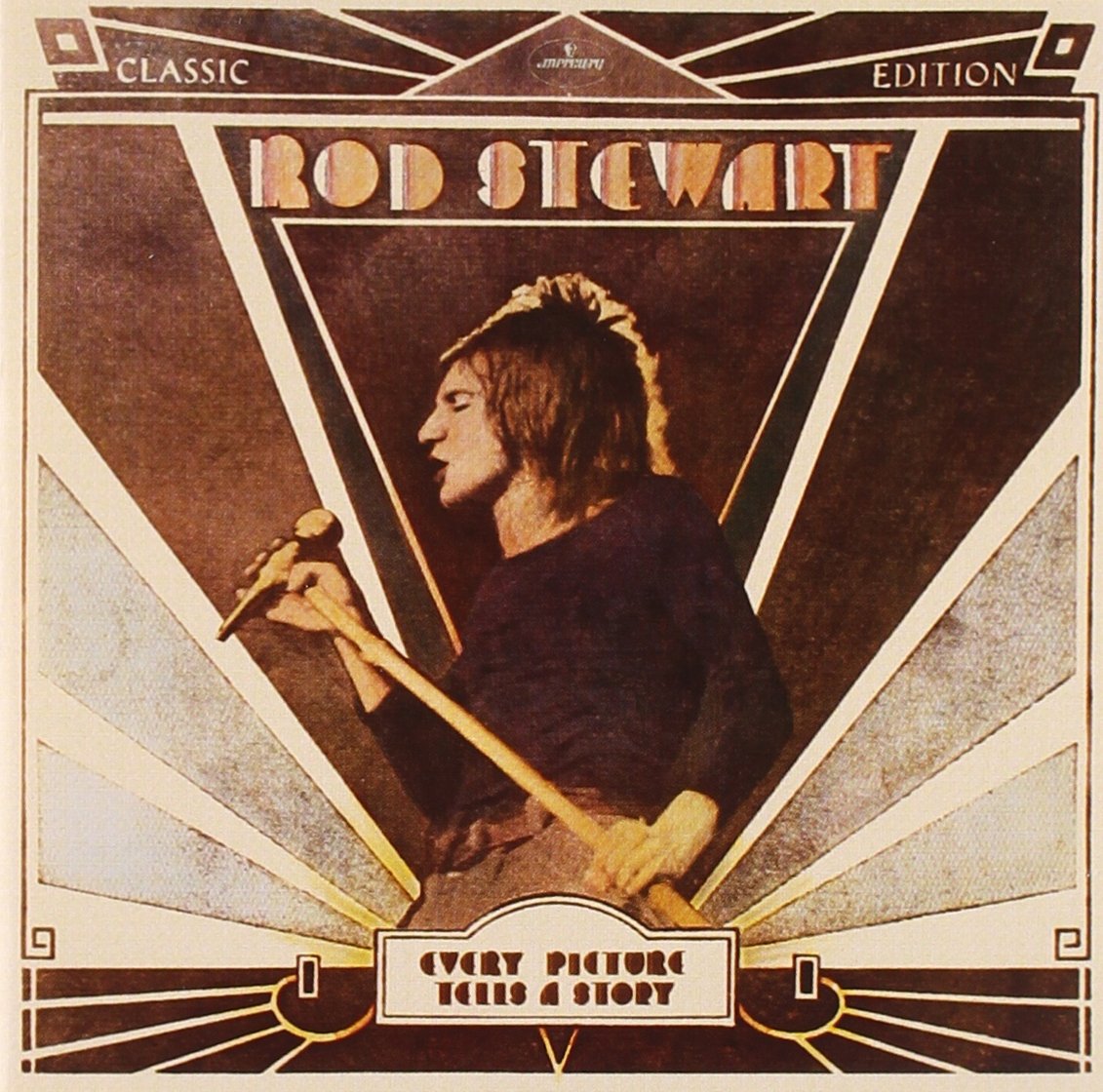
Rod Stewart: Sang on Beck-Ola and simultaneously pursued a solo career while joining The Faces with bass buddy Ron Wood. Recorded Rod Stewart (1969), Gasoline Alley (1970), Every Picture Tells A Story (1971) and Never A Dull Moment(1972) as a solo artist. As a member of The Faces, he recorded First Step (1970), Long Player (1971), A Nod’s As Good As A Wink… To A Blind Horse (1972), and the swan song, Ooh La La (1973). Became solo superstar; currently sells crooning compilations to grannies.
Nicky Hopkins: One of the most in-demand session men of the 1960s, Hopkins played with everyone from The Beatles, The Kinks and the Stones to Quicksilver Messenger Service, JeffersonAirplane and on his own solo albums. He died in 1994.
Mickey Waller: Played with many bands including Georgie Fame, Charlie Watts’ Rocket 88, recorded with Paul McCartney in the noughts, but died in 2008.
Jeff Beck moved on to his R&B period with the JBGII and a pair of albums titled Rough And Ready (1971) and Jeff Beck Group (1972). A studio album (1973) with ex-Vanilla Fudge rhythm section Tim Bogert and Carmine Appice called Beck, Bogert & Appice and a Japan-only live album release followed. In 1975, Jeff then entered the instrumental phase of his career with the wondrous Blow By Blow, followed by 1976’s Wired and 1977’s Jeff Beck With The Jan Hammer Group – Live! There And Back [1980], the shaky vocal/instrumental Flash [1985], and Guitar Shop [1989] formed the next group of releases. In 1992, Epic released the three-CD Beckology set. Jeff continues to record mainly guitar records to this day.
Beck-Ola stands as a prime example of late-’60s British blues-rock and one of Beck’s best records.
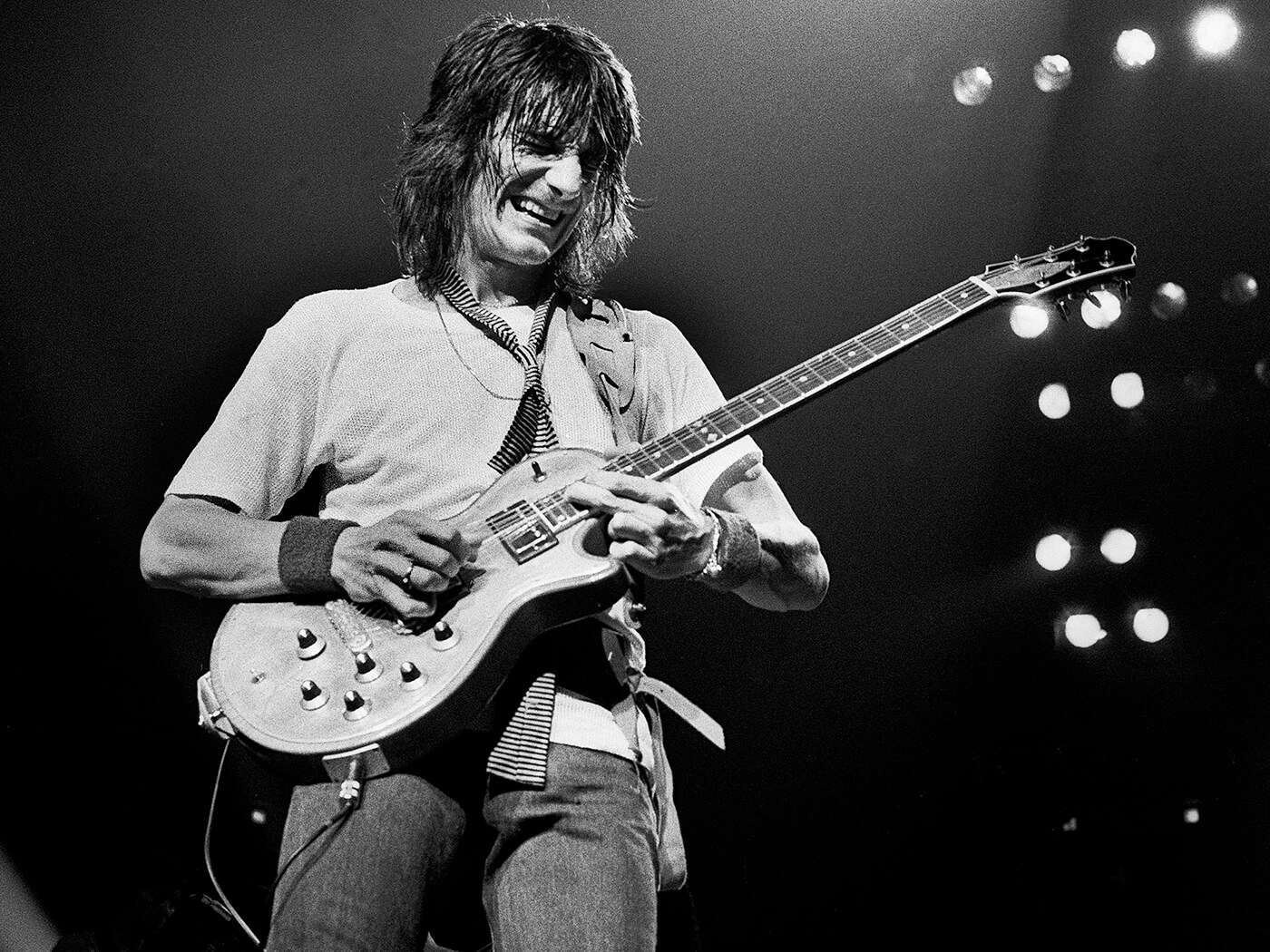
Let’s hear it for Ron Wood! The shaggy-haired guitar ace has played devil’s advocate to both Rod Stewart and Keith Richards — his style perfectly complementing the Faces and the Rolling Stones. Wood joined the Stones in 1975 after the Faces split up, but his history dates back to the sounds of swinging London as guitarist with R&B rockers the Birds and as bassist extraordinaire for the Jeff Beck Group. Most people might only know the man from his tenure with the Stones.
Live from Kilburn, Andy Newmark -drums; Willie Weeks-bass; Ian McLagan– keyboards, and of course ,Ronnie Wood ,Keith and Rod Stewart What a fronting trio. Ronnie, Rod and Richards (the 3 Rs of Rock) fit together visually, musically and presentation wise like a dream rock and roll team.
This set of videos of The First Barbarians, Ronnie Wood shouldn’t have left The Faces, Keith Richards should have left the Rolling Stones and joined Rod, Ronnie, Kenney and Ian (Ronnie Lane had left by then) in a revitalized Faces lineup. With Rod, Ronnie and Keith writing lyrics, we’d have had more classic rock LPs like A Nod’s, EveryPicture etc.
Ronnie Wood’s 1974 solo debut, “I’ve Got My Own Album to Do”, is somewhat of a forgotten artifact. He received a little help from friends Mick Jagger, Keith Richards, George Harrison and David Bowie, to name a few. One of the album’s best tracks is “Mystifies Me.” Hearing it all these years later begs the question, What would this have sounded like if it had been a Faces track?
From: ‘I’ve Got My Own Album to Do’ (1974)
I first heard Son Volt’s cover of this song. Jeff Tweedy did such a good job covering it that I thought it was his song. Then I ran across this! I couldn’t believe I didn’t know this was a Ron Wood song. This is an awesome performance. Ron and Keith were meant to play together and Ian is just fabulous.
I already knew about Page and Keith and Clapton but…?! ,Those were the questions going through my head when I discovered this record. I was blown away. I picked this record up on recommendation in my local record shop because the guy who owned the shop—the older, wiser, connoisseur of rock ‘n’ roll vinyl—told me that I must have it.
Put on “Let Me Love You” at a loud volume, and you are instantly a cooler person. It’s just true. I don’t know the science, but it adds up, And Jeff Beck’s solo in that tune… still one of the very best.
Beck, fresh out of the Yardbirds, released his first solo album in 1968 with help from Rod Stewart and Ronnie Wood. They weren’t yet christened the Jeff Beck Group, but they were clearly a band at this point. (Other luminaries like Jimmy Page, John Paul Jones and Keith Moon also help out.) But most of the flash is provided by Beck, who slings his guitar into some new territory on ‘Truth,’ firing up old traditional and blues numbers with instrumental tricks.
By 1968, Jeff Beck had become a major pioneering force on the electric guitar, following Eric Clapton in the Yardbirds, before clocking up two pop hits with Tallyman and Hi-Ho Silver Lining. By the time he was assembling the band for “Truth” he determined to make an album for himself.
With Beck having established himself as a guitar player of the first degree on a quartet of bold and wickedly wonderful Yardbirds albums in 1965 and 1966 (For Your Love, Having A Rave Up With The Yardbirds, The Yardbirds [Roger The Engineer] and Over Under Sideways Down), producer/manager Mickie Most, thinking to capitalise on the guitarist’s visibility, conceived the notion of turning Beck into a pop crooner. All but forgetting that Beck was first and foremost an instrumentalist, Most shackled him with a series of less-than-guitar-focused songs.
“I always kept my fingers on players,” Beck commented in the 70s. “Every musician around London always knew what the other one was doing. All groups used to come and see each other play, and it was really nice. There seemed to be a purpose. It was like a competition: ‘They’re doing that in their act, so we’ll have to cut that out’. It was great fun; nice, hot competition. I really liked the scene then.
“I had to round up a singer,” he continued. “I couldn’t think of who to get. I always liked Rod [Stewart], I dug him, with the teased hair and all the rest of it. “He was out of work at the time. He was hanging around a [London] club called The Cromwellian. I asked him if he wanted a job and [thinking Beck was drunk] he said: ‘Yeah, but I don’t believe you. Ring me tomorrow’. And I was more sober than I’ve ever been that night. And I couldn’t believe that he said yeah, because I thought he was a snob.”
With a singer in tow, Beck then set out to look for a bass player. Ronnie Wood continues the story: “I knew Jeff, but I’d never had a chance to go and sit through a whole show. I’d just heard little bits of him when he used to play with a band called The Tridents [Beck’s pre-Yardbirds band]. I suppose Jeff was one of my best friends, even though he was in another band.”
After the relative ease of getting the first two band members, finding a drummer was a nightmare. Beck went through Ray Cook, his former bandmate in The Tridents, the Pretty Things’ Viv Prince, ex-John Mayall drummer Mickey Waller (we’ll come back to him), Rod Coombes (later of The Strawbs), and another former Mayall graduate, Aynsley Dunbar. Although the last named held real promise, it resulted in yet another drum debacle. “I played with Jeff for four months,”.
“He was a bastard,” Dunbar complained of Beck. “He was so loud I couldn’t hear. I didn’t have any mics on my drums; the band had 100-watt Marshall amplifiers blaring; no monitors. With drummer Mickey Waller re-hired, and after several months of gigs, the quartet went into Abbey Road Studios on May 14, 1968, to begin recording an album. The material the group recorded was a combination of the live set, reworkings and some odds and ends. The album opens with a devastating slow version of the Yardbirds’ hit Shapes Of Things, with Beck turning in a virtuoso performance. Let Me Love You was part of the stage set and one of the few self-written pieces, setting up the call-and-response sequence between guitar and voice that Beck and Stewart had perfected live.
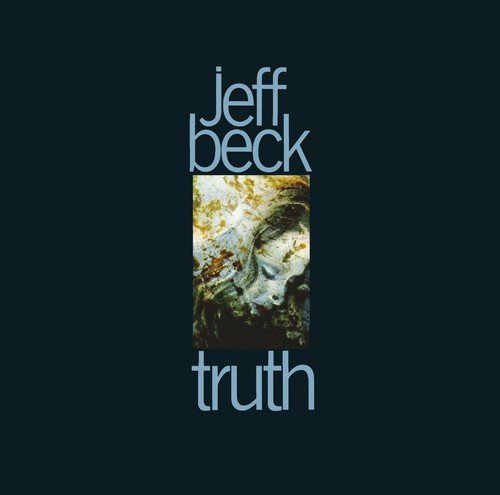
On July 29, 1968, Jeff Beck, along with a kick-around vocalist, a future Rolling Stone, and a drummer with a lot of bash released Truth. The album was a miracle of fury and berserk beauty, a testament to the jaw-dropping chops of a 24- year old guitarist who, over the course of 10 tracks and around 40 minutes, ran the gamut from electric blues and modified R&B to psychedelically influenced rock, classical, and even a little heavy-metal instrumentalism. With Truth, released just months before Led Zeppelin’s debut album release – and with songs and personnel in common. Jeff Beck, vocalist Rod Stewart, bassist Ronnie Wood, and drummer Mickey Waller (the core band) made an album that would become every guitar player’s bible and every hard rock band’s Holy Grail.
With Ronnie Wood on bass, Rod Stewart on vocals and guests like Jimmy Page, John Paul Jones and Keith Moon Nicky Hopkins, Aynsley Dunbar and Madeline Bell. popping up for guest spots on Beck’s Bolero, it was an album that not only helped establish the British blues rock sound, but featured many of its best exponents. Audacious and experimental, it smashes genre conventions at every turn.
Morning Dew, another song from the touring circuit, is a pulsating interpretation of Tim Rose’s classic, and it’s given a dirge-like solemnity from Beck’s breathtaking mastery of the wah-wah pedal. Here (and on closer I Ain’t Superstitious), Beck demonstrates amazing prowess with the then-new effects pedal.
Then there is the great catastrophe of You Shook Me, the old blues chestnut written by Willie Dixon and originally recorded by Muddy Waters. The song was on Truth, and was then re-fashioned by Led Zeppelin for their debut album some months later.
Ol’ Man River, the Oscar Hammerstein II/Jerome Kern standard is an odd little creature. With Beck on bass, John Paul Jones on Hammond organ, and tympani by ‘You Know Who’ – actually Keith Moon – it is one of the album’s lesser moments. But it did prompt Truth engineer Ken Scott to recall The Who’s drummer living up to his ‘Loon’ nickname. “One has to remember Mr Moon playing tymps.
On vinyl, side two of Truth opens with Beck having picked up an acoustic for a shaky but stirring version of the classical… er, classic Greensleeves. “It was just an idle mess around in the studio while I was waiting for Mickie,” he said. “Why not? It was the vital last track of the album, and nobody could think of what to play, so I just played it. That’s why there’s all the plinking and plonking and bad notes in it. I can’t play acoustic guitar very well.”
Rock My Plimsoul is a track Beck recorded back during his Mickie Most/solo career period. That staggered little drum lick from Aynsley Dunbar (who is uncredited) sets the song in motion, and provides a rhythmic trampoline on which Beck’s guitar jumps and twirls.
Willie Dixon’s You Shook Me and I Ain’t Superstitious are masterfully reinvented, even Broadway hit Ol’ Man River and the Henry VIII-authored Greensleeves are dragged into Beck’s musical vision.
And then there is the timeless and epic instrumental Beck’s Bolero. Recorded in May 1966, this rendition of Ravel’s famous Bolero was the B-side of Hi Ho Silver Lining and was meant to serve as the launching pad for Beck’s idealised supergroup. Players include Jimmy Page on electric 12-string, Keith Moon on drums, John Paul Jones on bass, and Nicky Hopkins on piano.
‘Truth’ is surely one album to consider as a forward thinking, Blues Rock to Rock Metal template for the future of guitar music. Some of the tracks were written as early as 1966, which just makes you realise how cutting this album is for something released in 1968.
Truth is the debut album by Jeff Beck, released in 1968 released on Columbia Records and in the United States on Epic Records. It introduced the talents of his backing band the Jeff Beck Group, who were specifically Rod Stewart and Ronnie Wood, to a larger audience.
After leaving the Yardbirds in late 1966, Jeff Beck had released three commercial singles, two in 1967 featuring Beck on lead vocals, and one without vocals in 1968. All had been hits on the British singles chart, and all were characterized by songs aimed at the pop chart on the A-side at the request of producer Mickie Most. Harder rock and blues-based numbers were featured on the B-sides, and for music on the album, Beck opted to pursue the latter course.
Recording sessions for the album took place over four days, 14th–15th May and 25th–26th May 1968. Nine eclectic tracks were taken from these sessions, including covers of “Ol’ Man River” by Jerome Kern, the Tudor period melody “Greensleeves”, and Bonnie Dobson’s “Morning Dew”, which had been a 1966 hit single for TimRose. Beck acknowledged two giants of Chicago blues in songs by Willie Dixon – Muddy Waters’ “You Shook Me” and Howlin’ Wolf’s “I Ain’t Superstitious”.
The album started with a song from Beck’s old band: “Shapes of Things”. Three originals were credited to “Jeffrey Rod”, a pseudonym for Beck and Stewart, all reworkings of previous blues songs: “Let Me Love You” the song of the same title by Buddy Guy; “Rock My Plimsoul” from “Rock Me Baby” by B.B. King; and “Blues Deluxe” similar to another song by B.B. King, “Gambler’s Blues”.”Plimsoul” had already been recorded for the B-side to the 1967 single “Tallyman”, and the tenth track, an instrumental featuring Jimmy Page, John Paul Jones, Keith Moon, and future Beck group pianist Nicky Hopkins, “Beck’s Bolero”, had been edited and remixed for stereo from the earlier B-side to “Hi Ho Silver Lining”. Due to contractual conflicts, Moon had been credited on the original album as “You Know Who”. This album was Rod Stewart’s first-ever album-length lead vocal showcase as an artist, and is regarded, along with ‘Beck-Ola’ as a musical touchstone for hard rockers in the years that followed.
Truth is regarded as a seminal work of heavy metal because of its use of blues toward a hard rock approach.
On 10th October 2006, Legacy Recordings remastered and reissued the album for compact disc with eight bonus tracks. Included were two earlier takes of “You Shook Me” and “Blues Deluxe”, the latter without the overdubbed applause, and the six tracks making up the three singles by Beck. The B-side to the 1968 single “Love Is Blue”, “I’ve Been Drinking”, was another “Jeffrey Rod” special, this time reconfiguring the Johnny Mercer song “Drinking Again”
Jeff Beck – electric guitars, acoustic guitar on “Greensleeves”; pedal steel guitar on “Shapes of Things”; bass guitar on “Ol’ Man River”; lead vocals on “Tallyman” and “Hi Ho Silver Lining”,backing vocals on “Let Me Love You”
Rod Stewart – lead vocals,
Ronnie Wood – bass guitar
Micky Waller – drums
John Paul Jones – bass guitar on “Hi Ho Silver Lining” and “Beck’s Bolero”; Hammond organ on “Ol’ Man River” and “You Shook Me”; arrangements on “Hi Ho Silver Lining”
Nicky Hopkins – piano on “Morning Dew”, “You Shook Me”, “Beck’s Bolero” and “Blues Deluxe”
When vocalist Steve Marriott left to form Humble Pie, his three Small Faces bandmates regrouped with JeffBeck Group axeman Ron Wood and singer Rod Stewart. With the name shortened to Faces, the U.K. quintet made an auspicious debut in 1970 with the album release “FIRST STEP”, a title that made sly reference to the beginner’s guide to guitar that Wood holds in the cover photo.
First Step was the first album by the then British group re named Faces, released in early 1970. The album was released only a few months after the Faces had formed from the ashes of the Small Faces (from which Ronnie Lane, Kenney Jones and Ian McLagan hailed) and The Jeff Beck Group (from which Rod Stewart and Ronnie Wood hailed.) The album is credited to the Small Faces on the cover , The album cover shows Ronnie Wood holding a copy of Geoffrey Sisley’s seminal guitar tutorial First Step: How to Play the Guitar Plectrum Style.
But there was nothing inexperienced about any of these musicians, and their chemistry and superb performances are evident on each of the 10 tracks. After an ace cover of Dylan’s “Wicked Messenger” the material is all original, with songwriting duties spread fairly evenly among the members; with a pair of instrumentals and such fine tracks as “Around the Plynth” Other highlights include Ronnie Lane’s folksy “Stone”, the hard-rocking “Shake, Shudder, Shiver”, “Three Button Hand Me Down” (on which both Lane and Wood play the bassline, affording the track a unique sonic quality in the Faces catalogue), and the soulful “Flying”.
it’s a consistently enjoyable collection. Faces were inducted into the Rock and Roll Hall of Fame in 2012, and the journey that brought them there begins with FIRST STEP.
In August 2015, the album was reissued in a remastered and expanded form, including two previously-unreleased bonus tracks recorded shortly after the album’s release, “Behind the Sun” and “Mona the Blues” (although the latter was remade by Lane and Wood in 1972 for their Mahoney’s Last Stand film soundtrack).
There are very few albums which are indispensable. The Beatles Revolver, Stones Exile on Maine Street and the like. For me, truly great records capture a moment.
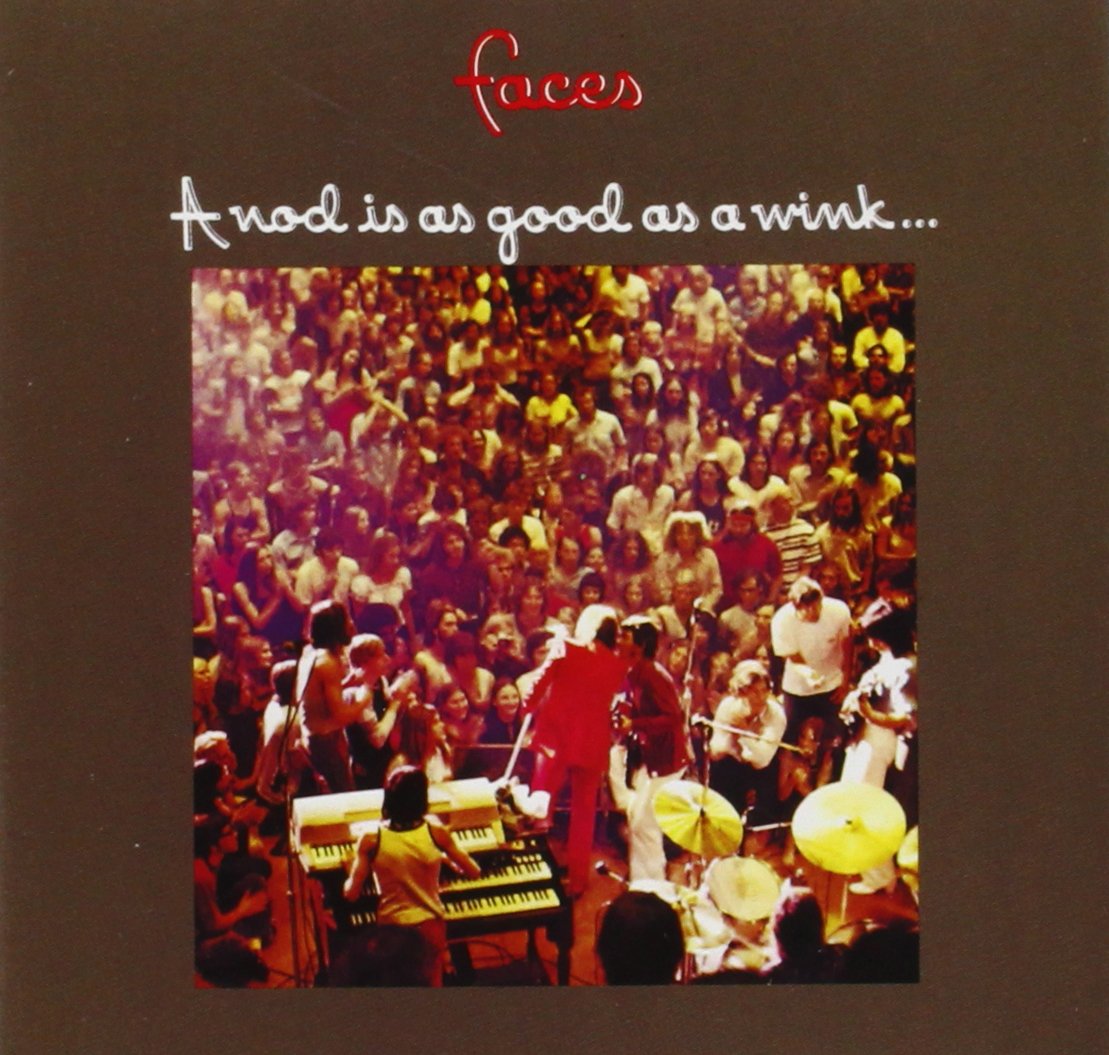
The Faces‘ third album from 1971, came in the middle of a whirlwind year for singer RodStewart. In the mere months that separated the album “Long Player” and “A Nod Is As Good As A Wink”Stewart had a huge hit with “Maggie May” and his first No. 1 solo album (‘Every Picture Tells a Story’) his third solo album was something that would soon irreparably damage the band, but at the time it was mere good fortune, helping bring them some collateral success that they deserved. Certainly, it didn’t change the character of the album itself, which is the tightest record the band ever made. Granted that may be a relative term, since sloppiness is at the heart of this band, but this doesn’t feel cobbled together, (which the otherwise excellent Long Player did).
‘A Nod Is as Good as a Wink .finally gave the group their long-awaited hit single in “Stay with Me,” . Loose, bluesy and boozy, rock ‘n’ roll doesn’t get more natural than this. The Faces and solo Rod Stewart were never as good as this before or since. From the opening ‘Miss Judy’s Farm’ which is awesome, the songs just get better and better. Their interpretation of Chuck Berry’s Memphis Tenessee followed by ‘Too Bad’ will make you feel grateful that you’re alive. Ending with the rampaging good times of “That’s All YouNeed.” In between, Ronnie Lane serves up dirty jokes the exquisitely funny “You’re So Rude” and heartbreaking ballads (the absolutely beautiful “Debris” , and generally serves up a nonstop party. There are few records that feel like a never-ending party like this seventies album , the slow moments are for slow dancing, and as soon as it’s over, it’s hard not to want to do it all over again. It’s another classic –
They were helped in that respect by new co-producer Glyn Johns, who came in as an impartial outside set of ears while helping to wrangle the unruly band members into recording shape. It couldn’t have been the easiest gig, but it’s easy to understand why Johns was attracted to it — aside from Stewart’s formidable vocals, the group boasted the prodigious talents of keyboardist Ian McLagan , drummer Kenney Jones and perpetually underrated bassist and great songwriter Ronnie Lane .
With Johns helping the Faces were brought more attentively to bear on some of their finest material. While public perception was increasingly focused on Stewart, the new album titled A Nod Is As Good As a Wink … to a Blind Horse — presented the band at their creatively democratic best. Of the eight originals they lined up for the LP, the majority were co-written, with Lane, McLagan, Stewart and Wood all having a hand in the record’s compositional makeup. As Lane recalled in the years after its release, Nod captured a group firing on all cylinders.
Side One
1. “Miss Judy’s Farm” (Rod Stewart, Ronnie Wood) – 3:42
2. “You’re So Rude” (Ronnie Lane, Ian McLagan) – 3:46
3. “Love Lives Here” (Lane, Stewart, Wood) – 3:09
4. “Last Orders Please” (Lane) – 2:38
5. “Stay with Me” (Stewart, Wood) – 4:42
Side Two
1. “Debris” (Lane) 4:39
2. “Memphis, Tennessee” Incorrectly titled on original US pressings of the album as simply “Memphis” (Chuck Berry) – 5:31
3. “Too Bad” (Stewart, Wood) – 3:16
4. “That’s All You Need” (Stewart, Wood) – 5:05
PERSONNEL –
ROD STEWART – vocals
RONNIE LANE – bass, acoustic guitar, percussion, vocals
RONNIE WOOD – lead, slide, acoustic and pedal steel guitars, backing vocals on “Too Bad”, harmonica
IAN McLAGAN – piano, organ, backing vocals “Too Bad”
KENNEY JONES – drums, percussion
HARRY FOWLER – steel drums on “That’s All You Need”
GLYN JOHNS – co-producer, engineer
PRODUCED BY FACES AND GLYN JOHNS
Rod Stewart was doing double duty with the Faces at the time of 1971’s ‘Every Picture Tells a Story,’ so his band mates’ contributions boost the loose, boozy vibe. As the decade progressed, Stewart would try on a few other hats soft-rock lothario, swarthy disco guy – but he’s at his best when he puts his throaty voice behind pure rock ‘n’ roll.
The album is a mixture of rock country, Folk and blues and some soul, and includes Stewart’s breakthrough hit, “Maggie May” and the Tim Hardin cover “Reason To Believe” taken from Hardin’s debut album of 1966. “Reason to Believe” was released as the first single from the album with “Maggie May” as the B-side, however, “Maggie May” became more popular and was a No. 1 hit in both the UK and US.
The album also included a version of Arthur Crudup’s “That’s All Right (Mama)” and a cover of the Dylan song “Tomorrow Is A long Time” that was an outtake from Dylan’s 1963 “Freewheelin” album.
All five members of the Faces (with whom Stewart at that time was thier lead vocalist) appeared on the album, with guitarist/bassist Ronnie Wood and keyboardist Ian McLagan on keyboards being most prominent. Due to contractual restrictions, the personnel listings were somewhat vague, and it was unclear that the full Faces line-up . Other contributors included Ray Jackson on mandolin (though Stewart forgot his name and merely mentioned “the mandolin player in Lindisfarne on the sleeve). Micky Waller on drums. Maggie Bell performed backing vocals (mentioned on the sleeve as “vocal abrasives”) on the title track, and Madeline Bell sang backup on the next track, “Seems Like A Long Time”. Pete Sears played all the piano on the album except for one track, “I’m Losing You” which featured Ian McLagan on piano, along with the Faces as a band.
This is the final rollicking concert of the legendary Faces featuring a high powered performance from Keith Richards, Rod Stewart himself shakin’ his booty like there’s no tomorrow, and a string section for a little class. Although Rod went on to bigger success, many say his association with Faces was the musical highpoint of his career and this concert is the cinematic proof. Stewart and his Faces group were joined on-stage by Rolling Stones stalwart Keith Richard. For the record, “Faces” consisted of Ron Wood (guitar) Ian McLaglan (keyboard), future Who member Kenny Jones (drums) and Tetsu Yamauchi (replacing Ronnie Lane on bass).
What a great track “Ooh La La” is a song from The Faces. The song was written by Ronnie Lane and Ronnie Wood and sung by RonnieWood. That is strange because The Faces had one of the best lead singers around at the time…Rod Stewart. Stewart by this time was soaring as a solo artist and his interest in the Faces was waning. He claimed the song was not in his key to sing. He did do vocals for it then and Lane but Wood ended up singing the released version. Rod Stewart and the Faces seem to sound better with each passing year. You realise there’ll never be another band quite like them. It’s almost as if they were so busy having a good time that they didn’t even realise just how great and lasting their music really was. There was nothing intellectual about the Faces, but they sure knew how to play it from the heart. There’s something so English about them and yet a lot of their influences were so obviously American, especially Rod’s love of Soul legend Sam Cooke. Ron Wood’s guitar playing from ths period is so unique, just listen to his work on a track like “Just Another Honky” from Ooh La La. There’s so much great music on the Faces and early Rod albums (which usually feature most if not all of the band). The title song of “Ooh La La” actually has Ron Wood handling the lead vocal and has been one of my favourite songs for a long time. There’s something so down home and relaxed (but not laid back) about it. Try finding some bootlegs of Faces live shows. They overflow with good times. May their music live on forever.
The Faces had one big hit…”Stay With Me” but this song is their greatest song to me. Rod Stewart finally covered the song in 1998 for a tribute to Ronnie Lane. Ronnie Lane did his own version with his band Slim Chance. Ronnie Wood also does it live in solo shows. A song between Granddad and Son about the ways of love. The song never ages because the subject matter never changes and it is continually passed along. The song creates an atmosphere and Wood not known for his singing ability did a great job on this one.
This week in 1973: The Faces scored their first UK #1 album with their final studio release, ‘Ooh La La’, released on Warner Bros. Records; with his career in the stratosphere due to the success of his solo albums, Rod Stewart had became increasingly distanced from his bandmates by the time of this recording; produced by Glyn Johns, highlights included “Silicone Grown”, “Cindy Incidentally” & the raucous yet bittersweet album closer “Ooh La La”, featuring the only-ever Faces lead vocal from guitarist Ronnie Wood; the album cover is a photo of Gastone’, a stage character of 1920s Italian comedian Ettore Petrolini, originally designed in such a way that when the top edge was pressed down Gastone’s eyes would discolour & move to the side, while his jaw dropped into a leering smile…
1. Silicone Grown 0:00
2. Cindy Incidentally 3:06
3. Flags And Banners 5:43
4. My Fault 7:45
5. Borstal Boys 10:54
6. Fly In The Onitment 13:48
7. If I’m On The Late Side 17:39
8. Glad And 20:19
9. Just Another Honky 23:23
10. Ooh La La 27:00
The complete Faces album released in 1973 including many of their best songs. I would say it’s their best studio album.





 The Fat Angel Sings