Posts Tagged ‘New York City’

Fiona Apple’s album’s master tapes had been sitting in the vault at Sony without a vinyl release, The release of “Tidal” special vinyl, went into the process of making Tidal and getting it mastered by the guy who mastered the album when it was made in 1996.

When I’m strong like music / Slow like honey / Heavy with mood.”

For most men, hurting women isn’t a deliberate project. Often, it’s accidental, or even pure carelessness. Yet, I do not know a single woman who has not been hurt by a man. Neither do you. Insidious or thoughtless, it doesn’t really matter. There’s an ache that goes unspoken among all the women I know; the ache of the first male rejection, the initial understanding and loss of power, the wound that bleeds a lesson: The world does not consider you to be fully human. This goes double or even triple for women of color, queer women, and those coping with disabilities, other marginalized identities, and traumatic experiences. Most of us do not have words for it. Somehow, at just 17-years-old, Fiona Apple did. Her stunning debut album, Tidal diluted that ache and mixed it with moonlight, one part per thousand.

Why you need this classic record in your collection,

A classically trained pianist born in New York City to a family full of professional entertainers, Fiona Apple managed, with a little help from her friends, to get her 3-track demo into the hands of Sony Music executive Andrew Slater. Bowled over by the convergence of her piano prowess, astute song writing skills, emotional depth, and world-weary contralto, all of which belied her seventeen years of age, Slater signed Apple to his Clean Slate label, part of The WORK Group, a subsidiary label of Columbia Records. “I couldn’t believe [the demo] was written and sung by a 17-year-old,” a bemused Slater admitted to Billboard in June 1996. “It sounded like a 30 year-old singer who had written a lifetime’s worth of material. I thought someone was playing a joke on me.”

“Slow Like Honey” is the key for unlocking Tidal. No, it’s not as feisty as the thrilling opener, “Sleep To Dream,” the first song she ever wrote (at 14), and the one that is full of so much swagger that the foremost rapper of our era, Kanye West, cites her as an inspiration upon his own matchless self-confidence. “Honey” is stronger, simmering quiet in the sticky-sweet of seduction. Here, Fiona confidently takes back possession of her own sexuality, even if it’s only in her dreams. She becomes the instigator and seductress, the lingering, fascinating thought, an object of desire whose subjective demands must be followed. “The First Taste” quietly, carefully echoes these appetites: “I lay in an early bed / Thinking late thoughts / Waiting for the black to replace my blue”. Desire becomes so much trickier when it has been subsumed and stolen at such a young age. Trying to construct pleasure outside the undertones of pain requires a massive amount of imagination, an act of grace or God. “Slow Like Honey” is both. Coming just before these two, I hear “Criminal” — the album’s crowning commercial single for a reason — not, as often portrayed, as the confession of a bad slut, but the imagined inversion of her own trauma: What if I was the powerful one? And, what if she was? The world adored this narrative, as it will, embracing any excuse to cast a woman as the perpetrator and not the victim. Top 40 charts favour the temptress, but never “Me and A Gun” Only one of these songs portrays the sexual violence that is actually experienced by over half of the female population  “Criminal” is a magnificent fantasy. In some ways, it is comforting to cling to this side of the story. There is strength in mythic re-tellings, especially for survivors. A prevailing criticism of Tidal is that it’s “emotionally indulgent.” I disagree, but also wonder: Which emotions are the one that qualify as indulgences? Fiona’s emotions on Tidal are as tightly-coiled as cobras, they strike and retreat, they lose no ground.

I see pain in the eyes of women I’ve never met, and feel a kinship. There is pain in Fiona’s eyes on the extreme closeup that serves as the artwork of her debut. But she looks unafraid. She looks in control. When “Tidal” came out, I was already well-versed in the ways men would wield their power over me with the rather epic, careless abandon that only masculinity breeds. What I wasn’t familiar with, however, was the steely, determined resolve that Fiona — and many other women before and since had manufactured to process this trauma. Rage can be a weapon of defense when it is calm. One of the most sinister forces behind this seething and majestic record was Fiona’s rape at the age of twelve by a strange man who stalked her all the way inside her New York apartment building. His act of domestic terrorism took calculation, foresight and brutality, but still, he felt empowered to feed her a script of self-blame: “Next time don’t let strangers in,” an adult man told a child after he’d finished sexually assaulting her. Of course, we have no choice; the strangers are already inside, they’re the men and boys we love and trust, fathers and husbands, brothers and uncles. Many of them appear to to care about us. Until they don’t. Until they become strangers again. For every Fiona before and since — it’s not your fault that the child is gone.Even when disturbed and unhappy, Fiona treats her feelings with the utmost respect, delivering solemn disaffection and a languid self-loathing with the kind of reverence usually reserved for romance. Some of these songs were written in minutes, but none of them verge on hysteria. They are calculated summations of years spent aching.

“Rage can be a weapon of defense when it is calm.”

Fiona Apple was a classically-trained pianist from the age of eight, her father and mother, though never married and separated earlier on, were both professional performers. As a teenager, she finagled a three-song demo into the hands of producer Andrew Slater, who signed her almost immediately upon hearing her voice, began to manage her, and even produced Tidal. Her songs are vampy and confessional, heavy with mood, but there is nothing adolescent about the experiences recounted. Between Slater’s shepherding and the expertise of multi-instrumentalist Jon Brion on marimba, harp, vibraphone and more, Tidal pieced together teenage Fiona’s otherworldly song writing into the sleek ten-track album that defined her. Of course, it would also be the men who tied the tracks to an era; these songs would feel ancient if they weren’t occasionally soldered to the ‘90s. (Later on, when she was older, Fiona would mount a massive resistance to the overproduction on the early, leaked version of her 2005 album Extraordinary Machine.) Yet, a thing out of time is never as tender.

“Honestly, I’m not a very skilled pianist,” Apple admitted during a 1997 Keyboard magazine interview. “I can play my own stuff, obviously better than anyone else can, but as far as other music goes, I’m really not very good. It’s hard because…when we were making the album, Andy Slater was always saying, ‘No we have to take it back to what you wrote it on.  Back to the roots, that’s the only way it’s going to sound real.’ And the whole time I was saying ‘But I don’t want to play piano on this. I only wrote songs on the piano because it’s the only instrument I know. I don’t want this to be a fuckin’ piano album.’ But Andy kept saying, ‘No, this is how you sound. This is you.’”

In 1996 an interview in billboard that tells the story of Apple and Slater’s meeting and teases her debut, Tori Amos appears as the top of a box office grossing list, having just sold out Madison Square Garden. This was the world that welcomed Fiona with open arms, boosted her to sell three million copies of her debut, and turned her into a star, despite whatever reticence she may have had about celebrity. According to one strain of folklore surrounding the record, Fiona insisted that the name, “Tidal”, was taken in part because of its phonetic proximity to the funny emptiness of “Title.” But given the wild power of the thing that had come out her, she must have known this magnetism needed proper naming. What primeval force is more fitting than the tides to preside over such a magnificent airing out of wounds? Nothing is quite solid on Tidal anyway, and despite the ferocity, it is always a peaceful album, lapping like waves. The hypnotizing pull of these highs and lows make Tidal even easier to sink into; it is a record that swells and rages on an instinctual level. It remains one of the most important artistic distillations of female trauma because of the way she harnesses her pain, transforming it into a quiet source of power.

There’s little unrequited pining in Fiona’s version of the events, no matter how painful; “Shadowboxer” butterfly-floats above a stinging, out-and-out battle of wills, “Never Is A Promise” brooks no bitterness, though it’s disengagement is far from forgiving. Actually, most of the album occurs entirely in Fiona’s head; she is caught up in oblivion but remains focused on turning her hurt into something steadying and beautiful, still concerned with possibilities and potential outcomes. This is not indulgence, but a survival mechanism. On the album’s final two tracks, “Pale September” and “Carrion,” whose respective circumstances occupy very different ends of the emotional spectrum, she again commands and imagines the power she has over her partners. Poised even while candidly discussing most invasive and intimate events, her voice grows husky with rage on “Sullen Girl,” the track that confronts her assault head-on. She gives us the story, however cloaked the details may be, she gives us the full-throated vulnerability of coping, breaking, and mourning, in the process becoming one of the most self-aware female narrators of the ‘90s, or hell, in the entire history of rock.

Following the release of “Tidal”, Fiona Apple won the coveted VMA for Best New Artist, an award she wasn’t expecting. Instead of basking, she couldn’t help but continue to disrupt, urging her fans to ignore whatever picture perfect awards show narrative they’d just seen: “Go with yourself,” she commands, bug-eyed and nervous, entirely positive we don’t need her — or anyone else. Quietness won’t work here, so she screams into the night her infamous pronouncement — “This world is bullsh*t!” — pleading with us to believe her, a teenager in a fancy dress and long, loose curls, unconquered by a red carpet or some accolades. Her pain speaks a different language in public, but the grammar of empathy remains the same.It would be a relief if women did not have to create art out of pain so often, and if the work didn’t resonate so deeply whenever we are allowed to voice it freely.  “I’m strong like music,” Fiona sings at the end of “Slow Like Honey” a self-fulfilling prophecy for an audience of one that ended up resonating with millions. “I’m very thrilled that other people can get something out of my songs,”

Fiona Apple’s debut album “Tidal”, originally released July 23rd, 1996.

The Cure were arresting enough as a band to land its first album “Three Imaginary Boys” into the U.K. charts in 1979. A year later, with their sophomore effort “Seventeen Seconds” ready to be released in April, the band arranged for a brief tour of the of the United States, the first time they had “jumped the pond” after having played entirely British gigs up to that point, with the exception of a handful of dates in Europein places like Netherlands, Belgium, and France.

The Cure’s first-ever show on the North American continent was not in New York City. It was in scenic Cherry Hill, New Jersey, at the Emerald City Lounge, on April 10 or 12, 1980. Actually, a local fanzine review of that show in Cherry Hill by Frank Chmielewski show survives, and it’s interesting to note how unusual the Cure seemed to the writer.

So original, this Cure, it is really hard to expalin it. It is not a dance band, yet it is very rhythmic, and has a textured sound. … The Cure’s music is brain-stroking, maybe.

Remarkably, according to Chmielewski one of the openers for the Cure at that show was The Dickies.

Anyway, the Cure then headed to D.C. for a show at the Bayou and then traveled to NYC for a three-show stint at Hurrah on West 62nd Street on April 15th, 16th, and 17th. Some of you might recall that Hurrah was the club where in December 1978 Sid Vicious got into a fight with Todd Smith (the brother of Patti Smith) during a gig, which incident led to the incarceration of Sid Vicious in Rikers Island. It was also where “Divine” starred in the play The Neon Woman. These three Cure gigs took place towards the end of Hurrah’s existence, as it was defunct by 1981.

It’s not entirely clear which show of the three this footage comes from. The Cure was taped by Charles Libin and Paul Cameron, who took video footage of many bands in New York during that era. For any band playing multiple gigs in New York, their whole M.O. was to watch the first one(s) as prep for the final show, where they would do the actual taping. So it’s likely this show took place on April 17th, 1980.

We presented a portion of this footage early last year, but only two songs were available then. Fortunately for us “new shit has come to light,” as a certain fictitious stoner once said. In this clip we have an actual majority of one of the shows, with eleven songs represented from a set that probably would have had somewhere shy of twenty.

Of the Hurrah dates, Robert Smith said that “we’d obtained cult status … but we only played New York, Philly, Washington and Boston. We played three nights … at Hurrah in New York and it was packed.” Simon Gallup noted one of the key differences of playing in the United States, that “instead of having cans of beer backstage, we’d have shots of Southern Comfort!”

This is not a “complete” show, as already mentioned, and indeed it’s not even continuous, there are breaks between the songs. Libin and Cameron knew what they were doing for sure, which makes this footage very enjoyable to apprehend.

Thanks to Dangerous Minds

Setlist :

1. Three Imaginary Boys – 0:00
2. Fire In Cairo – 2:54
3. In Your House – 5:50
4. M – 9:35
5. 10.15 Saturday Night – 10:32
6. At Night – 16:06
7. Boys Don’t Cry – 21:26
8. Jumping Someone Else’s Train – 24:00
9. Another Journey By Train – 26:25
10. A Forest – 29:46
11. Secrets – 35:53

New York Indie duo in the vein of Velvet Underground and The Strokes.  After releasing a debut 7” last year, Dirty Hit’s QTY have previewed their next release with new single ‘Dress/Undress’.

The new track, their first for the label, was produced by Suede’s Bernard Butler, who manned the desk for their debut album, due later this year.

Dress/Undress’ is gritty but maintains a majesty and infectious coolness that seems to exude from anything Dirty Hit Records touch at the moment. The track is part of a new 7” set for release on 28th April alongside b-side ‘Ornament’. The band are also set to head out to Austin for a bunch of shows at SXSW.

Why to get excited about them: They can knock out arms-aloft choruses like few others right now – most notably on the Bernard Butler produced slinker Dress/Undress .

‘Dress/Undress’ sees the duo’s vocal partnership really blossom, Dan Lardner and Alex Niemetz’s respective styles working in perfect tandem. A track that they say “speaks to the anxieties, routines and amusements of our day-to-day life”, it’s ultimately a delight, the irresistible guitar tones that recall numerous NYC icons from decades gone by remaining a hallmark of their sound.

To label this as QTY’s strongest offering so far would be clichéd to say the least – everything they’ve done has been instantly impressive in its own way – but it does add further weight to any assertions that they might just be onto something special. The title is a metaphor for the two “bookends” of the daily routine; keep on like this and QTY will have a shelf full of hits at their disposal.

Image may contain: text

Image may contain: 1 person, closeup and outdoor

If you’re a fan of Waxahatchee or Adia Victoria, Vagabon will be your new favorite artist. Cameroon-born New York-based singer-songwrtier Lætitia Tamko makes music that sounds like nostalgia itself, with fuzzy guitar riffs, hazy vocals and ambient choruses. Her debut album Infinite Worlds is out in February.

“In my country, and in a lot of countries, people still go to the well to get their water,” Vagabon’s Laetitia Tamko explains to me as she begins to reveal the metaphorical crux of one of her new songs. Tamko grew up in Cameroon before moving to New York in the early 2000s, and she instinctually refers back to her personal history to make this central point. Choosing her words extra-carefully, Tamko describes the ritual of going to a well in detail: “You walk it back to your house, you use the water or put it in a container, and then you do the same trip back,” she continues. “People don’t always check to see if there’s any more left after they’ve taken what they need”.

http://

Ultimate Painting , The band was so happy with the previous recording that they offered a few of the tracks from the show alongside some others on a “live tour bootleg” cassette. After last year’s excellent self-titled debut, they went right ahead this year and dropped “Green Lanes”, which is one of those follow-ups that doesn’t change trajectory, but adds another dozen really good songs to already-strong repertoire.

New and old songs were on display side-by-side at this show at Rough Trade in NYC, where the band took the stage and launched promptly into “Ultimate Painting,” “Rolling In the Deep End” and “Riverside” from their first album before the new “(I’ve Got The) Sanctioned Blues” came in for a visit. The band’s love of classic English rock is obvious, and they honor their musical taste with some of the best and most approachable new writing in the genre among just about anyone from their native UK. Of the new material, the band’s strongest entrant might well be the album’s first song, “Kodiak,” a sunny jaunt that shows off the band’s trademark skill at making rock hooks. To wind things up, the band played “Ten Street” from the first album, turning it into a 13-minute guitar centerpiece. When their 50 minutes were up, the band didn’t tease us with a will-they-or-won’t-they encore situation. They had said what they were going to say, and informed us that we could meet them at the merch booth. Anything else would be un-Britishly improper.

hi and lo recorded this set with a soundboard feed from Rough Trade engineer Dustin, together with Schoeps MK4 microphones from our usual “FOB” location. The sound quality is outstanding. Enjoy

http://

theepoch

The Epoch Collective, is a community of musicians, writers, visual artists, filmmakers, and more. We were grown together, and are growing still.

One of the final shows of the recent Bellows/Eskimeaux tour. Gabrielle Smith, aka Eskimeaux, was selling merch in a tiny, dusty cellar when a fan approached Smith and gushed to her something of how, The Epoch changed her life!” While flattered, Smith was not terribly surprised this is the sort of reaction The Epoch receives regularly.

Searching The Epoch tag directs one towards a seemingly infinite number of posts citing the group’s influence, pictures from shows, and even handmade cross-stitches. But gaining Internet fandom is not terribly difficult. Over the past three years, The Epoch bands has transformed from being their own biggest fans to having an incredibly devoted and wide spread fan base. For example Told Slant the band’s emotional outpour is overwhelming in itself, it was even more powerful to see how cathartic their music is for their fans. But perhaps the most admirable part about The Epoch is that they have found success completely by their own means. Starting a band with your best friends is a dream many have, but being in three or four bands with your friends, touring together, living together, and being genuinely kind people is actually an accomplishment. This is obviously a group worth examining.

http://

Most of the members met through attending the same schools or the same shows in the New York City area. While the details of their friendship foundations would require a much longer piece, the core Epoch members orated a brief timeline of the group, from their repressed high schools bands to now, when most of the members lived together in Brooklyn. The Epoch has transformed and will transform still. Because, as the collective says, “We were grown together, and are growing still.”

http://

The first unofficial Epoch band was The Mighty Handful. The self-described super group of relative unknowns would hand everyone in the audience instruments and shred paper from their parents’ offices for confetti; the concept was very much 2007-DIY party. But even back in 2008, there are glimmers of The Epoch as it is today. A majority of The Epoch members were involved in the band, even on the periphery: Henry Crawford, Jack Greenleaf, and Felix Walworth played in the band, Oliver Kalb may have made an appearance once, and Smith cites the shows as the beginning of her friendship with her future bandmates. But while the grandiose showmanship of The Mighty Handful may barely resemble the performances of its members now, Crawford said the “grains of the language and the attitude” would influence The Epoch. Specifically, the importance of mantras. The group’s future collective would be called The Epoch.

The collective had no trouble finding members; they were already there. But one large struggle was the creation of a logo. Finally, they agreed on the birds of flight because they felt the image best represented a group that may not sound similar, but love each other completely.

http://

Around the time of its conception, the Epoch members were spread across the country, each member had began independently writing music. Crawford was attending college in Chicago when he began Small Wonder. In January, Crawford released Wendy, a weighty, emotional record filled with soaring melodies. Greenleaf, like Crawford, also relocated to Chicago. It was there that he rediscovered his teenage love of Pop and The result became Sharpless, whose sophomore album “The One I Wanted To Be” was released in May.

sharpless

Back on the east coast, room mates Kalb and Walworth created Bellows and Told Slant,  Kalb released As If To Say I Hate Daylight, Bellows’ first album. After touring extensively with Bellows and Told Slant, graduating college, and returning to New York City, Kalb released his sophomore record, Blue Breath. In 2012, Walworth released the debut Told Slant LP Still Water. Now, two years later, the album has been re-released on vinyl. Kalb and Walworth, roommates, enlisted a variety of friends to play in their bands, but each has been a mainstay in each other’s bands, along with Gabrielle Smith. Smith describes herself as “a pretty late bloomer with music.”One of her first bands, Legs, was composed mostly of members found on Craigslist. Smith’s  current project, eskimeaux, are now, with a solid four piece live band, eskimeaux will be following up several EPs with a new album.

http://

Emily Sprague grew up in upstate New York. After performing for years in the Woodstock area under her own name, she moved to Albany. It was there that she met the Epoch gang. About a year ago, she adopted the name Florist, and has released several EPs of shivery honesty. Susannah Cutler is an artist and a musician. Cutler has been around The Epoch since its beginning , but she was “primarily represented as a visual artist up until recently.” She credits The Epoch as giving her the confidence to give her music a name and take her musical desires more seriously. Her project is called Yours Are the Only Ears.

http://

A lot of the NYC bands were trying to create a feeling , Most of our bands don’t sound similar but a uniting quality is that we all want to create music that people can feel like they are a part of rather then feel like they are just watching.

If you like this you should check out these bands.

Small Wonder, Florist, Bellows, Eskimeaux, Told Slant, Yours Are The Only Ears, Sharpless,Lamniformes,

Track By Track: Brooklyn Punks The So So Glos Run Us Through Their Blistering New Record

Brooklyn’s The So So Glos released their third LP Kamikaze There’s some talent behind this one too, being recorded by John Reis (Drive Like Jehu, Hot Snakes) and mixed by Mike Mogis (Bright Eyes, Rilo Kiley and Cursive).

The record is a slab of hard hitting NYC styled punk rock, drawing clear influence from and pays tribute to America’s greatest punk bands from The Ramones to Black Flag.
The Band led us through a track by track explanation of the albums songs.

DANCING INDUSTRY
This one is a call to action. Calling kids of all ages, come out, come out wherever you are. Come from behind your screens and on to the dance floor. Lets build a new army of empathic, peace seeking individuals. Lets churn out this feeling in an “assembly line” like fashion. This ain’t a party that we’re starting, it’s a movement that we’re blowing up. This song was written the day after we finished recording our previous album, Blowout. It’s the first track on the record, and the first words you hear are “BLOWN OUT”. It picks up right where we left off. The saga continues….

A.D.D. LIFE
There’s too much information and we’re all having trouble concentrating. We’ve got an entire generation with A.D.D. in a world that’s constantly connected but still isolated. This was also written a few days after the completion of Blowout and I was listening to a lot of Fiona Apple at the time.

http://

GOING OUT SWINGIN
This is a self-destructive “going out” party anthem. It’s an equally empowering & self-deprecating feeling. The use of the word swinging is a quadruple entendre. Going out swinging: either sexually swinging, or swinging a baseball bat (playing for the losing team), swinging from a noose, or swing dancing on the dance-floor. If you listen closely, you can hear Broadway’s own Danny Miller playing the cello over the requiem outro. Alex recorded the strings with Danny in a little apartment on the Upper West Side of Manhattan.

DEVILS DOING HANDSTANDS
The hangover from last night’s party. The protagonist here has a momentary sense of clarity and is fully aware of the spiritual journey he is on. At this point in the record, we’re looking back at mistakes of the past and saying “next time around, I’ll do handstands on the ground” to change my state of mind. This one is for an optimist who see’s through a pessimistic lens. An ode to reincarnation.

MAGAZINE
It’s an attempt to dispel the myth that on the cover of magazines girls must stay lean and boys must stay mean. This is another call to action by the protagonist who’s intentions are to burn down the beliefs that fuel the structural institutions which perpetuate the stereotypes between us & marginalize communities of people based on gender, race, class, you name it…

SUNNY SIDE
Heartbreak opens the floodgates to climatic variation. It’s nothing new under the sun, but this is sarcastic one. This song came out when a hurricane hit Brooklyn and the power went out over Manhattan for a week. I wrote this song in a plastic bag.

KINGS COUNTY II BALLAD OF A SO SO GLO
In this song we’re talking about the self-obsessed culture in which we live. This is the story of two So So Glos lost in a world of celebrated narcissism.

A So So Glo is defined as: 1. A postmodern egotist whose devotion to themselves supersedes any moral, social or political cause (this can also be used as an empowering term for someone who works to combat this type of behavior). 2. The Glo that is emitted from a portable information device such as a phone tablet or computer.

FOOL ON THE STREET
A fool on the street who refuses to play the game. The fool witnesses people rising to power and takes note of the moral compromises that are made to make it to the top. The fool harbours feelings of disillusionment, directed toward the ones we put on a pedestal. This was written underground. I think it means absolute power corrupts absolutely, and all that jazz.

CADAVER
The feeling you get at the end of your rope. Our hero is on the verge of a nervous breakdown, shooting off at the mouth. This is a character who truly is beyond caring what people think. This song evolved out of an idea that we’d been kicking around for a little while but it wasn’t written until the day before we recorded it.

INPATIENT
A glimpse into a stay at an inpatient mental rehabilitation center. Protagonist is institutionalized and removed from society. Lyrics on this one by Matt.

DOWN THE TUBES
Using Kamikaze as a metaphor for taking someone in a human relationship down with you because of all that they’ve done. This one is also a comment on violence. It’s an ANTI violence song that plays with narrative prospective

http://

MISSIONARY
The feeling you get when you’re on a mission and you need to shout it out loud at the whole wide world. This particular mission is guided by peace, love and punk rock ethics. Picture a missionary using an extreme of explosive proportion to get though to the kids who need it. John Reis can be heard chanting along with the gang on the outro.

Image result for leon russell live at the fillmore east 1970

This week will forever be considered one of the darkest and strangest in recent memory. The election of Donald Trump, Then we lost arguably the greatest songwriter in modern music with the passing of Leonard Cohen, and a certain troubadour who was a source of spiritual comfort for many entered the place where “there is no Space & Time.” Claude Russell Bridges, whom the world lovingly knew as Leon Russell, was a “Rainbow Minister & Ringleader” for the Hippie Generation, a “superstar” that shone very brightly.

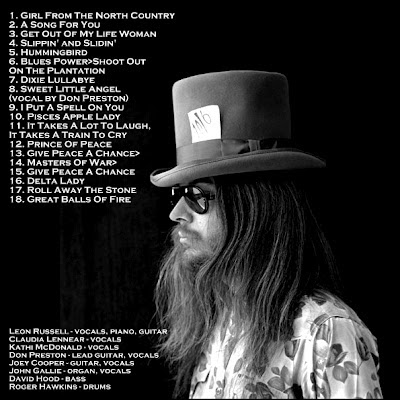
This is a great live set,  Elton John opened for Leon Russell at these shows. This concert was recorded before the Elton John’s one at the Fillmore East. Elton John was a great fan of Leon Russell and logically invited him to open his shows.  At these Fillmore East concerts, Leon Russell headlined over an up and coming Elton John and the band McKendree Spring. This set finds him performing much of the material from his first solo album, but with a feel that would reflect where he was heading on his second album, Leon Russell And The Shelter People. It was a bigger, more adventurous sound, which would feature many of the same musicians that jelled so well on the Cocker tour. The material on this tour was equally diverse, featuring rock & roll, country, blues, soul and gospel, woven together by Russell’s distinctive Oklahoma twang and his creative arrangements.

The set begins rather starkly, with Russell performing solo at the piano, opening with Bob Dylan’s “Girl From The North Country,” followed by his own “Song For You.” The set is paced in a way that is reminiscent of an old-fashioned revue, with additional musicians and chorus singers joining in as the set progresses. Anchored by David Hood and Roger Hawkins from the Muscle Shoals rhythm section, talented soloists, and two of the greatest female singers of the time (Lennear and McDonald), the set continually gains momentum with each song, establishing the feel of a rollicking road show.

As the set continues, Russell performs some of the true gems from his debut album, including “Hummingbird,” “Dixie Lullabye” and the high energy, “I Put A Spell On You.” The entourage also plays an outstanding version of “Shoot Out On The Plantation” that surfaces out of a short tease of “Blues Power,” the song Eric Clapton covered so well on his first solo album.

Russell also performs “Pisces Apple Lady” before bringing it all to a frenetic close with the double whammy of “Prince Of Peace” and “Give Peace A Chance” (a Russell original, not the John Lennon song). These last two numbers clearly display the incredible power of this talented group of musicians and singers, bringing the feel of an old time Southern gospel revue to the stage of the Fillmore East.

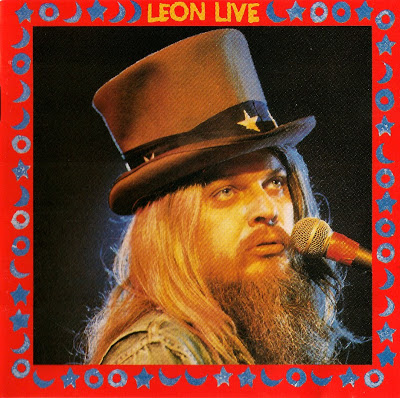
When comparing this concert to the one recorded, 3 years later, for Leon Live (One Of My Favourite Ever Live album set and a wonderful package). Similarities and differences are striking. Similiraties since it’s the gospel-that-rocks that all Leon’s admirers love to hear, but differences since the set was more sober and tighter that the quite indulgent later ones. I doubt any Dr John – Elton John or any-John-you-want won’t be enthusiasts in listening to such a great performance. Nothing better to listen to when you’re down and out. It makes you imagine life’s worth the living. Measure the miracle. Note that this set was never released officially but that the sound is very good probally taken from the soundboard..

LEON RUSSELL
Fillmore East, New York, NY; November 20-21st, 1970 [late show?] The Band for Leon was Roger Hawkins Drums, Dave Hood Bass Guitar. John Gallie Organ and ketboards Don Preston and Joey Cooper Guitars, Claudia Lennaer & Kathi McDonald on backing vocals

http://

Ty Segall can seemingly transform his music from Glam Rock God to Grunge Rocker at will, but the prolific rocker can do just about anything well, and that includes intimate stripped down acoustic sets . In the Summer, Segall went on a short tour of solo acoustic shows in various New York City venues accompanied by Wand’s Cory Hanson, and it was a very different concert experience from the usual Segall stomp-fest, but it sounded just as good. It’s no secret that Segall is a huge Neil Young fan . He even has a tattoo of Young’s name on his right arm on the Wednesday night at Baby’s All Right, he trotted out a cover of Neil Young’s “For The Turnstiles.” At the Mercury Lounge on the Friday night, he played an entirely new song live, hilariously introducing it as a song “about a tree growing inside of an airplane” before admitting after playing it that “I lied, it’s a love song.” It’s not clear if it was written as an acoustic song or just adapted with the rest of his stuff for the show, but it sounds great either way. Also at the Mercury Lounge he played the Cars’ “My Best Friend’s Girl.”

http://

The prolific Segall released an EP and two live records—one with the Ty Segall Band and another that was a split with King Tuff . Earlier this year, In the Red revealed plans to release albums by Segall’s bands Fuzz and The Traditional Fools .