Every album represents something foundational to our lives during the time of its creation. Yours Conditionally was about extricating ourselves from an industry that made us feel joyless and restrained. After a successful campaign that involved starting our own label and learning how to record on our own, We Can Die Happy finds us on the other side of that leap of faith, reveling in the sense of freedom and control we’ve found in our work. While making the track list for Yours Conditionally, a couple of songs didn’t seem to fit.
One song, I Miss That Feeling, had been giving me trouble for months. The concept came to me after I noticed the way that certain physiological aspects of anxiety could be read as feelings of pleasure when presented as a list, without context. We had gone as far as recording and mixing it, but when I listened back, I knew I had gotten it wrong. I scrapped everything except the chorus lyrics which detailed my own experiences with panic attacks and started over. I hopedI Miss That Feeling would be an easy fix and the rest of the EP would take shape around it. Instead each song resolved itself while I Miss That Feeling remained stubbornly incomplete. In the final days of our deadline, feeling the pressure, I had a panic attack. Even in the middle of hyperventilating, I thought spiraling into anxiety over a song about anxiety was oddly fitting. Very me. In the end I settled on a kinder approach. I made the minor chords major; I softened things. I made the song a love letter to my constant companion rather than a denunciation of it.
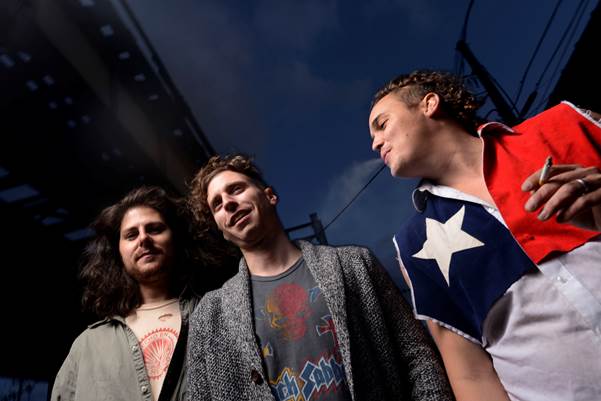
Back in 2015, Denver outfit The Yawpers brought their blues rock sounds to Bloodshot Records with their label debutAmerican Man.The trio are now back with their follow-up, Boy in a Well, set for release this Friday, August 18th. Produced by The Replacements’ Tommy Stinson (who also plays on the album) and Alex Hall (JD McPherson, Pokey LaFarge), “Boy in a Well” is a concept record about just what its title suggests. Set in WWI-era France, the story follows a mother who abandons her child down a well, where he grows up alone and afraid. The complex and ambitious tale is told both through 12 muscular, unpredictable rockabilly tracks as well as an accompanying comic book by the Legendary Shack Shakers J.D Wilkes.
“I wanted to write a melodramatic tragedy, but one so tragic that it has kind of a necessary levity,” says frontman Nate Cook, who wrote the record in the wake of his failed marriage. “Musically, the intention was to make a biting, frenetic, punk fueled record that sounded like it was recorded in the ’50s. Nodding to the past, present, and future. Emphasis during recording was placed almost solely on the spirit of the take and or song, often sacrificing polish for authenticity.” the band has provided an exclusive track-by-track breakdown of the entire thing. Cook takes us through the record’s theme and creation, while drummer Noah Shomberg digs into the songs’ structure and dynamics.
“Armistice Day”: Nate Cook (vocals, guitar): As the first song of a record that’s both historical and narrative, the writing on this one proved maybe the most difficult. Sonically, we all tried to maintain a very muted, fogging opening, and then midway tear through to something more immediate. On the narrative side, this is the song where the eponymous character is conceived by a young French girl and a soldier returning from the front lines. Instead of hope, I tried to set up a life that is entirely perverted by and beholden to the past.
Noah Shomberg (drums, vocals): One of the main musical themes Jesse [Parmet, guitars/vocals] and I attempted to address with Boy In A Well was to create intensity without using large dynamic shifts as a tool. However, sometimes you just have to smash. The song starts out nebulous in groove and slowly builds intensity via rhythmic shifts. The purpose of the drums and guitar here is solely to create a bed for the vocals to rest on. The song builds progressively throughout the third verse but not necessarily in volume until the last vocal melody refrain.
“A Decision is Made”: NC: Obviously a more rockabilly tune, and necessarily. We needed to forward the narrative substantially here, so there’s quite a bit of exposition and explanation. Rockabilly lends itself to wordier songs, and so I was able to cram a pregnancy, parental abuse, a birth, and a messianic complex into three minutes.
NS: Straight up rocker. I tried to re-imagine the “rockabilly” shuffle on the drum kit and explore different ways of phrasing it. Where can I place accents to help build tension and build intensity through the verses?
“A Visitor is Welcomed”: NC: The girl who threw our titular character down a well has dealt with the trauma through delusion. She believes her child is the second coming of Christ, and brings offerings of food, gifts, etc to the monster that is growing underneath.
NS: The groove on this song was inspired by a few late nights watching Ken Burns’ documentary on Jazz. We wanted to use a groove that sounded like the “Big Four” as a nod to our musical heritage. It’s a groove that originated from drummers in second line bands in the late 1800s.
“Room With a View”: NC: The first song told entirely from the perspective of the Boy in the Well. I attempted to not use personal pronouns, and make sure his description were limited to comparisons, as he has had no interaction with the outside world, and has no real sense of “I”.
NS: Stay out of the way. The function of the drums here is to support and add color. Nothing more, nothing less.
“Mon Dieu”: In a shameless ripoff of Steinbeck, this song finds a rabbit falling in the well, and the boy’s desire for love killing it. This becomes the impetus for him climbing out.
Looking back, this song felt like it came together the easiest. It was one of the first songs we jammed on and completed. The drum arrangement is all over the place. It’s maniacal and suits the performance of the song just right. We recorded this song with only one microphone which forced me to hit the cymbals a little bit differently. Instead of crashing with the middle of the stick, I played everything with the tip of the stick. I think it adds a cool sonic texture to the drums in this song.
“The Awe and the Anguish”: NC: We recorded the first two thirds of this song entirely on a field recorder that was the same [Alan] Lomax used. We used one mic, and self controlled dynamics, which was new for us. This serves two functions, one being demarcating the boy’s transition from the well to the outside world, and also to demonstrate the alien nature it presents to him.
NS: This was another attempt to stay out of the way of the vocals (and story). The melody and guitar part are so vibey, all it needed was some maraca and a few downbeats on a marching bass drum … until the end.
“Mon Nom”: NC: This is a song entirely about the boy’s search for identity, and finds him using personal pronouns as he grasps a greater sense of who or what he is. Given his upbringing, most of his conclusions are pretty menacing. The last repeated line means “I am the second coming of Christ” in French.
NS: In my opinion, this song achieved everything we were trying to do with the performances on the record. We use rhythm to build the intensity of the whole song. The drums start out stripped down, eventually adding each part of the drum set and then variations of the basic groove to build tension. Nate’s vocal delivery is incredibly dynamic, starting in a low Johnny Cash rumble and ending in a Nick Oliveri style scream. The vocal delivery complements the lyrics most effectively on this song. Additionally, Jesse’s guitar playing is straight forward and outside of the box all at once.
“Face to Face to Face”: NC: In the course of her routine visits to the well, mother encounters son. They recognize each other. In a bizarre sacrifice form, and out of some novel primal instinct in him, they have an “Oedipal” encounter.
NS: Rhythmically and harmonically, this song is outside of the wheelhouse. One of the more interesting instrumental arrangements on the record for me. We tested what we could get away with on this one, but still kept the style somewhat familiar.
“No Going Back”: NC: The encounter is predictably violent, and some innate ethical boundary has been crossed. The mother lies still, presumably dead, and the boy, having destroyed (again) something he loves, is wracked with agony.
NS: I don’t recall what inspired us to write a rockabilly song in 5/4, but we got a kick out of how unusual it sounded. It took us several hours of playing various grooves and parts in 5/4 to wrap our heads around it. Nate and I keep the groove straight forward and Jesse does a great job at smoothing out the angular feel. The transition to 4/4 in the chorus gives the song some serious momentum. Some of the playing towards the end of the song is a personal nod to a drum hero of mine, Jon Theodore [of Queens of the Stone Age and The Mars Volta]. Lastly, I think this is another instrumental arrangement that compliments the lyrics/story.
“God’s Mercy”: NC: This is basically a suicidal lament, as the boy throws himself back down the well. Finishing the job this time.
NS: This is a lullaby, so I did what seemed natural: Stay out of the fucking way. We used a ribbon mic placed about three feet above the tom, cranked the gain, and I played the floor tom with my hands. We achieved a pretty cool sound.
“Linen for the Orphan”: NC: Months have passed. As it turns out, the girl was only rendered unconscious during the encounter with her son, and has come to term with their child. Unfortunately, she dies in child birth. Her parents, not wanting the child, decide to get rid of him. After a doctor smothers the child with a sheet, they need to find a place to dispose of the body.
NS: This guitar/drum vibe was inspired equally by the Cramps and the Dead Kennedys. I loved the feel of the song “Police Truck”, so Jesse and used that for some of the inspiration for the verse grooves. My favorite parts are the builds in the song. I tried to use the bells of the cymbals to build intensity rather than just crashing. I also tried to get as quiet as I could but without ever getting too loud. Tension, release, tension, release.
“Reunion”: The body is taken to the well, and thrown onto the bones of its father.
The main riff was taken from a jam session that Jesse and I had from the previous summer. We brought that to a rehearsal and Nate pushed the song into a surf pop direction to juxtapose the lyrical content. Irony, a classic Cook move. We had our pal, Tommy Stinson, lay down some 12 string on this track which added a pretty and twangy sonic layer to the song. All in all, what better way to end the record?
The Denver indie pop duo and sailing enthusaists Tennis husband-wife team Alaina Moore and PatrickRiley, released their fourth album, “Yours Conditionally”. The new record includes the lovely track “Ladies Don’t Play Guitar” as well as opener “In The Morning I’ll Be Better” and the dreamy, dizzying “Modern Woman.” That last song has a new video out in which the band’s Alaina Moore gazes at her reflections in a series of vintage domestic tableaus. Like “Ladies Don’t Play Guitar,” “Modern Woman” is a mannered, sarcastic meditation on womanhood, delivered with a dose of melancholy sincerity.
In the video accompanying the single, she peers into a vanity mirror at her reflection, maintaining eye contact with her own image as she reaches for various potions and salves, the products she leans on to make herself beautiful. The video comprises several dreamy vignettes shot over the course of a single day at a gallery in Denver. Director Luca Venter, who also directed the band’s “In the Morning I’ll Be Better” video, and set designer Kelia Anne envisioned different rooms for the shoot—“really feminine and really domestic,” Moore explained. In each scene, there’s a mirror, and Moore stares into it, transfixed.
Star Treatment, the new Wovenhand album, David Eugene Edwards, the Denver musician who has been leading Wovenhand since 2001, since it was a side project of his mutant-country band 16 Horsepower.
His music deals in darkness, and obsessiveness. His songs are steeped in the history of American music, of folk and country and blues, and yet they owe as much to some of the clanging, confrontational forms that followed: punk, metal, hardcore, noise-rock. His songs sound like incantations, like prayers bubbling up from below.
I’d would have been shamefully ignorant of Edwards’ work until Converge frontman Jacob Bannon’s label Deathwish, Inc. put out Wovenhand’s album “Refractory Obdurate” two years ago. Deathwish is usually an amazing source of coloring-outside-the-lines hardcore and metal, I’ll listen to anything that label puts out at least once. Edwards’ clanging, crashing sermons are as much alt-country as they are metal, but he fit weirdly well into the label’s whole project. Wovenhand’s sonics only glancingly intersect with metal, but they conjure a grandeur that we can also hear in some of the best doom. With the new album Star Treatment, Wovenhand have left Deathwish for the more amorphous indie Sargent House Records, but they might be more metal than they were last time out. Opener “Come Brave” has a grand, seething distorto-riff at its heart. The thundering groove of “Crook And Flail” might have pianos and bongos mixed in, but those instruments somehow add to its heaving enormity; they don’t just ornament it. “Golden Blossom” is one of the quieter moments here, but the warmth of its stargazing psychedelia feels like the dank-club equivalent of a lighters-up arena moment.
This time around, Edwards is drawing plenty of his help from the intersecting worlds of metal and hardcore. Two of the musicians from his band are also members of Planes Mistaken For Stars, the reactivated Midwestern post-hardcore greats. Sanford Parker, the renowned Chicago metal producer, recorded the album, and he did it at Steve Albini’s Electrical Audio studio. But this isn’t Edwards’ punk album — at least, not any more than any of his others. Edwards is concerned with older things. He’s said that he named the album Star Treatment because he’s using it to explore humanity’s ancient fascination with the night sky. And in Star Treatment, we can hear the sounds of tiny human specks attempting to wrap minds around the infinite, around forces much grander than themselves. Edwards is a devout Christian, and that’s probably a part of it, too. There’s a ritualistic feel to the album, a sense of devotion to the cosmos. And even if you’re not the tiniest bit spiritual, which I’m not, there is a power in asking the mere questions that so many belief systems attempt to answer.
Edwards belongs to an older breed. He’s in there with Cave, Michael Gira, Carla Bozulich, Dan Higgs, Polly Jean Harvey, David Tibet. He’s a mystic wanderer, the type who seeks transcendence in darkness as well as in light. He never hides his voice. It’s a huge, barreling wail, a declamatory roar. And the music matches the majesty of that voice, calling on traditions that can sometimes go past ancestral country music and into tribal-chant territory. This is big music, a type of music that we don’t often hear anymore. It’s music for calling down heaven. There is plenty of great music coming out these days, but very little of it is concerned with summoning spirits in that same way. We don’t get many albums like this anymore.
Before Nathaniel Rateliff put together his new soul band the Night Sweats, the Denver musician was regarded as a latter-day folk singer on the fringes of Mumford & Sons’ neo-roots revival. Given his music, the designation was understandable, but it was also incomplete. There’s always been more than a little soul coursing through his songs, too. The Night Sweats, then, isn’t a new direction for Rateliff so much as a reconnection to music he’s been singing at least since it helped him pass the hours when he worked on a Denver loading dock before becoming a full-time musician. It’s a natural sound for Rateliff, so much so that this 11-song collection found a home on Stax, the revived Memphis label that was such a big part of soul music in the 1960s and ’70s. Indeed, these tunes have a vintage air about them in the trebly guitar riffs, bright sprays of brass and punchy basslines, circling tightly around rock-solid drums. Atop such a powerful engine, Rateliff glories in his role as soul shouter. And while the singer and his band are drawing on a classic form, their interpretation makes for an exciting and contemporary sound.
He wowed Jimmy Fallon with his confessional song “S.O.B.” on The Tonight Show, his life has been a blur of festival appearances and headlining dates at venues that seem to get bigger every week. He’s barely had a single day off from the madness and none are coming up in the foreseeable future. “We never expected to be received in such a way,” he says as his bus makes its way across the English countryside. “And we’re going work as hard as we can.”
Lou Reed, buoyed & rejuvenated by the response to the urban apocalypse suite of the just released New York album, hits the road…..Chronicling his grotesque & rotten home town ‘Big Apple’, whilst taking no prisoners, offers up wry & fragile hope among the decaying ruins. Does he succeed? Listen & hear……Tracklist includes
01/ Dirty Blvd. 02/ Endless Cycle 03/ Last Great American Whale 04/ Beginning Of A Great Adventure 05/ Busload Of Faith 06/ I Love You, Suzanne 07/ One For My Baby (And One More For The Road) 08/ Doin’ The Things That We Want To 09/ Rock ‘N’ Roll 10/ Video Violence 11/ The Original Wrapper 12/ Sweet Jane
Recorded live on November 29th, 1989 in Denver while Stevie Ray Vaughan and Double Trouble were on tour for their new album, “In Step”. The Show at Tingley Coliseum, Albuquerque, NM / McNichols Arena, Denver, CO recorded over two nights November 28th/29th, 1989. A great Soundboard recording.
However, that night Stevie Ray, along with guest guitarist Jeff Beck, did not focus strictly on playing songs from the album, but instead had fun rocking out on versions of Stevie Wonder’s ‘Superstition’ and Jimi Hendrix’s ‘Voodoo Child,’ both of which are included famously here. During their performance of ‘Life Without You,’ one of Vaughan’s earlier songs, the newly reformed guitar hero even took the time to speak out on substance abuse and plead with his audience not to go down the same road he had.
01 – The House Is Rockin’ [00:00]
02 – Tightrope [02:41]
03 – Let Me Love You Baby [08:20]
04 – Look At Little Sister [14:10]
05 – Leave My Girl Alone [17:38]
06 – Riviera Paradise [23:54]
07 – Wall Of Denial [34:31]
08 – Superstition [40:29]
09 – Cold Shot [45:29]
10 – Crossfire [52:29]
11 – Voodoo Chile (Slight Return) [56:38]
Unfortunately, less than a year later one of the greatest guitar players the world has ever known was dead at age 35 from a helicopter crash.
The R&B/soul project from the Denver singer-songwriter, has shared “I Need Never Get Old,” the first taste of its upcoming self-titled album.
Due out on the classic soul Stax Records, the album is scheduled for release late this summer. It includes production from the Shins’ Richard Swift, who has also worked on the latest release from fellow Denver based band Tennis.
If you’ve frequented the Night Sweats live shows in the Denver area lately, you’ve likely heard “I Need Never Get Old.” This recording, which the band shared today, captures the Night Sweats’ live dynamics. Horns, guitar, percussion, Rateliff’s vocals — they all find a nice mix on the track, which has that lively, vintage dance party atmosphere.
Stax has a storied history in Memphis soul and blues music with greats like Otis Redding and its house band Booker T. & the M.G.’s. Powered by Nathaniel Rateliff’s well-loved solo material, the Night Sweatshave been a force locally and nationally for the last few years, having recently returned from playing Treefort in Boise.
“I never did this stuff before, because it never really came to me,” Rateliff told us of his transition from folk to a soulman. “It just so happened that it came together for me. You have to be open to whatever comes to you.”
Listen to Nathaniel Rateliff and the Night Sweats’ “I Need Never Get Old” here
The Silent Sunrise is the fourth album from the USA shoegaze with a moody psych and rock twist “A Shoreline Dream” the band are from Denver Colorado with two original member Ryan Policky and Erik Jeffires in 2012 they released three EP’s one a month in the last three months of the year.” The Silent Sunrise” is the first album in three years.
Tennis are a Indie Pop Denver band made up of husband and wife duo Alaina Moore and Patrick Riley, they have released three albums to date and a number of Ep’s




 The Fat Angel Sings