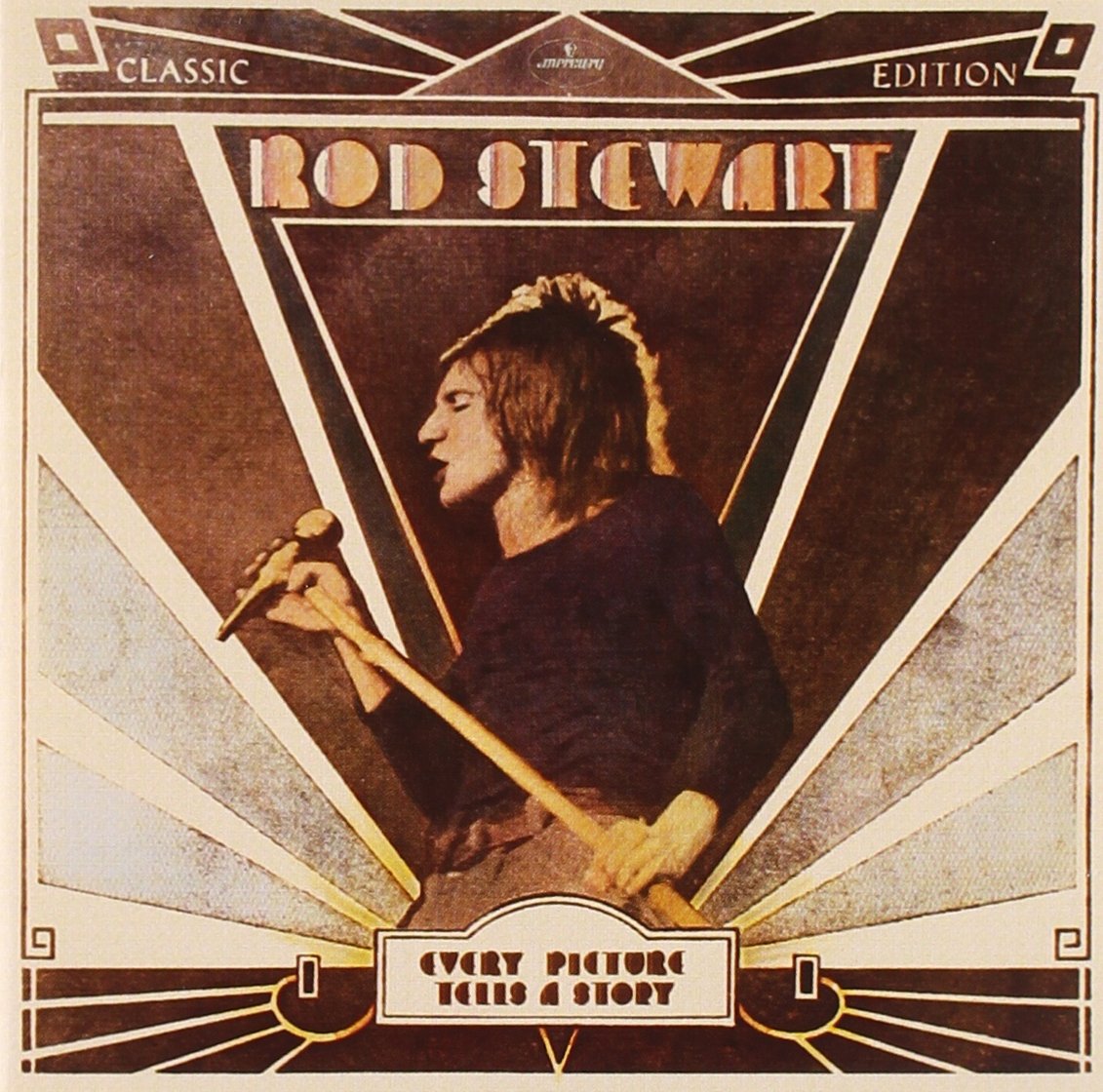
Rod Stewart was doing double duty with the Faces at the time of 1971’s ‘Every Picture Tells a Story,’ so his band mates’ contributions boost the loose, boozy vibe. As the decade progressed, Stewart would try on a few other hats soft-rock lothario, swarthy disco guy – but he’s at his best when he puts his throaty voice behind pure rock ‘n’ roll.
The album is a mixture of rock country, Folk and blues and some soul, and includes Stewart’s breakthrough hit, “Maggie May” and the Tim Hardin cover “Reason To Believe” taken from Hardin’s debut album of 1966. “Reason to Believe” was released as the first single from the album with “Maggie May” as the B-side, however, “Maggie May” became more popular and was a No. 1 hit in both the UK and US.
The album also included a version of Arthur Crudup’s “That’s All Right (Mama)” and a cover of the Dylan song “Tomorrow Is A long Time” that was an outtake from Dylan’s 1963 “Freewheelin” album.
All five members of the Faces (with whom Stewart at that time was thier lead vocalist) appeared on the album, with guitarist/bassist Ronnie Wood and keyboardist Ian McLagan on keyboards being most prominent. Due to contractual restrictions, the personnel listings were somewhat vague, and it was unclear that the full Faces line-up . Other contributors included Ray Jackson on mandolin (though Stewart forgot his name and merely mentioned “the mandolin player in Lindisfarne on the sleeve). Micky Waller on drums. Maggie Bell performed backing vocals (mentioned on the sleeve as “vocal abrasives”) on the title track, and Madeline Bell sang backup on the next track, “Seems Like A Long Time”. Pete Sears played all the piano on the album except for one track, “I’m Losing You” which featured Ian McLagan on piano, along with the Faces as a band.
Bringing It All Back Home is the fifth studio album by American singer-songwriter Bob Dylan, released in March 1965 by Columbia Records. The album is divided into an electric and an acoustic side. On side one of the original LP, Dylan is backed by an electric rock and roll band—a move that further alienated him from some of his former peers in the folk song community. Likewise, on the acoustic second side of the album, he distanced himself from the protest songs with which he had become earlier identified (such as “Blowin’ in the Wind” and “A Hard Rain’s a-Gonna Fall”), as his lyrics continued their trend towards the abstract and personal. although the acoustic side included some tracks in which other instruments were backing up Dylan and his guitar, but no drums were used.
The album reached the top ten of the Billboad Albums chart, the first of Dylan’s LPs to break into the US top 10. It also topped the UK charts later that Spring. The lead-off track, “Subterranean Homesick Blues”, became Dylan’s first single to chart in the US, This is the point where Dylan eclipses any conventional sense of folk and rewrites the rules of rock, making it safe for personal expression and poetry, not only making words mean as much as the music, but making the music an extension of the words. A truly remarkable album.
“She Belongs To Me” extols the bohemian virtues of an artistic lover whose creativity must be constantly fed (“Bow down to her on Sunday / Salute her when her birthday comes. / For Halloween buy her a trumpet / And for Christmas, give her a drum.”)
“Maggies Farm” is Dylan’s declaration of independence from the protest folk movement. Punning on Silas McGee’s Farm, where he had performed “Only A Pawn In Their Game”at a civil rights protest in 1963 (featured in the film Dont Look Back), Maggie’s Farm recasts Dylan as the pawn and the folk music scene as the oppressor. Rejecting the expectations of that scene as he turns towards loud rock’n’roll, self-exploration, and surrealism, Dylan sings: “They say sing while you slave / I just get bored.”
“Love Minus Zero/No Limit” is a low-key love song, a “hallucinatory allegiance, a poetic turn that exposes the paradoxes of love (‘She knows there’s no success like failure / And that failure’s no success at all’)…[it] points toward the dual vulnerabilities that steer ‘Just Like A Woman.’ In both cases, a woman’s susceptibility is linked to the singer’s defenseless infatuation.” Among other things, Bringing It All Back Home had a substantial effect on the language of a generation.
“Outlaw Blues” explores Dylan’s desire to leave behind the pieties of political folk and explore a bohemian, “outlaw” lifestyle. Straining at his identity as a protest singer, Dylan knows he “might look like Robert Ford” (who assassinated Jesse James), but he feels “just like a Jesse James”.
“On The Road Again” catalogs the absurd affectations and degenerate living conditions of bohemia. The song concludes: “Then you ask why I don’t live here / Honey, how come you don’t move?”
“Bob Dylan’s 115th Dream” narrates a surreal experience involving the discovery of America, “Captain Arab” (a clear reference to Captain Ahab Of Moby Dick fame), and numerous bizarre encounters. It is the longest song in the electric section of the album, starting out as an acoustic ballad before being interrupted by laughter, and then starting back up again with an electric blues rhythm. The music is so similar in places to Another Side of Bob Dylan’s “Motorpsycho Nitemare” as to be indistinguishable from it but for the electric instrumentation. The song can be best read as a highly sardonic, non-linear (historically) dreamscape parallel cataloguing of the discovery, creation and merits (or lack thereof) of the United States.
“Gates Of Eden” builds on the developments made with “Chimes of Freedom” and “Mr. Tambourine Man”. “Of all the songs about sixties self-consciousness and generation-bound identity, none forecasts the lost innocence of an entire generation better than ‘Gates of Eden,’” “Sung with ever-forward motion, as though the words were carving their own quixotic phrasings, these images seem to tumble out of Dylan with a will all their own; he often chops off phrases to get to the next line.” (This is the only song on the album that is mono on the stereo release and all subsequent reissues.)
One of Dylan’s most ambitious compositions, “Its AlrightMa (I’m Only Bleeding) is arguably one of Dylan’s finest songs. Heylin wrote that it “opened up a whole new genre of finger-pointing song, not just for Dylan but for the entire panoply of pop”, A fair number of Dylan’s most famous lyrics can be found in this song: “He not busy being born / Is busy dying”; “It’s easy to see without looking too far / That not much is really sacred”; “Even the president of the United States / Sometimes must have to stand naked”; “Money doesn’t talk, it swears”; “If my thought-dreams could be seen / They’d probably put my head in a guillotine.” In the song Dylan is again giving his audience a road map to decode his confounding shift away from politics. Amidst a number of laments about the expectations of his audience (“I got nothing, Ma, to live up to”) and the futility of politics (“There is no sense in trying”; “You feel to moan but unlike before / You discover that you’d just be one more / Person crying”), Dylan tells his audience how to take his new direction: “So don’t fear if you hear / A foreign sound to your ear / It’s alright, Ma, I’m only sighing.”
The album closes with “Its All Over Now Baby Blue” described as “one of those saddened good-bye songs a lover sings when the separation happens long after the relationship is really over, when lovers know each other too well to bother hiding the truth from each other any longer … What shines through “Baby Blue” is a sadness that blots out past fondness, and a frustration at articulating that sadness at the expense of the leftover affection it springs from.” If Paul Clayton is indeed the Baby Blue he had in mind, as has been suggested, Dylan was digging away at the very foundation of Clayton’s self-esteem.” However, the lyric easily fits in with the main theme of the album, Dylan’s rejection of political folk, taking the form of a good-bye to his former, protest-folk self, according to the Rough Guide to Bob Dylan. According to this reading, Dylan sings to himself to “Leave your stepping stones [his political repertoire] behind, something calls for you. Forget the dead you’ve left [folkies], they will not follow you … Strike another match, go start anew.” The only musician besides Dylan to play on the song is Bill Lee on Bass guitar.
In a interview Dylan said, My thoughts, my personal needs have always been expressed through my songs; you can feel them there even in ‘Mr Tambourine Man’. When I write a song, when I make a record, I don’t think about whether it’ll sell millions of copies. I only think about making it, the musical end-product, the sound, and the rhythmic effect of the words. ~Bob Dylan (to Sandra Jones, June 1981)
A surrealist work heavily influenced by Rimbaud (most notably for the “magic swirlin’ ship” evoked in the lyrics), The album was hailed it as a leap “beyond the boundaries of folk song once and for all, with one of [Dylan’s] most inventive and original melodies.
“Mr. Tambourine Man” was “Dylan’s pied-piper anthem of creative living and open-mindedness…a lot of these lines are evocative without holding up to logic, even though they ring worldly.” called “rock’s most feeling paean to psychedelia, all the more compelling in that it’s done acoustically.”
One of Dylan’s most celebrated albums, “Bringing It All Back Home” was soon hailed as one of the greatest albums in rock history.
In a 1986 interview, film director John Hughes cited it as so influential on him as an artist that upon its release, “Thursday I was one person, and Friday I was another.”The album closes with “It’s All Over Now, Baby Blue“, However, the lyric easily fits in with the main theme of the album, Dylan’s rejection of political folk, taking the form of a good-bye to his former, protest-folk self, according to the Rough Guide to Bob Dylan. According to this reading, Dylan sings to himself to “Leave your stepping stones [his political repertoire] behind, something calls for you. Forget the dead you’ve left [folkies], they will not follow you…Strike another match, go start a new.” The only musician besides Dylan to play on the song Bill Lee on bass guitar.
Other songs and sketches recorded at this session: “Love Minus Zero/No Limit”, “It’s All Over Now, Baby Blue”, “She Belongs to Me”, “On the Road Again”, “If You Gotta Go, Go Now”, “You Don’t Have to Do That”, “California,” and “Outlaw Blues”, all of which were original compositions.
….when we recorded Bringing It All Back Home, that was like a break through point, it’s the kind of music I’ve been striving to make and I believe that in time people will see that. It’s hard to explain it, it’s that indefinable thing..
~Bob Dylan
Stray’s 1970 self titled debut album is one of those lost hard rock classics of all time , chock full of acid-tinged biker-rock , bluesy, harmonics-heavy dirges, Sabbath-y slammers , scratchy, wah-inflected funk rockers and shimmery pop gems , all of it drenched in Del Bronham’s speed-freak guitar work. The follow-up, 1971’s “Suicide”, is almost as good (check out the heavy-as-bricks title track), although by 1976’s “Hearts Of Fire” they had lightened up, as it were, a bit too much, and disbanded soon after. These days, the group, with Bromham on board, is back together, and has been hailed as an influence on a generation of British rockers, including Iron Maiden, who released a cover of their signature song, “All in Your Mind,” in 1990.
Del Bromham – Guitar, Vocals
Steve Gadd – Lead Vocals
Gary G Giles – Bass Guitar
Richie Cole – Drums
Lone Justice Lead singer Maria McKee: “Barely out of her teens, she comes on with a spitfire defiance and a repertoire of yelps, growls, and shouts that are the essence of country spunk.” Three decades later, This classic debut album Lone Justice still sounds like an astonishingly precocious debut for McKee, even if the band sometimes sets up obstacles for her to leap over (she always does), and the production tilts the whole enterprise toward mainstream rock (especially on Tom Petty’s “Ways To Be Wicked”, which could be an outtake from an ’80s Heartbreakers album like Long After Dark). No matter. From the moment she steps up to the mic on the opening phrases of “East Of Eden”, McKee is a dynamo in a lineage that includes singers like Wanda Jackson, Dolly Parton, Loretta Lynn, and Linda Ronstadt when she was still in the Stone Poneys .
There the rousing Soap Soup and Salvation , playing the part of a save-my-land heroine on After The Flood, or trying to salvage a failing relationship on the touching ballad Don’t Toss Us Away (written by her brother Bryan MacLean, who was a member of the seminal L.A. band Love) , McKee never missteps. She can break the momentum of a line, slip out for a half-spoken interjection, then fall right back into the melody, and nothing seems to rattle her. From the moment they appeared on the club circuit, the buzz on Lone Justice spread cross-country rapidly, so anticipation was high for this first album, and for their animated live shows, which often would include a take on Lou Reed’sSweet Jane that was a twang-infused hybrid, punk-country with a touch of the Rolling Stones around the time of Let It Bleed . Lone Justice aren’t spoken about much these days; you wonder how big they might’ve gotten if there were such a thing as “Americana” in the mid-’80s. check out this live set in 1985 at the Ritz in New York City.
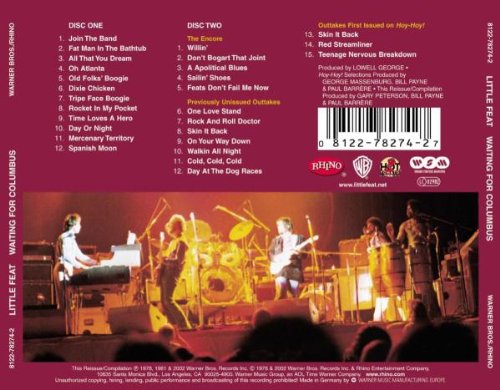
“Waiting for Columbus” was recorded during seven performances in early August 1977. The first four shows were held at the Rainbow Theatre in London, UK on August 1st–4th, 1977. The final three shows were recorded in George Washington University’s Lisner Auditorium on August 8th–10th in Washington, D.C. Little Feat was backed at some of these shows by the Tower of Power horn section.
August, 1st back in 1977 (Monday) Little Feat played the first show in London with the Tower Of Power horns, but none of the songs from that evening were chosen for the official release.
Is this the greatest live album, Ever!!! I’ll never forget the first time I heard the version of Spanish Moon. Everytime I hear those horns . Outstanding.
How the group pulled off one of the best live albums of all time, the double-LP “Waiting for Columbus”, is both a heartening story of persistence and a sad, cautionary tale about how band politics can become toxic, and destroy a beautiful thing in the process.
When Lowell George proposed doing a live album in early 1977, the group approved the idea at least partly, because they considered it a good sign that George was involving himself in any decision-making.
They were also anxious to capture their onstage power in the way the Allman Brothers Band, the Rolling Stones, Neil Young and the Band had before them. Little Feat made plans to include the five-piece Tower of Power horn section (Mic Gillette and Greg Adams on trumpets, with Lenny Pickett, Emilio Castillo and Stephen “Doc” Kupka playing saxophones), incorporating new super-funky arrangements inspired by Allen Toussaint’s work with the Band on Rock of Ages.
Every once in a while an album comes along that completely changes the way you think about a band. For me that band is Little Feat and the album is their timeless live offering, “Waiting For Columbus”. Spanning the course of seven shows in 1977, the band makes their way through a set of swampy blues-rock in a uniquely 70’s paradigm that reaches other-worldly altitudes. Little Feat was a band that makes you think many contemporary bands aren’t as revolutionary as you thought.
Little Feat members had always enjoyed recreational drugs and heavy partying, but George was now fully in the grip of a destructive cocaine habit. He often refused to rehearse or jam, disappeared for days at a time and virtually stopped writing songs, leaving production decisions and music construction to keyboardist Bill Payne and guitarist Paul Barrere. In an interview with journalist Bud Scoppa, Barrere described ’77 Little Feat as “without focus or direction, no real managerial control over the business aspect, and because our personal habits were so askew,
It’s one thing to hear the album, but it takes on awe-inspiring qualities when you sit back and listen to it.
First off, lead vocalist and slide-guitarist, Lowell George was an immense talent and should be heralded as a national treasure. His vocal work and lyrical contributions are timeless in-and-of-themselves. Not to mention, as a session guitarist he played on Robert Palmer’s cover of Allen Toussaint’s Sneaking Sally Through The Alley and as a producer, he produced The Grateful Dead’s 1978 album Shakedown Street. Combined with keys player Bill Payne, rhythm/lead guitarist Paul Barrere, Richard Hayward on drums, and bassist Kenny Gradney, Little Feat came together and made something special with “Waiting For Columbus” (especially considering the ensuing disbandment of Little Feat and George’s untimely passing).
On the original two-LP set the concerts’ song order was reconfigured for more dramatic effect, with nine performances from D.C. and eight from London. The Rolling Stones’ Mick Taylor guests on “A Apolitical Blues” from the August 3rd gig, which was otherwise excluded from consideration; it was subsequently known as the “Black Wednesday” show by the band. Barrere and George were seriously hungover after staying up all night with some of the Tower of Power members after the second show. Castillo told writer Ben Fong-Torres for his Willin’ band biography that Hayward and George got into a screaming match just before going on stage, with punches thrown. Road manager Doug Zahn prevented Hayward from physically attacking George, who started the fisticuffs. Other band members reportedly fought in the dressing room after the show as well.
Waiting for Columbus is an impressively thorough expression of the times in which it was created. They’re playing all the sounds available to them and pulling it off in a unique way that celebrates the cultural heritage of the American South, and more-than-adequately covers the eclectic influences of the day. There’s jazz, blues, rock n’ roll, boogie, folk, gospel, soul and the many expressions of these styles within the Americana framework.
The party gets started with a klanky cowbell run that leads into a pot-stirring vibe as “Fat Man in a Bathtub” gets revved up. This tune exemplifies the attitude of Little Feat that never takes itself too seriously; allowing the music to breathe without the air of seriousness that constricts many acts. The improvisational aptitude of the band more than compensates for any nonsensical attitudes displayed in their lyrics. Which are satisfying and flush with wit and humor.
“All That You Dream” opens up as an up-tempo rock city number before breaking into the glorious chorus of “I’ve been down, but not like this before”. Seemingly, to celebrate the perspective of the downtrodden as they harmonize beautifully through this gripping serenade.
“Oh! Atlanta” is the kinda tune that makes you look at ATL from a different angle. One that says “there must be something to this city”. A good ole’ country get-down that moves through luscious musical changes and makes you think, “there’s definitely some tonk in that honky”. Upon taking a closer look at this song, I realized that I didn’t fully appreciate the creativity and musical awareness of Little Feat. Notably, Lowell’s vocals throughout the verse are syncopated and stylized in truly original form.
“Old Folks Boogie” creeps up with a jazzy blues feel and lyrical content that shows how these guys can have fun with their music.
“And you know that you’re over the hill – When your mind makes a promise that your body can’t fill – Doin’ the old folks boogie – And boogie we will – ‘Cause to us the thought’s as good as the thrill” is a hilariously accurate insight to the aging process.
“Spanish Moon” is a song that plays like a soundtrack to wherever you end up at the end of “On Your Way Down” (included on the extended 2002 release). A low-down sinister groove, rife with visceral storytelling and a prominent feeling that it’s goodto be bad, “Spanish Moon” has one of the baddest bass lines on the album. The low-end here is heavier than lead and trudges through the filth of the visceral storyline.
At the moment, I can hardly think of a band that weaves as rich a narrative and moves through it with such compelling musical dexterity. As if to place exclamatory punctuations, the “Tower of Power” horn section lies in wait to unleash their brass-blasting fury.
Moving on to one of Little Feat’s most famous songs, a little left-hand piano boogie quickly opens up to some right-hand woogie as the extended/re-worked version of “Dixie Chicken” takes flight. Complete with an extended piano solo that traverses through a syncopated Fats Waller/Jelly-Roll Morton style and leads into a delightful, Dixieland breakdown with the Tower of Power horns. Cascading piano, sultry clarinet, trumpet and trombone lead the jam before it explodes into “Tripe Face Boogie” which features a tantalizing mix of synthesized sounds and Rhodes piano through the instrumental section.
“Willin’ > Don’t Bogart That Joint” is a slowed-down country crooner section with a beautiful, lonesome feel to it. Riding the edge between all-out-sorrow and a feeling of redemption that says “I’ve been through some shit, but I’m gonna be alright.. And damnit, if I’m not gonna be better off for it.” Speaks to a man at the end of his rope, but ready to heed the omen of progress:
“A Apolitical Blues > Sailin’ Shoes” marks the downright bluesiest section of the album. It starts off chuggin’ down the tracks and settles into a juke-joint vibe that carries through until the last track on the album; Bill Payne’s“Feats Don’t Fail Me Now”. A song that features a frothy bass line that keeps comin’ back for more. Drummer, Richard Hayward drops it into gear while Lowell’s vocals rev up the engine on this beast, for an expansive journey fitting to close out the album.
Little Feat represents a brand of Southern culture that belongs to everyone. Much in the same way that the 1776 ethos isn’t only identifiable to Boston, or Philly. They connect with something in all of us and deal with the full experience; the celebration of life, the evil urges, and a humorous outlook on the hard times that keeps the soul light.
Lowell George became a producer-for-hire, and began work on a solo album that was eventually issued as Thanks, I’ll Eat it Here. He died at the age of 34 while on tour promoting it, ironically playing the Lisner Auditorium a final time on June 28th, 1979, succumbing after a heart attack the next day, most likely brought about by a cocaine overdose. Little Feat eventually regrouped, and with many different line-ups they made fantastic music for decades. Hayward was killed by cancer in August 2010, as was Barrere in October 2019. Of the survivors, Payne has been the most active, working most recently with Leftover Salmon and the Doobie Brothers.
Waiting For Columbus’ cover art by Neon Park (Martin Muller) still confounds easy interpretation, and forms part of the mystique of the album. Is the anthropomorphic tomato-woman a symbol of idyllic America, before Columbus “discovered” her? Three additional outtakes were included on the 1981 Little Feat compilation Hoy-Hoy! and seven more emerged on the Rhino reissue in 2002. Maybe someday the powers-that-be at Warner Bros. Records will release everything recorded and finally satisfy the still-thriving Little Feat cult?
Waiting for Columbus continues to exert a big influence, especially on country, bluegrass, blues and jam bands. On October 31st, 2010, Phish performed the whole album in Atlantic City as part of their annual “Halloween disguise” shows, and on July 21st, 2018, the Peach Festival in Scranton, Pa., saw the remaining members of Little Feat join with moe., Turkuaz and the Midnight Ramble Horns to recreate Waiting For Columbus one more time.
Simply stated, Waiting For Columbus is a timeless classic, worthy of any record collection.
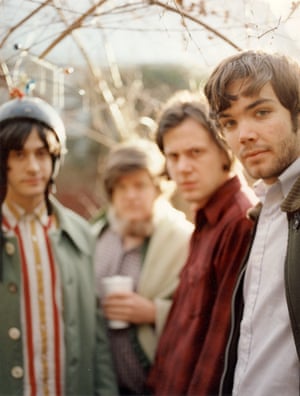
The Antlers – “Hospice”–Released in(2009; Frenchkiss Records) is the third studio album by American indie rock The Antlers, and their first concept album . It was initially self-distributed by the band in March 2009, and was then eventually remastered and re-released.
Part of what makes a concept album truly work is the narrative it’s beholden to. Hospice is a grizzly and harrowing work, which seeks—if nothing else—to completely hollow you as a human being. Dealing with a hospice worker’s romantic entanglement with a patient with terminal bone cancer, Hospice is an album with a palpable feeling of mournful hopelessness.
Singer Peter Silberman’s vocal styling is responsible for at least 50 percent of the latent intensity of the narrative, a quivering whisper of toiling emotions, annunciating with ruthless efficiency a narrative of intense tragic beauty, backed by the sometimes gigantic walls of sound produced by the band, as if to jolt you from the dreamy vocal patterns. It is passionate, powerful and pragmatic in its vision of a relationship that is cultivated through frailty and exposed through its own flaws. Hospice is a direct narrative of suffering without any obfuscation at all, its music perfectly pairing with the rollercoaster anyone experiences in a relationship, with an ending that either uplifts and destroys
The album was released to critical acclaim. Music blogs endorsed the re-release of Hospice with their “Best New Music” stamp. NPR Radio placed the album at number one on their list of the top ten albums of early 2009. At the end of the year, praising its “power to emotionally destroy listeners
Personnel
Peter Silberman – vocals, guitar, accordion, harmonica, harp, keyboards
Darby Cicci – trumpet, bowed banjo
Michael Lerner – drums, percussion
Justin Stivers – bass
Sharon Van Etten– vocals on “Kettering,” “Thirteen,” “Two,” and “Shiva”
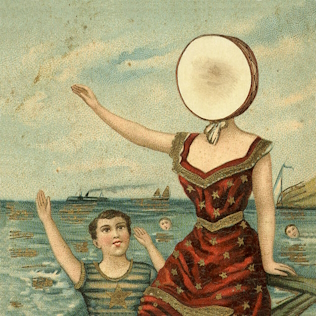
Neutral Milk Hotel’sIn The Aeroplane Over The Sea is one of the great cult records. Issued in 1998, it’s full of enigmatic lines, like “Now she’s a little boy in Spain/Playing pianos filled with flames”, and Jeff Mangum’s raw performances are enticing. In The Aeroplane Over The Sea was expected to sell around 5,000 copies, but it’s sold closer to half a million and Jeff Mangum’s influence can be heard in the next generation of indie folk bands like The Decemberists and Arcade Fire.
For the most part, the mythology around Neutral Milk Hotel has existed beyond their control. Their singer and leader, Jeff Mangum, is certainly a part-recluse, but beyond anything he’s simply a man who called it quits at the very moment his band saw their name in lights. By shunning interviews, he’s subsequently been billed as either a JD Salinger-like enigma or a modern-day Syd Barrett. These are two exaggerated interpretations, coined largely because the band, who split in 1999, have barely said a word since then.
The trouble is, they departed with a record that remains hard to explain. Unintentionally, they timed their disbandment with the rise of music-forum discussions, Neutral Milk Hotel ended just when mythology became a crucial factor in propelling a band’s reputation, and in the absence of anything to diminish them, their reputation simply just grew and grew .
That’s not to say the 1998 album that made their name, In the Aeroplane Over the Sea, isn’t a phenomenal record. Born from Mangum’s bizarre, brutally heartfelt interpretation of The Diary of Anne Frank, it shuns reality and historical interpretations for surrealist imagery, Bulgarian street music, drone sections and a lifetime’s supply of fuzz pedals.
The first release under the Neutral Milk Hotel moniker was the 1994 EP “Everything Is”, a short collection of tracks featuring Mangum. On the band’s full-length debut album “On Avery Island”, which followed shortly thereafter, Mangum was joined by childhood friend and frontman of the band Apples In Stereo Robert Schneider who contributed production and instrumentation. Upon the album’s release, the full band was formed and extensive touring began.
“In the Aeroplane Over the Sea” went on to inform the following decade’s biggest alternative breakthroughs, from Arcade Fire’s rousing collective cries to Beirut’s well-travelled spirit. You can even hear the splintering emotion mirrored on Bon Iver’s cabin-feverish debut, For Emma, Forever Ago. And the record is so crammed full of the frontman’s subtle, autobiographical references, it’s still being decoded 18 years on. By disappearing, they allowed word of mouth to set the agenda and “In the Aeroplane Over the Sea” attained the status of being the one indie record you had to hear. Mangum’s unique lyricism, combined with his reclusion, only enhanced fever around the band.
By the time the wheels came off, Neutral Milk Hotel were already enjoying cult status. One of the reasons they split is that Mangum found it hard to deal with the attention he started to get. “Jeff’s a very private person,” Bill Doss, co-founder of the Olivia Tremor Control, told the Guardian, “and kids were freaking out over him. [They’d] be following him around, these little packs of kids staring at him. It weirded him out, and he just sorta backed off.”
The first NMH albun, On Avery Island, had sold 5,000 copies. The band’s early converts were on board for life, and shows soon had the status of being emotionally overwhelming, must-see experiences. But the group still enjoyed the freedom to write and record with little-to-no expectation, sharing communal spaces in Athens, Georgia; making music with zero regard for time of day or final product.
That goes some way to explaining Mangum’s sudden reluctance to pursue the project as soon as it took off. Involved in cassette culture and DIY collectives from an early age, music was a free-spirited outlet for him. Once he realised it was not what he had imagined it to be, he decided enough was enough., in a rare interview in 2002: “I went through a period, after Aeroplane, when a lot of the basic assumptions I held about reality started crumbling. I guess I had this idea that if we all created our dream we could live happily ever after. So when so many of our dreams had come true and yet I still saw that so many of my friends were in a lot of pain … I realised I can’t just sing my way out of all this suffering.” Given how many bands today tend to press on before fading out with a whimper, his decision to go out with a bang seems admirable.
A reunion tour in 2013 did little to tarnish the Neutral Milk Hotel legacy. Proceeds went to a charity aimed at improving the lives of Mongolian children, and they weren’t billed beyond the hype in nostalgic festival headline slots. And by not caving in and releasing another record in conjunction with a tour, they helped keep things on their terms. Everyone’s accounts of the reunion shows are wildly different. Depending on who you ask, these comeback gigs were either religious experiences or bitter disappointments. But most crucially, Neutral Milk Hotel remained a source of personal investment. Every one of the band’s fans has their own epiphany, an individual account of the first time they were struck down by what they heard. By opening up these moments to a new generation, or simply those who missed the boat last time round, Mangum finally managed to hold the ropes of his band’s mythology.
The band’s never released a followup album, so their non-album material is pored over more than most. ‘Engine’ turned up on the b-side of the ‘Holland, 1945’ single. The version of ‘Holland, 1945’ was recorded in the London Underground – a train can be heard approaching at the end, and a single person clapping.
Little Feat is an American rock band formed by singer songwriter and lead vocalist and guitarist LowellGeorge and keyboard player Bill Payne in 1969 in Los Angeles. George disbanded the group due to creative differences in 1979, shortly before his death. Surviving members reformed Little Feat in 1987, remaining intermittently active to the present day.
Lowell George had met Bill Payne when playing in Frank Zappa’s Mothers Of Invention, Lowell says that Zappa fired him because “Willin'” contains drug references (“weed, whites and wine”). George often introduced the song as the reason he was asked to leave the band. On October 18th, 1975 at the Auditorium Theater in Rochester New York while introducing the song, George commented that he was asked to leave the band for “writing a song about dope”.
Zappa was instrumental in getting George and his new band a contract withWarner Bros. Records. The eponymous first album delivered to Warner Bros. was recorded mostly in August and September 1970, and was released in January 1971. When it came time to record “Willin’,” George had hurt his hand in an accident with a model airplane, so Ry Cooder sat in and played the song’s slide part. Lowell’s accident is referenced on the cover art of the band’s 1998 album Under the Radar. “Willin'” would be re-recorded with George playing slide for Little Feat’s second album Sailin’ Shoes, which was also the first Little Feat album to include cover art by Neon Park, who had painted the cover for FrankZappa’s Weasels Ripped My Flesh.
The cover shows a mural in Venice California, painted by the L. A. Fine Arts Squad in 1970 – “Venice in the Snow”.
Guitarist Jimmy Page stated Little Feat was his favorite American band
Fifty years ago, an album arrived that changed the way we hear rock music and made improvisation the test of credibility for rock bands. The album was, “Fresh Cream”. When it appeared, on December 9th, 1966, it inspired a rush of new terms, including “supergroup,” “power trio,” “jam rock,” and “drum solo.”
In ‘1966 it was all new, and all due to a band named Cream, which had formed just six months earlier. They arrived with a significant pedigree,The members from London’s early-to-mid ’60s blues and jazz scene. The bands that provided Cream’s ingredients—The Yardbirds, John Mayall’s Bluesbreakers, and the Graham Bond Organization—each had elements that suggested what the bold new band would become.
The resumes of Cream’s players, account for the first of their new catch-phrases “Supergroup”, though their previous, individual star power hardly qualified as “super.” Two of the band’s members—drummer Ginger Baker and bassist/singer Jack Bruce had far greater recognition among serious music listeners than casual pop fans. Guitarist Eric Clapton was the most renowned, for his work with both The Yardbirds and John Mayall’s Bluesbreakers. But because he ditched the former act before they scored their U.S. run of hits (like “For Your Love”), he had scant Stateside fame. Even so, the whole of the band added up to more than its parts, fueling enough buzz to birth the “supergroup” tag.
Fresh Cream featured originals like “N.S.U.,” “Dreaming,” and “Sweet Wine” plus American blues standards like Robert Johnson’s “Four Until Late” (sung by Clapton), Muddy Waters’ “Rollin’ and Tumblin’,” Willie Dixon’s “Spoonful” and Skip James’ “I’m So Glad.” Non-LP single “I Feel Free,” added to U.S. pressings of the album, would become the group’s biggest hit single in their native U.K.,
The super deluxe Fresh Cream offers three CDs and one Blu-ray Audio with a treasure trove of extras. In addition to mono and stereo mixes of the original U.K. album, the set includes a myriad of mono single and EP material (including two ultra-rare French mono EPs), seven brand-new stereo remixes of album tracks and ten unreleased outtakes, and four complete and unedited BBC session appearances in 1966 and 1967. The Blu-ray Audio features 24/96 KHz high-resolution mixes of the U.S. album running order in stereo and mono, plus U.K. album track “Spoonful” and non-LP tracks “Wrapping Paper” and “The Coffee Song,” also in stereo and mono.
This new edition is packed in a gatefold slipcase with a 64-page hardcover book featuring liner notes written by David Fricke. (The outer slipcover features the U.K. design of the album front, while the inner package features the slightly altered U.S. cover.)
Cream’s having just three players pared the sound down far enough to provide new rhythmic, and spatial, possibilities. The spareness of the instrumentation left extra room between the players, giving the music space to swing while also highlighting the contributions of each participant. The “power trio” dynamic make it easier to isolate and appreciate each star’s technique the set-up provided a generous enough platform for each player to encourage the third and fourth terms Cream presaged—”jam-rock” and the drum solo.
From their previous jazz flirtations, Cream’s players had plenty of experience with soloing. But for the new band, they brought the full expanse of jazz jamming to the chordal structures of the blues. Solos often became the focus of the song, In the process, Cream made improvisation the test of credibility for rock bands, as well as an integral part of the song rather than a mere elaboration or time-killer. The tracks’ longer lengths allowed listeners to bore further into the music, losing themselves entirely.
The band’s expansive solos mirrored the wanderings of the blissfully altered mind. Cream’s specific approach to soloing brought to rock a new density. The musicians often solo’d at the same time, allowing Bruce’s bossy bass line to wend in one direction while Clapton’s wild guitar wandered in another. The result created as many complex and exciting interactions as messy and indulgent ones. While Clapton later denounced Cream’s “all-at-once” approach as a result of sloppiness and ego, in fact it gave the band a sense of tension and dimensionality that remains unparalleled. Cream’s solo-centric style found its clearest expression in the drum cadenza, created by Baker for the instrumental track Toad. Ginger Baker infused his work with more freedom and complexity. After hearing “Toad,” every serious drummer in rock pined for a showcase, inspiring drum breaks ranging from the cogent (Led Zeppelin’s John Bonham in Moby Dick) to the clunky (Ron Bushy in Iron Butterfly’s In-A-Gadda-Da-Vida). Eventually, this led to 15 minute live smack-downs which did more to pack concert hall bathrooms than did the beer its patrons quaffed. Cream themselves indulged “Toad” to a greater degree on their 1968, half-live double set Wheels of Fire. It boasted a sixteen minute-plus elaboration of the song, hogging an entire side. If “Wheels” found the band in full jam-band mode, “Fresh Cream” presented a more tentative, and terse, manifestation of that mission. Like many debut works, it was more about potential than fulfillment. The lengths of the songs remained clipped by the band’s later standards. Only two tracks exceeded the five minute mark. The longest, Spoonful, offered a six and a half minute riff on Willie Dixon’s blues classic, starring Clapton’s shimmering dips and dives.
Other songs seem unformed, like the meandering waltz Dreaming, the campy bauble Wrapping Paper (included on international editions) or the indifferent run at Robert Johnson’s Four Until Late.
At the same time, the album’s opening track, I Feel Free, idealized Cream’s deliverance from the bonds of their previous bands. In the process, songs like the flamboyant N.S.U., or the swaggering Sleepy Time Time, provided a blueprint for all ’60s psychedelic blues-rock bands to come. ‘Fresh Cream’ became the test-run for groups as seminal as The Jimi Hendrix Experience, the Jeff Beck Group and Led Zeppelin.
Cream itself would go on to create more fully realized works, like 1967’s Disraeli Gears, which perfected their flower-power pop side, or the aforementioned ‘Wheels of Fire,’ which captured them in their full frenzy. But before all that came ‘Fresh,’ a work which forever changed rock’s sound, configuration, vocabulary and goals.
The Kinks had a rocky romance with the U.S. After the band’s initial burst of fame in the mid-’60s, they were banned from touring in the States for four years, due to “rowdy” performances. In the ensuing years, the group’s popularity dwindled across the U.S. Audiences struggled to connect with the band’s often specifically English subject matter, and the Kinks couldn’t help matters by promoting their music in concert.
The situation turned after the ban ended in 1969, and the Kinks toured and scored their first U.S. hit in years with “Lola” in 1970. Although they soon got dumped from Reprise Records, they were rescued by RCA, who gave the Kinks a big contract and a $1 million advance.
Things were looking up for the Kinks, although frontman Ray Davies couldn’t say the same about Britain. He was dismayed at his country’s political status and bothered by the sense of history that was being lost as new subdivisions were destroying old neighborhoods. Davies witnessed this trend in the northern London suburbs, near MuswellHill, where he and his family, including brother and Kinks guitarist Dave Davies, had grown up.
“It’s just very disturbing to see this happen,” Ray told Circus Magazine in 1972. “They’re knocking down all the places in Holloway and Islington and moving all the people off to housing projects in new towns.”
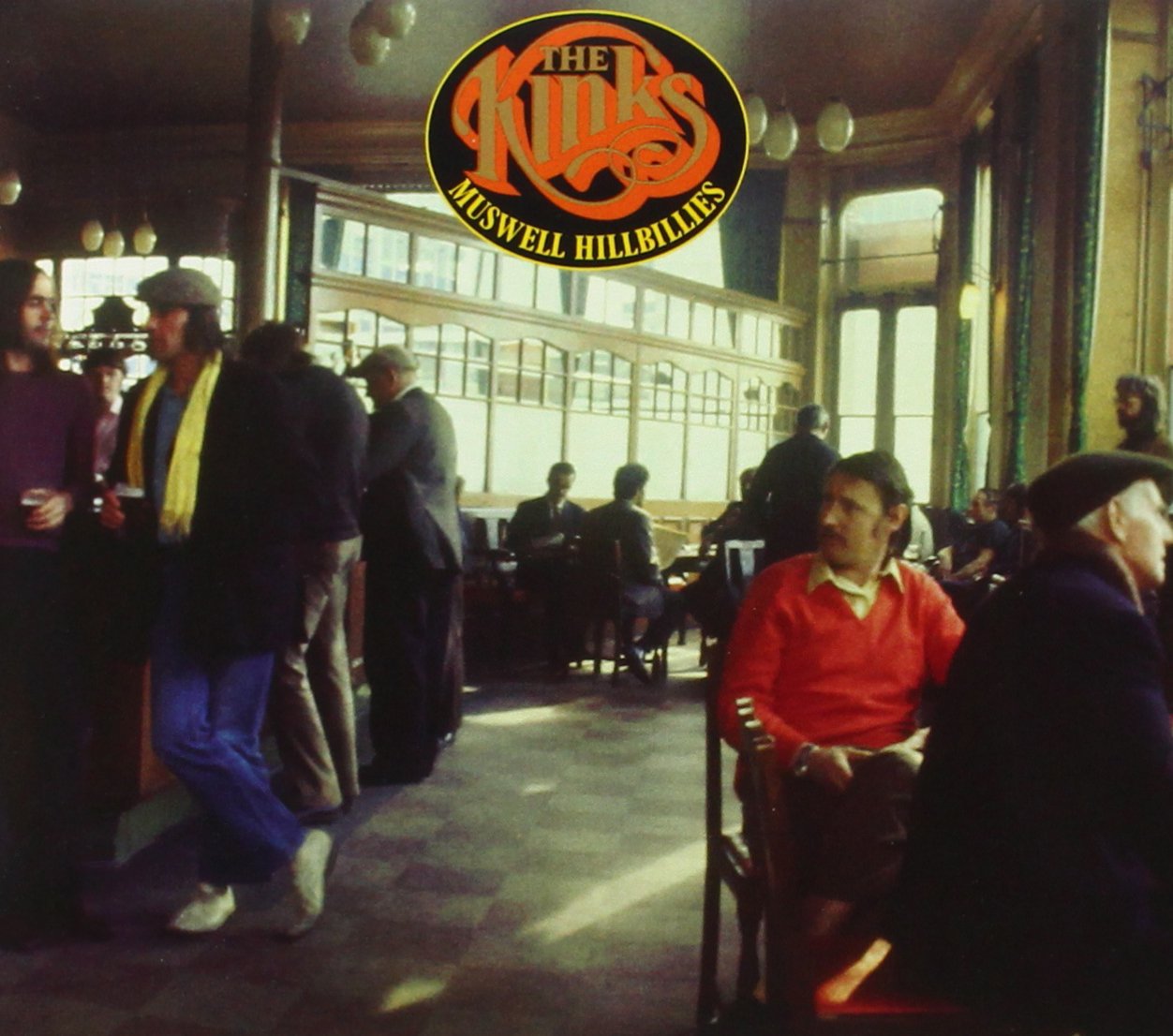
The songwriter decided to let his anger and sadness fuel the Kinks’ first RCA album, Muswell Hillbillies. As the title suggests, RayDavies conceived the record as a mix of British social commentary and rustic American music styles, including country and bluegrass. He perceived a connection between the music of the downtrodden in the U.S. and the marginalized working class in the U.K. “Muswell Hillbillies was about real people, real characters in the Davies family,” Dave remembered to Express in 2014. “Ray and I have always been great fans of the likes of Hank Williams and American country music, so [the album] gave us an opportunity to marry up the [idea] of Cockney families moving out to the suburbs and relating it to country music.”
Acoustic instruments, slide guitar, country beats and outdated equipment became the hallmarks of the Kinks’ new album. Lead single “20th Century Man” began with strummed acoustic guitar before turning into a country rock song in which the nostalgic Ray wondered about his place in modern life. “Here Come the People in Grey” matched a bucolic boogie-woogie with a story about government overreach. The song had its roots in the Davies brothers’ grandmother’s living situation.
“My gran used to live in Islington in this really nice old house, and they moved her to a block of flats, and she hasn’t got a bath now. She’s got a shower because there isn’t room for a bath,” Ray said in 1972. “And like she’s 90 years old, she can’t even get out of the chair let alone stand in the shower. … It’s just a lack of consideration for people. The government people think they are taking them into a wonderful new world but it’s just destroying people.”
Other family and neighborhood friends made appearances in other songs, from Uncle Son (who died from tuberculosis after doing outside labor for the government) to Rosie Rooke (a neighborhood fixture who symbolized a form of excitement for the young musicians). Davies found a way to tie Britain and America, thematically, on the sparse “Oklahoma U.S.A.” On the accordion-drenched tune, he sings of a poor English woman who finds joy in Hollywood escapism and the musical Oklahoma!
On the album’s closing title track, Davies sings of the American music and iconography that inspired him and so many of his fellow British rockers. Over glistening guitar, he declares: “My heart lies in old West Virginia / Never seen New Orleans, Oklahoma, Tennessee / Still I dream of the Black Hills that I ain’t never seen.” While many of Davies’ contemporaries got to see the U.S. on repeated tours, Davies felt he was kept at arm’s length from a country that interested him so much.
“I think a part of me always felt like I should have been brought up in Appalachia,” he admitted to The Guardian in 2013. “People associate me with north London, but I always felt a bit surprised to have been born here somehow. We had this strange thing that because we were banned, there was literally no way of us engaging with America. … I took the ban very personally.” The Muswell Hillbilies album was released on November. 24th, 1971. Although critics reacted favorably to the album, it wasn’t a big hit on either side of the Atlantic (especially in contrast to Lola Versus Powerman and theMoneygoround, Part One). Over the decades, it has become a well-respected entry in the Kinks’ chronology, with some even terming it the band’s last great album. When doing press for a deluxe re-release of the LP in 2014, both Davies brothers highlighted the album as one of their favourites, largely because of how it altered the Kinks’ musical perspective. “Muswell Hillbillies, because of its transformation of the group, was a fine record,” Ray said.







 The Fat Angel Sings