Bruce Springsteen will make his Broadway debut this fall with “Springsteen on Broadway,” a solo show at the Walter Kerr Theatre. Performances begin Tuesday, October 3rd, with an official opening on Thursday, October 12th. Springsteen will perform five shows a week through November 26th.
OCTOBER
3-7, 10-11 & 13-14, 17-21, 24-28, 31
NOVEMBER
1-4, 7-11, 14-18, 21-22 & 24-26
Springsteen on Broadway is a solo acoustic performance written and performed by Bruce Springsteen under the lights of Broadway. It is an intimate night with Bruce, his guitar, a piano, and his stories.
Tickets for “Springsteen on Broadway” will go on sale August 30th at 10am ET exclusively through Ticketmaster Verified Fan®. This unique fan-first technology levels the playing field to combat bots and get real tickets into the hands of fans who intend to go to the event.
“I wanted to do some shows that were as personal and as intimate as possible. I chose Broadway for this project because it has the beautiful old theaters which seemed like the right setting for what I have in mind. In fact, with one or two exceptions, the 960 seats of the Walter Kerr Theatre is probably the smallest venue I’ve played in the last 40 years. My show is just me, the guitar, the piano and the words and music. Some of the show is spoken, some of it is sung. It loosely follows the arc of my life and my work. All of it together is in pursuit of my constant goal to provide an entertaining evening and to communicate something of value,” says Springsteen.
“Bruce Springsteen is one of our greatest musical storytellers, and Broadway is built on a beloved tradition of musical storytelling. What a once-in-a lifetime thrill for all of us at Jujamcyn to welcome Bruce home to his rightful place in the Broadway legacy,” says Jordan Roth, President of Jujamcyn Theaters, which owns the Walter Kerr.
The creative team for “Springsteen on Broadway” includes Heather Wolensky (scenic design), Natasha Katz (lighting design) and Brian Ronan (sound design).
Bruce Springsteen’s recording career spans over 40 years, beginning with 1973’s ‘Greetings from Asbury Park, NJ’ (Columbia Records). He has released 18 studio albums, garnered 20 Grammys, won an Oscar, been inducted into the Rock and Roll Hall of Fame, received a Kennedy Center Honor, and was MusiCares’ 2013 Person of the Year. Springsteen’s memoir ‘Born to Run’ (Simon & Schuster) and its companion album ‘Chapter and Verse’ were released in September 2016, and he was awarded the Presidential Medal of Freedom in November last year. Springsteen’s The River Tour 2016 was named the year’s top global tour by both Billboard and Pollstar. ‘Born to Run’ will be issued in paperback by Simon & Schuster on September 5th.
I think it’s fair to say that Bruce Springsteen tends to get covered more by men than by women. But that doesn’t mean that there haven’t been some great covers by female artists over the years. Indeed, some of the biggest hit Springsteen covers just think of the Pointer Sisters’ “Fire” and Natalie Cole’s “Pink Cadillac” .
Joan Jett, who sang the title song in the 1987 movie “Light of Day,” having been selected for induction to the Rock and Roll Hall of Fame this year, and with this year’s Light Of Day festival , it seemed like a good time to take a look at some memorable Springsteen covers by women.
TORI AMOS:“I’m on Fire”
In the mid-90s, Amos performed this song on the VH1 series, “Crossroads,”
NICOLE ATKINS:“Dancing in the Dark” Springsteen’s fellow Monmouth County native recorded a moody, atmospheric “Dancing in the Dark” for last year’s Dead Mans Town album, which paid to the songs of Springsteen’s Born in the USA.
NATALIE COLE: “Pink Cadillac”
The Born in the USAB-Side became a Top 10 hit for Cole in 1988.
MELISSA ETHERIDGE: “Born to Run” Etheridge, who has often spoken about Springsteen’s influence on her, turned in a memorable performance of Springsteen’s anthem, with the Boss himself watching, when he was presented with a Kennedy Center Honor in 2009
EVERYTHING BUT THE GIRL:“Tougher Than the Rest”
From the British duo’s often-revelatory 1992 album, “Acoustic.”
PATTY GRIFFIN:“Stolen Car”
From her 2002 album, “1000 Kisses.”
THE POINTER SISTERS: “Fire”
The group had one of the biggest hits of its career with this sultry song — which Springsteen has said he wrote with hopes that Elvis Presley would record it — in 1978.
DONNA SUMMER:“Protection”
This tense, gritty tune sounds like it could have been a Springsteen classic if he had sung it himself, but he never has (or, if he has, he’s never released it). Summer released it on her self-titled 1982 album, which was produced by Quincy Jones.
TRISHA YEARWOOD:“Sad Eyes”
Country artists have long had an affinity for Springsteen’s heartfelt ballads. Yearwood included this stellar version of “Sad Eyes” — from Springsteen’s 1998 rarities boxed set, Tracks — on her 2000 album, Real LiveWoman.
I’m so excited to share the first taste of Jonathan Rado from the band Foxygen full album cover of BruceSpringsteen’s legendary 1975 LP Born to Run, Its the second release from the specialist Sounds Delicious .
It’s a sprawling, springy jam and we think Rado has nailed it. The song premiered earlier this week. Here is what Rado had to say about covering The Boss:
“I’m recording ‘Born to Run’ by the Boss, one of my favorite records of all time – also one of the highest grossing records of all time. I’ve always wondered though, what it would sound like if Bruce had recorded this deep into his ‘Nebraska’ home-recording phase. Like, what would it sound like if he made ‘Born to Run’ at home & played all the instruments? I’m gearing up to find out (on this week’s diners drive-ins and dives).”
This second release follows Yumi Zoumas widely praised cover album of UK Brit pop band Oasis “Whats The Story Morning Glory (which is officially sold out). The record received accolades from many bloggers and more. Here are a few of my favorite quotes about the album: (from critics and members!)
“This first Sounds Delicious release arrived today and has left me feeling humbled and amazed […] I just realized this made me a thousand times more excited about having backed this on Kickstarter in the first place, as I suspect there will be more nice surprises in store that hit me in ways I’d never expect.” .
It’s been such a thrill to see the records making their way into backers’ and members’ hands. Please continue to tag your pics #turntablekitchen and #soundsdelicious.
This release is exclusive toSOUNDS DELICIOUS and vinyl-only (although the record includes a digital download of the album) – so the only way to get a copy is by joining the club. If the Yumi Zouma (which sold out less than a week after we started shipping it) is any indication, this one will go fast.
Bruce Springsteen has unleashed his first archival live release of the year, with the rocker focusing on a rarities-filled St. Louis gig from 2008. The August 23rd, 2008 concert, recorded in the midst of the E Street Band’s tour in support of “Magic”, featured Springsteen and company performing some songs for the first time in decades thanks to sign requests in the audience. On the 2007-08 Magic tour, fans began bringing song-request signs. Bruce seemed to revel in the challenge, while the suggestions also appeared to inspire him to resurrect songs he hadn’t played in decades.
These include the band’s renditions of the Crystals’ “Then He Kissed Me” and Harold Dorman’s “Mountain ofLove,” which hadn’t been performed by Springsteen and the E Street Band since 1975.
Springsteen also delivered his seldom-performed cover of Chuck Berry’s “Little Queenie” in the encore; the St. Louis gig in 2008 marked the first time since 2002 that Springsteen played that track live, as well as the last time the E Street Band has whipped it out in concert.
There’s no finer show to capture this fan-artist dynamic than this outstanding performance in St. Louis on 23/08/2008 including the surprise opener of The Crystals’ Then She Kissed Me and Chuck Berry’s Little Queenie during the encore. In addition to those two covers, Springsteen also aired out rarely-played-these-days songs like “Rendezvous,” “For You,” “Drive All Night” “Detroit Medley” and Harold Dorman’s “Mountain of Love,” which he hadn’t performed since a New Year’s Eve concert at Philadelphia’s Tower Theater in 1975.
Check out Springsteen’slive archive site for full track list and download information. Physical copies of Scottrade Center, St. Louis, 8/23/08 will ship May 1st.
In November, the Springsteen archives bought a Buffalo 2009 Concert that featured a full album performance of Greetings From Asbury Park, N.J. as well as the last time saxophonist Clarence Clemons played with theE Street Band before his June 2011 death. 2016 also saw the official release of Bruce Springsteen’s famed Christic shows a pair of solo concerts recorded in Los Angeles in November 1990.
This marks the first archival concert from Springsteen this year. Shortly before Christmas, he gave an official release to his November. 22nd, 2009 concert from the HSBC Arena in Buffalo, N.Y. It contained the only full-album performance of his debut, Greetings From Asbury Park, N.J.,
Four and a half years to follow-up 1987’s Tunnel Of Love, Bruce Springsteen made up for it with a grand gesture, releasing “Human Touch” and “Lucky Town” on the same day: March 31st, 1992.
As the Tunnel Of Love Express Tour reached Europe in the summer of 1988, it was reported that Springsteen who had mostly been successful at keeping his personal life out of the tabloids was having an affair with vocalist and band member Patti Scialfa and had separated from wife, Julianne Phillips.
A year after participating in Amnesty International’s Human Rights Tour , he fired the E.Street Band, and he and Scialfa left New Jersey for Los Angeles, where they got married less than a year after the birth of their first child. The only music heard from Springsteen during this time was a pair of solo acoustic benefit shows for the Christic Institute, where he debuted six songs over the two nights.
The slick professionalism of Human Touch meant that the best songs had to fight to be heard. “Real World” worked better when performed solo on piano at the Christic concerts, where it and “Roll of the Dice” turned into shouting matches with singer Sam Moore (from R&B greats Sam & Dave). “Man’s Job” and “I Wish I WereBlind,” the former a solid slice of pop-soul and the latter a paranoid ballad, found Springsteen effectively channeling icon Roy Orbison , both in vocals and songwriting, for the first time in years.
But the overall fault of Human Touch lies with Springsteen, who created his most inconsistent batch of songs to date. “57 Channels (And Nothin’ On)” worked fine as a silly rockabilly tune at the Christic dates, but faltered when placed third in the album sequence (especially with an over-serious arrangement). “Cross My Heart,” “Gloria’sEyes” and “The Long Goodbye” are nondescript. And there’s no excuse for the travesty of “Real Man.”
Springsteen fared much better on Lucky Town. As the story goes, he was trying to find one last song to complete Human Touch, and wound up writing an entire new album’s worth of songs that reflected his newfound happiness. But rather than remove Human Touch’s weakest moments and replace them with the best of the new material, Springsteen decided to put out two separate albums.
Lucky Town succeeded in every place Human Touch had failed. Playing nearly all the instruments himself, except for drums (which were supplied by Gary Mallaber), Springsteen has rarely sounded looser on record, particularly on the opener “Better Days” and “Local Hero,” a surprisingly wry comment on fame. The ballads felt more personal too, with “If I Should Fall Behind,” “My Beautiful Reward” and “Living Proof” reportedly the song that he was originally targeted for Human Touch — serving as moving statements of hard-earned love and domestic bliss. Its prime flaws are the tunes where Springsteen interrupts the mood with social commentary, like on “The Big Muddy” and “Souls of the Departed.”
Even though they arrived on the same day, fans gravitated toward Human Touch because of its title track, a Top 20 hit that included “Better Days” on its B-side.
A world tour, with Bittan and Scialfa on board, followed. Since then, Springsteen has rarely performed the songs from those records, though “If I Should Fall Behind” was played regularly on the 1999-2000 reunion tour with the E Street Band and during the 2006 Seeger Sessions tour.
Lucky Town also released on March 31st, 1992, a more middling collection of E Street-less tunes that is often considered Springsteen’s worst effort. (Human Touch is often considered the ninth album because it was recorded first; but since they were put out on the same day, it’s fair game to consider one or the other the “ninth.”)
Despite getting mostly positive reviews, Lucky Town is overlooked by Bruce himself, getting barely a mention in his biography Born to Run. Songs from the album have received few live performances since the E Street Band reunited in 1999.
Among the likeliest explanations for Lucky Town’s obscurity among Springsteen fans are that it was his first post-E Street Band record; that the only E Street band members present on the record were Patti Scialfa and keyboardist Roy Bittan; perhaps most of all, that the autobiographical LP was too goddamn happy.
Sure, it may not have the bubbling social and emotional angst or operatics of his classics, but Lucky Town represented a refreshing and momentous change of pace for Springsteen. As a married man now with two kids (and a third one coming a few years later), a more domestic Bruce here demonstrated a truly profound understanding of the double-edged power of love: its life-changing magic and the ever-present fear of losing it.
The album opens with the snare-shot of its best track and lead single “Better Days,” a pristine rock spiritual about Bruce’s own redemption through his love for Patti. (She appears prominently in the song, singing shimmering, gospel-like backup vocals along with Lisa Lowell and future E Street fixture Soozie Tyrell.)
Even though the lyrics are tender and introspective, Springsteen sings with a ferocity that sounds at times like a raging shout the guitars and drums growl with intensity and the bass provided by a then-little-known sessions musician named Randy Jackson tosses and turns like it’s about to come off the rails.
And yet, this is unequivocally a love song. “These are better days, baby / There’s better days shining through,” he sings in the irresistible chorus. “These are better days, baby / Better days with a girl like you.”
Following that is the album’s title track and fourth single “Lucky Town,” about the redemptive power of tearing down loose ends to rebuild your life. The song stood as a straight-shooting pop tune about reclamation. “When it comes to luck, you make your own,” he drawls in the final verse. “Tonight I got dirt on my hands but I’m building me a new home.”
“Local Hero,” the third track, churns along like a stadium-shaking heartland rocker, but is, perhaps ironically, a clever commentary on Springsteen’s discomfort with his own celebrity status. He tells the story of seeing a portrait of himself at a local store and the brief alienation from his true self that results. And once again, he sings about being redeemed from that darkness by the humility and grace of those closest to him.
Of all the songs from Lucky Town, the one that has experienced the longest shelf life is “If I Should Fall Behind,” a heartrending ballad about the core promise of devoted relationships: when one person falls behind, the other person shall lift them up. The gorgeous lyrics read like that of a folk standard: “Now there’s a beautiful river in the valley ahead / There ‘neath the oak’s bough, soon we will be wed / Should we lose each other in the shadow of the evening trees / I’ll wait for you / Should I fall behind / Wait for me.”
As a master of peaks and valleys, Springsteen placed directly after “If I Should Fall Behind” the audaciously jangly pop song “Leap of Faith.” Going beyond the redemptive power of love explored on the rest of the album, here Bruce tackles the redemptive power of sex and… the female anatomy.
“Now your legs were heaven / Your breasts were the altar / Your body was the holy land,” he croons. “You shouted ‘jump’ but my heart faltered / You laughed and said ‘Baby, don’t you understand?’”
Taking it up a notch in the bridge, Springsteen delivers a slightly provocative metaphor about doing the nasty: “Now you were the Red Sea / I was Moses / I kissed you and slipped into a bed of roses / The waters parted and love rushed inside / I was Jesus’ son, yeah, sanctified.”
While maintaining the up-tempo vibe of the album’s first five tracks, the back half dwells upon the aforementioned flip-side of everlasting love: its fragility.
On “The Big Muddy,” Bruce tackles lust and greed as love’s own Achilles’ heel. “Waist deep in the big muddy,” he howls in the chorus, “How beautiful the river flows and the birds they sing,” he juxtaposes with an admission of imperfection: “But you and I we’re messier things.”
Remove the synth and polished production, and throw in the hiss of a 4-track cassette recorder, and “The Big Muddy” could easily have fit on Nebraska alongside such stark examinations of flawed human nature as “State Trooper” or “Highway Patrolman.”
Similarly, the album’s penultimate track, “Souls of the Departed,” takes on darker subject matter near and dear to Springsteen’s heart: the wars both at home and in the desert abroad. As a spiritual successor to “Born in the U.S.A,” the song is a snarling piece of social commentary that weaves between lamenting the Gulf War and the senseless violence taking place in Compton, just miles from his then-mansion in the Hollywood Hills.
In one of the final verses, Springsteen neatly reflects upon his own life to tie this anti-war song back to the album’s dominant theme of love as a double-edged sword. “Tonight as I tuck my own son in bed,” he intones, “All I can think of is what if it would’ve been him instead / I want to build me a wall so high nothing can burn it down / Right here on my own piece of dirty ground.”
Further contemplating his high-society standing and the innate fear that it could all come crumbling down, Springsteen confesses on “My Beautiful Reward,” the album’s closer, how he “sought gold and diamond rings, my own drug to ease the pain that living brings.” He hints at a feeling of imposter syndrome—that his success and fame belie the truth that he’s really just like “a drunk on a barroom floor”—but is lifted up to the sky, taking on the body of a soaring bird, because of his understanding wife’s love.
But the album’s back half is bolstered the most by “Living Proof,” the song that spawned this entire album. During the Human Touch sessions, Springsteen felt moved to write this song about his first child Evan’s birth
Continuing the stomping rock ‘n’ roll and near-shouted vocals of “Better Days,” the song juxtaposes the angst of knowing deep down he’s a troubled, self-destructive man with the sheer beauty of “this boy sleepin’ in our bed.” He commends Patti for how she “shot through my anger and rage / To show me my prison was just an open cage / There were no keys, no guards / Just one frightened man and some old shadows for bars.”
The truth is, putting aside the fact that most of its songs were perhaps too earnestly autobiographical for his audience at the time, Lucky Town is in some ways no different than many of Bruce’s classic full-lengths.
Shouldn’t Lucky Town be appreciated at least half as much, or have its songs performed live more often?
Wrecking Ball is the seventeenth studio album by American recording artist Bruce Springsteen, released March 5th, 2012, on Columbia Records . It was named best album of 2012 by Rolling Stone Magazine and along with the album’s first single, “We Take Care Of Our Own” which was nominated for three Grammy Awards.
Around the time of the 2008 economic collapse, Springsteen was working on a gospel music album. When he found that particular style of music didn’t suit his anger and frustration regarding what he was hearing in the news, and seeing happen to friends and relatives, he scrapped the entire record and started over.
The Boss began to write what started as “folk songs” about the current state of America and what he perceived as inequality, corruption and a lack of care. As a songwriter, Springsteen was about as angry as he’d ever been.
“You can never go wrong pissed off in rock ’n’ roll. The first half of [the album], particularly, is very angry,” Springsteen told a group of reportersin 2012, the year’s of the record’s release. “The genesis of the record was after 2008, when we had the huge financial crisis in the States, and there was really no accountability for years and years. People lost their homes, and I had friends who were losing their homes, and nobody went to jail. Nobody was responsible.”
Springsteen wrote “We Take Care of Our Own” as a question that could “gauge the distance between American reality and the American dream.” He penned “Easy Money” about a street thief taking inspiration from the crooks on Wall Street. He came up with “Death to My Hometown” about the havoc that was wreaked on the working class – not by wars or tyrants, but by greed.
As the new album began to take shape, Springsteen mostly eschewed the E.Street Band for the assistance of producer Ron Aniello, who helped flesh out the songs into bigger arrangements. Aniello brought some more contemporary touches – loops, hip-hop affectations – to Springsteen’s classic sound, although the tracks also included country influences, Irish folk constructs, gospel tinges and bedrock arena bombast. The diversity of sound wasn’t an accident, but something meaningful to Springsteen.
the only E Street Band members to appear on the album are Clemons, Steve Van Zandt, Max Weinberg , and Patti Scialtha. Patti Scialfa adjunct members Charlie Giordano and Soozie Tyrell are also heavily featured. The album features members of the Sessions Band including the horn section, and special guest appearances by Tom Morello and Matt Chamberlain .
“If you listen to the record, I use a lot of folk music. There’s some Civil War music. There’s gospel music,” he said of Wrecking Ball. “There are ’30s horns in ‘Jack of All Trades.’ That’s the way I used the music – the idea was that the music was going to contextualize historically that this has happened before: it happened in the 1970s, it happened in the ’30s, it happened in the 1800s … it’s cyclical. Over, and over, and over, and over again. So I try to pick up some of the continuity and the historical resonance through the music.”
Springsteen also brought in some songs he had previously written, because they fit the theme. “Wrecking Ball” was written for E Street’s final performances at Giants Stadium, but “Come on and take your best shot / Let me see what you’ve got / Bring on your wrecking ball” seemed to resonate with his idea of a resilient America. The song embodied a certain spirit and it gave the new album its title.
He also employed “Land of Hope and Dreams,” a tune Springsteen originally wrote for the E Street Band reunion tour in the late ’90s. Although the song had appeared on a live album, it had never shown up in a studio version.
“I wrote it before the tour as the band’s current manifesto. In other words, we have stood for these things in the past. This is our current statement of how we will try to stand for these things in the future,” said Springsteen , suggesting the song had roots in the past but also looked to the future. “It’s the train that keeps going when I’m gone, and when your music and these times are just a memory. … These ideas are something that I wanted at the end of this record.”
“Land of Hope and Dreams” also packed an emotional punch. It features a saxophone solo by Clarence Clemons the founding E Street Band member who had died the previous year. Other E Streeters like Steve Van Zandt and Max Weinberg and Patti Scialfa also contributed to what was mostly a Springsteen solo record.
Wrecking Ball, was Springsteen’s 17th studio album, was released on March 6th, 2012, and hit No. 1 in many countries around the world, including the U.S., the U.K. and New Zealand. The record earned mostly positive reviews in the music press, with many writers praising Springsteen’s passion, anger and musical versatility. The man himself saw the album as another installment in a decades-long “conversation” with listeners.
“The only thing I do keep in mind is that I’m in the midst of a lifetime conversation with my audience, and I’m trying to keep track of that conversation,” Springsteen said. “So if the artist loses track of the conversation he’s having with his audience, he may lose us forever. So I try to keep track of that conversation, while giving myself the musical freedom I need.”
January 24th, 2017. Live @ BBC Radio 6 Music.Ryan Adams perform a beautiful cover of Bruce Springsteen’s classic “Streets Of Philadelphia”.
The timing of the release of Adams’ cover is particularly apt, given that the 89th Academy Awards took place in LA on Sunday. The cover was recently recorded as part of BBC Radio 6 Music’s upcoming celebration of the year 1994 – which will be broadcast on Friday (March 3) – with Adams taking on Springsteen’s track from the Oscar-winning film Philadelphia, which although released in 1993 won the Oscar for Best Original Song at the 1994 ceremony.
Ahead of 6 Music Celebrates 1994 on Friday March 3rd, Ryan Adams performed an exclusive cover of the Bruce Springsteen 1994 classic Streets Of Philadelphia for Lauren Laverne in the 6 Music Live Room.
When it comes to our favorite musicians, it often seems like we know them inside and out. We analyze the meanings in their lyrics, pore over their interviews, and connect with their souls while listening to their songs. But what’s illuminated in the limelight never shows the whole picture.
The antics, accidental stage dives, and autobiographical lyrics of singer-songwriter Warren Zevon told fans a story—but certainly not the whole story. Here are seven little-known facts about the Excitable Boy.
Before they got big, Warren lived with Fleetwood Mac stars Stevie Nicks and Lindsay Buckingham in the 1970s. The two also appeared, along with Mick Fleetwood, on Zevon’s 1976 self-titled album.
Warren was diagnosed with pleural mesothelioma, a cancer caused by exposure to asbestos. It’s never been clear where Warren was exposed—it could have been on a job in his younger years, in his dad’s Arizona carpet shop
Warren’s only Grammy awards of his 30-year career came after his death. His final album, The Wind, won best Contemporary Folk Album at the 2004 Grammy awards, and “Disorder in the House,” a duet with BruceSpringsteen from the album, called won Best Rock Performance by a Duo or Rock Group. Warren’s son Jordan received the awards for his father.
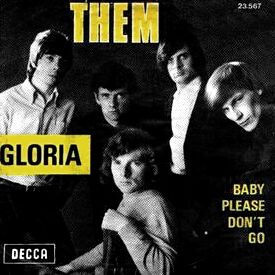
The song “Gloria” is built on just three chords that any garage band can play and that almost every garage band has. Yet the list of artists who have covered this tune include many bands Jimi Hendrix, the Doors, Patti Smith, Tom Petty, David Bowie, R.E.M., Iggy Pop, U2, Bruce Springsteen, Elvis Costello..even. Bill Murray strapped on a guitar and played it at Eric Clapton’s Crossroads Festival, the Grateful Dead used to jam on it, and it might be the only song that Jon Bon Jovi and Johnny Thunders have in common.
How has such a minimal song have had such a huge impact? Why does it still reverberate today, in arenas, at festivals, in bars and studios? And how did Gloria become such a resilient classic rock tune. Written more than fifty years ago by Van Morrison for his band Them , the story the song tells couldn’t be more archetypal: the singer (usually but not always male) knows this girl and he’s eager to tell us about her, but he doesn’t share much in the way of detail. She comes down the street, up to a room, knocks on a door, enters, makes the singer extremely happy.
She is, nearly all the time, about five feet, four inches tall (on the original demo, she was five feet). As physical descriptions go, that’s at once very specific and very incomplete. Dark-haired or light, curvy or slender, who knows? At just about midnight, she appears. There is, we can assume, something sensual about the way she moves, because the song itself slithers with an air of hypnotic mystery, those three chords (E-D-A) setting the scene.
The Shadows of Knight, version clocked in at a tidy two and a half minutes, but that was too constricting for other groups like the Hangmen, the Blues Magoos, and the Amboy Dukes, all of whom easily exceeded the five-minute mark and turned it into early psychedelic-rock classic.
On the debut studio recording by Them, Van Morrison takes the listener into his confidence, and it’s a little like bragging, He wants to tell us about his baby (on the demo, she’s his “gal”), but aside from her head-to-the-ground measurement, he doesn’t tell us much more. She makes him feel good. Also for some reason, he feels compelled to spell out her name before he says it, “G-L-O-R-I-A,” as though it were something exotic or complicated. so she does whatever she does with Van, and instead of describing what that might be, he spells her name out again. He wants to make sure we get that name right, This woman who’s about five feet, four inches, and her name is G-L-O-R-I-A.
“Gloria” was cut at Decca’s studio in West Hempstead in the summer of 1964, the first Them session. Them had been doing the song live for a while in Ireland clubs, but from all reports, they were not the most adept musicians in the studio, so the producer brought in some ringers, and here’s where the saga of “Gloria” gets a little fuzzy. It’s pretty clear from the audio evidence—compare the demo’s sluggish drumming to the finished studio version—that London’s top session drummer Bobby Graham was recruited. Graham told an interviewer for the Independent that Morrison “was really hostile as he didn’t want session men at his recordings. He calmed down but he didn’t like it.” In addition to Graham, The guitar playing was none other than Jimmy Page , Page: “It was very embarrassing on the Them sessions. With each song, another member of the band would be replaced by a session player…Talk about daggers! You’d be sitting there, wishing you hadn’t been booked.”
There’s something so compelling about the record, the rawness, the sudden startling instrumental leap midway through, Morrison’s intensity, the erotic momentum, the flurry of drums at the end. It was the sexiest thing. And it was stuck on a B-side, It was the flip side of Them’s second U.K. single “Baby Please Don’t Go” In England, “Baby Please Don’t Go” charted at numer 10. In America, it was released on Parrot Records, But it was “Gloria” that got a bit of attention, it was like that with “Gloria” it wasn’t a hit, but all around the world, local bands who discovered it found a Holy Grail. How many group rehearsals everywhere began with “Let’s try ‘Gloria’?” If you hadn’t been playing guitar for very long, this was an instant entry-level classic, and if you were playing gigs and didn’t have many songs in your live arsenal, you could stretch out on “Gloria” for a while, just keep that going. If you had a kid on Vox organ in your combo, it sounded even better.
Part of the brilliance of “Gloria” is in its vagueness and ambiguity. It feels explicit, but that’s a trick. The whole song is an ellipsis. Gloria the object of desire, someone who makes it all so easy: she comes up to your room, raps at your door (at a Bottom Line gig years ago, T Bone Burnett compared her knock to the drum beat of Al Jackson Jr. from the M.G.’s), no pining, no scheming. we don’t know if Gloria’s night ends satisfactorily.) The narrative is a sketch, but over the years, some of its interpreters have felt compelled to flesh it out. Leave it to Jim Morrison or JimiHendrix to make the goings-on considerably more graphic. It was a part of the Doors’s set since their early days on the L.A. club circuit (you can hear how the dynamics of “Gloria” got appropriated for the “Light My Fire” climax, the American Morrison went much further in his on-stage embellishments, some of which came out officially on posthumous Doors releases. He addresses Gloria directly, and sometimes there’s a predatory creepiness: “Meet me at the graveyard, meet me after school.” On one released version, he yells, “Here she is in my room, oh boy!” and for nine minutes it’s like a cautionary after-school special: her dad is at work, her mom is out shopping, and he’s giving her instruction: “Wrap your legs around my neck/Wrap your arms around my feet/Wrap your hair around my skin.” He continues “Hey, what’s your name, how old are you, where’d you go to school?” What’s her name? Is he missing the whole point of this song? here.
Not to be outdone, Jimi Hendrix, on a slamming off the cuff version with the Experience from October 1968, also asks her name she replies (he says), “It don’t make no difference anyway…You can call me Gloria.” Is she a call girl? (That would explain the midnight knocking.) A groupie? More likely. Hendrix mentions that Mitch Mitchell and Noel Redding also have “Gloria”s, and there is some kind of “scene” going on that involves the arrival of a pot dealer and, subsequently, the police. “Gloria, get off my chest,” Jimi says. “We gotta get out of here.” Meanwhile, he’s playing some amazing guitar, and Mitchell is just on fire, and the song is a long way from its beginnings with Them.
The song still belonged to Van Morrison, who has had a notoriously ambivalent relationship with some of his earlier hits, but he has almost always stuck with “Gloria” it’s on his landmark live album “Its Too Late To Stop Now”, and he’s revisited it over and over through the years, on record with John Lee Hooker, live with U2 (who not only have done Morrison’s version, but wrote their own song called “Gloria”) and Elvis Costello, on TV with Jools Holland’s big band. But in 1975, Patti Smith found a way to radically reinterpret it by incorporating it into the lead track from her debut album “Horses”. The cut is in two parts, the first part “In Excelsis Deo” starts off with a stark statement of intent “Jesus died for somebody’s sins, but not mine” and keeps building and building until Smith through a window, sees a “sweet young thing,” and she’s transfixed. It’s almost unbearably tense, the way Patti’s group coils around the melody, the rising excitement in her voice. It’s midnight (naturally: that’s when this always happens), and the woman comes up the stairs in “a pretty red dress” and knocks on the door, and you don’t even realize it, but the song is sneakily turning into Van Morrison’s: Patti asks the girl’s name. “And her name is…and her name is…and her name is…G…” you know the rest. With this performance, Patti’s done two things. She’s made a breathtaking breakthrough that’s completely new, and connected it with rock tradition (her guitarist Lenny Kaye is steeped in the era of “Gloria,” and compiled the essential garage-rock collection Nuggets). It was a tremendous cultural moment.
Nothing has been able to stop “Gloria” because the song is whatever it needs to be. It’s remained a rock staple. IggyPop has done it live (and singing “I-G-G-Y-P-O-P”), Joe Strummer’s pre-Clash band the 101’ers had it in their repertoire and so did Bon Scott’s group the Spektors, On his 1978 tour, Bruce Springsteen often would include it as part of a medley with “She’s The One” and sometimes “Not Fade Away.” R.E.M. was performing it in the eighties, and so was David Bowie, in conjunction with his own “The Jean Genie” .
Some more recent live interpretations stand out. Rickie Lee Jones starts to play it, and after about a minute and a half, it turns into a reminiscence. The band keeps on riffing on those three chords, those chords that give the singer all the freedom in the world to amplify, to comment, to reflect. “I was twelve when this song came out,” she says, “and I have never forgotten, I would never forget, that’s why I will never get old, what it felt like to me as he described this [and here she pauses] girl.” “I’m gonna shout it all night, gonna shout it every day,” the song goes, and if you were around twelve years old when it came out, as Rickie Lee was, or you were more like fifteen or sixteen, as Bruce Springsteen and Tom Petty were, that shout of ecstasy was something that made possibilities open up for you. And that’s why Springsteen (who introduced it at a 2008 show by saying “Bring it back to where it all started! Follow me boys!”) and Petty can’t stop going back to it. It probably was where it all started, in their nascent rocking days.
Tom Petty makes it almost like a prequel. It became a set-piece for him and his band the Heartbreakers in the late nineties, played the song several times on his Highway Companion Tour in 2006, and he closed most of the shows with it during his twenty-night run at The Fillmore Auditorium in San Francisco in 1997. Up to this century, and there are versions floating around, from German TV, from Bonnaroo, where he unspools a story about walking on an uptown street and approaching this woman: “Don’t walk so fast,” he tells her. “I’m a true believer and I loved you at first sight.” She spurns him, she bolts (in one version, she tells him he smells like marijuana), and he’s getting nowhere.
Like Springsteen in the song “Rosalita” he plays the only card he has. “I got this little rock and roll band,” he says. “Things are going good.” We don’t know what happens, ultimately, except this: all he wants to know is her name, this tiny shred of information. And suddenly, he hears it. Not from her, but from the wind. The wind began to sing her name. At this point, Petty’s audience knows what its part is, and the band has been patiently waiting for this eruptive moment, and like a huge gust of wind, the name rises up from the crowd, louder and louder: “Gloria!” Because even five decades after she first appeared, there’s no one anywhere who doesn’t know who she is, and the power she has.
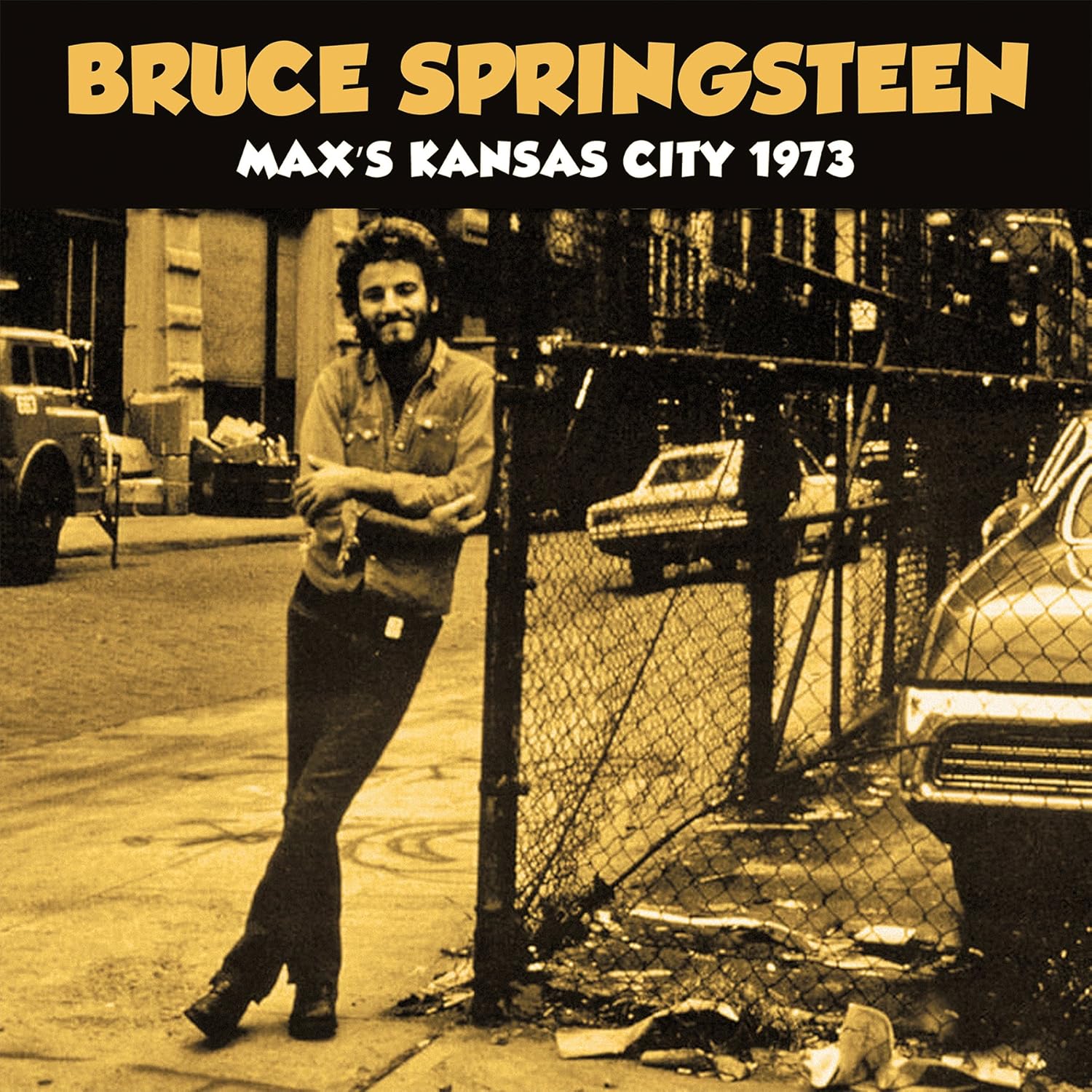
MAX S KANSAS CITY 1973 – Early Radio Broadcast from NEW YORK S most iconic venue. Bruce Springsteen a regular performer there during his early days would be an understatement; indeed, he played a staggering 17 shows at the venue in 1973 alone. This CD contains one such occasion captured on 31st January that year. Having just released his debut, Greetings From Asbury Park, N.J., Columbia Records had arranged a simultaneous radio broadcast to help promote the album. Featuring a host of early favourites, including Does This Bus Go To 82nd Street? and Spirit In The Night – along with several primitive versions of songs that would later appear on his sophomore record, The Wild, The Innocent & The E Street Shuffle, plus a number of other rarities – this collection is a fascinating artefact of the roots of one of rock music s most enduring talents


:format(jpeg):mode_rgb():quality(90)/discogs-images/R-1154504-1461764400-6042.jpeg.jpg)
:format(jpeg):mode_rgb():quality(90)/discogs-images/R-1137878-1441734508-8420.jpeg.jpg)



 The Fat Angel Sings