DITZ – ” The Great Regression “

Posted: September 4, 2022 in MUSIC

We have worshipped at the Ditz altar for a few years now, through their various line-up changes, developments in sound & their ‘5 Song EP‘ but now, here we are finally, with the announcement of their debut album, “The Great Regression” and holy smokes – what a f’ing incredible achievement it is!! even those of us who came to this with the highest of expectations have been left awestruck. Their dynamic, experimental punk is ferocious, cacophonous & urgent but complex, layered & considered, so every listen (and believe us, there have been many of them here already) will reveal something new & thrilling.

Ditz’s debut album, “The Great Regression” has been recorded by Ben Hampson and mastered by Kate Tavini. the 10-track album has been a long time coming – the five-piece first came together in Brighton at the end of 2015 and released their debut ep the following year. there have been a few line-up changes along the way, but they have been settled since their breakthrough tracks ‘Gayboy’, ‘Total 90’ and a cover of Peaches’ ‘fuck the pain away’ in 2019, which prompted Joe Talbot from Idles to proclaim “Ditz are the best band in Brighton, if not the world”.

Even though the various lockdowns slowed the band’s momentum for a while, they turned the situation to their advantage, using the downtime to fine-tune this incredible debut. abrasive but accessible, the great regression is set to be one of the most important British guitar debuts of 2022. first single ‘Ded Würst’ – a ferocious mix of Gilla band, Foals and a lyric bemoaning the moral quandary of minimum-wage employment – unsurprisingly became an instant favourite of Steve Lamacq on BBC radio 6 music.

Other highlights include ‘The Warden’, a song all about being too intense, ironically set to an intense backing somewhere between Deftones and Mogwai, and ‘I am Kate Moss’, which, according to singer Cal Francis, is about “the separation between your visual and personal identities, particularly within the context of masculinity and femininity”.

Such themes of insecurity and gender pop up a lot over the course of the album, as well as lots of references to the human body breaking and being harmed in unnatural ways, although there’s no one overarching concept, simply because the songs have come together over such a long period of time. the title is not so much a reference to society going backwards, but more the band’s penchant for childish jokes. “Sitting in a van all day can get silly,” laughs Cal. that’s not to say “The Great Regression” is in any way light-hearted. It’s full of anger, rage and despair. ‘Three’ takes some text from Stanislaw Lem’s 1961 sci-fi novel Solaris and applies it to the hollow activism of everyone from big corporations to middle class uni students. Other literary touchstones include Sylvia Plath, William Burroughs and Hubert Selby jr, but even more influential is the band’s ever-growing pile of equipment. “we spent a lot of time during the recording process just trying to make unusual sounds out of pedals, or whatever we could find,” says Cal. The album concludes with a cacophonous new version of ‘No Thanks, I’m Full’, which originally closed their debut ep in 2016. “Over the years the live version has evolved so much that we just had to record it again to do it justice,” explains Cal. “the lyrics are so old that i can’t place whether they are about the hazards of drinking or not drinking.” it’s proof of just how far Ditz have come on in that time and a reminder that, in order to progress, you need to regress. and we’ll drink to thator not.

For fans of: Idles / Lice / Girl Band / Crows / Protomartyr / Girls in Synthesis / John

‘The Great Regression’ is the debut album from DITZ released on 4th March 2022 via Alcopop records.
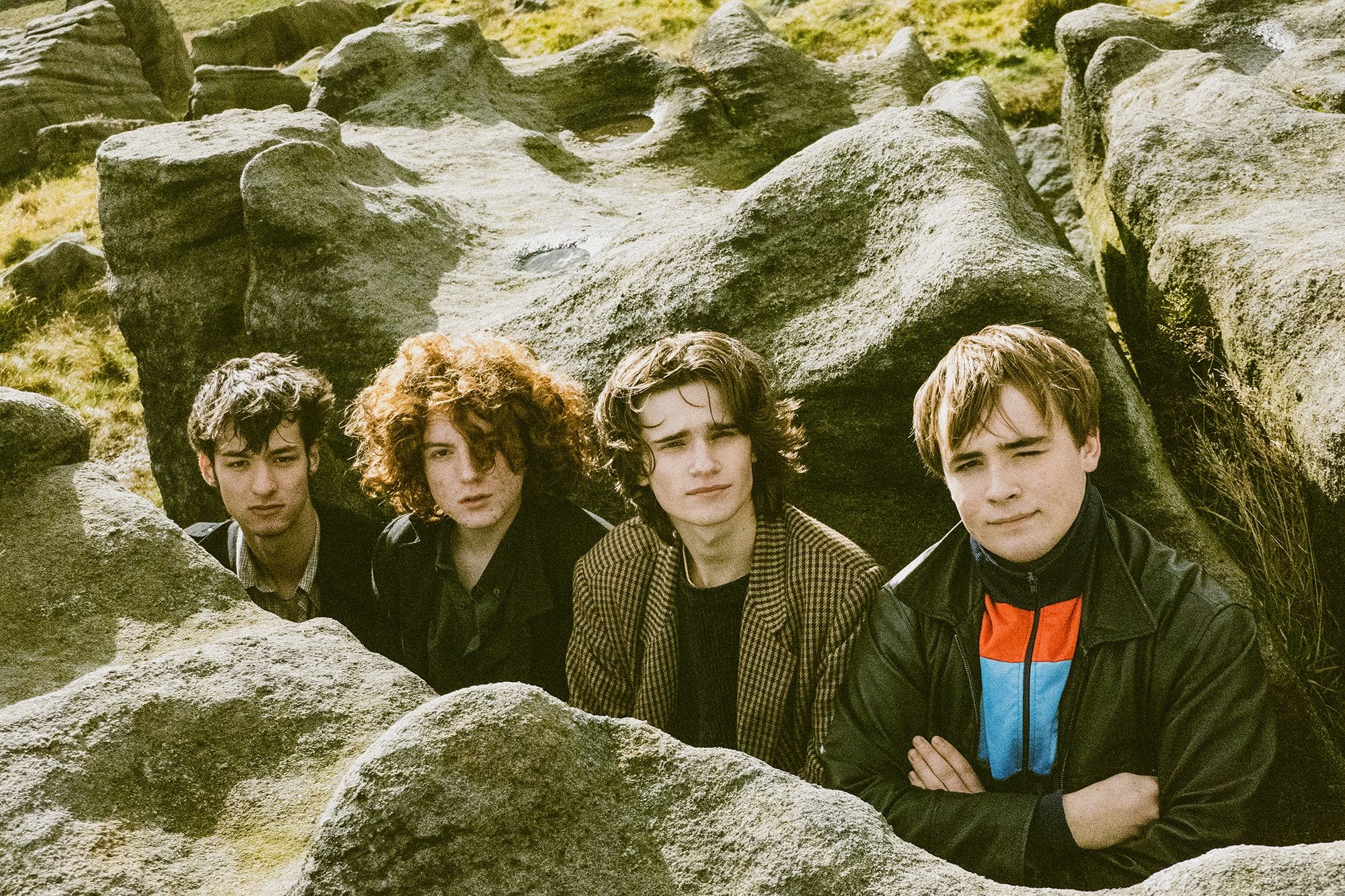
“Silk For The Starving” started with the intent to give an explosive snapshot of who we are – a twelve minute prologue for what’s to come. We worked hard on every note, every rhythm, and all pitched in together on the lyrics for every song. It brought the four of us together.

Although the EP feels like it’s all come together really quickly, it has been a long process. The initial roots of tracks like “Burn The Heather” were written about three years ago which is really bizarre to think about. It was a completely different track but had that same bassline and drum groove, we actually left that idea for a while and almost abandoned it but at the start of the lockdown we decided to try ‘re-working’ some old ideas and “Burn The Heather” was one of the tracks that came out of it!

“Burn The Heather” also caused a little controversy due to its obvious middle finger to the Grouse Shooting culture. We revelled in that controversy. Over the last few years we have spent the majority of our time locked away in our rehearsal space playing constantly. Once we decided we were going to record and release an EP it became clear pretty quickly that these four tracks were the right songs for the record. We never wanted this EP to be experimental or slow or anything like that. In our eyes, it is four energetic, honest single-esque tracks. For us any of the four tracks could have been singles, the idea of releasing a record with two obvious singles and two fillers was exactly what we didn’t want to do. In some ways “Television” and “Valley Bottom Fever” sum us up as a band better than the singles.

We made this record at quite a strange time, it was during lockdown but at a time when we could just about get away with going down to record. The feeling of the recordings is hard to put your finger on, to us there’s a sense of hope. In what was a bleak period of time we found ourselves in the studio with the producer we had idolised recording songs that we adore, so that strange combination of the state of the world at that time and the elation at still being able to do what able to do what we love resulted in the feeling that “Silk For The Starving” has, whatever that feeling is to you.”

The debut EP by The Lounge Society, ‘Silk For The Starving’, out June 18th on Speedy Wunderground

Experimental post-punk outfit Girls In Synthesis are set to release the eagerly anticipated follow-up to 2020’s incendiary debut, “Now Here’s An Echo From Your Future”.

Our second album ‘The Rest Is Distraction’ is out now. This record is a game changer for us, it represents a huge step forward and is something we are truly, truly proud of.

Big love and thanks to funkcutter (horns), Stanley Bad (violin), Eleni Poulou (keys), Bea Dewhurst (photography), Max Walker (mixing), Ayumu Matsuo (mastering) and Kieran Gabriel (video). And to you. So, enough chat. Listen. Absorb. And enjoy. The rest is distraction.

Entitled ‘The Rest Is Distraction’ and available this coming October 14th via the band’s own label Own It/Cargo Records, its mix of fractured guitar, crushing drums and bass, intense vocals and lyrical content – create as challenging a record as you will hear this year. Formed in 2016, Girls in Synthesis are John Linger (bass / vocals), Jim Cubitt (guitar / keys) and Nicole Pinto (drums). The trio’s double a-sided debut single “The Mound’/’Disappear” came out in the early part of 2017, and since then they have established themselves as the most forward thinking, viscerally challenging band around with unmissable live shows that continue to excite and astound in equal measure.

Recorded last year amidst the uncertainty of continuous lockdowns as a result of the global Covid-19 pandemic, ‘The Rest Is Distraction’ is far darker in content than its predecessor. Mainly exploring internal and mental struggles as opposed to external current affairs, it focuses on the claustrophobia of emotional anguish and continues to bravely delve into previously un-ventured topics.

Featuring frequent collaborators funkcutter and Stanley Bad on horns and violin, respectively, two songs also see Eleni Poulou, ex-The Fall, on keyboards. The album was mixed by long-term collaborator Max Walker, and features stunning landscape photography by Bea Dewhurst. The album was mastered in France by Ayumu Matsuo.

Sonically atramentous and less one dimensional than the band’s debut, ‘The Rest Is Distraction’ takes its cues from ‘Join Hands’ era Siouxsie & The Banshees, Brainiac and Crass’ ‘Christ The Album’, among others. From the first crackle of electricity on the opening track, to the heart wrenching taped voice-recording on the final outro, this LP triumphantly retains every ounce of intensity and vitality that makes Girls In Synthesis the most captivating band to emerge from the UK DIY underground in recent years. Listeners will find ‘The Rest Is Distraction’ a challenging, yet ultimately cathartic listen. Prepare yourselves for a sonic cleansing, Girls In Synthesis style.

‘The Rest Is Distraction’ (released 14/10/22): http://linktr.ee/girlinsynthesis. On tour UK/EU October-December ’22.

MO TROPER – ” MTV “

Posted: September 3, 2022 in MUSIC
Tags: ,

This Portland musician’s fizzy, DIY pop style has cult status written all over it, Portland artist Mo Troper is a songwriter and DIY home taper in the tradition of R. Stevie  Moore, Gary Wilson, Half Japanese and The Frogs, not to mention the whole Elephant 6 scene (Olivia Tremor Control in particular). He cranks out records at an alarming rate, full of very short songs that are crammed with catchy choruses that feel tossed-off, perhaps unfinished, but are often more sophisticated than they first seem.

If you’re new to the weird and often wonderful world of Mo Troper, “MTV” is as good a place to start as any, presenting 15 eccentric pop nuggets in 30 minutes, with only one song crossing the three-minute mark. A student of the classics (he covered The Beatles’ Revolver in full last year), Mo is an all-consumer who is not afraid to steal and presents well-travelled melodic styles in his own unique, often clever way. Some songs pass clever and proceed straight to novelty (“The Only Living Goy in New York” is a title Weird Al probably thought of and rejected) but it’s hard to deny the popcraft and hooks on songs like “Waste Away,” “Play Dumb” and “No More Happy Songs.”

released September 2nd, 2022

Produced by Mo Troper.

All songs written by Mo Troper (ASCAP Funny Uncle Virgil_, with the exception of “Waste Away” – written by Mo Troper and Nick Pounders. All Songs performed by Mo Troper with the exception “Play Dumb” – featuring Asher McKenzie on drums, Ben Burwell on bass, and Jackson Machado on guitar.

Jangly Scottish cult band of Sarah Records fame continue to make swooning guitar pop on their eighth album, Glasgow’s The Orchids have been making heartfelt, jangly indie pop for more than three decades, releasing records most famously on the legendary indie label Sarah Records. It’s been a while since they’ve released an album eight years, in acrual fact

But they are back with their seventh album titled “Dreaming Kind” due out September 2nd via Skep Wax (the label run by their former Sarah labelmates Amelia Fletcher and David Pursey of Heavenly/The Catenary Wires).

The band, which still includes frontman James Hackett, guitarist John Scally, drummer Chris Quinn, along with keyboardist Ian Carmichael, have managed to stay remarkably, satisfyingly consistent over the years, only making records  when inspiration strikes them. “Dreaming Kind” definitely feels inspired, with windswept and winsome songs set to arrangements that swing between jangly and delicate, and lush and jazzy. Some songs, like “I Never Thought I Was Clever,” are both. If you wished that bands still made swooning, heart-on-the-sleeve guitar pop a la Aztec Camera and The Blue Nile, The Orchids are waving to you saying, “we’re right here.”

The Orchids were musically one of the most interesting Sarah bands and certainly developed far more on that label than any band. Starting with a melancholy guitar pop sound on “Lyceum” and contemporaneous singles, they moved on to become more keyboard and sample/effects-based for their second and third albums, “Unholy Soul” and “Striving For the Lazy Perfection”, developing a more electronic sound, possibly as a result of their producer, Ian Carmichael, who was a member of dance band One Dove.

“Dreaming Kind” by The Orchids released on https://www.skepwax.com– Sept 2022.

Bob Mould has always worked best in power trio mode. After his iconic Minneapolis punk band Hüsker Dü fizzled out 1988, he spent a few years as a solo artist, releasing the well-regarded, acoustic oriented “Workbook” in 1989 and the louder but less successful “Black Sheets of Rain” in 1990.

Released from his contract with Virgin Records and inspired by Nirvana’s “Nevermind”, Mould found himself wanting to make noisy guitar pop again. He recorded demos which led to him signing to independent labels Creation Records in the UK and Rykodisc in North America. Recruiting bassist David Barbe and drummer Malcolm Travis to help record the album, he ended up forming a new band and while at at diner in Athens, GA, looking at the table’s container of sugar packets, they came up with their name.

With their roaring, punk-injected guitar pop sound, Sugar were definitely a more natural fit with a label of noisemakers like Creation (home to My Bloody Valentine and Ride) than Rykodisc (who were mainly known for being the first CD-only label).

“How ironic that after years fronting the hugely influential but desperately overlooked Hüsker Dü, Bob Mould’s first project with new band Sugar, 1992’s “Copper Blue”, would become the most commercially successful project of his career… it was released just as the seeds sown by his former band were bearing bountiful fruits in the post-Nirvana alternative nation, which provided ample explanation for its phenomenal success. But Sugar were well deserving of their success, regardless of time and place.

In any case, Sugar’s classic debut album, released September 4th 1992, is one of that year’s best, with Mould’s signature mix of rippers (“Changes,” “A Good Idea”), pop songs (“Helpless,” “If I Can’t Change Your Mind”) and even a little prog (“Hoover Dam”). “Copper Blue” was actually more of a hit in the U.K than across the pond, reaching No10 in the UK album charts and getting named the Best Album of 1992 by NME; the record really caught on with American alt-rock radio and MTV in 1993.

Sugar burned bright and hot, releasing “Beaster” (recorded during the same sessions as “Copper Blue“) a mere six months later, yet flamed out during sessions for their second album. Still, “Copper Blue” remains one of Mould’s best collection of songs. It’s a perfect record.

You can get “Copper Blue” and “Beaster” together as one deluxe double-LP set

Sugar – “Copper Blue” is the debut studio album by Sugar, released on this day (September 4th) in 1992.

R.E.M.’s debut EP, “Chronic Town”, was released on August 24th, 1982. It’s safe to say music was never the same, upon the release of the five-song record.

That’s because “Chronic Town” EP feels as if beamed in from another planet — a planet shrouded in murky atmospheres, Southern mysticism and post-punk eclecticism. There’s a faint psychedelic vibe running throughout, notably shading the jangly, Peter Buck riffs coiling through “Wolves, Lower” and the wistful grooves of “Gardening at Night,” while the taut tempos of “Carnival of Sorts (Box Cars)” and “1,000,000” give the songs vibrating velocity. The nearly six-minute “Stumble” feels like deconstructed dance music, as repetitive guitar embellishments do battle with Bill Berry’s percussion bursts.

Beneath the surface lurks layers of sounds and effects; these add barely perceptible, but mysterious, texture. Yet with the cryptic Michael Stipe’s lyrics and vocals. Phrases leap from the music here and there, giving off the air of a faded watercolour more than a crisp portrait. This is particularly effective in “Wolves, Lower,” which features quizzical notes-to-self (“Suspicion yourself, suspicion yourself, don’t get caught”) and interesting arrangements. The verse is a call-and-response: a questioning chorus sings the phrase “House in order,” while Stipe follows with yearning, wordless crooning.

“Gardening at Night,” a song dating back to summer 1980 that is allegedly inspired by Buck seeing a man gardening while wearing dress clothes, is also a puzzle, as Stipe employs a vocal technique that’s gorgeous yet indistinct. And then there’s “Stumble,” which begins with a brief clip of Stipe laughing, saying “Teeth!” and then chomping his choppers. “Chronic Town” is such a compulsively listenable because listeners are compelled to try to figure out its secrets.

As per usual with R.E.M. in those early days, sessions for “Chronic Town” were quick and efficient. The band wasted no time getting back into the studio after the July 1981 release of its debut 7-inch, the Mitch Easter-produced “Radio Free Europe.” According to the R.E.M. Timeline, the group headed to Easter’s Drive-In Studio during the first week of October. “The instruments were recorded on Friday, vocals on Saturday, and it was mixed on Sunday,” Buck recalled in 1983. “We didn’t have the money to take any longer.”

On October 3rd, 1981, the band tore through close to eight songs, some of which appeared on “Chronic Town” (“1,000,000,” “Gardening at Night,” “Carnival of Sorts (Box Cars)” and “Stumble”), and others which would later surface on “Murmur” (“Shaking Through”) or as early B-sides (“Ages of You,” “White Tornado”). R.E.M. also cut an abstract, collage-like song, later dubbed “Jazz Lips” or “This Is Jazz (Blow Nose),” that featured Stipe reading a 1959 magazine article above the cacophonous fray.

The EP’s lead-off track, “Wolves, Lower,” emerged after this initial session. The song was recorded twice in 1982, with R.E.M. tracking a fast version (heard below) in January, along with the take on “Carnival of Sorts (Box Cars)” that made the EP and then re-cut a slower version in June.

Looking back in 2007 with writer Fred Mills, Easter had clarity on the “Chronic Town” sessions. “By now, I was a bit more comfortable with them so I threw in suggestions involving tape loops, backwards sounds, etc. and they loved it all. The sense that we were doing something good was really energizing. We even had the good sense and confidence to go back and re-do ‘Wolves, Lower’ at something less than the speed of light.

“Most of my sessions were so low-budget and rationalized according to the ‘Rules of Punk Rock’ that taking the time to reconsider something was really posh and unusual!” he adds. “It struck me that the band had actually gotten better — everybody sounded bigger and better and clearer, somehow.”

Still, around the release of 1983’s “Murmur”, Buck described a slightly more freewheeling experience saying the band made “Chronic Town” “for our own pleasure, as a learning process. We used lots of backwards guitars and weird sound ideas. We tried anything we’d ever wanted to try, so a lot of things on there are too busy. We didn’t edit ourselves the way we did on [Murmur].”

Part of that experimentation had to do with Easter and his love of Kraftwerk. In R.E.M.: Fiction: An Alternative Biography, David Buckley wrote that Easter was “always ready to try something more mechanoid in the studio. Part and parcel of this were to use rudimentary musical concrete techniques — any means to distort the fabric of time, or to layer slabs of ‘found’ elements.”

Among the experiments: The bridge of “Wolves, Lower” contained both backward elements and a tape loop, giving it a back-masked, disorienting sound. Stipe also recorded some of his vocals outside, giving his vocals an intriguing (if somewhat intangible) ambience.

Although “Chronic Town” came together fast, the EP didn’t see the light of day until August 1982, owing to the fact that R.E.M. was working out terms of a contract with I.R.S. Records. This deal wasn’t necessarily on the radar when recording began — “Chronic Town” was actually meant to be released on a new indie label called Dasht Hopes, run by an Athens transplant named David Healey. However, life intervened, and R.E.M. also did demo sessions for RCA Records with producer Kurt Munkacsi in February 1982 before signing with I.R.S. in May. (Healey, however, is dubbed as “ex-producer” in the “Chronic Town” credits.)


The ORIELLES – ” Tableau “

Posted: September 1, 2022 in MUSIC
Tags: ,

The Orielles release their new album “Tableau”, a genuinely contemporary record which voyages far beyond the musical limits reached on their previous albums “Silver Dollar Moment (2018), Disco Volador (2020) and La Vita

Olistica (2021). The album was self-produced in collaboration with Joel Anthony Patchett (King Krule, Tim Burgess). As well as the adoption of contemporary 21st century production, the Orielles used concepts from the world of art and minimalism in creating Tableau. Sidonie had researched the graphic scoring method of Pulitzer Prize nominated trumpeter and composer Wadada Leo Smith. They also utliised Oblique Strategies – the playing cards designed to aide creativity created by Brian Eno and artist Peter Schmidt in the early 1970s.

The result is a double album that rewards serious immersion, as complex as it is diverse. Though Tableau is likely to challenge preconceptions, this is something the band suggest they have been doing for quite some time anyway. “All through our whole career we’ve had to prove ourselves so, so much” explains Henry. “You can’t disconnect the age and the gender thing either” adds Esmé, “People belittle your age because they see women in the band. Whereas lad bands, if they’re eighteen it’s apparently exactly what people want to see.” Being from a small town in West Yorkshire may have added to that also, but Sidonie counters that “being from Halifax has also been a blessing, it’s kept our egos in check.”


Perhaps more than any of this, though, “Tableau” is also simply the product of the unique telepathy between three singular musicians that have grown in symbiosis for over a decade now – simply the three of them in a room.

If you want a taster of how great the album is go straight to ‘Beam/s’ a gorgeous 7-minute-53-second piece of constantly shapeshifting celestial dream pop that heralds the truly extraordinary “Tableau“.

Ecstatic Peace Library are thrilled to announce Linger On by Velvets-obsessed music journalist Ignacio Julià.

This sumptuous new volume features interviews with Lou Reed, John Cale, Moe Tucker, Doug Yule, Nico and the most in-depth interviews ever granted by Sterling Morrison, as well as never-before-published photographs by James Hamilton.The book will be launched on the occasion of Sterling Morrison’s 80th birthday, this August 29th inside the historic and legendary Oak Room of The Algonquin Hotel in New York City with an exhibition of James Hamilton’s unseen portraits of The Velvet Underground curated by Willis Loughhead with Ecstatic Peace Library.

The author of Linger On is an internationally respected and trusted Velvet Underground chronicler; he is the Barcelona-based rock n roll editor Ignacio Julià, who also published books in Spanish and English on American post-punk band Sonic Youth. When members of The Velvet Underground toured in Spain Ruta 66 journalist Ignacio Julià was usually among their entourage, front row centre at curtain call, backstage after the gig, in attendance of afterparties and sometimes discovered in the band’s hotel rooms until lobby call.

Since 1985 Ignacio Julià has obsessively followed the band’s career, interviewing and wining and dining the members over the years, and publishing countless articles, intimate profiles and books in Spanish and English on The Velvet Underground. He is known among international Velvets fan clubs as one of the most dedicated chroniclers and archivists of studio bootlegs, live concert recordings, writings and poetry to the extent that even the band’s own members refer to his knowledge for fact-checking purposes.


Image  —  Posted: August 31, 2022 in MUSIC