Weird Milk are an exciting new London based band. Their musical odyssey began in the English countryside before graduating to the city to study and play music. The group are Charlie Vaughan, Zach Campbell, Alex Griffiths and Joe ‘Blue’ Moyle. Distinguished by their vocal harmonies and 60s influences they are one of the most exciting bands to emerge from the indie scene.
The band invest time and energy crafting their tunes with multiple layers of harmony and melody. The result is a sound which is vibrant and instantly accessible. “Anything You Want” sees Weird Milk stuck between two realities—a wistful, secure loneliness and an ambitious, fruitful venture into the unknown—but luckily everyone loves a good charming pop quandary. If their ravishing, subtle guitar warbles aren’t enough to satisfy your classic pop cravings, then the silvery vocal harmonies from co-lead vocalists Zach Campbell and Alex Griffiths will have you digging through your parents’ record collection in no time.
Band Members
Zach Campbell
Charlie Vaughan
Alex Griffiths
Blue,
Scottish Fiction are proud to present tonic youth, the brand new single from Glasgow four-piece Wojtek the Bear. “Tonic Youth” is the first of four singles being released by Wojtek the Bear during 2019, which will be collected on a limited edition 10” vinyl, old names for new shapes, in the autumn.
Coming straight off the back of their well received debut album, a talent for being unreasonable, Glasgow’s Wojtek the Bear have wasted no time in getting back into the studio to furnish us with fresh music for 2019. Recording in the legendary Chem 19 with producer Jamie Savage [The Twilight Sad, Miaoux Miaoux, The Phantom Band, RM Hubbert], the band, with chiming melodies, pulsing bassline and swirling guitars, aim for that musical sweet spot between Camera Obscura’s Lloyd I’m Ready To Be Heartbroken and Real Estate’s It’s Real.
Of the track, lead singer Tam Killean reveals; “When I first moved into Glasgow in my early 20’s I quickly encountered people at parties I’d never been exposed to before; kids who’d never worked a day in their life, spent their summers in Val-d’Isére or Biarritz and all seemed to have fucking ponies. This song is about how initially on coming into contact with them I had a bit of a crisis of confidence, thinking that I’d wasted my life by just getting absolutely smashed from the age of 15 onwards.”
Let it be known that Michelle Zauner’s first original release as Japanese Breakfast since 2017 is “Essentially” an indie-pop bop. “Essentially” wouldn’t sound out of place on Soft Sounds from Another Planet, as it’s a spacey, yet danceable thumper that finds Zauner demanding the kind of love that makes everything—and everyone—else seem trivial by comparison, like looking down on a crowd from a great height. “How is it you fall asleep so easy / Who is it you’re dreaming of tonight?” she wonders, insisting, “Love me essentially.
‘Hard to Believe’ is a song about being addicted to a bad relationship, and the endless cycle of trying and failing to end one,” explains Charly Bliss frontwoman Eva Hendricks. “[Drummer Sam Hendricks] wrote the guitar riff very early on in the writing process of Young Enough and we’ve always been obsessed with playing it because it’s so insanely catchy.” It certainly is. “Hard to Believe” is Charly Bliss power-pop in its purest form, an effervescent rocker that goes down like a shotgunned soda. As is customary for the band, the song’s bubbly instrumental blast belies harrowing emotional turbulence, a heavy weight masked by lightness: “I’m kissing everything that moves / I’m kissing anything that takes me far away from you,” sings Hendricks, unflinching in laying her conflicting feelings bare.
It’s hard to put into words how excited we are to share our second album “Young Enough”, out May 10th, with all of you. This album was a joy to make. We worked harder and were more focused than ever before, and our confidence and trust in one another and ourselves grew with every song we wrote.
This album is a celebration of personal growth, meant to be danced and cried to in equal measure. We can’t wait to share more songs and more information with you in the comings months, but for now, we hope you enjoy our first single, “Capacity” and the beautiful video directed by Michelle Zauner and shot by Adam Kolodny. Also, Also, a huge thank you to Ebru Yildiz for our beautiful album cover and press photos. In addition, we’ve added a handful of European tour dates in May.
British art-pop group ALASKALASKA are on a roll. Following their 2017 self-titled EP and 2018 singles “Meateater” and “Monster,” the South London sophisti-pop outfit are ready to unleash their debut full-length The Dots with firm footing. Their horn-laden, ever-morphing pop skyscapes and dancefloor fillers are always catchy, but never in a predictable sense. Led by principal songwriter Lucinda Duarte-Holman and bassist and producer Fraser Rieley, ALASKALASKA are willing to experiment with any groove or sonic texture that will further cultivate their heady, intoxicating art-pop.
ALASKALASKA vocalist, guitarist and principal songwriter Lucinda Duarte-Holman says of the band’s new single, “Tough Love’ is a protest and a paradox. It is an invite to each individual listener to interpret however they like.” Duarte-Holman wonders “who gives a shit about my opinions / who gives a shit about my point of view / who gives a shit about anything lately” to open the song, struggling to reconcile the many contradictions of our current cultural moment over nervy guitars, shuffling drums and steadily escalating synths, all combining to evoke both confidence and near-collapse.
Johnny Hostile chose Camille Berthonier, better known as Jehnny Beth, and even better known as a singer of the band Savages. A collaboration that makes sense because who knows Johnny better than Jehnny artistically? Already together in London in the 2000s, they compose many soundtracks for Chanel. An intimate piece illustrated by immersive shots, worthy of an experimental documentary. ‘xy chelsea’ the film about Chelsea Manning for which Johnny Hostile and Jehnny Beth have composed the soundtrack will have its worldwide premiere at Tribeca Film Festival
extract from ‘xy chelsea’ original soundtrack ~ set to be release on June 7th,
This week sister duo Bleached (Jessie and Jennifer Clavin) announced a new album, “Don’t You Think You’ve Had Enough?”, and shared a video for a catchy new song from it, “Hard to Kill.” Don’t You Think You’ve Had Enough?is due out July 12th via Dead Oceans.
The songs were written in Los Angeles and Nashville. Jessie did most of the instrumentation and Jennifer mainly did the lyrics and melodies. Shane Stoneback (Vampire Weekend, Sleigh Bells) produced the album. The album is the follow-up to 2016’s Welcome the Worms and 2017’s Can You Deal? EP. A press release says Don’t You Think You’ve Had Enough?is the band’s “first LP written from a place of sobriety.”
Jennifer had this to say about the album in a press release: “Writing these songs while sober became somewhat of a spiritual experience. I had to let go, trust the process, and allow an energy beyond my control to be present.”
“Hard To Kill” by Bleached off ‘Don’t You Think You’ve Had Enough?’ out July 12 on Dead Oceans Records
There is no other band in pop or rock who is able to master the balance between gloom and radiance quite like The Cure. And when it was released on May 2nd, 1989, no other album in their catalouge reflected both the darkness and light of their sound like “Disintegration”.
The band’s eighth LP was intended to be a return to the more oblique, gothic undertones of their landmark 1982 LP Pornography The epic, synth-heavy pastiche of opening track “Plainsong,” “Closedown” and the nine-minute “The Same Deep Water As You” all remain beacons of beautiful sorrow that seemed miles away from the pop vibrancy of such mid-80s faves as The Head On The Door and Kiss Me, Kiss Me, Kiss Me.
Disintegration and this particular classic lineup of The Cure, comprised of fearless leader and vastly underrated guitar hero Robert Smith; longtime bassist Simon Gallup; guitarist Porl Thompson; drummer Boris Williams; keyboardist Roger O’Donnell; and original drummer Lol Tolhurst, who didn’t play on the album but provided the basis for the song “Homesick” managed to channel the pop maneuvering of songs like “The Love Cats,” “Close To Me” and “Just Like Heaven” into a dark wave of black romance throughout the record’s 72 minutes.
The romantic gloom on Disintegration is more achingly beautiful depressive wallowers everywhere rejoiced. Perfect for any introspective occasion it also happens to be the perfect breakup album, including the album title! If there was a class called Album Openers , “Plainsong” would take up the first and last sections of the course. We relive the happy times captured in pictures “Pictures of You”, experience the high of expressing one’s love and devotion (“Lovesong”) only to experience the sadness of impending heartache (“Last Dance”) and the nightmares that follow (“Lullaby”). There’s also anger and desperation in songs like “Fascination Street,” “Prayers for Rain,” and “The Same Deep Water as You” in which Smith laments “can’t you see I try?/swimming the same deep water as you is hard.” With the sounds of breaking glass the epic title track begins where Smith describes his own failings. “Homesick” has Smith begging for another “go” before walking away and the album closer (“Untitled”) has Smith sadly admitting that he’ll “never lose this pain/never dream of you again.” Full of shimmery guitars, synths, and emotional lyrics, the album creates a lush atmosphere of love and loss. Perfect for heartbreak in the dark.
Each of the four singles taken from Disintegration provided more momentum for The Cure’s visibility and success on the charts across the globe. And while songs like “Fascination Street,” “Lullaby” and “Pictures of You” did, “Fascination” peaked at No. 1 on the Alternative Songs chart, it was the album’s most pop-positive moment, “Lovesong,” that skyrocketed them to the No. 2 position as well as largely universal acclaim to music listeners beyond the goth crowd.
“Despite making challenging music that deals with the biggest themes, their impact has been gigantic,” proclaimed Trent Reznor of Nine Inch Nails in his speech inducting The Cure into the 2019 Rock and Roll Hall of Fame. “They’ve sold the best part of who gives a shit how many million records and been an essential touchstone in the genres of post-punk, new wave, goth, alternative, shoegaze and post-rock. They’ve been in and out of fashion so many times in the last four decades that they ended up transcending fashion itself. Though they might be a hip name to drop in 2019, this wasn’t always the case. Their dedication to pushing sonic and artistic boundaries while making music for the ages wasn’t always rewarded with glowing reviews in the press. But they never failed to attract a passionate, intelligent and loyal fanbase who always knew the truth: The Cure are one of the most unique, most brilliant, most heartbreakingly excellent rock bands the world has ever known.”
‘Disintegration’
Dropping through sky, through the glass of the roof, through the roof of your mouth, through the mouth of your eye, through the eye of the needle / It’s easier for me to get closer to heaven than ever feel whole again I never said I would stay to the end / I knew I would leave you with babies and everything.” Running more than eight minutes, the title track to the band’s best album features Robert Smith at his wordiest … and nastiest. It’s basically a cycle-of-life thing, with childhood abuses giving way to similar adult patterns. Chilling.
‘Pictures of You’
“Pictures of You” is the fourth and final single from the British rock band the Cure’s 1989 album Disintegration. Called “chilly goth-rock” and “accessible…synth-pop”, the song has a single version which is a shorter edit of the album version.
“If only I’d thought of the right words, I could have held on to your heart / If only I’d thought of the right words, I wouldn’t be breaking apart all my pictures of you.Robert Smith has said that he wrote ‘Pictures of You’ after a fire at his home. Among the remains were some pictures of his wife in a wallet. But read the lyrics, and you’ll discover something that cuts way deeper: a broken heart and shattered memories.
‘Fascination Street’
a 1989 North-American-only single by the English rock band The Cure from their album Disintegration.Their American record company refused the band’s original choice of song“Lullaby” as the first single (it was the lead single in the UK and was released in the U.S. later) and used “Fascination Street” instead.
The song is notable for its extended bass introduction. “I like you in that like I like you to scream / But if you open your mouth, then I can’t be responsible for quite what goes in or to care what comes out.”The first single from the Cure’s breakthrough U.S. album is one of Robert Smith’s vaguest songs. Is it about sex? Control? A breakdown of a relationship? We can’t say for sure, but the menacing rhythm hints that something sinister is going on. A perfect summation of the Cure at their best.
“Lovesong”
The Cure, released “Lovesong” as the third single from their eighth studio album Disintegration in 1989. The song saw considerable success in the United States, where it was a number two hit.
The song is performed in A minor and is built around a distinctive bass riff. The verses follow an Am/G/F/Em chord progression, which changes to F/G/Am/C in the choruses. The lyrics are simple, with each verse having the same structure (“Whenever I’m alone with you / you make me feel like I am … again”). Speaking of its simplicity and unusually upbeat nature compared to the other tracks on Disintegration, Smith stated, “It’s an open show of emotion. It’s not trying to be clever. It’s taken me ten years to reach the point where I feel comfortable singing a very straightforward love song”
The single version of the song is almost exactly the same as the album version, but the mix is slightly different, with extra reverb and harmonies added to Smith’s vocals. In addition, in the instrumental section between the first two verses, the guitar doesn’t join the keyboards like it does on the album.
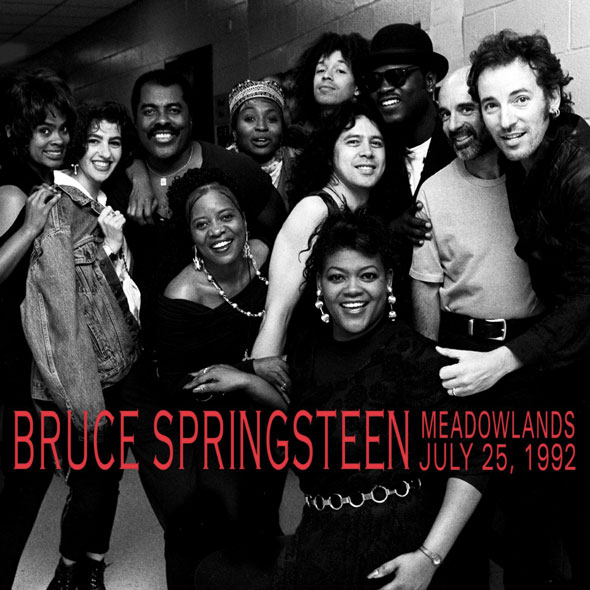
Performing with his new band in front of eager hometown fans, Springsteen goes the extra mile in this spirited set showcasing songs from Human Touch and Lucky Town along with a few special treats. New Jersey 1992 delivers 13 songs from the two albums, from “Living Proof” and “Souls Of The Departed” to “Real Man” and “All Or Nothin’ At All.” It also features the tour’s only performance of the gospel gem “Ninety-Nine And A Half (Won’t Do)” showcasing the background singers, plus a unique solo-to-band arrangement of “Open All Night” that hilariously updates the turnpike tale.
The 11-night stand at the Meadowlands Arena to kick off the 1992 U.S. tour was a bold statement of intent. It’s surely intentional that it was one show more than the famed ten-show run at the same venue in 1984, the difference being that this time Bruce was coming home with new friends, not familiar ones. Touring for the first time without the E Street Band and playing in front of what are arguably his most diehard fans is a daunting proposition. But with opening night jitters out of the way, the second show on July 25th, 1992 offers a hungry, highly entertaining performance that plays to the new lineup’s gospel-meets-roots-rock strengths.
Right from the top, Bruce is wholly committed and in stellar voice, his rich timbre leading the strong show-opening trio of “Better Days,” “Local Hero” (complete with local landmark namechecks to show his Garden State cred remained intact), and “Lucky Town.”
Bruce’s new musical collaborators “wouldn’t have looked out of place on stage with [Bob] Dylan circa 1978-81,” and that particular Dylan-era frame of reference applies to the music, too, as the approach to both new and old material was to make it more soulful while still rock ’n’ roll. The playing of the core band (Shane Fontayne on guitar, Tommy Sims on bass, and Zack Alford on drums) with a full European tour already under their belts is punchy and tight, while the background singers add gospel gravitas to the proceedings–an appealing combination.
Even on familiar material, these off-E Street versions don’t sound quite as “different” 27 years on, in a good way. The opening set features a first-rate “Darkness on the Edge of Town,” an eloquent reading of “The River” with a long, heart-heavy harmonica outro, and an inspired tour debut for “Open All Night.”
Aimed squarely at this turnpike audience, “Open All Night” starts solo and builds to full band in a manner that may suggest what the unreleased “Electric Nebraska”version sounded like ten years prior. Better still, in the middle of the song, Bruce tells an updated version of the yarn he spun on the Born in the U.S.A. tour, noting the closure of his beloved Howard Johnson’s and a reunion with the waitress at Bob’s Big Boy who reminds him her restaurant is still “open all night.” Good fun.
The first set wraps with four key tracks from the new albums, wrapped around a deeply personal “My Hometown,” introduced with an earnest story about parenting and dedicated from one relatively new dad to all the “moms and pops.” A dynamic performance of “Living Proof” again shows the song to be Bruce’s most powerful from the era. “Leap of Faith” is endearing and infectious thanks in large part to the singers, while the Sam and Dave-style vocal duet with Bobby King on “Man’s Job” raises it from catchy ditty to heartfelt homage. A feature-length “Roll of the Dice” wraps a spirited and undeniably entertaining first act.
After the break, the rarely performed “All or Nothin’ at All” proves a fine set opener and gets the energy of the show right back on track. It’s the one song from Human Touch that sounds like it could be a Born in the U.S.A. outtake, a spiritual cousin to the likes of “I’m Goin’ Down.” The crowd enjoys it too, singing along in full voice when tasked to do so. Having been played in concert fewer than a dozen times, its inclusion here is a welcome opportunity for fresh appreciation.
What follows is another rarity and one of the highlights of the tour, “Ninety-Nine and a Half (Won’t Do),” inexplicably performed only this night (and at a private tour warm-up in June, suggesting it may have been considered for a regular feature in the set at that point). The gospel tune has been covered by everyone from Wilson Pickett to Creedence Clearwater Revival, but Springsteen’s version casts him as a humorous preacher questioning the commitment of men in relationships, while King, Carolyn Dennis, Angel Rogers and the rest of the background vocalists sing like they’re wearing choir robes. The result is amusing, cleverly arranged, and another lost gem rediscovered by the download series.
On the whole, the 7/25/92 performance has aged well, but there are a couple of exceptions. “Real Man” is another rarity, performed on 7/25 for the very last time in concert. Bruce himself admits, “This next song I almost threw off the album because I thought it was too corny, but what can say? It’s how I feel.” Corny we accept, especially from a man in love. More difficult to ignore is the synthesizer that could not sound more dated, though in the end, “Real Man” is interesting if only for the sheer novelty factor of it in the overall canon.
Three recent classics return us to regularly scheduled programming: a spot-on “Cover Me” with fine fretwork from Fontayne, and two Patti Scialfa features, “Brilliant Disguise” and “Tougher Than the Rest,” the latter derailed slightly by those pesky period synths, though Bruce sings all three superbly.
The show’s denouement comes with the pairing of “Souls of the Departed” into “Born in the U.S.A.” “Souls” begins in desert darkness, with news reports of bombs over Baghdad riding desolate guitar strains a la U2’s “Bullet the Blue Sky.” It is a sharp-edged, commanding performance that moves through flourishes of “The Star-Spangled Banner” a la Hendrix into “Born in the U.S.A.” to slam home the point Bruce made so clearly on last month’s release: “War. What is it good for? Absolutely nothing.”
The show wraps with a run of crowd pleasers–”Light of Day,” “Glory Days,” “Working on the Highway,” “Bobby Jean,”“Hungry Heart”–and the tour’s gorgeous, stripped-down “Thunder Road,” before “Born to Run” and Bruce’s best-ever coda,“My Beautiful Reward,” send us out on a high, hopeful note.
Because of the new band, 1992-93 always carries an asterisk in Bruce’s live history, like a strike-shortened baseball season. But as was the case in the major leagues, they still played the games and the games still counted, especially to Springsteen himself. One can feel his commitment in this performance, joyfully trying to win over the Jersey crowd and largely succeeding.
With a multitude of tour dates on either side of the Atlantic promoting her excellent 2018 album, “Historian”, you could forgive Lucy Dacus for taking it easy on the new music for a bit. Thankfully though, you won’t need to, as Lucy has set up an almost Sufjan Stevens’ level of niche musical project, attempting to construct a series of Holiday themed tracks, to be released across 2019 for various days from Christmas and Halloween through to Bruce Springsteen’s Birthday .
This week’s offering comes in the shape of My Mother & I, release to coincide with both Taurus Season, when both Lucy and her mother were born, and the American version of Mother’s day. High concepts aside, My Mother & I is a beautiful track, with no need for a backstory. The track is both a reflection on all sorts of shared characteristics mother and child can share, from problems with body image through to the shared stubbornness and empathy traditionally associated with those babies born in the month of May. Lucy puts it far better than we ever could, ‘We — daughters, and all children — easily inherit the shame and fear of our mothers, but also the pride, self-assurance, and lessons of love.” If you weren’t already excited about the remaining holidays in 2019 already, Lucy Dacus has given us all plenty to be thrilled about.