
Hannah Peel releases a new seven track mini-album ‘Rebox 2’, featuring four new music box covers and three new instrumental pieces. Hannah Peel’s first Rebox came out as an EP in 2010, when she covered the likes of Cocteau Twins, New Order and Soft Cell. Initially only available as a Ltd Edition CD and download, the songs on the new release are all from the last couple of years, starting with a version of Perfume Genius’ ‘Queen’ from 2014. John Grant’s ‘Pale Green Ghosts’ is also about self-awareness and acceptance as the singer looks back at his younger self. Peel’s version retains the epic grandeur of the original with layers of multi-tracked voices and harp-like music box, while the synths revel in the sense of experimentation that inspired Grant to write the song in the first place. A striking image also opens ‘Palace’ – ‘in detail you are even more beautiful than from afar’. The Wild Beasts’ song from 2014. The final cover on the album is ‘Heaven, How Long’, originally written by East India Youth and arguably the centre-piece of their Total Strife Forever debut album from 2014. It’s a soaring, emotional pay-off to Peel’s new release, closing with the revealing, eternally longing line – ‘In spite of all the love inside me/There is a question I’ve been asking/Heaven, how long?’ All four songs are linked by new music written for the project by Peel and co-producer Erland Cooper (Erland & The Carnival/The Magnetic North).
Archive for the ‘CLASSIC ALBUMS’ Category
HANNAH PEEL – ” Reebox 2 “
Posted: August 1, 2015 in CLASSIC ALBUMS, MUSICTags: Hannah Peel, Reebox 2
10000 RUSSO’s – ” 10000 Russo’s
Posted: August 1, 2015 in CLASSIC ALBUMS, MUSICTags: 10000 Russos, Fuzz Club Records
pronounced “dez mil russos” are the latest spell-weavers to join the illustrious Fuzz Club Records banner.
I recently commented that Casper was perhaps a descendant of the renowned 16th century alchemist John Dee – that he continues to conjure these latter-day “Nuggets” seemingly at will, suggests I may not have been that far off the mark!. The band’s press release confirms that, “João Pimenta (drums/vocals), Pedro Pestana (guitar) and André Couto (bass), emerged from what they call “a dark, decadent city of a peripheral country in a peripheral continent”: Porto, Portugal”.
On listening to their eponymous debut album, I see 10 000 Russos as being more akin to their ancestral sea-faring voyagers of discovery, or as Timothy Leary observed, “You are venturing out (like the Portuguese sailors, like the astronauts) on the uncharted margins. But be reassured— it’s an old human custom.”

The band’s press release attests that the LP, ’10 000 Russos’ is, “A six track / 43 minutes long obscure and stomping mantra, their self-titled LP was entirely written and recorded inside an abandoned 1980s shopping mall, where escalators have been out of order for the last fifteen years and the only source of light are some plastic Swedish designed / Chinese made bulbs”.
10 000 Russos are a band who can take the isolation of their creative surroundings, and like the formative Joy Division in their abandoned “dark satanic mill”, sculpt a myriad of sonic earthly delights that be-lie their stark gestative landscape. Listening to ’10 000 Russos’, I am immediately transported in mind to The Young Gods in their heyday, but they are just one of many primal influences on a band whose originality and passion is worn on their collective sleeves.
’10 000 Russos’ kicks off with ‘Karl Burns’, a slow burning, haunting, melancholy epic tribute to the drummer with The Fall; ‘USVSUS’, sounds like a marching, Stephen Morris inspired, “solemn drumming ritual across the wastelands of the mind”; ‘Barreiro’, is perhaps a sparse dystopian hymn to the Lisbon municipality of the same name; ‘Baden Baden Baden’, launches in with all the swagger of a ‘Pretty Vacant’-esque riff intro, hypnotically building drone layer upon deliciously kaleidoscopic drone layer; ‘Stakhanovets / Kalumet’, was described to me by guitarist, Pedro Pestano as follows, “Stakhanovets is kind of an angry song, it’s gnarly and there’s a lot of contradictory shit going on. The lyrics refer to the Stakhanovite movement, a miner’s movement in the 1930’s Soviet Union that encouraged workers to work harder to increase production in a competition based system. Basically it meant employing an almost capitalist production stimulation technique in the soviet regime. We are not directly questioning the legitimacy of this in any system but it’s interesting to find very different systems using the same principles to achieve the same goal and still keep disagreeing. Kalumet means peace pipe and that’s what you get when you get there. It has this gnawa feel to it that on one hand brings you this sort of feeling that everything is ongoing and on the other there’s a feeling of relief or letting go when it’s over. This song was born in the studio when recording Stakhanovets. After that take of Stakhanovets we stayed on playing for a while and Kalumet came out. Sometimes you have twins and you won’t know until they are both out”.
’10 000 Russos’ is an exhilarating debut LP, and one that I hope to see performed live in the very near future…
10 000 Russos debut LP was released on 20th May and is available in digital and cd formats. Vinyl in regular edition (limited to 500), and in deluxe edition (limited to 100), is available now for pre-order from Fuzz Club Records. The album is graced with fine sleeve artwork by the prodigious Olya Dyer.
JASON ISBELL – ” 24 Frames “
Posted: August 1, 2015 in CLASSIC ALBUMS, MUSICTags: Americana, Jason Isbell, Something More Than Free, The 400 Unit
“Something More Than Free” is available on the 17th July through Southeastern Records, How does a song move from a notebook to your headphones? This behind-the-scenes video of Jason Isbell perfecting the song “24 Frames” — the first single from the new album “Something More Than Free”, sits the viewer right inside that process. After a bare-bones delivery from the songwriter, he and producer Dave Cobb work with Isbell’s band, the 400 Unit, to add in colours some guitar delay, a “Leonard Cohen ‘Hallelujah'” style bass line — to turn a contemplative moment into an inspirational one. “I’m gonna let your inner ’90s dude come out,” someone says offscreen, supporting Isbell’s claim that this follow-up to the universally acclaimed Southeastern will capture “the way indie rock sounded when I was 15.” It’s the way rock sounds now, too, in these good hands.
Returning with his fifth full-length, Something More Than Free, just a week ago, and now, the singer-songwriter has premiered a music video for the album’s title track, please check it out above.
The new James Weems-directed visual is reflective of the message Isbell relays in “Something More Than Free.” The clip follows three characters as they make their way through the work that defines their days, as the former Drive-By Trucker sings, “I don’t think on why I’m here or where it hurts / I’m just lucky to have the work.” It’s a moving clip fitting of the rich and thoughtful songwriting that earned Jason Isbell’s release a place on our list of 2015’s best albums thus far.

Jason Isbell and his band, the 400 Unit, are currently on tour, they have dates scheduled through mid-October, plus a four-night residency at Nashville’s Ryman Auditorium from Oct. 23rd-26th.
Earlier this year, Isbell was nominated for the Americana Music Association’s award for Artist of the Year. It’s a stacked category that also includes Rhiannon Giddens, Sturgill Simpson, Lucinda Williams and Lee Ann Womack; winners will be announced during the ceremony on Sept. 16th.
FLORENCE and The MACHINE – ” Queen of Peace ” and ” Long & Lost “
Posted: July 28, 2015 in CLASSIC ALBUMS, MUSICTags: Florence and the Machine, Florence Welch, How Big How Blue How Beautiful
The dog days are decidedly over in “Queen of Peace/Long & Lost,” the new double-feature video from London indie pop-rock megastars Florence and the Machine. The nearly 10 minute mini-movie is a gorgeous ode to the Scots countryside (director Vincent Haycock filmed it on the isle of Easdale), but its emotional frequency is less ode and more lament. Florence Welch, the band’s striking front woman, makes full use of her ethereal mythos in the video’s epic narrative, playing both victim and healer to a group hell-bent on violence and destruction.
Welch has the capacity for big, booming pop songs, and “Queen of Peace” does have a horn section set to 11, but her singing is remarkably reserved, only opening up in glimpses during the song’s emotional chorus. The high drama and striking visuals of the video at least match, if not surpass, both vocals and instrumentation in intensity.
The transition to the far quieter of the two singles, “Long & Lost,” is as melancholy and natural as the corresponding arrival of night in the video’s narrative. The final image of a mourning, desolate on a silent dock, is telling as both an epic story’s resolution and as an abstract portrayal of Welch as an artist, digging deeper and reaching harder than she ever has in this strange and wondrous performance.
Florence Welch ramps up the melodrama in “Queen of Peace/Long & Lost,” a 10-minute short film paired to two tracks from her recent LP, How Big How Blue How Beautiful. the singer exploring weighty themes – loss of innocence, male brutality, familial struggle – against the wind-swept backdrop of Scottish isle Easdale.
In “Queen of Peace,” Welch and her younger self roam around the countryside, lamenting at the feet of violent men. “Suddenly I’m overcome, dissolving like the setting sun,” the singer belts on the surging chorus. “Like a boat into oblivion, ’cause you’re driving me away.” In “Long & Lost,” the clip’s brooding counterpart, the Welches drift on a river as a storm threatens the night sky. “Lost in the fog, these hollow hills,” she sings with her trademark flair. “Blood running hot, night chills / Without your love.”
“The end of the video was done in a single take, at the very last seconds of light during a stormy barge ride on a freezing sea,” Haycock says in a statement. “The effort and focus on both the actors and crew was so amazing. Florence delivers one of my favorite moments to date, and it’s one of my proudest technical and narrative accomplishments.”
Haycock has previously collaborated with Florence Welch on four videos from her recent LP, helming clips for “How Big How Blue How Beautiful,” “What Kind of Man,” “St. Jude” and “Ship to Wreck.”
Last month, Florence and the Machine were promoted to Friday night headliners at the Glastonbury Festival after a cancellation from Foo Fighters..
KIM CHURCHILL – ” Silence Win “
Posted: July 11, 2015 in CLASSIC ALBUMSTags: Kim Churchill, Silence Win, singer songwriter
Kim Churchill – the album “Silence / Win” out 07.08.2015 including the single „“Window To The Sky“.
Having completed international dates as the hand-picked support act on Billy Bragg’s epic Tooth and Nail tour, and headlined his own show at London’s Borderline; Australian musical nomad Kim Churchill has released his new album Silence/Win . Silence/Win Kim Churchill’s 3rd studio effort was produced by Warne Livesey.
This album was recorded in the summer of 2013 in Ucluelet on Vancouver Island and is the first time Kim has entrusted a producer to hold the creative reigns. Says Churchill, “Paradoxically, by relinquishing control to someone else I think this record has a clarity and has really captured who I am in a way I was unable to achieve on my own.”
The month spent recording the album was also the first time in 5 years that Kim had a permanent roof over his head – the busker and surfer, who left home aged 18, preferring to travel and live in customized vans. In 2009, Kim won the Byron Bay Bluesfest Busker Competition and has returned annually to this festival’s main stage. Kim is known for his dynamic live performances which focus on his deft guitar-work while simultaneously playing bass drum, percussion, tambourine, harmonica and vocals.
“I think I find the most solace in not knowing where I am going and not knowing how I am going to get there. That way each moment contains the seed of mystery and the excitement of receiving exactly what a person with no expectations expects; nothing. And nothing is the perfect canvas for anything.”
Kim Churchill matches his lyrical artistry with fierce vocals; he is a sonic architect, using his instruments to create landscapes to animate his lyrics. Live, he is a true virtuoso.

The MYRRORS – ” Arena Negra “
Posted: July 11, 2015 in CLASSIC ALBUMS, MUSICTags: Beyond beyond is Beyond Records, Garage, The Myrrors, Tucson Arizona
There’s more than a hint of mystery surrounding The Myrrors, the impossible-to-define sonic-shaman hailing from the Tucson, Arizona. The mystery, however, feels far from manufactured – it would appear to exist naturally within the band’s collective DNA, a double-helix of third-eye vision that informs their every note.
Certainly, there’s something mysterious about the band’s first album, “Burning Circles in the Sky,” given that it was recorded “sometime in 2008” (as stated by The Myrrors themselves), but only saw release late in 2013. And there’s something mysterious about the constant hum of activity that has defined the band in the months since “Burning Circles” was released – a hum that includes adding two more releases to their fast-growing catalog, along with an invitation to appear at “Levitation,” the 2015 incarnation of Austin Psych Fest.
Yet with the release of “Arena Negra” – the band’s first release for Beyond Beyond Is Beyond Records – there are signs that the mystery has been solved. Put another way, there may have never been a mystery to solve in the first place. As the forty-two minute journey unfolds, it becomes abundantly clear that The Myrrors are simply one of the most compelling bands on the planet at the moment, whether their records are arriving three times a year, or only every three years.
The Myrrors sound is one of urgency, but urgency not beholden to velocity. From the twelve-minute “Arena Negra” title track that opens the album (by slowly slithering out of the ground and into the air), to the twenty-minute inhumanly heavy album closer, “The Forward Path,” it’s immediately apparent that the band has captured completely the sound of shackles being shed. “Arena Negra” comes on strong, as clearly, evenly and undeniably as the very light that enters your eyes, fueled by a heroic dose of Bardo Pond-esque levels of elevation and amplification.
“Arena Negra” is – both by turns and, miraculously, all at once – dramatic, reflective, ecstatic and otherworldly. It’s the work of craftsmen and the cosmos, equally, dialed-in to accurately reflect immensity and awe.
“Arena Negra” by The Myrrors is released March 25th by Beyond Beyond Is Beyond Records. It’s stunning.

HEATERS – ” Propane “
Posted: July 11, 2015 in CLASSIC ALBUMS, MUSICTags: Beyond beyond is Beyond Records, Grand Rapids, Heaters, Holy Water Pool, Michigan

From Grand Rapids, MI trio Heaters are getting ready to release their new platter of blazing psych, titled “Holy Water Pool”, September 25 via Beyond Beyond Is Beyond Recordings. The band haven’t shared any music from it yet but you can check out cover art and tracklist (and an older Heaters cut) below.
Heaters start their tour this weekend in NYC.
Heaters will also be back for 4 Knots Festival with Super Furry Animals, Stephen Malkmus & the Jicks, Mikal Cronin, Screaming Females,
The guys of Heaters, you’d think the three lanky psych rockers resided in Sunny California where bands like The Growlers, Shannon and the Clams, the Ty Segall Band have made psychedelia cool again, but this three-piece was born and bred in the snowy beaches of Michigan.
Guitarist Andrew Tamlyn, bassist Nolan Krebs, and drummer Joshua Korf formed the band back in 2013, and since then, they’ve released a handful of EPs – self-recorded in their homes – and their studio debut “Solstice” (Dizzybird Records). Aside from constantly laying down recordings, Heaters has also been touring non-stop, including frequent shows in Chicago. And just this month, Heaters also played Austin Psych Fest. With all that touring, the band has definitely been giving their van a run for its money. On their way to the Windy City, the Midwesterners broke down in Kansas City, but luckily they managed to get the van running, making it just in time, pulling up to the venue minutes before they were set to take the stage.
Fans and friends seemed relieved to see the trio loading in, and once Heaters got started, people instantly began moving, swaying to the fuzzy melodies of “Shump” and “Sanctuary Blues.” Heaters played the single, “Mean Green,” off their recent 7” via Beyond Beyond is Beyond Records.

The BLACK RYDER – ” Let Me Be Your Light “
Posted: July 10, 2015 in CLASSIC ALBUMS, MUSICTags: The Black Ryder, The Door Behind The Door

Once in a while, a record comes along that’s so intricate in its production, so moving in its performance, and so immediate in its emotion that you know even upon your first listen, that you’ll return to it again and again. You know right away that the record is so indelible that it will be there for you when you want to put on headphones late at night in a dark room and analyze its subtleties. But, mainly, you know that it will be there for you when you want to experience the sheer cathartic passion that only the best music can give. The Black Ryder’s “The Door Behind the Door” is such an album. This is the Official audio for “Let Me Be Your Light” from The Black Ryder’s
New album – The Door Behind the Door – Released February 24th 2015
DOWNTOWN BOYS – ” Wave Of History ” and ” Monstro “
Posted: July 9, 2015 in CLASSIC ALBUMS, MUSICTags: Downtown Boys, Post Punk, Providence Rhode Island, Victoria Ruiz
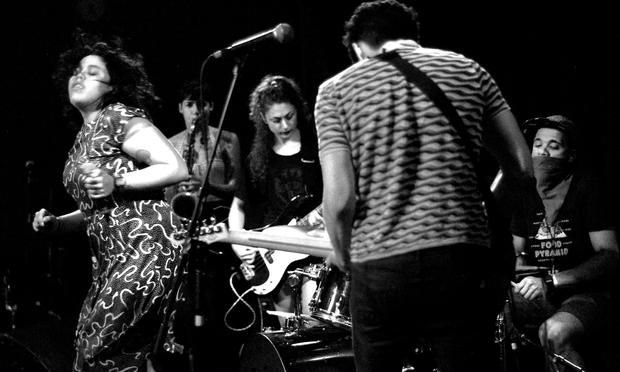
Punk has always had the capacity to speak the uncomfortable truths. loud, aggressive music that can provide a platform for expressing frustrations and anger: Some bands focus on the micro level, channelling and working through personal pain; others work by addressing larger social issues, corrupt institutions, or political disenfranchisement. Downtown Boys specializes in the latter, writing combustible and challenging songs that forcefully face difficult subjects head-on.
The provocative title of Downtown Boys’ record, Full Communism says it all: this is a band enraged and calling out injustices and a broken status quo — from the ever-widening gaps in economic class and the prison industrial complex to racism, homophobia and gender inequality. And as the album’s incisive opener, “Wave Of History,” states, the Providence, Rhode Island group both asserts itself as part of a younger group of similarly socially-active bands — like Priests, Pinkwash, or Perfect Pussy — and empowers a new movement to unite and create change. “Wave Of History” begins with sharp, militaristic snare hits and simple twin saxophone fanfare — which adds a rhythmic jazz-infused skronk counterpoint to the blistering fast guitar downstrokes. Then, vocalists Joey DeFrancesco and Victoria Ruiz kick the door wide open as they trade their explosively-charged call-and-response chants: “Riding in on a wave, a wave of history!… Not one step back, on the wave of history!…” And later, in unison, they declare “We are the surge!” — a line that will surely get a crowd riled up.
As a frontwoman, Ruiz, is especially charismatic; she’s a force of nature capable of toggling seamlessly between English and Spanish in many of her songs — sometimes from line-to-line, as if giving voice to those who may not be in a position to be heard. When she willfully shouts and spits “Necessity!” amid that unrelenting fury, you can feel the desperation in her voice with increasing urgency. Even in just under two unrelenting minutes, and without many words, Downtown Boys manages to say a lot.

The STOOGES – ” Funhouse ” Released July 7th 1970
Posted: July 7, 2015 in CLASSIC ALBUMS, MUSICTags: CLASSIC ALBUMS, Elektra Records, Fun House, Iggy Pop, The Stooges

The Stooges‘ debut album from 1969 didn’t even crack the Top 100 album chart, so it wasn’t like too many people were waiting for the follow-up. Which was just fine. Without expectations, the band was free to explore almost any path it wanted to on the follow up “Fun House”. The Stooges (1970): Here’s where the first seeds of punk sprung, and with such force that ‘Fun House’ still sounds fresh. The funny part? Iggy Pop says he drew inspiration not from fellow modernists like MC5, but from Chicago blues master Howlin’ Wolf.
Still, their record company had faith in them and the Stooges were slowly picking up fans with their plugged-in, distortion-overloaded brand of scuzzy garage rock. So the second album, while maybe not as anticipated as some of the other post-hippie records that were starting to trickle out around the same time, was still under the watchful eye of the band’s bosses.
The label enlisted former Kingsmen keyboardist Don Gallucci to run the sessions, which were already booked for a two-week period in the middle of May 1970 in Los Angeles. And like former Velvet Underground member John Cale, who produced the Stooges’ self-titled debut, Gallucci realized that the group’s proto-punk attack wasn’t easily captured on tape. So he did what he figured was the most sensible thing: He had the band play the handful of new songs it had written for the album a dozen times each, sorting through them later to pick out the most usable version.
Not that that made things any easier. As anyone who’s heard Fun House in the years since its release in July 1970 (or especially the seven-disc, 1999 box set 1970: The Complete Fun House Sessions) can tell you, the record is one of the most abrasive, pummeling and aggressive sonic assaults ever made. Capturing that on tape, and then settling on a definitive version, must have been no easy task.

But because the Stooges really had almost nothing to lose — their debut made little to no impression in mainstream circles they pretty much recorded Fun House the way they played live with their amps cranked to full power, band members huddled together in one room, singer Iggy Pop recreating his stage show in the studio.
The result is one of the most primal and unhinged albums ever made. Saxophone player Steve Mackay, a temporary addition to the band who also came from the Stooges’ hometown of Detroit, blurts his way through songs in an acid-damaged take on free-jazz pioneer Ornette Coleman’s improvised soloing, pushing Fun House into a sort of avant-jazz proto-punk garage scuzz-rock genre all its own.
From the opening smackdown combo “Down on the Street” , The Stooges could groove with the best of ’em as ‘Down On The Street’ proudly proves. The opening track on the band’s 1970 classic ‘Funhouse’ is hard, loud and heavy for sure, but that rhythm section of Scott Asheton and Dave Alexander drive this thing home. Ron Asheton’s guitar is brutal, while Iggy is in full force here. The song was released as a single, with added organ that, while adding a cool spice to the mix, ultimately cluttered the song. Pure bravado like this needs no extra ingredients.
“Loose” How many different ways can we say ‘sex,’ ‘danger,’ when talking about the Stooges? This is not music for the faint of heart, or the lame of mind. It’s gutturally cerebral, or was that cerebrally guttural? Either way you slice the cake, it oozes the same tasty slime to bathe in. Bring your unhinged self and immerse in the glory of it all. When Iggy sings, “Now I’m putting it to you straight from hell,” he ain’t kidding, and when he sings, “I’ll stick it deep inside,” well, we’ll leave that one up to you.
“T.V. Eye” “Ladies and gentlemen, welcome to violence, the word and the act.” One of the most righteous screams ever opens this barn burner. The guitar riff from the heavens above pummels into the brain as the onslaught builds. The whole song sounds like a riotous street fight as guitars slash like razors, drums splatter like machine gun fire, and Iggy screeches like a Molotov cocktail.
The closing “L.A. Blues,” probably the most unstructured song released by a major label during the first half of the ’70s, “Fun House” is a mess of sloppy guitar riffs, thrashing drums, larynx-shredding screams and saxophones . check out “1970” Over a Bo Diddley-inspired rhythm, the Stooges blast through this primal, life affirming rocker. The song’s riff, described by original Damned guitarist Brian James as “instant mayhem,” is relentless. You simply can’t help but get sucked into the vortex here. This song, and the attitude within, probably put more fuel in the tanks of punk rock, noise rock, and grunge, but still trumps them all in spades. The chaos grows and by the end of the song, the appearance of wild sax from Steve Mackay takes the whole thing into the stratosphere.
It’s also brilliant, a pre-punk milestone years ahead of the movement it unwittingly helped inspire.
Any surprise then that the album fared even worse than its predecessor? The Stooges didn’t even make the Top 200 this time, and when the band regrouped, after breaking up, a couple of years later to record its third LP, “Raw Power”, it was for a different record company. Drug addiction, alcoholism, low record sales — nobody could blame Elektra for severing its ties with the band. And hardly anyone noticed. At the time, anyway. It would take a fair few years, but “Fun House” eventually became known as an early punk classic, a landmark that inspired its fans to pick up instruments, not bother to tune them and bash out unregulated noise that amounted to a merciless attack on all accessible senses.

