Ben Hopkins and Liv Bruce are radiant beings who make every minute louder, more glamorous and deeply personal as in their band PWR BTTM . The punk duo has announced the new album “Pageant”, its follow-up to 2015’s Ugly Cherries, with the outrageous first track “Big Beautiful Day.”
“There are men in every town / Who live to bring you down,” Hopkins sings. “My advice is to look incredible / As you make their lives regrettable / By being your damn self.”
This is part of PWR BTTM’s core: revel in, and shout out, your individuality, even and especially in the face of misguided masculinity. But PWR BTTM is quick to extend their sympathies to those same men, “who never had a choice but to grow up and be scared to be your friend.” Pageant comes out May 12th on Polyvinyl Records.
“Big Beautiful Day” is taken from our new album, Pageant, out May 12th, 2017
47 years ago tonight, The Who performed at Leeds University in Leeds, UK on February. 14th, 1970. The recording of this landmark concert became known as the greatest live album in Rock history
Classic Rock photographer Ross Halfin is an avid record collector – especially when it comes to The Who. He owns multiple versions of the band’s classic Live At Leeds album, and here he tells us through ten different versions of them.
The Who’s “Live At Leeds” is among the greatest live rock album of all time, The original on vinyl is way better than the uncut, remastered version, which is too much. It goes on for too long. The original edit by Pete Townshend captures all the dynamics of The Who as a band. And the vinyl release sounds better.
In England, there were three variants of “Live At Leeds”. The first came out with a black-stamp cover, and the first 1,000 copies of it had the ‘Maximum R&B’ poster from The Who at the Marquee [in 1964] inside. There have been versions with blue stamps and red stamps as well.”
There have been Taiwanese versions, Spanish versions, a Peruvian version with a picture of Townshend jumping on the cover… The critic Nik Cohn, who inspired Pinball Wizard and wrote the article that became Saturday Night Fever, reviewed “Live At Leeds” for the New York Times, and called it a “hard rock holocaust”. The hardest version to find, then, is the one that came out in Israel with Cohn’s quote translated into Hebrew on the cover. It had to be withdrawn.
Since its initial reception, Live at Leeds has been cited by several music critics as the best live rock recording of all time
Son Volt’s new album, Notes of Blue, is “a tribute and a chance to connect with icons and heroes” for group founder and leader Jay Farrar.
The 10-song set — Son Volt’s eighth studio release and first in four years, due out February. 17th is the culmination of a pair of projects Farrar had in motion. “I was working on two different kinds of projects at the same time,” he says. “A Nick Drake, English folk-inspired project and a more blues-oriented band project.
Ultimately I felt like there was a commonality of purpose there, a common ethic, especially in terms of finger-picking and alternative tunings being a method with all those guys. So eventually those two projects just merged into one.”
The result is an album that has blues at its base such as the raw shuffle of “Sinking Down,” but with ambience and texture that can be heard in other tracks such as “Lost Souls” and “Cairo and Southern.” “I was aiming for where blues and folk and country music converge,” Farrar explains. “Ultimately I see it as kind of folk record and a rock record with elements of the blues — all of those things. There’s even some garage rock thrown in there,” such as on the stomping “Cherokee St.” and “The Storm.”
The “icons and heroes” he sourced for Notes of Blue were Nick Drake, Skip James and Mississippi FredMcDowell, specifically tapping into those alternate tunings he mentions. “At first they might seem a bit incongruous together, but I felt like there was a certain mystique attached to the guitar tunings and guitar voicings those guys used,” Farrar says. “They can open a lot of doors or provide a lot of different avenues to go down. It emanates from looking for ways to be challenged, really.”
Farrar was also anxious to strap on his electric guitar again after Notes of Blue predecessors such as 2013’s Honky Tonk and 2009’s rootsy American Central Dust. “Part of that meant bringing out the old Webster Chicago amplifier I used for Son Volt’s (1995 debut) record Trace, the amplifier that’s on the cover of that record,” Farrar says. “It’s a low-powered amp that just delivers a big sound, and I just wanted to revisit the sound of that amp. It sort of represents a quintessential sounding blues amplifier.”
Farrar plans to return to standard guitar tuning for his next project, but first he’ll be taking Son Volt on the road to support Notes of Blue. The trek kicks off March 2nd in Little Rock, Ark., and so far has dates booked into mid-May, including the Stagecoach California Country Music Festival on April 28. The new songs will be fun to play live, he predicts, but Farrar acknowledges that the different tunings will require some coordination with his techs in the wings. “We’re going to have some long talks, with charts about what guitars to use when,” Farrar says. “It’s going to be an adventure.”
Kallie North and Jessy Wilson, the duo known as Muddy Magnolias, quickly forged a musical friendship in 2013, one that has blossomed into a thrillingly organic blend of Seventies funk, seductive R&B, country roots and soul-searing gospel music. Yet, in the tough-minded title track from their upcoming LP, Broken People, they eloquently express the jagged nature of walking through life feeling lost and disconnected, harnessing a vibe that’s reminiscent of the Staple Singers and other socially conscious acts of that genre-blending era. Produced by RickBeato, with additional production by Mario Marchetti and Butch Walker, the 11 tracks on Broken People were recorded in Atlanta and Nashville in late spring 2016.
“Tell me what happened in this world?/We just don’t know anymore,” sing the women of Muddy Magnolias in the opening track on their striking debut. It’s the right lyric for the country right now. The music, too, reflects something relevant. As the gaps between us seem to be widening, the songs of Muddy Magnolias bridge divides—specifically, between city and country, blues and soul. Accordingly, the two vocalists who make up the group come from highly divergent locales. Jessey Wilson, who sang for a spell with John Legend, lived for a long time in Brooklyn before migrating to Nashville. There, she met the Texas-born Kallie North. For a twist, both singers take the lead in their songs without canceling each other out. In Wilson’s vocal sound you hear some of a young Aretha; North’s bold sounds can recall a fledgling Bonnie Raitt.
Jellyfish’s career was all about being in the wrong place at the wrong time. Their painfully short two album span came when grunge had taken a somewhat angst-ridden hold of the nation’s sensibilities and Kurt Cobain’s cries for help were the defining noises of the era.
Against this, Jellyfish’s love of harmony and hook lines were considered desperately uncool, but both their debut album, “Bellybutton” and the glorious sophomore effort “Spilt Milk” have consequently not only stood the test of time but actively improved with it.
From the slim pickings of just two studio albums (1990’s Bellybutton and Spilt Milk from 1993) and a brief four year existence,Ominvore Records have compiled various ‘new’ releases including, in 2012, the “Live AtBogarts” set and more recently “Radio Jellyfish”(a collection of largely unreleased radio sessions). A special mention must go to the most satisfying Omnivore set for Jellyfish aficionados, the “Stack A Tracks” two-CD collection which offered up instrumental versions of both albums.
Both Bellybutton and Spilt Milk are two-CD sets and the bonus discs for each contain – more or less – the entire albums in demo form (and more). These demos are incredibly well developed and quite similar to the polished album versions. “I remember thinking we should not veer to far from the arrangements we came up with on the demos, because I thought they were really good,” reveals guitarist Jason Falkner in the excellent notes. Some of these demos actually predate even the Fan Club set with the UK CD singles for The Ghost At NumberOne (CUSCD10) and New Mistake (CUSCD11) bolstering their appeal with some of those unheard recordings.
Bellybutton grows from the original 10-tracks to 36, while Spilt Milk echoes this with 25 tracks on top of the original 12. These are presented as eight-panel style digipacks with extensive booklets which include new interviews with various band members (and producer Albhy Galuten) and also a track-by-track guide by songwriters and core members Andy Sturmer (drums/vocals) and Roger Manning Joseph Jnr (keyboards/multi-instrumentalist). In the main, these are nice looking packages
Spilt Milk is a wonderfully unpretentious homage to pop music in its essential form: catchiness and melody are the keynotes here. From the soaring ‘Joining A Fan Club’ – with typically arch lyrics on fanboy culture and harmonies cut from Queen and The Beach Boys – to the psychedelic pop doodlings of ‘Sebrina, Paste and Plato’ the band explore a range of possibilities within the pop format – and well beyond. Never less than enjoyable, nearly always exhilarating, Spilt Milk is an absolute joy.
If anyone became worried about Ryan Adams and his broken heart following his acrimonios divorce from Mandy Moore, they won’t find much peace after listening to the new album “Prisoner”. From the opening track and lead single, “Do You Still Love Me?,”Adams sets the stage for an album full of heartbreak and confusion, frustration and uncertainty and plenty of questions, with the first being, quite simply, “Do you still love me?”
Though he may never get a clear answer to that question and others, Prisoneris far from a hopeless album. Sure, on a song like “Shiver and Shake,” he sings the heart jerking lyrics, “I miss you so much, I shiver and I shake / I’ve been waiting here like a dog at the door / You used to throw me scraps / You don’t do it anymore,” but then on “Doomsday” he stands up and admits, “My love, we can do better than this / My love, how can you complicate a kiss.” Somehow, in the midst of such significantly personal and affecting lyrics, Adams manages to display a type of confidence one can only find after picking up the remains of a destroyed heart and shaking it off.
Beyond the heartache, though, Prisoneris soaked in reverb and chorus, radiating the best of the ’80s at nearly every turn. Fans and critics alike are quick to point out the undeniable comparisons of Adams’ vocals and the record’s production quality to the likes of Petty or Springsteen, and nowhere is that more obvious than on “HauntedHouse” and “We Disappear.” When either track starts, close your eyes and you’ll swear you’re listening to a never-before-heard Springsteen outtake.
This ’80s-drenched sound shouldn’t come as much of a shock to fans of Adams; from a production perspective, Prisoner will soon be viewed as a companion piece and ultimately, a fulfillment, to his 2014 album “Ryan Adams”. In fact, as far as Adams is concerned, he’s finally perfected the sound for which he’s long been looking .
Throughout the new disc, Adams is at his best and his most brutally honest. Though he may not always find answers to the questions he asks, he manages to dust off his heart, toss it on his sleeve, and continue playing the part of a prisoner in love. Whether fans are drawn to Prisonerbecause of the pristine sound or the wide-open, unobstructed look inside the singer’s heart—or both—they’ll be greeted with a quintessential Ryan Adams record from start to finish.
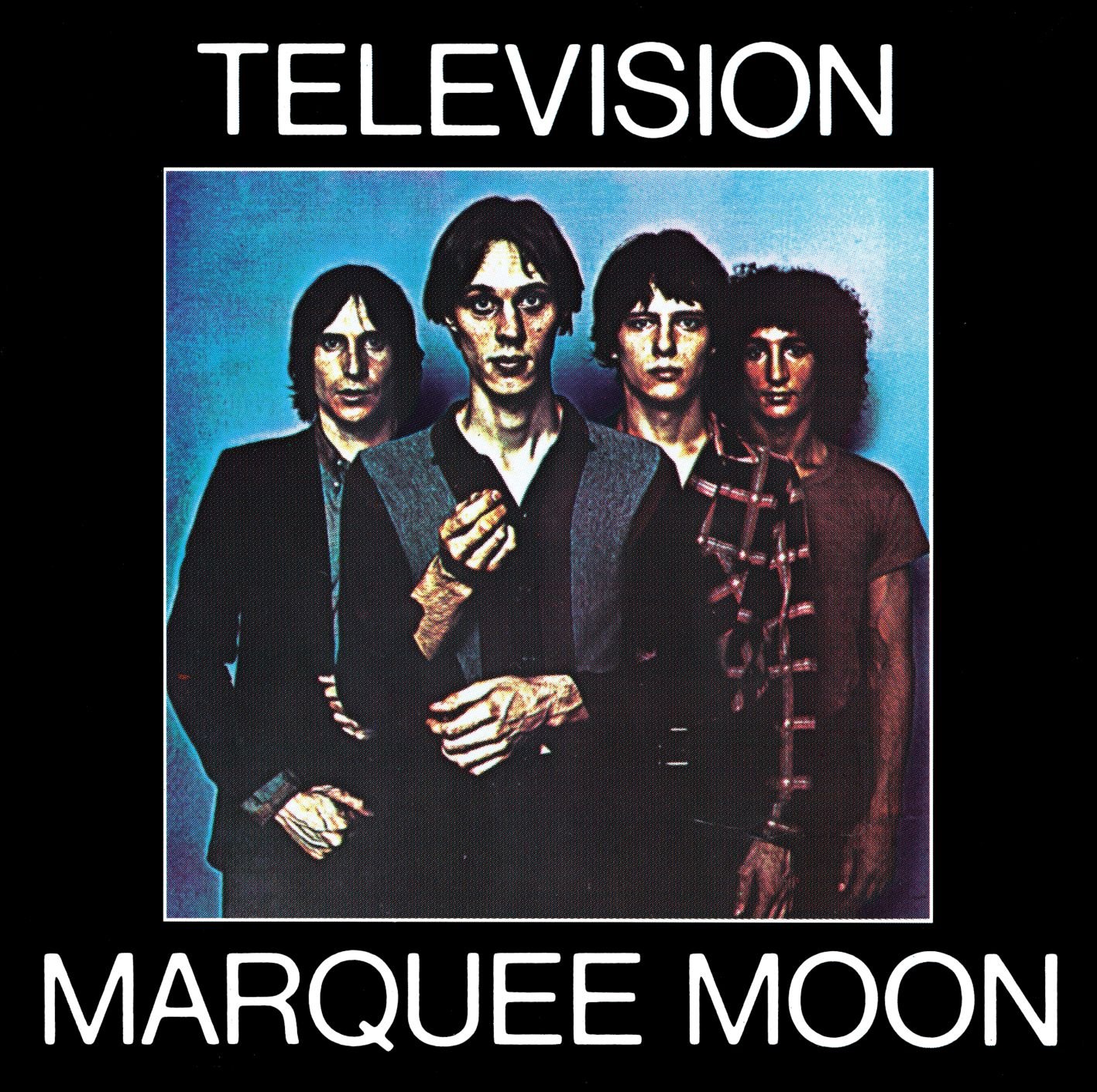
Released on February 8th in 1977: New York CBGB’s-scene band Television released one of rock’s all-time most influential guitar albums, ‘Marquee Moon’, on Elektra Records; made up of tense garage rockers that spiral into heady intellectual territory, the band fused blues structures with avant-garde flourishes while stripping away any sense of swing or groove; led by the 10:40 title track, the dual guitar work of Tom Verlaine and Richard Lloyd abandoned power chords in favor of almost jazz-like interplay, melodic lines & counter-melodies; it was crucial to the development of the post punk scene that followed; though critically-acclaimed at the time of release, it was not a commercial success – it is now widely regarded as one of the greatest & most influential statements in the history of alternative rock music…As founding fathers of the ’70s New York City underground rock scene, among the first bands who played CBGB, Television found themselves sticking out even among the out crowd.
Television delivered a tangled, serpentine guitar spar over Marquee Moon‘seight sprawling songs, and in twice the length of your conventional punk album, the final running time coming in at 46 minutes (and more than 10 of those minutes are reserved for the title track alone).
While that all might sound like a formula for an esoteric mess, guitarist/frontman Tom Verlaine, his six-string foil Richard Lloyd, and the indomitable rhythm section of Fred Smith on bass and Billy Ficca on drums could just as easily write catchy songs. The album’s longest track, its title cut, comes across as a sort of sonic response to Verlaine’s old girlfriend Patti Smith and her 1975 solo debut masterpiece Horses in its patterns and rhythms.
The band chose acclaimed English engineer Andy Johns to produce the album on account of his work on such early-’70s classics as Mott The Hoople’s Brain Capers and the Stones “Goats Head Soup” . However a lifestyle clash with Johns and Television produced studio tension from the outset. Once they got on the same page, Johns and Television created a literal master’s class in the kind of crisp yet sharp production that enhanced the angularity of their rhythms without losing their sense of melody and pop appeal.
“We wanted to rent a rotating speaker to get the sound for [‘Elevation’],” Lloyd explained. “But the rental people wanted way too much. So Andy came up with an idea. He took a microphone, and while I did the guitar solo to ‘Elevation,’ he stood in front of me in the studio, swinging this microphone around his head like a lasso. He nearly took my fucking nose off. I was backing up while I was playing.”
The risks Johns and the band took in the studio paid off. Marquee Moon became an iconic record for its mythical, godlike status amongst both music critics and young musicians, a select few of whom would go on to form bands
Spectres release their second album ‘Condition’ via Sonic Cathedral on March 10th. The follow-up to their acclaimed 2015 debut, ‘Dying’, it was recorded by Dominic Mitchison in the band’s adopted home city of Bristol and mastered by Frank Arkwright (Mogwai, 65daysofstatic) at Abbey Road Studios in London.
‘Condition’ is louder and more abrasive than their debut, but also a real progression. It sounds huge and adds a genuinely innovative and confrontational edge, partly inspired by last year’s remix album, ‘Dead’, which saw everyone from Factory Floor to Richard Fearless instructed to “kill” the songs from ‘Dying’.
“There were discussions about experimenting with electronics, but the idea soon petered out when we realised we still wanted to experiment with guitars,” reveals singer and guitarist Joe Hatt. It’s true that a track such as ‘EndWaltz’ has a relentlessly pounding, almost techno structure, in contrast to the kinetosis inducing dirge of ‘Dissolve’ – the first single from the album which appeared as an edible tablet download with a suitably stomach-churning video to match late last year. Elsewhere the almost restrained (by Spectres’ standards) white noise and wordplay of ‘A Fish Called Wanda’ and the sprawling ‘Colour Me Out’ are counterbalanced by brutal assaults such as ‘Neck’ and ‘Welcoming The Flowers’, which keeps threatening to drown itself in its own roiling diamond sea.
“On this album we became even less interested in actually playing guitar,” explains Hatt, “which meant that we got more into experimenting with the sounds we could get out of them when brutalising them and letting the feedback do the talking.”
‘Dissolve’ is the first single from Spectres’ new album, ‘Condition’, due out on March 10th, 2017
Spectres were formed in Barnstaple, North Devon in 2011. After moving to Bristol a couple years later they self-released a few EPs and singles on their own Howling Owl label, before joining forces with Sonic Cathedral for 2015’s ‘Dying’, their incendiary debut that they promised would “snap people out of their comfort zones. We want our noise to smack the spoon out of their mouths that is feeding them the warm diarrhoea that is served by start-up PR companies”. With the resulting largely positive coverage everywhere, The Times and The Guardian to BBC Radio 1 – not to mention people fleeing their gigs, hands pressed tightly over bleeding ears – would suggest they went some way to achieving this aim.
“We’ve managed to get way further than we ever should have considering the music – and enemies – we make,” admits singer and guitarist Joe Hatt, “so now it’s just a question of enjoying things until the van finally breaks down and we can’t afford to get it fixed again. We’ve all somehow still got the same jobs as two years ago, we still rehearse and record in the same spaces, we write music in the exact same way, so even though things have grown in terms of gigs and our audience, we are still the same horrible lot. Lack of success will never change us.”
Scottish alt-rock duo Honeyblood have been touring hard behind last year’s sophomore effort “Babes Never Die”, and those experiences have been funneled into a fun video for the album’s excellent title track. StinaTweeddale and Cat Myers captured phone video from backstage and the highway, and it’s all rolled up along with an abundance of performance footage into one of those classic road videos one that really gives you a sense of who these people are while ultimately letting the super-catchy music speak for itself. Here’s what Tweeddale had to say about it:
This video has such a special significance to us. It was filmed over three months of shows throughout the US and UK. It’s a real snapshot of that tour and what it’s like for us on the road. Most of the travel and backstage footage was filmed by Cat and I on our phones. However, we could not have made it without great folk getting involved and filming at the shows! The video was edited by Gareth Goodlad (On Red Productions).
Taken from the new album ‘Babes Never Die‘. Out now on Fat Cat Records.
With Trump’s first 100 days in office upon us, action must be taken to protect the causes that will come under threat from this administration. Our First 100 Days seeks to aid in that protection. Joining together with artists and labels we will be releasing one rare, unreleased or exclusive song per day to you via Bandcamp.
For a minimum contribution of $30, supporters will be able to access all 100 songs in the project, including new music from Angel Olsen, How To Dress Well, Toro Y Moi, The Range and many more.
All profits raised from Our First 100 Days will go directly to organizations working on the front lines of climate, women’s rights, immigration and fairness.
The project was started in conjunction with Secretly Group and 30 Songs, 30 Days, and aims to raise funds and awareness for organizations supporting causes that are under threat by the proposed policies of a Trump administration. This project is produced with the help of Revolutions Per Minute, an organization that provides strategy and support for artists making change. Fantastic concept, wonderful music and a great way to start work every day!