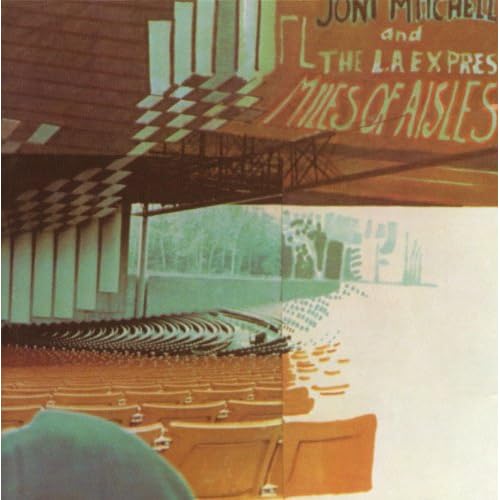
Miles of Aisles is the seventh album by the Canadian Singer Songwriter Joni Mitchell, released in 1974 on Asylum Records . It was her first live album, a double album documenting her concerts in support of the Court andSpark album with her backing band for the tour, the Tom Scott L.A Express . Recorded March 2nd – 4th and August 14th-17th 1974 The Universal Amphitheatre, Los Angeles Music Center and Berkeley Community Center.
Joni Mitchell’s first live album arrived at the peak of her fame. Recorded a couple months after her breakthrough Court and Spark debuted, the Canadian singer-songwriter documented the California stops on the tour supporting the new LP. Performing an expansive collection of tracks from her 1968 debut Song to a Seagull onward, Miles of Aisles carefully avoided the hits. “No one ever said to Van Gogh, ‘Paint a “Starry Night” again, man,'” said Mitchell before playing “Circle Game.” In 1991, she made the comparison: “I never wanted to turn into a human jukebox. I haven’t used up all my ideas yet. But I’m working in a pop field, and whether they’re going to allow an older woman to do that is an open question. It requires a loyal, interested audience who believes in my talent.
Universal Care is cathartic. Kal Marks’ are finding a release… a crushing, beautiful, absorbing release, an exploration of spirit and emotion in the hardest of times. Their latest LP, Universal Care, due out February 23rd via Exploding In Sound Records, finds the Boston trio at their most dynamic, seeping with vivid colors and sonic experimentation. Its a new approach for the band, one that began on shaky ground, an uncertainty that lead the band to create an album both brilliant and challenging. Universal Care is restless, drawing on personal hardship and these tumultuous times, taking life as it comes. The trio of Carl Shane (guitar, vocals), Michael Geacone (bass) and Alex Audette (drums), have created a record full of sonic risks and rewards, thick textures, skin crawling sludge, and hazy pop. Through unexpected twists and turns, the band capture a range of honest emotions and struggles without boundaries. Crushing distortion, atmospheric drifts, shifting rhythms, and warm acoustics all swirl together in unison. There’s a freedom in their agitation. A welcoming catharsis.
Kal Marks’ new album “Universal Care” will be released in early 2018
Formed as a solo project over a decade ago, the band has been evolving ever since, weathering the darkness with a sense of humor and one of Boston’s most explosive live shows. Having released two critically praised albums, LifeIs Murder (2013) and Life Is Alright, Everybody Dies (2015), Universal Care is a step forward, a brilliant new record that finds the band darting between their most accessible and chaotic moments with natural grace and fury. They’ve spent the past six years playing throughout the country, decimating one audience at a time,
Vocals & Guitar: Carl Shane
Bass: Michael Geacone
Drums: Alex Audette
“If post-punk speaks the language of disaffection, then don’t call Ought a post-punk band. It’s easy to listen to Tim Darcy’s wry vocal inflection and find cynicism in it, but Ought’s music swallows angst and spits it back out in the form of life-affirming songs. They seek to inspire with “Sun Coming Down” its an impulsive, interpretive ode to existence that, on particularly bad days, reminds me of all that I have left under this big, beautiful, blue sky
Ought Known the value of a song’s lyrics, David Byrne once said, “In a certain way, it’s the sound of the words—the inflection and the way it’s sung and the way it fits the melody and the way the syllables are on the tongue—that has as much of the meaning as the actual, literal words.” It seems Ought’s Tim Darcy takes a cue from this emphasis on lyrical delivery over lyrical content in the Montreal-based, post-punk band’s newest single “Men for Miles”. It’s the second track off their sophomore LP Sun Coming Down on Constellation Records
As you listen to the song’s frantic energy unfurl, you get a sense that Darcy is someone who lives in his own head most of the time. He proposes anarchy (“bringing this whole fucker down”) only to follow it up with clinical logic and rationality (“It came with instructions / It’s neither here nor there”). Over a heaping layer of rhythmic guitars and drums, he asks with a combination of paranoia and distrust, “What did you see? / What did I see?” In “Men For Miles”, the mental cage breaks open and unleashes an anxiety-ridden stream of consciousness that makes more sense and feels more potent in listening to the idiosyncratic tone in voice than it ever would on paper.
The move to Stones Throw Records with the release of Mister Mellow—Washed Out’s first album since 2014 ushered in a new iteration of the group that is sample based, chopped and screwed with a dash of his tropical influence. This album is full of low-key, trippy club bangers that feel as though they were meant for ending your night in the early hours on an Ibiza Beach. Laid back melodies with dreamy vocals and the odd flush of psychedelica makes this a pretty enjoyable listen.
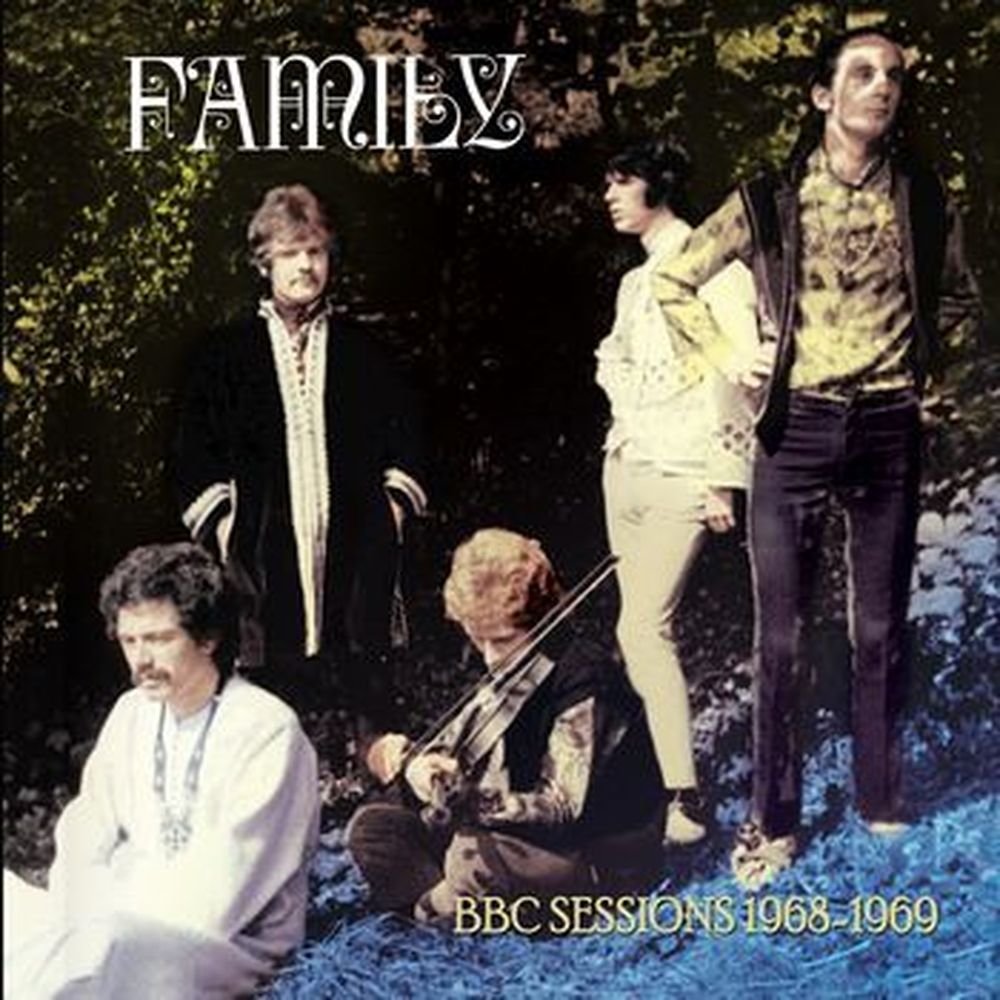
BBC Radio, Volume 1 – 1968-69 – Released by Hux Records in the United Kingdom in June 2004, this album features sixteen songs Family performed for various pop shows on BBC’s Radio 1 station between September 1968 and July 1969. Except for the July 1969 performances, which featured John Weider in place of Ric Grech, these recordings feature the original lineup. Many of these songs were composed with Grech and/or Jim King in mind and performed on the BBC before Family properly recorded them for disc, so many of these performances sound different from the officially released versions. Also included here is a stunning cover of J.B. Lenoir’s “I Sing ‘Um The Way I Feel.” More information on this release is available here.
BBC Radio, Volume 2 – 1971-73 – Released by Hux Records in the U.K. in September 2004, this album features fourteen songs Family performed on various pop shows on BBC’s Radio 1 station from March 1971 to May 1973. Although not as consistent as the earlier CD – these appearances on Radio 1 cover a period in which Family endured most of their personnel changes – it contains several interesting variations on their best-known songs that are definitely worth a listen, and an intriguing medley of “Processions” and “No Mule’s Fool” is included. More information on this release is available here.
BBC Radio, Volume 3 – 1970 – This Hux Records disc, released in the U.K. in August 2009, features rare BBCRadio 1 performances from January 1970 and September 1970, including Poli Palmer’s debut with the group. Among the surprises are Palmer’s instrumental “Here Comes the Grin” and a jam titled “Blow By Blow,” both available here for the first time anywhere. Most of the original BBC Radio 1 tapes that comprise this collection were “wiped” (Britspeak for “erased”), and so this album was derived from private off-air recordings. As this was done in 1970, sound quality is substandard, but it’s still worth a listen, as many of the songs featured here have arrangements different from the studio versions on the original Family LPs. More information on this release is available here.
Once Upon a Time – This box set brings together the complete Family catalog for the first time ever in a strictly limited edition complied with Roger Chapman’s co-operation, limited to 2,000 numbered copies and individually signed by Chapman. It includes all seven Family albums (plus one anthology) in mini LP Japanese-style gatefold sleeves, the Live album, plus two compact discs of previously unreleased alternative versions and rarities, three CD singles reproduced in original picture sleeves, and a 72-page hardback book about the band that features many previously unseen photographs and memorabilia reproductions – all for £125, or US$200. If you can afford it, buy it while you can. Also available is a box set of the four original albums of Chapman’s and Whitney’s mid-seventies band Streetwalkers, on CD.
Family an English rock band, active from late 1966 to October 1973, and again since 2013 for a series of live shows. Their style has been characterised as progressive rock, as their sound often explored other genres, incorporating elements of styles such as folk, psychedelia, acid, jazz fusion and rock and roll. Family’s sound was distinguished by several factors. The vocals of Roger Chapman, described as a “bleating vibrato” and an “electric goat”, were considered unique, although Chapman was trying to emulate the voices of R&B and soul singers with some reviewers noting however that Chapman’s voice could be grating and irritating occasionally.John “Charlie” Whitney was an accomplished and innovative guitarist, and Family’s often complex song arrangements were made possible through having multi-instrumentalists like Ric Grech and Jim King in the band and access to keyboards such as the Hammond organ and the new Mellotron. Family were particularly known for their live performances; one reviewer describing the band as “one of the wildest, most innovative groups of the underground rock scene”, noting that they produced “some of the rawest, most intense performances on stage in rock history”
The band’s rotating membership throughout its relatively short existence led to a diversity in sound throughout their different albums. Family are also often seen as an unjustly forgotten act, when compared with other bands from the same period and have been described as an “odd band loved by a small but rabid group of fans”.
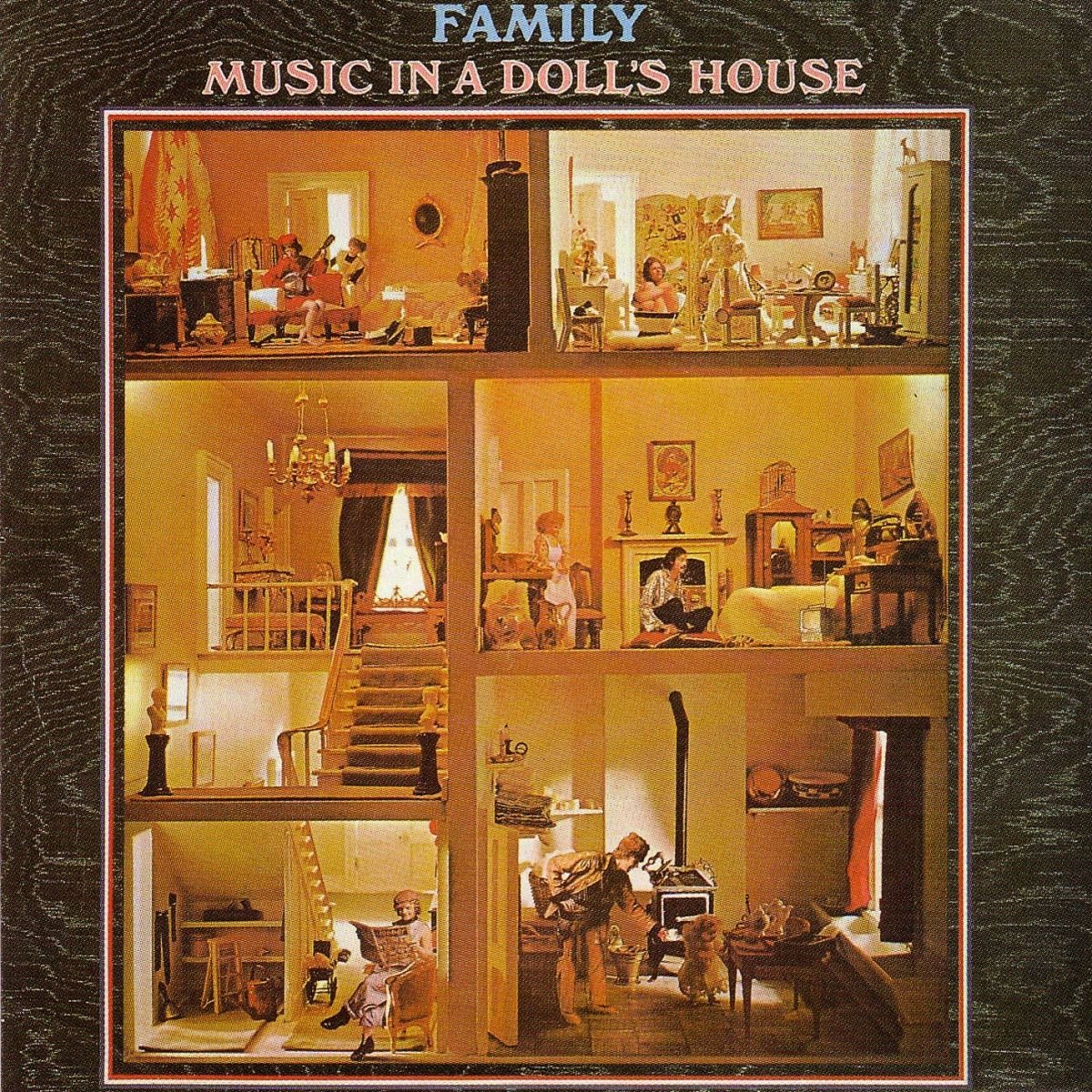
The band signed with the Reprise Records label (the first UK band signed directly to UK and US Reprise) and their debut album Music in a Doll’s House, was recorded during early 1968.Jimmy Miller was originally slated to produce it but he was tied up with production of The Rolling Stones’ album Beggar’s Banquet and he is credited as co-producer on only two tracks, “The Breeze” and “Peace of Mind”. The bulk of the album was produced by former Traffic member Dave Mason, and recorded at London’s Olympic Studios .
Mason also contributed one composition to the album, “Never Like This”, the only song recorded by Family not written by a band member. Alongside Pink Floyd, Soft Machine, The Move and The Nice, Family quickly became one of the premier attractions on the burgeoning UK psychedelic/progressive “underground” scene. Their lifestyle and exploits during this period provided some of the inspiration for the 1969 novel, Groupie, by Jenny Fabian (who lived in the group’s Chelsea house for some time) and Johnny Byrne. Family featured in the book under the pseudonym, ‘Relation’.
Music in a Doll’s House was released in July 1968 and charted in the UK to critical acclaim, thanks to strong support from BBC Radio 1’s John Peel. Now widely acknowledged as a classic of British psychedelic rock, it showcased many of the stylistic and production features that are archetypal of the genre. The album’s highly original sound was characterised by Roger Chapman’s vocals, rooted in the blues and R&B, combined with several unusual instruments for a rock band, courtesy of the presence of multi-instrumentalists Grech and King, including saxophones, violin, and cello . Music In a Doll’s House was as important to rock in 1968 as that other debut album from that year conceived in a tiny abode, the Band’sMusic From Big Pink. Like the Band’s freshman effort, Family’s first album presented a much more thoughtful and musicianly alternative to the excesses of much of the rock of the late sixties .
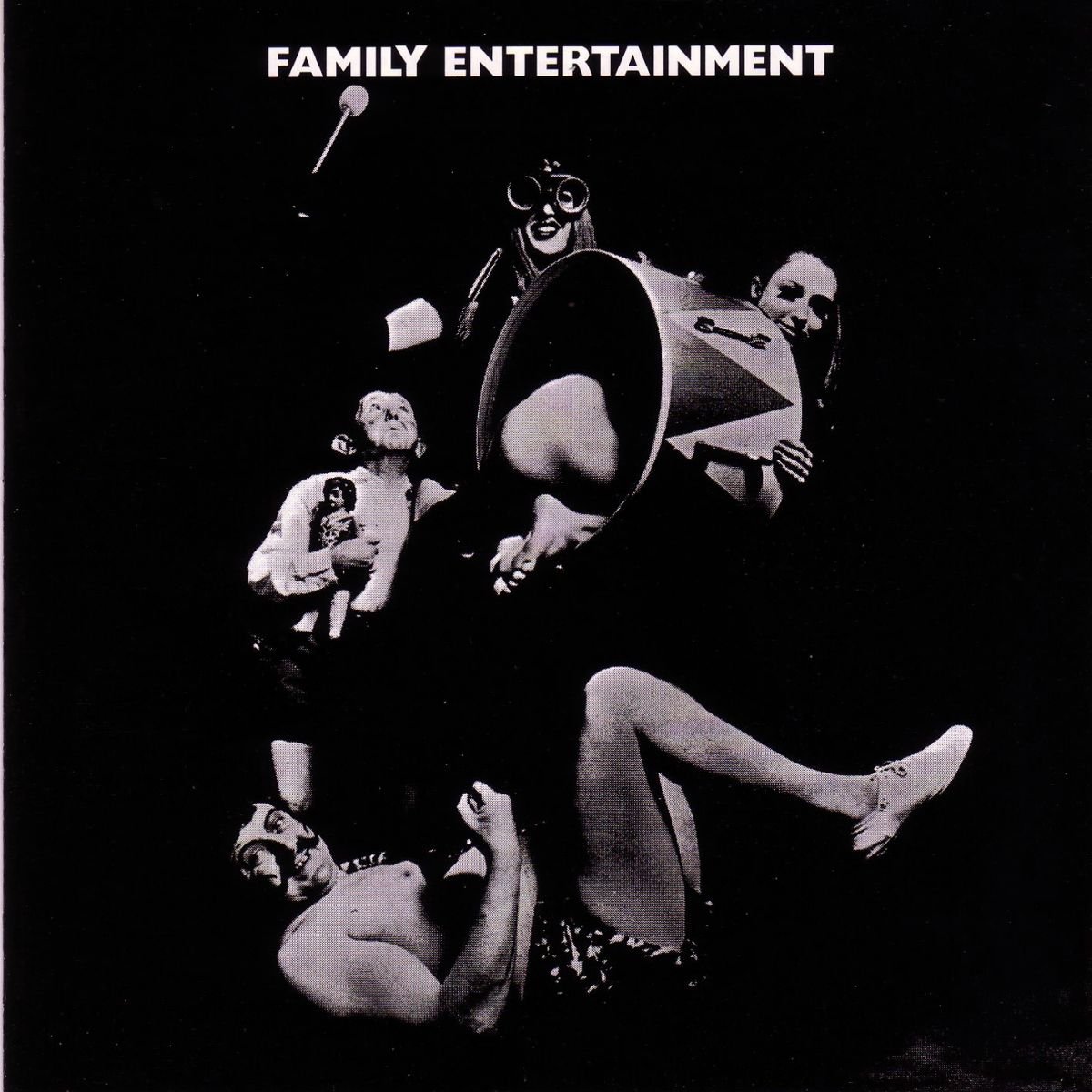
Family’s 1969 follow-up, Family Entertainment, toned down the psychedelic experimentation of their previous offering to some extent,and featured the single “The Weaver’s Answer”, although the group reportedly had no control over the mixing and choice of tracks, or the running order of the songs. The cover of Family Entertainment, depicting circus performers, was inspired by the sleeve of the Doors’s Strange Days.
Family Entertainmentshows these five musicians growing steadily. Chapman’s vibrato vocals evolve into more of a bleated growl, Whitney’s guitar riffs become more inventive, Jim King’s saxophone is decidedly funkier, and the already excellent drummer Rob Townsend becomes even more so. The biggest surprises, though, come from Ric Grech; not only does his improved bass work stand out dramatically here, he also wrote or co-wrote four songs on the album and sings lead vocals – sometimes with Chapman, sometimes solo – on these songs. His clear, flawless voice provided an an exciting contrast to Chapman’s primal shouting.
With the UK success of Family’s first two albums, the band undertook a tour of the United States in April 1969, but it was beset by problems. Halfway through the tour, Grech unexpectedly left the band to join the new supergroup Blind Faith; on the recommendation of tour manager Peter Grant, Grech was replaced by John Weider, previously of The Animals. A further setback occurred during their first concert at Bill Graham’s Fillmore East, whilst sharing the bill with Ten Years After and The Nice – during his stage routine, Chapman lost control of his microphone stand, which flew in Graham’s direction, an act Graham took to be deliberate.
Returning to the UK, the band performed at The Rolling Stones’ Hyde Park gig and the Isle of WightFestival that summer. In late 1969, Jim King was asked to leave Family due to “erratic behaviour” and was replaced by multi-instrumentalist John “Poli” Palmer.
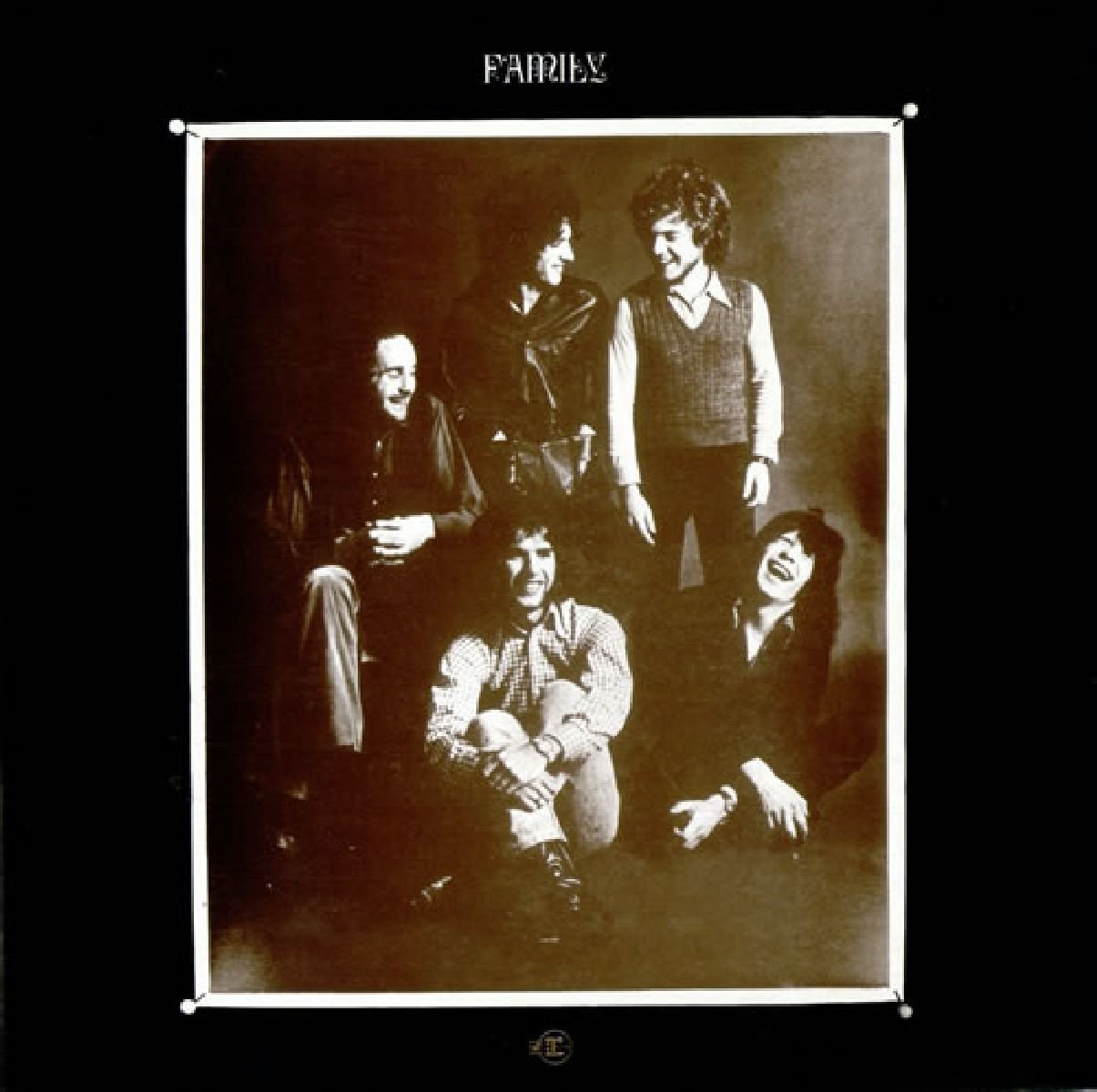
In early 1970, Family released their third studio album, A Song for Me; produced by the band, it became the highest charting album the band released, reaching No. 4 on the UK Albums Chart. The album itself was a blend of hard rock and folk rock. Issued in January 1970, A Song For Me is an act of defiance from a band that refuses to surrender to the kind of adversity that would have devastated other groups and comes back stronger and sharper than ever. Family had formed a new production company to replace John Gilbert’s management, and they gained a sense of freedom along with confidence in both their music and in taking full control of the recording process. The ten cuts on A Song For Me are an eclectic mix of country, folk, twelve-bar blues, and brutally hard rock in which conventional rock and roll boundaries are outlined and subsequently smashed. Weider’s rough bass certainly helped, and Palmer contributed an awesome array of skills as a pianist, flutist, and vibraphone player, but the remaining original members were no less potent. Charlie Whitney’s guitar slashed through chord changes with raw intensity, and Rob Townsend’s drumming was nothing short of a major assault. But it was Roger Chapman, as usual, who outdid everyone; his voice had now mutated in a hideously wonderful screech that, to paraphrase Robert Christgau, could kill small animals at a hundred yards.
Family’s follow up album Anyway, released in late 1970, had its first half consist of new material recorded live at Fairfield Hall in Croydon, England, with the second half a set of new songs recorded in the studio, Family had originally intended to follow up A Song For Me with a double live album, but they decided against it. Apparently, the problems were that their concert performances were rather undisciplined, sounding even more so on tape, and the sound quality seemed too rough to justify a two-record concert set. Also, they felt that any live versions of songs like “The Weaver’s Answer” and “Drowned In Wine” would pale in comparison to the studio versions. Family ultimately compromised by deciding to assemble a single album – side one would feature live performances of four songs that, with one exception (“Strange Band,” referred to earlier), were unavailable in studio form, while side two would contain four new songs from the studio. Hence Anyway, released in November 1970.
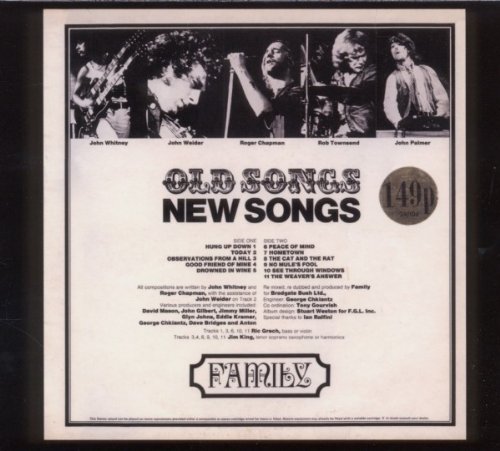
In March 1971 the compilation album, Old Songs New Songs, (which contained remixes and rare tracks) was released, but in June Weider left Family . He was replaced by former Mogul Thrash bassist John Wetton, who had just declined an invitation from Robert Fripp to join King Crimson.
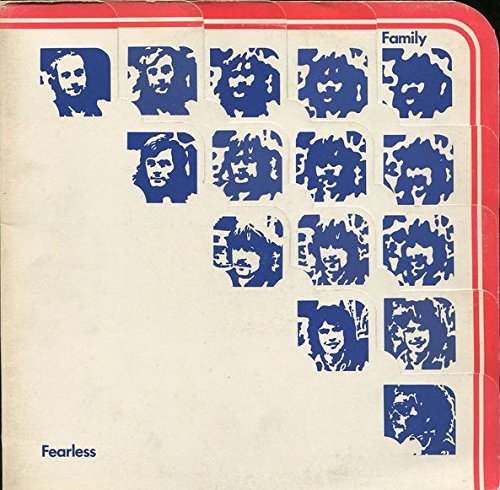
As with Grech in Family’s original line-up, Wetton also shared vocal duties with Chapman, and this line-up soon released Family’s highest-charting single “In My Own Time/Seasons” which reached No. 4, and the album Fearless in October 1971, This album, is the masterpiece, the best album Family ever made. Everything the group had become known for over the previous three years – curious arrangements, abrupt tempo changes, imaginatively abstract lyricism, stellar musicianship – clicked together here like a well-made combination lock. The group’s quest for innovation paid off handsomely on Fearless, with the band offering its tightest, most cohesive performances and an adventurous sampling of different rock styles. Like A Song For Me, Fearless is superb from beginning to end, but Fearless is better – albeit only slightly better – for two reasons. One is Fearless’s superior production, owing to the band’s greatly improved command of technical skills in the recording studio. The other factor was the result of their latest personnel change.
In June 1971, John Weider, having grown tired of playing the bass as his principal instrument, left the group. He was quickly replaced by an ambitious 22-year-old musician named John Wetton, whose steady, economical pacing anchored the music with great subtlety. Also, Wetton was an accomplished singer in his own right, offering a magnificent, unencumbered voice that stood out on its own andblended wonderfully with Roger Chapman’s voice no small achievement – in harmony arrangements. Chapman remained the center of attention, though, as his primitive bleating and the undeniably powerful passion that fueled it continued to make for decidedly uneasy (but still intriguing) listening.
In 1972, another album, Bandstand was released, which leaned more towards hard rock than art rock, featuring the singles “Burlesque” in late 1972, and “My Friend the Sun”, which was released in early 1973. Bandstand is the only Family LP not to feature an instrumental track.
For their sixth album, Bandstand, the group attempted a tougher edge to their sound; they experimented more with synthesizers, sought a grittier yet polished feel and, for the first time, introduced a female backing vocalist into the mix. The woman in question was Linda Lewis, a high-pitched London R&B diva of West Indian heritage who at the time was the girlfriend of Jim Cregan, who would soon become Family’s fourth and final bass player. Lewis’s five-octave range made her stand out considerably here, and she provided a formidable backdrop for Roger Chapman on this record.
The final outcome of all this innovation produced both mixed results and mixed reviews. Many critics and fans regard Bandstand as being superior to Fearless,Family came up with some really tough playing here, PoliPalmer concocted some wonderfully subtle synthesizer lines as well, and the group’s sound was crisper than ever. The whole, however, falls short of matching Fearless in terms of consistency. There are some undeniably weak moments here, and not every song onBandstandis as memorable as those that grace Fearless or A Song For Me.
The album’s sleeve was a similarly tremendous feat. Bandstand featured a cover depicting the image of – and die-cut in the shape of – an antique television set with the band onscreen posing in a dimly lit recording studio; opening the layered page revealed the television set’s mechanism underneath. Again, this was impossible to replicate to the letter on CD,
In mid-1972, John Wetton left Family to join a new line-up of King Crimson and was replaced by bassist JimCregan, and at the end of that year John “Poli” Palmer also left the band and was replaced by keyboardist TonyAshton, After Wetton’s departure (but before Palmer’s exit) Family toured the United States and Canada as the support act for Elton John,
In 1973, Family released the largely ignored It’s Only a Movie (and on their own label, Raft, distributed by Warner/Reprise), which would be their last studio album. Most of Family’s songs were written by the songwriting team of group leaders Charlie Whitney and Roger Chapman, but It’s Only a Movie is the only Family LP comprised entirely of Whitney/Chapman compositions. By the middle of 1973, Roger Chapman and CharlieWhitney felt it was time to dissolve their group, largely for three reasons. First, there was the lineup; there had been five personnel changes up to that point, meaning that there had been as many replacements as there had been original members. Chapman and Whitney feared that, with so many member turnovers, Family might soon turn into a parody of themselves; indeed, they were becoming notorious for being unable to hold onto a bass player for more than two albums.
Secondly, their songwriting was beginning to get formulaic, and they felt that their most innovative ideas had been exhausted. (Chapman: “The choruses came more and more. As you write [songs] you can’t help but standardize yourself.”) Thirdly, they realized that achieving mainstream success in America was a pipedream; though they stirred some interest in the U.S. with Bandstand so Family would call it a day .
There’s a famous quote from a movie. The movie was The Man Who Shot Liberty Valance and the often-repeated line was, “When the legend becomes fact, print the legend.”
Legend vs. fact. Reality and the silver screen. What goes on behind closed doors compared to what the public perceives. These are some of the themes of “Monty Got a Raw Deal,” the seventh track on R.E.M.’s 1992 album, Automatic for the People. In 1992, as R.E.M. were starting to record their eighth studio album, guitarist Peter Buck began to fiddle with a Greek stringed instrument called a bouzouki. Buck had already become enamored with mandolins, employing them on the band’s two previous LPs (1988’s Green and 1991’s Out of Time) before he began playing the bouzouki, which has a similarly stinging – but fuller, deeper – sound when plucked. He used the instrument to come up with a new tune.
“I wrote the main riff on my bouzouki in the hotel room in New Orleans,” said Buck, recalling that it happened in the middle of the night when a particularly affectionate couple were conducting business one room over. “I don’t know what the couple next door were doing,” he added. “It sounded like an orgy.”
The legend is that Buck came up with “Monty Got a Raw Deal” and, the very next day, R.E.M. recorded the basic foundation for it at Daniel Lanois’ Kingsway Studio in the French Quarter. But the facts appear to diverge from Buck’s memory.
R.E.M. made Automatic in a number of far-flung locales and one of them was the Crescent City. But the band made its way to New Orleans in March, a couple of weeks after they had already demoed a huge batch of tracks in their hometown of Athens, Ga. – at a local haunt, John Keane Studios. And back in Athens, R.E.M. had already tracked an instrumental called “Bazouki Song” (sic) that would turn into “Monty Got a Raw Deal.”
Now, it’s possible that Buck further fleshed out an already existing idea in New Orleans or that his passionate neighbors helped him distill the song’s dark sound. But his story just sounds better. Print the legend.
“I was up late, couldn’t sleep,” Buck repeated in 1992. “We put it down in one take and [singer] Michael [Stipe] said, ‘Oh, that’s my favorite song.’”
It was only fitting that when Stipe created lyrics for the instrumental track that he’d do his own mythmaking – in this instance, regarding the movie business. He was inspired to write about Montgomery Clift after a photographer who had worked with the late film actor visited R.E.M. during the band’s creative process.
“The Montgomery Clift thing came because there was someone who was a photographer on the set of The Misfits who came by the studio,” Buck said. “He had photos from it and he was talking about it. … We saw those pictures and, while we were recording it, Michael was talking about it.”
The Misfits, released in 1961, featured one of Clift’s last film roles (and the final screen appearances of Marilyn Monroe and Clark Gable). It followed the Clift’s fall from grace. In the late ’40s and early ’50s, the Nebraska native had become one of Hollywood’s young stars, emerging at the same time as fellow method actors Marlon Brando and James Dean. Film studios began to market the good-looking, but brooding, star as a sex symbol – an identity further enhanced by his role opposite Elizabeth Taylor in 1951’s A Place in the Sun.
The gossip mongers spread rumors that Clift and Taylor were an item off-screen too. But the two Hollywood hotshots were just very close friends. After all, Taylor revealed later, Clift was more interested in romantic relationships with men. But being openly gay – or bisexual, as people close to the actor have claimed – in ’50s public life was not a viable option. Like many others, Montgomery Clift concealed his sexuality.
That was only one of the tragedies of Clift’s relatively short life. In 1956, he fell asleep while driving, crashed into a telephone pole in Beverly Hills and smashed up his face. Although he underwent plastic surgery, Clift’s looks were forever changed (part of his face was immobile) and he entered a depression. He coped with the pain with alcohol and pills, became an addict and began a long, slow decline that ultimately ended with his substance abuse-related death in 1966. He was 45.
R.E.M. weren’t the first band to write about Montgomery Clift in a rock song. The Clash depicted the disaster of the actor’s final years in “The Right Profile” on London Calling. But Stipe took a more empathetic approach with his lyrics, finding obvious parallels between his present life as a bisexual rock star and Clift’s time as a closeted film star. Each had endured the harsh light of celebrity.
“Monty Got a Raw Deal” doesn’t dispute the power of the movies or the allure of fame, even if he regards the latter with a jaundiced eye. “The movies had that movie thing / but nonsense has a welcome ring,” Stipe sings, before warning, “and heroes don’t come easy.” Perhaps the idea is that you can’t be a hero unless you suppress a part of yourself to live up to what the popular notions of a hero might be.
The song goes from film noir (“mischief knocked me in the knees”) to European expressionism, as he sees Clift lynched in a tree and buried in the sand – conjuring images of From Here to Eternity – even if that was Burt Lancaster, not Clift, rolling on the beach with Deborah Kerr. Our narrator is implored to stay mum, leading the chorus: “Don’t you waste your breath for the silver screen.” As the song continues, “Monty” becomes both tragic and mythical. The character becomes bigger, more representative of the marginalized, seemingly surviving torture, death and being outed. “Raw deal,” indeed.
Bassist/keyboardist Mike Mills is unsure whether the title of “Monty Got a Raw Deal” is an accidental double reference to Monty Clift and Monty Hall (who hosted the game show Let’s Make a Deal) or a particularly wry joke by Michael Stipe. Mills is more confident speaking to his role in the song, strengthening the recording’s noir-ish feel with the Carter Burwell-like wheeze of a melodica and a lumbering bass part.
“The bass is actually an old Guild electric bass that’s only about two feet long. The strings are rubber surgical tubing. When you play it, you get sort of a sound like an upright bass,” Mills has said. “For me, that’s what I think of when I think of that song. It looks like a lap steel with surgical tubing on it. It’s very strange.”
It wasn’t the only offbeat, but effective, choice made when recording and doing overdubs for the song. In addition to Bill Berry’s steady, sharp drums, “Monty Got a Raw Deal” features intermittent industrial crashes – startling bursts of background stomping that suggest the hazards of Clift’s story, Stipe’s experience or other tragedies.
“How much of the song is real, how much of it is about Montgomery Clift and how much is about home?” Buck asked in 1992. “I couldn’t tell you.”
Swedish Singer Songwriter Natali Felicia has released her double single “Run Like the River” / “This Summer isCruel” this past spring. And so we were beyond excited at the news of a new track from the ethereal Stockholm songstress (who happens to be the daughter of renowned Swedish actor Kjell Bergqvist and fashion icon Yvonne Ryding.)
As it happens, “Say It” only makes us love her more. At once both sylvan and celestial, as serene as a forest, as sweeping as the Heavens, the song mixes Depeche Mode synth atmospherics, thundering drums and Felicia’s haunted, impassioned vocals. Indeed, the lyrics are something of a call to arms, as she fiercely proclaims, “Standing here we won’t run away / Standing here we say it louder than we’ve done before.”
“‘Say It’ is simply a song about people uniting to be stronger together,” she explains. “I wanted to paint a vision of people joining forces, ready to speak up and fight together – as we are and will always be stronger together.”
Considering the current state of just about everything, her timing couldn’t be more urgent.
It’s been a long seven years since Montreal’sWolf Parade released a full-length, having gone AWOL in 2011 after the release of their third full-length, Expo 86, the year before. Whatever may have transpired in the intervening years for the four-piece—who reunited in 2016 for a series of shows and an EP—it seems to have done them a hell of a lot of good. Co-frontmen Spencer Krug and Dan Boeckner lead the charge of these eleven songs with a renewed confidence and spark. Mixing futuristic electronics with good old fashioned rock and roll riffs, the pair—with drummer Arlen Thompson and guitarist Dante DeCaro in tow—trade their only slightly dissimilar voices and styles with each other to create, thankfully, a record very much worth the wait.
Proving their sense of humor is still intact after all these years, Wolf Parade kick off their rebirth with an apocalyptic song called “Lazarus Online.” Yet while the lyrics and the title recast the biblical character in a modern day setting of e-mails and online existence, the gloomy, piano-laced song itself treats the idea of death—and mourning—with the reverence and beauty it deserves. It’s about as strong a beginning as possible—perhaps one of the best songs of their career to date—and the pace picks up from there.
The jittery nerves of “You’re Dreaming,” the somber yet playful stadium-esque rock of “Baby Blue,” and the catchy melancholy and surreal nostalgia of “Am I An Alien Here”—which at times summons the spirit of the late David Bowie in a wondrous flourish of space-age morbidity—can stake claims to be near the top of the band’s repertoire. Similarly, “Artificial Life” and “King of Piss and Paper” end the album with a highly dramatic one-two punch of emotion that recalls exactly why this band were so revered to begin with and why their hiatus was such a loss. Only the Doors-esque “Who Are Ya” falls short of the expectations, its whimsical ’60s-style posturing feeling more like an insincere tribute than an actual Wolf Parade song.
It’s a small misgiving, however, and one that can be easily forgiven in the context of what surrounds it. Because this is a truly triumphant return, an ominous soundtrack to an Armageddon that seems to be getting closer with every damn day. Hopefully, we’ll have a bit more time to soak this up, revelling in the damage we’ve all done to ourselves before we all flicker, fade, and then explode in one final blast of nuclear regret that not even Lazarus would be able to return from. Make the most of it while you can.
A record that began with a message to the kids about control (“Drive”) ends with a song suggesting that we’re all powerless in the face of mortality. Time doesn’t stop. “The ocean is the river’s goal.” The only thing that’s truly “automatic for the people” is that every one of us has an end date. Even Andy Kaufman.
Maybe that’s gloomy – and there are plenty who think that the whole of R.E.M.’s Automatic for the People is pretty gloomy – but just because “Find the River” deals in death doesn’t mean it’s depressing. The finale gurgles with humanity, celebrating the path we’re all on, reminding the younger generations from the precipice of death: “All of this is coming your way.” Singer Michael Stipe’s goal doesn’t seem to be to inspire fear in the hearts of listeners, but acceptance. Enjoy your float downstream.
The resigned beauty isn’t just in the gently intoned words, but in the warm instrumentation. Most of it can be credited to the multi-talented Mike Mills, who played steady bass, soothing organ, Nashville piano, lots of acoustic guitars and that memorable melodica line on the track. With Bill Berry on drums, Mills recorded the song under the working title “10K Minimal” while R.E.M. were tracking demos in February 1992 at John Keane Studios in Athens, Ga. But because the demo was so fully realized, there was (10K) minimal work to be done when the “real” sessions began at Bearsville Sound Studios in Woodstock, New York.
“Mills did it in about 30 minutes, and it had such a great feel because it was all of a piece,” guitarist Peter Buck, who doesn’t appear on the song, “I refused to try to redo that.”
In addition to all of his instrumentation, Mills had the idea to do something unusual with the backing vocals. The motivation, it turned out, came from a song from R.E.M.’s second album.
“‘Harborcoat’ from Reckoning has got me and Michael and Bill all doing completely unrelated things, and yet it works together,”said Mills . “We tried it again on ‘Find the River.’ I had the idea that Bill and I would go in and do some harmonies without listening to each other. It’s great because mine is this incredibly angst-ridden emotional thing, and Bill’s is this really low-key sort of ambling part. They’re two opposite ends of the spectrum but they’re both on there, and it’s a beautiful thing.”
Because Stipe’s lead part, which was recorded at Miami’s Criteria Studios, is often understated, the other vocals become more prominent. Soaring and digging in the background, Mills’ and Berry’s differing approaches represent conflicting emotions about the impending fade-out. Stipe keeps it at ground level, even as he gets poetic with names of herbs and fruits to symbolize a return to nature. Although one of the herbs the frontman references – the mysterious “rose of hay” – isn’t an actual thing.
“I made it up because I needed, and could not find, something that rhymed with ‘way’ and ‘naiveté’,” Stipe revealed in 2008.
“Find the River” closes out Automatic for the People and it was the last single from R.E.M.’s eighth album. Released more than a year after its parent record had hit stores, the sixth single from Automatic came out on October. 21st, 1993. It proved to be the least successful, commercially, of the bunch, failing to chart in the U.S. and only getting to No. 54 in the U.K. It was one of only three R.E.M. singles released in the ’90s (out of a total of 24) to not make the Top 40 in Britain.
Due to the single’s lack of popularity, its relatively staid music video, directed by Jodi Wille, wasn’t widely viewed. In fact, when R.E.M. appeared on MTV in the U.K. in 2001, Mills requested that they show the “Find the River” video because he couldn’t remember having ever seen it.
R.E.M. didn’t perform the song much during their first post-Automatictour (1995’s mega-tour for Monster), but took to playing “Find the River” in later tours, featuring the elegiac number heavily in 1999 and 2003. It’s fitting that the band included it in their last full concert in Mexico City in 2008. It was a worthwhile component of their live swan song.
After all, as PeterBuck noted in 1992, “It’s a great way to end the record.”
R.E.M. at Stravinski Auditorium, Montreux, Switzerland on July 6th, 1999