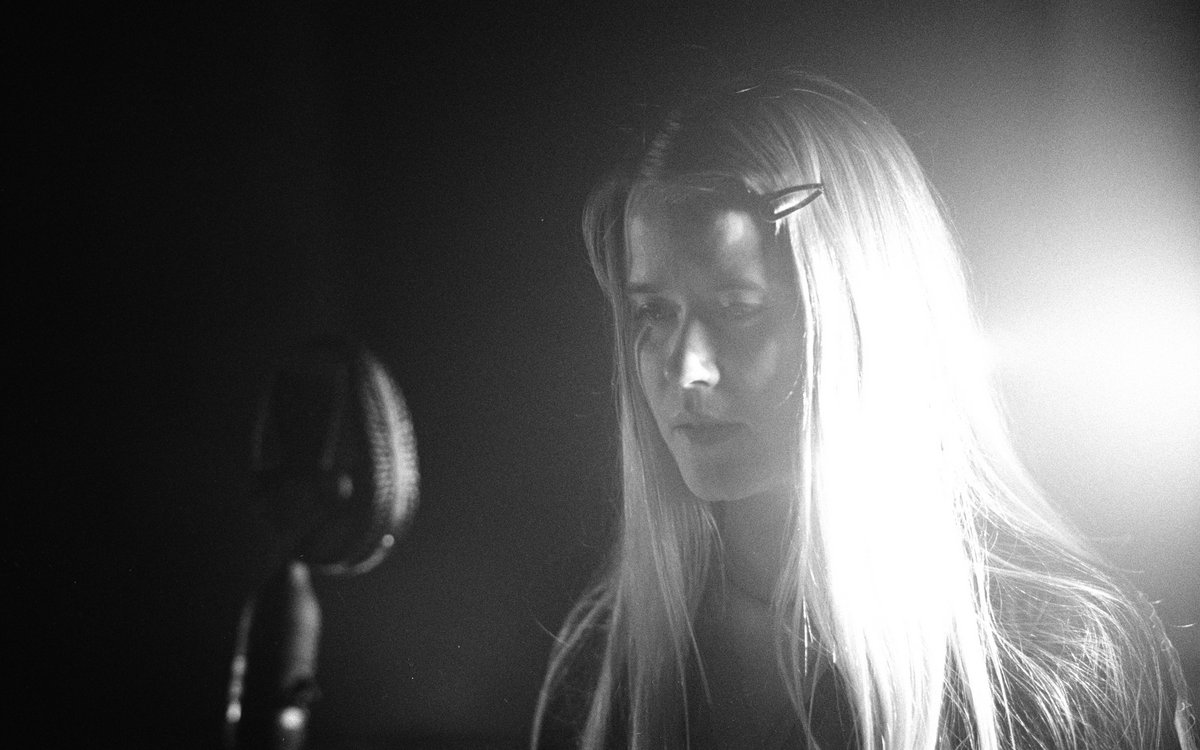
The first single on singer/songwriter Anna St. Louis’s debut LP If Only There Was a River was the song “Understand,” and it’s about what you’d expect: wanting to understand, wanting to be understood and the aha moment when you finally do/are, as well as the frustration in not understanding. “Untangled, finally,” St. Louis sings. “Put it all out on the table/ Understand me, do you understand?” If Only There Was a River, released in October on Woodsist/Mare Records, carries on in that same tone throughout its 11 tracks, one of comfort, low-lighted by the kind of delicate, spare acoustics that inspire deep and thoughtful respites. St. Louis, who’s making her full-length debut with the record, often retreats to a similarly soothing zone for her songwriting, which she’s only been doing for about five years now. Although, after spending time with If Only There Was a River’s carefully contrived ebbs and flows and smartly observed lyrics, you’d never know she was a spring chicken.
If Only There Was a River would certainly please any folk fan, and it bubbles over with natural, woodsy energy. St. Louis couldn’t have picked a better time for its release: It seems to usher in all the crispness and change we’re so desperate for in October after a long, steamy September. Nature creeps beyond the album’s treeline in pockets of sunlight and smoke. From the looseness of the album opener “Water” to St. Louis’ ample finger-picking on the mostly instrumental “Daisy” to its winding title track and kicker, If Only There Was a River is laden with quiet, warm music for a loud, cold world
Campdogzz are a Chicago indie rock five-piece who released their sophomore album, In Rounds earlier this month via 15 Passenger. The band was the first to sign to Cursive’s record label and they came to the Paste Studio to perform three songs: “Raw Bone Ring,” “Run Wild” and “Dry Heat.”
Campdogzz capture the bleak yet spirited heart of the industrial midwest in a five-piece band propelled by driving rhythms, insistent dual guitars set in intriguing arrangements, and the haunting, evocative songs and voice of Tulsa native Jess Price. In a moment, Jess turns a beguiling melody to a darkening storm, rich in portent and meaning.
Campdogzz have earned a devoted following in Chicago and the midwest, with a lineup that has solidified into a potent live band featuring Jess Price (lead vocals, guitar and keyboard); Mike Russell (guitar and backup vocals); Nick Enderle (guitar); Mahmoud Haygood (bass); and Matt Evert (drums). In addition to their own headlining shows and tours (until recently conveyed by a school bus rigged for self-sufficient touring and camping; if you don’t know where to get the best falafel in every American city, you are definitely not a Campdog), the band has opened for Big Thief, Sam Evian, Ohmme, Tim Kasher and others. They were recently seen in the first season of the Netflix series, “Easy,” recorded a popular Audiotree live video session, and self-released “Riders in the Hills of Dying Heaven” in 2015. That early recording has been streamed nearly 2 million times. Now, Campdogzz are poised to come aggravate your blues, bang your head, and remind you where you are on the long road away from home.
Songs:
1. Raw Bone Ring 1:03 2. Run Wild 6:41 3. Dry Heat 12:50
Mike Russell, Jess Price, Nicholas Enderle, Andrew Rolfsen, Chris Dye
When Will Toledo, lead singer and artists behind Car Seat Headrest, was 19 he wrote and recorded an album. The album titled Twin Fantasy was a Bandcamp masterpiece, it was what Brian Eno describes as “the sound of failure”, an experiment pursued but never truly finished and finalised.
So what has Toledo done? He’s re-imagined and re-recorded it for all his fans who’ve loved it and for all those fans yet to meet it. It’s intelligent, self-indulgent, interesting but above all else it is a step nobody expected Will Toledo and his band to make. Re-creating an album, not only aligns himself with his ‘day-ones’ but also highlights his ability beyond what the mainstream knew. The boy was prodigal. A simple foot step can sometimes feel like a giant leap, ask Neil Armstrong.
And now you can stream the entirety of the album including brilliant cuts ‘Cute Thing’ and ‘Beach Life In Death’. The album hinges on the juxtaposition of these two tracks. One; a meandering wander through adolescent anxiety and the other a hormonal hump-athon. These two themes continue to battle through a young Toledo’s work, as one imagine it did during the original recording. That’s how it appears to the audience. Fully prepared with all it’s raging hormones the album skips genres, tempos, and textures to reach some kind of climax to befit an awkward and engaging adolescent.
But during the ride we are reminded, not only that Will Toledo was wise beyond his years, not only that re-recordings aren’t always terrible, but that “the sound of failure” can sometimes just be the starting gun.
In 2011 Car Seat Headrest, who were at the time essentially just Will Toledo, released an album called Twin Fantasy—one of dozens he’d uploaded to Bandcamp over the course of a year. It was a sprawling meditation on failed romance that hinted at artistic ambition beyond its maker’s years and budget. In 2018 Car Seat Headrest, now a bona fide band, are also releasing an album called Twin Fantasy, a re-recording of that 2011 LP that fleshes out the crude sketchings of the original into something ornate, enveloping, exhilarating, and dizzyingly complex. It is not only the best album in Toledo’s catalog, it is one of the young year’s best rock albums.
Toledo recently went to great pains on Twitter to stress the fact that Car Seat Headrest consists of four people, not one, and he was right to do so; Twin Fantasy wouldn’t work nearly as well as it does without the contributions of all its players. The 13-minute rollercoaster of “Beach Life-In-Death” is a master class in the slow build: Toledo’s voice and guitar enter first, operating at 100 miles an hour, then the whole song slams on the brakes; Seth Dalby’s bass bobs and weaves, Ethan Ives’ guitar claws away in the background, and Andrew Katz’s drums bash and clatter; then the whole band joins forces to push the song deeper into the red. Constructing rock songs with multiple melodic sections tends to feel like an intellectual exercise, but the way the band members play off one another in “Beach Life” makes each segment feel like a natural progression rather than a patched-together assemblage of mismatched parts. They also know when to pull back: In the song’s second section, the instruments recede so Toldeo can wonder aloud, “It’s been a year since we first met/ I don’t know if we’re boyfriends yet.”
That line serves as an early entrypoint into the record’s primary concerns. Twin Fantasyis an album about romantic relationships—and there are enough textual clues to suggest it’s mostly about one very specific romantic relationship. But it’s also about the ways that artists create fictional worlds and characters as a way to get in touch with real-life emotions, or to exert control over situations that, in their own lives, are uncontrollable. In the 2011 version of “Nervous Young Inhumans,” there was a spoken-word passage that’s excised on the re-recording, in which Toledo cites Mary Shelley’s Frankenstein as an inspiration, saying, “I used the term ‘galvanistic’ to allude to that book as a symbol of how I created you as a character. I’m pretending that I know a lot more about you than I actually do.” Even the language Toledo uses there is slippery, the two versions of ‘you’—the real and the fictional—used interchangeably, blurring the distance between them. (In the new version, he uses a more potent metaphor to accomplish the same ends: “Do you know about Jesus? Do you really know? All you know is what you’ve been told.”) And while Twin Fantasy is, on some level, about a doomed romantic relationship, it’s also about the ways we take those heartbreaks and build stories around them. That it’s about both, simultaneously, is one of the things that make Twin Fantasy such a head-spinning triumph. In the exuberant “Bodys,” just as the song is gaining momentum, Toledo pauses to explicitly acknowledge the song as a construct, asking, “Is it the chorus yet? No. It’s just the building of the verse, so when the chorus does come, it will be more rewarding.” That kind of metatextual, commenting-on-the-form-while-the-form-is-in-progress has been attempted in film—think of Imamura’s A Man Vanishes or the end of Taste of Cherry—and while there’s no shortage of satirical rock albums poking fun at the industry, what Toledo is attempting here is something more philosophical, a deep-dive textual examination that borders on semiotics.
All of this doesn’t make Twin Fantasy sound like very much fun, so let me stop here to say: it is a hell of a lot of fun, a big, rocketing collection of rock songs that balances Kinks-like vocal harmonies with knotty, virtuosic guitar work and choruses as vast and clear as a summer sky. And while much of Fantasy’s existential detective work is around Toledo the narrator, musically Twin Fantasy is very much about Car Seat Headrest, the band. “Nervous Young Inhumans” is a dazzling rush of adrenaline, Ives’s upward-spiraling guitar line giving the song a sense of jubilance and weightlessness. (If you want to truly appreciate the difference the band makes, compare this to the 2011 version, which felt blurry and unmoored.) “Famous Prophets”—which clocks in at 16 minutes—earns its triumphant crescendo, the band gently stoking the tension until the whole song explodes.
But even in the album’s rapturous moments, its underlying preoccupations seep through. On “Beach Life,” Toldeo writes and rewrites his own biography: “I pretended I was drunk when I came out to my friends,” he sings, then immediately contradicts that narrative: “I never came out to my friends.” At the end of the bruising, hooky-as-hell, bash-and-pop anthem “Cute Thing,” he sings, “I accidentally spoke his first name aloud/ trying to make it fit in with the lyrics of ‘Ana Ng,’/ worked like a charm,” and then launches into a modified version of that They Might Be Giants song (Hopefully, Johns Flansburgh and Linnell are less litigious than Ric Ocasek.) And so we’re back to where we started: a real person inserted into pop song about a fake person to further mask their identity.
If there’s a final takeaway for Twin Fantasy it comes in the closing moments of the title track, when Toledo breaks the fourth wall one last time to speak to the object of his affections in a moment that recalls the introduction to Marvin Gaye’s Here, My Dear. “This is the end of the song,” he says, then adds, “And it is just a song. This is a version of me and you that can exist outside everything else. And if it is just a fantasy, then anything can happen from here. The names have been changed. So pour one out, whoever you are. These are only lyrics now.” That final phrase is a provocative one: when we embellish lived experience for the purposes of art—or, hell, even our own memories—which version becomes the real one? And does the “real” one even matter anymore? Or are reality and art just parallel versions—twin fantasies—of the same narrative we keep telling ourselves?
In “Beach Life-In-Death,” Toledo despairs, “I spent a week in Ocean City/ and came back to find you were gone/ I spent a week in Illinois/ and came back to find you were still gone.” In “Twin Fantasy,” he revisits those verses, but this time, the outcome is different: “When I come back, you’ll still be here/ When I come back, you’ll still be here.” It scans like Toledo going back into his own story, fixing the parts he didn’t like. He’s doing the same thing with Twin Fantasyon a macro level, revisiting a collection of songs that deserved more than he was able to give it at the time. The result is a blistering rock record of tremendous scope and heft, richly detailed and overflowing with memorable melodies. It is Car Seat Headrest’s first masterpiece.
Though this magnificent fragment of Will Toledo’s brain technically debuted on the nether-regions of Bandcamp back in 2011, the Twin Fantasy rework is nothing short of exquisite. If every rock song was this immaculate, we’d call it “gold” instead of “rock.” One reason it’s so fantastic is the song’s percussive underbelly: A swarm of pedal effects, drum loops and good ol’ fashioned kit noise carry the song through its near-seven minutes, as Toledo talks us through the song like a math problem, asking, “Is it the chorus yet?.” For all its magnificent sonic arrangements, though, the lyrics are even heftier, a testament to love, life and the fragility of the vessels that hold it all together: “Don’t you realize our bodies could fall apart any second?”
One of 2015’s most ambitious records, Anna von Hausswolff is a diamond in carving out colossal songs which start in one place and evolve into a myriad of others before, very often, bursting into something quite magnificent. We fell in love with The Miraculous the first time we heard the sprawling 10-minuter Come Wander With Me/Deliverance – before the whole album sound tracked a grey October in Budapest. The fourth album by Sweden’sAnna von Hausswolff grapples with mortality, but the music is far from morose. In fact, Dead Magic is possibly her most triumphant release to date, offering uplifting crescendos propelled by rising rhythms, swelling guitars, and von Hausswolff’s seemingly-unlimited vocal powers. It helps that von Hausswolf recorded the organ parts in one of the largest churches in Scandinavia, giving the album’s cathartic bombast and even more epic feel. But it’s not the tools von Hausswolf used that make Dead Magic so intoxicating; it’s the transfixing vision and unswerving commitment she brings to every note that she utters.
Me, my band and Randall Dunn spent 9 days in Copenhagen recording this record. The great pipe organ you’re hearing is a 20th century instrument located in Marmor Kirken, “The Marble Church”, Copenhagen.
Here is a poem for you by the Swedish writer Walter Ljungquist (1900-1974):
”Take the fate of a human being, a thin pathetic line that contours and encircles an infinite and unknown silence. It is in this very silence, in an only imagined and unknown centre, that legends are born. Alas! That is why there are no legends in our time. Our time is a time deprived of silence and secrets; in their absence no legends can grow.”
Please enjoy the music. Yours sincerely, Anna von Hausswolff” released March 2nd, 2018
La Luz is a band in Seattle, WA, started in the summer of 2012 by Shana Cleveland (guitar), Marian Li Pino (drums), Alice Sandahl (keyboard) and Lena Simon (bass). Everyone sings. Songs by Shana and La Luz.
La Luz just might be the greatest rock band in the world. It’s OK if you didn’t know. Since achieving instant hype on the strength of their pretty garage pop songs and haunted girl group vocals floating around guitarist Shana Cleveland’s glow-in-the-dark surf guitar lines, La Luz’s music has possessed an effortless ear candy quality that makes it easy to overlook—if not outright dismiss. But La Luz have always been stealth rock-‘n’-rollers with a taste for the raw; their discography reveals a band gradually ramping up the intensity of their sound while cloaking its creeping menace in soft clouds of four-part harmonies that soothe.
With the epic Floating Features, La Luz’s slow burn reaches a boiling point, leaving no doubt that the quartet—Cleveland, bassist Lena Simon, organist AliceSandahl, and drummer Marian Li-Pino—are among the most imaginative, dynamic rock bands currently active. Always technically impeccable, Floating Features is a showcase for the band’s deeply empathetic musical chemistry, embodied in moments of impassioned musicianship delivered with all of the confidence and none of the cockiness commonly associated with rock star moments. And there are a few of them here. Floating Features is a record rife with moments that thrill, from Cleveland’s fearless, heartbreaking guitar solos, her most powerful passages often preceded by howls emanating from somewhere just deep within the sound, to the angelic, enveloping atmospherics of “Mean Dream,” to stunning centerpiece “California Finally,” a song so rhythmically complex it seems to follow its own dream logic; the chorus of “I do what I want” tumbles into echolalia as Cleveland plays catch-up with Li-Pino’s off-kilter beats. A record of luminous beauty and subtle majesty, Floating Featuresis a portrait of a rock band playing at the peak of their powers, La Luz’s very own Houses of the Holy remade in their own heavenly image.
Low’s 12th album is awash in noise – static, electrical hum, broken down electronics. Over 11 songs, these forces work to obscure Alan Sparhawk and Mimi Parker’s voices, wrapped together as always in close harmony. Recorded at Justin Vernon’s April Base with producer BJ Burton, the album implodes the Low template and builds something terrifying and confusing in its place. Many songwriters have attempted to document the pressing anxiety of our overloaded information age; with Double Negative, Low processes the ugliness of our age without abandoning their signature haunting beauty.
Slowcore pioneers Low first introduced electronics to their moody, minimal instrumental palette cautiously, on 2015’s Ones and Sixes; the change, partially brought about by working with producer BJ Burton, helped revitalize both their sound and creativity. On Double Negative(also recorded with Burton), those electronics become a key component, truly directing the album—warping vocals (opener “Quorum” feels like a constantly-interrupted transmission), incorporating rhythmic noise (“Dancing and Blood”), adding a glacial effect to guitars (“PoorSucker”). It took the group nearly two years of trial and error to craft. This is all true, but it doesn’t capture what a terrifying, majestic, heavy gut-punch of an album Double Negative is, how emotionally affecting it is, how it feels like an ice cave one crawls into to find solace from worse weather and to escape potential predators. A stunning album, one that reveals new depths with every play.
“Rock The Machine” from Lisa’s album “Heard A Long Gone Song” out October 19th on River Lea, an imprint of Rough Trade Records. Pre-order available at Amazon & Rough Trade shops,
Between the 1960s and 1980s thousands of men lost their jobs as dockers in Dublin’s docklands. Advanced machinery moved in and put an end to the need for manual labour. In Irish mythology, the Cormorant bird might appear to you in your dark hour with the purpose of taking your troubles away. I’ve spotted hundreds of Cormorants along the River Liffey. The recording was for an album called ‘Starboard Home’ in collaboration with Ireland’s National Concert Hall. A special thanks to the dockers who appeared in this video: Declan Byrne, Alan Martin, Christy McDonnell, John ‘Miley’ Walsh, Paddy Daly, Mick Foran, Pat Behan and Paddy Nevins.
Lisa O’Neill’s album went even further. Her resolutely unpretty, belly-deep Irish drawl hymned the decline of industry, depression, and the deaths of young children. Let it submerge you and a modern folk masterpiece emerges.
Introducing the new LP from Bill Lloyd featuring songs co-written by Bill and friends, including Freedy Johnston, Tom Petersson, Graham Gouldman, Buddy Mondlock and more.
Bill Lloyd’s first two solo records—1987’s Feeling the Elephant and 1994’s Set to Pop—are rightfully seen as classic of the power pop/melodic rock genre. Combining ringing guitars with a keen sense of melody in songs such as “Lisa Anne,” “Nothing Comes Close,” “Trampoline,” “Niagara Falls” and several others, Lloyd created a template that was difficult to top. Several releases for several different labels would follow, with each one being very good or better; still, to this writer, Lloyd hadn’t quite been able to return to the elusive heights he achieved on his first few efforts.
Working the Long Game, Lloyd’s latest full-length for Texas-based SpyderPop Records, is not only his finest solo collection in nearly 25 years, . A dozen tracks, each one carefully crafted and melodically stimulating, and a sterling showcase for what can still be done with a solid base of guitars, bass and drums. Of course, there are some other complementary touches—the strings on the devastatingly beautiful and delicate “Wake Up Call,” Lloyd’s mandolin on the ever-so-slightly middle-eastern sounding Graham Gouldman co-write “What Time Won’t Heal”—but on the whole, these are uncluttered, six-string powered gems that are instantly likeable and retain their substantial charms long after the disc stops spinning.
Several of the songs on Long Game stand up with Lloyd’s best ever: the aforementioned “Wake Up Call” deftly balances musical sweetness and lyrical sadness, with an acoustic guitar figure that recalls Big Star’s “Thirteen,” while the joyously catchy “Go-To-Girl” sounds like it could have topped the charts in 1965. Then there’s “Yesterday,” a wonderfully loud, loose-limbed rocker that features bass by Cheap Trick’s Tom Petersson (who also shares writing credit with Lloyd), followed by the similarly muscular “Interrupted” and “Merch Table,” both of which will deposit themselves directly into your memory bank.
“Interrupted” was co-written with Nashville-based singer/songwriter Scott Sax (formerly of the late, great combo Wanderlust), and extols the frustration of attempting to collaborate on music via the internet. It features just a whiff of a “Long Cool Woman in a Black Dress” vibe in the verses and adds a positively incendiary guitar solo as a bonus. “Merch Table” is driven by a slew of cascading guitars and slam-bangin’ drums (Lloyd is credited with “many guitars and vocals” on this one in the notes) and lyrically serves as something of a statement of purpose for the struggling independent musician. (“You’re asking me, ‘Why do you still do this? I thought by now you would have had your fill’/There’s a thing that happens in the moment when it’s real” and “It’s been a decade since you bought new music/Got rid of all your old CDs/You don’t want to clutter up the house with new songs like these” are both totally relatable couplets.)
On the albums final two tracks, “Miracle Mile” and “Shining,” Lloyd one-man bands it in quite fetching fashion: his controlled-yet-powerful drumming on the former tune is a revelation (who knew?), while on the latter he closes things out in a mellower manner that’s somewhat reminiscent of Paul McCartney circa 1973. Beautiful vocal arrangement on this one, too.
Everything else on Working the Long Game is more than worthy as well, especially the jaunty title track which welds a perky little melody around a guitar riff inspired by the Beatles’ “Getting Better” and adds a cheeky set of lyrics. Oh, and let’s not forget “’Til the Day That I Break Down,” a classic Lloyd pop-rocker penned with frequent collaborator David Surface and another all-by-himself recording that sounds like anything but. It all adds up to a revelatory release by Bill Lloyd, proving yet again that there is still plenty of life in the tried and true guitars/bass/drums formula as long as you have the songs. And boy oh boy, has Bill Lloyd ever got ‘em this time around.
1989: It’s nine years since John Lennon died, and five years since The Television Personalities have had an album released. Fire Records sign the latest incarnation of the TVPs and let them loose in a proper studio. Dan Treacy’s muse is overcome by the versatility of Swatch watches and Back To The Future II, he doesn’t allow the songs on ‘Privilege’ to bend to temptation. The world is still wrong; it’s still unreal; as evidenced by the guest list at ‘Salvador Dali’s Garden Party’. Elsewhere there’s a hint of ‘60s soap operas, from Cathy Come Home to The Wicker Man.
This is Steeleye Span’s first record. This is what Ashley Hutchings got involved in after he left Fairport Convention, and I just think it’s a terrific record. I love the songs on this record, and I love the fact that there are two female singers, Maddy Prior and Gay Woods. A really interesting collection of songs beautifully performed.
The band didn’t actually have a drummer but there are some drums on the record, so it’s a real folk-rock record. I love the sound of it, I love the harmonies, the musicianly skill involved.”