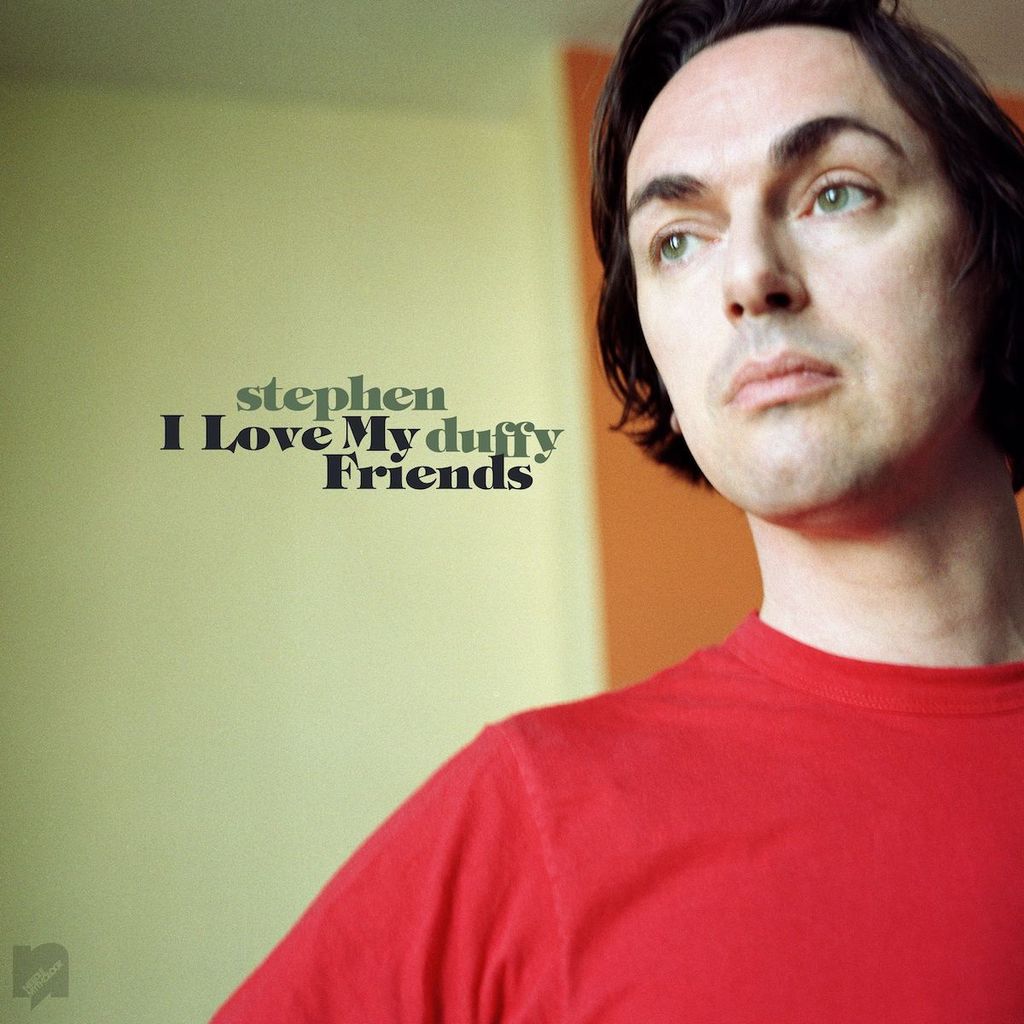
Stephen Duffy’s 1998 album was one of his three very good – albeit rather ‘lost’ – solo records from the 1990s. This one was particularly ill-fated, since label intervention meant that the album that was eventually released wasn’t really what Stephen wanted to put out at the time. Fed up, he reformed The Lilac Time and just moved on. 21 years later, fan and friend Pete Paphides decided that a revised edition of “I Love My Friends” would be the inaugural release on his new label Needle Mythology. With Duffy’s assistance they restored I Love My Friends to a kind of ‘director’s cut’ version with the mood-spoiling Andy Partridge-produced tracks removed and a few of others (that had been B-sides at the time) reinstated. The running order was also re-jigged for good measure. The album was remastered and sounded great on vinyl, but CD fans were really spoiled by a whole extra disc of ‘selected demos’ (all unreleased) that were delivered as a bonus item within the gatefold CD wallet.
Stephen Duffy’s 1996 solo album I Love My Friends has been made available for the first time ever on vinyl and vinyl replica CD. Produced by Stephen Street, the album was released to unanimously positive reviews and remains a favourite among his fans.
Following a time of personal upheaval, the album was the result of an unprecedented creativity for Stephen. “The tunes and the words were coming faster than I could write them down. That’s the dichotomy of I Love My Friends. My interior world was falling apart, but creatively it was a charmed existence.”
After tasting worldwide chart success with his 1985 hit Kiss Me, Stephen went on to record four albums of exquisite bucolic pop with his group The Lilac Time before recommencing his solo career. Stephen was a formative player in the West Midlands post-punk scene alongside Swell Maps and Duran Duran, whose first incarnation he fronted. In 2002, he reunited with Nick Rhodes to release an album of their early songs with the group.
For I Love My Friends, Stephen has reverted to the original intended sequence for the album, which was produced by Stephen Street, restoring fan favourites Mao Badge and In The Evening Of Her Day to the track list.
The two Andy Partridge-produced tracks recorded at the behest of Stephen’s label as putative singles now feature on a seven-inch single, which comes with the record. As with all Needle Mythology releases, a vinyl replica CD is available.
The CD version ofI Love My Friends features a bonus CD Blown Away – Selected Demos Volume 1 – ten previously unreleased demos for songs written during the I Love My Friends sessions but never recorded for the finished album.
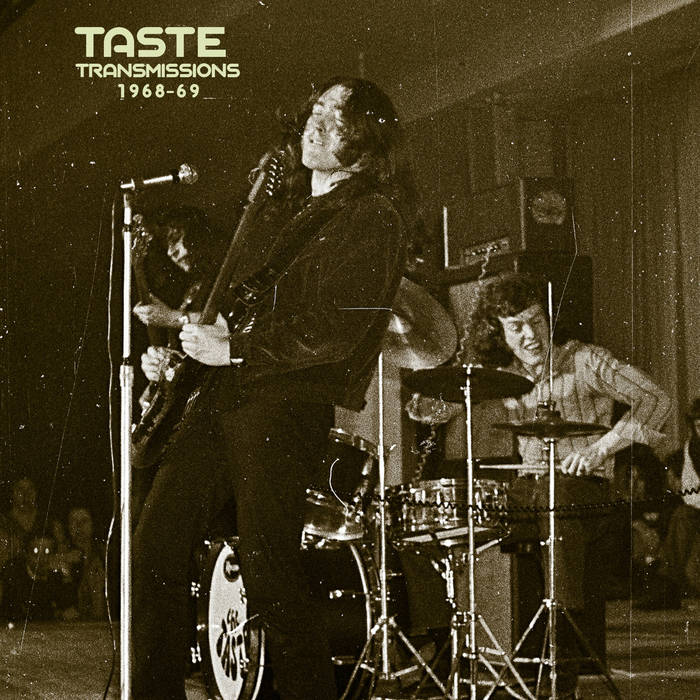
Taste were an Irish rock and blues band formed in 1966. They were founded by songwriter and guitarist Rory Gallagher who left the band in 1970. Formed in Cork, Ireland, in August 1966 as a trio consisting of Rory Gallagher on guitars and vocals, Eric Kitteringham on bass, and Norman Damery on drums. In their early years Taste toured in Hamburg and Ireland before becoming regulars at Maritime Hotel, an R&B club in Belfast, Northern Ireland.
In 1968 Taste began performing in the UK where the original lineup split up. The new lineup formed with Richard McCracken on bass and John Wilson on drums.The new Taste moved permanently to London where they signed with the record label Polydor. In November 1968, the band, along with Yes, opened for Cream at Cream’s farewell concerts.
Blister On The Moon / Dual Carriageway Pain / Norman Invasion / Born On The Wrong Side of Time (first broadcast 27 October 1968)
Same Old Story / Dual Carriageway Pain (First broadcast: 30 October 1968.
I’m Movin’ On / Sugar Mama / Leaving Blues / Wee Wee Baby (first broadcast 20 April 1969)
By 1972, what we call classic rock was pretty much at its peak though nobody at the time knew it. Except maybe Stephen Stills. The band and the double-album he piloted and released that year both named Manassas now seem pivotal. Manassas brilliantly summed up the remarkable 1960s creative surge that revitalized rock’s roots and encouraged experimentation just when it was at its crest. Predominantly a vehicle for Stills‘ artistic vision, the band released two albums during its active tenure, 1972’s Manassas and 1973’s Down the Road. The band dissolved in October 1973.
The top-flight outfit Stills assembled in late 1971 and named for a bloody two-part Civil War battle (the album’s cover shot was taken on that battlefield) could nimbly navigate damn near every polyglot style rock was evolving– from blues “Jet Set” to bluegrass “Fallen Eagle”, country rock “Don’t Look At My Shadow” to Caribbean beats “Medley”, folk-rock “Johnny’s Garden” to metal “Right Now”. Jamming out complex, textured arrangements in the studio, they successfully translated them to stages in Europe and the US. But Stills always felt that Manassas struggled for recognition because his handlers wanted him back in the gold rush that Crosby Stills and Nash (and sometimes Young) had generated.
Whatever the reason, Manassas remains one of rock’s half-forgotten treasures. But it’s arguably the best album and band Stephen Stills ever helmed.
Stills was Born in Texas, raised in Florida, Costa Rica, and the Panama Canal Zone as his military family rotated through duty stations. He absorbed all sorts of music along the way, and learned to play them on guitar, keyboards, bass, banjo, and assorted percussion instruments. The rootless kid found his mooring in sound. He beat up his family’s furniture until his dad finally got him drums to go with his drumsticks. After a week of college, he quit to be a musician.
His scuffling path through the folk revival introduced him to dozens of players, like Richie Furay and Neil Young, who would become his creative network. It also put him into play at the onset of rock’s 1960s creative surge. He was in Los Angeles trying to peddle his songs when he turned down a slot with the corporately manufactured Monkees (he recommended Peter Tork instead), and jumped headlong into the exploratory waves with his tempestuous band Buffalo Springfield. The Springfield surfed onto the national Top 40 charts with Stills’s brooding track For What It’s Worth. In the studio, on tracks as radically distinct as Kind Woman, Rock and Roll Woman, and Nowadays Clancy Can’t Even Sing, they probed the new ideas firing young musical imaginations from London to California. Live, the band crackled with guitar-hero firepower, when Stills and Young opened up in redoubtable jams.
His songs were innovative, superbly crafted, stylistically diverse; Bluebird is a stellar example of his fondness for complex structures. His lyrics could be elliptical or nakedly autobiographical; often infused with dark romance (Hung Upside Down, Questions) his confessional story-telling updated his beloved blues. Onstage, he hurled himself at the microphone, when he wasn’t prancing or dancing; he was so intense, his full-throated vocals seemed to come somehow from his entire body. Bandmate Richie Furay called him “the heart and soul of Buffalo Springfield.” Others, in a nod to his multi-instrumental chops, called him “Captain Many Hands.”
The unstable chemistry and battling egos that fired the Springfield’s creative ambitions inevitably blew it apart. But the band had barely disintegrated before Stills was off solidifying his guitar-hero credentials on Super Session, with Al Kooper and Mike Bloomfield. On Season of the Witch, Stills dialed up a distinctive voice on the wah-wah pedal Jimi Hendrix had turned him onto, floating sweet nothings and yearnings tinged with acerbity.
Thanks to his network, a series of accidents drew Crosby Stills and Nash together. Their 1969 debut met with critical hosannas and gold-record status, and marked the dawn of that record-industry supergroup, with high-powered handlers and big-ticket arena tours.
Graham Nash said, “Stephen had a vision, and David and I let him run with it.” Or maybe he just steamrolled over them. A year after Déjà Vu, what was now CSN&Y exploded, and its members released solo albums. Stephen Stills went gold, scored a hit (Love the One You’re With), and was the only album ever to feature both Eric Clapton (on Go Back Home) and Jimi Hendrix (on Old Times Good Times). But it and its followup drew ho-hum reviews; so did his tours. Critics and fans wondered if Stills was yet another self-indulgent rock star running out of gas.
Stills describes himself as “aggressive,” “obnoxious,” and the like, all meaning he’s a control freak—an auteur, if you like. In those days, he was usually packing an enviable pocketful of new tunes. He could out-sing almost anyone and play one-man band if he wanted. You can see how he’d be a hard guy to face off with about creative issues.
Yet he knew he needed feedback. He wanted to improvise with players whose ideas and chops stood up to his own. Then he could let jamming unleash creative interactions to enrich his ideas. That was how he worked during the Springfield’s best days.
A twist of fate gave him his shot. In 1971, he was coasting along on a lackluster but lucrative tour when he happened to cross paths with Chris Hillman. As Hillman recalls, “Stills was playing a concert in Cleveland with the Memphis Horns. I was sitting in the audience, going, ‘Jesus Christ. They’re making 25,000 bucks and they’re shitty. The Burritos are better than this.’ I went backstage, and that’s when we renewed the friendship.”
Their bond dated back to 1960s LA, when Hillman—among the most catalytic figures in rock history—got BuffaloSpringfield the gig as the Whisky A Go Go’s house band. That launched them to stardom.
Besides, Stills knew that Hillman was far more than a catalyst. After a whiz-kid run as a bluegrass mandolinist, he played innovative bass, doubled on guitar, sang lead and harmony, and co-wrote songs with the Byrds. When Roger McGuinn unceremoniously dumped his friend Gram Parsons after Sweetheart of the Rodeo, Hillman left, and the Flying Burrito Brothers were born. Parsons and Hillman penned a few matchless songs that other composers would likely swap body parts for, like Sin City and Wheels.
But the Grievous Angel was riding hard on the road to ruin; sloppy business dealings, erratic performances, and over-the-top drug use and boozing got him fired from his own group before Burrito Deluxe was released in early 1970. Hillman tried steering the band, but its personnel kept changing; the near-chaos made the Burritos musically unpredictable and financially disastrous.
So when Hillman and Stills accidentally crossed paths in Cleveland, they both glimpsed opportunity. Stills’ bounteous talents and fierce competitive drive almost ensured he would overshadow nearly any setting he was in, but he was discouraged by his solo ventures. He needed a creative ally he respected, someone who’d push back but not combust or split.
Hillman, who may be rock history’s best-ever second banana, firstly dealing with McGuinn and Parsons were hard-to-beat baptisms of fire was secure enough in his own creativity to deliver. He would co-write two songs for Manassas (Both of Us, It Doesn’t Matter), help Stills wrangle others into shape, and supply his subtle, pure-toned harmonies throughout.
As Stills explained, “I basically wanted a partner, somebody who had a sense of songs. Chris invented the phrase ‘lyric police,’ and was a tremendous help. But I was still on that real powerful, energetic ‘Let’s go, I know what I’m doing’ kinda thing. Chris realized it was my band, and that was OK for him.”
A few weeks later, Stills called Hillman and invited him down to Miami’s famed Criteria Studios, where engineer-producer Tom Dowd had shepherded Derek and the Dominos‘ monumental jam-fuelled Layla sessions the year before. As it happens, the producers for what would become Manassas worked on it too.
The stage was set to replace the sterile studio feel Stills hated with the onstage improvising looseness he loved. He had his co-pilot. So who else would joust with Captain Many Hands? .From the shambling Burritos came two key other talents for the band, Violinist Byron Berline was a bluegrass vet who’d clocked time with stars like Bill Monroe and Dillard and Clark. Fallen Eagle, a breakneck bluegrass protest song against ranchers killing our endangered national symbol, puts his dazzling, keening fiddle and Hillman’s virtuoso mandolin in the forefront.
Al Perkins had learned to play Hawaiian steel guitar at nine, mastered the dobro and pedal steel, performed with country and western bands, then shifted gears to tour his native west Texas as a rock guitar slinger. He supports or duels with Stills on all his axes. On Jesus Gave Love Away For Free, his aching steel solos swell and sigh; on Don’t Look at My Shadow, they glide with glee. On “Jet Set,” he plugs into effects to go grungy and deliver slashing, whiplash blues in Duane Allman fashion to counter Stills’ gurgling wah-wah. He plays both steel and guitar on Song of Love.
Perkins, Stills, and Hillman take their guitar army acoustic for Johnny’s Garden, where their loosely braided, ever-shifting lines gently nudge Stills‘ yearning vocal. The rest of the cast came from Stills‘ solo albums and tours.
Bassist Calvin “Fuzzy” Samuels brought the Caribbean feels Stills craved, as the burbling line on “Song of Love” demonstrates. But he could nail the bottom hard on blues-rockers like “Jet Set.”
Keyboardist Paul Harris, a session vet, could play almost any style; with Hillman’s adept rhythm guitar, his keys became the session’s sonic glue.
Latin percussionist Joe Lala co-founded Blues Image (Ride Captain Ride) and sang with gritty, soulful conviction. He vocally challenges Stills on Cuban Bluegrass, and delivers the pulsating Latin rhythms Stills adored throughout.
Drummer Dallas Taylor was Stills’ running buddy—and a wild card. He played on CSN(and sometimes Y)’s first two albums and tours; they fired him because his substance abuse rivaled the Grievous Angel’s. But this bad boy had exactly what Stills wanted on drums: he could float, dance, or slam it home.
The musicians quickly gelled in the studio, and within several weeks had recorded enough material at Criteria to fill a double-LP album release. The band was capable of a wide musical range, with a repertoire including blues, folk, country, Latin, and rock songs. Rolling Stones bassist Bill Wyman, a friend of both Hillman and Stills who visited Criteria during the sessions, was an early fan of the band, at one point expressing an interest in joining. (Wyman would contribute to the sessions by helping Stills re-write his to-date unrecorded song from 1968, “Bumblebee,” as the blues/funk tune “The Love Gangster,” with Wyman also playing bass on the track.) The band christened itself Manassas after Stills, who had a strong interest in American Civil War history, orchestrated a photo shoot for them in Manassas, Virginia, the site of the First and Second Battles of Bull Run.
What was slated to be Stills’ third solo album had morphed completely. The band’s chemistry clicked almost instantly, and its boundless energy and chops meshed with Stills‘ vision and discipline. A few weeks of jamming out arrangements fused the wildly diverse material and sounds into a sum greater than its parts. They came out of it as a fierce, tuned machine. (See for yourself on this high-quality German TV recording, where Stills wails on wah-wah for “Jet Set” and “Treasure of the Oneness.”)
No wonder Bill Wyman, who co-wrote Love Gangster with Stills and played bass for the track, said he’d leave the Stones to join Manassas. Hillman understood why: “We were always more of a band than people thought. Stills wouldn’t have been the same without us, that’s for sure. Manassas was the best band Stills ever played in.”
The album ends with a final stark jolt. Blues Man finds Stills alone with an acoustic guitar, like the host of a wild party sitting amid the wreckage after it’s over. He channels everything he ever absorbed from his revered blues masters into his gritty, anguished vocal and nimble fingerpicking to sketch a raw, painfully dark elegy for three of his friends. Jimi Hendrix, Al Wilson (Canned Heat), and Duane Allman had all recently died.
They weren’t the only ones: Janis Joplin and Jim Morrison were among the others. Many were wondering if rock’s creative surge had run its course. Did Stills? Who knows? But an era was indeed ending. And nothing Stills has done since approaches the epic scale and artistic heights of Manassas.
After the European leg of Manassas’ 1972 tour, Chris Hillman took several weeks away from the band to record a reunion album with his pre-Burritos band the Byrds, an effort that also included Stills’ ex-CSNY bandmate David Crosby,Manassas then regrouped and quickly completed their second album, Down the Road. Initial sessions for the album were again convened at Criteria Studios, but the band moved the sessions in midstream to CaribouRanch in Colorado and the Record Plant in Los Angeles after Criteria staff engineers Ron and Howard Albert expressed concern that the sessions were not producing quality results. Down the Road was completed in January 1973. After completing Down the Road, Manassas became dormant for several months. During the break, Stephen Stills married Véronique Sanson, whom he had met in Paris during Manassas’ 1972 European tour.
Stills was greeted by several sources of turmoil upon returning to regroup Manassas, as, in addition to Hillman’s future commitment to work with Furay and Souther, Dallas Taylor had become severely addicted to heroin, and Calvin Samuels had left the band for personal reasons. Stills dealt with these issues by securing the services of Jefferson Airplane drummer John Barbata (who had previously replaced Taylor in CSNY during their 1970 tour and Kenny Buttrey during Young’s 1973 tour) as a backup for Taylor, and bassist Kenny Passarelli of Joe Walsh’s band Barnstorm to replace Samuels. Samuels would return to the band for the last leg of its 1973 tour. Following the tour’s completion in October, Manassas’s dissolution was complete.
One of Manassas’ last shows, at San Francisco’s Winterland Ballroom in early October 1973, was made notable by the band’s being joined onstage by first David Crosby and Graham Nash, and, later in the show, by Neil Young. When later asked about this occurrence, Chris Hillman would comment “I could smell a CSNY reunion.” CSNY would, in fact, regroup for a world tour in early 1974. Following this tour, Stephen Stills would start a new band in 1975 with Kenny Passarelli and Joe Lala, but this was short-lived; Passarelli would soon depart to join the Elton John Band, and Lala would subsequently leave as well. Chris Hillman’s Souther-Hillman-Furay Band, which would also include Manassas members Al Perkins and Paul Harris (and eventually Joe Lala, who would later join Chicago), released its first album in early 1974.
That initial double album, along with Eric Clapton’s Layla stand as the most important and best albums we’ve ever been a part of.” Of the band’s prowess on stage, Stephen Stills has said “Manassas was such a terrific band. It really had some structure and reminded me of [Stills‘ previous band] the Buffalo Springfield at its best. Manassas could play anything.
Stephen Stills, vocals, keyboards & guitar (CSNY, ex-Buffalo Springfield)
Chris Hillman, vocals, mandolin & guitar (ex-Byrds, Flying Burrito Brothers)
Al Perkins, steel guitar & guitar (ex-Gram Parsons and Flying Burrito Brothers)
Calvin “Fuzzy” Samuels, bass, backing vocals (ex-CSNY and John Sebastian)
Paul Harris, keyboards (performed sessions and toured with John Sebastian during 1968-71, and sessions for B.B. King during 1969-70)
Dallas Taylor, drums (ex-Clear Light, CSNY and John Sebastian)
Joe Lala, percussion, backing vocals (ex-Blues Image and Pacific Gas & Electric)
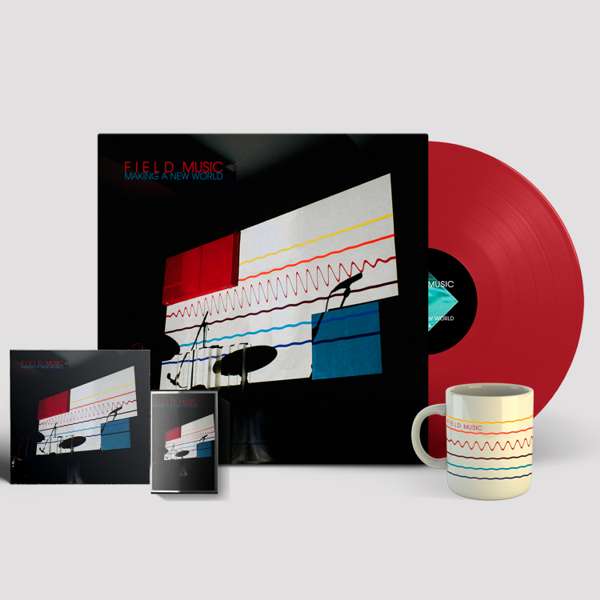
Britain’s Field Music (anchored by brothers Peter and David Brewis) announced a new album, “Making a New World”, inspired by the aftermath and repercussions of World War I, and shared its first single, “Only In a Man’s World.”Making a New Worldis due out January 10th, 2020 via Memphis Industries and features Field Music’s full live band in the recording sessions for the first time in a while. Check out the album’s cover art and tracklist, as well as the band’s upcoming tour dates, here. We’ll be playing both the new album in full and a set of what might loosely be termed Field Music classics . We’ve added in a show in Kendal, and we are pleased to announce Emma Pollock, Rozi Plain and Tenement & Temple will be taking it in turn to join us for these shows
Making a New World began when the band performed two World War I-themed shows for England’s Imperial War Museum at their sites in Salford and London in January 2019. The basic tracks for the album were recorded the day after the London Imperial War Museum show. While the majority of Field Music’s studio work has been put together by Peter and David Brewis, the one-day session featured Field Music’s full live band (Liz Corney on keyboards, Kevin Dosdale on guitar, and Andrew Lowther on bass), with Peter and David on guitar and drums respectively.
This is the first album since 2007’s Tones of Town that could be considered more of a full band album.
A press release describes the themes and inspirations of the album in more detail: “Making a New World [is] a 19-track song cycle about the after-effects of the First World War. But this is not an album about war and it is not, in any traditional sense, an album about remembrance. There are songs here about air traffic control and gender reassignment surgery. There are songs about Tiananmen Square and about ultrasound. There are even songs about Becontree Housing Estate and about sanitary towels.”
The jumping off point for the Imperial War Museum performances was, as the press release explains, “an image, from a 1919 publication on munitions by the U.S. War Department, made using ‘sound ranging,’ a technique that utilized an array of transducers to capture the vibrations of gunfire at the front. These vibrations were displayed on a graph, similar to a seismograph, where the distances between peaks on different lines could be used to pinpoint the location of enemy armaments. This particular image showed the minute leading up to 11am on 11th November 1918, and the minute immediately after. One minute of oppressive, juddering noise and one minute of near-silence.”
David Brewis explains further in the press release: “We imagined the lines from that image continuing across the next hundred years, and we looked for stories which tied back to specific events from the war or the immediate aftermath. In writing these songs, we felt we were pulling the war towards us – out of remembrance and into the everyday – into the now.”
David also had this to say about “Only In a Man’s World” in the press release: “I found myself researching the development of sanitary pads – not a statement I’ve ever imagined myself making – and was surprised at how little the advertising material has changed in a hundred years. It’s still, ‘Hey Ladies! Let’s not mention it too loudly but here is the perfect product to keep you feeling normal WHILE THE DISGUSTING, DIRTY THING HAPPENS.’ And you realize that it’s a kind of madness that a monthly occurrence for billions of women – something absolutely necessary for the survival of humanity – is seen as shameful or dirty – and is taxed more than razor blades?! At every stage of making this song, I had to ask myself, am I allowed to do this? Is it okay to do this? And I cringed in the next room when I first showed it to my wife. But I think confronting my own embarrassment is a pretty fundamental part of what the song is about.”
Field Music’s last album was 2018’s Open Here. In May David Brewis released “45”, a concept album about President Donald Trump released under his School of Language solo side-project moniker. Meanwhile, in January Peter Brewis released You Tell Me, the self-titled debut album for his side-project You Tell Me (a duo with Sarah Hayes of Admiral Fallow).
Squirrel Flower (aka Ella O’Connor Williams) is releasing a Dinked Edition of her Polyvinyl debut, I Was Born Swimming, at the end of the month. She made a splash with lead single “Red Shoulder,” a wrenching rock tune that pairs her poised vocals with scorching guitars,
No matter how vulnerable or genuine a musician’s work is, when they get up on stage there is always an added performative element. Whether under their own name or an alias, they’re recreating a past state of mind — one that still might be fresh, but is reconstructed nonetheless. Ella O’Connor Williams considered this when deciding to make music under her childhood moniker Squirrel Flower. After releasing a few albums under her birth name, she opted to change it up a bit when her music started to evolve.
She landed on a vibrant and playful phrase with an origin she can’t recall. When people critique the name, she gets defensive and rightfully protective over a piece of her younger self: something she recognizes in various ways through her music. Her debut album I Was Born Swimming is built from flashes of her past — from reflections about her birth to moments when she was attending college in Iowa — with moody country tracks that detail tatters of lost relationships and crunchy rock songs that document her growing fortitude.
sounding astoundingly alive. “Headlights,” Williams’ second track from the record, is practically its opposite—a soft, shimmering track that proves she’s just as excellent in the realm of tender introspection.
Her first semester away from home wasn’t the easiest. The transition from just 20 minutes outside of Boston to a rural farm town led to homesickness, depression, and taking the next semester off. It was during this resting period that she started making music as Squirrel Flower. She soon realized that time in Iowa had left its creative mark.
“I had written all these songs that were different from what I had been making in high school,” Williams explains. “I think the songs I was writing were influenced by just how stark the winter and the fall there was.” She contemplated transferring, but decided to stay. “It was a great decision because I ended up being really happy there,” she says.
Her music as Squirrel Flower isn’t something you’d find out of the hippie movement per se, but there are remnants of folk, twinges of Joni Mitchell or Neil Young. She began releasing EPs in high school, self-taught and inspired by British folk and 2010s acts like Bon Iver and Laura Marling. (Learning from the latter, she explained to me, was a blessing considering Marling’s songs are in “crazy open tunings” that gave her “a totally different way of playing” guitar.)
It wasn’t until her second year at Grinnell — where she double-majored in gender, women, and sexuality studies and studio art — that Williams started experimenting with distortion and electric guitar. She liked how powerful she sounded. Moving forward, she was determined to balance the blunt spaciousness of her folk music and powerful grandiosity of electric guitar-based rock.
Canadian indie-folk musician Andy Shauf has already released a few charming singles from his forthcoming concept album The Neon Skyline, including “Things I Do.” Shauf’s captivating storytelling lays out a crumbling relationship on the single, one piece of the bigger tale told across the record. “Things I Do” opens with a laid-back groove highlighted by a soft chorus of saxophones that give way to Shauf’s anecdote. “Seems like I should have known better / Than to turn my head like it didn’t matter,” he sings at the beginning.
In a similar fashion to Shauf’s 2016 record, The Party, The Neon Skyline’s structure follows a storyline that takes place over the course of a night, according to a press release: “The interconnected songs on The Neon Skyline, all written, performed, arranged and produced by Shauf, follow a simple plot: The narrator goes to his neighborhood dive, finds out his ex is back in town, and she eventually shows up.”
Andy Shauf from the album ‘The Neon Skyline,’ available January 24th, 2020
We do humbly present a video of myself—that is, Evan—performing the song “Phase” on an acoustic guitar in the chilly front porch enclosure of our house that is, Amperland studios, aka PGHQ, aka the house featured in the Command S documentary series about the making of “Skylight”, aka a rare & strange falling apart Dutch farmhouse built in 1731. Our new album “Marigold” which was also recorded here (inside, not on the porch) is coming out January 17th
This month the New Jersey alt-country outfit Pinegrove will share new album “Marigold”, the group’s debut on their new label, Rough Trade Records, and the announcement arrived with a single and video for one of its tracks, “Phase.” “Phase” feels like a return to the Pinegrove’ former sound on their acclaimed record, Cardinal.
In it, there’s a driving drum beat and palm-muted guitar setting the stage for frontman Evan Stephens Hall’s ardent yelps. The restrained verse builds to a chorus where everything comes to a crescendo at Hall’s cry of “I’m torn right through / Divided right in two.” There’s some fantastic slide guitar fills within, giving the track Pinegrove’s signature almost-country feeling. Pinegrove took a year-long hiatus after Hall issued a statement in response to an allegation of “sexual coercion” made against him in 2017. Since then, their self-release of Skylight in 2018 and new record deal with Rough Trade have shown the group attempting to put those events behind them. Thanks as always for listening!, Evan.
Pinegrove’s new album ‘Marigold’, coming January 17, 2020 on Rough Trade Records.
Athens, Ga., has long been a hotbed for great rock music (and music of all types) for the better part of the last 50 years, and it doesn’t look like that’s going to change . Raspy roots-rockers Futurebirds are four albums deep a decade into their career, but the arrival of their fifth is still a cause worth commemorating. Their earnest brand of country-tinged, sultry singsong fits right in alongside all your favorite indie-folk and Americana records. But Futurebirds are doing something different from many of those bands: Their three-part harmonies range from heartbreaking to chill-inducing, yet most of their songs possess a laid-back summery feel.
The songs on album number 5, “Teamwork”, find Futurebirds leaning into the psychedelic side of things, yet they’re as twangy as ever. “Trippin” takes delight in human error, “All Damn Night” is an escapist mountain holler tune and “Dream, Fam!” is a suspicious jam. This record could take Futurebirds to the next level—bigger venues, heftier touring schedules—but for those of us who’ve been around with this band since the beginning, Teamwork is just another chapter in this century’s great southern rock story.
Band Members
CARTEZZ, TOJO, WOMZ, B MAH, JOHNNY COLORADO
Futurebirds’ new song from the new album Teamwork, out January 15th.
This special edition of Cream’s album “Goodbye, Goodbye Tour – Live 1968”. This is the first authorised release of these four historic complete 1968 concerts. Each concert features previously unreleased tracks and the Royal AlbertHall show hasn’t featured on CD until now. Having decided to call it quits whilst on tour in the US during May 1968 by way of a farewell Cream agreed to undertake more live shows, predominantly in the US later that same year plus 2 final UK dates at the Royal Albert Hall that November.
Originally released in February 1969,“Goodbye” originally mixed live performances from those last tour dates with a handful of studio recordings and rose to the UK no.1 slot and no.2 on the US Billboard. Goodbye Tour – Live 1968, as the name suggests expands the recordings from the 3-piece powerhouse’s last tour.
This historic collection was produced by Bill Levenson. The Oakland Coliseum, Los Angeles Forum and San Diego Sports Arena concerts were mastered from the original 1968 analog mix reels by Kevin Reeves at Universal Mastering, Nashville, TN. The Royal Albert Hall concert was mastered from the original 1968 analog transfer reels by Jason NeSmith at Chase Park Transduction, Athens, GA.
The set features 36 tracks of which 29 are issued for the first time.
Francie Moon is, at this point, a New Jersey institution, a force creating balls-out rock n roll that is at turns, psych, garage, and punk, imbuing it with urgency and confidence.” Alternating between raging and chill, “All The Same” shows off both sides of their personality, a duality that feels immediate and lasting. Culled from their newest 3-song 7″ vinyl and expanding it with 5 more tasty tunes, All The Same is required listening.
Another incredible album by Francie Moon following on from 2017’s So This Is Life.
On All The Same Melissa Lucciola turns the amps up higher and the album is full of guitar pyrotechnics, Melissa throwing out Hendrix and Neil Young style licks with abandon. There are blistering instrumentals and tightly crafted garage/psych bangers aplenty and Melissa’s voice sounds as expressive and striking as ever.
One of the most exciting independent artists on the scene
Released September 21st, 2019 Recorded to cassette between 2016-2018 at The Shed in Stockholm,NJ.