Sydney band The Buoys have one last little treat for fans before the release of their new EP All This Talking Gets Us Nowhere, on July 10th. The band have now shared some brand new visuals for their latest single ‘Linda’, which is an anthem for anyone who has ever had a gutful of their boss.
The Buoys deliver no-frills rock with ‘Linda’, pairing relatable songwriting with powerful, blistering guitars and thundering drums to get straight down to business. They aren’t messing around, and they have no time for your bullshit. Keeping things simple dressed entirely in white with a sparse background, the band do what they do best in this clip and simply perform the hell out of their song. Letting their music do the talking for them, they hold nothing back and just let ‘er rip, allowing the viewer to experience all that The Buoys have to offer. Considering they were nominated for Best Live Act at this year’s FBi SMAC Awards, they certainly live up to this hype here.
Speaking about the single, Zoe Catterall (guitar and vocals) said of the song, “Linda is for anyone who’s had a shit boss. After being yelled at and begrudgingly working somewhere just so I could afford rent, I wrote Linda and quit.” All This Talking Gets Us Nowhere is the second EP from The Buoys, following 2017’s self-released Soft Boy.
In making the EP, Zoe stresses the importance of working with a diverse crew of people. “There are so many talented women/non-binary/trans people in the arts and we really wanted to do our best to showcase this,” she says. “We recorded the body of work with Antonia Gauci, a music mastermind, and continue to work with an amazing photographer April Josie who even pieces together the clip for ‘WAH’. Speaking of clips we‘ve worked extensively with Director Clover Ryan who always puts together a diverse team, she worked on ‘Inside Outside’ and ‘Gold’. The glue that keeps it all together is our amazing manager Nat Day.”
The four piece have gone from strength to strength lately, with pre-COVID support slots for the likes of Violent Soho and Rolling Blackouts Coastal Fever, as well as sets at Farmer & The Owl and Grampians Festival. Now, with All This Talking Gets Us Nowhere about to be released into the world, the band are making waves for all the right reasons and we cannot get enough. Let’s hear it for The Buoys!
“All This Talk Is Getting Us Nowhere” is out July 10th Released Through Spunk Records.
Grabbing guitars this time around, although “The Fight” sees The Overcoats with a slightly rockier and grittier sound, its anchor is still the amazing harmonies that Hana Elion and JJ Mitchell produce. The album is a battle cry; a rallying call as the band forged a new identity. Released at the start of March, it’s almost like they released the perfect album to get us through this pandemic without even knowing it.
Tempering punk energy with vulnerable vitality and irresistible catchiness, The Fight is a ten-song battle-cry. It’s the kind of record that might inspire you to quit your job, run a marathon, divorce your husband, change your life in the way you always wanted to, but needed an extra push for. The Fight is the push. “The idea you have to fight for who you are, what you want, and what you hope to see in the world became poignant for us,” says Overcoats. “We realized the thing to do is not to wait for life to get easier, but to start fighting harder.”
Case in point – the soaring Fire & Fury thanks to its ascending refrain, “We’ll get through it.” If that doesn’t give you the motivation to get through whatever it may be, you’re ice cold. New album The Fight, released March 6th, 2020 Loma Vista Recordings
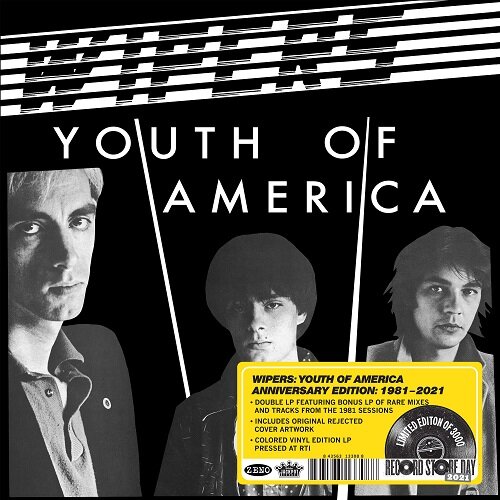
To mark the 40th anniversary of Wipers’ second album, “Youth of America”, the group has put together a commemorative vinyl reissue with Jackpot Records that features several previously unreleased tracks.
When Greg Sage roars “it’s no fair” midway through Youth of America, the vowels long and colicky, it’s not exactly a noble moment. Complaining about unfairness rarely is, because even if it’s accurate, it’s still a badge of comfort. “No fair” are petulant words, stagnant words, the conclusion of people who have set up camp in their perceived burdens. “No fair” is not a phrase of a revolution, because fairness is built on shifting sands; it’s not as steely a protest as “unjust” or “wrong.” And the people to whom life truly has been cruellest don’t have the time to complain about it; they’re too busy trying to out manoeuver the system that failed them. Now that’s not fair.
When Portland’s Wipers released their second album in May 1981, the shadow of Reagan’s conservatism was only beginning to spread. But the writing was on the wall: He’d spent his first 100 days shoving through so many revisions to tax policy and restrictions on federal power, he was accused of effectively squashing the concept of an activist government full stop. The sense of selfishness was demoralizing. An anticipatory static filled the air; the spectre of “no future,” that familiar credo of punk, wore a Windsor knot.
By this time, also, the “youth” in question had already heard plenty of punk—enough for its most stinging, mutinous qualities to have calcified into a formula. Punk, while still radical in its political messaging, was moving decisively in one direction: shorter, faster. Not everyone was pushing out 21 songs in 35 minutes, like the overachievers in Wire, but bands were doggedly dispatching songs quicker than the punk class before them; this included Wipers’ 1980 debut, “Is This Real?”, which followed all the spiny punk tropes and, upon release, sank without a ripple. Down in Los Angeles, a movement was brewing around Black Flag, who were about to shift the median with their debut album, Damaged, and its songs barely over the 3-minute mark.
It didn’t take a Rimbaud scholar to see that gloomy, 10-minute, Krautrock-inspired songs would be a tough sell in the early-’80s punk economy. But Sage, a scientific-minded contrarian—he’d started building recording equipment and playing guitar in the third grade after seeing a movie about Thomas Edison—tested his hypothesis anyway. And on “Youth of America”, The Wipers all but acknowledge the absurdity of their approach. You hear every roll of the dice, and the slight inhale of disbelief after they land; it builds the train while it’s already in motion, laying each link of track just before derailment.
Punk had never quite shown its seams like this before, its questioning of itself and its construction; it had never felt like such a righteous search for answers that was more concerned with asking the questions. The simultaneously thriving post-punk and no wave scenes had also taken mallets to the conventions of punk, but they’d had no problem casting aside the politics and guitars, as well. In Youth of America’s six grim, unhurried songs, Sage is weighed by his own dilemmas and asks them overtly: How can he change? What of this world is worth saving, and what possible advice can be wrung from that stone for the next generation? What can be said of this violent country as it enters a new era of turning that contempt inward? Why did he take on this role, anyway, and when will he finally cross the rubicon where his listeners need to save themselves by rebelling against him, already a geriatric punk at 29 years old?
Mirroring Sage’s outlier status: Portland itself. Far removed from the switchboards of American punk—New York, D.C., L.A.—the Pacific Northwest wouldn’t become a rock destination for another decade. Until a Wipers superfan named Kurt Cobain threw a baby into a swimming pool (and copied Sage’s penchant for flannel), the scene was off the grid; it was filled with D.I.Y. savants like Sage who disdained conformity and showed it with clever, cutting music they had no intention to scale. (When the Seattle scene exploded in the early ’90s, and A&R execs descended on seemingly every band in a 200-mile radius, Sage still refused to follow the “grunge” slipstream, famously turning down an opening tour slot for Nirvana.) It was truly a place of creativity for purpose, not product.
To understand “Youth of America”, it’s best to start at the conclusion. “When It’s Over”—a clear mission statement on the album across six minutes—is, in many ways, the most insurrectionist track on the album: It opens with over three minutes of an anxious, abrasive instrumental. Sage’s guitar wields full narrative reign—his chords open brashly, in the type of rapid churn that Buzzcocks and Stiff Little Fingers mastered. But then, in a surprising upheaval, he adds longer, musing tones that challenge the air over Dave Koupal’s bass and Brad Naish’s drums; soon the guitar has its own wandering spirit, its own melodic refrain, building its power in a direct nod to motorik momentum. The instrument is a clearly defined character, demanding its own experience.
Minutes into “When It’s Over,” when the guitar cedes to Sage’s voice, the transition is abrupt enough to almost feel bashful, a second-guessing of the kind of ego that allowed that irreverent open; piano supports his low, Bauhaus-worthy gothic grumble, so deep the ear must strain to make out his laments. “In the land of dreams, I find myself sober/Wonder when it’ll all be over,” he moans. When the guitar skitters back in, it’s at first noisy yet deferential to the words, clanging back on its first motif with tinny, sinister restraint; it feels like a dramatic battle between instrument and vocalist, a battle for the soul of the track—and perhaps the listener’s, too. The stakes rise and never resolve; Naish adds a clawing, claustrophobic pulse. The guitar ultimately regains its full audacity—mirroring Sage’s voice while it also gains intensity, screaming, “Will you be laughing when it’s over?”—and the song ends on its miserable questions, asked at a fever pitch. .
His words on the comparatively poppy “Taking Too Long” offer more of a quiet, paternal disappointment than a scolding. “What was coming from the sky?” Sage demands. Missile or omen, the result is immutable: “You never, ever change your mind.” It’s almost graceful at times in its sour melody, a pinch of sugar dissolving into acid.
Sage seems to acknowledge this on “Pushing the Extreme,” which has a taunting, declaratory quality absent from much of Youth of America. It’s macabre in a slightly cartoonish way, and makes its most obvious overtures to fully igniting a class war. “Through your mirror there is such vanity/Through the light, it broke to me,” Sage sings, scolding some Patrick Bateman wannabe over ghostly percussive mixing that shoots cymbals around like shrapnel. The sentiment is mirrored with even more gothic intonation in the unapologetically bratty “No Fair,” in which Sage mutters at the rising ruling class—“Take a piece of our lives, didn’t think we’d care?”—over Koupal’s bleeding basslines. In 1981,
In Youth of America’s title track, Sage yells to a generation, his voice raw and unaltered, “The walls are coming down/The walls are crumbling down on you.” It’s somehow simultaneously modest and hubristic to suggest his most useful role is at a lectern, that he is the one who must awaken that fury in others. Amid the deep, convulsing distortion of bass and guitar, he adds a stark political science lesson: “They attack you from the right side/Down the left side.” But that distance quickly collapses: “It is time we rectify this now/ We’ve got to heal it now.”
Sage stomps back to the mic to intone more civics: “The rich get richer and the poorer get poorer. Now there’s no place to go,” he mutters dourly. The track’s remaining five minutes are an inversion of the kraut- and psych-rock leanings from earlier in the record, when repetition bred power. “Youth of America” defends every moment of its 10 minutes and 27 seconds, maintaining its fearsome intensity and leaving an ominous chill in its wake.
Last month, Don Giovanni Records announced that for the first time ever, we’d be issuing a vinyl release of the 2013 long out of print cassette-only recording “Chalk Tape” by Screaming Females. This one-time vinyl pressing would only be made available to order for the limited period of one month. After this Sunday July 26th, the pre-order period will be over, and the vinyl will no longer be available.
Initially released in a limited run of just 100 cassette copies, “Chalk Tape” was available and sold at only one show (at which it sold out immediately) in 2013, which was the first show back for the band after a six-month hiatus from touring and performing. It has not been available in any physical format since then. Pitchfork called the EP “some of the hookiest, most melodic songs Screaming Females have ever recorded” in their original review of the EP.
The EP’s genesis came after an extended period of touring inactivity while guitarist/vocalist Marissa Paternoster was recovering from a severe illness. The band worked on the seven songs that would make up Chalk Tape as a writing and collaboration exercise to keep creative energy fresh, following up 2012’s Steve Albini produced 2xLP Ugly.
Chalk Tape has existed outside the official canon of Screaming Females’ catalogue since its release, though it is a unique document of a band concurrently writing, recording, and performing in real-time and capturing of their songs as they were being created.
This vinyl run of Chalk Tape is exclusively available for a limited pre-order, and in the spirit of the EP’s initial limited release, will only be available via this pre-order until Sunday July 26th. Vinyl pressing time is unpredictable these days but these are projected to ship in late October/early November.
Screaming Females is a three piece rock band from New Brunswick, New Jersey. We have been writing, recording, and touringwith one another for 13 years.
In his demos collection, Graham Nash opens with a stripped-down “Marrakesh Express,” recorded in his London apartment in the fall of 1968, and this is just one sample on a disc comprised mostly of never-before-released material which will be available on Graham Nash’s’ ‘Over The Years…The Demos’
The set was previously available on the second disc of the ‘Over the Years’ and will now be available on a 180g heavy weight vinyl. Featured demos include “Teach Your Children”, “Chicago”, and “Marrakesh Express”.
A good number of the demos included on Graham Nash’s upcoming compilation Over The Years... demonstrate just how much was done on their journey to finished tracks — whether for himself, for Crosby, Stills & Nash or for Crosby, Stills, Nash & Young. But the solo piano version of CSNY’s “Our House,” recorded in San Francisco during 1969, is one for which Nash was right on the money from the get-go.
“I had a definite idea of what form the song would take, and what we did was do our version of my arrangement,” Nash says, “When we made the record of ‘Our House,’ Stephen talked about a guitar solo, but it didn’t feel like a guitar solo song, and that’s how we ended up singing ‘la, la, lalalala…’ and like that, like a sing-song.”
Nash adds that the key to any demo was not so much how he felt about a particular song but rather how those he’d be recording it with reacted. “I knew it was a song that would interest my partners,” he recalls. “We had what we laughingly refer to as The Reality Rule, which is this — if I sit down and play you a song and you don’t react, you’ll probably never hear that song again. But if I play a song to David (Crosby) and Stephen (Stills) and David knows what he’s already going to do in the chorus and Stephen’s thinking of a guitar intro, now we’re talking. So it’s only the songs that all three of us loved that got recorded.”
It was 1999 and Ryan Adams, the man who formed alt.country pioneers Whiskeytown and led them for close to five years through series of beloved live shows and three studio albums – the last of which, Pneumonia, was only just in the can – was ready to move on. Having already jettisoned his first musical incarnation, The Patty Duke Syndrome (a short-lived punk outfit formed just outside of his hometown, Jacksonville, North Carolina), it was time for him to go solo and leave another band, another persona behind.
Since their much-lauded second album, Strangers Almanac, Whiskeytown had become the torch-bearers for the new breed of alt.country. It’s not difficult to imagine a young Sturgill Simpson nodding along to the slow rambles and dreaming lyricism of its frontman.
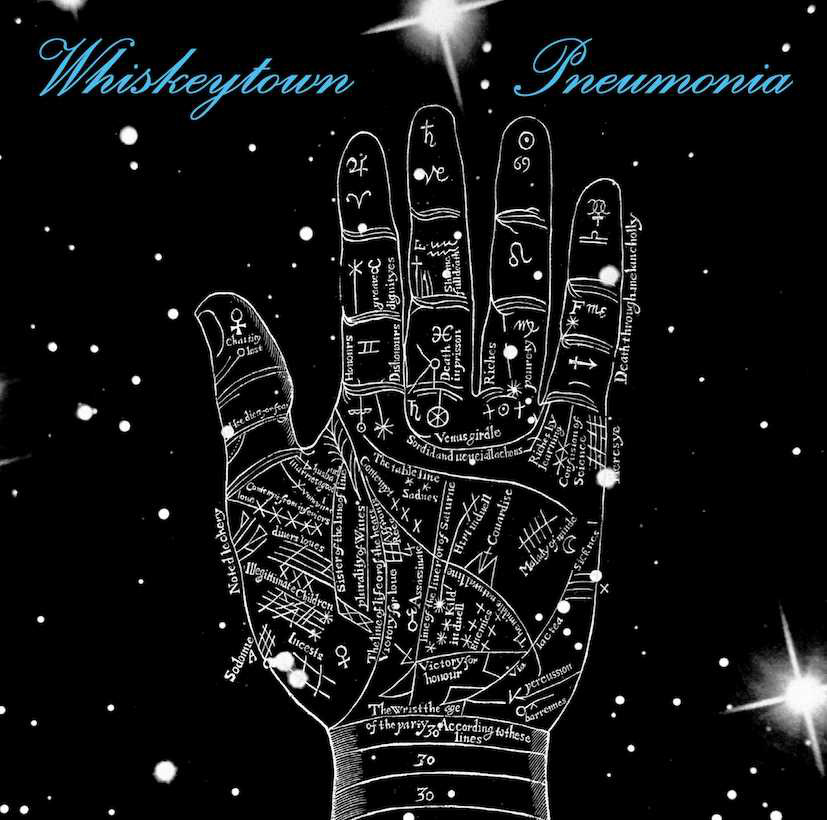
But it would be on their final, “lost” album, Pneumonia, that Adams finally stopped limiting himself to people’s perceptions of what Whiskeytown should be, and followed his own intuitions and influences.
Pneumonia was borne amid of a series of record industry mergers and a tumultuous tour in support of Strangers Almanac, during which the band cycled through line-ups, with just Adams and violinist Caitlin Cary as its constants. With the record being shelved for two years, Adams and company had amassed a great number of tracks to choose from, resulting in a folk- and country-influenced pop/rock creation that refused to be pigeonholed. At the time, fans of Whiskeytown were surprised by this musical departure, but it when it came to their shape-shifting frontman, Pneumonia would serve as a harbinger to Ryan Adams’ future solo efforts.
Adams had always insisted he never wanted to be the “frontman” of Whiskeytown, thinking of it as more of a collective that shared the spotlight and song-writing duties. But on Pneumonia, the prolific songwriter took the lead. When it came to developing the sound, however, it would be producer Ethan Johns (son of legendary producer/engineer Glyn Johns) who would take the reins. Their creative collaboration would continue on Adams’ solo debut, Heartbreaker, and subsequent albums.
Pneumonia is an open and honest album about loss and moving on from what pains you. Adams has described it as “the euphoria you get when you’re sick”, and there’s certainly a bittersweet sense to proceedings. The album opens with a lover’s farewell, ‘The Ballad Of Carol Lynn’, a song of strained appreciation for a troubled soul who’s too much for the singer to deal with any longer. It’s one of seven songs written with multi-instrumentalist Mike Daly and features Adams’ passionate vocals over a simple piano arrangement and harmonic interludes.
The following track, ‘Don’t Wanna Know Why’, is more upbeat rhythmically, but still stuck in the mud of a difficult parting of ways. The lyrics “Breathe in, breathe out” signify an attempt at the patience a lover seeks to find while in the middle of reconciling the end of something.
On ‘Jacksonville Skyline’, Adams goes into storyteller mode, recalling a small-town tale that feels like a homesick ode to his childhood home. At first the song seems like a simple vignette about day-to-day life in the south, but through the lens of Pneumonia as a whole, it takes on another meaning. Is its narrator longing for more simple days before the complications that clearly burden him, overwhelmed him? Over a decade after its recording, the song continued to resonate with Adams, who performed solo versions of it on his stunning solo 2011 acoustic tour, collected on the 15LP box set Live After Deaf.
The next four entries play like stages of a dissolving of a relationship. Even the song titles refer to those tense conversations one must have to explain, comfort, blame and finally accept. ‘Reasons To Lie’, ‘Don’t Be Sad’, ‘Sit And Listen To The Rain’ and ‘Under Your Breath’ are the heavy lifting of the sorrow this album dramatises.
‘Mirror, Mirror’ is the first hopeful song on the album. Almost out of place with its jaunty horn section and cheery backing vocals, it has more in common with a Ben Folds Five cut than anything anyone had heard from Whiskeytown. Nonetheless, upon re-examination, it feels fuelled by the freedom of a recently emancipated person who’s ready for what life has in store. ‘Paper Moon’, meanwhile, evokes a warm evening under the stars. Featuring orchestral arrangements by Glyn Johns, it lifts you up and carries you down cobblestone streets with its lilting melody and mandolins.
By the time the languid and sultry ‘What The Devil Wanted’ hits you, it’s clear we are now in the soft embrace of a new relationship. The past is gone and a new romance has blossomed. “All my time is wasteful now,” is not just a lyric, it’s a belief system for the man singing it. While most of Pneumonia takes on a first-person point of view, it’s not without some wonderful harmonising between Adams and Cary, especially on the penultimate track, ‘Easy Hearts’.
For a band remembered as alt.country pioneers, Pneumonia is full of welcome experimentation, each track bearing its own sonic feeling and diverse vocal delivery while still telling a cohesive story. It comes to a close with ‘Bar Lights’ and the hidden track, ‘To Be Evil’, an imperfect recording that ends with Adams laughing at his own mistakes. It’s as close to Springsteen as there Pneumonia gets, and – whether consciously or unconsciously – if Adams is leaning on The Boss here, it doesn’t matter. The results are a fitting farewell for a band that many would have liked to have seen stick around.
Out this week is the new multi-disc compilation, “Surrender to the Rhythm: The London Pub Rock Scene of the Seventies”. The collection is an excellent overview of pub rock, a phenomenon that helped paved the way for British punk. Before we get any further, though, we need to address a question many of our readers are probably asking themselves: What is “pub rock?”
“Pub rock” was a movement that lasted for a handful of years in the early to mid seventies. Pub rock bands played a back-to-basics style of rock-n-roll that was loose and unassuming. Though very much a London scene, pub rock was kick-started by an American group. In the spring of 1971, Eggs Over Easy were in London recording, when they convinced a local pub, the Tally Ho, to let the band play there on a regular basis. Their subsequent performances at the bar were a popular attraction, and other musicians and pub owners took notice. By 1973, it was a thriving scene.
Our copy of the last great pub rock anthology, from EMI in the 1990s, “Surrender to the Rhythm” is probably the last word we could ever want to hear on a genre that history seems to have crunched into a boozy after thought, but which in reality was the most fun you could have by saying “oh yes, I’m definitely over eighteen” in a deep voice on a Friday night.
Sequestered in Kentish Town to record an album with Hendrix/Slade producer Chas Chandler, in the spring of 1971 exiled American band Eggs Over Easy persuaded the landlord of local pub The Tally Ho to let them perform at the venue. Though the band were back in America by the end of the year, they inadvertently became the catalysts that sparked the pub rock revolution, with the likes of Brinsley Schwarz, Ducks Deluxe and Bees Make Honey playing a burgeoning circuit that included The Kensington in Russell Gardens, The Lord Nelson on Holloway Road and The Nashville in West Kensington.
All of the key acts are here, and three CDs, seventy-plus tracks, mean they more than outweigh those peculiar gatecrashers. The Feelgoods, the Kilburns, the Hot Rods, the Kursaal Flyers, Brett Marvin,Eggs Over Easy, Brinsley Schwarz, Roogalator and, a few tracks earlier, frontman Danny Adler’s Smooth Loser predecessors, and Supercharge… Spin Cycle’s own pick of the bunch, on the strength of so many nights spent in dark, smokey pubs while Albie and the gang mashed high octane funk with low-brow humour, and turned “Save Your Kisses For Me” into a memory to be cherished. Surrender To The Rhythm charts the origins and development of the London pub rock scene throughout the Seventies, featuring all of the aforementioned bands.
Great choice of songs, too. Ian Gomm’s brooding take on Chuck Berry’s “Come On,” Bees Make Honey playing “My Funny Valentine,” Ducks Deluxe’s “Heart on my Sleeve” and frontman, the late Sean Tyla, popping up later with his Gang.
We hear Graham Parker kick through a live “Back to Schooldays” and Dave Edmunds, who was a godfather of the whole scene without ever actually playing the circuit, offers up a couple of numbers. Cado Belle, fronted by the magnificent Maggie Riley, Chilli Willie and the Red Hot Peppers, Starry Eyed and Laughing, Ace….
Yes, things do get a little weird towards the end as the likes of Darts, Chris Rea, Sniff ’n’ the Tears and the Fabulous Poodles start snapping at the originators’ ankles. But the always excellent Philip Rambow kicks out “Young Lust” like a lover, and the Inmates’ “Dirty Water” threatens to launch a whole new Pub Rock movement just as the third disc ends. A magnificent package, then, full of magnificent music. If you were there the first time, it’s a lot of what you yourself might have chosen. And if you weren’t, pick up a pint, light a ciggy, grab a space at the front, and please try not to sweat in my beer. With four hours of vital, vibrant music – including several previously unreleased tracks – bolstered by a 48-page booklet crammed with photos, memorabilia, anecdotes etc, Surrender To The Rhythm is the definitive aural document of a movement that would revolutionise the British music scene.
Matt Berninger of The National is releasing his debut solo album, “Serpentine Prison”, on October 2nd via Book, Berninger’s new imprint with Concord. Now he has shared another song from it, “Distant Axis,” via a video for it. Matt’s brother, Tom Berninger, and Chris Sgroi directed the video which features Matt lying on the floor while various objects are dropped towards him (including, randomly, a Predator VHS tape). Matt wrote the song with Walter Martin (formerly of The Walkmen).
“I met Walter Martin fifteen years ago when the The National opened for The Walkmen on a tour of shitty clubs in the American southeast. On that tour, I learned a lot about how to be in a band without ruining your life. I also learned a lot about Florida, Tennessee and Georgia. Walt and I have stayed friends, and about three years ago we started passing ideas back and forth. Distant Axis started from a sketch Walt sent me named Savannah. I think it’s about falling out of touch with someone or something you once thought would be there forever.”
Previously Berninger shared the album’s title track, “Serpentine Prison,” via a video for it. Booker T. Jones produced Serpentine Prison, with additional production by Sean O’Brien. The album features an array of special guest players, including: Matt Barrick (The Walkmen, Jonathan Fire*Eater, Muzz), Andrew Bird, Mike Brewer, Hayden Desser, Scott Devendorf (The National), Gail Ann Dorsey (David Bowie, Lenny Kravitz), Booker T. Jones, Teddy Jones, Brent Knopf (EL VY, Menomena), Ben Lanz (The National, Beirut), Walter Martin (The Walkmen, Jonathan Fire*Eater), Sean O’Brien, Mickey Raphael (Willie Nelson, Bob Dylan), Kyle Resnick (The National, Beirut), Matt Sheehy (EL VY, Lost Lander), and Harrison Whitford (Phoebe Bridgers).
Back in February, before the pandemic overtook America, Berninger shared a cover of Mercury Rev’s classic “Holes,” from their 1998 album Deserter’s Songs. The cover is part of the 7-Inches for Planned Parenthood series and was originally shared via a video for the track. In April, for Late Night with Stephen Colbert Berninger performed the cover from home, aided remotely by Steph Altman on piano.
In April Berninger contributed guest vocals to “Quarantine Boogie (Loco),” a hilarious new COVD-19 themed song by Walter Martin.
Last year Berninger teamed up with Phoebe Bridgers for the new song, “Walking On a String,” which they performed in Netflix’s Between Two Ferns: The Movie. Then they shared a studio version of the song via a black & white video featuring them recording it .
The National released a new album, I Am Easy to Find, back in May 2019 via 4AD.
At the beginning of the year, Berninger, along with The National, surprised fans with a cover of INXS’ classic hit, “Never Tear Us Apart.” Their rendition of the ‘80s hit was for Songs For Australia – a covers compilation, featuring songs mostly by Australian acts, that benefitted country’s rehabilitation efforts, following devastating wildfires.
The official video for Matt Berninger’s “Distant Axis”, from his forthcoming solo album ‘Serpentine Prison.’ Produced by Booker T. Jones, the album will be released via Book Records in conjunction with Concord Records on October 2nd.
Consistency was a hallmark of Creedence Clearwater Revival in more ways than one. During the Northern California rock band’s prime, there really was no such thing as a long wait for the next CCR album, with the group pumping out five studio albums in two years.
Without hesitation or ambiguity, bassist Stu Cook and drummer Doug “Cosmo” Clifford agree that CCR’s output was fuelled in large part by a steady thought running through the mind of singer, songwriter and guitarist John Fogerty: If Creedence dropped off the charts, the public would forget about the band.
Cook says he doesn’t know where Fogerty came up with that idea, but at the same time, Cook theorizes that CCR “was treated too well by radio,” meaning stations cycled through the band’s singles at an accelerated pace.
“They always flipped the singles over and played the B-side,” he explains. “They killed the A-side early and flipped it. So we had a lot of platinum singles, but we were going through them like wildfire. We didn’t get the normal chart life out of any one song; two songs kept us on the charts about as long as one and half songs (would have for another band).”
He adds, “Creedence was a singles band, and when we had enough singles, then we would go into the studio and crank out the remainder, and then we had an album.”
Creedence Clearwater Revival released its self-titled debut album on Fantasy Records in 1968. Then the band pumped out three albums in 1969: Bayou Country, Green River and Willy and the Poor Boys, with “Proud Mary,” “Bad Moon Rising” and “Down on the Corner” among their Billboard Hot 100 hits that year. The steady output continued into the new decade, withCosmo’s Factory arriving in July 1970 and eventually spending nine weeks at No. 1 on the American charts. And while in many ways it’s true to the CCR albums that came before and after, Cosmo’s Factory also stands apart for subtle as well as significant reasons.
Preceding an album’s release with a single was typical for Creedence, but with Cosmo’s Factory, the band issued two singles well in advance. “Travellin’ Band”/“Who’ll Stop the Rain” entered the Billboard Hot 100 in late January 1970, followed by “Up Around the Bend”/“Run Through the Jungle” in late April. From the subsequent sessions that filled out the 11-song album came another two-sided single, “Lookin’ Out My Back Door”/“Long As I Can See the Light,” which hit the Hot 100 in early August.
In classic Creedence fashion, most of the singles were short recordings, but Fogerty, Cook, Clifford and guitarist Tom Fogerty outdid themselves with the feverish, saxophone-supported “Travellin’ Band,” which barely surpasses two minutes.
“Well, ‘Travellin’ Band’ is a tribute to the great Little Richard,” Cook says. And in coming up with his part, Cook put himself in the position of the bassist who played in the rock pioneer’s backing band.
“If we’re going to borrow from Little Richard, let’s go all the way and be true to the whole thing,” Cook adds. “So I just picked a simple bass part that drove it and didn’t get in the way. It was well within my playing skills.”
Conversely, Cosmo’s Factory contains two of the longer tracks in the Creedence catalogue. The 11-minute cover version of “I Heard It Through the Grapevine” had humble beginnings. This was an idea of John’s that started out very loosely as presented to the band, and we basically jammed for weeks,” Cook says. “We jammed the jam, back and forth (on the chords), for a couple of hours per day, Monday through Friday. And then a week before we went into the studio to record it, John said, ‘Oh yeah, I’m sticking “I Heard It Through the Grapevine” on the front of (the jam).’ And we said, ‘Sounds good to us.’ ” Cook adds, “The jam was really a jam; it was probably Creedence’s only jam. We all threw ideas around, and each of us as players kept coming back and refining the stuff that we thought individually and collectively worked best on the track. And when the red light was on, all we had to do was fall back on the stuff we’d been jamming on for some period of time, and it went down in one or two takes, like most Creedence recordings.” Normally, Clifford would have his drum parts planned out, but that wasn’t entirely the case with “Grapevine.”
“When we were cutting it, it reached a magic point where there are things I had never played before and John had never played before,” he recalls. “That was pretty exciting, and at the end, when we had the take, I said, ‘I kinda varied on some spots.’ And he said, ‘So did I,’ and that was rare for him to (do that).”
Then there’s “Ramble Tamble,” the long and intricate track that opens the album. “The song, to a nonmusical ear, has a good flow, has different parts and fits together well,” Cook says, “but it’s very strict in its sections that, when combined, make up the entire arrangement, which was completely unlike what the other Bay Area bands were doing at the time.” Over the course of the song’s seven-plus minutes, Clifford incorporates a double-time beat and also a steady-snare Motown-style beat. “The tough part in that song was slowing down the tempo, and (it was also a challenge) bringing it back (up) — and it had to be exactly right, or the song didn’t work,” Clifford says.
Cosmo’s Factory closes with the slow, soulful “Long As I Can See the Light,” which like “Travellin’ Band” features saxophone. Yet it’s Clifford’s high-hat work as the song winds down that stands out, the result of him switching from 14-inch to 18-inch high-hat cymbals. “I wanted a more melodic tone from the high-hat,” says Clifford. But in that quest, he encountered a problem: Due to the weight of the bigger high-hat cymbals, he couldn’t get them to open. “So I went to the hardware store and got a spring, put it in there, cut it down to size, put it back in, and it worked perfectly,” he says. “I opened them up at the end of that song, and they were really screaming — wide open, just pounding them with the shank of the stick, trying to get as much wood on them as possible.”
The ominous opening to “Run Through the Jungle” was the result of some experimentation.
“We had a (toy version of a) kalimba, the African finger piano — that, with a slowed-down backward tape, just trying to use some of the techniques that George Martin was using at the time,” says Cook. “A guitar string being hit, then tuned at the same time — tuning it up, then down. Speeding things up, slowing them down so they got a surreal texture. Laying that all onto the multitrack, then trying to come up with a blend.”
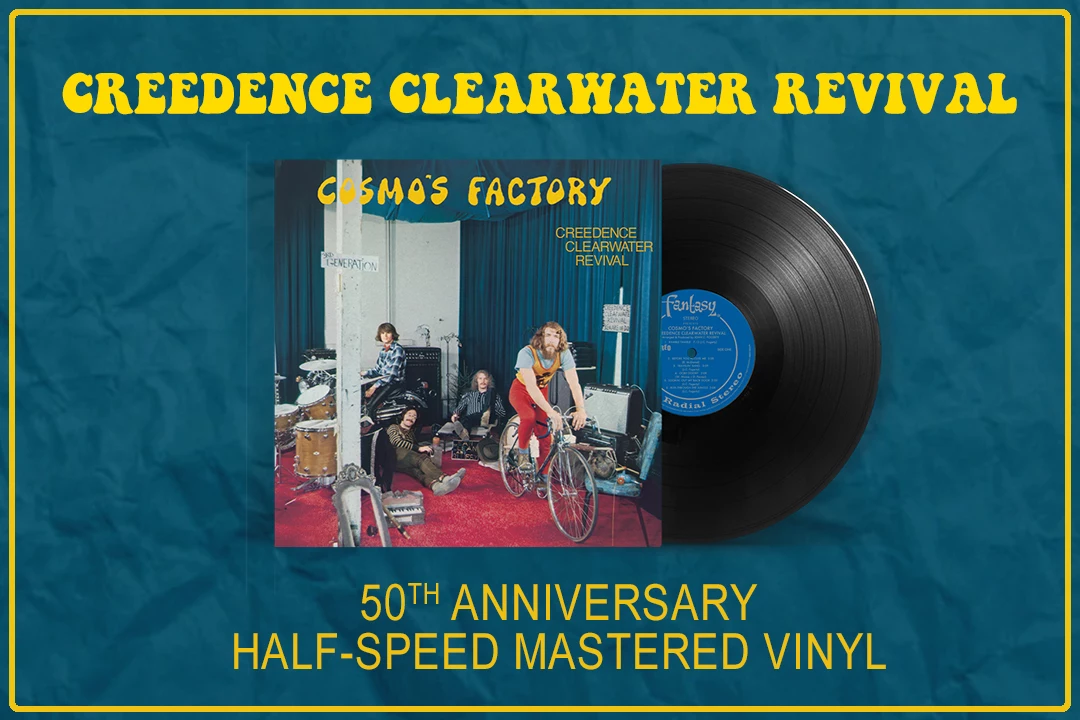
Clifford credits John Fogerty with coming up with the title for Cosmo’s Factory, and the factory itself was the band’s rehearsal space in Berkeley at 1230 Fifth St., where the album cover photo was shot by another Fogerty brother, Bob.
Like every CCR album cover up to this point, Cosmo’s Factory showed all four members of the band — only this time, there were plenty of props, too.
“Coming up with any kind of a picture is not quite as hard as coming up with a band name, but what do you do?” Cook says. “We took a bunch of junk that was laying around … the Lite-Brite kit (positioned under Tom’s raised feet). Doug was on his 15-speed bike. John had his motorcycle; I was laying on the floor playing some toy piano.” “I rode that bike to work every day,” adds Clifford. “I lived up in the hills, seven and a half miles away. Coming to practice was all downhill, and going home after playing drums for hours, it was (uphill through the traffic).”
Five decades later, Cosmo’s Factory remains the bestselling non-compilation album in the Creedence Clearwater Revival catalogue, with the Recording Industry Association of America bestowing multiplatinum status for sales of 4 million. CCR’s heyday wrapped with Pendulum, released in late 1970, and the band broke up after 1972’s Mardi Gras.
Even though its title contains Clifford’s nickname, Cosmo’s Factory is the drummer’s second favourite CCR album. At the top, he says, is Bayou Country, and for good reasons: “It wasn’t too far away from when we were playing in the bars, six nights a week, five sets a night. And ‘Born on the Bayou’ is my favourite Creedence song of all time.”
Cook describes Creedence as “an incredible rocket ride” that followed “nine and a half years of struggling,” during which the band went by other monikers, such as The Golliwogs.
“Now I can look back 50 years later (at Cosmo’s Factory) and go, ‘Well, I still love it,’ ” he adds. “It’s a great album.”
John Lee Hooker – A San Francisco favourite, John Lee Hooker came a long way from Tutwiler, Mississippi to the Bay Area. He was the son of a sharecropper and rose to prominence playing an electric-guitar-style adaptation of the Delta Blues. He developed his own boogie rhythm style in the late 40s. In the mid-30s, Hooker lived in Memphis where he performed on Beale Street and house parties. He worked at the Ford Motor Company in Detroit in 1943 and frequented Blues clubs and bars on Hastings Street in the black entertainment district on Detroit’s east side. Hookers’ style took off in a city not noted for guitar players. His recording career began in 1948 with Modern Records in Los Angeles who released a demo he had recorded in Detroit. “Boogie Chillen: became a hit and the best-selling race record of 1949. He was on his way. Later in the 60s, he recorded “Boom Boom,” (covered by the Animals) and “Dimples,” two of his most popular songs for Vee-Jay Records of Chicago. He toured Europe in the annual American Folk Blues Festival beginning in 1962. Hooker eventually began to record and perform with Rock groups such as the Groundhogs, and Canned Heat, The Heat recorded “Hooker ‘n Heat” with him in 1970. Other later collaborations included Van Morrison, Steve Miller, Santana, Bonnie Raitt, Jimmy Vaughan and others. Hooker died in 2001 at the age 83.
John Lee Hooker is a “blues legend” and you’re not just mouthing a cliche. You’re missing the specificity of what he brought to the form, the unique strand of DNA he sent coursing through the gene pool of countless rockers and blues artists in his wake. Hooker honed the blues into something new – a grinding, hymnal vamp, which he finessed for all it was worth. Hooker’s essential sound dispensed with the usual 12-bar blues progression to throw the focus on the thrust of the rhythm. It’s deep groove music he made, with a sound as indebted to the beat as funk, and as enamoured of repetition as an incantation. In Hooker’s greatest recordings, repetition bred intensity, both in his guitar playing and in his vocals which, in their chanting, droning cadence, could reach the transcendence of devotional singing.
All of this is worth noting as we approach what may or may not be the 100th anniversary of John Lee Hooker’s birth. The star, who died in 2001, upheld the blues tradition of not being overly concerned with exact birth dates. A variety of origin years have been credited by various sources, so let’s just settle on the one chosen by the record company now releasing his music, Vee-Jay Records. It picked this year to toast his centennial, marked by a well-curated, 16-song compilation of Hooker’s work, titled “Whiskey & Wimmen”.
Hooker’s anniversary arrives after the loss of another pivotal figure in 20th-century music – Chuck Berry, who was 90. In the same way Berry proved crucial to creating rock’n’roll, Hooker held a seminal role in the birth of the boogie branch of blues. On one level, his style transposed the earlier style of boogie-woogie piano to the guitar, then distilled it down to a ground breaking, minimalist kind of blues. To help create it, he used a different tuning than most blues players do. He went with “standard” tuning, as opposed to the “open” tuning favoured by most such artists. Hooker learned that style from his stepfather, Will Moore, an entertainer himself who had worked with Charley Patton and Son House.
Hooker, who was born in Coahoma County, Mississippi, left the family by age 14 and went to live in Memphis, where he performed on Beale Street. He cut his first records, starting with 1948’s Boogie Chillen, for the LA-based Modern Records. Hooker’s early songs were all singles, for a variety of labels, but he later developed into a prolific album artist imitated by thousands. Over the years, his songs were covered by stars such as the Rolling Stones, Van Morrison, Bonnie Raitt, Carlos Santana and countless others. Amid his sprawling catalogue, these 10 pieces best express his rarity and genius.
Boogie Chillen
Hooker’s first single became a No 1 jukebox hit, selling over 1m copies. It set the template for a style that often put its trust in a single riff, which he’d repeat, elaborate and then concentrate through the sheer dynamics of his playing and force of his vocal character. In that sense, Hooker’s approach had more in common with a Sufi singer like Nusrat Fateh Ali Khan than with most anyone reared in the Mississippi delta. He was now loud enough to compete with city life, and became a regular performer in clubs on Detroit’s East Side. A demo made its way to Modern Records in LA, which released ‛Boogie Chillen’. It was an R&B chart No.1 and Hooker’s career was under way.
Sally Mae
Hooker’s follow-up to his Boogie smash finds him singing with a knowing wink, addressing a woman who’s been driving him mad. The song showcases his sexy vibrato and his darting acoustic guitar work, which finds subtle intricacies in the beat.
Crawlin’ King Snake
Hooker’s reinterpretation of this song, originally recorded by Blind Lemon Jefferson in the 1920s under a different title, gave him a top 10 R&B hit. His version takes full advantage of the directness of his acoustic guitar style, sometimes paring a solo down to a single repeated note. Better, it features a vocal that’s both low-down in its lust and elevated in its perfection. While JohnLee was a juvenile, his sister took up with another bluesman, Tony Hollins, who gave him a guitar and taught him songs that would serve the kid all his days. Among them was an essential track for every John Lee Hooker playlist, ‘Crawlin’ King Snake’, which Hooker first recorded in 1949 – and copyrighted. Hence when rock came along and the likes of The Doors covered it on LA Woman in 1971, John Lee Hooker done got paid. The same goes for the times he recorded it himself, of which there were many.
I’m in the Mood
Bonnie Raitt was so moved by the need and randiness in Hooker’s original version from 1951, she later cut a take with him on an all-star duets album, The Healer, in 1989. Their tandem recording won Hooker his first Grammy, while the album earned the star his highest-listed album on the pop chart. Raitt later said working with Hooker changed the way she thought about men in their 70s and 80s. Modern enjoyed another R&B chart-topper in 1951 with ‘I’m In The Mood’ (a lewd ditty Hooker recorded eight times over the years and which tempted Bonnie Raitt into a duet with him decades later), and then he was off again, working with the Chicago label Chess, which got sued by Modern in 1952 over the single ‘Ground Hog Blues’. The thing is, John Lee was a star: his hard-rocking boogie style was hard to replicate and that made him worth fighting over. Modern finally bowed out of his increasingly tangled career in 1955
Frisco Blues
Hooker was moving in soon-to-be-famous circles as he worked with various Supremes, Vandellas and other Motown musicians during ’63-64. Taking this John Lee Hooker playlist in a slightly different direction, ‘Frisco Blues’, from an album that attempted to place him in yet another genre, The Big Soul Of John Lee Hooker, may have been a Detroit sound on a Chicago label (Vee-Jay), Only the title of this 1963 track gives you the slightest hint that Hooker took inspiration from Tony Bennett’s I Left My Heart In San Francisco, which hit the year before. Hooker’s hard blues overhaul, complete with raging electric guitar, features uncredited backup vocals from the Vandellas, who hid their role due to contractual obligations to Motown. Listening to Hooker’s vocal salute to San Francisco’s “cool, cool nights” on a “high, high hill”, we hear cadences that later influenced another singer devoted to a chanting style, Van Morrison. Unsurprisingly, Hooker and Morrison recorded many songs together decades later.
I Cover the Waterfront
Of all the Hooker/Morrison hook-ups, Waterfront features the greatest rapport between the two. Its elegant jazz melody, composed in 1933 by Johnny Green, leaves space for maximum improvisation, a hallmark of both stars’ styles. Hooker also cut his own version, in 1967, on a like-named album, letting him showcase a very different style from his usual boogie.
One Bourbon, One Scotch, One Beer
In 1966, Chess again branded him a traditional artist on The Real Folk Blues, though Hooker was working with a bruising band. The album’s most famous tune, ‛One Bourbon, One Scotch, One Beer’, has a history dating back to Amos Milburn’s early 50s version, though Hooker imbibed it as he saw fit. George Thorogood brought this song to the rock masses in the 70s, crediting Hooker’s version as his inspiration. In fact, the song was written by Randy Toombs and made into a hit in 1953 by Amos Milburn. Still, Hooker’s 1966 version goes deeper than the other interpretations, especially the macho one by Thorogood. Hooker leaves more space in the song, talking his blues rather than barking them. He lets the inebriation in the lyric sink in to the point where it achieves a nearly psychedelic headiness. The vibrato he puts on the word “beer” gives it a beautiful resonance. What’s more, Hooker’s rocking backing band features some players Chuck Berry used on his hits, including Lafayette Leake on loosey-goosey piano.
Boom Boom
Hooker laid down the hammer on Boom Boom, a sexy vamp with a sly guitar and a rolling piano. One of his biggest hits, cut in ’62 and redeployed in 1980 in the Blues Brothers movie, the song has been covered by everyone from the Animals to Mae West. Its stop-start rhythm lends it a killer hook while Hooker’s conversational vocal plays it cool. Folk was not the only new market opening up for Hooker. In London, rhythm’n’blues was rapidly becoming the sound of clubland, and his tunes soundtracked the fashionable dances performed by the original mods. The contemporary ‘Boom Boom’ was certainly no folk ballad: this tough dancefloor-aimed I-fancy-you ditty made the lower reaches of the US pop charts. but this version of ‘Boom Boom’ somehow didn’t make the soundtrack album – perhaps there were fears its authenticity might make some of the other tracks look weak. Hooker would have to wait until 1988, when he was apparently 76, for a big revival thanks to The Healer, an album which featured rock stars queuing up to pay homage to their hero on vinyl. Its title track, featuring guitar star Carlos Santana, attracted attention and the record made the US album chart, setting Hooker up for a rewarding old age in both financial and artistic senses.
I’m Bad Like Jesse James
Another notable Riverside session delivered ‛I’m Gonna Use My Rod’, later retitled ‘I’m Bad Like Jesse James’ and ‛I’m Mad Again’. Hooker seemed fine with being portrayed as a folk singer, despite his gun-totin’ lyric, which was hardly peace and love. Was he gettin’ paid? Then call him what you like – he’d already changed his name numerous times on record. Should you be in any doubt as to his credibility with the folk crowd, Hooker played in New York in 1961 – and the support act was Bob Dylan, making his debut in the big city.
Dimples
Hooker proved he could be as effective in a more conventional blues as in a boogie with Dimples. He wrote it about a friend’s wife, whom he had a crush on. His delivery laces his leer with a self-aware humour. The original 1956 take features wailing lead guitar from Eddie Taylor. Signing to Vee-Jay, Hooker issued ‘Dimples’ in 1956. By now he was recording with a full band and this easy-rolling hit about an attractive woman enjoyed an extended afterlife. In 1959, Vee-Jay realised the burgeoning folk boom in the US might provide Hooker with an opportunity, and also realised that it was not the label to facilitate it, so it licensed Hooker out to the New York company Riverside, which extended Hooker’s reach into a white audience through two albums, the first of which, The Country Blues Of, included another John Lee Hooker playlist staple, ‘Tupelo Blues’: a much-revisited song about a flood in the Mississippi town Elvis Presley had been born in. The song possessed a sense of history just like ‘Natchez Burning’ had for Howlin’ Wolf, establishing Hooker as a man with roots.
Hooker ’n Heat
By the late 60s, the hippie generation was returning to the roots of rock’n’roll, and Canned Heat, perhaps the band most steeped in Hooker’s boogie style, cut a double-LP with the singer, Hooker’n’Heat, the first of several they’d make together – and the first of his high-profile collaborations to feature on this John Lee Hooker playlist. It featured a fine version of ‘Whiskey And Wimmen’.
To Hooker, it was Groundhog Day: he’d already recorded with white bands he’d inspired, having cut an album in London with The Groundhogs in ’64. They’d named themselves after his ‘Ground Hog Blues’. There’s a bit of a cheat going on here. Hooker ’n Heat is actually a full album – a double set, in fact – rather than a single song. In 1971, when Hooker was living in LA, he met the members of the boogie-rock band Canned Heat. Together, they cut a classic, 17-track set that contains some of the star’s most committed performances, as well as some of his most intuitive collaborative works. Together, that resulted in Hooker’s first charted album. In deference to his genius, the band gives all of side one to him alone. For side two, the Canned Heat member’s Alan Wilson comes in on piano and harmonica; in the final songs, the whole band chimes in. It culminates in a sprawling, 11-minute rethink on Hooker’s very first record, Boogie Chillen No 2, demonstrating just how far, and free, his vamps could roam.
He couldn’t boast the effortless authority of Muddy Waters. He wasn’t an outlandish marketable character like Bo Diddley. He couldn’t terrify you from across the hall like Howlin’ Wolf. But John Lee Hooker was a blues survivor who’d rock you to the socks that were poking out of the hole in your soles; he was street-smart, adaptable, even crafty. And armed with nothing but a guitar and his dark, moody, mumblin’, barking voice, he’d make you dance with: ‘Boogie Chillen’, as he once called it. but isn’t the blues a noble cry of the poor African-American who is suffering? Hell yes, but Hooker’s telling us if you got feet, you can use them to beat the blues.
Hooker’s final album before he passed away, in 2001, was Don’t Look Back, a moving affair that nonetheless still bore his boogie-and-coulda-bin trademarks. The title track might have been ironic, as Hooker was doubtless aware of his impending demise. And he was looking back: he’d recorded the song before, but it had never sounded like this. Now it was a spiritual affair and an apt finale to a unique career








 The Fat Angel Sings