Archive for the ‘CLASSIC ALBUMS’ Category

May be an image of 2 people, people standing and text that says "the records the records/ shades in bed bed"

Among vinyl devotees, The Records will be forever known for the dizzying late-70s single “Starry Eyes” . The Records were formed out of the ashes of the Kursaal Flyers, a pub rock group featuring drummer Will Birch. In 1977, John Wicks joined the band as a rhythm guitarist, and he and Birch quickly started writing songs together, Wicks as composer, Birch as lyricist. The Kursaal Flyers dissolved three months after Wicks joined, but he and Birch continued to write songs together with the hopes of starting a new four-piece group with Birch on drums and Wicks on lead vocals and rhythm guitar. Birch soon came up with a name for the formative band: The Records. The new group was heavily influenced both by British Invasion bands like The Beatles and The Kinks and early power pop groups such as Badfinger, Big Star, and Raspberries. Power pop was experiencing a renaissance on both sides of the Atlantic, thanks in large part to the burgeoning punk/new wave movement.

The group’s line-up initially included bassist Phil Brown and lead guitarist Brian Alterman, whose guitar riffs have been compared to that of the Byrds. Alterman played on two early demos that were later included on the album Paying for the Summer of Love, before joining another band. Alterman was replaced by Huw Gower in 1978. Like Birch and Wicks, Gower and Brown were music veterans: Gower had played with a band called the Ratbites from Hell and Brown had been the bass player for the Janets

New Year’s Day in 1980: Joe Jackson & The Records started the year with verbal jousting in the UK press; Joe had been quoted in music weekly ‘New Musical Express’ (NME) saying “I feel more in common with what The Clash are doing than with The Records, who are about the most boring band I’ve ever heard”; The Records responded with a letter to the Editor, that read in part “While the Clash remain true to their ideals & therefore meet with resistance from many US radio stations, Joe, on the other hand, woos his followers with a selection of easy-on-the-ears Steve Miller rewrites…”.

The band’s 1979 debut – originally titled “Shades in Bed” in the UK, — stands as one of the absolute pinnacles of late ‘70s power pop, thanks to the consistent song writing (lots of power pop albums drop off bigtime after the first three songs), notch-above harmonies, and having a bit of a recording budget from Virgin Records (compared to the often indie label, cult power pop bands favoured by the collector cognoscenti today). “Teenarama” and especially the astounding classic song, “Starry Eyes,” gained some airplay around the world, and show up on every Top 25 Power Pop Songs lists since.

It was 40 years ago when The Records returned from the USA, from JFK, on TWA (708) after an eight week tour, during which time the group played a total of 38 shows, and enjoyed opening for Joe Jackson (six dates), The Cars in Central Park and the Midnite Special TV Show (with The Cars), having the Dbs and the Rubinoos opening for us, our album hitting #41 on Billboard, and meeting Billy Joel, Jan and Dean, Robert Palmer, Flo and Eddie and many other interesting characters along the way.

Will Birch and John Wicks had founded The Records in 1978. Will thought of the name in the bathtub. Influences included Big Star, The Raspberries, Blue Ash, Badfinger, Stealers Wheel and the Beatles’ Revolver LP. Will and John immediately wrote 11 songs including “Teenarama, Up All Night and Held Up High”. They advertised in Melody Maker and located Phil Brown (bass) and Huw Gower (guitar). In 1978 The Records joined the Be Stiff Tour as backing group for Rachel Sweet. They recorded the 45 “Starry Eyes” and signed to Virgin Records.

Their debut album Shades In Bed (aka ‘The Records’) helped to establish their reputation, particularly in the USA, where “Starry Eyes” was a minor hit. They toured with Joe Jackson, opened for The Cars in Central Park and played their own headline shows with the likes of the dB’s and The Rubinoos in support. In 1980 Jude Cole (ex Moon Martin) joined the group in time for their second album, “Crashes”, featuring “Hearts In Her Eyes”, a song Will and John originally wrote for The Searchers.

A third album, Music On Both Sides, was recorded in 1981. The Records disbanded in 1982.

They were hired to back Stiff Records singer Rachel Sweet on the “Be Stiff Tour ’78”. The Records opened the shows with a set of their own. Birch and Wicks also wrote a song for Sweet’s debut album entitled “Pin a Medal on Mary”. The song writing duo also penned “Hearts in Her Eyes” for the Searchers, who made an unexpected comeback with their power pop oriented album The Searchers in 1979.

Based on their demos (later released as Paying for the Summer of Love), the band was signed to Virgin Records in 1978. Their debut single, “Starry Eyes”, was released in the UK that December and has since become their best-known song and an oft-covered power pop standard. Allmusic called it “a near-perfect song that defined British power pop in the ’70s”.Due in part to its clear influence by American power pop, the song was a bigger hit in the US than in the UK; it peaked at No. 56 on the Billboard Hot 100 in October 1979.

The group prepared their debut album with producers Robert John “Mutt” Lange and Tim Friese-Greene. Huw Gower produced “The Phone”, which was added to the album in preference to one of Lange’s efforts, a cover of Tim Moore’s “Rock ‘n’ Roll Love Letter”. The debut LP “Shades in Bed” yielded another single, “Teenarama”, their second-best known song. The album was released in the US in July 1979 as The Records with different song sequencing and with the original single version of “Starry Eyes” replacing Lange’s re-recording that appeared on the UK edition.

The album was sufficiently well received to peak on the Billboard chart at No. 41. Gower also produced the bonus four track disc of cover tunes included in the album release, which also received FM airplay, notably the version of Spirit’s “1984”, which was strong enough to become short-listed by Virgin as the second single off the album. deep-cuts like “Girl” demonstrate the British group’s soft powers. Vocalist John Wicks, who died in 2018, the Records always seemed more indebted to studio-trained, throwback pop acts than the more caustic punk of the time. The result was songs like “Girl,” which unites charging guitar riff’s with the sort of airy, all-hands-on-deck harmonies even the Hollies would have envied.’

That was the pinnacle of their success. Returning to the UK, Will Birch engaged the services of producer Craig Leon to record two new songs and to remix two tracks from Shades in Bed for a possible single release. Huw Gower acted as co-producer. After an aborted German tour with Robert Palmer, Gower left the band and relocated to New York, where he joined forces with New York Dolls lead singer David Johansen. Their collaboration led to the successful album Live It Up.

Jude Cole, a 19-year-old American, who had been in Moon Martin’s backing group The Ravens, joined for the album “Crashes” (1980). The album was not a hit, and did not yield any successful singles, and record company support for the band dried up during the Crashes tour. Cole stayed in the US, while the core of Birch, Wicks and Brown returned home to England.

The trio expanded into a quintet with guitarist Dave Whelan and lead singer Chris Gent. Previously, most of the songs had been sung by Wicks, but with other members frequently taking lead vocals for individual songs. Birch has since declared that the decision to recruit a lead singer was made “perhaps unwisely”. This line-up recorded a third album for Virgin, 1982’s “Music on Both Sides”. Like its predecessor, the album was not a hit.

After this, the band effectively broke up. Birch turned to tour managing, running ‘Rock Tours’, a sightseeing London Bus venture, producing and writing. In 1990 the original band briefly reformed to contribute a track for the 1991 Brian Wilson tribute album, Smiles, Vibes & Harmony. Birch, Brown and Wicks cut the basic track for “Darlin'” in London; Gower added his parts and mixed it in New York. The same year also saw the US release of Paying for the Summer of Love. Both recordings received great press, but were not enough to outweigh unresolved past issues within the core membership, which effectively killed any possibility of restarting the group. Wicks relocated to the US in 1994 and was writing, recording and performing both solo and with a new incarnation of the band up until 2018. Brown succumbed to an undisclosed degenerative illness on February 2nd, 2012. Wicks died following a year-long struggle with cancer on October 7th, 2018

The Records

It’s hard to believe, but there was a time when The Who weren’t ubiquitous, practically synonymous with loud rock concerts. For U.S. audiences, their real breakthrough came in 1967 with their appearance at the Monterey International Pop Festival. Here they showed their talents as a singles band with “Happy Jack” and “Substitute,” they demonstrated their penchant for art-rock with their rock opera “A Quick One While He’s Away,” and nearly stole the show with simply smashing finale to “My Generation.” Now that career-changing performance makes its way to red, white, and blue striped vinyl for Record Store Day Drop 3. Limited to just 6,500 copies, you’ll want to drive that magic bus to your local shop and get in the queue!.

The Who’s set at the Monterey festival in 1967, including tales of psychological warfare with Jimi Hendrix, upsetting Ravi Shankar and more… On June 18th 1967, The Who brought what Rolling Stone called their “pulverising music” to the Monterey International Pop Music Festival at the Monterey County fairground, California. Among the festival’s organisers were John Phillips of the harmony group The Mamas And The Papas and The Beatles’ press officer Derek Taylor. The organisers had pledged the festival’s profits to charity, and asked the bands to perform for free. Most accepted, albeit grudgingly, except Indian composer and sitar player Ravi Shankar who pocketed $3,000 for his afternoon performance.

As The Who had only just dented the US market, co-manager Chris Stamp agreed to the group playing for nothing. Stamp had recently permed his hair to look more like his hero Jimi Hendrix, discovered LSD and embraced what he called “love and communication… and all that shit.” But he was still compos mentis enough to know this was a good opportunity for The Who.

The other acts on the Monterey bill included Country Joe And The Fish, Jefferson Airplane and Scott McKenzie, whose hit San Francisco (Be Sure To Wear Flowers In Your Hair) was now an anthem for what critics were calling ‘the summer of love’. The stage was wide open for a loud, aggressive group from England.

The Who were due to play on Sunday evening and arrived the day before. Pete Townshend watched Otis Redding work his magic on Saturday night, but America’s take on psychedelia left him cold. “The effect of LSD on American music made it crap, with very few exceptions,” he complained.

If ever The Who had the opportunity to, as Townshend put it, “leave a wound” it was now. But they weren’t the only Track Records act on the bill. “The Who paid my fare home,” says Keith Altham, who covered the festival for New Musical Express, “but Jimi Hendrix paid for my flight out.” To add to the frisson, The Who and fellow Track act Hendrix were both due to play on Sunday evening. By then, as many 80,000 people had passed through the gates into the fairground or congregated outside, hoping to see and hear something, anything. The festival had also attracted unprecedented media coverage, with over 1,000 journalists besieging Derek Taylor’s press tent.

“I wasn’t wearing a psychedelic shawl. It was a tablecloth I bought in Shepherd’s Bush.” Roger Daltrey

Backstage, the Grateful Dead’s sound engineer turned chemist, Owsley Stanley, was distributing free LSD trips and Rolling Stone Brian Jones was drifting around dressed like a Regency prince, but looking, as Keith Richards once said, “like a ghost about to leave a séance”. Roger Daltrey recalls Jones joining him, Janis Joplin, The Mamas And The Papas’ Mama Cass and Jimi Hendrix for a jam session in the dressing room under the stage.

Jimi was playing Sgt. Pepper on his guitar,” said Daltrey. “But, and this was the amazing thing, he was playing all the parts. He would go from a bit of orchestration, to a vocal part, to a solo – the whole thing on one guitar.” The others stood and watched, accompanying Hendrix by beating out a rhythm on anything close to hand.

Others remember it differently. Pete Townshend recalled arguing with Hendrix about who would go on first, as neither wanted to follow the other. At one point Hendrix stood on a stool in front of Townshend to show off on the guitar, as if to say, “Don’t fuck with me, you little shit.” In the end, John Phillips suggested they toss a coin. Townshend won.

The Animals’ frontman Eric Burdon, his Newcastle accent now softened by California or drugs or both, introduced The Who as “a group that will destroy you completely in more ways than one”. Behind him, the band crashed into Substitute followed by Summertime Blues. It was hard to imagine anything more removed from The Mamas And Papas’ passive California Dreaming or anything else played that weekend.

The Who tore through Pictures Of Lily, A Quick One, While He’s Away, Happy Jack, and My Generation. Instead of peace, love and flowers, they offered wanking, pervert train drivers, adolescent turmoil, and Pete Townshend hacking away at the stage with his guitar, like a lumberjack trying to dismember a log with a blunt axe. In the subsequent Monterey Pop movie, you can hear the gasps from the audience as stagehands rush on to salvage the broken equipment. Ravi Shankar watched the performance and was disgusted by “their lack of respect for their music and their instruments.”

“The effect of LSD on American music made it crap.” Pete Townshend

There was an air of English decadence about The Who at Monterey. In their paisley jackets, Edwardian ruffles and puffed sleeves, the group looked like a gang of marauding dandies. In 2005, Keith Altham recalled that Moon had accessorised his outfit with a necklace made from human teeth. Even Daltrey, who’d rarely worn targets and chevrons in The Who’s pop art days, had joined the revolution. The cape draped around his shoulders was an explosion of red, brown and burnt orange hues, described in New Musical Express as “a heavily embroidered psychedelic shawl”. In fact, it was nothing of the sort. “It was a tablecloth I bought in Shepherd’s Bush market,” Daltrey admitted. “But it did the job.”

Later, Brian Jones introduced Jimi Hendrix as “the most exciting guitarist I’ve ever heard”. Townshend watched Hendrix’s set with Mama Cass: “He started doing this stuff with his guitar. She turned around to me, and said to me, ‘He’s stealing your act.’ And I said, ‘No, he’s doing my act’.”

Townshend has since achieved a Zen-like calm on the subject of Jimi Hendrix, but Daltrey still sounds defensive. “I always have to defend The Who when people start raving about Hendrix at Monterey, and what he was doing,” he huffs. “It was totally nicked from The Who.” Daltrey was right – until Hendrix sprayed his guitar with lighter fluid, set it on fire and tossed the charred remains into the audience. Keith Altham remembers running into a subdued Townshend at San Francisco airport the next day, and being warned not to just write about Jimi. “Hendrix triumphed at Monterey,” Altham points out now, “but it was The Who that had drawn first blood.”

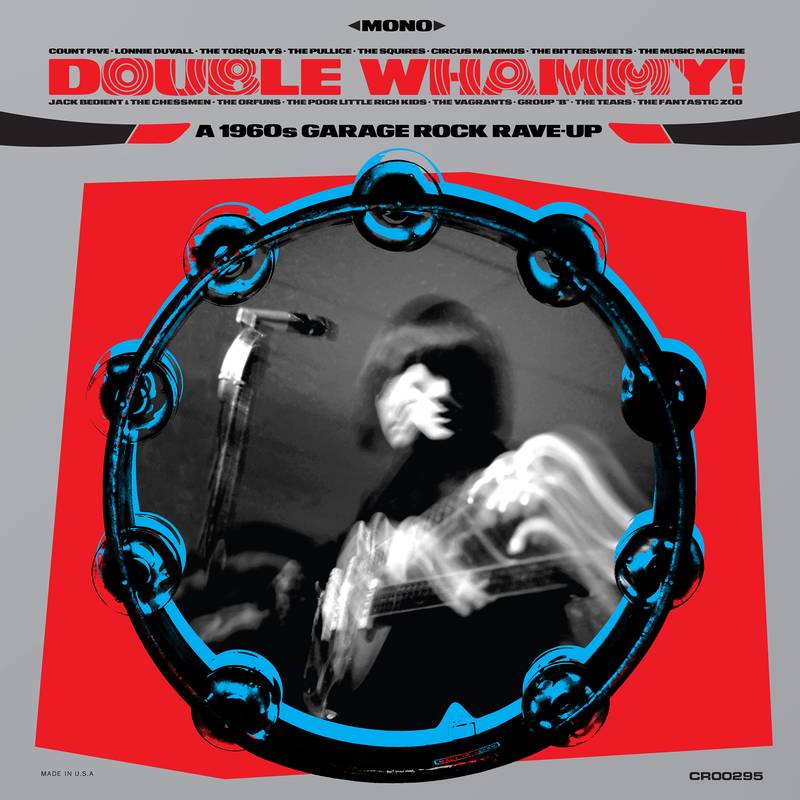
Craft Recordings has followed up last year’s Poppies: Assorted Finery from the First Psychedelic Age with a new collection focusing on garage rock sounds.  Double Whammy! A Sixties Garage Rock Rave-Up lives up to its title.  Like Poppies, it’s not an overall anthology of the genre but rather an impeccably curated journey through rarities and oddities.  The biggest names here are Count Five (with the unedited version of their 1966 top five hit “Psychotic Reaction”) and The Music Machine (with the previously unreleased, full-length version of “The People in Me”).  But the other artists are no less worthy. 

Producer/compiler Alec Palao writes that “perhaps the easiest way to explain garage rock is simply as the American grass roots response to the British Invasion, as the Beatles kicked a stale record industry into overdrive, and a generation was primed materially, emotionally, and philosophically to create and consume.”  Create they did, often only armed with guitar, bass, drums, and organ – and perhaps a harmonica and the occasional vocal harmony!  There’s plenty of D.I.Y. goodness here from a variety of labels including Fantasy, Scorpio, Vanguard, and even Art Laboe’s Original Sound and Stax – not to mention some professional, polished productions that nonetheless managed to capture that primal, raw garage spirit (the Sonny Bono-produced cover by Joey Paige of Bill Wyman’s “‘Cause I’m in Love with You,” Trade Martin’s production of The Vagrants’ “I Can’t Make a Friend”).  Hooks and riffs abound on the catchy likes of The Torquays’ “Harmonica Man (From London Town),” The Bittersweets’ “In the Night,” and Lonnie Duvall’s British Invasion-influenced “Attention.”  

En toto, the set produced and compiled by Alec Palao features three previously unheard cuts out of 16.  Steve Stanley has designed a beautiful package including a reflective silver jacket and a gorgeous, four-page booklet at LP size which boasts Palao’s detailed track-by-track annotations.  The album itself is pressed on blue vinyl.  With every track crisply mastered in AM radio-ready mono by Joe Tarantino, energy abounds on this Double Whammy! 

Originally released in 1975, Metamorphosis was first official rarities compilation under The Rolling Stones’ name. You’ll hear outtakes, demos, and other rarities from The Stones’ early days, featuring session legends like Big Jim Sullivan, Clem Cattini, and one Jimmy Page.

Side two, meanwhile, includes session material from Beggars Banquet and Let It Bleed. Though the result may have been a bit piecemeal, Metamorphosis presets a compelling collection of intriguing rarities and critical session material. Now, the compilation arrives on hunter green vinyl with a special iron-on of the album artwork. After the release of Hot Rocks 1964–1971 in 1971, an album titled “Necrophilia” was compiled for release as the follow-up, with the aid of Andrew Loog Oldham, featuring many previously unreleased (or, more accurately, discarded) outtakes from the Rolling Stones’ Decca/London period. While that project failed to materialise—with More Hot Rocks (Big Hits & Fazed Cookies) being released in its place—most of the unreleased songs were held over for a future project. In 1974, to give it an air of authority, Bill Wyman involved himself in compiling an album he entitled Black Box. However, Allen Klein wanted more Mick Jagger/Keith Richards songs in the project for monetary reasons, and Wyman’s version remained unreleased.

Metamorphosis was issued in its place. Most tracks that appear on side one of the vinyl album are outtakes, written by Jagger and Richards for other artists to perform. They were mostly recorded with session musicians like Big Jim Sullivan on guitar, Clem Cattini on drums, and Jimmy Page on guitar, and were not intended for release by the Rolling Stones. Indeed, on most of these tracks the only Rolling Stones member who appears is Jagger. While “Out of Time” and “Heart of Stone” were already well known, they appear here in drastically different renditions, with session players providing the backing.

Side two includes unreleased band recordings created up until the Sticky Fingers sessions of 1970. Some people found that the song “I’d Much Rather Be With the Boys” had a homosexual subtext, so The Toggery Five version changed the lyric to “I’d rather be out with the boys.” Released in June 1975, Metamorphosis came out the same day as the band’s authorised hits collection Made in the Shade and was also seen to be cashing in on The Rolling Stones’ summer Tour of the Americas. While the critical reception was lukewarm—many felt some of the songs were best left unreleased— Metamorphosis still managed to reach No. 8 in the US, though it only made No. 45 in the UK. Two singles, “Out of Time” (featuring Jagger singing over the same backing track used for Chris Farlowe’s 1966 version) and a cover of Stevie Wonder’s “I Don’t Know Why” briefly made the singles charts.

Upon its initial release, Metamorphosis was released with 16 songs in the UK, while the American edition had only 14—omitting tracks “Some Things Just Stick in Your Mind” and “We’re Wastin’ Time”. The album’s cover art alludes to Franz Kafka’s The Metamorphosis.

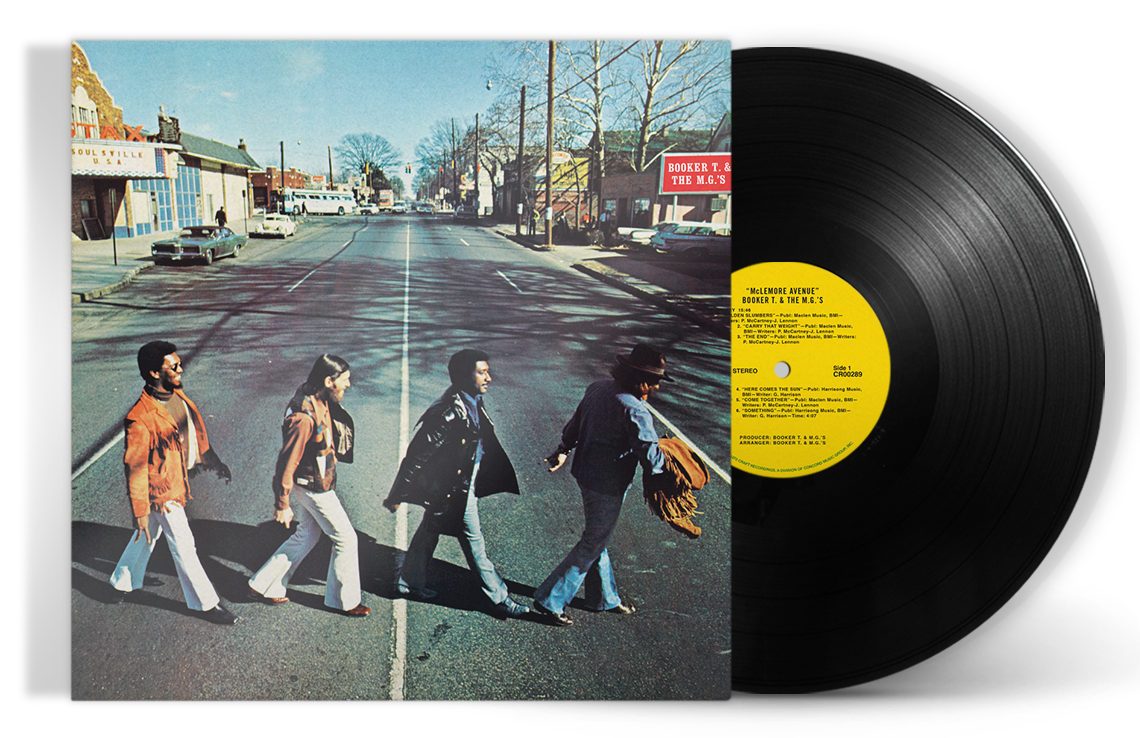
50 years ago, Booker T & The M.G.’s released their ode to The Beatles’ Abbey Road, and to the street where Booker and his band recorded: McLemore Avenue. Here Booker T. Jones (keyboards), Steve Cropper (guitar), Donald “Duck” Dunn (bass), and Al Jackson Jr. (drums) deliver funky, bluesy takes on 13 songs from The Beatles’ album, making them all their own. In fact, their renditions caught the ears of The Beatles, and Paul McCartney has used the M.G.’s version of “The End” as his walk-on music on tour for years. Cut from the original analogue master tapes by Jeff Powell in Memphis, pressed onto 180-gram vinyl at MRP and housed in a Stoughton-printed sleeve, the music and the iconic album art have likely never looked or sounded better. It’s worth lining up across the street for!.

As the longtime house band for Stax, Booker T. & The M.G.’s not only helped to shape the label’s iconic sound but also backed sessions by some of the biggest acts of the ’60s—from Otis Redding and Carla Thomas, to Sam & Dave and Wilson Pickett. The group also released many acclaimed titles of their own, and their 10th studio album, 1970’s McLemore Avenue, was no exception. Inspired by The Beatles’ Abbey Roadreleased just a year before, Booker T. Jones set out to record a tribute to the album—naming his version after the Memphis avenue where Stax Records stood. In an interview Jones recalled that when he first heard Abbey Road, “I thought it was incredibly courageous of The Beatles… They were the top band in the world but they still reinvented themselves.”

Featuring the classic lineup of Booker T. Jones on keyboards, Steve Cropper on guitar, Donald “Duck” Dunn on bass, and Al Jackson Jr. on drums, the instrumental McLemore Avenue offers a supremely funky take on Abbey Road’s songs in the form of three medleys and one standalone version of “Something.” AllMusicpraised that “Not only is McLemore Avenue a stellar interpretation of Abbey Road, it’s one of the finest Booker T. & the M.G.’s albums to boot.”

This special 50th-anniversary edition of the LP has been cut from the original analogue masters by Jeff Powell at Memphis’ Take Out Vinyl and pressed on 180-gram vinyl at Memphis Record Pressing. The album comes housed in an old-school-style tip-on jacket, featuring the classic, tongue-in-cheek cover image of the band crossing McLemore Avenue.

Rostam (full name Rostam Batmanglij, formerly of Vampire Weekend) shared a new song, “Unfold You,” via a video for it. Rostam self-directed the video, which features himself and actress Hari Hef . “Unfold You” was inspired by a Nick Hakim song and features saxophone playing by Henry Solomon. Sax sells! Meaning, the sax part sent the song over the edge. 

Rostam released his debut solo album, Half-Light, in 2017 via Nonesuch Records. Since then he’s produced the latest albums by Clairo and Haim.  In recent years, Rostam has focused primarily on producing, working with Clairo on Immunity and Haim on their new album Women In Music Pt. III. Although the ex-Vampire Weekend member has not formally announced a new project, “Unfold You” is his first official new solo music since 2017’s Half Light. “Under a lulling beat, mesmerizing saxophone licks, and shimmering keys, ‘Unfold You’ speaks to Rostam’s willingness to be open to a new love,”

Rostam had this to say about “Unfold You” in a lengthy press release statement:

“In November 2017 I played a show with Nick Hakim at Cafe De La Danse in Paris. This was the first Rostam show outside of America. I wasn’t familiar with Nick’s music but I was immediately drawn to it. Later that night in my hotel room I was winding down after the show and listening to some of Nick’s records. The song ‘Papas Fritas’ came on, it’s an instrumental track, and I suddenly found myself singing a melody over it and recorded that in my voice memos. Anyone writing songs probably has a few hundred voice memos on their phone. I kept coming back to this one though, and when I returned from a North American tour in February 2018 I booked some days at my favourite Vox Studios in Hollywood.  

“That’s where I first met Henry Solomon, who came in to play sax on ‘Unfold You.’ I had written out some sax lines for a few sections of the song, but others we arranged together in the studio. I wasn’t exactly sure where ‘Unfold You’ would land. I hadn’t finished writing the song, but I continued building out the track with Nick’s ‘Papas Fritas’ as its backbone. I decided I’d let the recording process take me where it would.

“‘Unfold You’ was the first thing me and Henry had worked on. A year later, I’d ask him to come back to Vox and record some sax lines I sketched out for the song ‘Summer Girl,’ which I was producing for Haim. Henry can also be found playing himself in PTA’s [Paul Thomas Anderson] video for the song.  “Summer Girl’ came out within a few months of us starting to record it, but ‘Unfold You’ took years. In some ways it had to—because the recording of the song tracks an evolution and a metamorphosis for me. As I write this, I’m finishing a record that deals a lot with the subject of change and for this whole album, change was what I was searching for musically.

In the summer of 2016, I was sitting on a park bench on Commercial street in Provincetown, Massachusetts. I found myself in conversation with a stranger who left me with a piece of advice that has stuck with me. ‘Change is good,’ he said, ‘Go with it.

Rostam had this to add about the video: “Hari and I found ourselves in the same quarantine pod in Massachusetts this past July. We also found we had a bunch in common, having gone to the same college nine years apart. The video was shot on the Dune Shacks Trail during the last several days of the trip.”

Agitated is more than pleased to announce the long over-due return to wax (and CD) by Carlton Melton, the new album from San Franciscan / Northern Californian space-trippers is here, and its ready to tune you out and turn you on.

Nestled deep in the forests of Mendocino County in Northern California, huddled under the protective shade of towering redwoods and within earshot of frothy waves crashing against the Pacific coastline, squats a geodesic dome that has served as crucible for the experimental genius of Carlton Melton. Nature and Man operate under different logics. But here, Carlton Melton wholly entrusts this idyllic environment with the task of inspiring and guiding their musical improvisations.

The Dome has been the ideal setting to facilitate their creativity. Without forcing a specific dynamic or theme, the band inhabits its womb-like confines to improvise, explore, dream. Their music draws on psychedelia, stoner metal, krautrock, and ambient atmospherics to convey, above all else, a mood.

A prickly guitar melody will float lazily, a wall of dissonant feedback will resolve into a hypnotic drone, or a colossal riff will exhume the soul of Jimi Hendrix. One hears Hawkwind or Spacemen 3 jamming with Pink Floyd at Pompeii.

Indeed, Carlton Melton have one foot in the ancient world and one tentacle in deep space. They are both the pack of proto-humans drumming with femurs in Kubrick’s 2001 and the film’s inscrutable monolith hinting at the universe’s mysteries. The “Stoned Ape” theory holds that early hominids ingested psychedelic mushrooms that provided an evolutionary boost to their brains, helping them blossom into Homo Sapiens. Imagine such cavemen trippin’ balls, their nightmarish visions sending them into feverish bouts of rage and then gentle moments of introspection. They very well could have heard the music of Carlton Melton rattling inside their skulls, first driving our ancestors mad then upward into a higher realm.

http://

Andy Duvall (drums, guitar), Clint Golden (bass), and Rich Millman (guitar, synths) have yet to play Pompeii, but they have already wowed crowds at European festivals such as the Liverpool International Festival of Psychedelia, Roadburn, and Desertfest Antwerp. Live, they are jaw-dropping. On record, mind-altering.

In fact, with each album, Carlton Melton adds a subtle new element, synapses firing new neural connections. In 2020, they release new full-length “Where This Leads”, marking ten years of the band’s working relationship with their UK label Agitated Records and five years of recording with Phil Manley in his El Studio in San Francisco. With “Where This Leads”, the band rewires the listener’s mind. “Smoke Drip Revisited” is a ticklish acid flashback, “Porch Dreams” a dabbling in country psych, and “Closer” a driving, freak-out of guitar heroics.

One senses that the group is conveying a message that cannot be expressed verbally but only suggested through synth sighs, walloping rhythms, and soaring solos.

Releases October 30, 2020

Hull / Leeds-based shoegazers bdrmm follow their hugely acclaimed debut album “Bedroom” with “The Bedroom Tapes”, a limited-edition 12” EP that rounds up remixes and lockdown live sessions. The first side features stripped-down versions of “Gush, A Reason To Celebrate” and “Forget The Credits” from the album, plus a version of 2019 single “Question Mark”. Originally recorded at home by the band’s Ryan and Jordan Smith for various radio sessions, these versions feel fragile and expose the feelings that are buried under the noise of Bedroom.

The flip features Andy Bell’s radical reworking of “A Reason To Celebrate” under his GLOK guise, which finds the previously unexplored middle ground between the late Andrew Weatherall and underrated 4AD outfit Ultra Vivid Scene. It is joined by Ditz’s dynamic deconstruction of If.… and International Teachers Of Pop’s almost obscenely cheerful ‘de-mix’ of Happy.

A selection of remixes and live sessions

http://

Releases October 23rd, 2020

Music and words by bdrmm

October 2020 brings the release of “Splintered Metal Sky”, is the long-awaited new installment in the ever vast musical cannon of White Hills. The album takes the listener on a post-punk, psychedelic ride fuelled by industrial-strength fuzz and propelled by powerful beats where songs weave in and out of each other to imitate the rhythm of the city the band calls home. Splintered Metal Sky is about oscillation and evolution. It’s metamodern music looking at human existence in relation to technology and the hyper-driven architectural reshaping of a city. The music was largely inspired by the drone and roar of machinery pulsing through New York City, which is in a never-ending state of demolition and reconstruction. Dave W. (guitar & vocals) and Ego Sensation (bass & vocals) took to the streets, gathering field recordings of sounds from the subway, drills, jackhammers, people in parks, traffic, mayhem and the occasional silence.

These recordings were then manipulated and constructed into rhythmic lines that were used as the basis for songs. The music, mixing noise with disciplined beat, embodies the paradoxical nature of the city: the grimy littered dead end alley just steps away from the sleek luxury skyscraper; the half eaten chicken bone being devoured by a rat on the subway tracks just beneath the glittering facade of the Chrysler building; the endless milling about of the 8 million people who call this slab of land home on their way to and from everywhere and nowhere.

Informed by industrial innovators Einstürzende Neubauten and SPK, the avant garde post-punk of Tuxedomoon and the dub-electro of Cabaret Voltaire, the album vibrates with the energy of a sensually feral, raw beast.

http://

The band recorded and mixed “Splintered Metal Sky” at Studio G in Brooklyn with producer/engineer Jeff Berner (Psychic TV). White Hills previously worked with Jeff for the Valley King Records release of the single Putting On The Pressure. The album features numerous guest appearances. The idea to recruit collaborators came after a meeting between Ego and fellow Only Lovers Left Alive alumni, Lebanese singer, Yasmine Hamdan, while she was in NYC recording with former Sonic Youth drummer Steve Shelley.

The band asked her to add vocals to a song and she jumped at the opportunity, which led to a stunning vocal performance on the track Rats. Energized by the collaboration, Dave & Ego decided to approach other cohorts to join in. This led to guest appearances by filmmaker and musician Jim Jarmusch (ambient guitar on c:Construct & Illusion), Simone Marie Butler of Primal Scream (vocals on Honesty) and former Cop Shoot Cop and current member of Human Impact Jim Coleman (synth on Numbers & c:Construct).

Each person added their own flavour and perspective, pushing the songs to places not before imagined by the duo. Running with the idea of collaboration, Dave decided to work with someone on the cover concept. In came longtime friend of Dave’s Johnny Brewton, who has quite a resume of his own in the art world, having worked with and for Mark Motherbaugh at Mutato Muzika, Tom Waits, Hunter S. Thompson and Charles Bukowski to name a few. He is the man behind XRay Book Co, who produce art publications like XRay Magazine, and Bagazine. Upon the two discussing the concept of Splintered Metal Sky, Johnny went to work cutting up images and constructing the concept visually through the medium of collage. 

Releases October 23rd, 2020

Returning to the intimate acoustics of his debut, Keaton’s fourth album as a singer-songwriter is a devastating meditation on loss, brought to life with all the pain and beauty that has been his art form for the last 10 years.

It was from a remote outpost in the english countryside that Keaton finally felt ready to confront the decades long illness, and imminent death of his father, who passed two days before he finished recording the album. Keaton: “i made it at home, mostly alone, to the sound of birds and rainstorms, at strange hours of day and night. once the bones were recorded, i was somewhat unexpectedly joined by an amazing group of people, who came to musically lift me on their shoulders, and take these unsaid feelings to another plain in terms of sound.”

“Monument” released through Play It Again Sam is Keaton’s first album since 2016’s Kindly Now. Keaton Henson’s new album “Monument” is a rare thing. It is an album about loss, and dealing with losing the ones we love, but told, in incredibly candid detail, through the aspects of our lives that surround the trauma itself, about love, ageing, recovery, life, seen through the prism of grief. With the posting of an enigmatic and cryptic goodbye in 2016; Epilogue, Henson’s next project ended up becoming Six Lethargies, a complex and ambitious symphony for string orchestra, dealing with the minutiae of mental illness. He put away the guitar and retreated to his home for three years to compose it. Monument now finds Keaton re-emerging with an album of songs about grief, and how it permeates our lives.

The record began when, having recovered from both Six Lethargiesand the circumstances that inspired it, Henson moved from London to the wilds of the English countryside, spending long days outside chopping wood, tending to the grounds, and watching birds of prey soaring above. It was from this remote outpost that he finally felt ready to look at a subject he had been avoiding for his entire song-writing career; the decades long illness, and imminent death of his father, who passed two days before he finished recording the album.

Prayer, a performance. taken from the upcoming album Monument, out 23rd October 2020.