Badfinger– 1970 -This was a rock band from Swansea, that had all the potential in the world and was coming into its own between 1970-1972. Their first three albums on Apple including “No Dice,” (1970) and “Straight Up,” (1971) were best sellers and featured four consecutive, exquisite singles “Come and Get It,” (produced by Paul McCartney) “No Matter What,” (produced by Mal Evans) “Day After Day,” (produced by George Harrison, and “Baby Blue,” (produced by Todd Rundgren).
All but the last reached Top 10. They also wrote and recorded “Without You,” a song that Harry Nilsson covered and rode to the top of the charts.
Their story is often told today as a tragedy but before the suicides of core members Pete Ham, in 1975, and Tom Evans eight years later, Badfinger was one of the great pop-rock bands of its time. And it was “Come and Get it,” written by Paul McCartney and released on the Beatles’ Apple label, that started the ball rolling.
They began in 1961 as the Iveys, from Swansea, Wales. By the late ’60s the personnel had stabilized as Ham (vocals/guitar/piano), Mike Gibbins (drums), Ron Griffiths (bass) and David Jenkins (guitar). A couple of changes later, and the classic line-up emerged, with Evans replacing Griffiths and Joey Molland taking the place of Jenkins, but not before the still-developing quartet experienced some optimism and some disappointment.
Things first started happening for the Iveys in 1968 when Mal Evans,the Beatles’ assistant, became their champion at the company. It took him a while but he (with some nudging from cohort Peter Asher) finally convinced the Beatles to sign the Iveys. Their first single, “Maybe Tomorrow,” was released to little fanfare, bombing in the U.K. and peaking at No#67 in the United States. It wasn’t until the second half of 1969 that the Iveys’ fortunes began turning around. McCartney, having been told of the group’s frustration with its Apple deal, offered the Iveys a song he’d written for the film The Magic Christian, “Come and Get It.”
He also offered to produce the recording—as long as the band copied his demo and didn’t try to change a thing. It was further suggested by Neil Aspinall, the head of Apple, that the Iveys change heir name to Badfinger. Finally, they were on their way. Released on December 5th, 1969, in the U.K. “Come and Get It” took off on both sides of the Atlantic in early 1970, reaching #4 in the U.K. and #7 on the American Billboard singles chart. It established Badfinger as one of Apple’s success stories, with two more top 10 singles following in both markets, “No Matter What” (#8 in 1970) and “Day After Day” (early 1972). “Baby Blue” landed at #14 in the States, and there were a few quasi-successful albums during the original Badfinger era—No Dice(1970), Straight Up (production begun by George Harrison, finished by Todd Rundgren; 1971) and Ass (late 1973).
Badfinger moved on to Warner Brothers and two other labels but their best days were behind them. Unscrupulous management by Stan Polley after Apple Records dissolved destroyed the band literally. Pete Ham hung himself in 1975, but the surviving members soldiered on for the next six years, with little success. Tom Evans, who never recovered from Ham’s death, took his own life by hanging in 1983, and tragically, Badfinger was no more. Sad, since their music surely benefited from the Apple Records brand and by production work from two Beatles. By the way, the Iveys (Badfinger’s original name) was Apple Records first signing in 1968.
There were other highlights during their initial run all four Badfinger members played at The Concert For Bangla Desh Ham, Evans, and Molland played acoustic guitars while Gibbins played percussion , but the self-inflicted death of Ham by hanging at age 27 effectively ended their glory days. The surviving members would carry on in various guises on other labels, and Molland still leads a Badfinger group today, but rock historians will always look back on those few years in the early ’70s as Badfinger’s time to shine.
In the late ’60s, when rock music was exploding in countless, new creative directions, when musicians were testing all of the limits—in the studio, onstage and in life—the Mothers of Invention proudly declared themselves freaks. And their leader, Frank Zappa, was the freakiest freak of all.
He’d first come to the attention of the public in a small way in 1963, when he appeared, as a young man with a greasy pompadour, on The Steve Allen Show—“playing” a bicycle. (Scroll to the bottom to check out the video.)
For rock fans though, it was the Mothers’ debut LP, appropriately titled Freak Out!, that first opened our eyes and ears. Released on Verve Records in June 1966, it was only rock’s second double album (preceded by Dylan’s Blonde on Blonde), but the fact that it was recorded by a band unknown outside of the Los Angeles club circuit made it an instant curiosity—especially when DJs and fans heard what kind of outrageousness these crazy-looking Mothers were up to.
Freak Out! was unlike any other rock album that had come before. Produced by Tom Wilson—whose other clients included Bob Dylan, the Velvet Underground, Simon and Garfunkel and many notable jazz artists—it threw into a crockpot all manner of oddness: avant-garde experimentalism, blistering psychedelic rock (although Zappa eschewed drugs), doo-wop, blues and more, with songs, often satirical, pointing fingers at authoritarianism, hypocrisy and, in “Trouble Every Day,” the very real horror of race riots plaguing the Watts section of Los Angeles. The album ended with a side-long, 12-minute freeform jam called “The Return of the Son of Monster Magnet (Unfinished Ballet in Two Tableaux)” that established the Mothers of Invention as some of the most gifted and boundary-busting musicians in rock.
On album number two, Absolutely Free, released just days before the Beatles’ Sgt. Pepper’s Lonely HeartsClub band, the expanded group, now eight musicians including horn players, fine-tuned its ideas, with barbed commentary on society (“Plastic People,” “Brown Shoes Don’t Make it”), absurdly surreal musings (“The Duke of Prunes,” “Call Any Vegetable”) and more of that brilliant musicianship.
But it wasn’t until their third release (actually Zappa’s fourth, as it followed his solo opus Lumpy Gravy) that the Mothers truly found their footing: We’re Only In It for the Money, released on Verve in March 1968, would become Zappa’s highest-charting album for six years (it reached #30), even while the band remained defiantly and resolutely anti-commercial in its scope. In fact, it was initially conceived as part of a larger Zappa project titled No Commercial Potential, which ultimately encompassed three other diverse albums: the aforementioned Lumpy Gravy, Cruising with Ruben & the Jets and Uncle Meat.
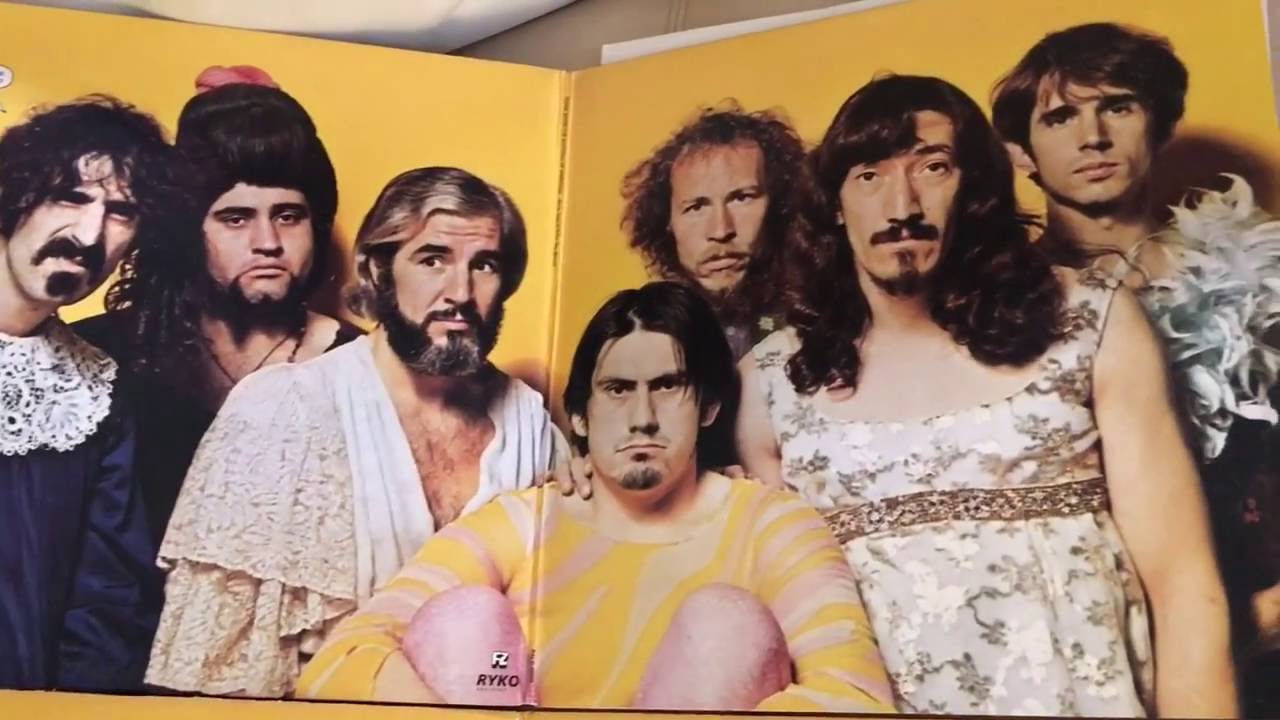
There is some question regarding who exactly plays on “We’re Only In It for the Money“. The front cover shows seven Mothers, including Zappa. The liner notes list, and picture, eight: guitarist, pianist and vocalist Zappa; drummer Jimmy Carl Black (who famously declares himself to be the “Indian of the group” at the end of the lumbering, foreboding Musique concrete opener, “Are You Hung Up?,” one of two numbers featuring minor spoken parts by Eric Clapton); another drummer, Billy Mundi; bassist Roy Estrada; woodwinds player Bunk Gardner; another woodwinds musician, Ian Underwood, who also played piano; and Euclid James “Motorhead” Sherwood, who plays baritone and soprano saxophones. Don Preston, a multi-instrumentalist who had played on Absolutely Free, and would work with Zappa for several more years, is listed as “retired.”
What confuses the issue is that later re-releases of the album state, in their liner notes, that, “All musical duties on the album were performed by Frank Zappa, Ian Underwood, Roy Estrada and Billy Mundi. JimmyCarl Black, Don Preston, Bunk Gardner and Euclid James ‘Motorhead’ Sherwood were all featured in some capacity on the record.”
Regardless of who did what, Money, produced by Zappa, is indisputably a ’60s classic and, for many, the apex of Zappa’s early years, if not his entire career. It was a concept album, owing to but simultaneously parodying Sgt. Pepper.
Its inside gatefold photo was a carefully choreographed takeoff on that previous year’s game-changer. Originally intended for the front cover, an idea nixed by the record label due to photo licensing issues (a portrait of the band in drag—Zappa wearing pigtails and a mini-skirt—adorned the outside instead), the Mothers’ Pepper parody was created by Cal Schenkel, with photography by Jerry Schatzberg. It found the band members surrounded by a seemingly random collage of people and objects, ranging from President Lyndon Johnson to the Statue of Liberty, Lee Harvey Oswald to Jimi Hendrix, the latter actually present for the photo shoot. Where the Beatles had had their name spelled out in flowers, the Mothers used vegetables and watermelons.
The humour displayed in the album art carried over to the music, but “We’re Only In It for the Money” also had its share of rather serious, biting moments as well. Its patchwork of musical elements—more of that patented avant-weirdness, doo-wop harmonies and deliberately funny voices, found sounds (including snorts, whispered dialogue from engineer Gary Kellgren and a telephone conversation in which a female caller, ostensibly Pamela Zarubica, a.k.a. Suzy Creamcheese, tells the other party, “He’s gonna bump you off, yeah; he’s got a gun, you know”)—was matched to Zappa’s sharpest lyrics to date; its 18 tracks, many of which segued abruptly into the next, were somewhat connected lyrically, albeit loosely at times.
In a few songs, Zappa bravely lampooned a sizable segment of his own audience, who adhered to the blossoming flower children/hippie ethos: “Flower Punk,” a takeoff on the oft-recorded “Hey Joe”—played at a breakneck pace in convoluted time signatures—asked, “Hey, punk, where you goin’ with that flower in your hand?”; “Take Your Clothes Off When You Dance” instructed listeners to free their minds and bodies and do just that; and, most notably “Who Needs the Peace Corps?” savaged the burgeoning youth migration to San Francisco at the time with lines like, “I’m hippy and I’m trippy, I’m a gypsy on my own, I’ll stay a week and get the crabs and take a bus back home, I’m really just a phony but forgive me ’cause I’m stoned.”
On the other hand, Zappa certainly had no love for the vapid suburban lifestyle of the hippies’ parents. “Bow Tie Daddy,” appropriately set to a giddy vaudeville-style melody, cautioned, “Don’t try to do no thinkin’, just go on with your drinkin’, just have your fun, you old son of a gun, then drive home in your Lincoln,” while the acerbic “The Idiot Bastard Son” spoke of a father who’s “a Nazi in Congress today” and a mother who’s “a hooker somewhere in L.A.” Zappa’s focus often shifted to the frayed relationships between adults and their nonconformist children—in “Lonely Little Girl,” he wrote, “The things they say just hurt your heart, it’s too late now for them to start to understand.”
Being Zappa there was both frivolity and outright darkness, sometimes in the same song: “What’s the Ugliest Part of Your Body?,” set to a balladic, sing-along doo-wop melody, proposed nothing beyond that question (“Some say your nose, some say your toes, but I think it’s your mind”). Another, “Let’s Make the Water Turn Black,” was truly otherworldly, with its descriptions of Kenny’s “little creatures on display” and Ronnie saving “his numies on a window in his room,” not to mention “Mama with her apron and her pad, feeding all the boys at Ed’s Café, whizzing and pasting and pooting through the day”).
But several of Money’s songs induced palpable shudders among the young who encountered them upon the album’s release. Zappa’s political statements didn’t hold back, and he spoke openly to the paranoia and fear that was in the air during that game-changing year of assassinations, domestic strife and the escalation of the Vietnam War. In “Concentration Moon,” the ballad near the top of the track list, Zappa described deadly attacks on young people who posed a threat to the powers-that-be in the ’60s: “American way, how did it start?, thousands of creeps, killed in the park, American way, try and explain, scab of a nation driven insane.” The kids, he suggests, may soon have regrets that they ever left home: “Concentration moon, wish I was back in the alley, with all of my friends, still running free, hair growing out every hole in me.” Directly following it was the mournful and equally dismal “Mom & Dad,” which continued the harrowing theme: “Someone said they made some noise, the cops have shot some girls and boys, you’ll sit home and drink all night, they looked too weird… it served them right.”
“Harry, You’re a Beast” was, perhaps, the album’s most chilling of all, a graphic depiction of male dominance and the ritual abuse of women. Set to an awkwardly chirpy melody, Harry informs Madge, presumably his wife, that she’s “phony on top and phony underneath,” after which he rapes her: “Madge, I want your body! Harry, get back! Madge, it’s not merely physical! Harry, you’re a beast!” The album’s printed lyrics follow the depiction of the incident with several instances of the word “censored,” but a later remix of the album by Zappa (which is best avoided—Zappa inexplicably re-recorded bass and drum tracks) reveals those censored words—among several segments of the original recording either altered reluctantly by Zappa or excised by the label—to be “Don’t come in me, in me,” repeated several times. Madge, as the song concludes, is still sobbing as Harry proclaims, “Madge, I couldn’t help it, doggone it.” Needless to say, rock music had never before addressed this sort of despicable behaviour so openly. (A reference to comic Lenny Bruce was cut from the final track.)
Each of these songs, up through the self-deprecating “Mother People,” the final vocal number (with its x-rated stanza,“Better look around before you say you don’t care, shut your fucking mouth about the length of my hair, how would you survive, if you were alive, shitty little person?”), contained a plethora of words to consider, and bulged with innovative musical ideas, yet the vast majority of Money’s songs were extremely short, ranging from under a minute to a little over two, with three tunes falling between three and four minutes. Only the album-closing “The Chrome Plated Megaphone of Destiny,” one of three tracks featuring the Sid Sharp-conducted Abnuceals Emuukha Electric Symphony Orchestra and Chorus—the liner notes instructed listeners to read Franz Kafka’s In the Penal Colony before proceeding with this one—flirted with serious length, clocking in at six-and-a-half minutes, nearly all of it experimental noodling.
The whole ofWe’re Only In it for the Money is just under 40 minutes total, encompassing uptempo tracks, ballads and the aforementioned studio explorations. It goes by briskly though, stopping and starting and shifting gears constantly and unexpectedly to what might seem dizzying effect at first but quickly settles into its own groove.
Frank Zappa, both with and without the Mothers of Invention, would never stop seeking new ways to express himself, until the end of his life. He recorded more than 60 albums in all, some exceedingly brilliant, others disappointing to an alarming degree. But it was on this early release, We’re Only In it for the Money, when he helped make it clear that anything was possible in rock music, that Frank Zappa confirmed his true genius.
“New York at Night” is the 13th studio album from veteran rock ‘n’ roll troubadour Willie Nile, and the strongest manifestation to date of his deep affinity for the city. The album’s 12 new originals exemplify the artist’s trademark mix of romance, idealism, humour, emotional urgency and a true believer’s passionate embrace of all things rock ‘n’ roll. This affectionate tribute from the veteran singer-songwriter was released even as the city itself often resembled something of a ghost town due to the Covid-19 pandemic. The record celebrates family, unity and the city Nile has called home since the early 1970s
New Yorker Magazine has described Willie as “One of the most brilliant singer-songwriters of the past 30 years”, and Uncut Magazine dubbed him the unofficial poet laureate of New York City.Nile says the idea for the name, “New York at Night”, came to him one Friday night in the summer of 2018, when he was walking alone near Times Square to catch a subway. When he got on the train he saw a man all covered in thick whipped cream. After he exited the train he saw all sorts of characters on the street in Greenwich Village. As he continued his walk home, he thought “New York at night, wow, what a name for a song”. After he got home he picked up his guitar and wrote the song. Most of the songs are New York inspired but it is not a concept album. Nile says “What all the songs on this album have in common is that they reflect my life and experiences living in New York.”
Nile first recorded “Run Free” in 2003 with his band, at the time, The Worry Dolls, but it was never previously released. “Surrender the Moon” is a song started by Nile’s brother John Noonan who died a year after starting the song in 2007. Nile finished the song for this album. Nile co-wrote “New York is Rockin'” with Curtis Stigers for Stigers’ 1995 album Time Was.
In February 2020 Nile announced plans to release his 13th studio album in 2020. On his own website he took advance orders for digital downloads, CDs, signed lyrics and other merchandise to raise funds to produce the album. In a March 2020 interview by Jam Band News, Nile said ““I like the independent world.” “There are no constraints and you can work at your own speed. I’ve no complaints about having been on major labels. I was on two of them and I was able to do what I wanted to do.
But things have changed so much in the music business that being independent allows for so many more options.”[5] Nile has employed similar crowdfunding campaigns for five of his previous albums.
The former Creedence Clearwater Revival leader and three of his kids remake classic tracks by the band (“Proud Mary,” “Bad Moon Rising”), as well as select covers (“Lean on Me,” “City of New Orleans”). While self-quarantining together the Fogerty Family recreated the cover of Cosmo’s Factory transforming it to Fogerty’s Factory. The family have also taken to their home studio during this isolation to create some music together, The Family Band. “Bringing a little light from our home to yours. We are having a little family fun together during the pandemic. It’s such a great feeling to be making and playin’ music surrounded by love. We all need to celebrate the life we have and remember how precious it is. I love music, I am listening every day. Makes everything feel better for me. Put the records on, pull out the old guitar, turn the radio up.. and dance to the music!” – John Fogerty.
With his new album, Fogerty’s Factory, Fogerty enlisted his children Shane, Tyler and Kelsy to revisit some choice songs from his classic catalogue as well as covers that he always felt a fondness for. Spawned from a series of weekly videos filmed by his wife Julie on her iPhone while killing time during the pandemic, the idea eventually gelled into an actual album that replicates the cover of the quintessential Creedence albumCosmo’s Factory, right down to its cover design and the typeface text.
“Fogerty’s Factory” finds John Fogerty revisiting Creedence Clearwater Revival classics and other cover songs with an impromptu family band formed during the coronavirus lockdown. Some songs you might recognize from John’s historical career are ‘Proud Mary,’ ‘Fortunate Son,’ ‘Down on the Corner,’ ‘Centerfield,’ and tons more! Although in his 70s, John shows no signs of slowing down, creating new music and continuing to tour the world, so be sure to tune in, subscribe, and keep on the pulse of all things John Fogerty.
Coming to you a day early due to the long weekend, this week Fogerty’s Factory performs Arlo Guthrie’s version of “City Of New Orleans” ( written by Steve Goodman) live from the farm! ‘Good morning, America, how are you?’ Now that is an important question. You all take care of yourselves.
While the Quarantine continues the Fogerty Family – Shane and Tyler (Hearty Har) and Kelsy – will be joining their Dad for some musical fun covering songs from the classic Fogerty collection.
Originally issued solely via his website, the latest solo album by the long time Yes vocalist got an official release this year. Yes-mates Chris Squire, Steve Howe, Alan White and Rick Wakeman are among those dropping by the studio to add assistance.
When Jon Anderson quit Yes in 1980 some wondered what on earth he was going to do. However in a few short years he’d established himself as a solo artist of note and hit the charts with Vangelis. All before rejoining Yes who went on to be bigger than ever. On the back of his recently re-released second solo album Song Of Seven cover star Anderson reflects on that period of his career and details the upcoming reissue of Olias Of Sunhillow.
Never to stand still musically, he is currently releasing an album he started 29 years ago, now called “1,000 Hands” a reference to the fact that numerous guest musicians perform on the album, including Ian Anderson, Billy Cobham, Jean Luc Ponty, Chick Corea, Zap Momma, Chris Squire, Alan White Steve Howe and many more. This album produced by his friend Michael Franklin really speaks to the power of a musical life still in the throes of a fervent artistic endeavor, always wanting new experiences in music, always wanting to surprise the listener. The album is scheduled for release in 2020.
Finally, in Jon’s words: “Music is our spiritual connection to the soul, that’s why people all over the world connect to Music and to each other through Music”.
To date Matador’s Revisionist History series has set its focus on the hallowed year of 1995 – surfacing critical releases by Pavement, Yo La Tengo, Guided by Voices, and Chavez.
Today, however, we whirl the dial on the in-house wayback machine and travel toward the future: the year 2000 and Mary Timony’s debut solo album, ‘Mountains’, which will be reissued on January 15th. Remastered by Bob Weston, Mountains comes back to us as a gold foil-embossed gatefold 2xLP and will include the previously unreleased original takes of “Return to Pirates,”“Poison Moon,” and “Killed by the Telephone,” which were delivered along with the original master tapes 20 years ago, but were omitted from the final album. The record is completed by a newly recorded orchestral version of “Valley of One Thousand Perfumes” produced by composer Joe Wong (Russian Doll, Midnight Gospel) and mixed by Dave Fridmann.
At the turn of the century, Timony (Ex Hex, Wild Flag, Hammered Hulls) was already a celebrated presence in American underground music – a fixture of D.C. and Boston rock ’n’ roll via her work in Autoclave and Helium respectively. By 1998, though, Helium was drawing to a close and Timony was feeling uncertain about the future. “I had never been good at the rock’ n’ roll business, and making a living from being in a band just didn’t seem like it was in the realm of possibility for me,” she writes. “I just knew I wanted to make another record because that was the part of being in a band that I liked the most.”
At the time of its original release, Timony called ‘Mountains’, “A Trip to the New Underworld.” “A bunch of hard stuff was happening in my life: family illnesses, people dying, people leaving, relationships ending. I fell into a deep depression,” she explains. “I tried new ways of making music: I tried writing songs without any filter at all, and I purposely didn’t think about what the music would sound like to anyone else. I was only interested in describing what was in my head.” Recorded and mixed in Boston alongside Christina Files and Eric Masunaga and in Chicago with Bob Weston, Mountains found Timony dialing into territory that was barer and more confessional than her work in Helium. Stark arrangements were augmented with newly ornate instrumentation — piano, vibraphone, and viola — and the lyrics were tinted with slyly occult imagery.
“Listening back to Mountains now I am struck most by how raw it sounds,” says Timony. “I hear the depression and angst, but also I hear all of that darkness disappearing through the power of music and friendship—and turning into songs during those happy and productive months recording and hanging out in Christina’s loft in downtown Boston.”
Today, you can also watch Timony in the Brett Vapnek-directed short film, “Dream Machine” (1999).
Halsey has no inhibitions when it comes to getting raw emotionally — and Manicis her most fearless move yet. She chases her darkest anxieties all over the spectrum, from hip-hop to rock to country, in hits like “Without You” and “Graveyard” — the kind of album where you can find Alanis Morissette, Suga from BTS, Jennifer’s Body samples or a voicemail pep talk from John Mayer. Halsey has the too-much too-young celebrity blues: as she sings, “I remember the names of every single kid I’ve met/But I forget half the people I’ve gotten in bed.” Yet she wrestles with her issues in her own unmistakably real voice
“Poetic lyricism and [a] tendency to deliver dark, angsty verses disguised as fun, catchy pop songs.” – Madelyn Tait. The continued renaissance of Halsey thrives in the US songstresses latest release. As usual, the electro-pop hitmaker knocks it out of the park in terms of the songs themselves, but Manic is thematically miles ahead of her previous releases and well beyond her 25 years.
Known offstage as Ashley Nicolette Frangipane, the singer takes her newest LP as a chance to deep-dive into her own internal battles with bipolar disorder and channel those internal struggles into a creative triumph. It’s more personal, emotive, intense and compelling than anything Frangipane has put out before, and a thoughtful peek beyond the curtain to the woman behind the moniker.
hi friends! we’re excited to announce that our version of The Blue Nile’s “Hats” is being rereleased and will now be available to stream everywhere for the first time! it will be out in full 12/18 via Better Company. it’s been remixed and remastered and features additional arrangements by the wonderful San Fermin today you can hear The Downtown Lights featuring backing vocals from the great Benjamin Gibbard.
The Portland based indie pop outfit Pure Bathing Culture have covered the Blue Nile’s 1989 album Hats in its entirety. In a statement, Pure Bathing Culture’s Sarah Versprille said, “We became immediately obsessed with their world of nostalgia and longing and the way the songs were simultaneously extremely sad at times but also intensely romantic and modern. It made us feel like the music we wanted to make was validated in some way by the fact that their music had already existed in the universe.” Listen to their take on “Saturday Night,” featuring Death Cab for Cutie’s Ben Gibbard.
The album is part of Turntable Kitchen’s Sounds Delicious series, which finds artists covering their favourite albums in their entirety. (Previous entries included Ben Gibbard’s take on Teenage Fanclub’s Bandwagonesque, Jonathan Rado doing Bruce Springsteen’s Born to Run, and Mutual Benefit playing Vashti Bunyan’s Just Another Diamond Day). Pure Bathing Culture’s Hats is limited to 1,000 copies and is available exclusively through Turntable Kitchen.
This week Swedish post-punk band Viagra Boys released a video for their new song “Creatures,” which will be featured on their upcoming album Welfare Jazz, out January 8th, 2021 via YEAR0001. The quirky, Erik Kockum-directed video picks up where their previous video “Ain’t Nice” left off, where band member Sebastian Murphy is shown continuing to wander around an 18th century estate.
Welfare Jazz features production by Matt Sweeney (Bonnie “Prince” Billy, Run the Jewels), Justin and Jeremiah Raisen (Yves Tumor, Kim Gordon, Sky Ferreira), and past collaboratorsPelle Gunnerfeldt and Daniel Fagerström (The Hives, The Knife). Viagra Boys’ most recent release was their Common Sense EP, which came out back in March also on YEAR0001.
YEAR0001 is a multidisciplinary record label, management and creative studio founded in Stockholm in 2015. Our vision is to act as an independent incubator active in the landscape of music, culture, fashion and technology. We believe in using transparency and co-creation to achieve a more sustainable landscape for our artists and creators.
From the album ‘Welfare Jazz’, out January 8th on YEAR0001
Midnight Sister, the Los Angeles-based duo of Juliana Giraffe and Ari Balouzian, are releasing a new album, “Painting the Roses”, on January 15, 2021 via Jagjaguwar. This week they shared another song from it, the glam-sounding “Foxes,” via an Oliver Bernsen-directed video for the single. Midnight Sister – the project of intense creatives Juliana Giraffe and Ari Balouzian – is brought to you by the isolating landscape of the San Fernando Valley – its colours, its diners, its lunatics, its neon lights. Both lifelong residents of this storied valley, Giraffe and Balouzian have only become more inspired by the area’s mythology over the years, its two-faced magical wonderland and tragic circus. And Saturn Over Sunset works almost as an album version of Altman’s Shortcuts, each song a character study of the valley’s odd personae. Giraffe, 23, the daughter of an LA disc jockey, was raised almost exclusively on disco and Bowie. Her lyrics and lyrical melodies, informed very much by her film-making background, were composed gazing out from a tiny retail window on Sunset Boulevard. Her Rear Window-like longing allowed her imagination to run wild and cook up the wild narratives that would fill Balouzian’s compositions. Balouzian, 27, is classically trained and already a go-to arranger for odd-pop names like Tobias Jesso Jr. and Alex Izenberg. Midnight Sister represents a first for both of them. It’s Giraffe’s first time writing and performing music. And it’s Balouzian’s first foray into playing true pop music.
“The album culminated into what felt like an interesting movie of dramatized characters that were around us for
Giraffe had this to say about the song in a press release: “The song and video explore the relationship between performer and performance. Dissecting what it means to feel trapped by someone’s/something’s gaze and how the inherent invasive nature of the camera corners the performer through a dance of reality.” When Painting the Roses was announced in October the band shared the first new song from it, “Doctor Says,”
Painting the Roses also includes “Wednesday Baby,” a new song first shared in September via a video for it. Painting the Roses is the duo’s second album, the follow-up to their 2017-released debut album, Saturn Over Sunset, also released by Jagjaguwar. Midnight Sister’s art-pop would appeal to fans of Broadcast, influential ’60s pioneers such as The United States of America and The Free Design, and Charlie Hilton.
Midnight Sister ‘Panting the Roses’, out January 15th 2021 on Jagjaguwar Recordings.



 The former Creedence Clearwater Revival leader and three of his kids remake classic tracks by the band (“Proud Mary,” “Bad Moon Rising”), as well as select covers (“Lean on Me,” “City of New Orleans”). While self-quarantining together the Fogerty Family recreated the cover of Cosmo’s Factory transforming it to Fogerty’s Factory. The family have also taken to their home studio during this isolation to create some music together, The Family Band. “Bringing a little light from our home to yours. We are having a little family fun together during the pandemic. It’s such a great feeling to be making and playin’ music surrounded by love. We all need to celebrate the life we have and remember how precious it is. I love music, I am listening every day. Makes everything feel better for me. Put the records on, pull out the old guitar, turn the radio up.. and dance to the music!” – John Fogerty.
With his new album, Fogerty’s Factory, Fogerty enlisted his children Shane, Tyler and Kelsy to revisit some choice songs from his classic catalogue as well as covers that he always felt a fondness for. Spawned from a series of weekly videos filmed by his wife Julie on her iPhone while killing time during the pandemic, the idea eventually gelled into an actual album that replicates the cover of the quintessential Creedence albumCosmo’s Factory, right down to its cover design and the typeface text.
“Fogerty’s Factory” finds John Fogerty revisiting Creedence Clearwater Revival classics and other cover songs with an impromptu family band formed during the coronavirus lockdown. Some songs you might recognize from John’s historical career are ‘Proud Mary,’ ‘Fortunate Son,’ ‘Down on the Corner,’ ‘Centerfield,’ and tons more! Although in his 70s, John shows no signs of slowing down, creating new music and continuing to tour the world, so be sure to tune in, subscribe, and keep on the pulse of all things John Fogerty.
Coming to you a day early due to the long weekend, this week Fogerty’s Factory performs Arlo Guthrie’s version of “City Of New Orleans” ( written by Steve Goodman) live from the farm! ‘Good morning, America, how are you?’ Now that is an important question. You all take care of yourselves.
While the Quarantine continues the Fogerty Family – Shane and Tyler (Hearty Har) and Kelsy – will be joining their Dad for some musical fun covering songs from the classic Fogerty collection.
The former Creedence Clearwater Revival leader and three of his kids remake classic tracks by the band (“Proud Mary,” “Bad Moon Rising”), as well as select covers (“Lean on Me,” “City of New Orleans”). While self-quarantining together the Fogerty Family recreated the cover of Cosmo’s Factory transforming it to Fogerty’s Factory. The family have also taken to their home studio during this isolation to create some music together, The Family Band. “Bringing a little light from our home to yours. We are having a little family fun together during the pandemic. It’s such a great feeling to be making and playin’ music surrounded by love. We all need to celebrate the life we have and remember how precious it is. I love music, I am listening every day. Makes everything feel better for me. Put the records on, pull out the old guitar, turn the radio up.. and dance to the music!” – John Fogerty.
With his new album, Fogerty’s Factory, Fogerty enlisted his children Shane, Tyler and Kelsy to revisit some choice songs from his classic catalogue as well as covers that he always felt a fondness for. Spawned from a series of weekly videos filmed by his wife Julie on her iPhone while killing time during the pandemic, the idea eventually gelled into an actual album that replicates the cover of the quintessential Creedence albumCosmo’s Factory, right down to its cover design and the typeface text.
“Fogerty’s Factory” finds John Fogerty revisiting Creedence Clearwater Revival classics and other cover songs with an impromptu family band formed during the coronavirus lockdown. Some songs you might recognize from John’s historical career are ‘Proud Mary,’ ‘Fortunate Son,’ ‘Down on the Corner,’ ‘Centerfield,’ and tons more! Although in his 70s, John shows no signs of slowing down, creating new music and continuing to tour the world, so be sure to tune in, subscribe, and keep on the pulse of all things John Fogerty.
Coming to you a day early due to the long weekend, this week Fogerty’s Factory performs Arlo Guthrie’s version of “City Of New Orleans” ( written by Steve Goodman) live from the farm! ‘Good morning, America, how are you?’ Now that is an important question. You all take care of yourselves.
While the Quarantine continues the Fogerty Family – Shane and Tyler (Hearty Har) and Kelsy – will be joining their Dad for some musical fun covering songs from the classic Fogerty collection.


