Posts Tagged ‘Tango In The Night’

No photo description available.

“Tango in the Night” is the final album the band would record as an infamous quintet. It’s a pop and production masterpiece, yet remains this monolithic, lucrative idea of a Fleetwood Mac record. In reality it’s this brilliant album that is really the first Buckingham/McVie Record.

Made at a time of complete turmoil in the band. If you were a Fleetwood Mac fan in 1987 this album definitely caught you off guard because at that time no one expected the most successful line-up of Fleetwood Mac to reunite again.
Not only that but the band members themselves at that time were really in no position to record a Fleetwood Mac record. Stevie Nicks, coming off a successful solo career, was dealing with her cocaine abuse. John McVie was a full blown alcoholic, and Mick Fleetwood also was dealing with his personal demons, still addicted to cocaine and actually broke, having to file for bankruptcy.
if it wasn’t for Christine McVie and especially Lindsey Buckingham, this album never could’ve been made.
Taking a painstaking 18 months to record, both Lindsey and especially Christine had arrived to the sessions (which took place at Lindsey’s home) with some of their strongest songs to date.

It started with “Sara.” The first two Fleetwood Mac albums to feature Lindsey Buckingham and Stevie Nicks—the self-titled album and then “Rumours” featured production typical of the pop-rock generated in Los Angeles in the ’70s. They were professional and pristine, exhibiting an instrumental and emotional warmth that was, in terms of the actual recording technique and the cerebral atmosphere of the people making the records, a product of isolation. On their next record, “Tusk”, Buckingham shifted the balance of Fleetwood Mac’s studio pop. He deliberately produced his songs so that they sounded trebly and makeshift as if they were translated from brain to tape as quickly as possible—and produced Nicks’ and Christine McVie’s songs with a lush and carefully-sculpted dimensionality. “Sara,” a song Nicks wrote to a daughter she never had, is so gently shaped that every instrumental and vocal materializes in the song like vapor in the atmosphere. Nicks said that when she writes songs, she tries to “make little worlds” for the listener. Whether intentional or not, this sensibility invaded Buckingham’s production of the song; “Sara,” as it appears on “Tusk”, is its own world.

The follow-up to “Tusk”, 1982’s “Mirage”, was a kind reflexive scaling back; both Warner Bros. and Buckingham wanted to regenerate the success and the coherent atmosphere of “Rumours”. It didn’t take.

After a brief tour, the band went on hiatus. Nicks released two successful solo albums; McVie and Buckingham put out one each. In 1985, Buckingham had begun work on an additional solo album, when Mick Fleetwood suggested Buckingham fold his new songs into the more monolithic, more lucrative idea of a Fleetwood Mac record.

The resulting album, “Tango in the Night”, is exactly that: a monolithic, lucrative idea of a Fleetwood Mac record. It was recorded over eighteen months between 1986 and 1987, mostly at Buckingham’s home studio in L.A. Buckingham devoted himself to the record, labouring intensely over its songs, its sounds, and the integrity of its design. Recording technology had advanced substantially since the early ’80s, and Buckingham found the methods by which he could determine the shape and temperature of a Fleetwood Mac song had expanded.

“Most of the vocal parts were recorded track by track,” . “The voices used in the textured vocal choirs were mostly mine. I used a Fairlight machine that samples real sounds and blends them orchestrally.” Out of these newly available materials, he could practically build an entire band, which was useful at the time. Mick Fleetwood was almost entirely consumed by his cocaine habit at the time, and the band had been experiencing an internal drift for years. “Constructing such elaborate layering is a lot like painting a canvas and is best done in solitude,” Buckingham added.

Out of these 18 months recording Stevie Nicks participated in the sessions for only two weeks and when she did show up most of the time she seemed either uninterested, high, or drunk. It’s not surprising that Lindsey had to cut/splice many of her recorded tracks to make them listenable.

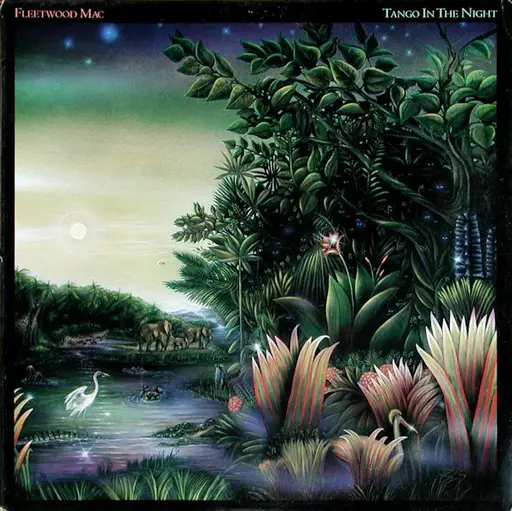
The album’s artwork, “Homage a Henri Rousseau” by Brett-Livingstone Strong, is so lush and romantic that it walks a fine line between formal elegance and kitsch, blending the terrestrial with the celestial. It’s an accurate illustration of “Tango in the Night’s” sound design, of the glitterings and humid shimmers that Buckingham placed in the songs. He made each track on “Tango” just as he produced “Sara”: less an arrangement of bass, guitar, drums, and vocals than a complete world, a living panorama. There’s a phenomenal wholeness to the recordings on “Tango” that seems like a superficial compensation for how deeply fragmented the band was at the time.

After Nicks resurfaced from her cocaine addiction at the Betty Ford Clinic, she visited Buckingham’s studio for a few weeks. Three of her recordings figure into the finished “Tango”, only two of which were written by her. Her voice, invariably hoarse after years of cocaine abuse, often warps or fails the already incomplete material. She howls her way through “Seven Wonders,” a song written mostly by Sandy Stewart. (Nicks receives credit because she misheard “All the way down you held the line” as “All the way down to Emmiline”; For all of its bluster, the song is not only enhanced by the incidents of its arrangement but is the incidents of its arrangement; try to imagine the song without its synth hook and hear the rest of it evaporate. On “When I See You Again,” Nicks’ voice almost crumbles and shatters into atoms. “Stevie was the worst she’s ever been,” Buckingham has said 2013. “I didn’t recognize her…I had to pull performances out of words and lines and make parts that sounded like her that weren’t her.” Fittingly, each verse and chorus that Nicks sings sounds generated by a different uncanny assemblage of Stevie, among them one who sings in a kind of mutilated whisper. After the bridge, Nicks completely disappears. Buckingham finishes the song.

Buckingham’s songs on “Tango” are less knotted than they were on “Tusk” and “Mirage”, newly permissive of space. The first single, Buckingham’s “Big Love,” is a song that inadvertently simulates the essential failure of the album. It is devoted to a totally abstracted and imaginary form of love, while “Tango in the Night” is devoted to a totally abstracted and imaginary form of Fleetwood Mac (neither of which could be assembled in reality). The song’s arrangement feels austere and detached, a by product of the narrator’s alienation, but it’s also decorated with overlapping, pointillist guitar phrases. Even the empty spaces on “Tango” feel like deliberately-wrought emptinesses—for instance, the airy synths that hover over the verses of McVie’s “Everywhere,” or Buckingham’s title track, which through its sense of space imparts the feeling of rowing through fog and mystery.

Still, it’s McVie whose work is most realized by Buckingham’s impressionism. Her “Everywhere” is the best song on the record. Like “Big Love” it too is about encountering an idea too big to contain within oneself (love, again). But where “Big Love” apprehends it with icy suspicion, “Everywhere” responds with warmth, empathy, and buoyancy, describing a kind of devotion so deeply felt that it produces weightlessness in a person. Its incandescent texture is felt in almost any music that could be reasonably described as balearic. Elsewhere, “Isn’t It Midnight,” McVie’s co-write with Buckingham and her then-husband Eddy Quintela, seems an inversion of the values of “Everywhere,” a severe ’80s guitar rock song that gets consumed by a greater, more unnerving force by its chorus, as if it’s succumbing to a conspiratorial dread. “Do you remember the face of a pretty girl?” McVie sings, and Buckingham echoes her in an unfeeling monotone (“the face of a pretty girl”) while behind him synths chime in a moving constellation, UFOs pulsing in the dark.

Christine’s songs, (co-written with her new husband at the time Eddy Quintela,) like “Everywhere”, Mystified”, “Little Lies”, and “Isn’t It Midnight”, have became radio staples all over the world.

Lindsey’s album tracks like “Caroline”, “You And I (Part II)”, (the excellent Part 1 Of The song is now included on the expanded 30th Anniversary edition,) the killer title track which has some of his most ferocious guitar playing, to “Family Man”-a song that also should’ve been a huge hit yet many radio stations thought he was saying “Mother F**ker” instead of “Mother/Father” which made program directors hesitant to play the song.

This is the essence of “Tango in the Night”: something falling apart but held together by an unearthly glow. More of a mirage than “Mirage”, it is an immaculate study in denial (its most enduring hit revolves around McVie asking someone to tell her “sweet little lies”). It’s a form of dreaming where you could touch the petals of a flower and feel something softer than the idea of softness. In this way, “Tango” seems to emerge less from Buckingham’s pure will and imagination than from a question that haunts art in general: How can one make the unreal real, and the real unreal?

The remaster of “Tango in the Night” isn’t as topographically startling as  “Mirage”, where new details seemed to rise out of the mix as if in a relief sculpture; it sounded good on CD in 1987. The reissue does sound warmer and brighter, and the instruments feel less digitally combined, which lifts background elements to the surface, like the seasick drift of the bass notes in “Caroline” and the coordinated staccato harmonies in the title track. The reissue also includes two discs of b-sides, demos, and extended remixes, several of which were previously unreleased. “Special Kind of Love” is described as a demo but sounds like a completely developed Buckingham song, gentle and simple, with every edge expressively filigreed; it could’ve been a potential second sequel to “You and I.” “Seven Wonders” appears in an earlier, more relaxed arrangement, with Lindsey’s guitar warmly swanning between the notes that would eventually be reconstructed in perfect digital isolation by a synthesizer.

The demos also reveal the ways in which the songs could fold into and out of each other. On the “Tango in the Night” demo you can hear Buckingham, at the edge of every chorus, begin to invent the trembling choral part that opens “Caroline.” Nicks’ eventual solo track “Juliet” is present in two of its primordial forms—as the instrumental “Book of Miracles” (credited to both Buckingham and Nicks) and as a five-minute “run-through.” The run-through is especially curious, reducing “Book of Miracles” to a formulaic blues-rock over which Nicks’ voice produces a just-barely musical static, full of wobbles and distortions and exclamations. After the take she says, ecstatically, “I thought that was wonderful! I didn’t play! I did not play because I am so smart!”

Nicks exhibits a strange, dissonant giddiness in this moment that isn’t present in any of the band member’s memories of the recording process. At the time, in his interview with the Times, Buckingham imaginatively described “Tango in the Night” as a restorative process. “This album is as much about healing our relationships as “Rumours” was about dissension and pain within the group,” he said. “The songs look back over a period of time that in retrospect seems almost dreamlike.” Twenty-six years later, Buckingham summarized the experience to Uncut magazine in more severe terms:“When I was done with the record, I said, ‘Oh my God. That was the worst recording experience of my life.’”

The jealousy and resentment he felt toward Nicks for the success she experienced in her solo career, and the prevailing feeling that his architectural work on the band’s records went unnoticed and unappreciated, had built to a flashpoint. Later in 1987, the band met up in anticipation of the promotional tour for “Tango”, for which they had already secured dates and signed contracts. At the meeting, Buckingham announced he was quitting the band. “I flew off of the couch and across the room to seriously attack him,” Nicks said in 2013. “…I’m not real scary but I grabbed him which almost got me killed.” They spilled out of McVie’s house and into the street. Buckingham ran after Nicks and threw her up against a car. She “screamed horrible obscenities” at him, and he walked away, from the moment and the band. What’s left, after these harsh fragments of reality are swept away, is Tango in the Night”: a remarkably complete album, Just a dream.

Once “Tango In The Night” became a huge commercial success the band, including Stevie Nicks, was eager to go on the road only to be shot down by Lindsey.
After a very bad meeting gone wrong at Christine’s home, Lindsey would end up quitting the band, only to be replaced by two musicians (sound familiar?) And even though the tour would become successful without Lindsey the magic just wasn’t there. (Once again. Sound familiar?) In the end the music from “Tango In The Night” deserved better.
Hard to believe that even through all of that turmoil and botched world tour, that today it’s the second most successful Fleetwood Mac album after  “Rumours”.
In retrospect it’s been proven that “Tango In The Night” is Lindsey’s baby. He recorded, produced, and did all of the arrangements at the sessions. It shouldn’t be surprising that by the time the record was finished he was emotionally and physically drained.
It’s ironic that the 31st Anniversary of this album occurred when we all received the news that Lindsey had left Fleetwood Mac again for a “ tour disagreement” (yeah right) except this time he was supposedly fired. (I still don’t know how Lindsey can be justifiably fired from the band that he,more than any other member, is responsible for their success.)
It’s also a shame that as of today it’s the last album recorded by the “classic five” lineup of the band.
For years fan had hoped for one more studio album, but now with the recent death of Christine McVie that will never happen.

The reissue of Fleetwood Mac’s studio album featuring the quintet of Lindsey Buckingham, Mick Fleetwood, Christine McVie, John McVie and Stevie Nicks. It contains several hit singles including “Big Love,” “Seven Wonders,” “Everywhere,” and “Little Lies.” [Available in Regular, Deluxe and Super Deluxe editions. Deluxe adds a disc of rare recordings and non-album tracks. Super Deluxe adds a third CD featuring 12” remixes and more, a DVD containing five music videos, and the 180gm vinyl repress.

“Tango In The Night” continues to impress. What we know now with all of the excellent outtakes that have come to light that it easily could’ve been a double album. After 18 months of drama though, one can understand why it wasn’t.
Fleetwood Mac
* Lindsey Buckingham – guitars, keyboards, Fairlight CMI, lap harp, percussion and drum programming, vocals
* Stevie Nicks – vocals
* Christine McVie– keyboards, synthesizers, vocals
* John McVie – bass guitar
* Mick Fleetwood – drums, percussion
See the source image

In December 2012, three members of Fleetwood Mac cried together, in public, at the memory of something that had happened all of 25 years previously. Singer Stevie Nicks, guitarist Lindsey Buckingham and drummer Mick Fleetwood were doing a round of media interviews to announce the band’s 2013 tour when they were asked about the events of 1987, when Buckingham quit the band following the release of the album “Tango In The Night.” 

Tango In The Night was released on April 13th, 1987. The first single from the album, “Big Love“, was already a Top 10 hit on both sides of the Atlantic, It was their fourteenth studio album, 

Buckingham did not respond directly to the interviewer. Instead he turned to Nicks and Fleetwood and reiterated his reasons for leaving the group at a critical stage of their career: foremost among them, his sense that Nicks and Fleetwood had lost their minds and souls to drugs. 

“What Lindsey said in that interview was very moving,” Fleetwood says. “He told us: ‘I just couldn’t stand to see you doing what you were doing to yourselves. You were so out of control that it made me incredibly sad, and I couldn’t take it any more.’ It was really powerful stuff. This was someone saying: ‘I love you.’ It hit Stevie and me like a ton of bricks. And we all cried, right there in the interview.” 

It was a moment that Mick Fleetwood still describes as “profound”. But even after all these years, his memories of that time in 1987 are still raw. For when Lindsey Buckingham walked out on Fleetwood Mac, he did not go quietly. When Buckingham told the band he was leaving, it led to a blazing argument that rapidly escalated into a physical altercation between him and former lover Nicks, in which she claimed she feared for her life. 

“It is,” Fleetwood says, “a pretty wild story. It was a dangerous period, and not a happy time.” And yet, for all the drama that came with it, “Tango In The Night” was a hugely important album for Fleetwood Mac. It became the second biggest-selling album of their career, after 1977’s 45-million-selling “Rumours“. 

In 1985, Lindsey Buckingham was writing and recording songs for what was planned as his third solo album. Fleetwood Mac had been on indefinite hiatus since 1982, following a world tour in support of their album “Mirage“. In that time there had been solo albums from all three singers: Nicks’ The Wild Heart sold a million copies; Christine McVie’s eponymous album yielded a US Top 10 hit with Got A Hold On Me; but, to Buckingham’s chagrin, his album Go Insane had not made the Top 40. 

There had also been problems for them over these years. Nicks had been treated for drug addiction. More surprisingly, Mick Fleetwood had been declared bankrupt following a string of disastrous property investments. “At that time,” Buckingham later admitted, “the group had become a bit fragmented.” 

By the end of ’85, Buckingham – working alone at his home studio in Los Angeles – had three songs finished: Big Love, Family Man and Caroline. But while he was busy making music, Mick Fleetwood was busy making plans to get the band back on track. 

The wheels had been set in motion when Christine McVie recorded a version of the Elvis Presley hit Can’t Help Falling In Love for the film A Fine Mess – backed by Mick Fleetwood and the band’s other remaining founding member, her ex-husband John McVie. She invited Buckingham to produce, alongside engineer Richard Dashut. 

“It was the first time for nearly five years that we’d all been in a working environment together,” Christine said. “We had such a good time in the studio and realised that we still had something to give each other in musical terms after all.” Mick Fleetwood was more forthright. “The reality,” he says, “is that Fleetwood Mac were intending to make an album. And Lindsey was in many ways pressured into it. ‘Hey, we’re making an album – let’s go!’” 

Buckingham relented, partly out of a sense of duty. “I had a choice,” he said, “of either continuing on to make the solo record, or to sort of surrender to the situation and try and make it more of a family thing. I chose the latter.” What Fleetwood didn’t know is that Buckingham’s agreement was conditional. “I had the idea,” Buckingham said, “that that was going to be the last work with the group.” 

The biggest problem for Lindsey Buckingham was, of course, Stevie Nicks. “I’ve known Stevie since I was 16 years old,” he said. “I was completely devastated when she took off. And yet I had to make hits for her, So on one level I was a complete professional in rising above that, but there was a lot of pent-up frustration and anger towards Stevie in me for many years.”

“He got very angry with me,” Nicks has said. “He tossed a Les Paul across the stage at me once and I ducked and it missed me. A lot of things happened because he was so angry at me.” Buckingham’s frame of mind was not helped by the not inconsiderable success that Nicks enjoyed in her solo career. In 1981, her solo debut, “Bella Donna“, went to No.1 in US. Other hit albums and singles followed. Buckingham’s solo records sold next to nothing. 

For all that, Buckingham threw himself into the album. He either wrote or co-wrote seven of the 12 tracks that made the finished album. He also acted as co-producer with Richard Dashut. And it was at his home studio that most of the recording was done. 

What was unusual about the recording of Tango In The Night was the absence of Stevie Nicks for much of the process. Nicks actually contributed three songs to the album, but was in the studio for only two to three weeks. 

One trick of Buckingham’s, in Big Love, was especially brilliant. For the song’s climax, he used variable speed oscillators on his voice to create the effect of a male and female in a state of sexual excitement – the “love grunts”, as he called them. 

“It was odd that so many people wondered if it was Stevie on there with me,” he said, a little disingenuously. Although there were other great songs on the album – slick pop rock tunes in the classic Fleetwood Mac style, such as Christine’s “Little Lies” and “Everywhere”, and Stevie’s “Seven WondersFleetwood calls Tango In The Night “Lindsey’s album”. But for Buckingham himself, there was a sense that in the transition from solo album to band album, something had been lost. A perfectionist, intensely analytical, he felt that Tango In The Night was too predictable, too safe. 

“She was not hugely present,” Fleetwood says. “I don’t remember why. And I don’t think we would remember. Fleetwood says that he and Nicks were doing more cocaine during the making of “Tango” than when they were recording “Rumours” an album on which they seriously considered thanking their drug dealer in the credits. 

“Certainly, I smoked a lot of pot. But I was never a big user of coke,” Buckingham adds. 

“Actually,” he admits, “it was way worse on “Tango In The Night.” For sure.” 

While Tango was being recorded at his home, he found a way of keeping the two cokeheads – plus assorted hangers-on – at a safe distance.

Lindsey had a Winnebago put in his driveway,” Fleetwood says. “And that’s where Stevie and I would go with our wrecking crew. With me, the party never stopped. It wasn’t until years later that I asked him: ‘What was all that about?’ And he said: ‘I couldn’t stand having you punks in the house. You’d turn up at the studio with people that you’d met from the night before, and you’d start gooning around. You were too fucking crazy.’ Lindsey was never a drama queen, enjoying the 80s drug culture like Stevie and me. It wasn’t his scene.

The drug taking was only one part of the problem. There were other things eating away at Buckingham.

Just as Rumours had done in the 70s, so Tango In The Night defined the soft rock era of the 80s. Perhaps most significant of all, it marked the third coming of the Mac, following the successes of the Peter Green-led blues rock Mac of the late 60s and the Buckingham/Nicks-fronted AOR The the Mac of the 70s. And for Mick Fleetwood, it represented a personal triumph. Mick Fleetwood is not sure it is simple coincidence that Fleetwood’s two biggest-selling albums, “Rumours” and “Tango In The Night”, were made when the band was at its most dysfunctional. “Also,” he says, “I’m not sure I should be so proud of it.” 

While he freely admits that his own drug-fuelled insanity was instrumental in Lindsey Buckingham’s exit, it was Fleetwood who kept the band together once Buckingham had gone. And this was key to the success of “Tango In The Night“. In the 90s, Buckingham re-joined Fleetwood Mac, and, more importantly, made his peace with Stevie Nicks. They have both come a long way since that dark day in 1987: Buckingham now married and a father of three, Nicks happily drug-free. All that remains between them is what Mick Fleetwood calls “the good stuff”. 

“My motto” Fleetwood says, “was ‘the show must go on’. It was almost an obsessive-compulsive desire to not give up. And it worked.”

Fleetwood Mac will release an expansive, 30th anniversary edition of their 14th studio album, 1987’s Tango in the Night, on March 10th via Warner Bros. Records. The reissue is packaged in three formats: a one-CD set featuring remastered audio, an expanded two-CD version with rare and unreleased recordings and a deluxe version featuring three CDs, a 180-gram LP and a DVD with music videos and a high-resolution version of the album.

Christine McVie Singer-songwriter looks back on heady days at Château d’Hérouville, discusses band’s future plans
With Tango in the Night, Fleetwood Mac fully immersed themselves in the decade’s glossy production style. Showcasing the diverse styles of primary songwriters Lindsey Buckingham, Stevie Nicks and Christine McVie, the 12-track LP spawned a quartet of hit singles: “Big Love,” “Seven Wonders,” “Everywhere” and “Little Lies.” Their second highest-selling album behind 1977 masterwork Rumours, it remains the group’s final studio project with the classic quintet line-up of Buckingham, Nicks, McVie, John McVie and Mick Fleetwood.
The deluxe and expanded reissues features a disc of 13 previously unheard recordings, including an alternate version of shimmering Christine McVie ballad “Mystified,” a demo of Buckingham’s epic, percussion-heavy title-track and rare B-sides “Down Endless Street” and “Ricky.” The deluxe edition offers a third disc with 14 12-inch mixes – including dub versions of “Seven Wonders and “Everywhere” – and a DVD with videos of “Big Love,” “Seven Wonders,” “Little Lies,” “Family Man” and “Everywhere.”
Buckingham and Christine McVie recently announced an album of duets tentatively titled Buckingham McVie. The set, which features contributions from John McVie and Fleetwood, is loosely slated for a May release.

Fleetwood Mac have spent the past few years reissuing their peerless back catalogue in the obligatory remastered, expanded, deluxe editions. Last year brought us the 1982 album “Mirage” which somehow managed to make an album already slathered in cocaine sound even more cokey, all sheen and shine.

Next up is Tango in the Night, coming out on Warner on 10th March, They’ve got this early, unreleased version of the Stevie Nicks track Seven Wonders for you. It’s longer but also a little harsher than the album version, drawing out the fatalism of the chorus and de-emphasising the keyboard hook.

Tango in the Night came out five years after Mirage, and had originally been planned as a Lindsay Buckingham solo record – Nicks spent only two weeks in the studio with the band because she was concentrating on her solo career. Be thankful that it became a full-band record, because the album became defined not by his songs but by the contributions of the other writers; without the two singles from Christine McVie“Everywhere” and “Little Lies” – it would be a very different record. While many Mac fans might have their favourite writer in the group, it takes all three of Buckingham, Nicks and McVie to balance the group.

That balance is what makes Tango in the Night so great. For all that the music is of a piece – sophisticated, slick, without ever being over-complicated – it manages to shift through moods effortlessly. Buckingham is on edge throughout and has explained that Big Love, his single from the album, gets misinterpreted: when he sings that he is “looking out for love”, he doesn’t mean he is looking for love, he is putting himself on guard for it. In the title track, he’s restless, discomfited (“Try to sleep, sleep won’t come”); Caroline upbraids a woman who is crazy and lazy; Family Man seems to be a hymn to domestic stability, but even then he can’t help observing that “the road gets tough”.

McVie’s songs appear much more straightforward. “Everywhere” is a simple, gorgeous statement of love; “Little Lies” its counterpart, the realisation that the feelings of Everywhere depend on self-deception. Nicks’s are neither straightforward, nor angry: Welcome to the Room … Sara was written after treatment at the Betty Ford clinic, and uncertainty echoes throughout her contributions (“If I see you again / Will it be the same?” she asks on When I See You Again. “If I see you again / Will it be over?”), and “Seven Wonders” exemplifies that, with Nicks confronting the notion that even living to see the seven wonders will never match what she has lost.

Fleetwood Mac – Tango in the Night

Reissue Track List (Deluxe Edition)
Disc One: Original Album – 2017 Remaster
1. “Big Love”
2. “Seven Wonders”
3. “Everywhere”
4. “Caroline”
5. “Tango In The Night”
6. “Mystified”
7. “Little Lies”
8. “Family Man”
9. “Welcome To The Room… Sara”
10. “Isn’t It Midnight”
11. “When I See You Again”
12. “You And I, Part II”
Disc Two: B-Sides, Outtakes, Sessions
1. “Down Endless Street”
2. “Special Kind Of Love” (Demo)*
3. “Seven Wonders” (Early Version)*
4. “Tango In The Night” (Demo)*
5. “Mystified” (Alternate Version)*
6. “Book Of Miracles” (Instrumental)
7. “Where We Belong” (Demo)*
8. “Ricky”
9. “Juliet” (Run-Through)*
10. “Isn’t It Midnight” (Alternate Mix)*
11. “Ooh My Love” (Demo)*
12. “Mystified” (Instrumental Demo)*
13. “You And I, Part I & II” (Full Version)*
*Previously Unissued
Disc Three: The 12″ Mixes
1. “Big Love” (Extended Remix)
2. “Big Love” (House On The Hill Dub)
3. “Big Love” (Piano Dub)
4. “Big Love” (Remix/Edit)
5. “Seven Wonders” (Extended Version)
6. “Seven Wonders” (Dub)
7. “Little Lies” (Extended Version)
8. “Little Lies” (Dub)
9. “Family Man” (Extended Vocal Remix)
10. “Family Man” (I’m A Jazz Man Dub)
11. “Family Man” (Extended Guitar Version)
12. “Family Party” (Bonus Beats)
13. “Everywhere” (12″ Version)
14. “Everywhere” (Dub)
Disc Four: The Videos (DVD)
1. “Big Love”
2. “Seven Wonders”
3. “Little Lies”
4. “Family Man”
5. “Everywhere”
(Plus a High-Resolution Stereo Mix of the Original Album)