Neil Young has shared a new song “Peace Trail,” the title track off the rocker’s upcoming 38th studio album due out December 9th.
“The world is full of changes/ Sometimes these changes make me sound,” Young sings on the slow-burning, angst-filled track. A second Young vocal – lightly coated in voice modifying software like Auto-Tune creeps in the background: “I think I’ll hit the peace trail/ I know that treasure takes its time/ I think I’ll hit the peace trail/ I think I like my chances now.”
Although Neil Young has spent the past few years on the road performing with his band Promise of the Real, the rocker recorded Peace Trail alongside a stripped-down outfit featuring drummer Jim Keltner and bassist Paul Bushnell at Rick Rubin’s Shangri-la Studios. The album also features the previously released DakotaAccess Pipeline protest song “Indian Givers.”
“Peace Trail” was released as an instant download to fans that pre-ordered Young’s new album. Peace Trail is available to purchase now through Young’s site in a variety of formats, including a vinyl version that’s accompanied by a “100% organic hat.” The new track also marks Young’s return to streaming services like Spotify and Apple Music 16 months after he pulled the vast majority of his catalog from non-Tidal and Pono streaming services due to “devalued” sound quality.
“AM radio kicked streaming’s ass. Analog cassettes and 8 tracks also kicked streaming’s ass, and absolutely rocked compared to streaming,” Young wrote in July 2015. “Streaming sucks. Streaming is the worst audio in history. If you want it, you got it. It’s here to stay. Your choice.” Young has not yet commented on why he allowed his music back on Apple Music and Spotify.
Ty Segall can seemingly transform his music from Glam Rock God to Grunge Rocker at will, but the prolific rocker can do just about anything well, and that includes intimate stripped down acoustic sets . In the Summer, Segall went on a short tour of solo acoustic shows in various New York City venues accompanied by Wand’s Cory Hanson, and it was a very different concert experience from the usual Segall stomp-fest, but it sounded just as good. It’s no secret that Segall is a huge Neil Young fan . He even has a tattoo of Young’s name on his right arm on the Wednesday night at Baby’s All Right, he trotted out a cover of Neil Young’s “For The Turnstiles.” At the Mercury Lounge on the Friday night, he played an entirely new song live, hilariously introducing it as a song “about a tree growing inside of an airplane” before admitting after playing it that “I lied, it’s a love song.” It’s not clear if it was written as an acoustic song or just adapted with the rest of his stuff for the show, but it sounds great either way. Also at the Mercury Lounge he played the Cars’ “My Best Friend’s Girl.”
The prolific Segall released an EP and two live records—one with the Ty Segall Band and another that was a split with King Tuff . Earlier this year, In the Red revealed plans to release albums by Segall’s bands Fuzz and The Traditional Fools .
Ty Segall did an impromptu rendition of Neil Young’s song “Down By the River” during the encore of his Teragram Ballroom show in Los Angeles over the weekend. He was joined by Mikal Cronin for the cover; watch it below. The concert was a benefit fundraiser for The Smell, the vital D.I.Y. venue in L.A. that received a demolition notice earlier this year. This isn’t the first time Ty Segall has done one of Neil Young’s songs live; he played “For The Turnstiles” during an acoustic set.
Ty Segall performing a cover of Neil Young’s 1969 ‘Everybody Knows This Is Nowhere’ single “Down By The River” at The Teragram Ballroom in Downtown Los Angeles, CA for Penniback Records to benefit The Smell
Fifty years ago this Saturday, Stephen Stills, then a member of Buffalo Springfield, was on his way into Hollywood to hear some live music on the Sunset Strip. But in one of those defining rock & roll moments, what he encountered was a rally: hundreds, if not thousands, of kids protesting about a new curfew and the imminent closing of one club, Pandora’s Box, by way of a fake “funeral” for it.
“The commercial merchants on Sunset Boulevard in a certain area decided that the element of young people on the street every night was not conducive to commercial enterprise,” Stills said in a 1971 interview. “A bunch of kids got together on a street corner and said we aren’t moving. About three busloads of Los Angeles police showed up, who looked very much like storm troopers. … And I looked at it and said, ‘Jesus, America is in great danger.'”
Within weeks of this event, Stills had written – and Buffalo Springfield had recorded a song inspired by that night, “For What It’s Worth.” With its emphasis on Stills‘ spooked voice, drummer Dewey Martin’s ominous snare drum and Neil Young’s warning-bell two-note guitar part in the verse, the track became the band’s only hit, peaking at Number Seven in the spring of 1967. Yet equally striking was its sound: The eerily quiet song captured the uneasy mood of the moment that extended beyond Los Angeles to Vietnam, and lyrics about “a man with a gun over there” and “young people speaking their minds/Getting so much resistance from behind” were the sound of the rock counterculture cementing its socially conscious voice.
“For What It’s Worth” has transcended its origin story to become one of pop’s most-covered protest songs – a sort of “We Shall Overcome” of its time, its references to police, guns and paranoia remaining continually relevant. The Staple Singers were among the first to cover it, in 1967, but since then, it’s been recorded by a mind-bendingly diverse number of acts: Ozzy Osbourne turned it into a grim stomper, Lucinda Williams into a ghostly ballad, Kid Rock into a classic-rock homage, Rush into a swirling soundscape, Led Zeppelin (in live bootlegs) into languid blues. (Robert Plant also cut a version with his pre-Zep band, Band of Joy.) Public Enemy even sampled it on 1996’s “He Got Game.”
According to BMI, the song’s publishing house, “For What It’s Worth” been played 8 million times on TV and radio since its release. In 2014, it came in at number three on Rolling Stone’s readers poll of the best protest songs. “The way it’s written, it’s so open to interpretation,” says Heart’s Ann Wilson, who released a cover last year on her first EP with side project the Ann Wilson Thing. “It’s so open that it’s brand new today. The main hook, ‘Everybody look what’s going down’ – you can apply that, to say, the current election. The song is going, ‘What the hell is this?’ You can apply the song to any situation in any decade.”
By 1966, the situation in Los Angeles was tense. An increasing number of club goers was descending on the Strip, irritating area residents and upscale boutiques, and the LAPD instigated a 10 p.m. curfew for anyone under 18. On the night of November 12th, a local radio station announced there would be a protest at Pandora’s Box. According to reports, a fight broke out for reasons having nothing to do with the curfew; a car carrying a group of Marines was bumped by another vehicle. Egged on by that fight, the protesters (some of whom carried placards that read “We’re Your Children! Don’t Destroy Us”) trashed a city bus and threw bottles and rocks at storefronts.
Approximately 1000 young music fans gathered at the Pandora’s Box club on Sunset Strip to protest a 10pm curfew imposed by local residents during the The “hippie riots” in L.A. on November 12th, 1966.
“It was really four different things intertwined, including the war and the absurdity of what was happening on the Strip,” Stills later told The Los Angeles Times. “But I knew I had to skedaddle and headed back to Topanga Canyon, where I wrote my song in about 15 minutes.” The folk-blues feel of the song harked back to Stills‘ days in the Greenwich Village folk scene.
As anyone who’s heard it knows, the phrase “for what it’s worth” appears nowhere in the song. According to one legend, Stills played it for one of the group’s managers, prefacing it with, “Let me play you a song, for what it’s worth.” Buffalo Springfield singer-guitarist Richie Furay recalls he, Stills, and Young playing new material for Atlantic’s Ahmet Ertegun, a major supporter of the Springfield. “Ahmet had come to Los Angeles and we were at Stephen’s house,” Furay recalls. “At the end of the day, Stephen said, ‘I have another one, for what it’s worth.'”
On December 5th, only a few weeks after the Strip mayhem, the Springfield went into an L.A. studio to lay down the song in a one-day session. Young credited engineer Stan Ross with the song’s spare, almost sinister arrangement. “Stan came in and said, ‘You gotta do this one thing to the drum, the snare,'” Young said in JimmyMcDonough’s bio “Shakey”. “Took a broom, a guitar pick and mixed that in so it’s got that sound – of a guitar pick going through a broom, on the straw. That was it.” Added Stills later, “Neil came up with the wonderful harmonics part with the vibrato. The combination of the two guitar parts, with my scared little voice, made the record.” Furay admits he didn’t hear anything special in the song at first: “I was more into the electric work, like ‘Bluebird’ and ‘Rock & Roll Woman,’ that phase of where we were,” he says. “I didn’t hear it, but Stephen felt the pulse of it and there you go.”
Everyone else knew the song was special, and the single was rush-released with an amended title, “(Stop, Hey What’sThat Sound) For What It’s Worth,” at Ertegun’s suggestion. The song was also added into new pressings of the band’s first album, replacing another Stills original, “Baby Don’t Scold Me.”
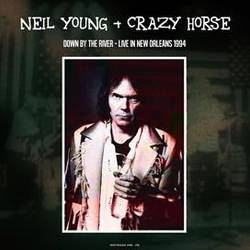
Recorded live at the Superdome in New Orleans for Farm Aid 7 in September of 1994, this is classic grunge-era Neil Young and Crazy Horse. Though the set list consists of only 5 tunes, the show’s running time is nearly an hour as Neil and the band give epic performances of all-time favorites like “Down By The River”, and Dylan’s “AllAlong The Watchtower”, as well as newer arrivals like “Country Home” (from 1990’s Ragged Glory) and “Change Your Mind” (from 1994’s Sleeps With Angels). An essential Neil live set available now in unprecedented sound quality.LP and coloured vinyl.
Neil Young and Crazy Horse perform “Down By the River” live at the Farm Aid concert in New Orleans, Louisiana on September 18th, 1994. Farm Aid was started by Willie Nelson, Neil Young and JohnMellencamp in 1985 to keep family farmers on the land and has worked since then to make sure everyone has access to good food from family farmers. Dave Matthews joined Farm Aid’s board of directors in 2001
At the June 15th stop on Neil Young and Promise of The Real‘s current European Tour, the legendary rocker treated fans in Lyon, France to his first “Cortez The Killer” encore in three years. A few days later, while in Spain on June 20th, Neil Young and the band whose membership includes Lukas Nelson and Micah Nelson delivered another scorching “Cortez The Killer” encore. High quality, audience-shot footage of the 17-minute “Cortez” finale has surfaced.
Like other tour stops, Young’s appearance at Poble Espanyol in Barcelona, Spain began with a solo acoustic set during which he played “After The Gold Rush,” “Heart Of Gold,” “Comes A Time,” “The Needle And The Damage Done” and “Mother Earth.” After being joined by Promise Of The Real for “Out On The Weekend,” the rest of the main set showcased favorites such as “Alabama,” “Words (Between the Lines of Age),” and the set closing “Rockin’ In The Free World” as well as lesser-played selections like “Revolution Blues” and “Vampire Blues.”
And then you have Cortez The Killer.
The summation and conclusion to all of this; a song about a man who was “not able to sleep well” (Neil’s description) due to the crimes he committed. We see flashbacks of all these other varied antagonists who carelessly allowed greed to control them, to destroy their own peace of mind and the world around them. Cortez represents them all. He takes off his mask and reveals more than one face; and a mirror.
It’s a proper cinematic climax, the type Neil Young has so obviously been enamoured with for so most of his career.
As so often happens, Neil tells us a story with this tour, and Cortez brings this particular story to a befitting conclusion.
“Cortez the Killer” hails from the album Zuma, one of Neil Young’s most overlooked albums, often lost in the shuffle of its predecessor, the much-praised Tonight’s the Night, which came out just five months prior. But there’s really a very simple explanation for the song’s high rating. Just take it from Young himself, who once proclaimed that, “ ‘Cortez’ is some of my best guitar playing ever!”
Remarkably, the song’s structure was largely shaped by an accident—a power failure which occurred in the midst of recording a perfect, transcendent take of the song. Rather than recut the tune, Neil Young just plowed forward and later he and producer David Briggs went back and did some creative editing, which required the lopping off of several verses. “They missed a whole verse, a whole section!” Young says. “You can hear the splice on the recording where we stop and start again. It’s a messy edit…incredible! It was a total accident. But that’s how I see my best art, as one magical accident after another. That’s what is so incredible.”
“Cortez the Killer,” about the Spanish explorer who conquered Mexico with bloody success, is also a prime example of Young’s physical style of lead playing. Also check out the beauty of this acoustic version.
“I am a naturally very destructive person,” he says. “And that really comes out in my guitar playing. Man, if you think of guitar playing in terms of boxing…well let’s just say I’m not the kind of guitarist you’d want to play against. I’m just scarred by life. Nothing in particular. No more scarred than anyone else. Only other people often don’t let themselves know how damaged they are, like I do and deal with it.”
In the late ’80s, Neil Young re-embraced distortion. He cut “Rockin’ in the Free World.” He teamed up with Crazy Horse for 1990’s album Ragged Glory And then he and his Crazy friends hit the road in the winter of 1991, for what Young termed the “Smell the Horse” tour, which was documented on the Arc-Weld album.
These were loud, noisy shows, a commitment that ran even to the support acts, Sonic Youth and Social Distortion, both of whom Neil had hand picked for that purpose. Extended, tangled performances were akin to the electric music captured on the “Live Rust” album more than a decade earlier. But Young with Crazy Horse bassist Billy Talbot, drummer Ralph Molina plus guitarist/keyboardist Frank “Poncho” Sampedro weren’t trying to relive the past so much as they were inspired to the present. Apparently, the band watched CNN reports from the first Gulf War every night before taking the stage.
“It blew my head off during that tour,” Young said about the war in Iraq in Johnny Rogen’s Zero to Sixty: A Critical Biography. “When we were playing that stuff, it was intense. It was real. I could see people dying in my mind. I could see bombs falling, buildings collapsing on families.”
The nasty images and violent news spurned the singer-guitarist to play some of his roughest material from the new record along with enshrined tunes about death and genocide such as “Powderfinger” and “Cortez the Killer.” He and Crazy Horse also debuted a version of Dylan’s “Blowin’ in the Wind,” accompanied by the sound of a blaring air raid sirens and gunfire. Weld consists of rock and roll songs by Young and Crazy Horse, duplicating seven songs that had appeared on either “Rust Never Sleeps” Or “Live Rust” from twelve years earlier. It also echoes those albums as Young, in both cases having spent most of a previous decade pursuing different musical avenues, returned to straightforward rock and roll via the acclaimed Ragged Glory album with Crazy Horse, then celebrating that return with an accompanying multi-disc live document and concert film.
After coming off the road, Neil Young assembled recordings from the shows to document the four-month tour in the form of a double-live album. The concerts had been loud enough, but Young did further damage to his hearing while mixing the live record, which he would give the appropriately metallic title of Weld.
“I made Harvest Moon[after Weld] because I didn’t want to hear any loud sounds,” he said in 1995. “I still have a little bit of tinnitus but fortunately now I’m not as sensitive to loud sounds as I was for a year after the mixing of Weld.”
But Weld wasn’t the only thing Young was putting together in the summer of 1991. In addition to the live album, he began playing with fragments of concert sounds, weaving together layers of guitar distortion, drums, crowd noise, lyric fragments and stage chatter into an abrasive collage.
The experimental record, to be titled Arc, evolved in a 1987 film project called Muddy Track, for which Young recorded beginnings and endings of live performances and edited them together. He showed the piece to SonicYouth’s Thurston Moore, who encouraged the rock legend to attempt a similar treatment with the professional recordings from the current tour.
Young came away with a one-track, 35-minute album that featured snippets of him singing “Like a Hurricane” and “Love and Only Love” (which repeat, almost like a refrain), as well as squealing feedback and low-end rumbling that was a ringer for constant explosions. Many would compare it to Lou Reeds Metal Machine Music.
“It’s new-age metal,” Young said in April 1992. “That’s what I would call it because you can listen to it really quiet. It’s soothing… It’s a generic rock ’n’ roll sound; it has no identity. It’s the tone, the metal tone. It’s like being inside a giant milkshake blender. It’s another dimension. Most bands’ beat defines who they are. There is no beat on Arc.”
In a limited release, Young packaged his conventional live album with Arc, which he called “more art and expression than anything I’ve done in a long time.” Via Reprise, he released 25,000 of the three-disc set, Arc-Weld, on October. 22nd, 1991. He ended up putting out the records separately, as well. (A VHS concert video was released too, although it has gone out of print.) Fans and critics reacted positively to the intensity of the performances on Weld while regarding Arc as, at best, something of a curiosity.
Although Neil Young would take a short hiatus from loud music following the release of Arc-Weld, he wouldn’t stay away for long. As the “godfather of grunge,” he’d soon team up with Grunge rockers Pearl Jam and reconvene with Crazy Horse multiple times throughout the ’90s.
1. “Hey Hey, My My (Into the Black)” – 0:00
2. “Crime in the City” – 5:42
3. “Blowin’ in the Wind” (Bob Dylan) – 12:14
4. “Welfare Mothers” – 19:04
5. “Love to Burn” – 26:08
6. “Cinnamon Girl” – 36:06
7. “Mansion on the Hill” – 40:54
8. “F*!#in‘ Up” – 47:08
Of course the second cd is mandatory listen after the first one
1. “Cortez the Killer” – 0:00
2. “Powderfinger” – 9:46
3. “Love and Only Love” – 15:42
4. “Rockin’ in the Free World” – 25:03
5. “Like a Hurricane” – 34:23
6. “Farmer John” (Don Harris, Dewey Terry) – 48:25
7. “Tonight’s the Night” – 53:24
8. “Roll Another Number” – 1:02:05
No set felt more crucial this weekend than Neil Young’s on Saturday at sundown, achieved as much by its perfectly timed moments as its political impact (his anti-Monsanto organic seed free-for-all was hilarious) and sheer sonic force. Save for a 6-song solo acoustic intro (which kicked off at Golden Hour with “After the Gold Rush” and “Heart of Gold”), Young was in full-on guitar god mode, playing louder and more furiously than anyone in the Stones or Dylan’s band the previous evening. And his backing outfit, the Promise of the Real (featuring WillieNelson’s sons Lukas and Micah) was no less mind-blowing. During extended jams (Crosby, Stills, Nash and Young’s “Helpless,” Crazy Horse’s “Powderfinger” and 17-minute epic “Cowgirl in the Sand”), Lukas went head-to-head with the 70-year-old master, channeling a bit of his dad’s erratic picking, some Jimi Hendrix-esque freakouts and Stevie Ray Vaughan’s finesse.
Clearly, the younger fellas keep Young on his toes. And they had a blast in the process, particularly apparent when Young joked “We only have so many songs,” then pulling out a set list the size of a small human, allowing the camera to grab a close-up while his finger teased over more than 100 possible tunes like a Ouija board needle running rampant. It was a badass rock star move that revealed just how impressive this band is – they’ve rehearsed for countless classic cuts.
But Young owed his overall one-up to the moon, which rose – full and almost-orange like a humongous, cratered pumpkin – as the sun set behind the mountains opposite it. Of course, he had a hand in its impact: “Harvest Moon” appeared one song sooner than it did Weekend 1 – while the moon was at its biggest and brightest, like a second blazing sun – so that it hung just above the stage as Young crooned “But there’s a full moon risin’/ Let’s go dancin’ in the light/ We know where the music’s playin’/ Let’s go out and feel the night.” As wizard, astronomer, living legend – effortlessly encompassing a bit of each – Young’s music imbued the desolate desert with magic, vitality and harmony.
On Sunday at the inaugural Outlaw Music Festival held at Montage Mountain in Scranton, Pennsylvania. The lineup featured Lee Ann Womack, Chris Robinson Brotherhood, Sheryl Crow, Willie Nelson, Neil Young & Promise Of The Real and more. Sunday was Neil & POTR’s sixth U.S. performance this year as they spent the summer tearing up Europe. Young and his young backing band delivered an impressive 95-minute performance in Scranton and audio of the entire set has surfaced.
Neil started his set with a handful of solo classics including “Heart Of Gold,”“Out On The Weekend” and “Harvest Moon.” Promise Of The Real emerged to back Neil Young on the back half of the set. The biggest surprise was the return of “Welfare Mothers” off the Neil Young & Crazy Horse album Rust Never Sleeps.Young had never performed the song with Promise Of The Real in the past and Sunday’s version marked the first in the U.S. since 2003 as he did play “Welfare Mothers” with Crazy Horse in Australia and Belgium during their 2013 tour together.
Young & POTR ended their performance with a run of beloved gems from Neil’s songbook starting with “CowgirlIn The Sand.” Next up was “Everybody Knows This Is Nowhere,” before the band showed off their improvisational prowess on a 15-minute “Cortez The Killer.” The group brought their Outlaw set to a close with “Fuckin’ Up” and “Rockin’ In The Free World.” On September 30th, Neil Young & Promise Of The Real will play their first of two shows at Town Park in Telluride.
Neil Young + Promise of the Real at The Pavilion at Montage Mountain September 18th, 2016, Scranton PA
Heart of Gold
Out on the Weekend
Unknown Legend
Human Highway
Harvest Moon
Hold Back the Tears
Powderfinger
Welfare Mothers
Cowgirl in the Sand
Everybody Knows This Is Nowhere
Cortez the Killer
Fuckin’ Up
Rockin’ in the Free World
Promise Of The Real
Neil Young – vocals, acoustic guitar, electric guitar, harmonica
Lukas Nelson – electric guitar, piano, vocals
Micah Nelson – electric guitar, electric charango, piano, synthesizer, vocals
Corey McCormick – bass, vocals
Anthony Logerfo – drums
Tato Melgar – percussion
Neil Young’s musical activist statements are famed , he’s unveiled another in protest of the Dakota Access Pipeline.
The song is called “Indian Givers,” after the (terrible) expression used to describe people who take back the gifts they’ve given. Young implies that oil interests are infringing on the sovereignty promised to Native American nations, and he holds us all responsible: “Our brothers and sisters have to take a stand / Against us now for what we all been doing.”
Throughout the song, Young repeats, “I wish somebody would share the news,” and he tries to do just that. He fills the accompanying video with footage and photos from protests, interspersed with shots of him in a car surveying a (presumably North Dakotan) landscape. Young references the August. 31st protest by Dale “Happy” AmericanHorse Jr., the Sicangu Lakota man who chained himself to a backhoe to prevent pipeline construction.
On Friday, Young released a version of the song on his Facebook page that used the word “squaw,” but re-recorded that portion when a fan alerted him that its usage was problematic.
“Thanks for bringing the word squaw to my attention,” Young replied, per the Indian Country Today Media Network. “I will change it as soon as I can get back into the studio. I mean no offense.”




 The Fat Angel Sings