Posts Tagged ‘Led Zeppelin’

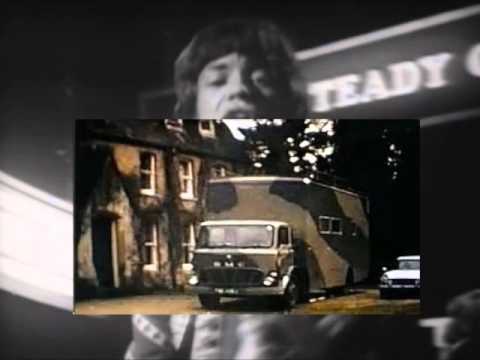
Image result for the rolling stone mobile studio images

Mobile recording studios have a longer history than you might think. As early as the 1920s, record companies in both the U.K. and the U.S. were experimenting with location recording, albeit with incredibly primitive equipment. This was the pre-magnetic tape era, after all.

In the U.K., the pioneer was EMI, closely followed by its chief rival, Decca. The purpose, for the most part, was to record live concerts of classical music, and while the equipment changed out of recognition during the following 30 years or so, that purpose remained: to capture live performances.

By the time rock music arrived around the mid ’60s, a new generation of mobile studios appeared that would capture some of the most important recordings of the era. And curiously, most of them were not recordings of live gigs. That was because the mobile studio soon became used as much for the freedom it offered artists to record in domestic locations as for capturing their stage performances.

Digital technology has helped bring about the demise of the mobile truck since the turn of the millennium. Now, artists can of course record on devices as small as an iPad (to name but one famous example, Damon Albarn recorded the Gorillaz album The Fall in just that way). Even if you don’t want to be quite as stripped-down as Albarn, a laptop armed with plugins and a small digital mixer can offer almost as much as a fully fledged mobile studio at far less cost.

However, before the mobile trucks rumbled off into the distance, the freedom they provided in that short period produced some remarkable recordings. Here are six of them.

The Who, Live at Leeds (1970)

This album, still regarded by many critics as the finest live rock LP ever, was originally designed to be Live at Hull and Leeds. It was recorded by the Pye Records mobile on eight-track analogue tape machines installed beneath the auditorium in a cloakroom. At this stage, mobile trucks were used simply to carry recording equipment to a gig. That equipment then had to be removed, assembled, and used in whatever space could be found.

With nothing more than split cables from the vocal, speaker, and drum microphones, the two recordings were plagued with technical problems. Some of the bass track from Hull was lost, and the Leeds concert suffered from crackles, which have caused controversy ever since. Years later, when the crackles were erased using digital wizardry, some fans objected that they removed the authenticity of the recordings.

Originally released as a single six-track vinyl LP, Live At Leeds has since appeared in many incarnations, some with and some without the infamous crackles. The Hull gig recorded the night before (February 13th) has been released, too, with John Entwistle’s missing bass parts replaced with carefully synced recordings from Leeds. There are those who claim that Live At Hull 1970 is even better than the raw and powerful Live At Leeds. They can both be heard on the 40th Anniversary collectors’ edition.

Led Zeppelin, IV (1971)

You could toss a coin over whether Led Zeppelin’s III or IV was the more significant album, but it doesn’t really matter for our purposes—both made very extensive use of the Rolling Stones Mobile (RSM) and were released before two other other landmark RSM recordings, the Stones’ Exile On Main St. and Deep Purple’s Machine Head.

A former 18th-century poorhouse, Headley Grange in Hampshire was the chosen venue, as it had been for much of Zeppelin III. The majestic sound of John Bonham’s drums—sampled a thousand times and still used today—was created in wood-paneled Headley Grange with a pair of distant Neumann condenser mics. It has probably never been equalled.

The Rolling Stones, Exile On Main St. (1972)

Just as The Who’s Live At Leeds is regarded by some as their finest hour, so the Stones’ Exile On Main St. stands as a testament to the band at its peak—even if a wobbly one at times.

In 1970, Mick Jagger bought Stargroves, a country house in Hampshire. The band’s pianist and tour manager, Ian Stewart, suggested that in order to make full use of it, they needed their own mobile studio. This saw the birth of the most famous truck of them all, the Rolling Stones Mobile. It is one of the few things you can use the word legendary about without risk of exaggeration.

Unlike earlier trucks, the Stones Mobile had a control room inside the vehicle, so it really could go anywhere and do almost anything. The band used it to record most of the Sticky Fingers album, and a year later, beset with taxation problems, they decamped to the Villa Nellcôte in the South of France, with the RSM following.

The sessions that followed have become the stuff of rock legend and lore. Beside the technical problems imposed by an unsuitable recording environment—a cramped, damp basement—and compounded by an erratic power supply, the band’s “personal issues” should have made the resulting album a shambles. Indeed, engineer Andy Johns described them as “the worst band in the world” for much of the time. But somehow, in true Stones fashion, what emerged from the chaos was one of rock’s most memorable and charismatic albums. It just reeks of authenticity thanks, at least in part, to the location and the way in which most of it was recorded.

Deep Purple, Machine Head 1972

If Exile On Main St. really put the Stones Mobile on the map, it was Deep Purple who immortalized it in “Smoke On The Water.” The song recalls the night in 1971 when the Casino in Montreux, Switzerland burned down following a gig by Frank Zappa and The Mothers Of Invention.

The plan had been to record the next Deep Purple album in the Casino, but the fire put paid to that. A couple of other venues in the town were hastily found for the recording sessions, which produced, among others, “Smoke On The Water,” the lyrics of which refer to the RSM as “the Rolling truck Stones thing.”

The Who, Quadrophenia 1973

On the face of it, this seems an unlikely album to have emerged from a mobile studio, and in fact it was made at an unlikely location, too. Ronnie Lane’s Mobile (known as the LMS) was parked in Battersea, south-west London for much of the recording of Quadrophenia, in an urban jungle outside a still uncompleted Ramport Studios, which The Who were in the process of building.

Ronnie Lane, the ex-Faces bass player, had chosen an American Airstream trailer for his mobile studio, and Bad Company, Led Zeppelin (notably on Physical Graffiti), Rick Wakeman, and Eric Clapton were just some of the musicians who would make excellent use of it. Of all the British golden-era mobiles, Lane’s was one of the most successful.

Radiohead, OK Computer 1997

There were many impressive albums recorded using mobile studios between The Who’s Live At Leeds in 1970 and Radiohead’s OK Computer in 1997, and there were more mobiles than we have space to include here, among them Jethro Tull’s Maison Rouge, Virgin’s Manor Mobile, and Mickie Most’s RAK.

By the late ’90s, however, the era of the truck was coming to an end—and OK Computer provides fitting mood music. Relatively inexpensive and highly portable digital equipment and computers meant that the need for a large studio on wheels was passing.

In fact, OK Computer wasn’t recorded using a truck at all, but it epitomizes why mobile trucks had been so popular: location recording enabled a band to work at their own pace, in their own way, in an environment completely unlike an essentially sterile fixed-site studio.

For this album, which Rolling Stone described as “the last masterpiece of the alt-rock movement,” Radiohead were given a reputed £100,000 by their record company. Their producer Nigel Goodrich used it to buy recording equipment for use in St Catherine’s Court, a spectacular manor house near Bath in Somerset, owned at the time by actress Jane Seymour. In the same way that the natural acoustics of Headley Grange helped Led Zeppelin achieve astonishing looseness, vitality, and depth, so St Catherine’s Court added its brooding presence to a haunted, dark, and troubled album.

One thing binds together the albums featured here: none of them could have been made in a traditional fixed-location recording studio. In the case of recordings of gigs, it’s obvious why that should be. But a common quality shared by the albums featured here is the live ambience of an environment that wasn’t carefully designed to sound neutral. In the age of Pro Tools sameness, that is definitely something to be cherished.

There is another angle, too. Musicians often complain that “clocking in” to record every day is too much like going to work, especially in a traditional city-center studio. In a residential location, they can not only experiment with different sounds but also socialize and make music in a freer and more creative way. You may not be able to quantify that.

Led Zeppelin‘s soundtrack to their concert film The Song Remains The Samehas been remastered and will be reissued across multiple formats in September.

The band’s performances in July 1973, at New York’s Madison Square Garden, were recorded for the concert film, The Song Remains The Same. The soundtrack to the film, produced by Jimmy Page, was originally released in 1976. Recorded live at the conclusion of a North American tour in support of the band’s Houses of the Holy album

The release is scheduled for Sept. 7, which will mark the 50th anniversary of the first show Jimmy Page, Robert Plant, John Bonham and John Paul Jones ever played together. In addition to the Super Deluxe Boxed Set edition,

This reissue is similar to the recent reissue of their live album How The West Was Won, since the formats on offer include an expansive super deluxe edition box set that includes the remastered audio on two CDs and four vinyl LPs and a two-DVD set of The Song Remains The Samefeaturing the full theatrical version of the film plus bonus content including four performance outtakes that were not part of the original film:  Celebration Day, Over The Hills And Far Away, Misty Mountain Hop, and The Ocean. The box also includes a DVD of the entire album in Dolby Digital 5.1 Surround and PCM Stereo, a download card of all stereo audio content at 96kHz/24 bit, a 28-page book (with photos and an essay by Cameron Crowe), a replica of the Japanese program from 1977, and a print of the original album cover (as usual, the first 30,000 will be individually numbered).

9-disc super deluxe edition • Blu-ray audio • Full album 5.1 mix

As well as the big box, there’s a 4LP vinyl set, a blu-ray audio with the 5.1 mix (96kHz/24 bit) and surround mixes and a humble remastered two-CD package.

It’s worth noting that for the 4-LP set, Page made a change to the track sequence, allowing the 29-minute version of Dazed And Confused to be featured in its entirety on one side of vinyl for the first time.

The Song Remains The Same will be reissued on 7 September 2018.

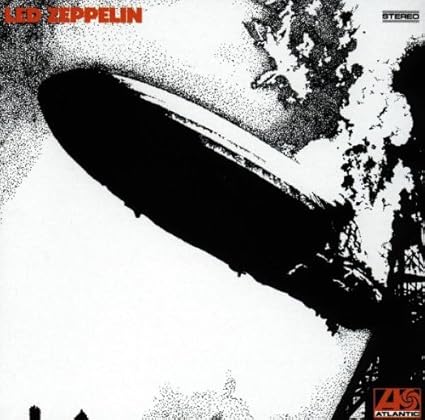
Led Zeppelin 1

Whether you mark the genesis as the death of  The Yardbirds, the Scandinavian tour by The New Yardbirds or the band’s first show under the new name, Led Zeppelin’s birth, however gradual, takes place in 1968, on way to its crowning moment, the release of the band’s self-titled debut not two weeks into the new year, January 12th of 1969.

The story arguably begins back in 1966, when Jimmy Page joined The Yardbirds, first on bass as replacement for Paul Samwell-Smith, but then switching to guitar, where he shares those duties with Jeff BeckBeck was soon to depart, in October that year, Jimmy’s thoughts wandered off to bigger things, a supergroup of sorts, while he bides his time for nearly two more years with an act proving to be somewhat directionless. The Yardbirds would play their final show, a Bedfordshire gig, in July of 1968. At this point Jimmy is already in possession of most of the riffs and song ideas he would need in his next incarnation.

“We were a vehicle for what Jimmy wanted to do when he came in,” explains Yardbirds drummer Jim McCarty. “He had a pretty free rein, as all the guitar players did and he pushed The Yardbirds sound into more of a heavy metal context. He really was the master of the riff.”

Everyone was paying attention to the band’s star axeman. Recalls Steve Lyman, of legendary Michigan rockers SRC, who caught the band just before their demise, “The first British group that I actually saw perform live was The Yardbirds, at a small club in Ann Arbor, Michigan called The Fifth Dimension. I already had two albums by The Yardbirds at that time, so it was a real thrill for me to see this British group performing live. Jimmy Page was the guitar player at the time, because The Yardbirds went through various incarnations. Eric Clapton was their first guitar player, Jeff Beck and then Jimmy Page. I was mesmerized by that Yardbirds show. I was the lead guitar player in a band The Fugitives, which became the SRC, so seeing Jimmy Page play became a real thrill for me because I had been listening to these Yardbirds records on my record player and trying to figure out what they were playing.”

But in the summer of ’68, The Yardbirds, now splitting up, but nonetheless still committed to a Scandinavian tour. A new lineup to fulfill these dates was called for. After Chris Dreja bows out to begin a career as a photographer, session stalwart John Paul Jones is recruited. In the all important vocal slot, Jimmy had wanted on the team Terry Reid, but Reid demurs, suggesting a young Birmingham singer named Robert Plant. Robert is the one who brings along local drummer and hard-hitter John Bonham. Before the new foursome would hit the road, they perform a session for the P.J. Proby album Three Week Hero. A track there called “Jim’s Blues” would live on as the band’s first session together, on the technicality that Robert is present blowing some harmonica.

Original Judas Priest vocalist Al Atkins happened to be there to watch the formation of what would be called The New Yardbirds, the makeshift name the band used to fulfil those Scandinavian dates.

“I used to know Robert,” says Atkins. “We used to go for a beer together, and sometimes he’d borrow my microphone because he couldn’t afford one, if I wasn’t playing. We had one mic between the two of us. I had the best one. And a buddy of mine, ‘Are you playing tonight?’ ‘No, oh go on.’ It was great times. Robert’s roots have always been blues. He’s a very intelligent guy when you’re talking to him about the blues stuff. He knows everything about that. You can’t argue with him about anything on that subject. But I saw him before Zeppelin, when he was playing at Henry’s Blues House and Alexis Korner was playing on his own, a solo gig he got there, like a one-man band thing or something, and Robert got up and played harmonica and sang along with him.

Image result for led zeppelin led zeppelin 1st album images

“And then with Jimmy Page, they joined The Yardbirds, went over to Europe, came back, and next thing they were called Led Zeppelin. I went to see them play at Mother’s in Erdington. They were supporting Blodwyn Pig, and I think they got 75 quid or something. But when I saw him with Jimmy onstage that night I was totally blown away. And Bonham was absolutely out of his head. He was drunk, I think. And they did a set, and it was very mixed, including a lot of stuff that was going to be coming on the new album. They were loud, but they were brilliant. Robert’s voice had just changed overnight. I couldn’t believe the difference in his voice. Fantastic vocalist. And yeah, John Bonham, he couldn’t come back onstage. They did the encore and the drummer from Blodwyn Pig came on and played this blues thing with them and they just jammed the encore. The good ol’ days.”

Jimmy had made his mind up that they were going to blow everyone off the stage,” adds (now deceased) engineer Andy Johns, soon to be working closely with the band. “That’s what my brother told me. This is when Jimmy still had The Yardbirds thing going. Glyn said, ‘I was with Jimmy the other day, and Jimmy said, I’ve got this new lineup now, and we’re going to blow everyone offstage.’ So that was an intentional thing, to be as dramatic and as riff-conscious as possible. And Jimmy was a fabulous writer, and had a lot of great ideas in the studio, and was just wonderful to work with.”

But in August of 1968, even before the band’s dates in Scandinavia, Jimmy’s Yardbirds mate Jeff Beck would release his album Truth, which many a rock historian debate as the blueprint for what Led Zeppelin would become.

“Well, it was right around the same time,” explains Zeppelin bassist John Paul Jones. “I was on that Jeff Beck album and Jimmy was with The Yardbirds at the time, so my influence on the Jeff Beck album would probably be similar to my influence on the Led Zeppelin album, just like Jimmy. I don’t know, I suppose. You can come to the same conclusion with any number of blues-based rock bands. But it soon took off from there. Most of the songs we had done on the first album had been done by Jimmy and The Yardbirds as well. It was only things like “Good Times Bad Times,” which was a riff I brought in, that I wrote in the studio. That’s got John’s famous drum part, of course. John never used double bass. He did in fact bring in a double bass drum for rehearsal, and we played a couple of songs with it, but then we hid it when he went for lunch. When he came back it was gone.”

“We loved Zeppelin,” says Nazareth guitarist Manny Charlton, also there to watch the band being born. “They were just an extension to what was going on with the guitar bands like The Who, on from The Beatles. It went from The Beatles to The Who and then into that blues boom thing, with the Jeff Beck Group. The Yardbirds and Cream, really, initially, we were doing the electric blues thing. The Yardbirds moved from that blues thing to another area, where they kept the same sound but they started writing what you would call riffs, and in some cases, like pop songs. A pop song but played with that power-trio lineup. Because initially when Cream started, they were doing ‘I Feel Free’ and stuff like that, basically writing pop songs to get away from the blues, to get away from ‘You Shook Me.’ But the Jeff Beck Group took it to another level, and then Led Zeppelin obviously did as well. But their first album was basically electric blues songs.”

Into the fall, The New Yardbirds would play their first date, September 7th, 1968, at the Gladsaxe Teen Club in Gladsaxe, Denmark, following up with another 10 days around Scandinavia. Significantly, the band have in their set  “Communication Breakdown,” which is recorded as soon as the band get back, in October of that year. It’s a small thing, but one might also call the recording of this bedrock Zeppelin track as the birth of the band. Indeed the song is a step up in intensity, away from other songs in the set at this time such as “Hush,” “The Hunter,” “Somethin’ Else” and “Train Kept A-Rollin’.”

In any event, 1968, as it pertains to the birth of the band, is next marked by the first show on British soil, October 4th at the Mayfair Ballroom, Newcastle upon Tyne. Conducting a brief British tour, the next benchmark is the band’s first show under the new name — Chris Dreja had issued a cease and desist order on the use of The Yardbirds moniker — on October 25th, at the University of Surrey in Battersea. And for the record, as the story goes, the band chose for its new title Led Zeppelin, because John Entwistle had suggested to Jimmy that his new “supergroup” would go down like a lead balloon. Into November, rough and tough manager of the band Peter Grant negotiates a $143,000 advance for his boys from Atlantic Records and the hype machine lurches into operation, never to wane across a full decade of dominance.

“We didn’t move into a style; I think we kind of created it,” muses John Paul Jones, on what the band brought into being over the nine-day burst of creativity in late 1968 that would result in the band’s debut album. “And if you would have asked me in 1969, as people did, what sort of band I was in, I would have said a progressive rock band. But then that became to mean something else. There you go banging up against categories again. That came to mean something else entirely. And then it was just sort of like blues rock, because the band was quite blues-orientated. And it was just the style, the way the members of the band played together. But in terms of actual riffs, well, anything with notes, lots of notes, like ‘Black Dog,’ ‘Good Times Bad Times’… those were my riffs. And anything that was kind of lurchy and chordy were Page’s riffs. That’s how you tell them apart.”

Related image

The impact of the band’s first album would be felt far and wide. “Led Zeppelin had just come out,” remembers Blue Cheer’s Randy Holden. “They were doing something entirely different. I went to see them at their gig at the Whisky, which was their first gig in California as far as I know. I liked their album; I thought they got a really heavy sound on the album, but then live they used these Rickenbackers and they’re the most god-awful sounding amps I ever heard, which really surprised me. But the record really came off great.”

Deep Purple bassist Roger Glover, “Led Zeppelin influenced me a lot because I was in a pop group called Episode Six and we were trying to get heavier and weren’t making it because we were just playing the same music but louder. When the album first came out, you could tell it wasn’t the loudness so much as a feeling, what you felt about the music rather than how they played it. Episode Six, as we were, weren’t the right combination of people to be heavy, and I gradually gained the impression that heavy music wasn’t for me because I didn’t like what we were playing — loud pop music. And I decided for a time to go into folk music. I’ve never been so struck by an album as I was by Led Zeppelin. It really left me open-mouthed. What they were playing was very simple stuff, loud and exciting, and it moved me. I suddenly wanted to be in a club playing that music — loud, straightforward, with simple guts. And by pure coincidence, just about that time I was offered a job with Deep Purple! But for Zeppelin, I might never have been in Deep Purple.

“I remember Jimmy played me the first Led Zeppelin album,” chuckles Yardbirds drummer Jim McCarty. “There was ‘Dazed and Confused’ and there was a Howlin’ Wolf-type thing, ‘How Many More Times” which is very similar to the stuff we’d been playing; it was similar to ‘Smokestack Lightnin’,’ I thought. And then there was another one which was similar. It was very well done, the first Zeppelin album; I thought it was very good. You can see the links, how easy it was to go from us to them.”

And like so many others that were there to bear witness to the birth of this great band, Foreigner guitarist Mick Jones had also found himself impressed with what Jimmy had put together. “At the time, I was cutting my teeth in France,” explains Jones. “Don’t ask me how, but I’d become sort of the musical director and producer of Johnny Hallyday, who you’ve probably heard of. He was sort of the French Elvis, as it were. And so we would go over to England to record, and we ended up with an engineer named Glyn Johns, who at that time, he worked with Steve Miller Band and later the Eagles. I think he had been working with the Eagles even before their record came out. But he had worked a lot with John Paul and Jimmy when they were session musicians.”

“And they happened to be session musicians on the stuff that I was doing for Johnny Hallyday. And so I was fully aware of who they were. And every time I was playing with Jimmy Page, he blew me away every time we went into the studio. I had so much respect for him as a guitar player. So that’s where our friendship developed. He would even come over to Paris with Glyn Johns and cut tracks over there. In fact, some of the music that we were doing with Johnny Hallyday provided the opportunity for Jimmy to work closely with Glyn Johns in preparing the first Zeppelin album. And I remember the day that Glyn took me into the studio, the back of Olympic Studios in London, and he said, ‘I’m going to play you a couple things on Jimmy’s project.’ And he sat down and played me ‘Communication Breakdown’ and it just blew me away. Just blew my mind. I couldn’t believe it. I had never heard anything as mean and powerful in my life. It just left me staggered.”

Millions across the planet were soon to feel equally staggered, but again, the groundwork and indeed so much more, was set in 1968, and really, much of it packed into the back half of the year. The breakdown in communication that caused the demise of The Yardbirds to the recording of “Communication Breakdown” takes no more than an astonishing four months, and by the end of the year, is a record that will forever change rock ‘n’ roll. Fully 50 years later, the impact of Led Zeppelin is still reverberating.

Words By Martin Popoff

Led Zeppelin Led Zeppelin - 1st [B] - Uncorrected - G vinyl LP album (LP record) UK ZEPLPLE672541

Image may contain: 4 people

Dazed and Confused” is a song written by American singer-songwriter Jake Holmes in 1967, It was described as “a stark, spooky folk-rock track with stinging reverbed lead guitar, Holmes‘ own pained vocals, and furiously strummed rhythm guitar that winds itself into an anguished climax. Holmes recorded the song for his debut album “The Above Ground Sound” of Jake Holmes and he performed it in the late 1960s and early 1970s on the New York City folk scene and the college coffee house circuit. The lyrics refer to the effects of a girl’s indecision on ending a relationship.  This version from Live Supershow 1969 .

In August 1967, Holmes opened for the Yardbirds at a Greenwich Village gig in New York According to Holmes, “That was the infamous moment of my life when ‘Dazed and Confused’ fell into the loving arms and hands of Jimmy Page.” When the track appeared on Led Zeppelin’s eponymous debut album in 1969, Holmes was aware of it at the time, but didn’t follow up on it: “In the early 1980s, I did write them a letter and I said basically: ‘I understand it’s a collaborative effort, but I think you should give me credit at least and some remuneration.’ But they never contacted me.

After hearing Holmes perform the song in 1967, English rock group the Yardbirds reworked it with a new arrangement. It became a centerpiece of the group’s tours in 1968, several recordings of which have been released. “Dazed and Confused” was further adapted later that year by Yardbirds guitarist Jimmy Page’s “New Yardbirds” group (soon to be rechristened Led Zeppelin) for their debut album, Led Zeppelin“Dazed and Confused” became a concert staple with solos that sometimes stretched the performances to 45 minutes.

When the Yardbirds disbanded in 1968, Page planned to record the song in the studio with the successor group he had assembled that summer. According to Zeppelin bassist John Paul Jones, the first time he heard the song was at the band’s first rehearsal session at Gerrard Street in London, in 1968: “Jimmy played us the riffs at the first rehearsal and said, ‘This is a number I want us to do’.” The future Led Zeppelin recorded their version in October 1968 at Olympic Studios, London, and the song was included on their debut album Led Zeppelin (1969). “Dazed and Confused” was the second song recorded at the Olympic sessions.

Page recorded the song in one take with a Telecaster and violin bow as he had performed it with the Yardbirds.  Singer Robert Plant wrote a new set of bluesier lyrics, according to Page though Plant is not credited on the album. Other sources say Page wrote the new lyrics himself. Whichever the case may be, Plant’s vocal is raw and powerful, delivered with “unrelenting passion.”Other than the lyrics and vocal, the song remained very similar to that performed by the Yardbirds earlier that year.

This bolt of lightning likewise illuminates the already thick and portentous soundscape further setting a tone for the impending sonic onslaught. John Bonham (drums) sneaks in with a rock solid downbeat beneath Plant’s opening line. During the bridge [Bonham] explodes front and centre with his trademark blend of keen rhythmic gymnastics and straight-ahead swinging percussive support. The band collectively combust throughout the remainder of the cut as they alternate between scintillating and scorching.”

Led Zep RSD 2018 cover

Limited Edition 7-Inch Single, Produced By Jimmy Page, To Be Released On Record Store Day Featuring Unreleased Versions Of “Rock And Roll” And “Friends”

Led Zeppelin are releasing something special for Record Store Day. Before the legendary band kicks off its 50th anniversary celebration this September, a special 7-inch vinyl single will arrive at independent record stores everywhere on April 21st from Atlantic Records and Rhino.  The single, pressed on yellow vinyl, will premiere two previously unreleased studio mixes: the Sunset Sound Mix of “Rock and Roll” b/w the Olympic Studios Mix of “Friends.”  Both of these tracks have been selected for this release by producer Jimmy Page.

“Rock and Roll” is only the third track released from the fabled Sunset Sound Mixes of Led Zeppelin IV.  The studio mix of “When the Levee Breaks” actually made the original album, while the mix of “Stairway to Heaven” was included on the 2014 Deluxe Edition.  The Olympic Studios Mix of “Friends” is described by the label as a “stripped-down version without the orchestration of the final mix, offering a true fly-on-the-wall feel from the band’s recording sessions for Led Zeppelin III at Headley Grange.”

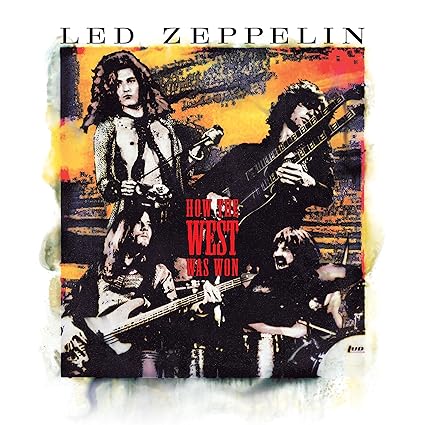
This limited edition single will follow the release of the remastered How the West Was Won in multiple formats on March 23rd including the first ever vinyl and Blu-ray Audio editions (with the Blu-ray containing hi-res 5.1 surround sound). The live album features performances from Led Zeppelin’s landmark California concerts at the Los Angeles Forum and Long Beach Arena on June 25th and 27th, 1972, as sequenced to replicate one entire concert.

How The West Was Won (3CD/4LP/1DVD)

Led Zeppelin are undoubtedly one of the greatest live acts of the 1970s, but their only live album from the era — the soundtrack to 1976’s The Song Remains The Same — captured them on a rather limp night. This situation was finally resolved in 2003 when Jimmy Page combed through hours of tapes from the band’s 1972 tour and cobbled together this killer 18 track set. There are tons of Zeppelin bootlegs floating around, but none of them sound this crisp and alive, even though they occasionally cheated and combined multiple versions of a song into one. Highlights include a ferocious “Immigrant Song,” a 25-minute “Dazed and Confused” and a 23-minute “Whole Lotta Love” jam. “It’s Zeppelin at its best,” Page said in 2003. “Every single member of the band is in tip-top form. It’s the magic point where it takes on a fifth element.”

Fifteen years ago, Led Zeppelin issued How the West Was Won, premiering performances from the band’s June 25th and 27th, 1972 concerts at the Los Angeles Forum and Long Beach Arena.  Now, those seminal tracks have been newly remastered under the supervision of Jimmy Page for a surprise addition to the band’s Super Deluxe library – as well as in a variety of formats, all of which are due from Atlantic/Swan Song on March 23rd including the first-ever Blu-ray Audio and vinyl editions.  The remastered How the West Was Won arrives in advance of the band’s official 50th anniversary celebration, which will kick off this September.

How the West Was Won (a No. 1 album in the U.S. and a No. 5 in the U.K.) sequenced material from the Los Angeles and Long Beach concerts to replicate a single concert from start to finish as the band introduced songs from its then-unreleased fifth album, Houses of the Holy (which would be released nine months later), and looked back on its already-storied catalogue.  Among its 18 tracks are a 25-minute version of “Dazed and Confused,” a 21-minute blues medley built around “Whole Lotta Love,” and fiery takes on “Rock and Roll,” “Moby Dick,” “Immigrant Song,” “Black Dog,” and of course, “Stairway to Heaven.”

https://www.youtube.com/watch?v=X4geAf_rHx4

The remastered How the West Was Won will be available in the following versions:

  • CD – Remastered audio on three CDs;
  • Vinyl – Remastered audio on four 180-gram vinyl LPs;
  • Blu-Ray Audio – 96kHz/24 bit 5.1 (DTS-HD Master Audio Surround) and stereo mixes (PCM Stereo and DTS-HD Master Audio Stereo);
  • Streaming & Digital Download – Remastered audio; and
  • Super Deluxe Boxed Set:

o Remastered audio on three CDs and four 180-gram vinyl LPs.
o DVD of album in Dolby Digital 5.1 Surround and PCM Stereo, plus photo gallery.
o High-def download card of all stereo audio content at 96kHz/24 bit.
o A book filled with rare and previously unpublished photos of the band at each of the concert locations, plus memorabilia and ephemera.
o High-quality print of the original album cover, the first 30,000 of which will be individually numbered.

Look for all formats from Atlantic/Swan Song on March 23rd, and watch this space for information on further Led Zeppelin releases as the band’s  50th anniversary approaches!

Led Zeppelin, How the West Was Won (Atlantic/Swan Song 83587-2, 2003 – reissued 2018)

Day on the Green

Led Zeppelin’s eleventh—and final—American jaunt was in support of their seventh studio album, Presence ..

The 1977 tour was plagued by unfortunate incidents, with the most notorious occurrences taking place backstage at one of the last shows and a most tragic event bringing an end to the outing.

The vibes were bad before they even played a single gig. Large, menacing manager Peter Grant had recently gone through a nasty divorce, while guitarist Jimmy Page was incredibly thin, reportedly in the throes of heroin addiction. Throughout the tour, police had to be brought in to quell audience violence, culminating in a riot in Tampa; nineteen were arrested, 50 were injured. At multiple stops, a new crop of younger, wilder fans threw lit firecrackers on the stage, which would explode inches from the band members. During a Cincinnati show, a fan died after falling from the third level of the coliseum—the first tragic event of the tour. The trek was to run for three legs of dates from April through August. For the final leg, eleven stadium shows were scheduled. The band only played four of them.

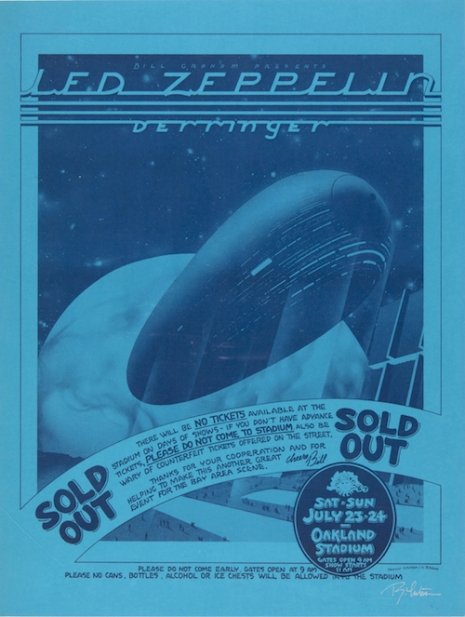
On July 23rd and 24th, Zeppelin performed in front of sell-out crowds at Oakland Coliseum. Rick Derringer and Judas Priest opened. The shows were part of the recurring “Day on the Green” concerts organized by Bill Graham. The stage set was constructed to resemble the Stonehenge monument, and was likely the main inspiration for one of the funniest moments in the brilliant mockumentary, This Is Spinal Tap    (and before you say, “But what about…,” we debunked the theory that Black Sabbath’s Stonehenge stage influenced the film).
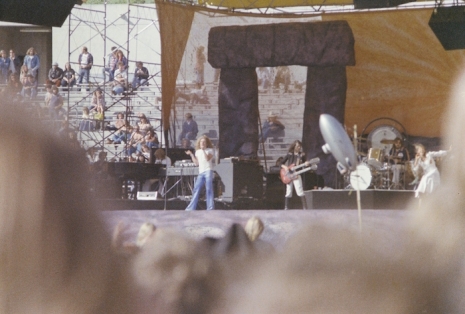
Led Zeppelin

Two nasty backstage episodes took place on the 23rd. The first happened when Peter Grant was asked by a member of Graham’s crew if he needed help getting down some stairs, which Grant perceived as a slight on his weight. John Bindon, a London gangster brought on by Zep as their chief enforcer for the tour, stepped in and knocked out the stagehand, who banged his head on the concrete floor. Later, Grant’s teenage son was about to remove a temporary sign to keep as a souvenir, but was sternly rebuffed by a member of Graham’s security team. This prompted drummer John Bonham to kick the guy in the balls, and then Grant and Bindon beat the man so badly that a shocked Graham had him rushed to the hospital. Graham also claimed that his production manager was hit on the head with a lead pipe.

 On the 24th, Graham’s security were looking for revenge, yet the show concluded without further incident. The following day at the band’s hotel, the SWAT team showed up and arrested Bonham, Grant, Bindon and tour manager, Richard Cole, who were charged with assault. After they were bailed out, the Zep entourage flew to New Orleans for the next show. Once they were settled in, Plant received a call from his wife and learned that his young son, Karac, had died suddenly on the 24th. Plant immediately flew home to England. Led Zeppelin would never play stateside again.

Footage from the July 23rd gig is available online. This first video appears to be professionally filmed, and was perhaps meant as B-roll for a TV news piece. The first note of the Zeppelin show is heard at the 5:55 mark. At 6:10, the camera zooms in for a closer look at the band and the Stonehenge stage set.

thanks dangerousminds.net

Atlantic

On November. 8th, 1971, Led Zeppelin released their fourth album. There was no title printed on the album, so it is usually referred to as Led Zeppelin IV, following the naming sequence used by the band’s first three studio albums. The album has alternatively been referred to as , Four Symbols, The Fourth Album (those two titles each having been used in the Atlantic catalogue), Untitled, Runes, The Hermit, and ZoSo, the latter of which is derived from the symbol used by Jimmy Page for the album sleeve. Page often had the ZoSo symbol embroidered on his clothes.

The album contains many of the band’s most famous songs, including “Black Dog”, “Rock and Roll”, “Going to California” and the band’s signature song, “Stairway to Heaven”, Led Zeppelin IV was a commercial and critical success. The album is one of the best-selling albums worldwide

To celebrate its 46th birthday of Led Zeppelin‘s masterful fourth album, which of its songs are the best and worst,
there’s hardly a wasted track on the fourth album release. Is it the best rock ‘n’ roll record ever made and, at the same time, not even the best Zeppelin album, Its amazing, emblematic of the band, but not their best work.
Maybe the ultimate testament to Led Zeppelin’s greatness is that an album as colossal and widely worshiped as IV actually has three or four legitimate challengers for “Best Album” within their amazing catalog. But if IV is not their best for groundbreaking reasons, Its influential, mould-setting reasons then whichever of Led Zeppelin’s first seven albums is playing on your stereo right now is the best record that’s ever been made. But I’d give IV the silver medal and save the gold for Physical Graffiti, which has even more range, weight and sophistication.

The best song on the album?
It changes all the time. The opening rush of “Black Dog” is one hell of a way to kick off an album, and “Stairway to Heaven” is such an expertly structured song. But “When the Levee Breaks” is the one that most often has me turning up the volume. Those drums!
“Stairway to Heaven.” has become synonymous with Led Zeppelin you’ll find it’s astounding. Also, like the album itself, it’s emblematic of the band. It shows off what they do best:: creepy, Celtic folk, cryptic lyrics paired with haunting vocals, a bombastic crescendo with evil blues guitar and drum fills that define perfection. That said, the first 10 seconds of “Four Sticks” is probably the best thing they’ve ever done. that said, the first minute of “When the Levee Breaks” is probably the best thing they’ve ever done. which closes the LP with so much power and atmosphere, and maybe the heaviest drum sound ever captured, from the bottom of that stairwell at Headley Grange. I suppose, too, because it’s fundamentally a blues, it can represent Led Zeppelin’s musical bedrock in its most epic form , “Black Dog.” So powerful, so sexy, so smart. We’ve all read about the hard work and creative genius that went into making the song work, but it’s impossible to think of it as anything but purely instinctual when it’s playing.

“Four Sticks” is the only song that consistently feels sub-par when I listen to IV. The fact its named that way because Bonham played it with a pair of drumsticks in each hand doesn’t say much about the lyrics, which I’ve heard described by Jimmy Page as being abstract, and to me that sounds like another way of saying, “This was filler and we couldn’t even be bothered to tidy up the lyrics, so yeah, it’s so abstract, man.”

Led Zeppelin

The hipster record clerk at my favorite record store insisted on calling it Zoso. Atlantic Records had it listed as Four Symbols or Led Zeppelin IV. If they wanted to break the pattern established by the numerical naming of their first three albums, they should have given it an actual title. it’s perfectly acceptable to occasionally and judiciously refer to it as “Zep IV.”

Image may contain: 1 person, night

Robert Plant releases Carry Fire, his 11th solo album on Nonesuch Records. The self-produced album is Plant’s first since since 2014’s lullaby and…The Ceaseless Roar. As with that record, Robert is accompanied here by The Sensational Space Shifters, along with some guests, such as Chrissie Hynde and Seth Lakeman.

Robert Plant’s “Bones of Saints” from his 2017 album, Carry Fire, released 13th October.

Led Zep The Destroyer 4LP yel

Audience recording from the Richfield Coliseum in Cleveland Ohio, on April 28th 1977. limited edition of a tape close to being excellent, virtually free of hiss, trebly and overloaded at times. The tape shows wear occasionally and presents cuts and edits almost in its entirety. The band is upfront and the clarity of the instruments is very detailed, the bass is a little indistinct at the end. The cuts and edits eliminate most of Plant’s comments, miss the first few seconds of many songs, cause tape disturbances when the recording resumes and interrupt two tracks in progress. Before Nobody’s Fault the taper curses as he informs he is having problems, a squeal precedes the first cut, when the recording resumes the first few guitar notes are missing.

4-28-77-tkt

In My Time is cut briefly in the final vocal a cappella and joined to the last phrase of You Shook Me. No Quaaludes, as introduced by Plant, is cut during the second vocal theme and joined to a couple of seconds of the wha-ed guitar episode, and finally cuts out. Audience noise is minimal, a wise guy is introducing the songs to his mate! s before Plant, an irreverent yell of “this sucks!” in Over the Top ,and the taper cursing again in Stairway; there’s some mumbling in the quiet moments, but nothing really annoying. This is a superb gig, the pacing and playing, together with the very enjoyable recording, make for a listening treat. Page is precise, concise and powerful; Jonesy is all over the place; Plant’s vocal gymnastics are strong from the beginning to the end and seems genuinely touched by the audience’s response; Bonzo is frightening, he seems to destroy the drum kit in every track, the recording captures particularly well his crushing presence. Collectively is the same story, the enthusiasm does not let up a minute, every piece receives special attention and there are no lazy moments. In My Time features great introductory licks to the guitar leads; No Quarter features amazing interplay and Jonesy’s most inspired piano playing. Ten Years is overloaded by the loud twelve-string and cymbals, Achilles by the drums, even distorting the tape, but both are very clear. Tape wear is evident in Over the Top, Kashmir and Stairway; there’s a little distortion in the encores: Rock and Roll, Trampled. Despite these deficiencies, the performance is not affected at all and allows its enjoyment. This show should restore the faith to detractors of this era. 

Led Zep The Destroyer spine

The tape for Zeppelin’s second night in Cleveland is one of the strangest.  The tapers were located a ways from the stage, they were experiencing problems with their equipment, and he and his friends were not shy about expressing their opinions throughout the entire show.  It is also obvious one of his friends attended the previous evening’s concert and liked to tell the others which song is coming next.  Despite these obstacles this is considered one of, if not the best, audience document outside of the tapes for Los Angeles.  Its reputation is due to it being very clear and powerful.  Zeppelin was the perfect band to use the Richfield Coliseum’s questionable acoustics to their advantage and the result sounds like battery artillery storming the beachhead to the delight of a packed house.

https://www.youtube.com/watch?v=_FLgsVzQixI

This tape has been known as The Destroyer since it was released shortly after the event [I believe it might have been as much as a year later or more].  It was first released as a vinyl box set on the Smilin’ Ears Records label complete with the famous painting of the warriors huddled on top of one another.” [collectorsmusicreviews.com]

Recorded 28th-Apr-77 Cleveland, The Second Night

Audience recording from the second night at Richfield Coliseum in Cleveland, OH – 28th April 1977 apparently one of the best performances on the whole tour. Released in 1978; originally sold for $22 via the Pied Piper bootleg catalog.

THE DESTROYER
SMILIN’ EARS 77-300
Side 1: The Song Remains The Same – Sick Again (14:11)/ Nobody’s Fault But Mine (5:36)
Side 2: Since I’ve Been Loving You (17:24)
Side 3: Guitar Solo medley incl. The Star Spangled Banner – Achilles Last Stand (18:21)
Side 4: White Summer medley incl. Black Mountain Side – Kashmir (15:31)
Side 5: Ten Years Gone (8:56)/The Battle Of Evermore (5:25)/ Going To California (4:19)
Side 6: Black Country Woman medley incl. Bron-Yr-Aur Stomp (7:00)/ Trampled Underfoot (6:19)/ Rock & Roll (3:54)
Side 7: Kashmir (17:13)
Side 8: Over The Top medley incl. Out On The Tiles/ Moby Dick (16:25)
Recording: Very good mono audience. Taped on platform usually used for television camera for sports broadcasts. “All the cuts exist for two reasons: the taper was trying to save tape, and the recording was done on 60 minute (30mins per side) cassettes. ”  Comments: Deluxe box set. Two different covers. Two audience sources exist for this date.

Master tape in detail:
01. The Song Remains The Same (beginning cut) 03:44
02. Sick Again 07:05
03. Nobody’s Fault But Mine 07:17
04. In My Time Of Dying 11:37
05. Since I’ve Been Loving You 09:43
06. No Quarter (cut at 05:07) 20:45
07. Ten Years Gone 10:05
08. The Battle Of Evermore 06:27
09. Going To California 05:14
10. Black Country Woman 01:42
11. Bron-Y-Aur Stomp 05:42
12. White Summer (cut at 00:29) 03:45
13. Black Mountain Side 01:34
14. Kashmir 09:34
15. Over The Top 17:26
16. Noise Solo (cut at 10:06) 10:10
17. Achilles Last Stand 10:28
18. Stairway To Heaven 11:44
19. Rock And Roll(beginning cut) 04:12
20. Trampled Underfoot 06:59