Posts Tagged ‘Johnny Thunders’

Left us on this day (April 23rd) in 1991: American rock’n’roll/punk rock guitarist, singer & songwriter Johnny Thunders (believed to be drug-related causes, age 38), who came to prominence as a founding guitar player of influential, proto-punk band, The New York Dolls (1971-75); born John Anthony Genzale, Jr., he renamed himself after a comic book of the same name; the Dolls released the seminal albums ‘New York Dolls’ (1973) & ‘Too Much Too Soon’ (1974); Johnny left & formed The Heartbreakers in 1975, recording on & off until 1984 (including the essential 1977 album ‘L.A.M.F.’); he also recorded solo, including the 1978 considered classic LP ‘So Alone’, featuring a rock & punk celebrity cast & arguably his greatest composition, “You Can’t Put Your Arms Around A Memory”; he also formed Gang of War with MC5’s Wayne Kramer for one album in 1990; his final recording was a version of “Born To Lose”, with German punk rock band Die Toten Hosen less than two days before his passing in New Orleans; in 1999, veteran documentary filmmaker Lech Kowalski released ‘Born To Lose: The Last Rock ‘N’ Roll Movie’; Danny Garcia’s featured documentary, ‘Looking for Johnny’, was released in 2014…

My admiration of Johnny Thunders stems from my huge love of his tenure with the New York Dolls and The Heartbreakers. I’ve just started listening to his solo catalogue again. And I started off with what are identified as his three true studio albums, “So Alone”, “Que Sera Sera”, and “Copy Cats”. Does anyone recommend listening to specific other releases of his that are floating around out there? There are so many titles live albums, compilations, bootlegs, Love to get your recommendations please.

“DTK live at the Speakeasy” often included in some LAMF reissues. “Live at the Village Gate” is good. If you can get your hands on one, “LAMF Heartbreakers definitive edition” box CD set. It includes 4 CD’s (and badges!), LAMF lost ’77 mixes, LAMF the restored Track LP, LAMF demo sessions ’76, ’77, LAMF alternative mixes (21 in total for that disc), deluxe booklet by Nina Antonia including a comprehensive interview with Walter Lure. You should still be able to find one on EBay probably. “Belfast nights” has pretty good sound quality. “The Yonkers demos” often included in some comps. “Madrid memory”, “The Heartbreakers live at Max’s” great sound quality. Walter Lure’s Waldos have a couple CD’s “Rent Party” and the still pretty new “Wacka Lacka Loom Bop A Loom Bam Boo” on Cleopatra Records.

‘Johnny Thunder lives on water, feeds on lightning.
Johnny Thunder don’t need no one, don’t want money.
And all the people of the town, They can’t get through to Johnny, they will never, ever break him down.
Johnny Thunder speaks for no one, goes on fighting.
And sweet Helena in bed prays for Johnny.’
“Johnny Thunder”—R. Davies

In the late summer of 1980, the remains of what was Giant Sandworms went in an exhaustive road trip to find our place in NYC’s post-punk rock whirlpool of unsigned bands. We were unprepared for this mythic belly flop into the catacombs of both the Lower East Side and the herculean task of day-to-day advancement of spinning our wheels just to play CBGB for 16 people, 15 of them being our friends.

New York City was a harsh, smelly, tinderbox of sorts. The Hell’s Angels block on First Avenue and Third Street held an obit on the west side of the street, sprayed on the brick wall in memory of Big Vinny “When in doubt, knock ’em out.” .The building was like any other building in 1981, serving as Alphabet City’s 24/7 narcotics market and shooting galleries. It wasn’t always a pleasant interaction and even Johnny Thunders was just another mark.

Back then, everybody had a story about Johnny Thunders, everybody. Way back in the early ’70s, rock had become listless. With a few exceptions, groups made the same record again and again, then a live album, with audience applause engineered to sound like panzer divisions. But the onset of change would begin in small camps, garages, and basements, by like-minded kids that didn’t fit. New York City had become dangerous, abandoned and for the taking. Beneath the Brill building, Warhol’s Factory, Manny’s Music (“try it, you buy it”), record companies furnished with mahogany and leather and maybe a faint trace of Birdland and, more recently, The Fillmore, offered up stagnation. The industry and its product were stamped in Billboard Magazine, in self-congratulatory pages, while raw, young talent went unfostered. It became near impossible to break into the machinations of this music machine.

In 1973, one band The New York Dolls almost got through. They were representing their city with driving blues rock, and hard-luck tales of youth punching back at the disorder of war, technology, urban renewal and the luckless stars of a time where nothing was forbidden. It was unapologetic, dirty, loud, and fast. The cover of their debut album found the quintet in full drag and unwashed long hair with more swagger than the Rolling Stones could muster on their best night.

Todd Rundgren produced it and it sounded as they did—no whiteout on this term paper. David Johansen was a lead singer with the goods. Lead guitarist, Johnny Thunders’ sound was driven, mangy, loud, and original. “Trash,” “Vietnamese Baby,” and “Subway Train” were unforgettable titles. There would’ve been no Sex Pistols without them and that’s just for starters. It was pure from-the-streets commentary on the times.

CREEM magazine awarded the Dolls the No. 1 best new band and No. 1 worst band in their yearly poll in 1973. Love ’em or hate ’em, they made a huge impression. The record peaked at paltry No. 119 on the Billboard album chart , and they toured in the U.S. supporting Mott The Hoople and went back to London for a short tour as well. They could inspire from an audience a chorus of boos, or offer truly compelling performances that left people gasping, saying it was the best rock show of their lives.

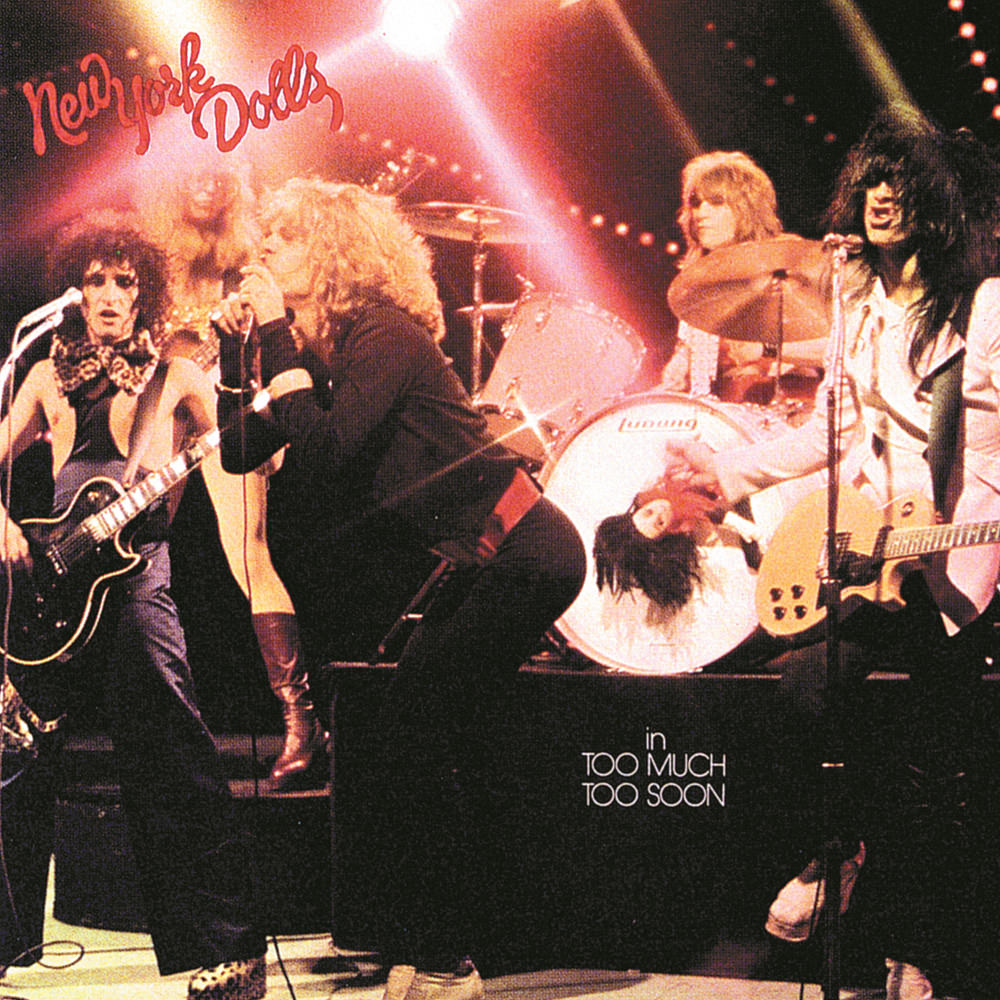
The band was schizophrenic and the media found them authentic if nothing else. Bowie had referenced Billy Murcia in song (“Time” from Aladin Sane), the original Dolls drummer who OD’d in a London bathtub in ’72 just before the band signed to Mercury. By ’74 the quintet made Too Much Too Soon with Shangri-Las’ producer Shadow Morton. It held “Babylon,” “Human Being,” and Thunders’ first lead vocal on “Chatterbox.” It was camp but cool, choosing mostly great covers like Philadelphia’s “Gamble and Huff” and Sonny Boy Williamson’s “Don’t Start Me Talking.” Record sales were even worse than the first outing, and the tours were hampered by bassist Arthur ‘Killer’ Kane’s alcoholism and the heroin habits of Thunders’ and drummer Jerry Nolan. Infighting and a lack of new material found them waning, they dropped by Mercury.

In ’75, Thunders and Nolan quit the band. But along with the MC5, The Stooges, and The Dictators, the Dolls were the American precursor to a punk-rock movement that found its place in every city young, reckless, and hungry.

Johnny Thunders forms The Heartbreakers, Thunders might have been without a band or a steady gig for a week before he formed The Heartbreakers, which, for a downtown minute, included Richard Hell. But the group would be ex-Doll Jerry Nolan, guitarist Walter Lure, and Billy Rath on bass. They worked and developed a devil-may-care harder rock sound and, planned or not, they were synonymous with heroin. You wouldn’t find The Heartbreakers pictured with Nancy Reagan’s “Just Say No to Drugs” slogan above their heads. What I did see on every other pole and telephone booth after moving to New York City with a post-Heartbreakers pic of Johnny sideways in a hat, syringe sticking out of the brim, pimping his next show, trading street cred for self-parody by 1982.

The Heartbreakers played around New York and then overseas as be part of the historic Sex Pistols’ Anarchy Tour. Four dates in and things imploded. London was not used to a group like this, unafraid to play a guitar solo, yanks dressed big-city junkie cool with enough ego and stage presence to be long remembered. They stayed and recorded the record L.A.M.F. , a very good journal of a rock & roll band with antisocial bravado and American conceit and big dirt-sugar pop hooks. But the record was muddy and poorly mixed and has by now a remixed version or two, but you don’t get them when you need them and Nolan left the band because of it.

They became an apparition of sorts, who would through the years get back together for a payday, but in their time, they were the house band at Max’s Kansas City and took on all contenders. (Their swagger-y ’79 live album, Live at Max’s Kansas City, smokes).

Thunders stayed in London and the next year put out his debut record “So Alone”, one of ’78’s best by anyone. He had Paul Cook and Steve Jones hot to play from The Pistols’ demise and Thin Lizzy’s Phil Lynott on bass, some Peter Perrett (Only Ones) on guitar, and it opens on a cover of The Chantays’ “Pipeline” and it don’t quit. The ultimate in blood-on-the-page ballads is “You Can’t Put Your Arms Around a Memory” and covers Otis Blackwell II’s “Daddy Rolling Stone” with Thunders on the first verse, Lynott emotive second, and Steve Marriott, the white blues-boogie screamer, who turns the final verse into sulfur, striking fire, holding nothing back.

The studio is said to have been an all-day and all-night den of vice and electricity, where all involved saw a success in its making and a fortune cookie that read “Your Time is Nigh.” So Alone was helmed by a young (pre-U2) Steve Lillywhite. It earned some good press on both continents, sold better than expected and is a rock ‘n’ roller’s album. Johnny’s vocals were as good as they got and his playing was tough, sincere and even tender. It has aged well. But and he never hit that high again. In fact, all three of the voices heard in “Daddy Rolling Stone,” would be dead within a decade.

After returning to the States, Thunders became more difficult, more undisciplined, and toured to survive and make his bones with mostly sub-par bands, or worse. Thunders and Wayne Kramer were in that storied, short-lived combo Gang War. The few songs I’d heard were reggae influenced, but with no real direction. The band was more like a ghetto timeshare for two very talented men. It was a project that brought no record deal and no new respect for the future rock ‘n’ roll legends. Lots of time-wasting though.

Fighting with his band, fighting with his roadies, and with the audience. Trolling the faces to call down: “hey douchebag, pussy, come suck me off!” as if he was waiting on something or someone to take the weight off, to just be John again, or someone else completely. The shows might have been sloppy the first week, but you end up floating downstream letting a last power chord float when he didn’t know the bridge or when the band did one out of thin air he didn’t know. Thunders would look back, frown, turn up a notch before doing standards like “Can’t Kick,” “Chinese Rocks” or a cover he still found a friend in.

May be an image of 4 people, people standing, people playing musical instruments and guitar

IMG_2112

By the early 1970s, the New York Dolls were taking Punk attitudes and music in a new direction, albeit with a healthy dose of Glam. They played their first gig in late 1971 and, having secured a support slot with Rod Stewart in London early the following year, they signed to Mercury Records before going on to become one of the most influential groups on the New York scene; the Punk Rock capital of the world at that time. The line-up that signed to Mercury was singer, David Johansen, guitarists Johnny ‘Thunders’ and Sylvain Sylvain, bass guitarist Arthur “Killer” Kane and drummer Jerry Nolan who took over from Billy Murcia who had tragically drowned under the influence of drink and drugs.

It was a rare privilege to see the New York Dolls in their glory days in February 1974. An older good friend took us to the show at Barberellas night club in Birmingham. He was very cool dude and introduced me to lots of great music. He had long hair, was into all American bands and had took me to see my second ever gig Fairport Convention at Mothers in Erdington,

The New York Dolls gig was a wonderful treat. The show was at the Barberella’s one of Eddie Fewtrells night clubs along with the now famous Rum Runner and the much smaller venue Rebecca’s. The line outside was filled with beautiful glittery young boys in drag, glam rags and glitter on their naked, hairless chests, stardust running down their cheeks. It was a patent leather paradise! There were several really attractive transvestites all glistening and lighting up the night.  I loved the Dolls’ look; so outrageous, camp and trashy in their Glam parody, but mostly because they were still just adorable mischievous boys in make-up. And can we talk about the hair? The ozone layer’s first hole appeared in the early 70’s, all to keep some really spunky, high hairdos in place. The Dolls used more hairspray than the Ronettes!

https://www.youtube.com/watch?v=Ctg5FCS1wCM

After a newsreel montage of Hitler’s army invading France, Bob Gruen’s black & white film Lipstick Killers appeared onscreen, featuring the Dolls as glam gangsters applying lipstick in preparation for their next crime. An usher told us to move aside because the band would be coming down the aisle. Soon we had the Doll boys pushing right past us as they jumped onstage!

The unmistakable pink Dolls drum set, Jerry Nolan’s machine-gun rhythms, the simplistic yet heart-wrenching guitar solos by Johnny Thunders in his tight yellow pants and gigantic teased up hair-do, and the camp, raspy vocals of David Johansen. Three encores later, we were severely transformed, and our ears rang all the way home!.

All of the members of The New York Dolls played in New York bands before they formed in late 1971. Guitarists Johnny Thunders and Rick Rivets, bassist Arthur Kane, and drummer Billy Murcia were joined by vocalist David Johansen. Early in 1972, Rivets was replaced by Syl Sylvain and the group began playing regularly in Lower Manhattan, particularly at the Mercer Arts Center. Within a few months, they had earned a dedicated cult following, but record companies were afraid of signing The Dolls because of their cross-dressing and blatant vulgarity.

See the source image

When the New York Dolls released their debut album in 1973, they managed to be named both “Best New Band” and “Worst Band” in Creem Magazine’s annual reader’s poll, and it usually takes something special to polarize an audience like that. And the Dolls were inarguably special — decades after its release, New York Dolls debut still sounds thoroughly unique, a gritty, big-city amalgam of Stones-style R&B, hard rock guitars, lyrics that merge pulp storytelling with girl group attitude, and a sloppy but brilliant attack that would inspire punk rock. Much was made of the Dolls’ sexual ambiguity in the day, but with the passage of time, it’s a misfit swagger that communicates most strongly in these songs, and David Johansen’s vocals suggest the product of an emotional melting pot who just wants to find some lovin’ before Manhattan is gone, preferably from a woman who would prefer him over a fix. If the lyrics sometimes recall Hubert Selby, Jr. if he’d had a playful side, the music is big, raucous hard rock, basic but with a strongly distinct personality

The the noisy snarl of Johnny Thunders’ lead guitar quickly became a touchstone, and if he didn’t have a lot of tricks in his arsenal, he sure knew when and how to apply them, and the way he locked in with Syl Sylvain’s rhythm work was genius — and the Dolls made their downtown decadence sound both ominous and funny at the same time. The Dolls were smart enough to know that a band needs a great drummer, and if there’s something likably clumsy about Arthur Kane’s bass work, Jerry Nolan’s superb, elemental drumming holds the pieces in place with no-nonsense precision at all times. “Lonely Planet Boy” proved the Dolls could dial down their amps and sound very much like themselves, “Pills” was a superbly chosen cover that seemed like an original once they were done with it, “Jet Boy” was downtown rock & roll masterpiece no other band could have created. And while New York Dolls clearly came from a very specific time and place, this album still sounds fresh and hasn’t dated in the least — this is one of rock’s greatest debut albums, and a raucous statement of purpose that’s still bold and thoroughly engaging.

Besides “Personality Crisis” and “Frankenstein”, “Puss In Boots” was always one of my favourite New York Dolls songs. I envisioned it being about a rhinestone cowboy in high- heeled boots because of the lines, ‘And now you’re walkin’ just like you’re ten foot tall / Don’t ‘cha know the shoes are makin’ him lame…’ Can you picture it?! A glammed up drunken cowboy tripping on his shiny platform boots while some guy shoots at him!!! , You have to love Johnny’s intoxicated, wobbly guitar solos. It sounds like he’s tipping over on his platform shoes like the cowboy in the song – as he bends the strings just out of reach of ‘in tune’! It’s so ridiculous and beautiful at once! Johnny was such a doll!, Creem Magazine’s readers voted the Dolls simultaneously as the best AND worst new band of 1973. The band proudly declared this fact in their tour advertisement!

The debate about who inspired punk rock rages on, but the Dolls must have unwittingly been mainly partly responsible. After all, Malcolm McLaren literally molded the Sex Pistols after the New York Dolls. And the world wasn’t ready for the Pistols either! Todd Rundgren’s production of the Dolls’ debut LP gave it a slightly polished garage sound. It was exactly like John Lennon described Glam Rock; “It’s Rock n’ roll with lipstick on!”

See the source image

Their follow-up, “Too Much Too Soon”, in May 1974. It was not as well-received as their debut and the band broke up in 1975 having been dropped by Mercury Records. Do not be put off, give it a listen and you will hear they were a lot more Punk than Glam. After the clatter of their first album failed to bring them a wide audience, the New York Dolls second album produced by the legendary girl group producer George “Shadow” Morton. Although the sound of the record was relatively streamlined, “Too Much Too Soon”. The differences are apparent right from the start of the ferocious opener, “Babylon.” Not only are the guitars cleaner, but the mix is dominated by waves of studio sound effects and female backing vocals. Ironically, instead of making the Dolls sound safer, all the added frills emphasize their gleeful sleaziness and reckless sound. The Dolls sound on the verge of falling apart throughout the album, as Johnny Thunders and Syl Sylvain relentlessly trade buzz-saw riffs while David Johansen sings, shouts, and sashays on top of the racket. Band originals — including the bluesy raver “It’s Too Late,” the noisy girl-group pop of “Puss N’ Boots,” and the Thunders showcase “Chatterbox” — are rounded out by obscure R&B and rock & roll covers tailor-made for the group. Johansen vamps throughout Leiber & Stoller’s “Bad Detective,” Archie Bell’s “(There’s Gonna Be A) Showdown,” the Cadets “Stranded in the Jungle,” and Sonny Boy Williamson’s “Don’t Start Me Talkin’,” yet it’s with grit and affection  he really means it, man! The whole record collapses with the scathing “Human Being” on which a bunch of cross-dressing misfits defiantly declare that it’s OK that they want too many things, ’cause they’re human beings, just like you and me. Three years later, the Sex Pistols failed to come up with anything as musically visceral and dangerous. Perhaps that’s why the Dolls never found their audience in the early ’70s: Not only were they punk rock before punk rock was cool, but they remained weirder and more idiosyncratic than any of the bands that followed. And they rocked harder, too.

The New York Dolls created punk rock before there was a term for it. Building on the Rolling Stones‘ dirty rock & roll, Mick Jagger’s androgyny, girl-group pop, the Stooges’ anarchic noise, and the glam rock of David Bowie and T. Rex, The New York Dolls created a new form of hard rock that presaged both punk rock and heavy metal. Their drug-fuelled, shambolic performances influenced a generation of musicians in New York and London, who all went on to form punk bands. And although they self-destructed quickly, the band’s first two albums remain among the most popular cult records in rock & roll history.

https://www.youtube.com/watch?v=x9d5csMFAfE

It’s a shame that the band only made two studio albums. Their red patent leather Commie look was stunning, and a controversial third Dolls album would have been red-hot!. By the middle of 1975, Thunders and Nolan left the Dolls. The remaining members, Johansen and Sylvain, assembled a new line-up of the band. For the next two years, the duo led a variety of different incarnations of the band, to no success. In 1977, Johansen and Sylvain decided to break up the band permanently. Over the next two decades, various outtakes collections, live albums, and compilations were released by a variety of labels and The New York Dolls’ two original studio albums never went out of print. Johnny Thunders formed the Heartbreakers with Jerry Nolan after they left the group in 1975. Over the next decade, the Heartbreakers would perform sporadically and Thunders would record an occasional solo album. On April 23rd, 1991, Thunders — who was one of the more notorious drug abusers in rock & roll history died of a heroin overdose. Nolan performed at a tribute concert for Thunders later in 1991; a few months later, he died of a stroke at the age of 40.

In 2004, former Smiths vocalist Morrissey who was once the president of a British New York Dolls fan club — invited the surviving members of The New York Dolls to perform at the 2004 Meltdown Festival, a music and cultural festival that was being curated that year by the singer. To the surprise of many, David Johansen, Syl Sylvain, and Arthur Kane agreed to the gig, with Steve Conte (from Johansen’s solo band) standing in for Thunders and Gary Powell from the Libertines sitting in on drums. The group’s set was well-received by critics and fans (and was recorded for release on DVD and compact disc), which led to offers for other festival appearances, but only a few weeks after the Meltdown show, Kane checked himself into a Los Angeles hospital with what he thought was a severe case of the flu. Kane’s ailment was soon diagnosed as leukaemia, and he died only a few hours later, on July 13th, 2004, at age 55.

How wonderful that the New York Dolls re-united in June of 2004 for Morrissey’s Meltdown Festival in London. Thirty years on, and only three remaining original members, but it was still a blast. They performed “You Can’t Put Your Arms Around A Memory” for their lost comrades, not knowing that another would be gone in only a few weeks.

On his Aladdin Sane album, David Bowie sang: “Time, in quaaludes and red wine, demanding Billy Dolls and other friends of mine. Take your time…” Billy Murcia was the first to go. Then Johnny, Jerry, and Arthur (Killer) Kane. Die young, stay pretty.

It’s amazing that Johnny had nine lives and lived as long as he did, but when he died in April, 1991 at age 38 it was still a tragic shock. There was a multitude of guitar-shaped floral arrangements, banners which read, “You Can’t Put Your Arms Around A Memory” (a song Johnny co-wrote with Ralph Kramden). Poor Johnny had survived New York City and London, but met his fate in New Orleans.

The New York Dolls can be reunited every night, whenever you need to hear them, wearing tight shiny pants and boots that’s etched into my mind forever. Rock on David and Sylvain! Rest in peace Billy, Johnny, Jerry and Arthur. Take good care of each other.


From Johnny Thunders’ personal tape archive, this recording is among hundreds of live, studio and writing session tapes he stored away for safe keeping in a box simply labeled ‘Thunders Tapes’. Cleaned up and mastered, our attempt is to reveal the recordings Johnny felt worthy of keeping and to release only the best audio quality and performances that live up to his musical legacy. In the debut release, we hear Johnny and his band performing at a Swiss radio station in 1985. The digital version includes extra songs not on the vinyl.

Spectacular sound. Great set. Production note: The producers have endeavored to attribute and credit all work contained in these recordings. Any omissions brought to their attention shall be corrected in future releases.

http://

Released October 28th, 2020

From Johnny Thunders’ personal tape archive, this recording is among hundreds of live, studio and writing session tapes he stored away for safe keeping in a box simply labelled ‘Thunders Tapes’. Cleaned up and mastered, our attempt is to reveal the recordings Johnny felt worthy of keeping and to release only the best audio quality and performances that live up to his musical legacy. In the debut release, we hear Johnny and his band performing at a Swiss radio station in 1985.

http://

The digital version includes extra songs not on the vinyl. Spectacular sound. Great set. Production note: The producers have endeavored to attribute and credit all work contained in these recordings. Any omissions brought to their attention shall be corrected in future releases.

Released October 2th8, 2020

Johnny Thunders & Wayne KramerJohnny Thunders & Wayne KramerJohnny Thunders & Wayne KramerFreudlp076

The New York Dolls & MC5 guitarists collaboration! with Wayne Kramer, It’s the first time on vinyl; in a limited edition in dark red & dark yellow coloured vinyl, on 2xLP with five bonus ‘Live at Max’s’ tracks only previously available on bootleg. Johnny Thunders & Wayne Kramer’s ‘Gang War’ In 1979, Johnny Thunders, renowned band Heartbreakers and New York Dolls guitarist, teamed up with Wayne Kramer, also legendary guitarist of Detroit’s seminal MC5, to form ‘Gang War’, an alliance that lasted the best part of a year. Although Gang War released no records and without a label – at the time they were an underground act; in retrospect the collaboration is looked on as a ‘rock fantasy’ supergroup.

https://www.youtube.com/watch?v=_Q2PWcA8t4I

These live recordings bear testimony to this unique partnership between two celebrated rock guitar icons. Gang War came about shortly after Johnny released his ‘So Alone’ album, and Wayne was not long out of jail after serving two years of a sentence of four years for a coke bust. Arriving in Detroit with the Heartbreakers, Johnny met his teenage idol Wayne who jammed with them at the gig. Johnny stayed on, moving his family to Michigan and pledging his future to Gang War. They toured regularly and recorded a couple of demos with a view to getting a deal, but although there was great interest, after eight or nine months they split. On these recordings, both contribute lead vocals and guitars on Thunders and the Dolls tracks such as London Boys, Endless Party and M.I.A.; songs familiar from Kramer and MC5 such as Ramblin’ Rose and Hey Thanks, and fascinating cover versions such as These Boots Are Made For Walking and The Harder They Come.

https://www.youtube.com/watch?v=Q79IQuw-0zg

Together with the between-track repartee they also demonstrate the difference between the two – as Wayne Kramer has said: “Music is important to me and I value the honour, the opportunity, to be an important musician. Johnny, on the other hand didn’t consider himself a musician. He considered himself an entertainer.”

“The only heroic rule is to be alone, alone, alone…” – Cesare Pavese

“What did Johnny Thunder’s guitar sound like? It was the sound of the…incommensurable.” – Rene Ricard

The music on So Alone is the color of black hair; it is the sound of machines being manipulated by addicts and criminals under conditions of destitution. All love is wretchedness. We listen to rock and roll to escape the terror of history, to escape its fragmentations and ceaseless changes. Johnny’s music does not impart anything approaching ‘truth’ but instead offers a profound sense of the ‘Real’ – the morbid, the uncontrollable, the unwholesome.

Let us dispense with a detailed list of who played what, where and what a toxicology report of each of the (at the time) living bodies might have revealed. All rock music is palimpsest just as is ‘rock journalism’, with its endless recitation of the same words and events. It would be a waste of time to illustrate this point by citing fact after banal fact, so let’s instead simply attempt to situate Johnny in a different milieu, a different light.

Johnny Thunders, like many rock musicians – of a certain, perhaps vanishing ilk – was a consummate sufferer; he cultivated the deepest level of suffering and picked the perfect career to exploit it. A surface examination of this statement would seem easy to confirm. He was a junkie who wasted every opportunity that came his way. A man in revolt, he lived in a permanent state of bad faith. Ignored, of course, is the fact that there was a metaphysical yearning in his search for oblivion, in his self-laceration. With that in mind we should consider placing Johnny Thunders in a tradition alongside Jean Genet, Simone Weil, and Antonin Artaud.
Jean Genet has stated that crime, sexual degradation, even murder were threshold experiences that led to the highest glory. Simone Weil believed that the proof of god’s existence was in His absence, and that the most dire affliction was evidence of this absent God’s love.

Up until quite recently, the heroes of our liberal, affluent society have been its opposite; anti-liberal, anti-bourgeois. They’ve been obsessive, ill-mannered outsiders who used violence in all its variety to leave their mark. Think of Lucien Freud with his spurned mistresses, multi-million-dollar gambling debts and sizable complement of illegitimate children. Sanity to such artists was a form of cowardice. Their impact was to achieve by the extremity of their personal lives and their intellectual points of view, a totalizing vision that went against the grain of our supposedly polite, civilized world. These violent, profligate, destroyers of the self have been considered (perhaps until now) the true heralds of ‘the Real’.

The body of work Johnny Thunder’s left behind is little more than fragments, shards of black glass strewn here and there, mostly overshadowed by the physical, spiritual and moral wreckage of his life. Perhaps, in our own decentered, disjointed time, this can be considered a success; fragments after-all, are the art objects par excellence of the 21st century. As such, So Alone is his masterwork, his one complete statement – a compendium of jagged, melancholy yet perfect fragments.

Perhaps the time of the artist/visionary as extremist is over. Perhaps there will be no more Johnny Thunders; no more near-penniless, globetrotting drug-addicts continuously traversing the capitals of the world, pockets brimming with narcotics, trailing an ever growing arrest record. Such a scenario seems impossible to imagine in 2018.
The same centrifugal forces that compelled Johnny to inject heroin into his arm, to abandon his wives and children, also compelled him to pick up the guitar and leave a permanent mark on the world.

ny dolls The 50 Albums That Shaped Punk Rock

The New York Dolls – were David Johansen, Johnny Thunders, Sylvain Sylvain, Billy Murcia, and Arthur Kane Jr. A band that kept the erection but deflated the egos. The Dolls “single handedly lowered the standards of an entire industry.” They came on like a prima ballerina on a spring afternoon wearing a rag-tag concoction of Thrift Store and Salvation Army toss offs. the band’s first two albums New York Dolls (1973) and Too Much Too Soon (1974) became among the most popular cult records in rock.

From fashion sense alone, the New York Dolls set a unique tone, inspiring glam rock and hair metal artists alike. On stage, they donned an androgynous wardrobe, wearing high heels, eccentric hats, and satin. However, their influence doesn’t just end at their choice of women’s attire and big-screen drama. Their sharp-tongued alienation and jigsaw guitars get at the wild energy and “anything goes” intensity of kids escaping their family lives and finding freedom in the big city. That could mean pushing deeper into hard rock or embracing pop, as long as it was done with the smirking power of David Johansen. The opener to the Dolls’ self-titled debut has been covered by everyone from Sonic Youth to Scott Weiland, Teenage Fanclub to Todd Rundgren, showing their ability to appeal to anyone, even though they refused to play by anyone’s rules.

The band had a glammed up look and pared down sound. They were funny. They were rude. They covered classic rock and roll hits like “Stranded in the Jungle” by The Cadets under a red communist flag.

The New York Dolls won Best New Band and Worst New Band in Creem Magazine’s Readers Poll in 1973. Music aficionados complained that the New York Dolls couldn’t play. So what? Whoever said Bob Dylan could sing? Robert Christgau called them “the best hard-rock band since the Rolling Stones.”

The New York Dolls predated punk and glam metal. They influenced rock groups like the Sex Pistols, The Damned, Kiss, the Ramones, Guns N’ Roses, W.A.S.P (whose leader, Blackie Lawless, replaced guitarist Johnny Thunders after he left the group in 1975, playing guitar in the last New York Dolls performances, and also played guitar and sang in bassist Arthur “Killer” Kane’s only EP, Mr. Cool, When the Dolls started, Patti Smith did poetry readings before their shows. Richard Hell and Tom Verlaine caught the Dolls right before they formed the Neon Boys, which became Television.

The New York Dolls can be traced to the 1967 band The Pox, which included Sylvain Sylvain and Billy Murcia, who were friends since a schoolyard fight at Van Wyck Junior High in Jamaica, Queens. Sylvain crossed the Suez Canal from Cairo to be a New York Doll and the first words of English he learned were “fuck you.” Murcia came from Bogota, Colombia, not Jersey, and the two were finally able to finish sentences, according to the book Too Much Too Soon: The New York Dolls. They met Johnny Genzale at New Town High. The Italian bassist was thunder on a basketball court or a baseball diamond, but wound up being just a Jaywalker. Arthur Kane came down from the Bronx with a thick Irish accent.

The Pox were recorded by Harry Lookofsky, the same guy who produced “Walk Away Rene.” When the Pox broke up, the two friends got into fashion, opening Truth and Soul. Sylvain also worked at men’s boutique, A Different Drummer that was across the street a doll repair shop called the New York Doll HospitalSylvain said that the shop inspired the name for their future band. They also sold “keef,” which was really good hash. By the early seventies they were playing with Rick Rivets. Thunder rechristened himself after the hero of DC Comics’ All-Star Western after he turned down the Volume. Thunders played lead guitar and sang for the band, called Actress during practice but named Dawn of the Dolls on an October 1971 rehearsal tape release.

https://www.youtube.com/watch?time_continue=3&v=t69u9J9pQuk

David Johansen was living on East 6th Street when he got the call because he looked like a cross between Mick Jagger and French actress Simone Signoret. Thunders decided that he no longer wanted to be the front man, David Johansen joined the band. Johansen had started singing in the late 1960s in the local Staten Island band the Vagabond Missionaries before hitting Café Wha with Fast Freddie and The Electric Japs. He was a stud on Main Street and maybe some other porn movies. David Jo looked 16 and bored shitless. Rick Rivets was replaced by Sylvain Sylvain and the bottom was held together by bass guitarist Arthur “Killer” Kane and drummer Billy Murcia.

The Bowery butterflies wore Spandex and platform boots at their debut first performance at homeless shelter The Endicott Hotel on Christmas Eve 1971. They caught the eye of Andy Warhol who helped them get a gig on Broadway, lower Broadway. Ex-Paramount Records exec Marty Thau saw a sign outside the Mercer Center advertising: “NEW YORK DOLLS: 2 SETS $3.” For six bucks he and his wife caught “five guys dressed as women in horrible makeup and jewelry” and became the band’s manager, arranging a residency at the Center.

Bands did New York City residencies at theaters in the early seventies. Frank Zappa and the Mothers of Invention played Wednesday afternoons at the Garrick Theater on Bleecker St. The Fugs played seven nights a week at the Players Theater on MacDougal Street. The Velvet Underground played around the block twice a night, five days a week at Max’s Kansas City. The New York Dolls had a regular Tuesday-night gig in the Oscar Wilde Room of the Mercer Arts Center.

The New York Dolls were plastic dolls with a fresh coat of paint . Who was gonna sit through the madness and still act quaint? They mixed drag queens with glam rock to lead an assault on what was happening on the radio. “Is it a crime for you to fall in love with Frankenstein?” asked David Johansen, Johansen began a solo career who would go on to become Buster Poindexter .before learning intricate blues guitar and go back to being David Jo. Johansen only wore a dress one time onstage at Club 82, though he rocked the Capri pant.

Mercer Arts Center kicked The New York Dolls out in 1972 because they wanted neither rock nor roll in the theaters. The center came crawling back after they saw the diminished bar tabs. The Center’s Blue Room theater also hosted the Modern Lovers and Suicide. Rod Stewart invited the Dolls to open for him at a London concert. The Mercer Arts Center was buried in the Grand Hotel collapse just after five p.m. on Friday August 9, 1973.

Well if you don’t like it, go ahead, find yourself a saint. Billy Murcia would be dead of “misadventure” before the New York Dolls even signed a record contract. While on a brief tour of England in 1972, Murcia passed out from an accidental overdose at a party. He was put in a bathtub and force-fed coffee to bring him around but wound up choking on it, dying of asphyxiation. Murcia was found dead on the morning of November 6th, 1972, at the age of 21, David Bowie, who proclaimed The New York Dolls as a major influence, immortalized Murcia when he sang “Billy Dolls and other friends of mine” in the song “Time” which opened side two of his 1973 album Aladdin Sane.

Once back in New York, the Dolls auditioned drummers, including Marc Bell (who was to go on to play with Richard Hell, and with the Ramones under the stage name “Marky Ramone”), Peter Criscuola (better known as Peter Criss, former drummer of Kiss and Jerry Nolan, a friend of the band. They selected Nolan.

The Dolls were signed by Mercury Records‘ A&R man Paul Nelson. Their debut album was produced by Todd Rundgren. Stereo Review magazine said they sounded like lawnmowers. How she ever gonna love you when she can’t parlez vous your Francais?They topped from the bottom in Creem magazine and lit out for Europe, where Bob Harris called them “mock rock” on the BBC’s Old Grey Whistle Test.

The New York Dolls’ second album, Too Much Too Soon, was produced by George “Shadow” Morton. He made his bones recording morbid motorcycle death hits like “Leader of the Pack” and “Out on the Street” for girl groups like the Shangri-Las and helping Janis Ian bridge the racial divide in “Society’s Child.” There’s gonna be a showdown don’t you worry. Mercury Records let them go shortly after the album also failed to do much on the charts.

By 1975 the Dolls were playing smaller venues than they had been previously. Drug and alcohol abuse by Thunders, Nolan and Kane as well as artistic differences added to the tensions among members , Future Sex Pistols manager Malcolm McLaren managed to split the band up by 1975. He put the band in front of a communist flag for a 5-concert-five-borough tour of New York. Television opened for them. Their last show in New York State was at The Shoram, in Quogue, New York. Thunders and Nolan left while on tour in Florida in 1975. Blackie Lawless sat in on guitar for the rest of the Florida tour. The New York Dolls played at the Beacon Theater on New Year’s Eve, 1975 and a follow-up show at Max’s Kansas City. The group played its final shows in 1977.

Too Much Too Soon

Sylvain formed The Criminals. Johansen got funky, but chic and by the late 1980s he rechristened himself Buster Poindexter for Saturday Night Live, kept it through Sunday morning, made some movies, had some laughs. Thunders and Nolan formed The Heartbreakers with bassist Richard Hell.

A rock n roll nurse went into my head. In 1991, Johnny Thunders died in New Orleans. It was originally believed he overdosed on heroin and methadone but it later came out that he had t-cell leukemia. Nolan died in 1992 following a stroke brought about by bacterial meningitis.

Early New York Dolls demo tapes were released on cassette as Lipstick Killers on ROIR Records in 1981. Sylvain’s The Criminals, cut a solo album for RCA and drove a cab. He recorded the album Sleep Baby Doll for Fishhead Records in the early 1990s.

The Smiths’ Morrissey reunited Johansen, Sylvain and Kane for the Meltdown Festival in London in 2004. Morrissey’s Attack label released a live album. A film called New York Doll came out and it looked like the Dolls could be back. But Arthur Kane died of leukemia on July 13, 2004. After reuniting, they recorded and released three more albums One Day It Will Please Us to Remember Even This (2006), Cause I Sez So (2009) and Dancing Backward in High Heels (2011)

All dressed up, I got nowhere to go. In November 2006, the Dolls headlined “Little Steven’s Underground Garage Presents the Rolling Rock and Roll Show” about 20 times and the former new Dead End Kids played in Australia and New Zealand. On September 22, 2007, the Dolls were then dropped by Roadrunner Records

The current lineup is David Johansen on vocals and harmonica; Sylvain Sylvain on guitar, bass and piano; Brian Delaney on drums, and Claton Pitcher on guitar and vocals.

A lot of the information for this article was retrieved from the book Too Much Too Soon: The New York Dolls by Nina Antonia

Image may contain: 1 person, outdoor

Although Johnny Thunders legacy remains underground, there are no end of ‘Best of..’ listed artists who name check the New York Doll / Heartbreaker as a major influence, which has outstripped any empirical chart statistic.

To celebrate the 40th Anniversary of his first solo album which he self proclaimed as the best album he ever made, Remarquable Records is releasing the latest in their Johnny Thunders releases, a previously unreleased special 40th Anniversary mix of his cover of the Shangri-Las ‘(Give Him A) Great Big Kiss’ featuring Steve Jones & Paul Cook (Sex Pistols); Walter Lure & Billy Rath (Heartbreakers); John ‘Irish’ Earle (Thin Lizzy); Chrissie Hynde & Patti Palladin.

Recorded during his stay in London in the Spring of 1978 it was co-produced by Steve Lillywhite. This release also tips a hat to the songs writer George ‘Shadow’ Morton who died five years ago (14Feb13) and who also produced Thunders for the New York Dolls ‘Too Much Too Soon’ album. It is backed with a full length instrumental of the track.

“Personality Crisis: Live Recordings & Studio Demos 1972-1975”. A trio of pre-Mercury demo sessions – arguably as close as the Dolls ever got to nailing their sound in the cold austerity of the recording studio – are joined by a collection of incendiary live shows (including two American radio broadcasts)

Formed in 1971 in New York City, and originally classified as hard rock, the New York Dolls became one of the creators of punk rock before there was even a term for it. With a line-up of vocalist David Johansen, guitarist Johnny Thunders, bassist Arthur Kane, guitarist Sylvain Sylvain and drummer Billy Murcia, the New York Dolls sported an androgynous wardrobe of high heels, eccentric hats, make-up and satin onstage, and in the words of the Encyclopedia of Popular Music were “one of the most influential rock bands of the last 20 years”, boasting such high profile fans as Morrissey, the Sex Pistols, The Ramones, Kiss, Guns N’ Roses and The Damned.

It is commonly perceived that the essence of the New York Dolls was never satisfactorily captured by their two albums for the Mercury label, both of which many believe suffered from unsympathetic production. Fortunately for us all, the band’s untutored rawness, unencumbered strength of purpose and unique vision is better served by the recordings that are gathered together for the first time on Personality Crisis: Live Recordings & Studio Demos 1972-1975. A trio of pre-Mercury demo sessions – arguably as close as the Dolls ever got to nailing their sound in the cold austerity of the recording studio – are joined by a collection of incendiary live shows (including two American radio broadcasts) that, despite the variable sound quality, capture their unfettered outrageousness and life-affirming vitality. This package serves, then, as an alternative view of one of the few genuinely essential rock’n’roll bands to emerge from the early Seventies wastelands.

Includes early versions of acknowledged New York Dolls’ classics: ‘Jet Boy’, ‘Trash’, ‘Personality Crisis’, ‘Puss ‘n’ Boots’, ‘Stranded In The Jungle’, ‘Babylon’, ‘Who Are The Mystery Girls’, ‘Bad Girl’ and ‘Pills’.

Come in a beautifully designed clamshell box set containing its own booklet with full sleeve notes, plus individual card wallets for each of the discs. All material contained within this package has been specially remastered for this release.This package serves, then, as an alternative view of one of the few genuinely essential rock’n’roll bands to emerge from the early Seventies wastelands.

Released April 27th, 2018 via Cherry Red Records.

Image may contain: 1 person

Although Johnny Thunders legacy remains underground, there are no end of ‘Top 10..’ listed artists who name check the New York Doll / Heartbreaker as a major influence. His musical legacy has outstripped any empirical chart statistic. His most fertile and unparalled contributions were made in the 1970s, when his songs became a lifelong soundtrack for fans, and his emblematic guitar style bonded with his charisma and thrift couture to influence peers and generations thereafter. Between January and June 1978 Johnny enrolled producer Steve Lillywhite and recorded a wealth of material which contributed to his first solo album ‘So Alone’. To celebrate the 40th Anniversary of the album Johnny self proclaimed as the best album he ever made, Remarquable Records is releasing a special companion to add further insight to that creative period and showcase a bedevilled artist supported by an unrepeatable cast of friends and musicians which allowed Johnny more time and more control in the studio than he ever had in his truncated life. Consisting of previously unreleased studio recordings ‘So Alonesome’ is an essential sibling to ‘So Alone’. Featured msuicians include Steve Jones & Paul Cook (Sex Pistols); Peter Perrett & Mike Kellie (The Only Ones); Paul Gray & Steve Nicol (Eddie & The Hot Rods); Walter Lure & Billy Rath (Heartbreakers); Phil Lynott (Thin Lizzy); Steve Marriott (Small Faces/Humble Pie); John ‘Irish’ Earle (Thin Lizzy); Chris Wood (Traffic); Chrissie Hynde (Pretenders) & Patti Palladin (Snatch).

tracklist: 
Pipeline (Alternate Mix); Dead Or Alive? (Alternate Mix); (Give Her A) Great Big Kiss (single version 2015 mix); Leave Me Alone (Hot Ones Version); So Alone (Heartbreakers Version); Daddy Rollin’ Stone (Thin Ones Version); London Boys (Alternate Mix); (She’s So) Untouchable (Early Version); Subway Train (Basic track – Early Versions); The Wizard (Full Length Version-2015 Mix)