Posts Tagged ‘Jimi Hendrix’

Without doubt, 2017 has been a year that, though yielding some phenomenal music, also put some serious effort into killing off too many of our rock ‘n roll heroes.
The wonderful thing about records is that, no matter how many musicians we lose, when they go, or how their work changed over time, we’ll always have those vital, tangible slabs of wax cut deep with the songs that have defined and soundtracked our lives.
As we head into the final few weeks of December, do us (and yourself) a favor and revisit some of your favorite records, whether from this year or three decades past.
Those records brought you here, they keep us here, and we’re pretty sure they’ll still be here when we’re long gone.

Limited Edition Electric Ladyland [Redux] 4 Panel 2 Disc DigiPak.

DISC 1
1. AND THE GODS MADE LOVE – ELEPHANT TREE
2. HAVE YOU EVER BEEN (TO ELECTRIC LADYLAND) – OPEN HAND
3. CROSSTOWN TRAFFIC – SUPERCHIEF
4. VOODOO CHILE – ALL THEM WITCHES
5. LITTLE MISS STRANGE – ORIGAMI HORSES
6. LONG HOT SUMMER NIGHT – THE HEAVY EYES
7. COME ON (LET THE GOOD TIMES ROLL) – EARTHLESS
8. GYPSY EYES – WO FAT
9. BURNING OF THE MIDNIGHT LAMP – MOS GENERATOR

DISC 2
1. RAINY DAY, DREAM AWAY – GOZU
2. 1983…(A MERMAN I SHOULD TURN TO BE) – SUMMONER
3. MOON, TURN THE TIDES… GENTLY GENTLY AWAY – CLAYMATION
4. STILL RAINING, STILL DREAMING – MOTHERSHIP
5. HOUSE BURNING DOWN – KING BUFFALO
6. ALL ALONG THE WATCHTOWER – TUNGA MOLN
7. VOODOO CHILD (SLIGHT RETURN) – ELDER 

http://

18th September 1970, Jimi Hendrix was pronounced dead on arrival at St. Mary Abbot’s Hospital in London at the age of 27 after choking on his own vomit. Hendrix left the message ‘I need help bad man’, on his managers answer phone earlier that night. Rumors and conspiracy theories grew up around Hendrix’s death. Eric Burdon claimed Jimi had committed suicide, but that’s contradicted by reports that he was in a good frame of mind. In 2009, a former Animals roadie published a book claiming that Jimi’s manager had admitted to him that he arranged the murder of Hendrix, since the guitarist wanted out of his contract.

Jimi did things with those six stings like no other guitarist. Never mind the gimmicks, playing with his teeth, behind his head, setting fire to the damn thing. Jimi was the guitarist’s guitarist.

Did he have a vision, did he have a plan? Probably not. It was one of those ‘right time, right place’ moments that brought Jimi over to England after Keith Richards’ girlfriend Linda Keith had told Chas Chandler from the Animals to go and check this new guitarist when he was in New York. Funny how these twists of fate happen. Did you know it was Beatle George Harrison who recommended the Rolling Stones to Decca’s A&R man Derek Rowe. And it was Rowe who had turned down The Beatles!

Bassist Noel Redding was the first to audition for the Experience. Redding had been working in a variety of English groups who were going nowhere fast. Apparently Redding was chosen because Hendrix liked his attitude towards music and his ‘Afro’ hairstyle.

Then came drummer Mitch Mitchell, who had an acting background and had starred in a children’s television programme, Jennings and Derbyshire, when he was a teenager. Now a session drummer, Mitchell had worked with The Pretty Things, Bill Knight & The Sceptres, The Riot Squad, Georgie Fame and the Blue Flames, and The Who (as a session drummer while the band was deciding on a replacement for Doug Sandom, their eventual choice being Keith Moon).

I wonder what Noel and Mitch thought of Jimi the first time they met. Here was this softly spoken American geezer who could make his guitar do things that were totally alien to any other player.

The three gelled and went on to record three landmark albums: Are You Experienced, Axis: Bold as Love, and Electric Ladyland. Again it’s hard to appreciate the groundbreaking qualities of these records. All music genres normally have a bunch of artists with a similar feel. But no one sounded like this guy; just listen to works like “Foxy Lady”, “Purple Haze”, “Manic Depression”, “Hey Joe”, “Little Wing”, “Voodoo Chile” and their blinding version of Dylan’s “All Along The Watchtower”.

It is funny how things turn out. Hendrix was particularly fond of Elvis Presley. The 15-year-old went to see the King of Rock and Roll perform when he played a show in Jimi’s hometown of Seattle in 1957. Leap forward to London in the late ’60s and a young Freddie Mercury was particularly fond of Jimi Hendrix (he saw him play live over a dozen times).

Touring the UK with Pink Floyd in 1967, Jimi stole the show every night. A review in the Coventry Evening Telegraph said: “More than 3,000 youngsters attended two houses at the Coventry Theatre. He [Hendrix] can play guitar with his teeth, lying on the stage, or behind his back – and do it better than most in a more conventional position. The result was a stunning, completely individual performance, which included hits like ‘Hey Joe’, ‘The Wind Cries Mary’ and ‘Purple Haze’ and the wildest version yet of ‘Wild Thing’.


https://www.youtube.com/watch?v=pRg9h-XCHKs

On June 4, 1967, the Experience played their last show in England, at London’s Saville Theatre, before heading off to America. The Beatles’ Sgt. Pepper album had just been released and two Beatles (McCartney and Harrison) were in attendance, along with a roll call of other UK rock stardom, including: Brian Epstein, Eric Clapton, Spencer Davis, Jack Bruce, and Lulu. Hendrix and the Experience opened the show with his own rendering of “Sgt. Pepper’s Lonely Hearts Club Band”, rehearsed only minutes before taking the stage, much to McCartney’s astonishment and delight.

On 18 September, 1970, American record buyers had put the Carpenters at No. 1 with ‘Close To You.’ In the UK, Smokey Robinson and the Miracles were on top with ‘Tears Of A Clown.’ At the movies, we were watching Five Easy Pieces, Tora! Tora! Tora! and Kes. And, at the fateful age of 27, James Marshall Hendrix left us.

46 years later, Jimi Hendrix’s influence on guitarists and on the music world in general only grows greater by the year. Modern-day artists who have gone on the record about the motivating effect his playing had on their own ambitions include his friend Eric Clapton, Dave Grohl, Prince and Johnny Marr, who once said: “Jimi was super-talented naturally, but you don’t get to be that good just by rolling out of bed and crossing your fingers.”
Within two months of the sad news, ‘Voodoo Chile’ was top of the UK singles chart. On the next album chart after his untimely departure, Hendrix’s current release Band Of Gypsys reappeared on the bestsellers — rather spookily at No. 27. It then climbed to No. 14.

Among the many ways in which Hendrix’s death impacted his peers, one little known fact is that at this time, a young Mark Knopfler had just quit his job as a newspaper reporter. “They gave me one last story to write up an hour before I left,” he remembered. “It turned out to be the story of Jimi’s death.”

His former colleague in the Jimi Hendrix Experience, Noel Redding, also told a touching tale. “I never used to dream about Jimi,” he said, “but one night I had a dream and Jimi came into the room. I said ‘But you’re dead,’ and he said ‘It’s cool, I just wanted to see you again.’”

Image result for miami pop festival 1968

Newly unearthed footage of Jimi Hendrix performing at the 1968 Miami Pop Festival will be revealed in the two-hour documentary American Masters: Jimi Hendrix – Hear My Train a Comin’,  Now, before the film debuts, you can get an exclusive first look at this amazing clip of Hendrix performing “Foxy Lady” onstage in Miami on May 18th, 1968 during his headlining set.

Interspersed with black-and-white photos of the late Hendrix and his Experience bandmates Mitch Mitchell (drums) and Noel Redding (bass), this colorful video depicts the famed left-handed guitarist powering through one of his most enduring numbers. Sporting a fedora, blond streaks in his hair, a puffy white shirt and red velvet pants, Hendrix clearly stuns his daytime audience with his explosive, soulful playing.

Image result for miami pop festival 1968

American Masters: Jimi Hendrix – Hear My Train a Comin’ will also be released on Tuesday on DVD and Blu-ray and is joined by a companion audio release, The Jimi Hendrix Experience: Miami Pop Festival. The television special and home video release boast previously unseen footage and home movies shot by Hendrix and Mitchell, while the CD and audiophile vinyl set marks the first-ever release of Hendrix’s Miami Pop performance. It includes the very first stage performances of “Hear My Train a Comin'” and “Tax Free,” plus renditions of the live staples “Fire,” “Hey Joe” and “Purple Haze.”

The Jimi Hendrix Experience - Are You Experienced

It’s difficult to overestimate the importance of “Are You Experienced” in rock history. The Jimi Hendrix  Experience’s debut album was a game-changer for rock guitarists, a mind-mending collection of songs and sounds, a sonic embodiment of psychedelic 1967 and the Summer of Love.

Hendrix conjured both love and confusion by astounding the British and American rock establishments with the Experience’s live performances. He alters how nearly every guitarist on the third stone from the sun will approach the instrument for the next 50 years, and beyond. That’s a pretty crazy legacy for an album first released on May 12th, 1967.

As his all-too-brief recording career bloomed and wilted, sonic virtuoso Jimi Hendrix grew into his role as a recording studio visionary, helping change perceptions of what a rock song could sound like. He perfected his blend of psychedelic songwriting and wizard-like electric guitar flourishes on 1967’s Axis: Bold as Love, but on “Are You Experienced?”, his debut album with The Experience that included (drummer Mitch Mitchell, bassist Noel Redding), he harnessed the sound of a raw, thrilling power trio at the peak of its power. “Foxy Lady” has one of the downright nastiest guitar riffs ever recorded, and “Fire” is the most appropriately titled song in rock history ever. At Chandler’s encouragement, Hendrix began to write songs, just as sessions were beginning for the debut. Because he was a novice, Hendrix would take inspiration from anywhere. The rock classic “Fire” wasn’t the result by incendiary passion, but a desire to get warm on a cold night at Redding’s mother’s house. “Move over Rover and let Jimi take over” was literally about him getting the family dog to make room next to the fireplace.
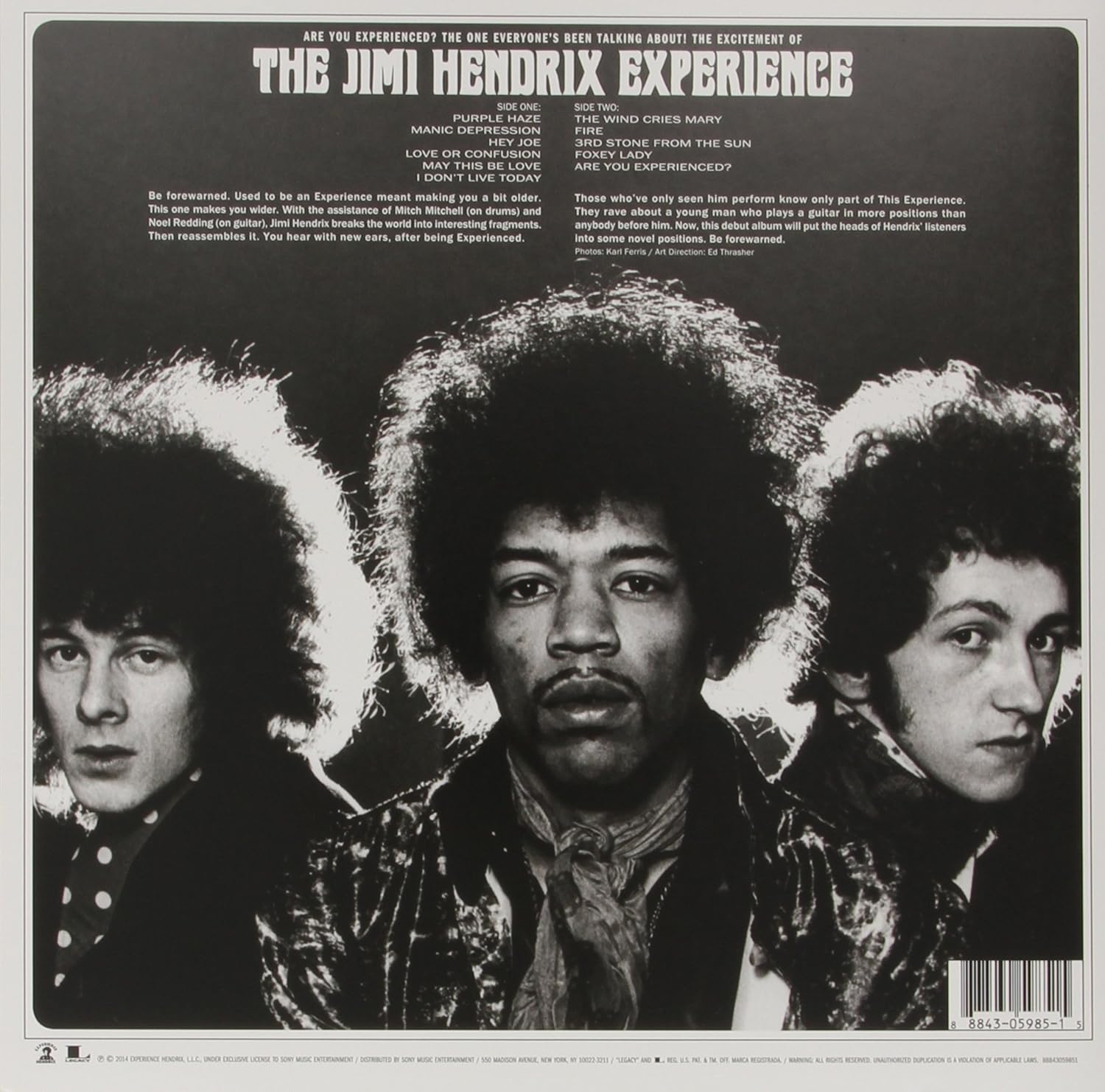
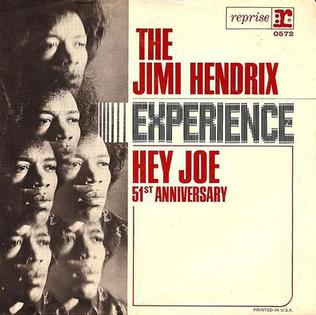
Image result for jimi hendrix are you experienced single sleeves

Hendrix introduced the Octavia pedal on ‘Are You Experienced.’ Created for Hendrix by sound technician Roger Mayer, the effects pedal doubles the guitar sound with the same pitch an octave higher or lower and adds some fuzz. You can hear it at work on the “Purple Haze” guitar solos. Later, when the recording was sent to Hendrix’s U.S. label, it was attached with a note – “Deliberate distortion: Do not correct.”

Image may contain: 3 people

After growing up in Seattle and teaching himself to play guitar as a teenager — flipping right-handed guitars upside down to accommodate his left-handed playing, thereby helping him to approach the instrument in radical new ways Jimi Hendrix did a brief stint as an Army paratrooper. Then he moved to Tennessee and spent about four years on the Chitlin’ Circuit as a guitarist for the Isley Brothers, Little Richard, and Curtis Squires, also gigging with his own band the King Kasuals alongside future Band Of Gypsy’s member Billy Cox. In 1966, at the urging of Linda Keith, he moved to London and met the Animals’ Chas Chandler, who became his manager and helped him form the Jimi Hendrix Experience with British rhythm section Noel Redding and Mitch Mitchell. The story goes that both drummers Mitch Mitchell and Aynsley Dunbar both auditioned to join the Experience. Hendrix liked them equally, so fate was left to a coin flip (which benefited the jazz-influenced Mitchell). Dunbar ended up doing all right, playing with Jeff Beck, David Bowie and Frank Zappa, as well as getting inducted into the Rock and Roll Hall of Fame as a member of Journey. Mitchell drummed with the Who a few years earlier, just before they hired Keith Moon, while Hendrix wrote “Foxy Lady” about Heather Taylor, who later married Who singer Roger Daltrey.

They scored some minor UK hits, won essentially all of England’s rock royalty as fans, and hit the studio to record their debut album. ‘Are You Experienced’ was recorded in three different London studios – CBS, De Lane Lea and Olympic – largely because of Chandler’s shortage of ready cash. New to management, Chandler thought he could pay for time upon completion of the album. He ran into difficulties when owners demanded payment right away. Polydor, Track Records’ distributor, guaranteed Chandler a line of credit so the Experience could finish the album at Olympic Studios.

Apparently, Polydor was so excited about ‘Are You Experienced’ that the distributor released Hendrix’s debut album early. Track Records was surprised when an error caused 2,000 copies to be sent to London stores two weeks before the planned release date, on May 12th, 1967.

Although the Experience were having massive success with their first three singles (“Hey Joe,” “Purple Haze” and “The Wind Cries Mary”) and debut LP in the U.K., American record companies weren’t sure Hendrix would be a hit in the States. But Reprise Records became convinced after the trio’s wild performance at the Monterey Pop Festival in June. Unlike the British edition, the U.S. version would include the singles, which replaced “Red House,” “Can You See Me” and “Remember.”

Image result for jimi hendrix are you experienced single sleeves

What they came up with was unlike any album ever released — and not just because of Hendrix’s inventive guitar work, though there’s no downplaying his revolutionary approach or the way it shaped everything else about his sound. Like a mutant who’d gained full mastery over his powers, he ably controlled every available weapon in a guitarist’s arsenal: feedback, effects pedals, the whammy bar, even his teeth. In concert, that skill set played into wild exhibitionism that extended all the way to his wardrobe, his gigs so explosive that they often ended in smashed instruments (and, famously, once with a guitar set aflame). That showmanship is a huge part of his legend, but Are You Experienced presents him as more than just a marvelous instrumentalist.

“I Don’t Live Today” (along with Cream’s “Tales of Brave Ulysses”) helped popularize the “wah-wah” guitar effect. But, at that point, the famous pedal didn’t exist. On the solo for “I Don’t Live Today,” Hendrix created the spectral glide – which seemed like a voice saying “wah-wah” by hand. That sound inspired Vox to create the wah-wah pedal, bestowing a shortcut on legions of guitarists.
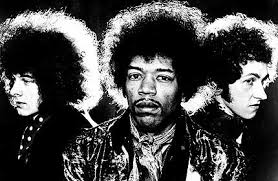
Image result for noel redding

On the LP, all that power is reined in and meticulously deployed, often with a subtlety you wouldn’t expect from such a showboat. A controlled chaos lingers in the album’s background and ramps up at strategic moments, a wave of noise that sweeps through and irreparably alters the landscape of a song. Even if you’ve never listened to Are You Experienced, you’ve heard it in the tumultuous closing moments of “Purple Haze” one of the most famous rock songs in history. It manifests elsewhere in the tumbling rhythms of “Love Or Confusion” and the tripped-out space travels of “Third Stone From The Sun” and even the gently drifting ballad “May This Be Love” And it’s all over the madcap freakout “I Don’t Live Today” the record’s closest parallel to Hendrix’s untamed stage show. And on the remarkable title track, it’s flipped backwards, chopped up, and pieced back together into an otherworldly statement of intent.

Just as often, though, Are You Experienced demonstrates how much this trio could accomplish without a blaring wall of sound. The spare and visceral “Manic Depression” weaves insane riffs and even crazier drums into the foundation for a new kind of blues. “Fire” is similarly combustible, initiating with a riff so startling. “The Wind Cries Mary” is a simple, beautiful display of Hendrix’s softer side; to me, his clean, aqueous rhythm work, also heard throughout “Hey Joe” was and is every bit as revelatory as his fireworks displays.

Event: BLACK FRIDAY 2016
Release Date: 11/25/2016
Format: 10″ Vinyl
Label: Sony Legacy
Quantity: 3000
Release type: RSD Exclusive Release

When Chas Chandler discovered Jimi Hendrix in New York in June 1966, the Animals‘ bassist was so impressed by Hendrix’s performance of “Hey Joe.” Chandler brought Hendrix to London that September to record the American rock standard as a demo to secure a recording contract. October. 23rd, 1966 would mark Hendrix’s first day of recording at London’s De Lane Lea studios as a member of the Jimi Hendrix Experience.

The session would yield the first instrumental tracks of “Hey Joe,” one of the most memorable songs of their debut LP, “Are You Experienced”.
Once they’d arrived in London, Chandler recruited guitarist Noel Redding, who would play bass, and drummer Mitch Mitchell to back Hendrix. Short of cash for extended studio time, Chandler rehearsed with Hendrix at his new London apartment.
“When I started with Jimi, we were sharing the flat and doing all of our work there,” Chandler recalled The flat was Jimi’s rehearsal room. That was such an advantage. When we took the Experience into rehearsals, Jimi had already developed the song to the point where he could indicate the chord sequences and tempo to Mitch and I would work with Noel about the bass parts. Then everything would come together.”
Chandler chose De Lane Lea studios because the Animals had recorded their big hit “House of the Rising Sun” there. But problems cropped up at that first session.
“When Jimi first came to London, his visa had been restricted,” said Chandler. “I had received an extension, one that carried us through the date I had scheduled for us to record ‘Hey Joe.’ The day we were recording ‘Hey Joe,’ I had gone over to the immigration office in the morning to get some papers completed for a three-month extension of his passport. It took so long that I came straight from immigration to De Lane Lea Studio’s.
“Right after we started, Jimi threw a tantrum because I wouldn’t let him play his guitar loud enough in the studio. It was a stupid argument over sheer volume. He was playing through a Marshall twin stack and it was so loud in the studio that we were picking up various rattles and noises. He said, ‘If I can’t play as loud as I want, I might as well go back to New York.’”
“‘Hey Joe’ is a very difficult song to do right and it took forever,” Redding recalled in his autobiography Are You Experienced. “The Marshalls were too much for the mikes and Chas and Jimi rowed over the recording volume. That ‘loud,’ full, live sound was nearly impossible to obtain (especially for the bass) without the distortion, which funnily enough became part of our sound. No limiters, compressors or noise reduction units yet.”
“In my pocket I had his passport and immigration papers,” continued Chandler. “I took them out, threw them down on the console, and said, ‘Well, here you go. Piss off.’ He looked at them, started laughing, and said, ‘All right, you called my bluff!’ and that was it.”
During the two-hour session, was all Chandler could afford, the Experience laid down the preliminary backing tracks for “Hey Joe.” Hendrix’s lead vocal and backing vocals by the Breakaways, a group of female session singers, (Jean Hawker, Margot Newman, and Vicki Brown)were recorded later. The finished demo, however, did not immediately impress record companies.
“Chas tried to interest Decca Records,” wrote Redding. “No luck. But then they’d turned the Beatles down, too.” The song was released in the UK on the Polydor label in a one-single deal. Hendrix then signed to the Track label, which was set up by Kit Lambert, producer for The Who. Dick Rowe of Decca Records turned down Hendrix for a deal, unimpressed with both “Hey Joe” and “Stone Free.”
“Hey Joe” would become a Top 10 hit single in the U.K. before it was released in the U.S. in 1967 as part of the Are You Experienced album.

This is the song that started it all for Hendrix. After being discharged from the US Army in 1962, he worked as a backing musician for The Isley Brothers and Little Richard, and in 1966 performed under the name Jimmy James in the group Jimmy James and the Blue Flames. Hendrix introduced “Hey Joe” to the band and added it to their setlist. During a show at the Greenwich Village club Cafe Wha?, Chas Chandler of The Animals was in the audience, and he knew instantly that Hendrix was the man to record the song.

It is unclear who wrote this song. Many people believe it was written by Chester Powers (aka Dino Valenti of Quicksilver Messenger Service), but Hendrix himself – and also The Leaves – attribute it to William (Bobby) Roberts. No one has been able to copyright it, so the song is considered “traditional,” meaning anyone can record it without paying royalties.

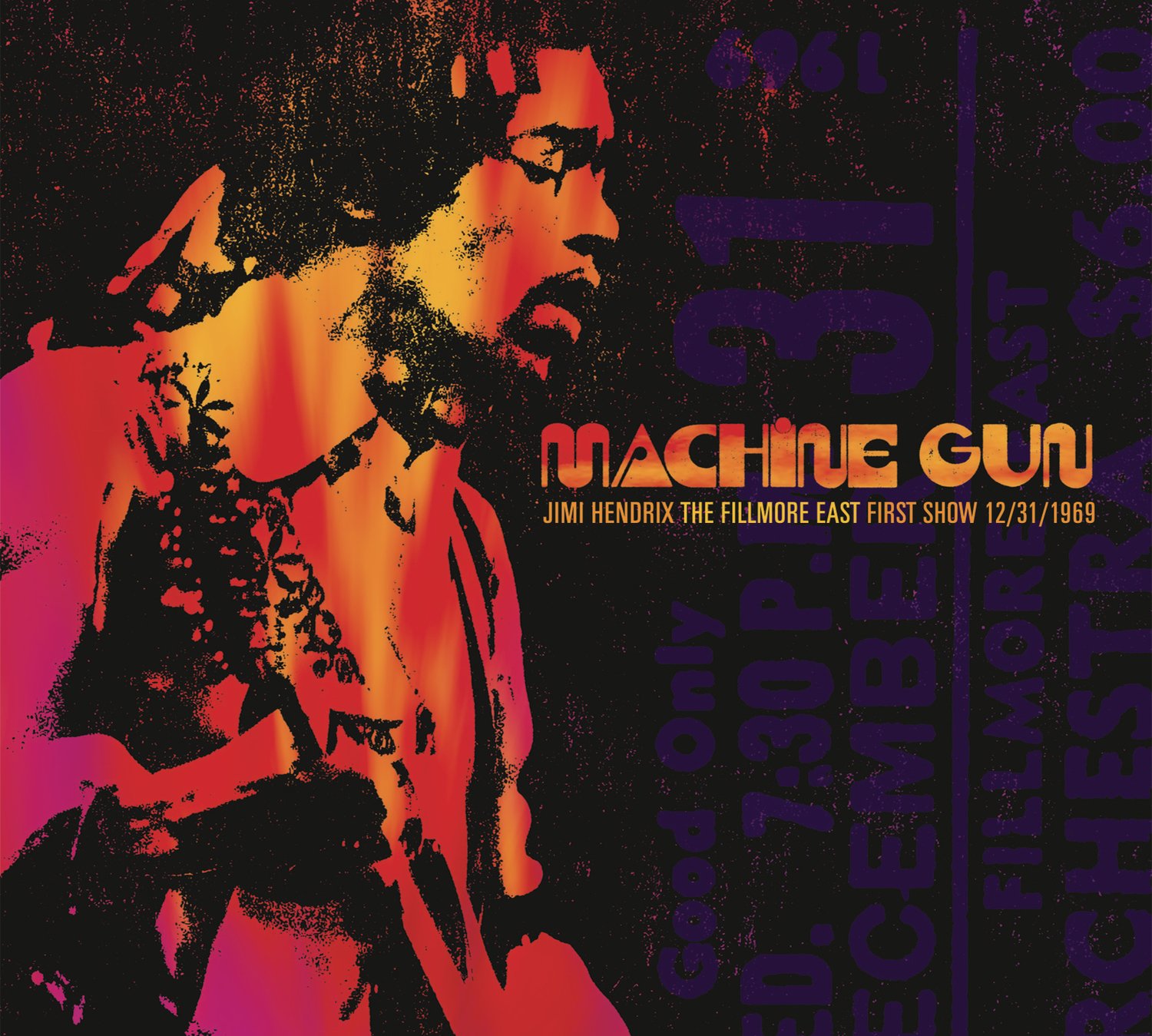
As the ’60s came to a close, Jimi Hendrix began to push the boundaries of funk, rock and R&B with a brand new group of musicians, Band of Gypsys. Together with bassist Billy Cox and drummer Buddy Miles, Hendrix unveiled stunning, newly written material across four shows at the legendary Fillmore East in New York City. “Machine Gun: The Fillmore East First Show 31/12/69” marks the first time Band of Gypsys‘ first show has ever been released in its entirety, newly mixed by Eddie Kramer from the original 1″ eight-track masters.

Well, this is something serious Hendrix collectors have been waiting for. Band of Gypsys famously played a total of four shows 12/31/69 and 1/1/70 at the Fillmore East (two shows each night). This is the complete first set from the first night; their debut live show. Although the original Band of Gypsy’s album was compiled from the second night, it wasn’t because there weren’t amazing performances to choose from on the first night. The first couple songs are a bit rough around the edges, but when Jimi goes deep blues with “Hear My Train a Comin’,” he really starts feeling it and turns in an absolutely amazing version (that’s why it was previously released on Band of Gypsys 2 and Live at the Fillmore East). “Machine Gun” is another stunner.

There are significant differences to the lyrics, and the structure of the song is different as well (Billy Cox says both Jimi and Buddy Miles were doing things that weren’t done in rehearsals). “Bleeding Heart” is another amazing blues performance leading into two songs that were almost never performed live: “Earth Blues” and “Burning Desire.” Throughout the set, the band is absolutely locked in. They aren’t just playing; they’re clearly listening to each other and Hendrix turns in some scorching guitar. The most interesting thing might be the realization of how much of these sets and songs was improvised by the band, as shown by the differences in “Machine Gun” from night to night. Eddie Kramer deserves credit for a truly excellent mix (and probably some judicious editing on “Changes”).

It’s not really fair to compare Machine Gun to Band of Gypsy’s since one is a largely unedited complete performance and the other is the best cuts selected from a couple shows. That said, there are performances here that rival those of the original Band of Gypsy’s album, and hearing Jimi on his game with great sound will always be welcomed.

700830 iow poster.l

In 1970 the festival had grown significantly to the point where it actually outgrew itself; for 32 years after this the Isle of Wight did not see another large scale music gathering. It’s estimated that the crowds were well in excess of half a million. Fans were drawn to what was one of the most ambitious line-ups ever put together for a festival on British soil, with artists from both sides of the Atlantic.

Even before the festival officially opened there were some bands that played for free on Wednesday and Thursday, including, Mighty Baby, Kris Kristofferson, Supertramp, The Groundhogs, Terry Reid and Gilberto Gil.

At the festival proper on  the Friday it was the band Chicago topping the bill with support from Family, Taste, Procol Harum and James Taylor as well as bands that have largely been forgotten, including Arrival, Fairfield Parlour, Cactus and Lighthouse.

Also on the bill on Saturday was Miles Davis who had reinvented himself as a jazz rock artist in the wake of his Bitches Brew album that was released in April of 1960; Davis’s band included Chick Corea and Keith Jarrett. Other acts included, Tiny Tim, ELP (set included ‘Pictures at an Exhibition’), and John Sebastian. The tye-dyed one was the first of the Woodstock alumni to play the festival.

Sebastian’s appearance, along with the others who starred in the film, which had recently been premiered in the UK, as well as having Matthews Southern Comfort’s version of ‘Woodstock’ topping the charts a few weeks earlier, all significantly added to the draw of the 1970 Isle of Wight Festival. It was as though people could not risk missing the next Woodstock.

Sandwiched between these acts and the notional bill-toppers was supposed to be Cat Mother, but they didn’t show, Sly and the Family Stone and Joni Mitchell. Third top was Ten Years After; their Woodstock appearance had turned them and in particular, Alvin Lee, into box office gold. Joint top were the Who and the Doors – it was not by all accounts the latter’s finest hour and less than a year later Jim Morrison would be dead.

If Saturday was impressive, Sunday was stellar. With Melanie, Free, The Moody Blues, Donovan, Leonard Cohen, Richie Havens Joan Baez and Jethro Tull among the big names with Jimi Hendrix topping the bill. It really was an extraordinary coming together of talent. Less than three weeks after he walked off stage at the Isle of Wight, James Marshall Hendrix was dead.

Jimi Hendrix


Hear Jimi Hendrix's Band of Gypsys First Performance from 1969

The debut concert of Jimi Hendrix’s Band of Gypsys will be officially released for the first time on September 30th. Titled Machine Gun: The Fillmore East First Show 12/31/69, the album presents the group’s New Year’s Eve show at New York City’s Fillmore East. The band played two sets that night, and two more the next. While the second night’s performances were culled for 1970’s Band of Gypsys album, the first night’s concerts were never released. Those shows marked the first public performance of the band.

Jimi Hendrix – guitar, vocals; Billy Cox – bass; Buddy Miles – drums, vocals

The only album of completely live Jimi Hendrix recordings to be released during his lifetime, Band Of Gypsys found the iconoclastic guitarist with a new rhythm section and soaring to new creative heights. At last here is a good portion of the group’s public debut, recorded on opening night of a New Year’s Eve and New Year’s Day engagement at Fillmore East. These performances gave Hendrix the opportunity to showcase new material and fulfill a contractual obligation simultaneously. The circumstances surrounding these shows are now well known; Hendrix had just successfully defended himself against drug possession charges in Toronto and now, due to a contract signed before he was known, was being forced to deliver an album of original material to Ed Chalpin, an entrepreneur determined to exploit Hendrix’s success.

Despite the troubling circumstances, the Band Of Gypsys performances would go down in history as some of the greatest of Hendrix’s career. Featuring new material that he had been developing in the studio and featuring an abundance of spontaneous jamming, this new music found Hendrix inspired by the solid funky bass of his old friend Billy Cox and the extraordinary gut-bucket drumming of Buddy Miles. This new rhythm section, which had been working in the studio with Hendrix for several months, contributed hard funk and R&B elements to Hendrix’s groundbreaking style. The lyric direction was also changing, displaying a social consciousness previously unexplored. Hendrix was clearly pushing the boundaries of his music and his newest blues-based numbers like “Machine Gun,” and “Hear My Train A Comin’,” was hitting emotional heights in his guitar playing that would never quite be duplicated again.

https://www.youtube.com/watch?v=eBynJX6RBuI

This composite is assembled from several different recordings made during the first of two Fillmore East concerts on New Years Eve, none of which were included on the original album release. Following the introduction, the Band Of Gypsys take the stage for the first time. They kick things off with the debut performance of “Power Of Soul,” a prime example of Hendrix’s new direction. Despite the vocals being muted during this and the following song, this is a powerful opening number, containing a deep funky groove previously unexplored with The Experience. Unlike anything Hendrix had written before, this song reflected a social and spiritual awareness in the lyrics. For the Fillmore East audience (who heard the vocals loud and clear), this song was in direct contrast to the psychedelic rock and enigmatic imagery that defined his songs with The Experience. Like much of the material Hendrix was now working on, this is a hard-edged funk anthem conveying the need for love and compassion during turbulent times.

The next two numbers represent new approaches to songs Hendrix had already been performing. Both take on a new vigor with this rhythm section. The first of these, “Lover Man,” is essentially a variation on B. B. King’s “Rock Me Baby.” This is a fascinating listen for its lack of vocal, as it facilitates undistracted listening to the intense instrumental interaction between these three musicians. It also serves as a good bridge between the funky opening number and the pure blues to follow with “Hear My Train A Comin.” At this point the vocals are now mixed in and the recording goes from mono to stereo, greatly improving the listening experience. Perhaps better than anything else featured here, “Here My Train A Comin'” displays why Hendrix was a peerless guitarist. The searing emotional wallop of the improvisations, the sophisticated technique and the sheer spontaneous artistry that Hendrix displays here is quite compelling.

Next up is the Band of Gypsys debut performance of Buddy Miles‘ biggest hit, “Them Changes.” A bit looser and featuring more jamming and Buddy Miles spontaneous rapping than the officially issued album version (sourced from the following night), this is just as infectious. The recording concludes with “Izabella,” which Hendrix dedicates to the soldiers fighting in Vietnam. This dedication makes more sense since this number segued directly into “Machine Gun,” which like the remainder of this performance, is unfortunately unavailable from the direct recording sources. “Izabella” would first see the light of day on the Woodstock 2 album, which is considerably looser and less focused than the version performed here.

Pretty Green Carnaby Street, will be hosting an exclusive event previewing the Limited Edition Pretty Green X Jimi Hendrix collaboration on Thursday 18th August from 6-9pm.

This will be an opportunity to buy pieces from the range before it goes on general sale across the country on 25th August.

Any purchases from the collection on the launch evening will received a Limited Edition 7 inch vinyl of Voodoo Child, Tote bag and Hendrix look book.

The event will be strictly by registration only and a limited number of people will gain entry to this very exclusive preview. There will be a special guest to DJ on the night and Sony will have a pop up store selling the best of Jimi Hendrix albums. Brewdog, our drinks sponsor, will be providing free drinks for all guest attending.