Posts Tagged ‘Jason Molina’

Image may contain: text

Magnolia Electric Co “What Comes After The Blues” was released fifteen years ago today on 5th April 2005 From the original Secretly Canadian press release:

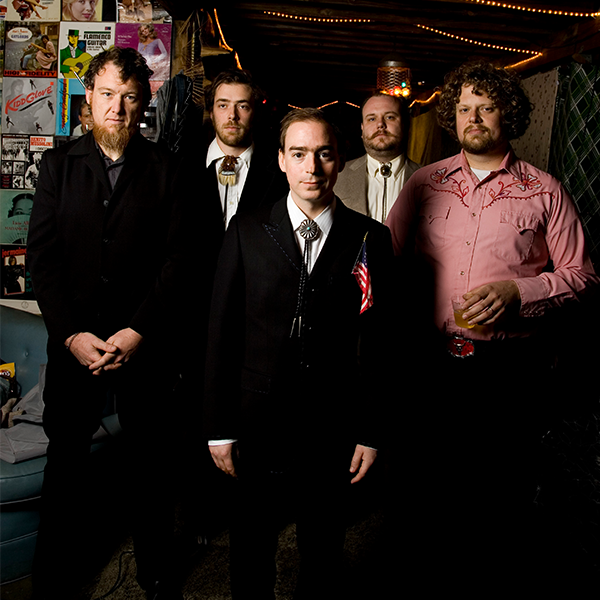
With this record, we entered a new era with Jason Molina. After seven full-length studio albums in as many years – each recorded using a revolving cast of players under the name Songs: OhiaMolina retired the name Songs: Ohia as well as his wayward days and settled in with a new and consistent cast of players. He has named this group Magnolia Electric Co., after his final Songs: Ohia album, finding a once-in-a-career band down in Bloomington in Pete Schreiner, Jason Groth, Mark Rice and Mike Kapinus.

Sonically, on What Comes After the Blues, there isn’t a huge departure from where Songs: Ohia was headed. The steel howling hauntedly, the guitars soaring and crunching with verve, and the songs still resonating with timelessness. Steve Albini’s live-in-a-room and captured-as-it-was-played engineering technique is still a crucial player as well. Where we find the marked difference with this new band and with these players in this new cloak are in their confidence as afforded by experience and trust in one another. These guys are talented, hard-working, and actually enjoy playing with one another – and you can hear it in the songs. Magnolia Electric Co. made a no-bullshit album that is both rocking and full of life; it’s a fist pumper and manages to hit great depths of beauty as well.”

https://secretlycanadian.com/re…/what-comes-after-the-blues/

Image may contain: possible text that says 'SONGS: OHIA PROTECTION SPELLS'

‘Protection Spells’ is the last of the three Songs: Ohia records we’re celebrating this week. Taken from around the time of the record’s release, here are Jason Molina’s own words on this unique collection of songs:

“The Protection Spells is a collection of songs recorded over a period of several Songs: Ohia tours. Presented here are nine entirely improvised pieces. The approach to these songs involved no rehearsals, no second takes, no additions and no going back. What you have here are songs that just happened in real time. The many musicians on these recordings were friends, bandmates and, at times, total strangers. I have long hoped to offer the listener a chance to have some of these great accidents on record. It is a direct look at my songwriting process, only a little more risky, and nobody has any idea what direction we are going until we all start working on it together.

I think that the years of improvised music I played in the past helped to strengthen the risk-taking with these songs. Here the the goal was to still have basic songs without falling into long freak-out noise experiments, saving that kind of exploration for live settings. You will notice the appearances and disappearances of ideas that could never be recreated, not that they are all brilliant, but they are certainly not forced. The seemingly arbitrary moments of strange repetition the lyrics, the clear lack of a preconceived system of established song parts, all are the marks of improvised songwriting. Since even the singing had no idea what the floorplan of the song was to be, there were some unanticipated troubles and some shy steps taken, but I have preserved these mappings of the dangerous musical byroads that Songs: Ohia has always depended on. I hope you enjoy this”

https://secretlycanadian.com/record/protection-spells/

No photo description available.

Magnolia Electric Co’s ‘Trials & Errors’ was released 15 years ago today on January 18th, 2005. A live album originally recorded in April 2003 at Club Ancienne Belgique in Brussels, the record is the first to bear the Magnolia Electric Co moniker despite the band having been touring as Songs: Ohia over that period, and was met with comparisons to the live recordings of Neil Young & Crazy Horse.

Recorded only a few months after they had formed, “Trials & Errors” captures Jason Molina’s new band Magnolia Electric Co. on one magical night in Brussels in 2003. It is a scintillating audio document of one of America’s most important contemporary live acts evolving into something really special and doing what it does best – whipping an audience into a frenzy. This set captures Molina & Co right after Molina had retired the Songs: Ohia machine in favor of this powerful new vision of his.

Two years in the planning process, the new project took its name from the last Songs: Ohia full-length album. Composed of a nucleus of four members, this particular show captures the newly christened band on its first tour in its earliest state. Still a four-piece with Pete Schreiner providing the back beat drum pulse, Mike Kapinus on bass and melancholic trumpet, and the two Jason’s dueling over guitar solo space: Molina’s down-tuned guitar matching his now settled tenor voice, and Groth’s Creedence-channeling rhythm guitar and solos filling out the upper register. With Molina as the principal songwriter, the songs are as classic as his fans have come to expect over the course of seven Songs: Ohia full-lengths (all released between ’96 and ’03). With his new band, however, fans can finally enjoy a stable & more-than-able rhythm section that just gets tougher and tougher with each performance. Like a juggernaut that simply chews up everything in its path, on Trials & Errors, the new Magnolia grinds through three old Molina favorites (two from Songs: Ohia’s Didn’t It Rain and one from the Songs: Ohia album Magnolia Electric Co), three songs which will be released on the upcoming Magnolia Electric Co studio album (out Spring 2005) as well as four songs that will only exist on record in their live form as presented here.

Fans may recognize that Trials & Errors comes peppered with an homage or two to Neil Young. One could, in fact, argue that the album is an existential response to Tonight’s the Night. While from the songwriting perspective Molina is often pegged as the perennial downer, this is not, like Young’s, a record born out of a series of sudden tragedies, but rather out of a whole life of growing up & out in the Midwest, surrounded by a small town mentality in a wide open space. The bastard second of three children, the Midwest is a funny place, often patted on the head and doled out placations of “Oh that’s nice – now go run along while the East & West do their business.” It is an album about finally accepting one’s place in this world; about standing ground and owning up to it with confidence. These are familiar themes that run through some of the greatest literary works of our last great century. Join Magnolia Electric Co as they play their part in a long-standing tradition of touring musical artists (Lynyrd Skynyrd, Creedence Clearwater Revival, Bruce Springsteen & the E-Street Band) that capture the spirit of their own homes, traditions and principles and communicate those through the chooglin’ rock of ages on stage for rooms full of empassioned audiences 150 nights a year. This is all about that wandering spirit, and the longing to wrangle it into place every now & again.

In subsequent tours, this core line-up would soon shift to find Mark Rice (the Impossible Shapes, John Wilkes Booze) replace Schreiner on drums, with Schreiner (the Panoply Academy, Scout Niblett, the Coke Dares) moving to bass guitar, and Kapinus (Okkervil River sideman) shifting to keyboards/piano & trumpet while Groth (the Impossible Shapes, John Wilkes Booze, the Coke Dares) and Molina remain constant on guitar.

Image may contain: 1 person

This week sees the 10th anniversary of the release of Magnolia Electric Co’s ‘Josephine’. To mark this, Jason Evans Groth has kindly shared some of his thoughts and memories of creating the album:

Magnolia Electric Co’s ‘Josephine’ was released ten years ago today on the 21st July 2009. Continuing the band’s collaboration with producer Steve Albini, the album was dedicated to bassist Evan Farrell who passed away in December 2007.

To mark the 10th anniversary of the album, Magnolia Electric Co’s guitarist Jason Evans Groth shared some of his memories of recording the album. “Josephine was cathartic for all of us, was a truly full-band record, was weirder in a lot ways and more accessible in a lot ways than other stuff we’d been doing, and is a testament to what a family can do if they stick together through the tragedies.”

Josephine, to me, sounds like a family celebrating and mourning something that had been loved and had been lost, and doing it together, all as one. Jason dedicated the album to and even said in interviews that it was about our dear friend and one-time bandmate Evan Farrell, who had perished in a fire in December of 2007, just a few months after the one tour he did with us. At the time I was a little uneasy about that dedication, probably because I knew many of those songs had been written before Evan, some had even been played with him. But Jason was right – songs change, feelings about their meaning change, and I was caught up in facts to help suppress the feelings I had about the tragedy. We made a shrine to Evan in the studio. We talked and thought a lot about him. Jason had taken it hard. In the three years prior to this, death had become a tragically common occurrence. In 2005 we were in the studio recording Nashville Moon with Steve Albini when Michael Dahlquist – Silkworm’s drummer and a dear friend of Steve’s – was killed in an incredibly tragic car accident; Jason lost his mother; our then-new European booking agent, Jens Pape, also died suddenly and unexpectedly; and Heath Ledger, who had been working with Jason on a documentary project, died. I know Jason was thinking about all of it – he told me he was – those few years. He told me he thought he was cursed, and cursing other people.

And then it was the fall of 2008, and it was time to make a new record. Jason and Mikey went to Denton, TX to make the Molina and Johnson record (where the original “Josephine” was recorded) and we hadn’t toured since Evan died, which was weird for us; more than a whole year off the road. Jason had played a smattering of European solo shows, some with another band. Around April Jason started emailing me with ideas. On tour, he said, he wanted to do anything we wanted to play – “the ancient stuff.” He was concerned about tunings but asked me to come up with versions we could use on the road. Tour would happen in the fall, and then we would make the record. Looking back through emails, we talked about tuning a lot. The tour was booked for mid-late October/early November, with recording starting on November 6th and going through the 20th.

Up until sequencing we all worked on it together. We brought the songs to life and we hung out and worked together and loved being around one another. I still get chills thinking about the hug Jason gave me after the saxophone solo I played for “O! Grace.” I’m really glad a lot of the session is captured, expertly, in Ben Schreiner’s Recording Josephine documentary.

Josephine was cathartic for all of us, was a truly full-band record, was weirder in a lot ways and more accessible in a lot ways than other stuff we’d been doing, and is a testament to what a family can do if they stick together through the tragedies. I love my Magnolia Electric Co family so much, and I miss Jason more than I can express. I especially miss him when I think about this session and this record, and how much we all felt like one making it.

We had heard nothing about songs. Eventually, the last week of September, Jason wrote and said he had been “pulling my teeth out here” to get us some demos. Those eventually came, early in October, and were ethereal, haunting versions of the songs that would show up on Josephine (and some that wouldn’t). And they were in weird tunings, just like Jason’s old days. I felt that he had been collaborating with me without me knowing it, using me as a way to summon up the courage to do things like he used to, things that he did out of necessity then and which seemed mysterious to him now. He told us “I’m not ignoring ELO type arrangements on this record.” He told me he wanted to make his version of In the Aeroplane Over the Sea. He told me he wanted it to be “less Crazy Horse and more crazy.” And what we made probably had a little of all of that. We were working out songs together in the studio, recording them in one or two takes live, with the vocals being monitored through an amp in the room where we all were (which is why they have an extra-ghosty quality to them, I think). And then we were overdubbing like crazy, too.

My favorite dubs are the tambourine part in “Rock of Ages” (just describing what I wanted to Steve Albini is a pleasant memory), watching Pete do amazing hand percussion, and seeing Mark play vibes. The “Whip-poor-will” recording – just thinking about it – brings tears to my eyes. Jason and me playing guitar on stools in the drum room at Electrical, with Mikey sitting next to us so we could do those live three-part harmonies, which sounded tighter at that recording than I thought they ever could. My Tele Deluxe – the guitar I played at 99% of the Songs: Ohia/MECo shows – had gotten really sick, and was getting a fret job in Chicago, so I was put in the position of using guitars I didn’t understand, and that made me play in a more wild, quiet, and careful way all at once. My favorite guitar tones on the record came out of my wife’s telecaster, including maybe my favorite recorded thing I’ve ever done, the guitar solo in “Shenandoah.”

MEC.png

I hope everyone else misses Jason Molina with their whole, entire aching heart? Posthumous reissues like this one generally don’t help much in softening that ache, but they do serve as a reminder of Molina’s genius, which is nearly unparalleled in the 21st century songwriters’ canon—he sits on a tall hill next to the Leonard Cohens and Bob Dylans of the world. This box set reissue of The Lioness, released late last month and containing lost songs, liner notes written by Molina’s friends and collaborators and other memorabilia, is a deliberate homage to the late artist’s life and music. The songs from the Lioness sessions, which were recorded just shy of the new millennium and originally released in 2000, capture a moment in his life so rosy with newfound love, you’ll wonder how this wonderstruck Molina is the same one who later tackled burdensome grief as Magnolia Electric Co. But, on the new, never-before-heard outtakes from the Lioness sessions, he is more rooted in life’s ups and downs.

He does the work of a priest—blessing love, bestowing wisdom for braving life and making sense of death. The Lioness, as well as these outtakes, showcase a Jason Molina rising. His ability to balance dark themes of doom and despair with the warm but complicated matters of the heart was fully realized on this album.

He would go on to write music like this for 13 more years, but, now, five years after his death, that doesn’t seem like a whole lot of time. Molina knew that life was complicated, but his music has a way of making it easier to understand.

Lionsesh

The Lioness is the first Jason Molina project to fully turn away from the battlefield folk and deconstructed Americana of earlier Songs: Ohia recordings. At the dawn of the 21st century, the album felt modern. It aligned Molina with a new set of peers – Low, Gastr del Sol, Red House Painters and, most importantly, the influential Scottish band Arab Strap, whose producer and members were crucial in the creation of The Lioness. The avant-garde tones and arrangements of Arab Strap are absorbed here into Molina’s songwriting to create what would become, for many acolytes, the archetypal Songs: Ohia sound. Love and Work: The Lioness Sessions, the box set reissue, will serve as the seminal log of the era, complete with lost songs, photos, drawings, and essays from those who knew Molina best.

We know Molina was diligent in both love and work. He treated songcraft like a job at the mill, and his approach to romance was not so different. We know that when he fell in love with his wife, he was dutiful in his adoration. There were strings of love letters and poetic gesture. Included in this edition are replicated examples of this relentless love – an envelope with a letter from Molina, a photograph of Molina and his to-be wife, a postcard, a Two of Hearts playing card, and a personal check for one million kisses. Some of these items were gifts he would send to his new love from the road; others, like the 2 of Hearts, were totems he’d carry with him around this time as a symbol for his burgeoning love.

And so, the head-over-heels album that is The Lioness has its workman counterpart. Nearly another album’s worth of material was recorded in Scotland during the album sessions. While similar in tone and structure, the songs seem to deal in the grit and dirt of being. These are songs for aching muscles getting soothed in the third-shift pub. But they’re also examples of Molina’s diligence as he constructs what would be the essential elements of The Lioness. In addition to these outtakes, we also have a 4-track session made weeks earlier in London with friend James Tugwell. Comprised of primarily guitar, hand drums and voice, these songs are raw experiments that mostly serve to illustrate Molina’s well of words and ideas. But then, there is the devastating Sacred Harp hymn Wondrous Love. While he may have had his new love in mind, one can’t help but think of Molina’s legacy as he softly warbles “Into eternity I will sing / Into eternity I will sing.” You don’t have to try too hard to mythologize Molina. He did all the work for you.

Click to view larger image

Since Jason Molina‘s death in 2013, there have been some memorable and intimate releases. In 2016, Secretly Canadian released The Townes Van Zandt Covers (I’ll Be Here In the Morning/Tower Song). It came as no surprise that Molina should be drawn to these songs. His melancholic sad tones seemed well suited to those Townes songs who, like Molina, also battled with alcoholism.

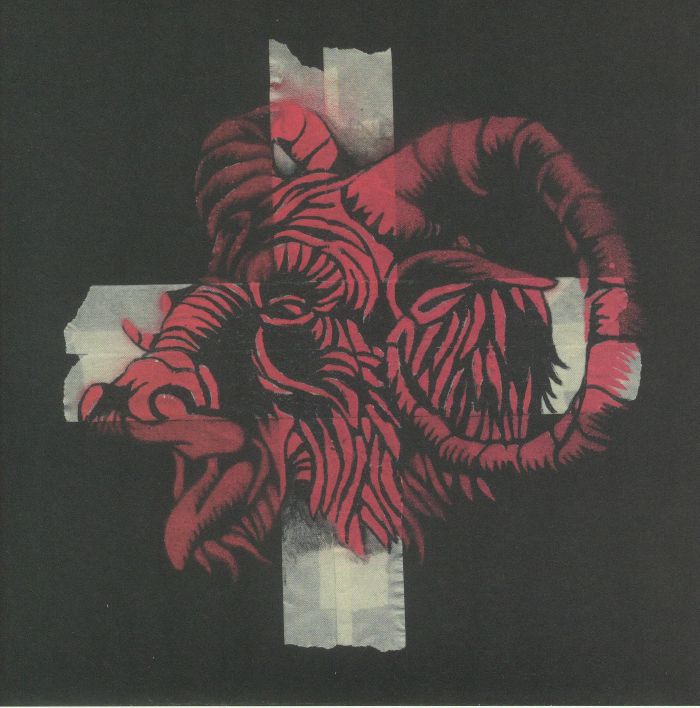
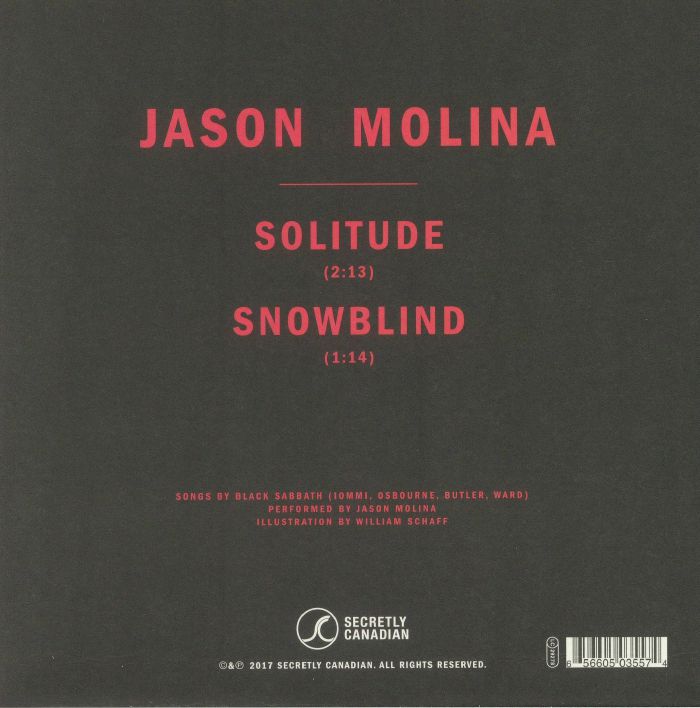
The latest offering from Secretly Canadian may be a less obvious connection – The Black Sabbath Covers 7″.  Although Molina was in the punk band Spineriders in the late ’80s and early ’90s this isn’t a return to those days, instead, the two tracks Solitude and Snowblind were recorded in the late ’90s, with just voice and acoustic guitar. He makes them both his own although they are no sooner started then they’re over – combined they come in at just under 3:30 minutes but this does allow the b-side to be adorned with an etching of a black ram by the brilliant Rhode Island artist and musician William Schaff.

http://

When Jason Molina took on another artist’s song, he willed his own universe into it, his own personal and artistic mythology. Be it Conway Twitty or Townes Van Zandt, their blues were infused with Molina’s own entrancing blues. This pair of newly discovered, home-recorded Black Sabbath covers is no different. Molina, a through-and-through fan of metal (seek out his high school metal band the Spineriders‘ album if you haven’t yet) peels back the sinister and stoned elements of Sabbath, zeroing in on the loneliness and brooding. He takes “Solitude,” from 1971’s unfuckwithable Master of Reality — and one of Sabbath’s more mystical, near-proggy songs — and doubles down on the title. Molina extracts Ozzy Osbourne’s gorgeously cooed vocal performance and transforms it into a high and lonesome sound, a desert campfire howler. And on his cover of “Snowblind,” from 1972’s Vol. 4, it becomes obvious what a guitar hero Sabbath’s Tony Iommi was for Molina.

Click to view larger image

Songs: Ohia - Magnolia Electric Co. @LP, Blue Swirl Vinyl, Limited to 600 Pieces, Out 12/16

Newbury Comics have been hoping to release some Jason Molina music ever since they started putting out records three years ago, so couldn’t be happier about announcing this Newbury Comics exclusive edition of Songs: Ohia’s ‘Magnolia Electric Co’. Released midway through his career (and preceding a band name change to Magnolia Electric Co.), this double lp deluxe edition sees the Songs: Ohia sound open up in ways that had been only hinted at on previous releases. The lyrics, as always, are worth the price of admission alone.

Our version is pressed on two slabs of Blue Swirl vinyl, in a lovely gatefold sleeve (with printed inner sleeves) in an edition of 600 pieces (+ download).

The hallmark of Jason Molina’s career, Magnolia Electric Co., is both a confluence of all he would create and a line in the sand to mark a shift in his song writing approach. It was the last statement under his iconic Songs: Ohia moniker, and the moment before he began making new legends as Magnolia Electric Co. for the next 10 years. Now — here at the end of that decade — with Molina gone, his work gathers more weight and meaning. This expanded 10-year anniversary edition of Magnolia Electric Co. features one never-before-released track plus many rarities. The full-band studio outtake of fan favorite “Whip Poor Will” is a sweet and spare version that ended up being played far differently on Magnolia Electric Co.’s final album Josephine (2009). Also included is the studio version of “The Big Game Is Every Night.” Previously only available on the Japanese version of the album, this opus serves as Molina’s thesis statement, its poetry weaving through the 20th Century, through art and sporting culture — ultimately questioning what it means to be an American in the autumn of the American Era.

The edition also gathers Molina’s gutting demos for the record, including those two outtakes. Nearly each begins with audible sound of the RECORD button being pressed down on the tape player. They are so close and intimate, it’s hard to look them right in the eyes. But you should.

Out on 12/16 and available for order now.

http://

Loneliness comes in different shapes. There is the infectious, magnetic kind, a paradoxically communal loneliness that rubs off on those who come into contact with it. This is the loneliness of barrooms and big cities, of waiting rooms and grey parks. And then there is the singular loneliness of wide-open vistas and big skies, the kind that preys directly on the significance – or rather the lack of significance – of the individual.

Jason Molina knew a thing or two about being alone. In the first verse of Just Be Simple, one of his finest and best-loved songs, he sings ‘why put a new address on the same old loneliness?’ It is an admission. He is admitting that he is resigned to a life lived alongside his nemesis, solitude. Later in the same song he appears to anthropomorphise loneliness. It becomes a living, breathing thing, an unwanted neighbour you’ve learned to live with or a malign household deity that requires constant sacrifice. And cruelly, in an apparent contradiction, it becomes something that will never leave you (remember the old Jermaine Jackson song, Lonely Won’t Leave Me Alone?) For many people there is no escape. Or rather there is one, final escape.

For Jason Molina the final escape came two years ago when he died alone, of alcoholic organ failure, in his Indianapolis apartment. But Molina was never short of company, of friends or of admirers. Like all drinkers there were times when he withdrew from human contact, when he hid things with silences or lies. But his friends always stood by him, his collaborators always valued him and his fans never ceased to adore him. One of the reasons for this is that he was, by all accounts, an enigmatic joy of a person, a confident talker, an endearing bullshitter. The other reason is the music. Molina’s songs – and he wrote and recorded hundreds of them as Songs: Ohia and later the Magnolia Electric Co. – steer assertively around sentimentality but never let the tears dry completely. His lyrics could be ironic or self-referential but he was never far away from uttering a heartbreakingly simple truth about a complex emotional situation. All this was backed up by stark, minimal country arrangements or warped Crazy Horse-style jamming.

It comes as no surprise to learn that Molina was and is held in almost holy regard by his fellow musicians. Throughout his career he was beating off potential collaborators with a stick, and in the two years since his death dozens of artists have covered his songs and acknowledged his influence. Through the Static and Distance – curated by Tanakh’s Jesse Poe – is not the first Jason Molina tribute album. It may not be the last. But the wealth of material and the quality of artists lining up to pay their respects ensures that it is still a worthy endeavour. Molina may have been lonely but he had a hell of a lot of admirers.

There isn’t a bad song on Through Static and Distance, but you knew that already, right? Molina didn’t write bad songs. The question is, how do the interpretations stand up to the originals? How does a performer go about covering a song by an artist he idolised? What does he change? Unsurprisingly, the varied acts go about it in different ways. Peter Hess and Eoin Russell – former members of Songs: Ohia – choose to dispense with vocals altogether on their new rendering of Tenskwatawa, opting for combination of clarinet and pedal steel which is both earthy and melodic. The melancholy is tangible in the space vacated by their one-time bandmate. Farewell Transmission, an epic personal apocalypse of a song, is handled with quiet skill by San Francisco newcomer Annie Fleming, with a little help from alt-folk gun for hire Brendon Massei of Viking Moses. Bob Corn comes across like a laconic, Mediterranean peasant version of Will Oldham on The Lioness.

The songs here are full of hope and danger, none more so than Being In Love, which is given a slow-building fragility by Tiger Saw. And then of course there is Just Be Simple, taken on by the album’s head honcho Jesse Poe, who replaces the clear steel guitar of the original with muted clarinet without forfeiting the song’s emotional hit. Other highlights include the elemental and slow-burning Ocean’s Nerve, given a harp-tinged going-over by Michael Tanner of United Bible Studies Brighton’s Gemma Williams (the artist formerly known as Woodpecker Wooliams), and Mara Flynn’s drone-heavy Calling Bird. There are tight, muscular performances by Nad Navillus (once Molina’s guitarist) and The Verms, who take on Constant Change and Declarer respectively, while Jesse Rifkin’s The Body Burned Away – all itchy percussion and echoey vocals – is perhaps the biggest departure.

Add to this some excellent contributions by Sharron Kraus (Ring the Bell) Thalia Zadek (who gets to have a crack at the anthemic Hold On Magnolia) and Small Sur (a piano-led, slowed down version of Two Blue Lights) and you’ve got a hefty piece of work on your hands. And it’s all topped off by a wonderful ensemble re-creation of I Could Not Have Seen the Light.

It is inevitable, sad, and strangely comforting that a number of these songs feel like Molina’s ruminations on his own demise, messages channelled through time and relayed through fellow musicians. One such is Guy Capecelatro III’s Soul. ‘I tell all my friends that I’m bound for heaven/and if it ain’t so, you can’t blame me for living’, he sings, heartbreakingly, and the lines ‘No one should forgive me/I knew what I stood to lose’ in Paul Watson’s North Star Blues have a power that can only have grown in the last two years. Marissa Nadler’s comparatively polished take on It’s Easier Now, with the lyrics ‘It’s easier now/that I just say I got better’, contains, in hindsight, all of an addict’s hope and despair. But we should not dwell for too long on Molina’s self-destructive tendencies.

It is worth noting that many of the artists involved in Through the Static and Distance cite their first exposure to Molina’s songs as a life-changing experience. Others collaborated with him, and talk of those times as if they had been in the presence of a higher being. It goes some way to explaining the adulation in which he is held. Many artists who die prematurely become cult-like figures. It is testament to Molina’s talent and his magnetic personality that he reached this status long before he finally succumbed to his lifestyle. And it’s proof that the music trumps the myth.

This tribute provides a space in which some of the musicians who rightly look up to Molina’s work can express their gratitude to him and to his family (proceeds from the album go to Molina’s estate). It also gives fans another perspective on the music of one of the best and most quietly influential songwriters to have ever tried his hand at the game. Jason Molina may never have known it, but he is not alone.

Songs: Ohia ‘The Magnolia Electric Co.’ (10th Year Anniversary Edition) out now on Secretly Canadian, a fine year for reissues although none can be more welcome than this 10 Year Anniversary Edition of Magnolia Electric Co confusingly the last album by Songs: Ohia before Jason Molina took the name of this album for his new band. No surprises there, “Magnolia Electric Co” is Molina’s masterpiece and celebrating its decade long existence is right and proper. Molina died at the age of 39 as a result of chronic alcoholism. His music had a dark heart and a desolate core. He sung about it, lived it and possibly died of it. Often compared to Neil Young the music of Jason Molina went well beyond that of a mere copyist. He was a true original, always located on the fringes of success and a man whose recognition that he was “paralysed by emptiness” led him towards destruction that played out in “bad luck lullabies”. His music is Americana gold including classics like the uber powerful seven minutes of the epic “Farewell Transmission”, the quiet wonder of one of his greatest songs “Just be simple”, the power surge of “John Henry Split my Heart” and the wasted country beauty of “Hold on Magnolia”. The album was also unique in that Molina relinquished his vocal duties on two songs, the Merle Haggard-esque “The Old Black Hen” and the sauntering “Peoria Lunch Box Blues”, giving the lead vocals respectively to Lawrence Peters and Scout Niblett.

Beyond the core of the released album the 10th Anniversary Edition are extra rare tracks and a second disc consisting only of demos, which was originally released, in its first pressing. Taking the demo album first this truly does add weight to the originals. Firstly it has Molina doing his own versions of “Old Black Hen” and “Peoria” which are rough, ready and heartbreaking. There are also sterling versions of “Farewell Transmission”, an uber poignant “Hold on Magnolia”, a stripped back version of “I’ve been riding with the ghost” that this reviewer prefers to the original and two acoustic demos of the extra tracks “Whip Poor Will” and what must rank as one of Molina’s greatest songs “The Big Game is Every Night”. The former appeared in a polished version on 2009’s “Josephine” but both sweet versions here beg the question why Molina left them of “MEC”. The lines on “Whip Poor Will” still resonate not least “so all of you folks in heaven not too busy ringing the bell/some of us down here ain’t doing very well/ some of us with our windows open in the Southern Cross motel”. When it comes to the “The Big Game is Every Night” this was originally included on the Japanese pressing of the album. It picks up the whole gamut of Molina themes of the moon, NFL football (“Unitas to Berry – so good its scary”), blues, musicians and a hardy perennial – references to snakes. The acoustic version of the song is actually less harrowing than the electric version which stretches to 10 minutes. In it he finishes with the embittered (and self reflective) observation “Show an American if really I am the snake they’re all saying/If they look up here do they see just my black tail swaying?/If I’m all fangs and all lies and all poison/If I’m really what they’re saying/I don’t want to disappoint them”. Like “Blue Factory Flame” it is utterly engrossing and compelling. The raw power of the songs conclusion sees Molina reach the pinnacle of his recording career.

The passage of ten years and the passing of Jason Molina confirms that “Magnolia Electric Co” is every bit the equal of Neil Young’s “On the Beach”, Will Oldham’s “I See A Darkness” and Johnny Cash’s “American III Solitary Man”. Sadly we just didn’t know how great Jason Molina was.