Flyte are Will Taylor (vocals, lead guitar), Nick Hill (bass, vocals), Sam Berridge (keyboards, guitars, vocals) and Jon Supran (drums, vocals).
The band spent the first months of 2017 in Australia putting the finishing touches to their debut album with ‘Courtney Barnett’ producer Burke Reid, a collaboration that delves deep into new sonic territory to create a modernist but timeless sound that revels in coming-of-age nostalgia, cinematic synth melodies and prolific storytelling themes of life, love and death.
One of the great treasures of 2017 came in the form of British act Flyte’s debut album The Loved Ones and I don’t know that anyone else seemed to notice. It’s a god damn shame, as it’s a wonderful album that is stripped down to just the core elements of pure songwriting bliss that it’s almost way too good for present-day consumption. I’ve been following the band throughout the years releasing singles, seeing them evolve from releasing 80’s sounding slices of Brit-pop to this more refined 60s sound that feels timeless and essential. The band went into the recording of the album not set on making a big single or moment, but rather making an album that flowed seamlessly with each track as important as the last. It’s fitting on this list that they end the album in old-school fashion, with a cover of Alvvays’“Archie, Marry Me.”
Last year, vocalist Will Taylor and keys player Sam Berridge got drunk and uploaded a cover of Joni Mitchell’s ‘River’ to their Facebook page. The slap-dash DIY charm and heart-wrenching voices started a Flyte-movement. Racking up over 1M streams, fans wanted more sessions, and Flyte began carefully curating covers in London landmarks with towering acoustics, earning a reputation for their trademark four-part harmonies, as well as their live sound. Pulling on all their resources, the band also started a successful sell-out club night Chasing Heaven, where friends were invited to play at intimate London venues.
Accomplished songwriters Will, Sam, Nick, and Jon have released a flurry of alternative-indie anthems including ‘We Are The Rain’, ‘Closer Together,’ and ‘Light Me Up’ over the past few years and have amassed over 1.5M Spotify streams. Evolving together as a band and great friends.
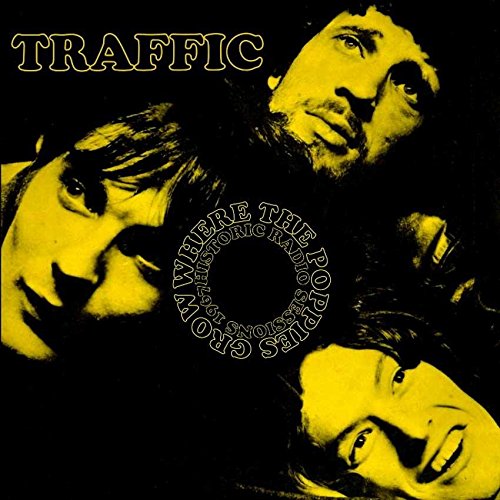
Steve Winwood formed Traffic with Jim Capaldi, Dave Mason, and Chris Wood in 1967. In the spirit of the times, the group was intended to be a cooperative, with the members living together in a country cottage in Berkshire and collaborating on their songs. Signed to Island Records their single “Paper Sun,” peaked in the U.K. Top Five in July 1967 and also spent several weeks in the lower reaches of the charts in America. Traffic recorded two sessions for Saturday Club and Top Gear shows in 1967. Session 1 first aired October 1967 while Session 2 first aired December 1967 recorded for the BBC Top Gear programme. Both are released here for the first time. Traffic also toured Europe and the live recording that comprises part two of this album was also made for radio broadcast, this time in Sweden at Radiohuset, Stockholm on September. 12th, 1967
Fallon’s old band the Gaslight Anthem went on hiatus in 2015, clearing the way for solo efforts from band members. BrianFallon released his debut, the Butch Walker-produced Painkillers, last year. When he started recording Sleepwalkers, he connected with Ted Hutt, who also produced the Gaslight Anthem LP The ’59 Sound.
Fallon is planning an extensive tour of North America and Europe in support of his new record.
Music video by Brian Fallon performing If Your Prayers Don’t Get To Heaven. (C) 2017 Island Records, a division of UMG Recordings, Inc.
The CD and vinyl box sets collecting the Island Records works of Spooky Tooth, one of the key English experimental rock bands of the 1960s and ‘70s, are out now. ‘The Island Years — An Anthology, 1967-1974’ is released worldwide by USM.
The band were originally known as Art, for a few months in 1967, when they released their sole album, ‘Supernatural Fairy Tales.’ They were then joined by American singer and songwriter Gary Wright, who went on to play with George Harrison on ‘All Things Must Pass’ and to great solo success, notably with songs such as ‘Dream Weaver’ and ‘Love Is Alive.’
By 1968, Art had transmuted into Spooky Tooth, who released the album ‘It’s All About’ in June that year, written largely by Wright and with a cover of Janis Ian’s ‘Society’s Child.’ That set was produced by Jimmy Miller, just as he was beginning his long association with the Rolling Stones. The original band also featured other notable players such as Greg Ridley, later a founder member of Humble Pie, and Luther Grosvenor, who went on to Mott The Hoople and Widowmaker.
After three further albums in 1968 and ’69 and the subsequent departure of Wright, Spooky Tooth released three more Island albums with frontman Mike Harrison, and one more without him, 1974’s ‘The Mirror.’ The band were a well-known and respected presence on the British rock scene without ever reaching the UK charts, but no fewer than eight of their albums made the American bestsellers, released first there on A&M and then Island. 1969’s sophomore release ‘Spooky Two’ was the highest-charting, at No. 44.
The 9-CD set features all of the Island albums, with a generous selection of rare and previously unreleased material added. This includes a full concert from April 1972, recorded in Germany, and a 48-page book.
An 8-LP vinyl box set comprises straight reissues of the Spooky Tooth and Art albums in replica original packaging. A full-size reproduction of the extremely rare ‘Art’ Island promotional poster, designed by the celebrated psychedelic artists Hapshash and the Coloured Coat, is included, along with a download card for all the material.
Buy the CD and vinyl editions of Spooky Tooth’s The Island Years — An Anthology, 1967-1974’
For the first single off of London-based band Flyte’s debut LP (out August 25th via Island Records), the alternative four-piece stays close to their roots. “Cathy Come Home” sets its eyes on a former schoolmate of the bandmates whose experience rings true no matter what side of the Atlantic you’re on.
“Cathy is about parents struggling to let their children out into the world,” explains lead singer Will Taylor, who forms Flyte with Nick Hill, Jon Supran, and Sam Berridge. Written from the perspective of Cathy’s parents, the song addresses the young woman in question and begins contemplatively: “Maybe you’re right / We’re holding on too tight.” But its tone soon shifts, beckoning her to return for dinner. The protective call is both banal and far-reaching, an attempt to protect that’s situated somewhere between offering a shield and building an impenetrable bubble. “We were watching a lot of Ken Loach while we were writing it,” says Taylor, “hence the slightly bleak narrative and of course, the title.” In what the band describes as a “rare” turn of events, the song’s lyrics and music arrived together. Taylor also says that it’s reflective of what to expect on the rest of the album.
“The whole album is more or less a live performance, so within those limitations we’re trying to surprise the listener as much as possible,” explains Taylor, who promises “no shortage of twists and turns” within the 35-minute framework of the album (which they hope listeners will experience from start to finish). Their four voices will continue to feature prominently, and ultimately, are core to their approach. “The vocals are where we’ve been most creative,” continues Taylor, “whenever we need to make a moment in a song work better, we use our voices.”
FLYTE’S debut album (Island Records) is out August 25th, 2017.
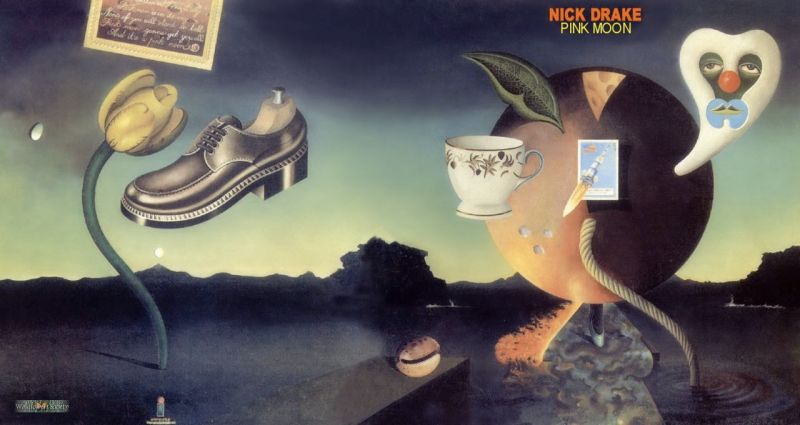
Nick Drake was planning to shear back his songs’ surplus of detail before recording his third and final album—if you could call strings and light electric guitar excessive, that is. Pink Moon was recorded in two successive nights with just Drake and producer John Wood in the room, and nothing but Drake’s acoustic guitar and a couple isolated piano runs behind his unmistakable voice. Pink Moon echoed Drake’s gradual withdrawal from civilization. It’s always been hard to ignore the crawling fragility in Drake’s performances, but on Pink Moon he’s almost aggressively alone. The slight motion of “Know” is undercut by its solitude: The beat moves him, but it’s a tough haul. The title cut, “Road” and “Parasite” are all melodically beautiful, but emotionally impossible to bear. The exhaustion ofPink Moon foretells Drake’s passing almost too well, but its trim power can’t be questioned. Released two years before Nick Drake’s death in November 1974, at the age of twenty-six,
Nick Drake has been saddled with the kind of (death) “cult” reputation that lends itself to fervent fan-kid obsession (I know, I’ve been there) by some, much to the annoyance of others. Unfortunately for the poor bloke, like Jeff Buckley, and more recently Elliott Smith, his premature passing led marketing men and music journalists to focus on his sensitive, dark, quiet “ethereal” side.
Nick Drake delivered the master tapes of Pink Moon to Chris Blackwell at Island Records, In an interview Island’s press officer David Sandison recalled that Drake’s arrival at the record company had certainly not gone unnoticed, although there had been no indication that he was delivering them a new album:
“I saw him in reception after I came back from lunch and I was talking to somebody and I saw a figure in the corner on the bench, and I suddenly realized it was Nick. He had this big, 15 ips [inches per second] master tape box under his arm, and I said ‘Have you had a cup of tea?’ and he said ‘Erm, yes’, and I said ‘Do you want to come upstairs?’ and he said ‘Yes, okay’. So we went upstairs into my office, which was on top of the landing, it was a landing that went into the big office with a huge round table where Chris and everybody else worked and there was a big Revox and sound system there, and he just sat in my office area for about half an hour … After about half an hour he said ‘I’d better be going’, and I said ‘Okay, nice to see you’, and he left. Now, he went down the stairs and he still had the tapes under his arm, and about an hour later the girl who worked behind the front desk called up and said ‘Nick’s left his tapes behind’. So I went down and it was the big sixteen-track master tape and it said NICK DRAKE PINK MOON, and I thought ‘that’s not an album I know’. The first thing to do was get it in the studio to make a seven and a half inch safety copy, because that was the master. So we ran off a safety copy to actually play, and I think twenty four hours later or so, it was put on the Revox in the main room and we heard Pink Moon.”
Pink Moon was recorded over a few days with producer John Wood prior to its February 1972 release date. It’s a brief record (twenty eight minutes), mainly focusing on a mal-tuned acoustic guitar and vocals. With a more lo-fi nature than its older siblings and his continued relative obscurity. Pink Moon does feature the occasional sparse message, (“Know” features only the lines: “Know that I love you / Know I don’t care / Know that I see you / Know I’m not there“), but the album offers so much more than that.
The album’s opening title track is lyrically simplistic and instrumentally nocturnal, but more in a relaxed, family bonfires and pumpkins with funny faces style. The piano almost sends mist through the stereo. It’s an atmosphere that permeates the next two songs before “Which Will” changes tack. The lyrics are so simplistic one can’t possibly quote them in context. It could be about breakups, breakdowns, hope or ambivalence.
“Horn” is a really beautiful, poignant instrumental. “Things Behind the Sun” bends from the franticly sinister to the carefree. The aforementioned “Know” feature’s the four lines above, but over a surreal background juxtaposing Drake’s sighs with an off-kilter guitar line more reminiscent of The Fall’s Rough Trade years than Damien Rice. In all fairness to the publicists, “Parasite” is a rather bleak song. It’s also one of my favorite songs of all time. Whether Drake is “changing a rope for a size too small“, or “lifting the mask from a local clown” and “feeling down like him,” I’m smiling all the way. There’s a touch of surreal cynicism on “Free Ride,” seeing through “all of the pictures that you keep on the wall…all of the people that will come to the ball.” However it seems more indicative of somebody at the back of the room laughing at the people who can’t quite tell why they’re dancing than someone who deserves a carefully written biography. “Harvest Breed” is a fantastic hangover tune, particularly when backed by a color-free sky. “From The Morning” closes things with some renewed vigor, as people “rise from the ground.” I hadn’t listened to Pink Moon in a long time. It’s still my favorite NickDrake album, and one of the best of its era.
Flyte are Will Taylor (vocals, lead guitar), Nick Hill (bass, vocals), Sam Berridge (keyboards, guitars, vocals) and Jon Supran (drums, vocals).
The band have spent the first months of 2017 in Australia putting the finishing touches to their debut album with ‘Courtney Barnett’ producer Burke Reid, a collaboration that delves deep into new sonic territory to create a modernist but timeless sound that revels in coming-of-age nostalgia, cinematic synth melodies and prolific storytelling themes of life, love and death.
Last year, vocalist Will Taylor and keys player Sam Berridge got drunk and uploaded a cover of Joni Mitchell’s ‘River’ to their Facebook page. The slap-dash DIY charm and heart-wrenching voices started a Flyte-movement. Racking up over 1M streams, fans wanted more sessions, and Flyte began carefully curating covers in London landmarks with towering acoustics, earning a reputation for their trademark four-part harmonies, as well as their live sound.
Accomplished songwriters Will, Sam, Nick, and Jon have released a flurry of alternative-indie anthems including ‘We Are The Rain’, ‘Closer Together,’ and ‘Light Me Up’ over the past few years and have amassed over 1.5M Spotify streams. Evolving together as a band and great friends.
Music video by Flyte performing Victoria Falls. (C) 2017 Island Records
Looks can be deceiving. And with Roxy Music, that was the entire point.
Bred mostly in the working-class backgrounds from the industrial outskirts of mid-century London, the core personnel who founded Roxy Music did so as much out of artistic vocation as they did self-image reformation.
The otherworldly personae, the cobbled genre-mutations, the elegantly forged retro-futurism—the look and sound of Roxy Music are the visual and aural reflections of an inflated sense of grandeur cycling between fantastical and romantic. And while it was the unorthodox of art-school training that the band—especially vocalist Bryan Ferry, saxophonist-oboist Andy Mackay and noise architect Brian Eno wore on their sleeve, no environment could inspire such appetites for extravagance as the bleakness of rural England.
Brian Ferry, was the son of a County Durham coal miner, sought escape in the far-off glamour of Old Hollywood and Tin Pan Alley standards while Eno, brought up in Essex, was transfixed with the sonic control of tape manipulation; Mackay’s activities were decidedly avant-garde, partaking in experimental sound performances and the radical Fluxus art movement. Guitarist Phil Manzanera, a virtuoso with particular hankerings for complex prog-rock and psychedelia, was the sole well-heeled Roxy youth, while drummer Paul Thompson the only whose blue-collar origins remained resolutely well-preserved in taste.
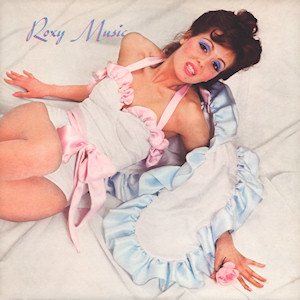
It’s not uncommon to hear 1972’s Roxy Music framed as the natural result of Ferry’s elaborate aesthetic vision compounded by Eno’s technical wizardry. Other less prominent, but equally wastebin-bound, interpretations attribute the LP’s glow to either Eno or Ferry alone. Each of these theories, however, offer indefensibly lacking accounts of the gorgeous, alien glamour captured on Roxy Music’s self-titled debut. There’s hardly a more compact tutorial on the world of Roxy than the album’s track-one, side-one. The band’s penchant for glamour was showcased both in the lyrics and in the 1950s-style album cover. The photographer Karl Stoecker shot the cover, featuring model Kari-Ann Muller, who later married Mick’s brother Chris Jagger (a stylised portrait of Kari-Ann Muller also graces the cover of Mott The Hooples album “The Hoople” . The album was dedicated to Susie, a drummer who auditioned for Roxy Music in the early days
EG Management financed the recording of the tracks for their first album, “Roxy Music” , recorded in March–April 1972 and produced by King Crimson lyricist Pete Sinfield Both the album and its famous cover artwork were apparently completed before the group signed with Island Records. A&R staffer Tim Clark records that although he argued strongly that Island should contract them, company boss Chris Blackwell at first seemed unimpressed and Clark assumed he was not interested. A few days later however, Clark and Enthoven were standing in the hallway of the Island offices examining cover images for the album when Blackwell walked past, glanced at the artwork and said “Looks great! Have we got them signed yet?” The band signed with Island Records a few days later. The LP was released in June to good reviews and became a major success,
The introduction to Roxy Music, “Re-Make/Re-Model,” stirs gently before it rumbles. Entering with a musique concrète sound collage abruptly supplanted by a lone Ferry suggestively moving between a pair of two-note piano chords, the song then erupts with the band firing a volley of competing fragments that swell into a formidable art-rock clash. “I tried but I could not find a way,” Ferry bellows through Manzanera’s maniacal noodling and Thompson’s percussive thunder; Mackay’s tenor sax trades blows with Ferry’s vocal intervals as Eno paints a squealing sonic backdrop. Building toward the song’s close, the band repeats a series of breaks, granting a brief solo moment to each member—exploiting the prog-rock bravado of the era to assert their avant-garde idiosyncracies.
“Virginia Plain,” the band’s first single was, consequently, also their first big hit, reaching no. 4 on the U.K. charts. A daring choice for a single, the song spurns the mandatory inclusion of a chorus, coasting instead on a continuous verse, offering only seldom breaks in the dominant melodic motif.
“Looking back, all I did was look away,” Ferry continues on “Re-Make/Re-Model.” But in terms of Roxy Music’s essence, nothing could be further from the truth. Ferry’s longing admiration for the stilted glitz of Golden Age cinema is transparent all throughout the album, even amid the futuristic imagery and cacophonous experimental penchants.
The track “2HB” is the most glaring example. Discreetly abbreviated from “To Humphrey Bogart,” the song is an unabashed tribute to Humphrey Bogart and his role in the celluloid classic Casablanca in particular. Lyrically, “2HB” incorporates dialogue from the film while the sax melody provided by Mackay is lifted from “As Time Goes By,” a central musical piece in the film.
The band’s appreciation for motion-picture memorabilia is felt where it isn’t outrightly declared. “Chance Meeting” plays like a despairing solo scene following act one of a Depression-era musical, before Eno’s sonic trickery intensifies the lament and drags it into the realm of feverish nightmare. The gang-vocal harmonizing and whimsical ratchet-and-clapper percussion on “Bitters End,” which closes out the record, vaguely evoke a pre-war barbershop setting. The medley “The Bob” inspires a variety-show mood, with each section separated into differing segments, structured in the manner of an orchestral suite.
Roxy Music outlasted the fleeting mania of ’70s glam rock by revising it to fit their image, rather than vice versa. And accordingly, their debut album is a triumph not just for how it shines amid the fad, but also in how it could just as easily be argued with that it belongs nowhere near such a thing.
After sharing bold new single Ultralife, Josephine Vander Gucht and Anthony West, better known as OhWonder, have revealed their new album of the same name will be out on 16th June via Island Records!
Across its twelve tracks, ‘Ultralife’ is set to take the hallmarks of the band’s signature sound and add new life and energy, experimenting more with sounds and a variety of genres. While writing and recording in New York and London, the pair also had to cope with the British capital’s wealth of public transport, the sounds of buses coming into their studio. “We could have made our lives easier by going to a studio with soundproofing, but that isn’t us,” Josephine explained in a statement.
The band have also shared a brand new single, ‘Lifetimes,’ a track about climate change that’s quite unlike anything the pair have ever released before. With a deep hip hop vibe, the track starts with a euphoric high before descending into striking beats and melodies, and even has a little bit of rapping from Anthony.
Written and produced by Oh Wonder , Music video by Oh Wonder performing “My Friends”. Island Records
To coincide with the 30th anniversary of U2’s iconic album, The Joshua Tree, Island Records will release a 2017 mix of ‘Red Hill Mining Town’ on limited edition 12” picture disc, featuring the classic photography of Anton Corbijn in colour. The previously unreleased mix is by Steve Lillywhite, who produced the band’s critically acclaimed debut, ‘Boy’. ‘Red Hill Mining Town’ is famously “the single that never was”, originally discussed as the second single from The Joshua Tree but then put to one side at the last minute in favour of ‘I Still Haven’t Found What I’m Looking For’. The Joshua Tree went to number1 in the U.K, U.S., Ireland and around the world, selling in excess of 25 million albums, and catapulted Bono, The Edge, Adam Clayton and Larry Mullen Jr “… from heroes to superstars”
U2 has shared a preview video of the vinyl being cut alongside the updated version of the track.








 The Fat Angel Sings