Oneohtrix Point Never’s ‘The Pure and the Damned’ video, starring Robert Pattinson, Benny Safdie, and Iggy Pop. Directed By The Safdie Brothers and taken from Oneohtrix Point Never’s Cannes 2017 award winning ‘Good Time Original Motion Picture Soundtrack’, out now via Warp Records.
A computer-animated Iggy Pop stars alongside Robert Pattinson in the strange new video for Oneohtrix PointNever’s “The Pure and the Damned.” Oneohtrix Point Never and Iggy Pop collaborated on the song as part of the former’s soundtrack for Good Time, the Safdie Brothers’ while Benny Safdie appears in the clip as well.
The clip opens with CGI Iggy Pop standing shirtless – of course – outside a house in the woods, singing the haunting piano ballad. Eventually the animated punk star appears inside the house, sitting on Pattinson’s bed and watching as the actor tries to force Safdie’s character to eat something. “The Pure and the Damned” takes an eerie, synth-heavy turn as Pattinson’s character walks outside and follows a trail of detritus to a strange wolf-like creature feasting on the innards of another animal. Wielding a sword, Pattinson engages the beast in a stare down that’s tense yet tinged with a sense of camp and melodrama.
Eagle Rock Entertainment will release American Valhalla – the vivid documentary tracing the musical journey of Iggy Pop and Joshua Homme – on DVD and digital formats on March 9th.
Something miraculous happens when two kindred spirits collaborate…which is exactly what happened when Iggy Pop and Queens Of The Stone Age frontman Joshua Homme joined forces to create Pop’s 2016 album Post Pop Depression. American Valhalla, co-directed by Homme and Andreas Neumann, traces this union – from the initial songwriting sessions and recording process to the subsequent critically-acclaimed Post Pop Depression tour.
Originally released in theaters via More2Screen and Eagle Rock Films in the summer of 2017, American Valhalla goes beyond a behind-the-scenes music documentary. Presented via Neumann’s stunning photography and cinematography, with intimate conversations led by Anthony Bourdain, the film explores themes of taking chances, instincts, and legacy. As Homme stated, “You risk nothing, you gain nothing” – a mantra echoed throughout the film’s 81 minutes.
Once inspired by Pop’s revolutionary raw brand of rock to make music of his own, everything comes full circle when Homme is contacted by his idol, out of the blue, to work on some songs. We see them meet, write and record (in total secrecy) at Rancho De La Luna studio in the Mojave Desert with Queens of the Stone Age’sDean Fertita (guitarist) and Arctic Monkeys’ Matt Helders (drummer). The lens is set on these interactions, as we watch these relationships evolve. Between lyric sheets, letters, journal entries, and riffs, viewers can experience the organic chemistry that blossomed into Post Pop Depression.
“As we got to know each other, you blew my mind” Homme tells Pop in the film. “You really came with such an open mind and saying ‘Yeah, I know what I’ve done but I’m here to…look forward.’”
As they prepared the tour to support the album, Iggy received news of the passing of David Bowie – his longtime friend and confidant. In these moments, Pop contemplates his own impermanence and, at his most vulnerable, pushes harder with carpe diem-resolve to rehearse and add the next great landmark to his legacy. Pop, Homme, Fertita, and Helders, are joined by Troy Van Leeuwen (guitarist – Queens of the Stone Age) and Matt Sweeney (bassist/guitarist) as they hit the road.
American Valhalla sets its scope onstage and backstage as they warm up, pump each other up, and deliver explosive sets, leading up to the final show at the Royal Albert Hall in London (captured on Post Pop Depression: Live From The Royal Albert Hall DVD and Blu-ray released via Eagle Rock Entertainment in 2016.
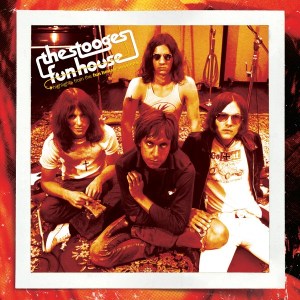
Back in 1999, Rhino Handmade had an early triumph with the release of the 7-CD box set The Fun House Sessions, chronicling the making of the album from the quintessential proto-punk bad boys, TheStooges. Now Run Out Groove has boiled down that set into four sides of vinyl and fourteen choice selections as “Highlights from The Fun House Sessions”. Recorded with producer Don Gallucci of The Kingsmen at Elektra Sound Recorders in Los Angeles back in May 1970 as The Stooges’ sophomore effort, Fun House made “Louie, Louie” look positively tame, and was commercially unsuccessful upon its initial release. But its influence as a key building block in the punk revolution can’t go unnoticed, as it quickly developed a cult following among both critics and fans. Blending fast and furious hard rock with improvisation and even a jazz element thanks to Steve Mackay’s saxophone and the loose feel, Fun House showed Iggy Pop, Dave Alexander, Ron Asheton, Scott Asheton, and Mackay at their most primal yet still pushing the musical envelope forward.
The first two sides of Highlights are sequenced to follow the track order of the original LP, with the third and fourth sides offering additional alternate takes, fly-on-the-wall studio chatter, and a 17-minute jam session/early version of the closing “L.A. Blues” entitled “Freak.” There are plenty of ferocious nuggets here that are illuminating to fans of the original album but accessible enough to be enjoyed on their own. Take 6 (Reel # 6) of “Down on the Street,” the lone A-side drawn from Fun House in its final version, spellbindingly pulsates. The taut garage band performance on “Loose” (Take 16, Reel 4) is almost-but-not-quite-commercial, no small accomplishment for The Stooges. Like Alexander’s throbbing bass on “Dirt” (Take 5, Reel 11) or Ron Asheton’s screaming guitar on “1970” (Take 2, Reel 1), Iggy Pop’s throaty wail on “See That Cat (T.V. Eye)” (Reel 2) explodes with no compromises. Desperation drips from his raspy delivery on “Lost in the Future” (Take 3, Reel 3). Outtake “Slide (Slidin’ the Blues)” offers something a bit different, with Mackay’s tenor sax wending through the bluesy drawl. Everything about Fun House is even more primal and raw in these alternate versions – musically unflinching, brutal, and immediate.
Designed by Peto Gerth, Highlights from The Fun House Sessions boasts a glossy gatefold with new liner notes. In a fine touch, the two multi-colored swirl 180-gram LPs, stored in protective sleeves, have vintage Elektra butterfly replica labels. With The Complete Fun House Sessions long out-of-print in CD format, this vinyl collection of screeching, raw power is a welcome arrival.
Third Man Books is pleased to announce our SIGNED SPECIAL EDITION of TOTAL CHAOS: The Story of The Stooges / As Told by Iggy Pop by Jeff Gold. Each Special Edition is signed by Iggy Pop himself, includes for the first time on vinyl two songs from Iggy’s pre-Stooges band THE PRIME MOVERS, and three reproduction Stooges posters co-billing the legendary band with the likes of John Coltrane, MC5, and more! Extremely limited edition.
EXCLUSIVE TO THE SPECIAL EDITION: Each Special Edition has a custom-made signature book plate that is SIGNED and NUMBERED by Iggy Pop himself* Includes a limited edition, first time available on vinyl,two-song single of Iggy’s pre-Stooges band The Prime Movers* Three exclusive reproductions of original Stooges posters* Book cover is specially printed in metallic gold ink* Available only from Third Man Books
*The first book to tell the story of The Stooges from Iggy Pop’s own words*Includes hundreds of rare and unseen photos*Additional contributions from Ben Blackwell, Dave Grohl, Josh Homme, Joan Jett, Johnny Marr, and Jack White*Rolling Stone ranked The Stooges in their Top 100 Artists of All Time*The Stooges are a Rock n Roll Hall of Fame inductee.*Author Jeff Gold wrote the best selling 101 Essential Rock Records*Editor Jon Savage wrote the best selling book England’s Dreaming: Anarchy, Sex Pistols, Punk Rock, and Beyond.
[The Stooges] took it to a place that no one else ever had. I think that they made such a lasting impression on musicians for decades to come.—Dave Grohl
Those first three Stooges records are to me perfect rock ‘n’ roll—absolutely perfect. It’s sweet enough for the girls and tough enough for the guys. It doesn’t care about you, you have to care about it.—Josh Homme
For me, Iggy and The Stooges have to be one of the greatest American rock bands that have ever been.—Joan Jett
Discovering The Stooges helped to change my life.—Johnny Marr
The Stooges’ Fun House is to me the very definition of Detroit rock ‘n’ roll, and by proxy the definitive rock album of America.—Jack White
Two years after the interstellar, metallic Garden of Delete, The esoteric electronic experimentalist Daniel Lopatin (AKA Oneohtrix Point Never) returned to score a crime drama starring Robert Pattinson. Retaining his own burning palette and pushing it through a Vangelis/Carpenter mesh, Lopatin continues to find new ways to inject anxiety and awe under the skin.
Its a somber, piano-heavy collaboration with Iggy Pop in which the Stooge dreams about petting crocodiles is a good place to start, but Lopatin delivers the high-voltage thrills all on his own.
check out the essential Tracks: “Hospital Escape / Access-A-Ride”, “The Acid Hits”, and “The Pure and the Damned”
Oneohtrix Point Never’s ‘The Pure and the Damned’ video, starring Robert Pattinson, Benny Safdie, and Iggy Pop. Directed By The Safdie Brothers.
This video features the tracks, Lust for Life and The Passenger, which are originally from the Iggy Pop album, “Lust for Life”. The album had been released about a month prior to the show, on the 29th of August. Most of the footage used here was shot for So it Goes; a British TV music show, presented by Factory Records founder, Tony Wilson on Granada Television between 1976 and 1977. So it Goes specialised in showcasing the punk rock scene of the day.
Manchester was the ninth date of the Lust for Life tour. The tour had started in Iggy’s then home city of Berlin on September the 12th and it would finish up two months later on the 18th of November at the Santa Monica CivicAuditorium. The musicians on the Lust for Life album had been The Idiot touring band of: Tony Sales – bass, Hunt Sales – drums, Ricky Gardiner – guitar, David Bowie – keyboard and backing vocals. Plus Carlos Alomar – guitar. However, by the time of the Lust for Life tour, Bowie and Gardner were gone, replaced by Bowie’s former lead guitarist from the Station to Station tour, Stacy Heydon, and multi-instrumentalist, Scott Thurston, on guitar, piano, synthesizer, harmonica.
Stacy Heydon, on how he came to be chosen for the Lust for Life tour “Iggy accompanied us throughout the Station to Station tour. He and Dave were best mates. I was approached by Jimmy. No doubt Dave gave his blessing”. Scott Thurston had already been a member of the 1973 – 74 live incarnation of The Stooges, and he had played on the Kill City material in 1975.
Stacy Heydon talking about the tour with Iggy: “The people in Manchester were among the best. Being mostly of English dissent I felt very much at home throughout the country. Jimmy was and is quite the entertainer. On countless occasions he would be sharing his extensive knowledge on things like French impressionists, psychology, various political systems, specific museum pieces and the like. Two steps later as soon as we’d taken the stage all bets were off. Being on tour with Mr Osterburg was not for the faint of heart but it did open my eyes to the immense wit and chameleon like qualities that he could extract from his psyche at will, and was the very fabric of his being. That said, whichever side of the cloth you happened to be with at any given time seemed to be the antithesis of the other. If it’s true that opposites attract, that little fucker must love himself as much as we all do!”
The material shot for So it Goes was shown on British TV about a month after the live show, on the 30th of October. Part of The Passenger was shown, a short interview with Iggy, and at the end of the show, part of Lust for Life, with credits played before the end of the song. Unfortunately, this broadcast led to the early demise of So it Goes. As John Cooper Clark states on his narration on “Anarchy in Manchester”, “Unfortunately for So it Goes, his (Iggy’s) noble onstage savagery led to the shows cancelation in late ’77. That FY appendage didn’t do it for Granada’s top brass.” And so the planned third series of So it Goes never happened.
A little extra material from the Iggy interview, and extra footage and different audio sources of the two songs from the live show have surfaced here and there. So as per my usual remit with these recreation videos, from the 10+ sources I could find, I have compiled all the best quality bits and pieces into one hopefully fluid and enjoyable whole. I could somewhat complete the two live performances. However no footage could be found for the first minute and a half of Lust for Life, so I used footage from another European date on the tour (possibly Amsterdam). It’s not a perfect match – Iggy is wearing different clothing and the venue and audience are obviously different, but better than a blank screen or omitting a large chuck of the track, I think. Frustratingly, in the multiple TV sets that are the backdrop to Tony Wilson’s intro, we see more footage from the show and two other Iggy interviews! What happened to that material?!
The amazing cover shot of Iggy leering into a Granada Televison camera was taken at the Manchester show by Kevin Cummings.
I am grateful to Easy Action for providing audio tracks and allowing me to use them on this video. The Manchester audio performances of Lust for Life and The Passenger are available to buy from Easy Action, as downloads and a limited edition 10” vinyl that has just been released this weekend.
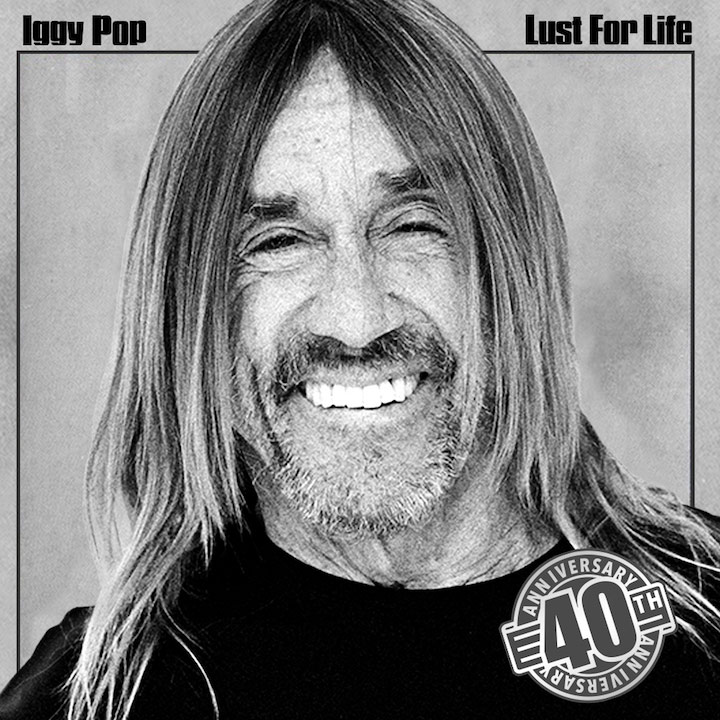
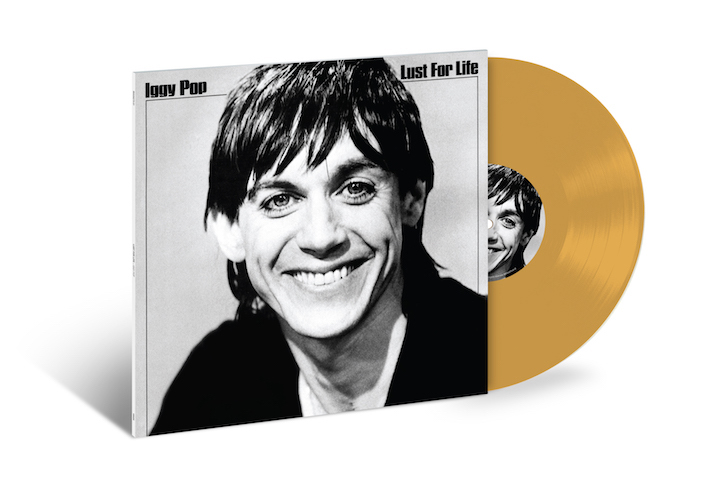
It was love at first drum. You can’t mention Iggy Pop’s “Lust For Life” without mentioning the hypnotic infectious drumbeat that kicks off the title cut with a bang. The lyrics are some of Iggy’s best. “I’m worth a million in prizes” is one of the greatest lines in rock. When the third verse comes in, the listener knows all the words and what they don’t…they’ll make up. Lust For Life is often considered the best post-Stooges Iggy Pop album, it is the 40th anniversary of Iggy’s explosive solo album.
Iggy’s first three solo releases all came out in the same year – 1977. Lust For Life came out on the heels of Iggy’s first post-Stooges release, The Idiot. The album was a collaborative effort with David Bowie (who had previously mixed The Stooges last album, Raw Power) and was heavily influenced by German culture, as both musicians were living in Berlin at the time. The band went on tour and shortly after, they jumped into the studio to write and record. On tour, they’d been playing The Idiot and old Stooges cuts but during sound checks, the band started experimenting with ideas.
Recording for Lust for Life started in April and ended in June, with the album hitting the shelves on 9th September 1977. Not even half a year had passed since the release of The Idiot and there was a new rock n’ roll record from Iggy. During this time, Iggy had also made a third album, Kill City, a demo he recorded in 1975 but most labels were hesitant, due to Pop’s reputation at the time. After the success of Lust For Life, the smaller label Bomp!Records jumped at the chance to put it out in November of 1977.
While The Idiot sounds more atmospheric and experimental for Iggy, Lust for Life sees him return to straightforward rock’n’roll. In the studio, Bowie would sit at a piano and name famous rock songs and say, “Okay now we’re going to rewrite [insert song]” and knock it out while Iggy would record it. While Bowie co-wrote many of the tracks, it’s Iggy’s lyrical wit and musicality that truly shines, along with an excellent lean and mean backing band provided by brothers Tony and Hunt Sales for the rhythm section, Carlos Alomar and Ricky Gardiner on guitars and Bowie on keyboard and backing vocals.
The infectious riff on the title cut, ‘Lust for Life’ was inspired by the Morse code opening to the American Forces Network News in Berlin while David and Iggy were waiting for 70s buddy cop series Starsky and Hutch to start. Whereas the song’s lyrics heavily reference all the stripteases, drugs, and hypnotizing chickens that make up Beat novelist William S Burroughs’ book, The Ticket That Exploded.
Iggy has always been a less-is-more kind of songwriter, so when it came to his lyrics, he took direction from the kid’s show host, Soupy Sales, who instructed kids to write fan letters that were 25 words or less. Bowie was so impressed by the expediency of Iggy’s improvisational lyrics that he ad-libbed most of the lyrics on his Heroes album.
In the 1980s, Iggy was financially struggling and facing the same demons of his early career.
At this time, Bowie famously covered the song they co-wrote together from The Idiot, ‘China Girl’ for his album, Let’s Dance. However, it’s lesser known that Bowie also covered two songs from Lust For Life,‘Neighborhood Threat’ and ‘Tonight’ on his album Tonight, which helped Iggy get back on his feet financially and get clean.
‘The Passenger’ is loosely based on a Jim Morrison poem from his collection called “The Lords/Notes on Visions” and while many Berliners may like to imagine Iggy riding along on their enviable public transit system, the song is actually written from his perspective of riding shotgun in David Bowie’s car, since Iggy was without a car or license at the time. The title also takes its name from Michelangelo Antonioni’s movie The Passenger starring Jack Nicholson, which Pop had spotted on a billboard in LA before decamping to Berlin.
With the success of The Idiot, RCA had given the newly popular Pop a rather large advance to make his follow-up. As Iggy recounted to biographer Joe Ambrose in his book, Gimme Danger: The Story of Iggy Pop:
“David and I had determined that we would record that album very quickly, which we wrote, recorded, and mixed in eight days, and because we had done it so quickly, we had a lot of money left over from the advance, which we split.”
In the summer of 1970, after a shambolic set at the Goose Lake Rock Festival in their native Michigan, The Stooges put together a new lineup as they prepared to hit the road in support of their second album, “Funhouse”Zeke Zettner, previously part of The Stooges road crew, became their new bassist, and second guitarist BillCheatham was brought aboard to reinforce the primal guitar work of Ron Asheton. With vocalist Iggy Pop, drummer Scott Asheton , and sax player Steve MacKay joining the new recruits, the band headed to New York City for a three-night stand at Ungano’s, a rock club in Manhattan. Danny Fields the legendary behind-the-scenes figure who signed the band to Elektra Records, brought a portable tape recorder to the show on August 17th, 1970, and “Have Some Fun, Live At Ungano’s is a suitably raw document of The Stooges in full flight. Sounding taut and feral, the band rips through six songs from the “Funhouse” album before bringing the set to an explosive conclusion with the spontaneous “Have Some Fun”/”My Dream Is Dead.” is one of the few live recordings documenting The Stooges during the period when Ron Asheton was lead guitarist. While the fidelity leaves something to be desired, the force and intensity of the performance make this a must for anyone wanting to hear The Stooges when they were the most dangerous band in rock.
Exclusive release from 2015.
Black/white splatter vinyl with poster insert.
7500 pressed.
Recorded live on 18th August, 1970
Tracklist
A1 Going To Ungano’s
A2 Loose
A3 Down On The Street
A4 T.V. Eye
A5 Dirt
B1 1970
B2 Fun House
B3 Have Some Fun / My Dream Is Dead
After David Bowie died in January 2016, his occasional collaborator Iggy Pop recalled the superstar musician’s impact on his career. Iggy didn’t undersell Bowie’s importance. “He resurrected me,” Pop told the New York Times “He was more of a benefactor than a friend in a way most people think of friendship. He went a bit out of his way to bestow some good karma on me.”
Bowie had been doing that ever since he’d heard the Stooges’ first two records, impressed by the force of nature known as Iggy and his pals’ gritty drive and wild noise. At the height of Ziggy-mania, he helped the former JimOsterberg kinda-sorta put the Detroit band back together and served as producer 1973’s “Raw Power” . But the Stooges imploded again, leaving Pop broke, drug-addicted and directionless. He checked himself into a mental institution.
While there IggyPop was paid a visit by Bowie, who then invited him on his 1976 tour. With both in the grip of drug addiction, they made a plan to move to Europe, get clean and make music at the same time. This marked the beginning of Bowie’s vaunted “Berlin Trilogy”, although the shift in musical style and tone actually began as the partners began working on what would become Iggy’s solo debut, “The Idiot”.
Pop and Bowie began sessions at Château d’Hérouville, just outside Paris, in the summer of 1976. Although they were staying in France, Iggy claimed that the two were inspired by “the idea of Berlin,” as well as the so-called krautrock of bands such as Neu! and Kraftwerk . In contrast to the garage rock of the Stooges, Pop and Bowie worked with drum machines, synthesizers and even toy instruments. It was very experimental even by Bowie’s design, according to Pop.
“I think I functioned as an outlet for his overflow. Because there are things he did with me that he couldn’t do as David Bowie, because it would have slowed him down or might have been a wrong move,” Pop said in 2006. “And then he was also able to use me to practice. … He made an Iggy album first, but watched the engineers there in the studio, learned how they worked, thought about it, had a chance to get to know the desk, and have daydreams about his own record while he worked on mine.”
So Pop saw The Idiot as a sort of test run/impetus for Bowie’s forthcoming “Low” which also began to take shape in France, then Germany in 1976. More than a decade later, the Thin White Duke confirmed Iggy’s take on the situation.
“Poor Jim, in a way, became a guinea pig for what I wanted to do with sound,” Bowie wrote in the Sound + Vision liner notes. “I didn’t have the material at the time, and I didn’t feel like writing at all. I felt much more like laying back and getting behind someone else’s work, so that album was opportune, creatively.”
Iggy would characterize his and Bowie’s working relationship in a few ways. One of them was that Bowie was like a film director. After all, he did encourage Pop to sing like Mae West on “Funtime.” Bowie would sometimes initiate a musical idea, a title, a concept and prod his collaborator to flesh out the idea. Pop later compared the relationship to My Fair Lady‘s Henry Higgins and Eliza Doolittle.
“He subsumed my personality, lyrically, on that first album,” Pop recalled, comparing it to having “Professor Higgins say to you, ‘Young man, please, you are from the Detroit area. I think you should write a song about mass production.’”
And “Mass Production,” with its finale of intertwined synthesizers, became The Idiot’s closing track. “Dum DumBoys” came about when Bowie suggested that Iggy write lyrics about his former band. For “Nightclubbing,” Bowie told him to imagine he was “walking through the night like ghosts.”
But not all of the concepts came from David. Iggy developed “China Girl” after falling for the girlfriend of French singer-actor Jacques Higelin, who was recording at the same studio. One night, Pop confessed his passion to Kuelan Nguyen, who replied with “Shh…” The lyrics were paired with something Bowie and Pop had created on toy instruments.
By the time the duo moved from Paris to Munich to Berlin, they had the material, although Bowie’s producer TonyVisconti recalled having to do quite a bit of mixing to get Pop’s album ready for release. Inspired by Fyodor Dostoyevsky’s novel of the same name (a Bowie idea),The Idiot was released on March 18th, 1977.
Even though The Idiot material predated the Low sessions, Bowie’s album was given precedence. It’s likely that the star wanted to debut the new “sound” with his own LP, not the one he had co-written and produced, but bore Pop’s name and picture on the sleeve.
Still, Bowie joined Pop’s band on keyboards to help promote The Idiot, which Iggy describedas “a cross between James Brown and Kraftwerk.” Meanwhile, Pop and Bowie’s German expressionism would continue, as Bowie made two more LPs in the trilogy and the duo collaborated onLust for Life, which came out only six months after The Idiot.
Even though Pop’s solo debut has been criticized for Bowie’s heavy hand, the record had a major influence on future new wave, alternative, gothic and electronic rockers .
Iggy Pop had hit bottom after the messy breakup of the Stooges and he needed help, and when friend and fan David Bowie offered to lend him a hand, he was smart and grateful enough to accept. Bowie produced Iggy’s first solo album, “The Idiot”, and after Iggy set up a tour to promote the record, Bowie put together the band and tagged along as their keyboard player. Bowie’s presence insured a larger audience than Iggy had attracted during the grim final days of his band, and he was determined to prove he could deliver the goods without making a spectacle of himself or collapsing into a drug-sodden heap on-stage.
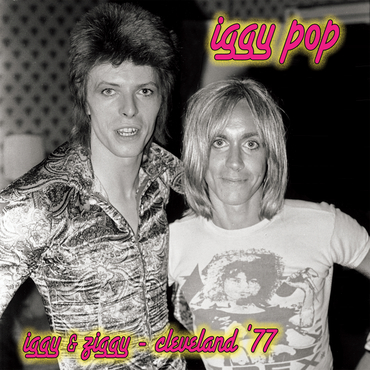
Unfortunately, anyone familiar with Iggy’s body of work knows the last thing you want from one of his live shows is a professional-sounding performance without a sense of danger, and unfortunately, that’s what the audience got during this March 21st, 1977 show in Cleveland, Ohio, part of a three-night stand Iggy and the band would perform at the Agora Ballroom. Iggy & Ziggy: Cleveland ’77 finds Iggy in fine voice, and at a time when he had a lot to prove, he leaves no doubt he was a solid musician and showman, singing with a sense of control and dynamics he couldn’t approach with the Raw Power-era Stooges.
However, Iggy also seems clearly afraid to push this material too far, and the caution robs the songs (nine of which are drawn from the Stooges‘ songbook) of much of their life force. Even worse, guitarist Ricky Gardiner doesn’t seem to know what to do with the Stooges material — he’s at least as skillful as Ron Asheton or James Williamson, but his attack is so toothless and polite that he reduces some of the greatest rock songs ever to mush. (Bowie’s keyboards are not nearly as ill-advised but they don’t fit the old material very well, though Hunt Sales and Tony Sales are a great rhythm section who do what they can to give Iggy the energy he needs.) Some of the material from this show also appeared on Iggy’s lamentable live album TV Eye Live.






 The Fat Angel Sings