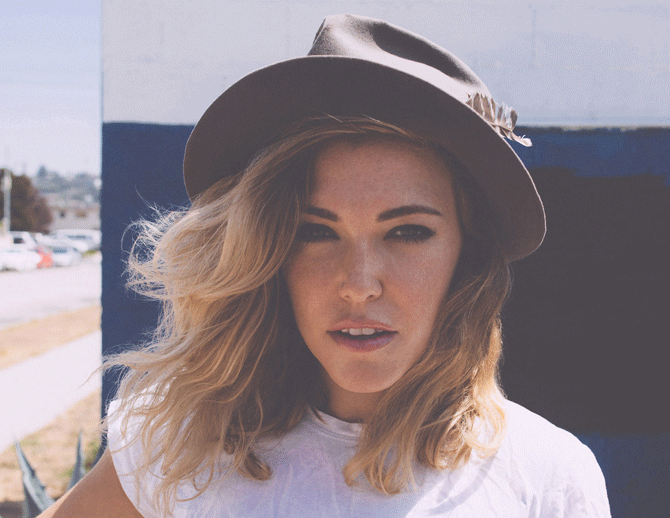
Growing up in Boston, Rachel Platten recalls harmonizing with her family to finely crafted pop songs – from Sam Cooke to The Beatles – that dominated her parents’ vinyl collection. As a teenager, Rachel gravitated towards, and began to become affected by, hip-hop and female singer-songwriters. “My CD collection was Tori Amos and Patti Griffin but then A Tribe Called Quest and Nas.” The commonality between the two seemingly different genres: confessional and vulnerable songwriting. Singing in various bands in New York Rachel went solo and booked herself on a coffee shop tour before collating her demos into an album and releasing single “1000 Ships” on an indie label. Her first single through Columbia “Fight Song” followed in 2015 and Wildfire is available now.
Jeff Lynne’s ELO packed London’s enormous Wembley Stadium to the rafters this past June with a greatest-hits set featuring many of the band’s most classic songs including “Mr. Blue Sky,” “Evil Woman,” and “All Over theWorld.” Now, that gig is getting a wide release this Friday, November 17th. Wembley or Bustwill arrive on that date from Columbia Records in a variety of formats: 2CD/1DVD; 2CD/1BD; 2 CD; and 3LP.
Jeff Lynne’s ELO performing Telephone Line (Live at Wembley Stadium). (C) 2017 Big Trilby Records, under exclusive license to Columbia Records,
Recorded on June 24th, the Wembley concert has been described by recent Rock and Roll Hall of Fame inductee Lynne as “the best time I ever had in music” and “beyond anything I could have imagined.” The upcoming release preserves the 23-song marathon setlist, which in addition to the famous ELO songs, also included The TravelingWilburys’ “Handle with Care” – a particularly poignant inclusion now after the untimely passing of Lynne’s friend and bandmate, Tom Petty. The nostalgic ballad “When I Was a Boy,” from ELO’s acclaimed 2015 album All Alone in the Universe, was also played.
You can watch the trailer for Wembley or Bust at the link below, and the track listing and pre-order links are also available now! Look for this joyful release this Friday, November 17th
Depeche Mode has been performing a cover of David Bowie’s “Heroes” on its Global Spirit Tour for the past several months, and today the group released a music video for a studio version of the cut in honor of the iconic song’s 40th anniversary. Tomorrow marks 40 years since Bowie released the title track from “Heroes” – the second in his acclaimed and so-called ‘Berlin Trilogy’. Having made their rendition a staple highlight of their ‘immaculate’ recent live sets, Depeche Mode have honoured the song with an official cover and video recorded from the ‘Highline Sessions’ and directed by Tim Saccenti.
Of the song, frontman Dave Gahan says:
’Heroes’ is the most special song to me at the moment. Bowie is the one artist who I’ve stuck with since I was in my early teens. His albums are always my go-to on tour and covering ‘Heroes’ is paying homage to Bowie.”
Music video by Depeche Mode performing Heroes. (C) 2017 Venusnote Ltd., under exclusive license to Columbia Records,
“The Freewheelin’ Bob Dylan” is certainly one of the most well-known Dylan’s record. It put Bob on the map as this new Folk singer with incredible original compositions and lyrics.
The album in itself is a work of art, gathering some of his best songs like Blowin’ In The Wind, Girl From The NorthCountry, Masters Of War, A Hard Rain’s A-Gonna Fall, Don’t Think Twice, It’s All Right, and more. Any artist with just one of these songs would have become a star (Blowin’ In The Wind launched Peter, Paul & Mary on the national stage).
It is especially poignant to hear outtakes of The Death Of Emmett Till and Talking John Birch Paranoid Blues , With that album, Bob Dylan gradually became the voice of a generation, a prophet, and a leader in the Civil Rights Movement, culminating with him singing during the March On Washington, along Joan Baez and others. He refused all those terms and continued his path into other musical territories for the next 55 years.
The Freewheelin’ is also revered for its cover, Bob and Suze Rotolo (Bob’s girlfriend from 1962 to 1964) walking down in West Village in New York, the epitomy of youth and love for the Baby Boomers.
Most of the material was unknown to most until 2012. At the end of that year, Columbia (Sony) released an under the radar collection, called “The Copyright Extension Collection Vol.I “, with less than a hundred copies. This collection had to be released due to changes in the European laws on copyright. If Sony wanted to keep the rights on those recordings for the next 70 years, they had to release all the material they have before the 50 years mark, each year. That is why we have for Christmas every year since 2012 a special release from several musical acts.
On this video, you have more than 50 outtakes available in superb quality, spanning from April 1962 to April 1963, including the rare tracks of the promotional edition of the album like Rocks & Gravel (broadcasted in an overdubbed version on the first season of the HBO show True Detective). A really great collection. Edited it down so to exclude officially released material on the album or the bootleg series.
Studio A, Columbia Recording Studios, New York City: 24 April 1962 The 1st Freewheelin’ Bob Dylan session, produced by John Hammond.
1. Goin’ To New Orleans (Take 1) 2. Goin’ To New Orleans (Take 2) 3. Sally Gal (Take 2) 4. Sally Gal (Take 3) 5. Rambling, Gambling Willie (Take 1) 6. Rambling, Gambling Willie (Take 3) 7. Corrina, Corrina (Take 1) 8. Corrina, Corrina (Take 2) 9. The Death Of Emmett Till 10. Talking John Birch Paranoid Blues 11. (I Heard That) Lonesome Whistle [Take 2]
Studio A, Columbia Recording Studios, New York City: 25 April 1962 The 2nd Freewheelin’ Bob Dylan session, produced by John Hammond.
1. Rocks And Gravel (Solid Road) [Take 3] 2. Sally Gal (Take 4) 3. Sally Gal (Take 5) 4. Baby Please Don’t Go (Take 1) 5. Milk Cow (Calf’s) Blues (Good Morning Blues) [Take 1] 6. Milk Cow (Calf’s) Blues (Good Morning Blues) [Take 3] 7. Wichita Blues (Going To Louisiana) [Take 1] 8. Talkin’ Bear Mountain Picnic Massacre Blues (Take 2) 9. Milk Cow (Calf’s) Blues (Good Morning Blues) [Take 4] 10. Wichita Blues (Going To Louisiana) [Take 2]
Studio A, Columbia Recording Studios, New York City: 9 July 1962 The 3rd Freewheelin’ Bob Dylan session, produced by John Hammond.
1. Baby, I’m In The Mood For You (Take 2) 2. Blowin’ In The Wind (Take 1) 3. Blowin’ In The Wind (Take 2) 4. Worried Blues (Take 2) 5. Babe, I’m In The Mood For You (Take 4) 6. Bob Dylan’s Blues (Take 2)
Studio A, Columbia Recording Studios, New York City: 26 October 1962 The 4th Freewheelin’ Bob Dylan session, produced by John Hammond.
1. Corrina, Corrina (Take 2) 2. Corrina, Corrina (Take 3) 3. That’s All Right, Mama (Take 1) 4. That’s All Right, Mama (Take 3) 5. That’s All Right, Mama (Take 5) 6. Mixed Up Confusion (Take 3) 7. Mixed Up Confusion (Take 5) 8. Corrina, Corrina (Take 7)
Studio A, Columbia Recording Studios, New York City: 1 November 1962 The 5th Freewheelin’ Bob Dylan session, produced by John Hammond.
1. Mixed Up Confusion (Take 1) 2. Mixed Up Confusion (Take 2) 3. Mixed Up Confusion (Take 4) 4. Mixed Up Confusion (Take 5) 5. Mixed Up Confusion (Take 6) 6. That’s All Right Mama 7. Rocks And Gravel (Solid Road) [Take 1] 8. Rocks And Gravel (Solid Road) [Take 2]
Studio A, Columbia Recording Studios, New York City: 14 November 1962 The 6th Freewheelin’ Bob Dylan session, produced by John Hammond.
1. The Ballad Of Hollis Brown (Take 2) 2. Kingsport Town (Take 1) 3. Whatcha Gonna Do? Studio A, Columbia Recording Studios, New York Studio: 6 December 1962 The 7th Freewheelin’ Bob Dylan session, produced by John Hammond. 1. Hero Blues (Take 1) 2. Whatcha Gonna Do? (Take) 3. I Shall Be Free (Take 3) 4. I Shall Be Free (Take 5) 5. Hero Blues (Take 2) 6. Hero Blues (Take 4)
Following several days of rumors, hints, teases, guerrilla-marketing tactics and social-media hints, ArcadeFire finally has some new material to share. “Everything Now,” the first single from a forthcoming album of the same name, first surfaced on a 12″ record that popped up for sale at Barcelona’s Primavera Sound Festival this week. Today, at long last, the whole world can experience the song’s brash, soaring intensity.
Musically, “Everything Now” taps into the chugging, dance-friendly urgency of 2013’s Reflektor. But its words — which describe a loud, media-saturated world in which instant gratification seems to make everyone less and less happy — recall the larger themes of Neon Bible . The keyboard hook that opens “Everything Now” has an undercurrent of dread, fatigue and frustration seeps into every line: “Every song that I’ve ever heard is playing at the same time — it’s absurd.”
Everything Now is Arcade Fire’s first studio album since Reflektor , though the intervening years have produced — among other projects — extended tours, a Will Butler solo album , a road documentary called The Reflektor Tapes, and protest single with Mavis Staples titled “I Give You Power.” Everything Now, the band’s fifth full-length studio album, will be Arcade Fire’s first release for its new label home, Columbia Records.
Fiona Apple’s album’s master tapes had been sitting in the vault at Sony without a vinyl release, The release of “Tidal” special vinyl, went into the process of making Tidal and getting it mastered by the guy who mastered the album when it was made in 1996.
”
When I’m strong like music / Slow like honey / Heavy with mood.”
For most men, hurting women isn’t a deliberate project. Often, it’s accidental, or even pure carelessness. Yet, I do not know a single woman who has not been hurt by a man. Neither do you. Insidious or thoughtless, it doesn’t really matter. There’s an ache that goes unspoken among all the women I know; the ache of the first male rejection, the initial understanding and loss of power, the wound that bleeds a lesson: The world does not consider you to be fully human. This goes double or even triple for women of color, queer women, and those coping with disabilities, other marginalized identities, and traumatic experiences. Most of us do not have words for it. Somehow, at just 17-years-old, Fiona Apple did. Her stunning debut album, Tidal diluted that ache and mixed it with moonlight, one part per thousand.
Why you need this classic record in your collection,
A classically trained pianist born in New York City to a family full of professional entertainers, Fiona Apple managed, with a little help from her friends, to get her 3-track demo into the hands of Sony Music executive Andrew Slater. Bowled over by the convergence of her piano prowess, astute song writing skills, emotional depth, and world-weary contralto, all of which belied her seventeen years of age, Slater signed Apple to his Clean Slate label, part of The WORK Group, a subsidiary label of Columbia Records. “I couldn’t believe [the demo] was written and sung by a 17-year-old,” a bemused Slater admitted to Billboard in June 1996. “It sounded like a 30 year-old singer who had written a lifetime’s worth of material. I thought someone was playing a joke on me.”
“Slow Like Honey” is the key for unlocking Tidal. No, it’s not as feisty as the thrilling opener, “Sleep To Dream,” the first song she ever wrote (at 14), and the one that is full of so much swagger that the foremost rapper of our era, Kanye West, cites her as an inspiration upon his own matchless self-confidence. “Honey” is stronger, simmering quiet in the sticky-sweet of seduction. Here, Fiona confidently takes back possession of her own sexuality, even if it’s only in her dreams. She becomes the instigator and seductress, the lingering, fascinating thought, an object of desire whose subjective demands must be followed. “The First Taste” quietly, carefully echoes these appetites: “I lay in an early bed / Thinking late thoughts / Waiting for the black to replace my blue”. Desire becomes so much trickier when it has been subsumed and stolen at such a young age. Trying to construct pleasure outside the undertones of pain requires a massive amount of imagination, an act of grace or God. “Slow Like Honey” is both. Coming just before these two, I hear “Criminal” — the album’s crowning commercial single for a reason — not, as often portrayed, as the confession of a bad slut, but the imagined inversion of her own trauma: What if I was the powerful one? And, what if she was? The world adored this narrative, as it will, embracing any excuse to cast a woman as the perpetrator and not the victim. Top 40 charts favour the temptress, but never “Me and A Gun” Only one of these songs portrays the sexual violence that is actually experienced by over half of the female population “Criminal” is a magnificent fantasy. In some ways, it is comforting to cling to this side of the story. There is strength in mythic re-tellings, especially for survivors. A prevailing criticism of Tidal is that it’s “emotionally indulgent.” I disagree, but also wonder: Which emotions are the one that qualify as indulgences? Fiona’s emotions on Tidal are as tightly-coiled as cobras, they strike and retreat, they lose no ground.
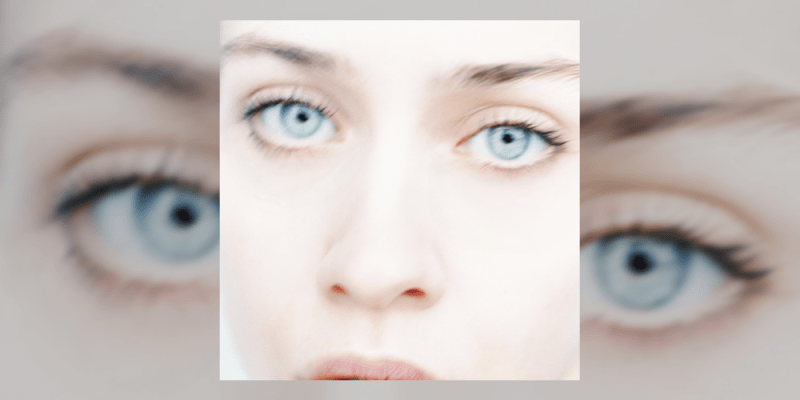
I see pain in the eyes of women I’ve never met, and feel a kinship. There is pain in Fiona’s eyes on the extreme closeup that serves as the artwork of her debut. But she looks unafraid. She looks in control. When “Tidal” came out, I was already well-versed in the ways men would wield their power over me with the rather epic, careless abandon that only masculinity breeds. What I wasn’t familiar with, however, was the steely, determined resolve that Fiona — and many other women before and since had manufactured to process this trauma. Rage can be a weapon of defense when it is calm. One of the most sinister forces behind this seething and majestic record was Fiona’s rape at the age of twelve by a strange man who stalked her all the way inside her New York apartment building. His act of domestic terrorism took calculation, foresight and brutality, but still, he felt empowered to feed her a script of self-blame: “Next time don’t let strangers in,” an adult man told a child after he’d finished sexually assaulting her. Of course, we have no choice; the strangers are already inside, they’re the men and boys we love and trust, fathers and husbands, brothers and uncles. Many of them appear to to care about us. Until they don’t. Until they become strangers again. For every Fiona before and since — it’s not your fault that the child is gone.Even when disturbed and unhappy, Fiona treats her feelings with the utmost respect, delivering solemn disaffection and a languid self-loathing with the kind of reverence usually reserved for romance. Some of these songs were written in minutes, but none of them verge on hysteria. They are calculated summations of years spent aching.
“Rage can be a weapon of defense when it is calm.”
Fiona Apple was a classically-trained pianist from the age of eight, her father and mother, though never married and separated earlier on, were both professional performers. As a teenager, she finagled a three-song demo into the hands of producer Andrew Slater, who signed her almost immediately upon hearing her voice, began to manage her, and even produced Tidal. Her songs are vampy and confessional, heavy with mood, but there is nothing adolescent about the experiences recounted. Between Slater’s shepherding and the expertise of multi-instrumentalist Jon Brion on marimba, harp, vibraphone and more, Tidal pieced together teenage Fiona’s otherworldly song writing into the sleek ten-track album that defined her. Of course, it would also be the men who tied the tracks to an era; these songs would feel ancient if they weren’t occasionally soldered to the ‘90s. (Later on, when she was older, Fiona would mount a massive resistance to the overproduction on the early, leaked version of her 2005 album Extraordinary Machine.) Yet, a thing out of time is never as tender.
“Honestly, I’m not a very skilled pianist,” Apple admitted during a 1997 Keyboard magazine interview. “I can play my own stuff, obviously better than anyone else can, but as far as other music goes, I’m really not very good. It’s hard because…when we were making the album, Andy Slater was always saying, ‘No we have to take it back to what you wrote it on. Back to the roots, that’s the only way it’s going to sound real.’ And the whole time I was saying ‘But I don’t want to play piano on this. I only wrote songs on the piano because it’s the only instrument I know. I don’t want this to be a fuckin’ piano album.’ But Andy kept saying, ‘No, this is how you sound. This is you.’”
In 1996 an interview in billboard that tells the story of Apple and Slater’s meeting and teases her debut, Tori Amos appears as the top of a box office grossing list, having just sold out Madison Square Garden. This was the world that welcomed Fiona with open arms, boosted her to sell three million copies of her debut, and turned her into a star, despite whatever reticence she may have had about celebrity. According to one strain of folklore surrounding the record, Fiona insisted that the name, “Tidal”, was taken in part because of its phonetic proximity to the funny emptiness of “Title.” But given the wild power of the thing that had come out her, she must have known this magnetism needed proper naming. What primeval force is more fitting than the tides to preside over such a magnificent airing out of wounds? Nothing is quite solid on Tidal anyway, and despite the ferocity, it is always a peaceful album, lapping like waves. The hypnotizing pull of these highs and lows make Tidal even easier to sink into; it is a record that swells and rages on an instinctual level. It remains one of the most important artistic distillations of female trauma because of the way she harnesses her pain, transforming it into a quiet source of power.
There’s little unrequited pining in Fiona’s version of the events, no matter how painful; “Shadowboxer” butterfly-floats above a stinging, out-and-out battle of wills, “Never Is A Promise” brooks no bitterness, though it’s disengagement is far from forgiving. Actually, most of the album occurs entirely in Fiona’s head; she is caught up in oblivion but remains focused on turning her hurt into something steadying and beautiful, still concerned with possibilities and potential outcomes. This is not indulgence, but a survival mechanism. On the album’s final two tracks, “Pale September” and “Carrion,” whose respective circumstances occupy very different ends of the emotional spectrum, she again commands and imagines the power she has over her partners. Poised even while candidly discussing most invasive and intimate events, her voice grows husky with rage on “Sullen Girl,” the track that confronts her assault head-on. She gives us the story, however cloaked the details may be, she gives us the full-throated vulnerability of coping, breaking, and mourning, in the process becoming one of the most self-aware female narrators of the ‘90s, or hell, in the entire history of rock.
Following the release of “Tidal”, Fiona Apple won the coveted VMA for Best New Artist, an award she wasn’t expecting. Instead of basking, she couldn’t help but continue to disrupt, urging her fans to ignore whatever picture perfect awards show narrative they’d just seen: “Go with yourself,” she commands, bug-eyed and nervous, entirely positive we don’t need her — or anyone else. Quietness won’t work here, so she screams into the night her infamous pronouncement — “This world is bullsh*t!” — pleading with us to believe her, a teenager in a fancy dress and long, loose curls, unconquered by a red carpet or some accolades. Her pain speaks a different language in public, but the grammar of empathy remains the same.It would be a relief if women did not have to create art out of pain so often, and if the work didn’t resonate so deeply whenever we are allowed to voice it freely. “I’m strong like music,” Fiona sings at the end of “Slow Like Honey” a self-fulfilling prophecy for an audience of one that ended up resonating with millions. “I’m very thrilled that other people can get something out of my songs,”
Fiona Apple’s debut album “Tidal”, originally released July 23rd, 1996.
After four years,comes a live video single for “Right Now” directed by Paul Thomas Anderson, indie-pop trio Haim are back with another song from their forthcoming sophomore album, “Something To Tell You” .
Its not a cover of The Jackson 5 but similarly named tuned, Haim’s “Want You Back” boasts its own effortless pop style that seamlessly blends Fleetwood Mac, funk and gentle electronica. The sister act crafted that pop confection on 2013’s debut “Days Are Gone” , and they’ve just about perfected it here. Este, Alana and Danielle don’t seem to waste a note during the song’s compact 3:57 runtime. Little acoustic guitar licks with handclaps and warm synth exhalations seemingly without notice. Este’s bass work struts but never gets showy. The sisters include a few call-and-responses that show a cohesion that can only happen from sharing the same blood and practicing together for years. That extends to the chorus, where Danielle raises a voice with her sisters to flatly say: “Just know that I want you back.” She argues “it’s hard to hear” it’s a total delight and so good to have this band back.
Something to Tell You is out July 7th via Columbia Records .
It’s been four long years since “Days Are Gone”, which is the only way to count our time away from the sparkling pop-rock of Haim. After teasing us with advertising around the world and a solo drum circle on a You Tube performance, Haim are finally back with a new song from the forthcoming album Something To Tell You, due July 7th on Columbia Records. Here’s a live studio version of “Right Now” shot and directed by Paul Thomas Anderson (Boogie Nights, There Will Be Blood, The Master).
“Right Now” certainly signals a change for Haim , The dynamic track is largely drum machine- and piano-driven at its outset, with some sparkling synths sprinkled in around the halfway point. As the song crescendos, with Danielle anchoring its lovestruck vocals, Este and Alana jump in on percussion, building to a soaring climax. All the while, Anderson’s slow pans allow the sisters Haim’s famed performance energy to shine through. “That’s how you fucking do it,” Este chirps at the end of the clip
On Beats 1, the band told Zane Lowe about how their mother was Anderson’s art teacher. That was at the tail-end of Days Are Gone, and years later, HAIM have entrusted Anderson to shoot the band live-to-tape, in the process of making Something To Tell You.
Ariel Rechtshaid returns to produce the new record, and Rostam Batamanglij (Vampire Weekend) guests. Haim will play new material on Saturday Night Live on May 13,
Filmed on location at Valentine Recording Studios, North Hollywood, CA
November 3, 2016
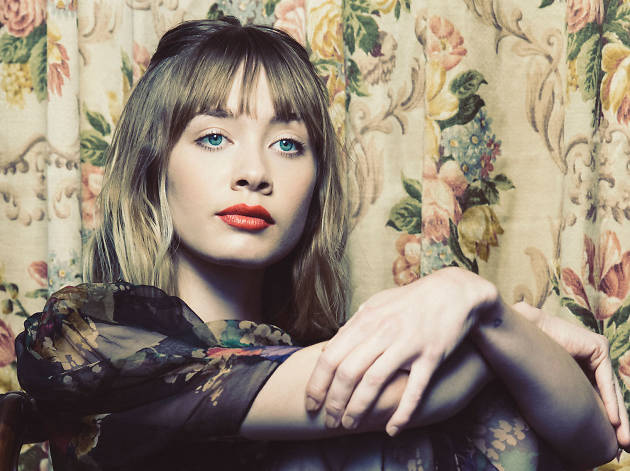
Portland native Alexandra Savior has shared both the album artwork for her forthcoming debut album, as well as a new song, “Vanishing Point”. The new track is taken from Savior’s new record, “Belladonna Of Sadness”, which is set for release on April 7th, 2017 through Columbia Records.
Alexandra Savior is also planning stops at summer festivals Boston Calling and Primavera Sound in Spain. Alexandra will also return to Europe this spring, with performances lined up in Paris, Berlin and 2 dates in London. After her first London date sold out in one day, a second one has been announced for May 30th, 2017 at Scala. Tickets on sale March 17th, 2017. Alexandra Savior made her mark last summer, following the release of debut single “Shades,” which left us completely hooked on the 21-year old singer/songwriter. Now, with a string of releases under her belt, including “M.T.M.E.” , Mystery Girl and the track “Mirage”.
Not only does she write music and perform live, Savior also paints her own artwork and writes, directs and edits her own music videos. Belladonna of Sadness was co-written by Alexandra and British rock frontman Alex Turner (Arctic Monkeys/Last Shadow Puppets) and co-produced by James Ford (Haim/Florence and the Machine) and Alex Turner.
‘Belladonna of Sadness’ now. After what was, very much a breakthrough year for the young singer in 2016, Alexandra Savior will surely be the name on everybody’s lips this year, especially following her hotly tipped SXSW appearances, Alexandra is also excited to return to Europe this Spring, with performances lined up in Paris, Berlin and 2 sold out dates in London. After her first London date sold out in one day, a second one has been announced for May 30th 2017 at Scala
The Portland native is treating fans to a slew of new this week! , today, both the official album artwork, which she painted herself for her upcoming debut album, as well as a new song, “Vanishing Point.” The hypnotic new track is lifted from Savior’s new record, Belladonna Of Sadness, which is due out April 7th 2017 via Columbia Records. Alexandra’s unique sound and style first caught the attention of several creative forces including T. Bone Burnett who placed her song, “Risk,” in the most recent season of HBO’s cult series, “True Detective.” In addition to that track, Alexandra also co-wrote the most recent Last Shadow Puppets’ single, “Miracle Aligner” along with the erstwhile Arctic Monkey, Alex Turner.
The Leicester band have been making all sorts of pronouncements of late, but for fans the wait is finally over.
New album ‘For Crying Out Loud’ will be released on April 28th, with Kasabian leading with a brand new single ‘You’re In Love With A Psycho’. is the first taste of the full-length follow-up to 2014’s 48:13 and heartily shakes off the experimental, electronic shades of that album to deliver some guitar-aided swagger.
In a post on Insta, guitarist Serge Pizzorno says ‘You’re In Love With A Psycho’ is “a weird anthem for everyone. You’ve either been in love with [a psycho] or you are one. It sort of celebrates that.”
He adds that it was one of the first tunes written for the new album – Kasabian’s sixth album in their 20-year career.
“It took about 15 minutes. It just flowed. I didn’t really think and all the lyrics came…”
Kasabian – You’re In Love With A Psycho (Lyric Video)
Taken from Kasabian’s new album ‘For Crying Out Loud’,



:format(jpeg):mode_rgb():quality(90)/discogs-images/R-4962966-1380732036-4332.jpeg.jpg)





 The Fat Angel Sings