On the Beach is the fifth studio album by Neil Young, released in 1974. It was unavailable on compact disc until it was released as a HDCD-encoded remastered version on August 19th, 2003 as part of his Archives Digital Masterpiece Series.
Recorded after (but released before) Tonight’s the Night, On the Beach shares some of that album’s bleakness and crude production—which came as a shock to fans and critics alike, as this was the long-awaited studio follow-up to the commercially and critically successful Harvest—but also included hints pointing towards a more subtle outlook, particularly on the opener, “Walk On”.
While the original Rolling Stone review described it as “One of the most despairing albums of the decade”, later critics used the benefit of hindsight to conclude that Young “[w]as saying goodbye to despair, not being overwhelmed by it”. The despair of Tonight’s the Night, communicated through intentional underproduction and lyrical pessimism, gives way to a more polished album that is still pessimistic but to a lesser degree. Much like Tonight’s the Night, On the Beach was not a commercial success at the time of its release but over time It’s attained a high regard from fans and critics alike. The album was recorded in a haphazard manner, with Young utilizing a variety of session musicians, and often changing their instruments while offering only bare-bones arrangements for them to follow (in a similar style to Tonight’s the Night). He also would opt for rough, monitor mixes of songs rather than a more polished sound, alienating his sound engineers in the process.
[The best song on the album…] Ambulance Blues:
“Ambulance Blues” closes the album. The melody ‘unintentionally’ quotes Bert Jansch’s “Needle of Death”. In a 1992 interview for the French “Guitare & Claviers” magazine, Young discussed Jansch’ influence:
“As for acoustic guitar, Bert Jansch is on the same level as Jimi (Hendrix). That first record of his is epic. It came from England, and I was especially taken by “Needle of Death”, such a beautiful and angry song. That guy was so good. And years later, on On the Beach, I wrote the melody of “AmbulanceBlues” by styling the guitar part completely on “Do You Hear Me Now?”. I wasn’t even aware of it, and someone else drew my attention to it.”
The second side of On the Beach ends with “Ambulance Blues,” it’s a stunningly brilliant, stream-of-conscious epic that ranks as one of Neil Young’s greatest lyrical achievements, taking on everything from Richard Nixon (“I never knew a man could tell so many lies”) to the sad state of Crosby, Stills and Nash (“You’re all just pissin’ in the wind/You don’t know it but you are.”) But it begins in a better place, looking back on the “old folky days” when “the air was magic when we played.” But time made that magic fade away, and sorrow mixed with pity quickly seeps into the verses. The song sat dormant for a good many years, but in 1998 he made a shocking return at the Bridge School Benefit and then he played it every night on the 2007-’08 theater tour.
If there’s any doubt that Neil Young was super bummed out when he made On The Beach in early 1974, listen no further to the title track that kicks off the second side of the LP. “The world is turnin’,” he sings in the opening lines. “I hope it don’t turn away.” It only gets worse from there as he contends with a radio interview where he winds up “alone at the microphone” before he decides to simply get out of town. “I head for the sticks with my bus and friends,” he sings. “I follow the road, though I don’t know where it ends.” The road took him to a disastrous CSNY reunion tour later that year that did little to lighten his mood, though by the end of the year he met future wife PegiMorton and things turned around. He played “On the Beach” at a bunch of 1974 CSNY shows, though it’s a super rarity this days. Since 1975 he’s only played it twice: at a 1999 solo acoustic show in Chicago and in 2003 at a Greendale acoustic show in Hamburg, Germany.
“Good times are coming, I hear it everywhere I go,” Neil Young sings on 1974’s “Vampire Blues.” “Good times are coming, but they sure are coming slow.” Featuring guitarist George Whitsell (who played with Crazy Horse in their 1960s band the Rockets) and bassist Tim Drummond scraping a credit card on his beard for a cool sound effect, “Vampire Blues” is a typically bummed-out On the Beach song where Young compares himself to a vampire bat seeking out “high octane” blood. The only time he ever played it live was at an Eagles show in 1974, though it has been rehearsed for his upcoming summer tour.
David Crosby got roped into playing guitar on this creepy On the Beach tune, but the tale of a Charles Manson-like figure freaked him out and to this day he says he doesn’t care for the song. It’s certainly hard to imagine the former Byrd writing a song from the perspective of a murderous psychopath with lines like, “Well, I hear that Laurel Canyon is full of famous stars/But I hate them worse than lepers and I’ll kill them in their cars.” But it was a reflection of the difficult time when the (supposedly) peaceful 1960s had given way to the violent, coked-out 1970s. Young hasn’t touched the song since a one-off Crazy Horse gig in 1987.
Personnel:
Neil Young – guitar on 1 3 5 6 7 8, vocal, Wurlitzer electric piano on 2, banjo on 4, harmonica on 7 8
Ben Keith – slide guitar on 1, vocal on 1 4, steel guitar on 2, Dobro on 4, Wurlitzer electric piano on 3, organ on 5, hand drums on 6, bass on 7 8
Tim Drummond – bass on 2 5 6, percussion on 5
Ralph Molina – drums on 1 5 6, vocal on 1, hand drums on 7 8
Additional personnel
Billy Talbot – bass on 1
Levon Helm – drums on 2 3
Joe Yankee – harp on 2, electric tambourine on 8
David Crosby – guitar on 3
Rick Danko – bass on 3
George Whitsell – guitar on 5
Graham Nash – Wurlitzer electric piano on 6
Rusty Kershaw – slide guitar on 7, fiddle on 8
On the Beach was savage and, ultimately, triumphant. “I’m a vampire, babe,” Young sang, and he proceeded to take bites out of various subjects: threatening the lives of the stars who lived in L.A.’s Laurel Canyon (“Revolution Blues”); answering back to Lynyrd Skynyrd, whose “Sweet Home Alabama” had taken him to task for his criticisms of the South in “Southern Man” and “Alabama” (“Walk On”); and rejecting the critics (“Ambulance Blues”). But the barbs were mixed with humor and even affection, as Young seemed to be emerging from the grief and self-abuse that had plagued him for two years. But the album was so spare and under-produced, its lyrics so harrowing, that it was easy to miss Young’s conclusion: he was saying goodbye to despair, not being overwhelmed by it.
Violent Femmes is the band’s most successful album to date and achieved a rare feat by going gold, four years after its release, and then later platinum, four years after that, without ever having yet made an appearance on the album chart. After achieving platinum certification on February 1st, 1991, eight years after its initial release the album finally entered the Billboard album chart for the first time on August 3, 1991″. Quite simply ,the ViolentFemmes’ self-titled album was the quintessential hymnal for the disaffected youth of America in the ’80s. With its jangly folk-punk frustration and venom-spitting lyrics, the debut featured tracks “Blister in The Sun,” “Kiss Off” and “Add it Up,” arguably the three best Anthems of the proudly maladjusted ever penned.
Most of the songs on both this album and its follow-up were written when the songwriter, Gordon Gano, was 18 years old and still in high school in Milwaukee, Wisconsin. Its one of the most distinctive records of the early alternative movement and an enduring cult classic”, noting that “the music also owes something to the Modern Lovers’ minimalism, but powered by Brian Ritchie’s busy acoustic bass riffing and the urgency and wild abandon of punk rock, the Femmes forged a sound all their own
Nothing sounded like it before and nothing has since captured the sublime and perverse joy of teenage angst and adolescent anarchy like the Violent Femmes. In fact, just listening to “Add it Up” has been known to cause acne, awkward haircuts and ripped jeans
In 2002, Rhino Records remastered the album, filled out the disc’s length with demos, and added another disc of live tracks and a radio interview for a 20th anniversary special edition, with liner notes by Michael Azerrad.
Country singer Emmylou Harris had no idea what she was in for the day she arrived at Columbia Studios to sing backup on her first Bob Dylan sessions. Emmylou Harris had just received the lyrics to “Romance inDurango” and was practicing when she realized the tape had already started rolling. “I thought, ‘Oh, I can fix anything that sounds funky or out of tune with the engineer later,'” she says. But there would be no second takes. “That album was like throwing paint on a canvas. And whatever happened was what it was supposed to be. I guess that’s another part of the genius of Dylan: He knew exactly what he was doing.”
Dylan thrived on chaos and chance while making Desire, a process that was a far cry from the heavily labored recording of his prior LP, 1975’s Blood on the Tracks. One night, Dylan was walking around Greenwich Village and was approached by Jacques Levy, a playwright and director who had previously written songs with RogerMcGuinn of the Byrds. Dylan invited Levy to hang out that night at the Other End, a long-standing folkie haunt; later on, at Levy’s apartment, they wrote “Isis.” “He said these magic words, ‘I’d like you to write some stuff for me,'” Levy recalled before his death in 2004. They continued work at Dylan’s summer home in the Hamptons, writing songs with a much different flavor than the reflective tone of his last album. “I guess I never intended to keep that going,” Dylan said. “Sometimes you’ll get what you can out of these things, but you can’t stay there.”
The album’s centerpieces were rooted in real-life drama. The album’s opening track and highlight, “Hurricane,” was based on the plight of boxer Rubin Carter, who was charged with three murders in 1966. A decade later, his case was protested by activists, who claimed that racism drove both his arrest and trial. Dylan picked up on Carter’s story and wrote an eight-and-a-half-minute song about him, which was both controversial and eye-opening. (In 1985, Carter was released after a judge found that he didn’t receive a fair trial 20 years earlier.) It also — surprisingly, given its subject matter and length
Instead, these were sprawling narratives of outlaws and wanderers, with clearer storylines than anything Dylan had written in more than a decade. They included the cowboy-on-the-run tale “Isis” and “Joey,” the 11-minute saga of fallen gangster Joey Gallo. “I thought ‘Joey’ was a good song,” Dylan said in 1981. “I know no one said much about it.” Perhaps it was overshadowed by “Hurricane,” the story of former boxer Rubin “Hurricane” Carter, who had been convicted of triple murder in 1966. “I read his book and it really touched me,” said Dylan. “I felt that the man was innocent.” Though Dylan and Levy’s lyrics were riddled with factual errors (as was “Joey”), the song helped turn public attention to Carter’s case; his conviction was overturned in 1985. Cover version of the 1976 classic.
Guitars, Vocals and Bass by Elliott Smith recorded at home in Barnard Castle Co. Durham, England.
The album’s atmosphere was also affected by a trip Dylan had taken to the South of France, where he had gone to a “gypsy festival” on his birthday. The gypsy imagery marked songs like “One More Cup of Coffee” and “Durango.” “I think ‘exotic’ is a good word to put on it,” said Levy. The only personal song on Desire is perhaps his most personal ever: “Sara,” a plea to his then-estranged wife, Sara Lownds, to return to him. According to Levy, Lownds showed up at the studio the night they recorded the song. “You could have heard a pin drop,” said Levy. “She was absolutely stunned by it.” .More than two dozen musicians were initially gathered — a violin player, an accordion and mandolin player, even Eric Clapton at one point — to work on Desire, but by the time it was released on January 16th, 1976, its scale had lessened by quite a bit.
During recording, Dylan kept several studios going at once, filled with musicians (including Dave Mason and EricClapton) and non-musicians. Says bassist Rob Stoner, “They had opened up all the adjacent studios to accommodate all these hangers-on and buffet tables. It was just like a huge party. And it wasn’t conducive to getting any work done.”
Eventually, the rooms were cleared and a core group cut the entire album over two long nights. “There was just a level of excitement,” says Stoner. “Sessions were called for 7 p.m., and we only stopped at seven in the morning because that’s when they tow your car on that street. We didn’t want to lose the vibe. No drinking, no drugs, no nothing. It was pure adrenaline.”
Scotland’s Incredible String Band combined traditional music of several cultures and brought that mixture into the hippie era, giving birth to freak folk. Among the ISB’s many fans is Robert Plant, who once cited the group’s “The Hangmans Beautiful Daughter” as a major influence on Led Zeppelin. The 1968 Elektra collection is ambitious and eclectic, applying a wide array of acoustic instruments (including sitar, oud, hammered dulcimer, pan pipe and harpsichord) to the frequently surreal lyrics of Robin Williamson and Mike Heron. These songs of minotaurs and amoebas are psychedelic in the broadest sense of the term, and make excellent use of multi-tracking and overdubbing, guided by the capable hand of producer Joe Boyd. A commercial success in its native U.K. as well as a Grammy nominee, THE HANGMAN’S BEAUTIFUL DAUGHTER is considered the Incredible String Band’s finest album, and it still works a strange magic on listeners.
For an album with lyrics like “If I were a witch’s hat, sitting on her head like a paraffin stove” and “I hear that the Emperor of China used to wear iron shoes with ease;We are the tablecloth, and also the table;also the fable of the dancing leaves”?
Just goes to show we baby-boomers had a damn sight more musical appreciation sense than we’ve been given credit for! This is, granted, the most mysterious, wordy, other-wordly of the Incredibles albums, but it Never loses its’ way musically, even in the key and tempo changes abounding in Williamson’s opening Keoaddii There or Heron’s 12 minute A very Cellular song, which, over 15 years on, Talking Heads adopted as a concert closer-now you know David Byrne was no fool either.
The best bit about this is you don’t need to be any of these things to enjoy this-stoned/hippy/old/living dead. It probably goes without saying that the duo’s instumentational abilities are great on any of their first 4 albums-this being the 3rd-but here the sheer variety of what they play and what they get out of those instruments defies belief. You could almost listen to the album for that alone, or for the poetry of the lyrics.
This day in 1979, I walked home from Virgin Records exactly 38 years ago today with a plastic bag containing the double album by The Clash. It was priced as a single LP but had two vinyl records tucked inside. The inner sleeves had “hand written” lyrics and it has to be the lyrics I’ve read most often. Both historically and personally The Clash, London Calling had a huge profound impact.
The Punk-Rock legends’ third album was released in 1979 by CBS Records. Like so many great albums included on the Best Of’s lists: genres switch and there is an ambitious mix of sounds and musical ideas. London Calling addresses social displacement, unemployment and racial conflict – drug use and responsibility was also touched upon. From Lover’s Rock’s messages of safe sex to the anthemic rally of the title track; it is an album that has defined the decade and continues to influence bands. It has sold over five-million copies and is thought of as one of the defining records of the Punk era. London Calling captured The Clash’s energy and primal urges; their loud and vital voice and social consciousness. If previous albums (from the band) focused on British sounds and ideas: London Calling incorporated more American sounds and suggestions. Rebellious, romantic and exhilarating: a true one-of-a-kind treasure from one of Britain’s greatest bands of all time.
It was released in the United Kingdom on 14th December 1979 through CBS Records, and in the United States in January 1980 through Epic Records. The album represented a change in The Clash’s musical style, featuring elements of ska, funk, pop, soul, jazz, rockabilly, and reggae more prominently than in their previous two albums.
London Calling was widely regarded as one of the greatest albums of all time. In 1987, it was ranked on RollingStone magazine’s “100 Best Albums of the Last Twenty Years”. In 1993, NME ranked the album at number six on its list of The Greatest Albums of the ’70s. Vibe magazine included the double album on its list of the 100 Essential Albums of the 20th Century. Q magazine ranked London Calling at number four on its 1999 list of the 100 Greatest British Albums, and, in 2002, included the album in its list of the 100 Best Punk Albums
This fantastic catchy song was not listed on the cover of the original album so it was my first experience with so called bonus tracks that is so common these days. The Lyrics was however printed on the inner sleeve.
This album has been in my top ten since it was released, it is a classic rock’n roll album that everyone should own. I do not concider it a punk rock album musically but the attitude that reeks off this album is quintessential punk. The styles and genres are excitingly mixed and woven together, but laid on top of a punk rock foundation.
Depending on the source, the working title for what would become London Calling was either The New Testament or The Last Testament. The story works better if you believe Kosmo Vinyl’s argument for The Last Testament—thatThe Clash intended London Callingto be the last rock ‘n’ roll album, the paired bookend to Elvis’ first album, right down to the pink-and-green lettering.
Since The Clash continued to make rock music afterLondon Calling, it’s silly to take the “last rock ‘n’ roll album” assertion literally or as evidence of a collective ego gone mad. I think it’s more accurate to say that The Clash approached London Calling from the perspective of “What if this were the last rock ‘n’ roll record—what would that sound like, feel like, be like?” Given their concern about impending world doom expressed so clearly in the title track, they may well have felt on a subconscious level that London Calling could very well be the last rock ‘n’ roll record.
I can’t think of any other album that triggers as many different emotions, ignites so much passion and authenticates so many deeply held personal values. A work of tremendous energy, London Calling is also extraordinarily energizing. At the end of the record you may not be any clearer than Joe Strummer was about what we can do to change this fucked-up world of ours, but you leave with more confidence that somehow we’ll figure it out. More than any other record in my collection, London Calling can pick me up when I’m down, and give me hope whenever I feel all is hopeless.
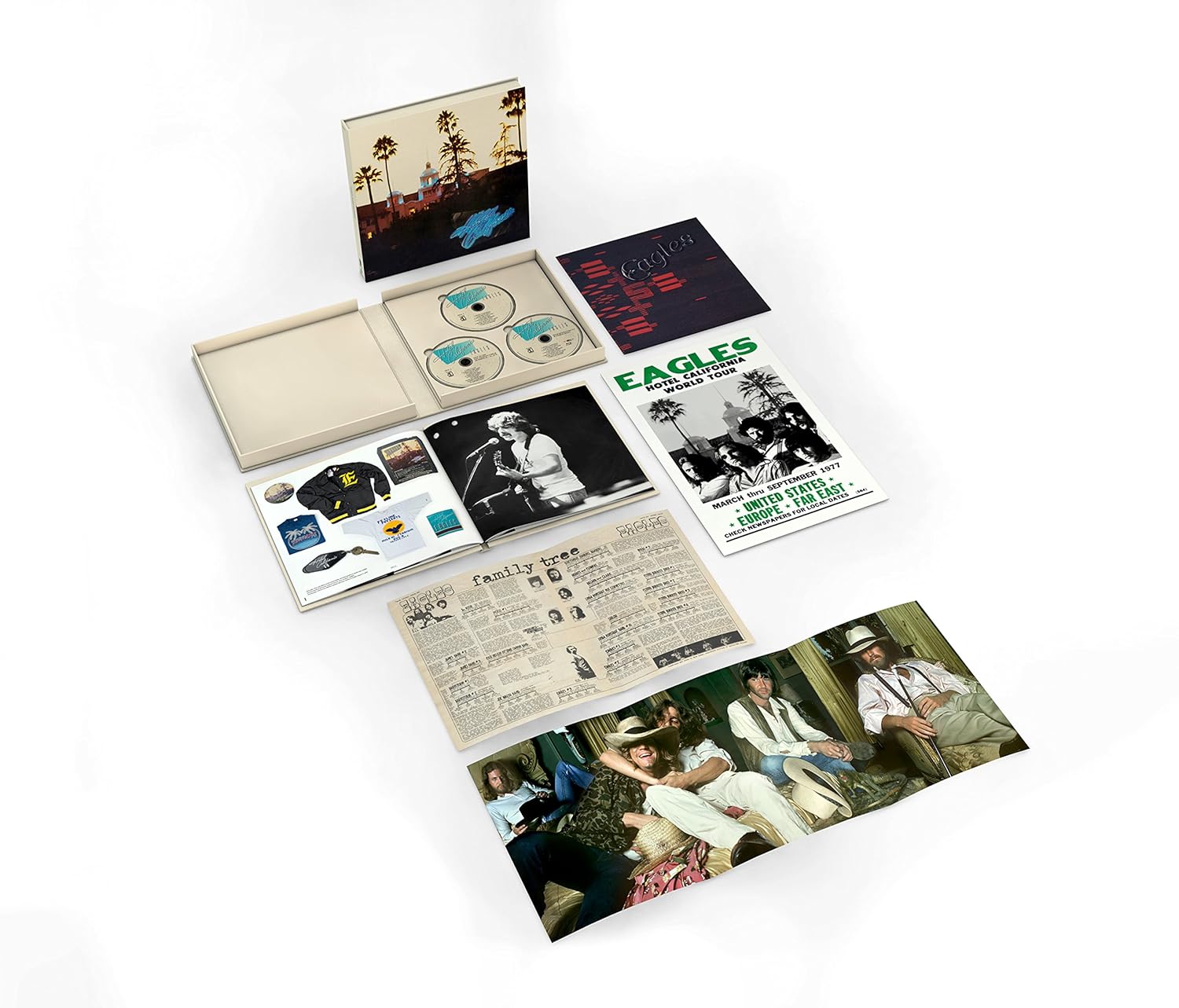
By the second half the Seventies, The Eagles’ “Peaceful Easy Feeling” seemed like a distant memory, a pleasantly stoned dream rudely interrupted by the pressures of business and fame. A deep malaise had set in, one which couldn’t be soothed by money, sex or drugs. It tightened its grasp on the band, the music industry and the country at large. Everything about Hotel California, the late-1976 album by The Eagles, was larger than life – beginning with the epic title track. Upon its release, its stature grew as mighty as the music within its grooves. It yielded two U.S. No. 1 singles, was certified platinum within a week of release, and sold over 17 million copies in the U.S. alone as of 2013 – a number that grew to over 32 million worldwide, and counting. Over forty years after its initial release, the most famous Eagles album has arrived in expanded form the band’s very first album to receive such a treatment. The 2-CD/1-BD deluxe box set edition (Elektra/Asylum/Rhino R2 562944) adds a disc of live concert highlights on CD and high-resolution stereo and surround mixes on Blu-ray, for a compelling and immersive trip back to the Hotel California. (A 2-CD edition has the original album and concert, while a single-CD edition has just the core album.)
With “Hotel California”, the Eagles sought to capture the excesses and self-destructive behavior that had become status quo in the rock world. It was a scene they were uniquely qualified to address. Their previous album, 1975’s One of These Nights, had spawned three Top 10 singles, and their greatest-hits album sold in such stratospheric numbers on its way to becoming the best-selling album of the 20th century in the United States – that the RIAA had to invent to platinum certification. “We were under the microscope,” Glenn Frey said of the time. “Everybody was going to look at the next record we made and pass judgment. Don [Henley] and I were going, ‘Man, this better be good.'”
Their efforts would create a song cycle that succeeded on nearly every level. Hotel California drew heroic sales figures and critical plaudits in equal measure, and affirmed the band’s shift from laid-back country-tinged pop act to major players in the rock & roll fast lane. The rich lyrics – both introspective and allegorical – had fans pondering their true meaning for decades to come. Was Hotel California about a mental institution? Drug addiction? A feud with Steely Dan? Satanism?
“The concept had to do with taking a look at all the band had gone through, personally and professionally, while it was still happening to them,” Henley told author Marc Eliot. “We were getting an extensive education, in life, in love, in business. Beverly Hills was still a mythical place to us. In that sense, it became something of a symbol and the ‘Hotel’ the locus of all that L.A. had come to mean for us. In a sentence, I’d sum it up as the end of the innocence, round one.”
On guitar, Joe Walsh and his arena-ready heft had replaced Bernie Leadon and his country-fried lilt. With Walsh trading licks with Don Felder, and Don Henley not only holding down the beat on his drum kit but taking an increasingly assertive role as the band’s “voice,” Eagles were taking flight to rock. Randy Meisner was as locked-in as ever on bass, as Glenn Frey added texture on keyboards and guitar. The impressionistic “Hotel California,” composed by Felder, Henley and Frey, was the band’s finest and most hard-hitting meditation on their preferred themes of excess, greed, and hedonism. The lyrics’ first-person narrative lent a personal feel to these big concepts, adorned with unforgettable images conjuring a vividly eerie experience. The music, anchored by Walsh and Felder on guitar, was as blazingly intense and atmospheric as the words.
In honor of Hotel California’s 40th anniversary,
The working title of “Hotel California” was “Mexican Reggae.” Though it’s since become synonymous with the dark, sinister underside of Los Angeles, the album’s title track took shape in a surprisingly idyllic setting. Don Felder had rented a beach house in Malibu, and was in the midst of taking in the ocean breeze as he leisurely strummed his guitar. “I remember sitting in the living room on a spectacular July day with the doors wide open, I had a bathing suit on and was sitting on this couch, soaking wet, thinking the world is a wonderful place to be. I had this acoustic 12-string and started tinkling around with it, and those ‘Hotel California’ chords just kind of oozed out.”
After completing the basic melody, he fetched his TEAC 4-track tape recorder to preserve his latest composition, which he embellished with bass and drum-machine overdubs. “I knew it was unique but didn’t know if it was appropriate for the Eagles,” he admitted. “It was kind of reggae, almost an abstract guitar part for what was on the radio back then.”
When the Eagles reconvened in the spring of 1976 to begin work on what was to be their fifth album, Felder assembled cassettes of his instrumental demos for his bandmates to mine for song ideas. Despite his initial reticence, the reggae-flavored tune made the cut.
Felder had submitted a cassette tape containing about half a dozen different pieces of music,” Henley said None of them moved me until I got to that one. It was a simple demo – a progression of arpeggiated guitar chords, along with some hornlike sustained note lines, all over a simple 4/4 drum-machine pattern. There may have been some Latin-style percussion in there too. I think I was driving down Benedict Canyon Drive at night, or maybe even North Crescent Drive (adjacent to the Beverly Hills Hotel) the first time I heard the piece, and I remember thinking, ‘This has potential; I think we can make something interesting out of this.'”
Glenn Frey was equally impressed. “We said this is electric Mexican reggae. Wow. What a nice synthesis of styles,” he said in 1992 . “Mexican Reggae” ultimately became the song’s working title during early sessions before the lyrics were finalized.
Black Sabbath were recording in the studio next door, and the noise disrupted The Eagles’ sessions.
To oversee the new sessions, the Eagles turned to veteran producer Bill Szymczyk, who had worked on their previous album, One of These Nights. Szymczyk was happy to return, but he had one condition: He wanted to record at Miami’s legendary Criteria Studios, far from the band’s standard base of operations at L.A.’s Record Plant.
His reasoning went beyond the technical. A recent earthquake had sent him “off the bed onto the floor,” instilling in him an intense fear of living on a fault line. “The day the earthquake happened was the day I became an independent producer,” he later joked . To avoid the earthquake zone, he insisted that the band record in Miami. Eventually a compromise was reached, and they would split time between both favored studios. “Every time we were at Criteria, the guys were actually quite happy to be out of L.A. and away from all of the partying and the hangers-on,” said Szymczyk.
They were joined at Criteria by Black Sabbath, holed up in the adjacent studio working on their Technical Ecstasy album. “The Eagles were recording next door, but we were too loud for them,” Tony Iommi told Uncut in 2014. “We kept hearing them through the wall into our sessions.” Hotel California’s delicate closing ballad, “The Last Resort,” had to be re-recorded multiple times to due to noise leakage.
Sabbath may have been louder, but the Eagles held their own when it came to partying. Sabbath bassist Geezer Butler recalled venturing into a studio recently vacated by the band: “Before we could start recording we had to scrape all the cocaine out of the mixing board. I think they’d left about a pound of cocaine in the board.”
When it came time to record “Hotel California,” Felder forgot what he’d written.
By the time the Eagles settled into Criteria Studios to lay down tracks for “Hotel California,” more than a year had elapsed since Felder first recorded his initial tape of the song. When he and Joe Walsh began to work out the extended guitar fade, Henley felt that something was missing.
“Joe and I started jamming, and Don said, ‘No, no, stop! It’s not right,'”said Felder in 2012. “I said, ‘What do you mean it’s not right?’ And he said, ‘No, no, you’ve got to play it just like the demo.’ Only problem was, I did that demo a year earlier; I couldn’t even remember what was on it.” Further complicating matters was the fact that the tape in question was at the other end of the country in Los Angeles. So the band was forced to improvise.
“We had to call my housekeeper in Malibu, who took the cassette, put it in a blaster and played it with the phone held up to the blaster,” he says. In the end, the results were deemed satisfactory. “It was close enough to the demo to make Don happy.”
Ian Anderson of Jethro Tull believed “Hotel California” sounded suspiciously like one of his songs.
In the Eagles‘ defense, the tour took place two years before Felder, the song’s primary composer, officially joined the band in 1974 – though he was a friend of founding guitarist Bernie Leadon at the time and could have conceivably attended one of the performances. Felder himself later denied having ever heard “We Used to Know” at the time he wrote the song, and claimed to know little about Jethro Tull other than that they featured a flautist.
Whatever the case, Anderson takes a magnanimous view of the incident. “It’s just the same chord sequence,” he continues. “It’s in a different time signature, different key, different context. And it’s a very, very fine song that they wrote, so I can’t feel anything other than a sense of happiness for their sake. … There’s certainly no bitterness or any sense of plagiarism attached to my view on it – although I do sometimes allude, in a joking way, to accepting it as a kind of tribute.”
The cautionary tale of “Life in the Fast Lane,” built around Joe Walsh’s famous central riff, once more commented on the high life with which the band was so closely associated. “Life in the Fast Lane” was inspired by a conversation with Glenn Frey’s drug dealer at 90 miles an hour. The Eagles‘ success made them, by their own admission, well versed in most forms of debauchery: illicit pharmaceuticals, hotel destruction and elaborate forms of sex play. Some of these late nights yielded memorable lyrics. One of the album’s standout tracks was inspired by Glenn Frey’s particularly harrowing car ride with his bagman.
“I was riding shotgun in a Corvette with a drug dealer on the way to a poker game,” he recalled in 2013 documentary The History of the Eagles. “The next thing I know we’re doing 90. Holding! Big Time! I say, ‘Hey, man!’ He grins and goes, ‘Life in the fast lane!’ I thought, ‘Now there’s a song title.'”
He held onto the phrase for months, until a hard-hitting riff spilled out of Joe Walsh’s guitar during a band rehearsal. The lick stopped Frey in his tracks. He asked Walsh to repeat it, and soon realized that he was hearing the sound of life in the fast lane. From there, the song began to take root.
The final track brought Frey uncomfortably close to the drug-fueled reality that surrounded the band. “I could hardly listen to [‘Life in the Fast Lane’] when we were recording it because I was getting high a lot at the time and the song made me ill,” he has said . “We were trying to paint a picture that cocaine wasn’t that great. It turns on you. It messed up my back muscles, it messed up my nerves, it messed up my stomach, and made me paranoid.”
Don Felder was originally slated to sing “Victim of Love.” The searing tale of a “Victim of Love,” penned by Felder, Frey, Henley, and “honorary Eagle” J.D. Souther, soared with the twin-guitar approach from Walsh on slide and Felder on lead.
“New Kid in Town,” co-written by Frey, Henley, and. Souther, revisited the band’s lush and languid country-rock sound, with its ruefully yearning lead expressively provided by Frey in his only lead of the album. The group’s trademark harmonies also shone here. Randy Meisner’s “Try and Love Again” also was in this vein, returning the band to its roots. The heart of the album may belong, however, to the heartbreaking Frey/Henley soul ballad “Wasted Time.” It closed Side One of the original album and opened Side Two in an instrumental reprise, which like the original track, showcased Jim Ed Norman’s majestic string arrangement. The Walsh-led “Pretty Maids All in a Row” (co-written by the guitarist and Joe Vitale) complements “Wasted Time” in its conversational reflection on a past relationship.
In addition to the title track, Felder’s primary contribution to Hotel California was the relentless “Victim of Love,” which showcased a rougher sound for the band. “We were trying to move in a heavier direction, away from country rock,” “And so I wrote 16 or 17 song ideas, kind of in a more rock & roll direction, and ‘Victim of Love’ was one of those songs. I remember we went in the studio and we recorded it live with five guys playing. The only thing that wasn’t played in a live session was the lead vocal and harmony on the choruses. Everything else was recorded live.”
In tribute to the song’s genesis, the phrase “V.O.L. is a five piece live” was proudly inscribed on the album’s run-out groove – signaling that “Victim of Love” was recorded live by the five Eagles. The message, etched by BillSzymczyk, served as a middle finger to critics who accused them of being too clinical and soulless in the studio.
Felder himself provided lead vocals on the initial takes of the songs, but some of his bandmates were not pleased with the results. “Don Felder, for all of his talents as a guitar player, was not a singer,” Frey said in The History of the Eagles. Henley echoed the sentiment. “He sang it dozens of times over the space of a week, over and over. It simply did not come up to band standards.”
The Eagles‘ manager Irving Azoff was given the task of breaking the news to him over dinner, while Henley recorded the lead part back at the studio. “It was a little bit of a bitter pill to swallow. I felt like Don was taking that song from me,” Felder said in the documentary. “But there was no way to argue with my vocal versus Don Henley’s vocal.”
Don Henley brought his own mattress to each hotel during the Hotel California tour.
To combat grueling tour schedules, many bands go to great lengths to approximate the comforts of home while on the road. The Eagles were no exception, even chartering an elaborate private jet for their travels. But the band’s head electrician, Joe Berry, recalls Henley’s special request for the Hotel California tour. “He insisted on having a king-size bed and mattress available at all times, which the crew had to drag around everywhere,” he told Marc Eliot in To the Limit: The Untold Story of the Eagles. “The tour seamstress made a special cover for it, with handles, to make it easier to pack it in the truck every night. It was Don’s bed, it went everywhere.”
Henley defends this apparent extravagance by chalking it up to excruciating back pain exacerbated by the nightly performances. “I used to have to hold my body in such a position that my spine got out of alignment,” he explained to Modern Drummer. “Between playing the drums and keeping my mouth in front of the microphone, it really twisted my whole body. I got to a point in the Seventies where I literally could not sleep.”
The discomfort wasn’t helped by the poor quality bedding at their accommodations. “Hotel mattresses are awful – the worst goddamn thing in the room,” he told Eliot. “So I brought my own mattresses and had it trucked around with the equipment.” Unfortunately, the concierges were less sympathetic to Henley’s bad back. According to Berry, the mattress “never once got used, because no hotel would allow us to bring it in.”
The cover was shot by the man behind the Beatles’ Abbey Roadand the Who’s Who’s Next and it almost got the band sued.
He scouted locations with photographer David Alexander, and assembled a shortlist of suitable venues. The Beverley Hills Hotel on Sunset Boulevard was quickly agreed upon as the favorite, but erasing all traces of the building’s bright and airy resort-like appearance would prove to be a serious technical challenge.
“To get the perfect picture, David and I had perched nervously atop a 60-foot cherry picker dangling over Sunset Boulevard in the rush hour, shooting blindly into the sun,” says Kosh. “Both of us brought our Nikons up in the basket and we took turns shooting, ducking and reloading. We used high-speed Ektachrome film as the light began to fade. This film gave us the remarkable graininess of the final shot.”
The chosen shot, captured at the so-called “golden hour” just before sunset, would become one of the most recognizable album covers in rock history. Ironically, most failed to recognize the supremely famous hotel in the photo. When word finally got out about the building’s identity, representatives for the luxurious establishment were less than pleased. “As the sales of Hotel California went through the roof, lawyers for the Beverly Hills Hotel threatened me with a ‘cease and desist’ action,” says Kosh, “until it was gently pointed out by my attorney that the hotel’s requests for bookings had tripled since the release of the album.”
The band blew off the Grammys, instead watching their win from band practice. The Eagles were nominated for several Grammy awards in January 1978, including the prestigious Record of the Year for “Hotel California,” but Irving Azoff didn’t buy the “It’s an honor to be nominated!” line. Despite their meteoric sales, the band’s image had taken a beating in the popular music press, and he was unwilling to subject them to any kind of PR humiliation. So when Grammy producer Pierre Cossette asked the Eagles to perform during the 20th annual ceremony, Azoff reportedly refused. The only way the band would play – or even attend – was if they were guaranteed that “Hotel California” would nab the prize.
Rigging the awards was obviously out of the question, so Azoff suggested hiding the band in a secret dressing room, where they would emerge only if their name was called for Record of the Year. This scheme was rejected, as was the request that another artist accept the award on their behalf (Jackson Browne and Linda Ronstadt were mentioned as possible surrogates).
When the Eagles‘ ultimately won, host Andy Williams was left standing expectantly, haplessly waiting for someone to come forward and accept the honor. Azoff hastily put out a release saying that the band was in Miami working on their new album, ending the statement with a dismissive “That’s the future, this is the past.” Guitarist Timothy B.Schmit later said they watched the telecast in the midst of their band rehearsal. If they were disappointed that they weren’t there to accept the award in person, they didn’t show it. “The whole idea of a contest to see who is ‘best’ just doesn’t appeal to us,” Henley told The L.A. Times.
Ten tracks have been culled from the band’s concerts of October 20th-22th, 1976 at the Los Angeles Forum, during which the album (released on December 8th, 1976) was previewed with performances of its two songs which would go to No. 1 on the U.S. Pop chart: “New Kid in Town” and “Hotel California.” J.D. Souther joined in on vocals for “New Kid in Town.” Live at the Los Angeles Forum also has the band reaching back to its first album for “Witchy Woman” and an appropriately breezy “Take It Easy,” plus other highlights like the On the Border pair of “James Dean” and “Good Day in Hell,” and the One of These Nights duo of “Take It to the Limit” (with Jim Ed Norman conducting the orchestra) and, of course, “One of These Nights.” Joe Walsh’s JamesGang favorite “Funk No. 49” also is aired here. It’s hard to fathom why the band – in top, edgy form, playing off the audience’s energy – didn’t opt to include an entire concert here, or highlights from the Forum run, replicating a full, roughly 20-song setlist. (Five tracks from the Forum shows were included on 1980’s EaglesLive including “New Kid in Town” and “Take It to the Limit.”) But the ten songs selected and expertly sequenced are choice, indeed, with tracks like “James Dean” and “Good Day in Hell” echoing the themes of Hotel California. Sound, too, is uniformly crisp and excellent on the live recordings. The Eagles have taken the “leave ’em wanting more” adage to heart.
The producer behind Taxi Driver and Close Encounters of the Third Kind wanted to turn “Hotel California” into a movie. “When we thought of this song ‘Hotel California,’ we started thinking that it would be very cinematic to do it sort of like The Twilight Zone,” Frey once reflected in a BBC 2 radio interview. “One line says there’s a guy on the highway and the next line says there’s a hotel in the distance. Then there’s a woman there. Then he walks in. … So it’s one-shots all sort of strung together, and you sort of draw your own conclusions from it.”
The song’s cinematic quality drew the attention of Julia Phillips, who made history in 1974 by becoming the first female producer to win an Academy Award for the Paul Newman and Robert Redford caper The Sting. A string of blockbusters followed, including Taxi Driver and Close Encounters of the Third Kind, and by the end of the decade she set her sights on adapting the Eagles’ smash. An initial meeting with Azoff led to a tentative predevelopment deal, but relations became frosty when she quizzed him on the particulars of the song’s copyright lawsuit that the band initiated against their former manager, David Geffen, and Warner Bros. Records.
Henley and Frey accompanied Azoff to the next meeting, which, by all accounts, was unpleasant. In her infamous tell-all memoir, You’ll Never Eat Lunch in This Town Again, Phillips portrays the rock stars as arrogant and difficult, with a weakness for white powder. However, Henley disputes this description in To the Limit. “Glenn and I remember that day quite vividly. We had gone to her house reluctantly. … We sat there, polite but not terribly friendly. We were too wary to be friendly. In an effort to loosen us up, and to create some kind of camaraderie, she dragged out this huge ashtray filled with a mound of coke. … She offered us some, and we said no; we didn’t know her that well, and it was a business meeting. It was a little early in the day for us. She looked nonplussed at that.”
Whatever the truth, the movie deal was dead in the water. Like their Grammy no-show, the band was not particularly distressed over it. “They didn’t really want to see ‘Hotel California’ made into a movie,” one band associate admitted to Eliot. “They were suspicious of the film business. After all, that was what ‘Hotel California’ was all about. I remember from the first day, Henley seemed really reluctant about it. Being the control freak that he is, he sensed he’d never be able to control the making of a film and was afraid of seeing what he considered his finest, most personal work reduced to the level of a sitcom.”
Hotel California is housed in a sturdy flip-top box containing a minimum of swag (a replica tour poster; a foldout photo; and an Eagles family tree reprinted from the April 23, 1977 issue of Sounds magazine delineating the band’s connections to The James Gang, Rick Nelson’s Stone Canyon Band, The Byrds, Dillard and Clark, and more) and two booklets. The first is a reprint of the Eagles tour program, and the second is a linen-bound hardcover. Buskin’s liner notes offer new commentary from producer Szymczyk, while the remainder of the handsomely-designed book is filled with memorabilia reproductions and photos, all of which are captioned in detail. Many of these items are fascinating, such as an advertisement for Rock’s Superbowl II (featuring Eagles, Hall and Oates, Jimmy Buffett, and Andrew Gold!) in Orlando, 1976, or the ticket stub for Summer Pop ’78 with a ticket price of $12.50 for Section A – General Admission!
There are very few albums which are indispensable. The Beatles Revolver, Stones Exile on Maine Street and the like. For me, truly great records capture a moment.
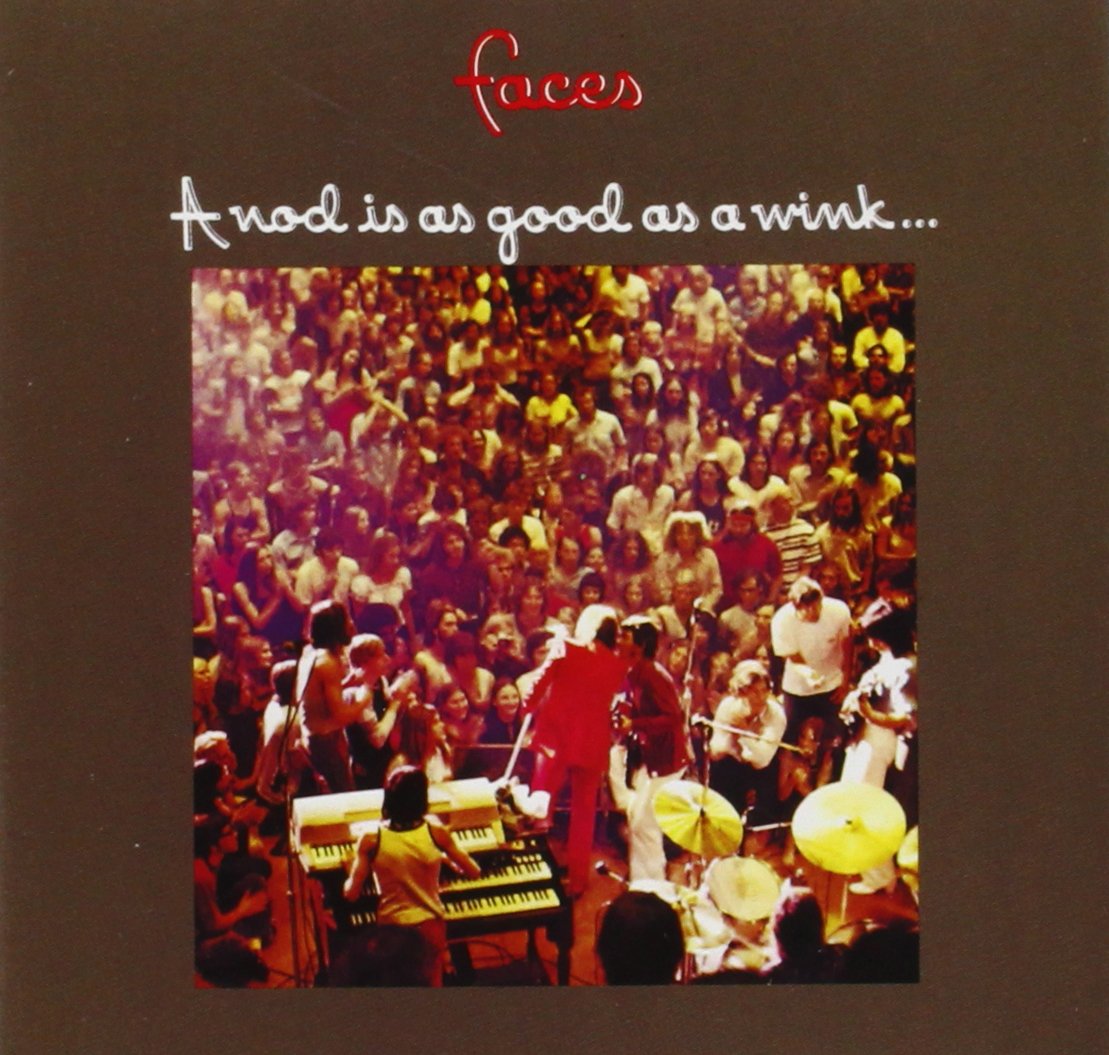
The Faces‘ third album from 1971, came in the middle of a whirlwind year for singer RodStewart. In the mere months that separated the album “Long Player” and “A Nod Is As Good As A Wink”Stewart had a huge hit with “Maggie May” and his first No. 1 solo album (‘Every Picture Tells a Story’) his third solo album was something that would soon irreparably damage the band, but at the time it was mere good fortune, helping bring them some collateral success that they deserved. Certainly, it didn’t change the character of the album itself, which is the tightest record the band ever made. Granted that may be a relative term, since sloppiness is at the heart of this band, but this doesn’t feel cobbled together, (which the otherwise excellent Long Player did).
‘A Nod Is as Good as a Wink .finally gave the group their long-awaited hit single in “Stay with Me,” . Loose, bluesy and boozy, rock ‘n’ roll doesn’t get more natural than this. The Faces and solo Rod Stewart were never as good as this before or since. From the opening ‘Miss Judy’s Farm’ which is awesome, the songs just get better and better. Their interpretation of Chuck Berry’s Memphis Tenessee followed by ‘Too Bad’ will make you feel grateful that you’re alive. Ending with the rampaging good times of “That’s All YouNeed.” In between, Ronnie Lane serves up dirty jokes the exquisitely funny “You’re So Rude” and heartbreaking ballads (the absolutely beautiful “Debris” , and generally serves up a nonstop party. There are few records that feel like a never-ending party like this seventies album , the slow moments are for slow dancing, and as soon as it’s over, it’s hard not to want to do it all over again. It’s another classic –
They were helped in that respect by new co-producer Glyn Johns, who came in as an impartial outside set of ears while helping to wrangle the unruly band members into recording shape. It couldn’t have been the easiest gig, but it’s easy to understand why Johns was attracted to it — aside from Stewart’s formidable vocals, the group boasted the prodigious talents of keyboardist Ian McLagan , drummer Kenney Jones and perpetually underrated bassist and great songwriter Ronnie Lane .
With Johns helping the Faces were brought more attentively to bear on some of their finest material. While public perception was increasingly focused on Stewart, the new album titled A Nod Is As Good As a Wink … to a Blind Horse — presented the band at their creatively democratic best. Of the eight originals they lined up for the LP, the majority were co-written, with Lane, McLagan, Stewart and Wood all having a hand in the record’s compositional makeup. As Lane recalled in the years after its release, Nod captured a group firing on all cylinders.
Side One
1. “Miss Judy’s Farm” (Rod Stewart, Ronnie Wood) – 3:42
2. “You’re So Rude” (Ronnie Lane, Ian McLagan) – 3:46
3. “Love Lives Here” (Lane, Stewart, Wood) – 3:09
4. “Last Orders Please” (Lane) – 2:38
5. “Stay with Me” (Stewart, Wood) – 4:42
Side Two
1. “Debris” (Lane) 4:39
2. “Memphis, Tennessee” Incorrectly titled on original US pressings of the album as simply “Memphis” (Chuck Berry) – 5:31
3. “Too Bad” (Stewart, Wood) – 3:16
4. “That’s All You Need” (Stewart, Wood) – 5:05
PERSONNEL –
ROD STEWART – vocals
RONNIE LANE – bass, acoustic guitar, percussion, vocals
RONNIE WOOD – lead, slide, acoustic and pedal steel guitars, backing vocals on “Too Bad”, harmonica
IAN McLAGAN – piano, organ, backing vocals “Too Bad”
KENNEY JONES – drums, percussion
HARRY FOWLER – steel drums on “That’s All You Need”
GLYN JOHNS – co-producer, engineer
PRODUCED BY FACES AND GLYN JOHNS
Déjà Vu might be the preferred choice of critics, no doubt due to the presence of Neil Young, but CSN, the trio’s glorious debut is arguably a much superior representation of their sound, and certainly a much purer one. And while some have described CSN as the ‘60s first true ‘supergroup,’ the same title could also be applied to Cream, who’d already formed and broken up long before Crosby, Stills and Nash had even made their first recording.
David Crosby, having been kicked out of The Byrds during recording sessions for 1968’s The Notorious Byrd Brothers, loitered around Laurel Canyon, pondering over his next move. It wasn’t until he hooked up with GrahamNash (ex-Hollies) and Stephen Stills that the idea of forming a new band became a real possibility.
Nash remembers: “We were in Joni’s living room – or was it Cass’s kitchen? – and David and Stephen began singing “You Don’t Have To Cry.” I asked them to sing it again then I added my harmony to it. The heavens opened: it was an unbelievable sound and we knew we had to make music together.”
In England they approached Apple, the independent label founded by The Beatles, but were rejected after hearing what they were given. CSN returned to America where, thanks to the enthusiasm of David Geffen and AhmetErtegun, CSN were subsequently offered a contract with Atlantic Records, the same label that would soon sign Led Zeppelin. Stills dominated the recording of the album. Apart from drums, handled by Dallas Taylor, he played nearly all of the instruments on the album. Nash played acoustic guitar on two tracks and Crosby rhythm guitar on a few. Stills played all the bass, organ, and lead guitar parts, as well as acoustic guitar on his own songs.
Recorded at Wally Heider’s Studio III in Los Angeles in early 1969, and released in May that same year, Crosby, Stills & Nash would go on to eclipse anything by The Byrds, The Hollies, or even BuffaloSpringfield. Also, by employing their surnames in the band’s title, instead of adopting an actual name, such as The Zombies, Jefferson Airplane etc, meant that CSN were already destined to stand out.
Right from opening Acoustic Guitars of “Suite: Judy Blue Eyes” (written about Judy Collins) and when those magical three voices blend – you realise you’re in the presence of something very special. Although the song is 7:24 minutes long , Its a marathon-like ode to his failed relationship with singer Judy Collins. Progressive-folk, raga, country-blues, even Spanish lyrics, “Suite” is an opus that takes the listener on a personal and deeply moving journey, and remains the one song that CSN should be best remembered for. Nash’s catchy “Marrakesh Express” might seem a bit twee now, at least to modern ears, yet back in the day, even a title such as that meant it was fully loaded with all manner of connotations. It’s followed by the stunning ethereal beauty of “Guinnevere” sashaying into your living room with a softly plucked Acoustics. Then you get hit with the full harmonious power and beauty of those three voices as a wall of one. When the trio first got together in Joni Mitchell’s house – they noticed the ‘timber’ of the combo.
Stills’ “You Don’t Have To Cry” is the song which started it all, and is a delightful country-blues number complemented by some exquisite three-part harmonies, followed by the trippy “Pre-Road Downs,” written by Nash, and which closed side one of the original record.
Flip the disc, and we begin with the iconic “Wooden Ships,” which would turn up on the Jefferson Airplane album “Volunteers” in November of 1969 (it was a co-write with Paul Kantner) and I’ve always loved both versions – a strange hybrid of Soulful Rock that seemed to belong to California in 1969. CSN’s original take is shorter and amps up the Guitar and Organ . The bass and rhythm section is so warm and sweet but it’s the Stills vocal followed by Crosby and back again that impresses . The lyrics describe a handful of survivors living in a post-apocalyptic world. The song was included in the Woodstock movie, thus helping to propel the group’s popularity ever further. The gentle “Lady Of The Island,” written by Nash, is a delicate love-song devoted to JoniMitchell, while “Helplessly Hoping” picks up where “You Don’t Have To Cry” left off, full of delicious harmonies and subtle acoustic guitar.
Crosby’s “Long Time Gone” had been floating around David’s head for a while, before nailing the master (a very early demo was included on the Voyage box set). Stills explained the process: “So with a song like “Long TimeGone,” I’d say, ‘Cros, go home.’ David would come back in the morning, and I’d say, ‘So, how do you like your song?’”
Clearly, Stills’ experience working in various studios over the years, meant that he knew exactly what to do when it came to overdubbing his instruments, as evidenced on “49 Bye-Byes,” a tune practically built from the ground up thanks to Stills’ knowledge of recording technology.
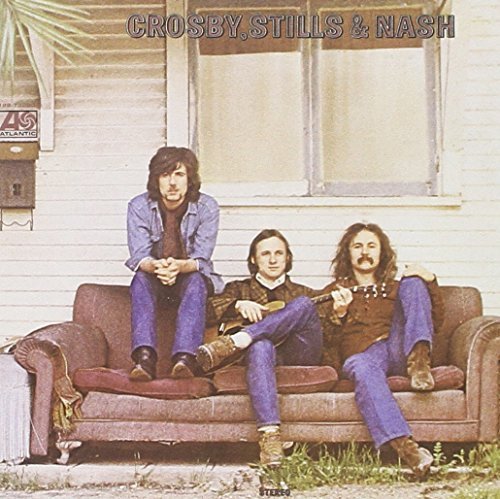
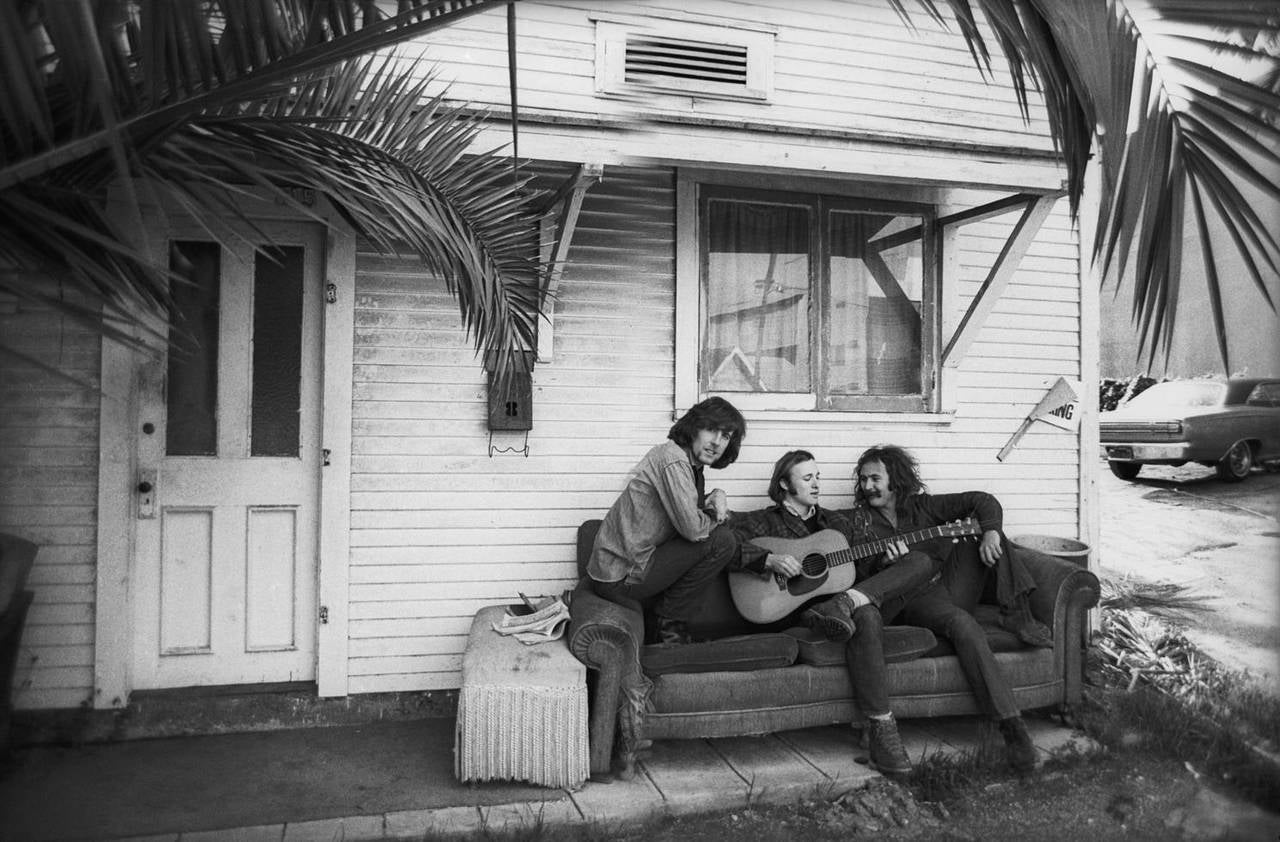
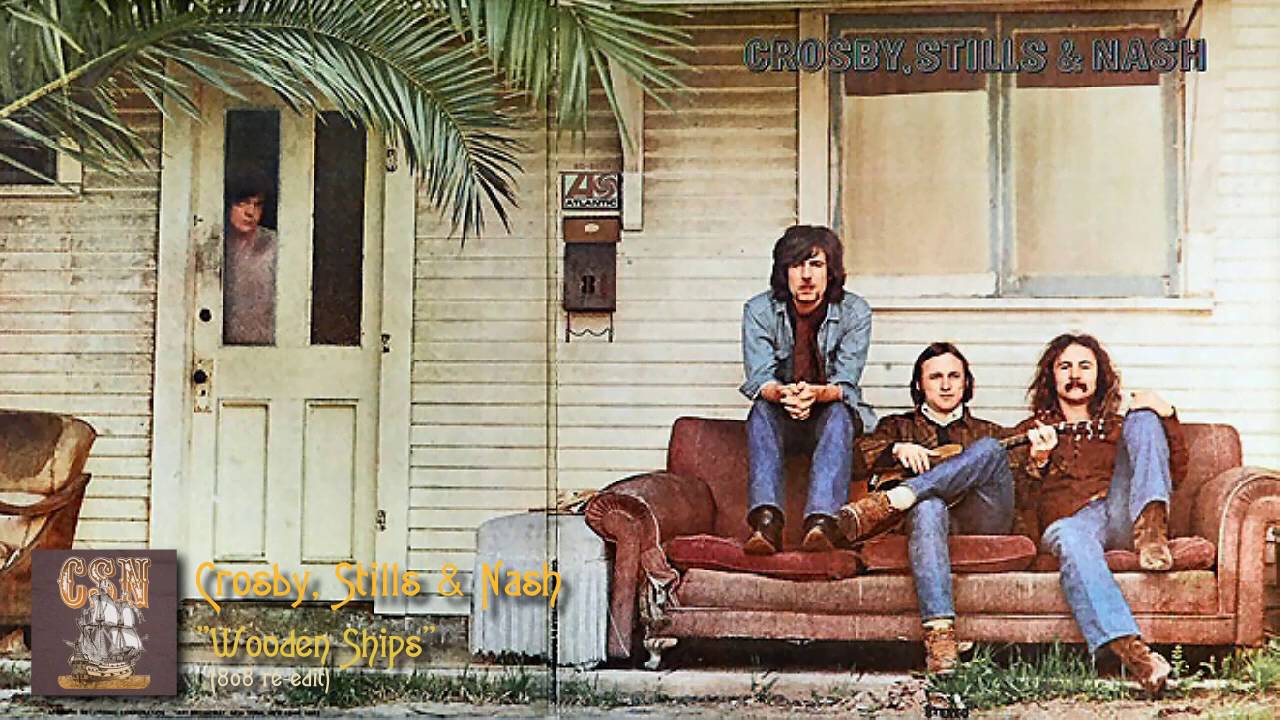
On the cover the members are, left to right, Nash, Stills, and Crosby, for no particular reason, the reverse of the order of the album title. The photo was taken by their friend and photographer Henry Diltz before they came up with a name for the group. They found an abandoned house with an old, battered sofa outside, located at 815 Palm Avenue, West Hollywood, across from the Santa Palm car wash that they thought would be a perfect fit for their image. A few days later they decided on the name “Crosby, Stills, and Nash”. To prevent confusion, they went back to the house a day or so later to re-shoot the cover in the correct order, but when they got there they found the house had been reduced to a pile of timber
Dallas Taylor can be seen looking through the window of the door on the rear of the sleeve. In the expanded edition, however, he is absent. The original vinyl LP was released in a gatefold sleeve that depicted the band members in large fur parkas with a sunset in the background on the gatefold (shot in Big Bear, California), as well as the iconic cover art. A long folded page inside displayed the album credits, lyrics, track listing,
The truly dedicated listener will likely want the 2006 HDCD expanded edition, which includes early takes of “TeachYour Children,” “Song With No Words,” “Do For The Others,” a tender folk ballad by Stills, and a cover of Fred Neil’s “Everybody’s Talkin’.” the group continued recording that year and the HDCD disc has four bonus tracks come from those sessions. “Do For The Others” would eventually show on “Stephen Stills” – his debut solo album from late 1970. The second it opens – you can hear why its been included on this Expanded CD Edition – not only is this song gorgeous to listen too – it’s beautifully recorded – essentially a Demo with Stills on Lead Guitar while the other two harmonise. It’s a genuine wow. Second up is another harmony winner in “Song With No Words” where they “dah dah” the melody that would eventually appear on David Crosby’s magnificent “If I Could Only Remember My Name” debut solo album in 1971. Truly beautiful is the only way to describe the Trio doing Fred Neil’s classic “Everybody’s Talkin'” made famous by Nilsson’s cover as used in the movie “Midnight Cowboy”. Crosby describes it in the liner notes as “Stills at his best…” There’s a demo of the “DéjàVu” classic “Teach Your Children” which is nice but nothing as good as the magical trio that preceded it. Fans will know that there are five other ‘outtakes’ from the period on the “Carry On” 4CD Box Set (1991) – one day we might get a Deluxe Edition 2CD set covering the event in its entirety.
While Crosby, Stills & Nash can never betray its hippie, idealistic origins, the record itself provides a timeless window into the lives of three young men whose unique, creative chemistry would inadvertently give rise to a whole new musical genre, one that included Poco, America, and most famously, The Eagles.
Years afterwards, Crosby would go on to sum up that special chemistry: “For whatever reasons, I think you get very few records like that in your life, which you can put on twenty years later and they still hold up. To this day, that first record comes on, and you don’t want to take it off or skip a tune. You just want to let it run.”
David Crosby – vocals; guitars on “Guinevere”; rhythm guitar on “Wooden Ships” and “Long Time Gone”
Stephen Stills – vocals, guitars, bass, keyboards, percussion all tracks except “Guinevere” and “Lady of the Island”
Graham Nash – vocals; rhythm guitar on “Marrakesh Express” and “Pre-Road Downs”; acoustic guitar on “Lady of the Island”
Dallas Taylor – drums on “Pre-Road Downs,” “Wooden Ships,” “Long Time Gone,” and “49 Bye-Byes”
Pink Flag was “perhaps the most original debut album to come out of the first wave of British punk” and also “recognizable, yet simultaneously quite unlike anything that preceded it. Pink Flag‘s enduring influence pops up in Hardcore Post Punk Alternative Rock and even Britpop, and it still remains a fresh, invigorating listen today: a fascinating, highly inventive rethinking of punk rock. The albums a brilliant 21-song suite. It’s a brief, intense explosions of attitude and energy, the band coming up with a collection of unforgettable tunes
Who says you don’t learn anything from art school?, Tell that to Colin Newman and see how long it takes you to get a fist to the face or a mouthful to the ear. As singer, songwriter, and guitarist of the band Wire, the art-school graduate opted for the six-string over his easel, but he didn’t stop painting. The wildly subversive “Pink Flag” album suggests, his art was in taking a minimalist approach to punk rock and hitting the genre with broader strokes. Like his contemporaries, there’s volume to his sound and angst to his songs, but it’s splattered across every facet to the music in wildly unpredictable ways. That’s why you can leap from the crunchy pop of “Ex Lion Tamer” toward the plodding psychedelia of “Strange” and over to the doo wop bliss of “Mannequin”. Basically, you never get the sense that they’re leaning on any one thing in particular, and that’s one of the many distinctions of post-punk.
Produced by frontman Billy Corgan; The Smashing Pumpkins’ third album is a twenty-eight-track opus of incredible scope and wonderment. Led by single Bullet with Butterfly Wings, The album features a wide array of styles, as well as greater musical input from bassist D’arcy Wretzky and second guitarist James Iha the album shot to the top of the charts and spawned a number of great singles. It has sold over ten-million units and considered one of the finest albums from the 1990s. Many would question the audacity of a group including twenty-eight tracks on an album. The fact there are no weak moments is backed by a record which sees the U.S. band present their most engaging and ambitious work yet. Billy Corgan’s unique and exceptional song writing is given room to breathe and explore. Mellon Collie’ helped reshape the face of Alternative-Rock, almost single-handedly. It is always a risk releasing a double album – regardless of how good you are – but The Smashing Pumpkins had no fear.
Go big or go home. That’s pretty much what this came down to. 25 years ago Smashing Pumpkins were commercial and critical darlings, coming off the scene-setting “Gish” and the monumental alt-rock statement of “Siamese Dream”. Their next move was a risk – a double album that shaped up as an anachronism on one hand and a potential commercial and critical disaster on the other. Their label told them as much, but Billy Corgan was set on it. “Mellon Collie And The Infinite Sadness” had to happen.
At this remove, it’s hard to imagine a world where the Pumpkins didn’t take the nuclear option. Mellon Collie feels like the last great hurrah for a certain breed of Gen X American rock band, a final grand statement from a disparate group of artists bound together by the fact that they’d upended the pop apple cart by accident.
Lacking the slash and burn punk streak of Nirvana and the cinematic dourness of Pearl Jam, Soundgarden and the wider Seattle set, Corgan’s music always felt more classic, more florid, less deliberately of the moment. But it’s easy to forget that both Gish and Siamese Dream were defined in part by their succinctness – shoegaze-literate hit after shoegaze-literate hit. Split across two sides that represented day and night, Mellon Collie’s sprawl was startling by comparison: 28 songs (totalling two hours) made the cut, and three times as many were written in a spree that recalled Bruce Springsteen’s feverish hot streak in the build up to Darkness On The Edge Of Town.
“I went around saying I was inspired by Pink Floyd‘s The Wall to try to create that kind of big, ambitious thing,” Corgan told David Wild in the liner notes for Mellon Collie’s 2012 reissue. “And, of course, jerks in the media still take me to task for saying that. For the record, from my point of view, I wasn’t trying to say that I had written my Wall … what I meant was that we were trying to reach for something expansive like Pink Floyd achieved with The Wall, as opposed to making a double album like The White Album by the Beatles, which was basically a wider collection of great songs by a group.”
Chief Pumpkin Billy Corgan was certainly on a creative streak in the early to mid-1990s. Between Siamese Dream, the outtakes collection Pisces Iscariot, the triple-LP length Mellon Collie, and the collection of b-sides compiled on 1996’s The Aeroplane Flies High (which showcased almost 30 new outtakes, although some were covers or written by guitarist James Iha). In this era, The Smashing Pumpkins released about 7 hours of new music recorded between December 1992 and August 1995, much of it written by Corgan, while even more music would surface on later reissues of Mellon Collie and The Aeroplane Flies High.
‘Set the Ray to Jerry’ is one of many Pumpkins outtakes that surfaced on The Aeroplane Flies High, as a b-side to 1989. It shares the gentle insistence of ‘1979’, moodily intense but never launching into a full-blooded rocker. It’s simple, with just drums, a simple James Iha guitar lead, and Corgan on bass. It was apparently written during the Gish tour, and dates back to the Siamese Dream sessions – Corgan told Guitar World that producer Flood vetoed the song.
Billy Corgan – Lead vocals, lead and rhythm guitar, piano, keyboards, autoharp, production, mixing, string arrangements
Jimmy Chamberlin – Drums, vocals
James Iha – Rhythm and lead guitar, vocals, mixing, additional production




 The Fat Angel Sings