Tragedy and bliss woven together. A soundtrack for when dawn approaches and fades into daylight
Driven to Oregon by a loved one’s death and a relative’s deteriorating health, Robinson and frequent collaborator Esther Shaw withdrew from society and devoted themselves to writing the project’s seventh album. Pared down to a threesome with Thor Harris, drummer for experimental titans Swans, Wrekmeister Harmonies use somber expansivity and vulnerable minimalism to detail a path to healing with The Alone Rush. J.R. Robinson perceives life as a long, gradual process of decay. Lightness fades into darkness, while innocence succumbs to the evils of modern society. His music reflects not only this worldview but his emotional response to it.
Chicago pop-punk trio Retirement Party have announced the details of their new album, “Runaway Dog”, out on May 15 via Counter Intuitive Records. Title track and lead single “Runaway Dog” grapples with the temporary loss of inspiration and motivation, but singer and guitarist Avery Springer sounds as formidable and catchy as she ever has. “I won’t, but I think they told me so / I will never pave the road that I want to,” Springer sings over perky, zippy guitars.
title track of the Chicago rockers sophomore album.
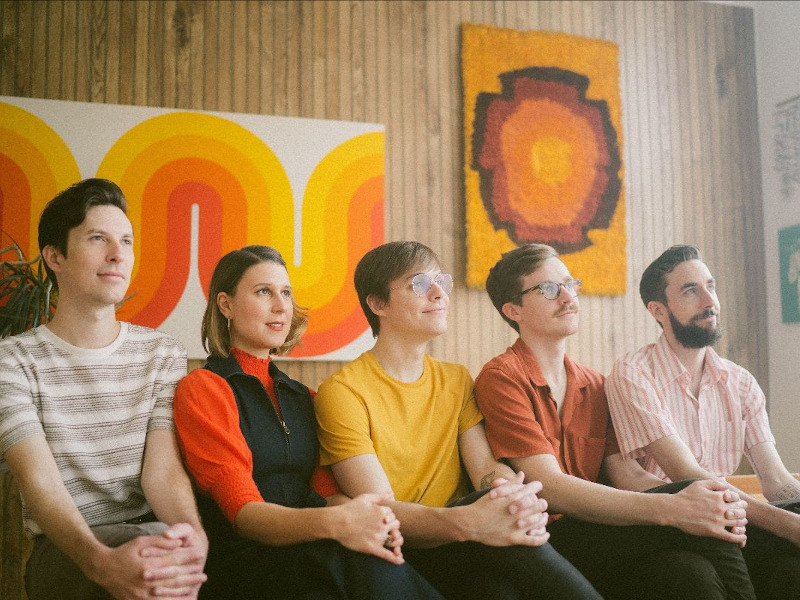
Chicago indie-pop collective Varsity recently signed with Run for Cover Records in 2018, and released a doubling of singles which showcased their ability to bring forth unique conversations in song surrounding personal relationships with a wide-eyed dreamy sparkle. This May, they will release their latest full-length effort Fine Forever, and once again, the moment marks another creative transition for the quintet.
On the album’s lead single and opener “Runaway”, they step away from the clouds and move onto the dance floor with streaks of Fleetwood flickers and a groove-laden bassline. Here, vocalist and keyboardist Stef Smith sings through the flashbulb lights without pause, being drawn only to where the heart leads. “Runaway / I don’t even know your name / You’re not going anywhere tonight / Unless you’re gonna run away.” It’s hard to imagine anyone doing so when Varsity’s love energy naturally pulls you in…
Band Members
stef, Dylan, pat, jake, paul,
Varsity’s Fine Forever will be released May 29th on Run for Cover Records.
Melkbelly sculpts their signature balance between subtle melody and frantic noise on new album “Pith”, their second for Carpark Records/Wax Nine. The Chicago-based foursome has made spatial dynamics central to its arrangements, reaching for weirder highs and more startling atmospherics, negative space giving way to enveloping walls of chaos. This sense of form is reflected not only in the purposeful production, but in the ceramic cover art created by Chicago artist Deborah Handler.
As with many of the groups who’ve been traversing Chicago’s underground scene for the past decade, Melkbelly are hard to classify. They’ve slowly pivoted from bizarro lo-fi noise into, well, a slightly more polished version of bizarro lo-fi noise, writing songs with titles like “Twin Lookin Motherfucker” and “Kissing Under Some Bats.” Miranda Winters’ deceptively calm vocals float alongside a largely indistinguishable wall of grunge guitar (courtesy of Bart Winters) and bass (Liam Winters), and James Wetzel’s Lightning Bolt–like percussion.
Recording in two short sessions six months apart, the band worked with longtime collaborator Dave Vettraino, this time at Bloomington, Indiana’s Russian Recording. Alongside an arsenal of rock gear and airy synth layers coaxed from a Moog Prodigy, Pith’s multidimensionality was refined by the studio’s collection of rare Russian tube mics, which were placed in every corner to capture Melkbelly’s unabashed loudness. Frontperson Miranda Winters’ charmingly bright vocals are newly effected, delayed to a menacing, mysterious thickness. Guitars, handled by Miranda and Bart Winters, interlock and separate with dizzying ease, riffs dissolving into floating trails and reappearing with metallic edges. Bassist Liam Winters’ low grooves bounce and kick along with drummer James Wetzel’s rhythmically unsettling performance, which stretches time yet never falters.
After two years touring internationally, the band felt comfortable enough to rearrange songs they knew well, their renewed closeness guiding them. Their literally familial relationship was crucial for support, as Pith was summoned from a place of mourning. “We lost an incredible friend suddenly and nostalgia always acts as a helpful tool for me in navigating difficult times,” Miranda says. “Revisiting emotionally challenging moments or significant social interactions helps shed light on confusing feelings for me. Lyrically, grief gave way to considering life.” She drew from diverse scenes—Grimm-like children’s stories too dark for kids; thorny, mossy forests—to create stories that feel distinctly Melkbellian: philosophically strange, strikingly textural, funny and sad and open-hearted.
Maturation, as well as their DIY reverence, can be heard on the tempo-shifting “Sickeningly Teeth.” It’s an homage to “feel[ing] like shit really loudly or obnoxiously. You know, in an unapologetic youthful way,” deadpans Miranda. James describes it as a “rhythmic exploration to make the song feel like it’s pulling itself apart.” Follow-up single “LCR” similarly shapes Pith’s dynamics and mood. Its shifting signatures held steady by James’ frantic beat, the track is a purgatorial homage to motion, ultimately propelled by its tangled guitars and layered vocal harmonies. “It’s about how having conversations with the dead can scoot you along in life, even when you’re really only hearing one side of the conversation or making up the other half,” says Miranda.
Since their 2017 debut Nothing Valley, the members of Melkbelly have an even better understanding of their sonic motivations. “We’re always going to sort through the past to make better sense of the present,” Miranda says, and in doing so Melkbelly continually finds ways to mutate its sound. On Pith, Melkbelly sought space, and succeeded in crafting it. What a pleasure to be let in.
1. “THC”
Miranda: This is a song about losing a friend physically versus losing a friend emotionally—it’s a sad Venn diagram. Liam: Miranda calls the bass during the verse on this track “prom bass” after the original bass line was much more aggressive. Bart: A friend of ours says he likes to get stoned and listen to this track on repeat, which to me is the highest compliment you can give. James: If there were one Melkbelly song selected for the golden record sent out on the Voyager Spacecraft, it would be “THC.”
2. “Sickeningly Teeth”
James: Teeth is a tempo experiment—it pushes and pulls itself apart as the song progresses. It once was a ten-minute song that got chopped down significantly in the recording/mixing process. Bart: Usually we kinda tear apart the melodic parts of the songs Miranda brings to the band, but we decided to lean into it on the chorus for this one. I miss the ending that just continued to slow down for another three minutes.
3. “LCR”
Bart: Not something that we overtly discussed, but on most of these tracks we tried to pull back a little during sections of songs to allow for more variety in the song. On “LCR,” one of the guitar takes is pulled from the opening verse, leaving just Miranda’s sparse rhythm guitar. Felt weird at first but ended up working, in my opinion. Miranda: This is one of those songs that just fell out super fast which usually makes me nervous. We were happy with how basic it was and fought to keep it simple.
4. “Little Bug”
Miranda: When we were in Berlin I was feeling real low and ended up at the apartment alone for a while. I was laying on my bed pitying myself when this moth showed up and wouldn’t leave me alone. The frustration inspired me to get up and start writing “Little Bug.”
5. “Humid Heart”
James: The oldest song on the record. Been playing this one for years and years and years.
6. “Kissing Under Some Bats”
Bart: This was originally not an eight-minute song, but during recording we started messing around with repeating the last note, stretching it past the point of being obnoxious or gimmicky (we hope) into a more meditative thing (Miranda still may not like this track). We are not reinventing the wheel, but, as with most Melkbelly songs, we don’t really have any goals for song genre or song length. It’s really just whatever we’ve been listening to lately or is rattling around in the back of our skulls.
7. “Season of the Goose”
Bart: We had a lot of challenges with this song. Initially it was James’ aggressive beat, then it was whether we should keep Bart’s synth-like guitar riff in the beginning. Developing this song was the complete opposite of something like “LCR.” We experimented with altering almost every aspect of the song at some point. I really like how it turned out, and its position on the album right after “Kissing Under some Bats.”James: I’m a huge advocate of “the riff” at the top of this song. It almost didn’t make the cut, but thank god it did.
8. “Mr. Coda”
James: The best song on the record. Liam’s time to shine. It was fun to experiment with the second half of this track. There’s some Moog Prodigy bass line that’s being triggered/gated by the kick drum. And some Serge synth drone wobble in the background. When we figure out how to play this one live, it will be great. Liam: Miranda had a very specific vision of the bass tone for this song. I tried a lot of different options until we agreed on something passable. I don’t think it was what she wanted, but I’m happy with how this song turned out.
9. “Stone Your Friends”
Miranda: This was a song that took a lot of playing before it felt comfortable. It’s about shopping at the mall.
10. “Take H20”
James: Oldie but goodie. Blue Man Group inspiration throughout (think “Rods and Cones”). Bart: We played this song live for the first time at the Pitchfork Music Festival. It was one of the easiest to record because we had been playing it for so dang long, but also I think we were a little bored with the song by the time we recorded it so we ended up going back to the recording and changing/adding additional instrumentation. I think we tried to channel Oozing Wound during the little jam-out.
11. “Flatness”
Bart: Just a simple song that highlights Miranda’s voice and proves James can play the drums softly.
released April 3th, 2020
Miranda Winters – Guitar, Vocals, James Wetzel – Drums, Moog, STS, Bart Winters – Guitar, Liam Winters – Bass Guitar
All songs written by Melkbelly
Lyrics by Miranda Winters
Though its title is taken from the Old English term for “the sound of winter,” much of James Elkington’s solo debut bears a distinctly autumnal vibe. With a feel that harks back to the British singer/songwriters of the early ’70s, Wintres Woma ultimately seems to capture the slow seasonal slide from fall’s gentle unbuttoning into an icier, more frigid landscape.
Elkington hails from the U.K. but makes his home in Chicago, where they know a thing or two about winter. He has a varied history that includes fronting indie rockers The Zincs and co-leading art-folk outfit The Horse’s Ha with Freakwater’s Janet Beveridge Bean. But over the past couple of years before beginning work on “Wintres Woma”, he had been working primarily as an accompanist, playing guitar and other instruments with British folk-rock legends like Richard Thompson and Michael Chapman, as well as Steve Gunn, Jeff Tweedy, and others.
Elkington’s first solo statement was cut in just five days at Wilco’s sonic headquarters, The Loft in Chicago. It seems to key in on the sensibility of artists like Thompson, Chapman, and their peers, who blurred the lines between folk, rock, and jazz in the ’70s with their nimble guitar work, and combined it with a poetic lyrical bent. The delicate-but-precise acoustic guitar patterns at the core of Wintres Woma sometimes feel like descendents of Nick Drake complex finger-picking latticework, especially when Elkington’s lines are countered by Nick Macri’s fluid stand-up bass on the speedy “Make It Up.”
The only track not written by Elkington, an instrumental take on the traditional Scottish folk song “The Parting Glass,” is so adventurously re-harmonized that it scarcely resembles its source, bringing to mind the trailblazing 1960s acoustic explorations of British guitarist Davey Graham. And the combination of Elkington’s sonorous baritone and virtuosic fretboard forays makes a strong case for him as the spiritual heir to the late U.K. folk legend Bert Jansch.
But for all of Wintres Woma’s links to a scene that was approaching its peak when Elkington was a zygote, the dominant artistic voice here is an unflinchingly singular one. The lyrics, in particular, travel a path that seems entirely their own, with imagery unusual enough to force your synapses into new configurations, and a bittersweetness palpable enough to take you by the tear ducts and squeeze.
“In the drug harbor, friends became verbs, chanting in squares the where and the why,” he sings in “When I Am Slow” atop a folkish guitar melody that could be either minutes or hundreds of years old. “Shut that accordion mouth and stop crying fat wedding-band tears,” he admonishes the subject of “The Hermit Census.” And it’s tough to imagine anyone else managing to slip a line like “entrails were made into garlands to welcome my reign” into a ballad as warmly homey-sounding as the crepuscular, harmonica-laced “Sister of Mine.”
The arrangements on the self-produced album are spare (if not stark) from start to finish, and mostly played by Elkington himself, with occasional assists on violin, viola, percussion, and the aforementioned bass and cello. With Elkington’s intimate, plum wine vocals and tactile guitar work at the core throughout, each track feels like a stylishly scrawled diary entry we’ve somehow wrangled the permission to read.
But whether Elkington is whistling through the graveyard on the ironically perky-sounding “Grief Is Not Coming,” recounting the surreal dream state of “Greatness Yet to Come,” or navigating his way through the nightmarish visions of “Hollow in Your House,” his combination of timeless folk flavorings and an artful modernity blend into a wistful but never forlorn kind melancholy. It’s the kind that steps far enough back from the shifting of the seasons of life to know that the whole thing is just a dream to be played out, a dance to follow through, on the way to becoming one with the true sound of winter.
We couldn’t be more proud to share Deeper‘s sophomore album “Auto-Pain” out today on Fire Talk. Truly love these boys and hope you’ll take some time today to check out the record. The press has been all over it, if you want to dig in more read this excellent feature via Stereogum .
Auto-Pain represents the constant wave of depression felt by many in everyday life. Stemmed from Aldous Huxley’s ‘Brave New World’, Auto-Pain is a concept meant to be an inverse to soma, a pill in the book which makes everything numb. The idea of auto-pain is to epitomize the desire to return to a connection with thoughts and clarity, which comes at the expense of feeling everything simultaneously. The album artwork features the now-demolished Prentice Women’s Hospital in Chicago capturing the band’s rounded-off brutalism, and the album title appears in Urdu, a nod to drummer Shiraz Bhatti’s Pakistani heritage. The record was recorded and mixed by Chicago scene luminary Dave Vetraino (Lala Lala, Dehd) and mastered at Chicago Mastering by Greg Obis (Ne-Hi, Melkbelly).
A portion of the proceeds from Auto-Pain will be donated to Hope For The Day an organization that actively works to break the silence surrounding mental health
From Deeper’s Sophomore album “Auto-Pain” out March 27th on Fire Talk Records.
Chicago band Deeper have just released their new album, “Auto-Pain” and they’ve just shared one last appetizer before we can hear the whole thing. “The Knife” is a jagged post-punk ripper, moody and measured, that comes with a genuinely excellent, equally tense music video set in an auto garage. Following up their 2018 s/t debut, their new album feels leaner and more to the point. The jagged guitar licks and Nic Gohl’s vocals cut right to bone and creates a tension that I am unable shake throughout. Bassist Drew McBride, and drummer Shiraz Bhatti are on point throughout. While they don’t sound anything like The National, the rhythm section reminds me of how it takes me couple of listens of their albums to fully digest what they’re doing and really appreciate it. Deeper were on tour with Montreal’s Corridor when the coronavirus pandemic took hold and they’re now back at home in Chicago.
Inspired by Aldous Huxley’s dystopian classic Brave New World, the timing of this album feels like it was preordained for these crazy times with Chicago’s weather particularly gray and dreary. As the listener I am on edge throughout and sucked into their sphere.
Mike Bloomfield – is the subject of a new multi-disc anthology produced by Al Kooper, “From His Head to His Heart to His Hands”, released by Columbia/Legacy – is rock’s greatest forgotten guitar hero. From 1965 to 1968, he was nothing less than the future of the blues, charging the primal forms and raw truths of his idols – B.B. King, Muddy Waters, Howlin’ Wolf – with cutting-treble tone, breakneck improvising and incisive, melodic articulation on a machine-gun series of classic records: Dylan’s epochal single “Like a Rolling Stone” and the Highway 61 LP; the Butterfield band’s ’65 debut album and ’66 raga-blues thriller, East-West; and the 1968 Top 20 hit Super Session, a dynamic jamming collaboration with Kooper. In 1966, Eric Clapton, on the verge of his own stardom, called Bloomfield “music on two legs.” But in the Seventies, as Clapton ascended to sold-out arenas, Bloomfield slipped into twilight in San Francisco, working with low-profile bands and making small-label records while wrestling with chronic insomnia and heroin.
Bloomfield – (1943-1981) Born in Chicago, Bloomfield gravitated toward the Blues after playing in high school Rock and Roll bands. He was born to play the Blues, spending time in Chicago’s South Side Blues clubs with black bluesmen such as Sleepy John Estes, eventually performing with Chicago’s finest, Howlin’ Wolf and Muddy Waters during the early ’60s. He also met harmonica player, Paul Butterfield and guitarist Elvin Bishop. A grandfather, Max, owned a pawnshop, and Bloomfield got his first guitar there. Born left-handed, he forced himself to play the other way around. “That’s how strong-willed he was,” says Goldberg. “When he loved something so much, he just did it.”
The Butterfield Blues Band was born in 1965 with the addition of keyboardist Mark Naftalin, bassist Jerome Arnold, and drummer Sam Lay. The debut album the eponymous “The Paul Butterfield Blues Band,” was released in October 1965 and met with little success nationally. But more important, Bloomfield played on Bob Dylan’s epic single “Like a Rolling Stone,” and on most of the tracks of Dylan’s 1965 “Highway 61 Revisited,” album. Additionally, he also joined Dylan at the Newport Folk Festival in July, along with the balance of Butterfield’s band (sans the leader). and keyboardists Al Kooper and Barry Goldberg. This was Dylan’s historic appearance in which he strapped on a Telecaster, and the band played electric – the first instance of an electric-guitar performance by the folk rocker. Dylan remembered Bloomfield as “the guy that I always miss. . . . He had so much soul. And he knew all the styles.”
“He put tremendous force into what he was doing,” says pianist Mark Naftalin, who played with Bloomfield in the Butterfield band, then on many post-’68 gigs and sessions. “But that’s not the same as ambition. He turned away from possibilities of success ritually.
The Butterfield Blues Band’s second LP “East-West” from 1966 fared much better than its predecessor and has gone on to become a classic. During this period, Bloomfield also contributed guitar on albums by Chuck Berry, James Cotton, and Mitch Ryder. Next, after relocating to San Francisco in 1967, he formed Electric Flag with his long time collaborators Goldberg and Nick Gravenites, and bassist Harvey Brooks and drummer Buddy Miles completed the band. Michael was organic – he played directly from his heart into an amp,” says keyboard player Barry Goldberg, who met the guitarist in high school in Chicago and was in Bloomfield’s psychedelic-R&B big band the Electric Flag. “When he shook a string, it was like Otis Rush. He had the intensity in his soul. He didn’t need anything else.
They appeared together for the first time at the Monterey Pop Festival and released the “A Long Time Comin,” album in 1968, featuring “Killing Floor,’ “Texas,” and “Wine,” among other tasty tracks. The record was seen as uneven, and hostilities between band members and heroin abuse subverted the group. Teaming up with Kooper once again and Steven Stills., The band released the one-off “Supersession,” with one of Bloomfield’s finest moments on the soulful “Albert’s Shuffle,”
The classic example is Super Session, Bloomfield’s only hit record under his own name. Tracks from that album, outtakes and associated live material – arguably some of his most sublime, furiously poetic soloing on record – comprise From His Head‘s second CD. Guitarist Jimmy Vivino, the bandleader on Conan and a lifelong Bloomfield disciple, cites the gleaming tangle of vocal-like phrasing and diamond-hard melodic certainty in “Albert’s Shuffle,” the opener on Super Session, as the peak. “The intro and first chorus are breath taking,” he raves. “And it’s just a Les Paul Sunburst into a Super Reverb amp with that Bloomfield tone – no bass, volume all the way up. And you control it from the guitar.”
But Bloomfield is on only one side of the original LP. He quit the sessions after one night of recording, leaving Kooper a note: “Alan, couldn’t sleep. Went home.” Kooper finished the album with Stephen Stills. “You know what it was in retrospect? Michael wasn’t properly challenged by anyone,” Kooper says now. “Even I didn’t want to take that position. I’d rather be his friend.”
The album was a big hit landing at #12 on the Billboard Album Charts, and resulting in a sequel “Live Adventures of Mike Bloomfield and Al Kooper”, recorded at Fillmore West. Bloomfield turned to solo. session and backup work for the next 12 years, including guitar on a track of Mother Earth’s “Living With the Animals,” in ’68. He also produced James Cotton’s “Cotton in Your Ears,” sessions in ’69, and contributed to Janis Joplin’s “I Got Dem Ol’ Kosmic Blues Again Mama,” 1969 album – and helped put together the band.
His last major work was on “Fathers and Sons,” on the Chess label reuniting with Butterfield and Lay, backing Chess masters Muddy Waters and pianist Otis Spann. He gave up guitar playing in 1970 because of his addiction but did manage a few more albums in the 1970s, including “Triumvirate,” in 1973 with Dr. John and John Hammond Jr., and a reformed Electric Flag for an album “The Band Kept Playing.” He sat in with Dylan at San Francisco’s Warfield Theatre on 11/15/80, and continued to play live dates, with an appearance at S.F. State College on 2/7/81 that would be his last.
Sadly, Bloomfield was found dead in his car from a heroin overdose on 2/15/81. His guitar prowess would live on in his wake, and Rolling Stone magazine ranked him #22 on its list of “100 Greatest Guitarists of All Time,” in 2003, and he was inducted into Blues Hall of Fame in 2012 and the Rock and Roll Hall of Fame in 2015.
Back when they released 2017’s GN, Chicago’s Ratboys were regulars of the DIY/indie/punk world but they were injecting a little alt-country into their sound and they seem poised to be one of DIY/indie/punk’s next breakout bands. Now, three years later, their third album Printer’s Devil just might be the one that does it. Ratboys already seem to be getting more praise and hype than ever, and compared to their first two albums, Printer’s Devil sounds big. They’re channelling the soaring, power pop-tinged alternative rock of the ’90s, sounding kind of like a cross between Weezer and the Gin Blossoms but with a distinct delivery from vocalist Julia Steiner that sets them apart from any one band in particular. They also know how to change things up, withPrinter’sDevil finding time for punk speed, folk balladry, atmospheric build-ups, and plenty of the in-between. As ever, Julia’s earworm melodies and the band’s strong vision tie it all together.
Upheaval and change are themes spread throughout the songs on Printer’s Devil, the latest Ratboys LP, released via Topshelf Records. A tangible sonic shift is apparent thanks to a newly-expanded lineup – founding members Julia Steiner and Dave Sagan are now joined by Marcus Nuccio and Sean Neumann on drums and bass. What started as an acoustic duo has finally transformed into a full-scale indie-rock band with a clear identity. Recorded live at Decade Music Studios in Chicago, Printer’s Devil features big-chorus power pop songs like “Alien with a SleepMask On” and “Anj” that sound massive and larger than life, alongside intimate folk songs like “A Vision” and devastating alt-country tracks like “Listening,” showcasing once again the group’s signature versatility. Building off their previous albums Ratboys captures the bombastic, electrified fun of their live show in a bottle on Printer’s Devil and showcases their growing chemistry as a tight-knit group.
The Band:
Guitar, vocals, lyrics – Julia Steiner
Guitar, bass (Tracks 3, 8, 9) – Dave Sagan
Bass – Sean Neumann
Drums, synths – Marcus Nuccio
Drums (Tracks 3, 4, 8, 10), Vibes – Ian Paine-Jesam
Hailed indie-rock duo Ohmme as both a Chicago band to know and an outstanding live act, so you could say we’re pleased to report they’ve announced a new album, the follow-up to their 2018 debut Parts. Fantasize Your Ghost, coming June 5th via Joyful Noise Recordings, is preceded by lead single “3 2 4 3,” which arrives alongside an arresting music video somewhat reminiscent of Jordan Peele’s Us. Stewart and Cunningham are both classically trained musicians and are established players within the Chicago music scene. They are especially involved in performing and working for venues within the local experimental music scene. They’re constant collaborators and have recorded and toured with homegrown acts as varied as Tweedy, Whitney, Chance The Rapper and Twin Peaks.
Cunningham and Stewart are multi-instrumentalist, singer-songwriters with a penchant for two instruments in particular. “The band started because we knew we could sing well together and we wanted to make some noise with the guitar,” says Cunningham. Stewart elaborates, “Sima and I are both trained classical pianists and we know many of the sonic spaces keyboards have to offer. Since we were interested in experimenting and creating something different from what we had both done in the past, we chose guitar as our outlet for this band. We wanted to create both new and uncomfortable parameters for ourselves to force us into a different creative space.” These guitar-heavy experiments are sometimes earthy and resounding, at other times shimmering and buzzing—swirling around the duo’s expertly crafted vocals while creating a chaotic bed of harmony. Cunningham’s smoky alto complements Stewart’s higher-register croon, all underpinned by the restrained yet highly inventive polyrhythmic percussion of drummer Matt Carroll. Think Amber Coffman and Angel Deradoorian-era Dirty Projectors.
Band Members
Macie Stewart
Sima Cunningham
Official Video for “3 2 4 3” by Ohmme off the album ‘Fantasize Your Ghost’ out on Joyful Noise Recordings.








 The Fat Angel Sings