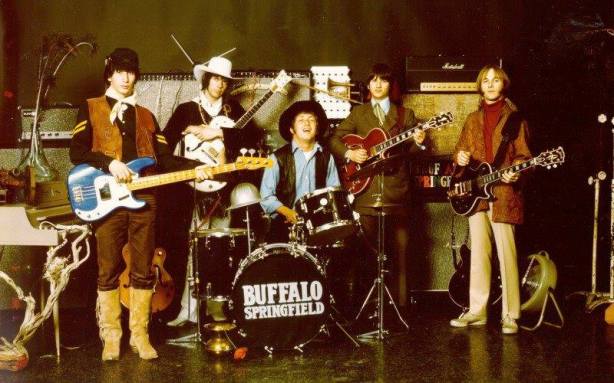
Posts Tagged ‘Buffalo Springfield’

Fifty years ago this Saturday, Stephen Stills, then a member of Buffalo Springfield, was on his way into Hollywood to hear some live music on the Sunset Strip. But in one of those defining rock & roll moments, what he encountered was a rally: hundreds, if not thousands, of kids protesting about a new curfew and the imminent closing of one club, Pandora’s Box, by way of a fake “funeral” for it.

“The commercial merchants on Sunset Boulevard in a certain area decided that the element of young people on the street every night was not conducive to commercial enterprise,” Stills said in a 1971 interview. “A bunch of kids got together on a street corner and said we aren’t moving. About three busloads of Los Angeles police showed up, who looked very much like storm troopers. … And I looked at it and said, ‘Jesus, America is in great danger.'”

Within weeks of this event, Stills had written – and Buffalo Springfield had recorded a song inspired by that night, “For What It’s Worth.” With its emphasis on Stills‘ spooked voice, drummer Dewey Martin’s ominous snare drum and Neil Young’s warning-bell two-note guitar part in the verse, the track became the band’s only hit, peaking at Number Seven in the spring of 1967. Yet equally striking was its sound: The eerily quiet song captured the uneasy mood of the moment that extended beyond Los Angeles to Vietnam, and lyrics about “a man with a gun over there” and “young people speaking their minds/Getting so much resistance from behind” were the sound of the rock counterculture cementing its socially conscious voice.

https://www.youtube.com/watch?v=2n9Rgkpz7yE

“For What It’s Worth” has transcended its origin story to become one of pop’s most-covered protest songs – a sort of “We Shall Overcome” of its time, its references to police, guns and paranoia remaining continually relevant. The Staple Singers were among the first to cover it, in 1967, but since then, it’s been recorded by a mind-bendingly diverse number of acts: Ozzy Osbourne turned it into a grim stomper, Lucinda Williams into a ghostly ballad, Kid Rock into a classic-rock homage, Rush into a swirling soundscape, Led Zeppelin (in live bootlegs) into languid blues. (Robert Plant also cut a version with his pre-Zep band, Band of Joy.) Public Enemy even sampled it on 1996’s “He Got Game.”

According to BMI, the song’s publishing house, “For What It’s Worth” been played 8 million times on TV and radio since its release. In 2014, it came in at number three on Rolling Stone’s readers poll of the best protest songs. “The way it’s written, it’s so open to interpretation,” says Heart’s Ann Wilson, who released a cover last year on her first EP with side project the Ann Wilson Thing. “It’s so open that it’s brand new today. The main hook, ‘Everybody look what’s going down’ – you can apply that, to say, the current election. The song is going, ‘What the hell is this?’ You can apply the song to any situation in any decade.”

By 1966, the situation in Los Angeles was tense. An increasing number of club goers was descending on the Strip, irritating area residents and upscale boutiques, and the LAPD instigated a 10 p.m. curfew for anyone under 18. On the night of November 12th, a local radio station announced there would be a protest at Pandora’s Box. According to reports, a fight broke out for reasons having nothing to do with the curfew; a car carrying a group of Marines was bumped by another vehicle. Egged on by that fight, the protesters (some of whom carried placards that read “We’re Your Children! Don’t Destroy Us”) trashed a city bus and threw bottles and rocks at storefronts.
Approximately 1000 young music fans gathered at the Pandora’s Box club on Sunset Strip to protest a 10pm curfew imposed by local residents during the The “hippie riots” in L.A. on November 12th, 1966.
“It was really four different things intertwined, including the war and the absurdity of what was happening on the Strip,” Stills later told The Los Angeles Times. “But I knew I had to skedaddle and headed back to Topanga Canyon, where I wrote my song in about 15 minutes.” The folk-blues feel of the song harked back to Stills‘ days in the Greenwich Village folk scene.
As anyone who’s heard it knows, the phrase “for what it’s worth” appears nowhere in the song. According to one legend, Stills played it for one of the group’s managers, prefacing it with, “Let me play you a song, for what it’s worth.” Buffalo Springfield singer-guitarist Richie Furay recalls he, Stills, and Young playing new material for Atlantic’s Ahmet Ertegun, a major supporter of the Springfield. “Ahmet had come to Los Angeles and we were at Stephen’s house,” Furay recalls. “At the end of the day, Stephen said, ‘I have another one, for what it’s worth.'”
On December 5th, only a few weeks after the Strip mayhem, the Springfield went into an L.A. studio to lay down the song in a one-day session. Young credited engineer Stan Ross with the song’s spare, almost sinister arrangement. “Stan came in and said, ‘You gotta do this one thing to the drum, the snare,'” Young said in Jimmy McDonough’s bio “Shakey”. “Took a broom, a guitar pick and mixed that in so it’s got that sound – of a guitar pick going through a broom, on the straw. That was it.” Added Stills later, “Neil came up with the wonderful harmonics part with the vibrato. The combination of the two guitar parts, with my scared little voice, made the record.”
Furay admits he didn’t hear anything special in the song at first: “I was more into the electric work, like ‘Bluebird’ and ‘Rock & Roll Woman,’ that phase of where we were,” he says. “I didn’t hear it, but Stephen felt the pulse of it and there you go.”
Everyone else knew the song was special, and the single was rush-released with an amended title, “(Stop, Hey What’s That Sound) For What It’s Worth,” at Ertegun’s suggestion. The song was also added into new pressings of the band’s first album, replacing another Stills original, “Baby Don’t Scold Me.”

https://www.youtube.com/watch?v=OuphMxyPWeA

If there is a wandering minstrel for a generation, some would think it would be Stephen Stills. He was a founding member of Buffalo Springfield,Crosby, Stills & Nash, Manassas and has had a great solo career to date.

Stephen Stills is one of the few rock artists who can claim to have grabbed the elusive brass ring of critical and commercial success not just once or even twice, but three times.

The first time was as a group member of Buffalo Springfield and writer of their 1967 hit “For What It’s Worth,” taken from their acclaimed first record. After Buffalo Springfield folded, he formed one-third of supergroup Crosby Stills and Nash, whose definitive performance at Woodstock in 1969 helped rocket their debut album release into multiplatinum orbit. And finally, just to make it perfectly clear he wasn’t simply riding the coat tails of others, in 1970 Stills released his first solo effort, which went to No. 3 on the album charts and spawned a Top 20 single, “Love the One You’re With.”

All milestones for sure, but these three classics have tended to obscure the rest of Stephen Stills’ work. And that’s unfortunate, because in Stills’ canon is an often overlooked gem in many ways the equal of his other projects: an album called Manassas, made by a band of the same name.

This seven-piece aggregation was assembled by combining players from Stephen Stills’ road band with others from the last incarnation of the Flying Burrito Brothers, which included ex-Byrds’ bassist Chris Hillman. So, though Stills was the acknowledged leader, officially Manassas has always correctly been referred to as a band — one with a “benevolent dictator” perhaps, but a band nonetheless.

The musicians’ wide range of experience enabled them to move between various forms of American popular music, integrating rock, pop, country, blues, Latin rhythms and other bits as well. This was very much in evidence on the group’s 1972 self-titled release, an album with so much good material that it came out as a two-record set. Even the names of the songs gave clues as to the variety found in the grooves: “Cuban Bluegrass,” “Colorado,” “The Love Gangster,” “Blues Man.”

One could hear the influences weaving in and out of the mix, courtesy of: Al Perkins’ pedal steel; Joe Lala’s percussion work; the tight-but-loose rhythm section of bassist Calvin Samuels and drummer Dallas Taylor; the stellar presence of keyboard ace Paul Harris; and the tenor harmony voice and rhythm guitar of Chris Hillman.

And let’s not forget Stephen Stills himself, writing and singing the songs, and playing his distinct lead guitar style, tying it all together. Even the first side is cut together as a seamless medley like production, with the other sides thematically arranged for maximum effect. Overall, think the Eagles meets Santana meets Johnny Winter, with bits of the Grateful Dead and Jimi Hendrix’s Band of Gypsies in places.

https://www.youtube.com/watch?v=HggVUWp0-M8

Still, you have to wonder why this went under so many people’s radar, especially with the gap left by the break up of CSN  (and Young) in 1970. There could be a number of reasons.

First, there might have been some confusion as to what this actually was: a third Stephen Stills album or something else? After all, even the cover sports Stills’ name large above the Manassas logo.

Second, it was released in April of 1972, and shortly thereafter the band went off to tour Europe. Some of the television appearances they made while over there show that when they got warmed up, they were as good as or better than most of their contemporaries. After returning to the U.S., Manassas had to make time to accommodate Chris Hillman’s commitment to prep for a Byrds’ reunion tour starting in October, which might have slowed their momentum. Finally, although Manassas did make the Top 10 in the album charts that year, it contained no successful single. But the Crosby and Nash duo effort released around the same time contained a Top 40 single, “Immigration Man.” Perhaps more significantly, Neil Young’s 1972 best-selling chart topper Harvest featured the singles “Heart of Gold,” which went to No. 1 in the charts, and “Old Man,” which reached the Top 40.

Eventually, various outside factors, including Hillman starting the Souther-Hillman-Furay Band and Stills and  reuniting Crosby Stills Nash and Young for a major world tour in 1974, would cause Manassas to officially call it quits in late 1973.

At least they left behind one great album to document their short existence, and maybe one day Manassas will take its place alongside Stephen Stills’ other, more famous contributions to rock ‘n’ roll.


Stephen has reached  71 on his last birthday. Stephen Stills is able to claim that he played at the 3 most important music festival of the 60’s. Monterey International Pop in 1967, Woodstock in August of 1969 and Altamont in December. of 1969.

On his first solo album “Stephen Stills”, he had both Jimi Hendrix and Eric Clapton play for him. And he’s ‘Still’ playing.

Is there anyone piece of his work that is your very favorite?


A rare cover of Buffalo Springfield song recorded circa 1969. issued on “Into The Afterlife” CD, Colin Blunstone’s short-lived alter ego turns in a suitably tasteful reading of this Buffalo Springfield “Again” track, only for it to languish in the vaults for over 40 years.

More classic psychedelic lettering by our good friend here in “Posterville”, and acclaimed father of the style and legendary BIG FIVE artist, Wes Wilson. WE have poster #61 in the old Fillmore poster series. This poster dates back 46 years ago. On this date in 1967, Buffalo Springfield, The Steve Miller Band and Freedom Highway played for a revved up audience at the Fillmore Auditorium here in the city by the bay. There are several variation of this poster due to the fact that the colors of inks were changed during the press run. I wish I could put up a few of the different colored posters as they are all really beautiful. This one is my favorite though.
The image here is of a fantasy face of a figure with a long head dress which forms the lettering. In one way,it is very unfortunate that Wes was about to have a dispute with Bill Graham which led to him no longer producing posters for the Fillmore concerts because most of the designs he created at this time were some of the most brilliant works of graphic artistry created in the 20th century. I truly believe that …..wouldn’t you agree? Alas, he went onto create a vast amount of posters long after that, and continues to this day producing some incredible pieces. Look up his website to see just what he’s been up too.

In spite of artistic differences, Family Dog’s “Top Dog” Chet Helms and Master Big FIve rock artist, Wes Wilson collaborated on the beginnings of what led to a revolutionary explosion of creativity in Psychedelic Poster Art. Both Helms and Wilson are credited with the artwork on this poster. The image on this piece certainly screams at the viewer… “Strange things are going to happen at this concert advertised on this Poster”! This is probably exactly was Chet wanted, and is one of the main elements of psychedelic art, …an appeal to weirdness.


It was 49 years ago (holy crap) on this day back in 1966, that Love, The Sons of Adam and The Charlatans played at the Fillmore Auditorium for the last Family Dog event to take place there. After that it was mostly ALL Avalon Ballroom with a couple of exceptions. Lights that night provided by Tony Martin’s Light Sights. This “Poster From The Past” is Family Dog poster #4 in the original series. It was printed three times.

Wes Wilson (Robert Wesley Wilson). Grateful Dea, Junior Wells, Chicago Blues Band, and The Doors. 1966. Offset Lithograph, 22 3/4 x 14" (57.8 x 35.5 cm). Gift of Joseph H. Heil; Wes Wilson (Robert Wesley Wilson). Jefferson Airplane / Grateful Dead. 1966. Lithograph, 20 x 14 1/4" (50.8 x 36.2 cm). Gift of the designer

Consider the design work of  Wes Wilson, the unofficial father of the 1960s concert poster: the Jefferson Airplane / Grateful Dead concert at the Fillmore, or The Grateful Dead, Junior Wells, Chicago Blues Band, and The Doors concert. Wilson, who dropped out of school for forestry, found himself in the right place at the right time—San Francisco, just before the “Summer of Love” working for a printer. His only formal design training was a few night school art classes and trips to the library for inspiration from the likes of Alphonse Mucha, Gustav Klimt, and Alfred Roller—excellent choices by anyone’s standard. Making the scene brought him in contact with concert promoters Chet Helms and the Family Dog and Bill Graham, and one thing led to another.

Stephen Stills’ early incarnation of “Carry On”  originally a song penned at the time of Buffalo Springfield era. Question is actually the first two verses of the song that became “Carry On” for those who do not know, the original song “Carry On” that is on the “Deja Vu” album is actually two different songs that they were working on at the time “Carry On ” and “Questions  both were unfinished songs but at some point during the recording process Stills or maybe another member suggested combining the two parts of each song . This is available on the rare out of print album “Replay” . It was released in 1980. Both the 45 rpm and the abum version is officially 3:17. Stephen Stills did the editing and remixing. from …. “Stills edited “Carry On,” lopping off the “Questions” tag section, adding a new lead guitar solo along with overdubbed bass and drums.”


NeilYoung 69


Neil Percival Young (Born November,12,1945) Legendary Singer-Songwriter and Musician… He began Performing in a Group Covering old Shadows Instrumentals in Canada in 1960, Then Moved to California in 1966, Where He Co-Founded the Band Buffalo Springfield along with Stephen Stills and Richie Furay, and later joined Crosby, Stills & Nash as a fourth member in 1969. He forged a successful and acclaimed solo career, releasing his first album in 1968; his career has since spanned over 40 years and 35 studio albums, with a continual and uncompromising exploration of musical styles. The Rock and Roll Hall of Fame website describes Young as “one of rock and roll’s greatest songwriters and performers”. He has been inducted into the Hall of Fame twice: first as a solo artist in 1995, and second as a member of Buffalo Springfield in 1997.


littlesteven645

Celebrating the amazing new book by Harry Kubernik titled “TURN UP THE RADIO” this weeks show (August 8th) is all about the crazy world of Los Angeles in the 50’s,60’s, and 70’s. featuring the bands THE BYRDS.BUFFALO SPRINGFIELD and THE DOORS and songwriters like PF SLOAN and JIMMY WEBB.

http://www.youtube.com/watch?v=TI0P2AoXsAE

The Lone Bellow perform a cover of the Buffalo Springfield song “For What Its Worth” with a beautiful backdrop of the Colorado mountain skyline in Estes Park

For Whats it Worth -

48 years ago today a band stepped onto the stage to play at the Troubadour on Santa Monica Blvd. The band took their name from a Steamroller parked up outside the house where two of the members were staying, Stephen Stills, Neil Young, Richie Furay, Bruce Palmer and Dewey Martin.