This memorable homecoming stop on the Tom Joad tour sees Springsteen return to Freehold and his parochial school, St. Rose of Lima Gymnasium in his hometown of Freehold, New Jersey on November 8th, 1996.. Joined by special guests Patti Scialfa and Violinist Soozie Tyrell joined in on six songs including “The River” and “Racing in the Street.” Patti Scialfa added backing vocals to three songs with Springsteen and Tyrell, including the second-ever performance of “When You’re Alone” from the Tunnel of Love album. It has only been performed live 10 times since this concert. Bruce reminisces and tears up the set list for nine tour debuts, including “The River,” “Two Hearts” “Racing in the Street,” and a rare “When You’re Alone” and the only tour performances of “Open All Night,” “Used Cars” and “My Hometown.” The concert was capped off by the premiere of a song Springsteen had written especially for the occasion: “Freehold.” The nine-minute number has Bruce recollecting some of his experiences growing up in the town. It has never had a studio version released and has only been performed infrequently since its debut at this show.
Springsteen offered reminisces about his time growing up in Freehold during the concert. Most of the concert featured Bruce going through the core of his his normal setlist from the Joad tour, but there were some variations especially chosen for the night. Out of the 25 songs performed, nine were making their tour premieres.
This concert came in the middle of Springsteen’s solo acoustic tour for the Ghost of Tom Joadalbum. However, this performance was even more intimate than most on the tour. With all proceeds benefitting the Latino community center at the St. Rose of Lima Church, the concert was held in the church’s gymnasium with all attendees sitting in bleacher or folding chairs. Tickets were only available to Freehold residents.
All volumes of The Bruce Springsteen Archive Series, plus concerts from 2014, 2016 and 2017, are available at Springsteen’s official live store for download and physical purchase.
Bruce Springsteen scored his first major pop chart hit in 1980 with “Hungry Heart.” Coming off that, it would have been reasonable to expect The Boss to strike while the iron was hot and write more ear candy so that his nationwide commercial success might match his critical acclaim and his live reputation. But Springsteen always had the long game in mind even as a young man, releasing an album in 1982 called Nebraskathat was almost defiantly anti-radio. It came down to the notion that the stories on that record, like the clash between duty and family at the heart of “Highway Patrolman,” were the ones he needed to tell to properly continue his career-long conversation with his fans.
In a 1998 interview with Double Take magazine, Springsteen explained where his head was at when he wrote and recorded the songs that would become Nebraska. “I think I’d come out of a period of my own writing where I’d been writing big, sometimes operatic, and occasionally rhetorical things,” he said. “I was interested in finding another way to write about those subjects, about people, another way to address what was going on around me and in the country – a more scaled-down, more personal, more restrained way of getting some of my ideas across.”
In terms of “Highway Patrolman,” that restraint is evident in the way that Springsteen doesn’t feel the need to fill in every little detail or burden the song with exposition. His narrator, police officer Joe Roberts, is clearly a man of few words, yet what’s roiling inside of him can be detected in Springsteen’s world-weary delivery. His basic problem: He is sworn to uphold the law in his little Michigan town of Perrineville, but, as he sums it up, “I got a brother named Franky and Franky ain’t no good.”
He then details how the scenario has played itself out over the years: Franky causes trouble, and Joe uses his position to sweep those problems under the rug. “But when it’s your brother sometimes you look the other way,” Springsteen sings, and it’s immediately clear where this stance of willful ignorance will lead. But Joe defends himself by telling nostalgic stories of happier times filled with drinking and singing; “Nothing feels better than blood on blood,” he explains. He defends his actions by falling back on family ties: “Man turns his back on his family well he just ain’t no good.”
Springsteen takes a verse to explain how the brothers came to be in this position, which is important because the themes of poverty and people forced into suffocating circumstances run rampant throughout Nebraska. Joe tells how he attempted to farm until he could no longer make ends meet. Meanwhile Frankie spends time in the Army at a time when the Vietnam War was ramping up, so we can only assume that his own personal problems were exacerbated by his stint in the conflict.
It all leads to the final verse, when Franky finally does the kind of damage that can’t be ignored. Joe Roberts hustles out to his vehicle and starts speeding through the streets in search of his brother. The juxtaposition in this section is fascinating, as the suspenseful, high-speed pursuit is contrasted by the staggering pace of the song. We are led to believe that Joe might finally confront his wayward brother, but Springsteen gives us a final twist: “Well I chased him through them county roads/ Till a sign said Canadian border five miles from here/ I pulled over to the side of the highway and watched his taillights disappear.”
The ambivalence of this ending is truly haunting. Franky might be getting away for now, but it seems a given that he is headed for a bad end without his brother around to clean up his messes. And for all of his good intentions, Joe is now left to wonder if he enabled Franky with his actions. “Highway Patrolman” is about impossible choices, a story song that teaches no lessons and leaves no morals. It’s also proof that in songwriting, less can be more, especially when you’ve got a master like Bruce Springsteen deciding what to include and what the listener can figure out for themselves.
When Bruce Springsteen joined English singer songwriter John Wesley Harding on “Wreck on the Highway” in 1994, it would be his only performance of that song in a 20-year span. The audio has been officially out there for years, but this week we’re proud to premiere a video documenting that performance.
The occasion: for Record Store Day, Ominvore Recordings is putting out John Wesley Harding’s first covers album, Greatest Other People’s Hits, which includes that live duo performance as well as Wes’s cover of “Jackson Cage” (he likes The River, it seems). It’s the first time on vinyl for both recordings. Look for the LP at indie shops this Saturday, April 21st.
On March 2nd, 1973, a young, scraggly, a no-name punk from New Jersey landed in Berkeley, California., just weeks after the release of his first studio album, “Greetings from Asbury Park, N.J.”, to record a performance for the King Biscuit Flower Hour radio show. A certain Bruce Springsteen opened the show that night for Blood Sweat and Tears, ravaging his way through a seven-song set, each tune picking at the essential storytelling-songwriting so heavily influenced by Dylan in those early years.
This performance showcases an early iteration of the E Street Band, with bassist Garry Tallent, keyboardist and accordionist Danny Federici, and Springsteen’s essential partner, saxophonist Clarence Clemons. (The world wouldn’t see the full classic lineup, including guitarist Steve Van Zandt, until 1975.) But it’s the Boss himself who steals the night with an unrelenting energy and obvious wealth of ambition. Some tracks, like “Wild Billy’s Circus Story” and “Bishop Danced,” are folkier and more story-driven. (The latter, with its fluttering accordion, has been rarely performed and never appeared on a true studio recording). Others, like “Lost in the Flood,” “Spirit in the Night” and “Blinded By the Light,” have remained constant in Springsteen’s 40-year touring career. He also offers a fun, fast-tempo “Does This Bus Stop at 82nd Street?”—cheekily chiming in, “A song about New York City, 82nd Street bus,” after a near two-minute intro. Springsteen completes the set with “Thundercrack,” an 11-minute epic that allows each member of the band to jam, with some provocative guitar work about halfway through.
You can tell the young Springsteen is having a great time as he performs—something that has never changed. This is quite possibly the very first professional live recording of The Boss to surface, recorded 45 years ago on this date.
The Band
Bruce Springsteen: guitar vocals Clarence Clemons: saxophone Danny Federici: organ Vini Lopez: drums Garry Tallent: bass
What makes this show particularly interesting and historical is that a few weeks earlier, Springsteen had actually been part of the very first King Biscuit Flower Hour, which was broadcast over three decades ago (February 18th, 1973). On that broadcast, Bruce only performed two songs and had to share the bill with Blood, Sweat & Tears and jazz-fusion pioneers, the Mahavishnu Orchestra.
Nearly three years ago, Bruce Springsteen’s archival download series delivered a previously un-bootlegged gem: Brendan Byrne Arena, August 5th, 1984, the first high-quality Born in the U.S.A. tour soundboard from multi-tracks and opening night of the ten-show New Jersey homecoming run. Now, the stunning complement arrives, August 20th, 1984, final night of that Brendan Byrne stand.
The latest archival release from Bruce Springsteen finds him at the peak of his commercial powers, performing in support of Born in the U.S.A.in 1984. This is the first complete recording to be officially issued from that tour.
This 1984 concert, taped at Brendan Byrne Arena in East Rutherford, N.J., follows earlier releases focusing on shows at Cleveland in 1978 and Springsteen’s most recent concerts in support of 2014’s High Hopes. Thirty of that tour’s 35 stops were also made available via live.brucespringsteen.net.
On August. 5th, 1984, Springsteen and the E Street Band played songs from Born in the U.S.A.album, which was release two months earlier, as well as a bunch of older favorites. The concert also featured their take on Tom Waits’“Jersey Girl.” . The E Street Band had recently been remade during this period following Steven Van Zandt’s departure. Springsteen had added both Nils Lofgren and Patti Scialfa, who would eventually become Springsteen’s wife, to the lineup. The August 5th show also marked the first of 10 nights at Brendan Byrne. Now we have the final night of those landmark shows featuring memorable guest appearances by Stevie Van Zandt and the Miami Horns, 20th August 84 is justifiably regarded as one of the best shows of the tour and earns a place on the short list of Bruce’s most celebrated shows of all time as much because of what it represented as the music performed.
Mixed by Jon Altschiller and mastered at Gateway.
SET ONE
BORN IN THE USA
OUT IN THE STREET
SPIRIT IN THE NIGHT
ATLANTIC CITY
JOHNNY 99
HIGHWAY PATROLMAN
I’M GOIN’ DOWN
DARLINGTON COUNTY
GLORY DAYS
THE PROMISED LAND
MY HOMETOWN
DARKNESS ON THE EDGE OF TOWN
BADLANDS
THUNDER ROAD
SET TWO
HUNGRY HEART
DANCING IN THE DARK
CADILLAC RANCH
TENTH AVENUE FREEZE-OUT
NO SURRENDER
COVER ME
PROVE IT ALL NIGHT
PINK CADILLAC
GROWIN’ UP
BOBBY JEAN
BACKSTREETS
ROSALITA (COME OUT TONIGHTENCORE
JUNGLELAND
TWO HEARTS
DRIFT AWAY
BORN TO RUN
DETROIT MEDLEY
TWIST AND SHOUT – DO YOU LOVE ME
Street Hassle is the eighth solo album by rock icon Lou Reed, originally released on Arista Records. The album is notable as the first commercially released pop album to employ binaural recording technology.
Arguably, Street Hassle – the apogee of Reed’s adventures in the New York junkie underworld, made up of three “movements” , The first part is titled “Waltzing Matilda” but has nothing to do with the Australian song of the same name; we’re guessing the title stuck with him after Australian tours in both ’74 and ’77. Street Hassle and Slipaway. But each movement bleeds into and informs the other, adding up to a stark meditation on the fragility of human life. Besides, if the track ended after the second movement, with an overdose victim’s corpse dumped unceremoniously in the street, it would simply be too harrowing; instead, a ruminative coda – with guest vocals from Bruce Springsteen – provides a sliver of solace. Ultimately, though, the message is heart-wrenchingly bleak, with Bruce adapting the words of Born To Run to fit Lou’s more pessimistic worldview: “Tramps like us, we were born to pay.” this amazing rock opera written in 1978 by the best living rock songwriter, the NYC man Lou Reed. The song is divided into three parts (Walzing Matilda, Street Hassle, Slip Away), which have all the same music structure that meets first the orchestra, then acoustic guitars and rock bass guitars, and at the end the prayer of a penitent man, made of tears..
This was Lou’s eighth solo album, and one of many a fan’s favourites, “Street Hassle” is most often noted for its epic three-part title track. As was common on ‘70s Lou Reed solo albums, Street Hassle contained a song originally written during his days in the Velvet Underground—in this case, “Real Good Time Together” (which more recently Patti Smith had been using as a set opener) – and the album the first pop album to employ binaural recording technology aka Dummy Head Recording, a recording technique that sounds so odd we suggest you look it up.
Street Hassle combines live concert tapes and studio recordings. All of the songs on Street Hassle were written by Lou Reed, The album was met with mostly positive reviews, Its Raw, wounded, and unapologetically difficult, Street Hassle isn’t the masterpiece Reed was shooting for, but it’s still among the most powerful and compelling albums he released during the 1970s, and too personal and affecting to ignore.
In 1975, the album Born to Run catapulted Bruce Springsteen from a regional critical favorite to a worldwide megastar.
But after Born to Run‘s release, a legal battle with his former manager, Mike Appel, kept Springsteen from making a follow-up album for nearly two years. Springsteen spent his time touring extensively across the U.S. with the E Street Band. When he returned to the studio, in 1977, he brought with him dozens of songs that he had written during his exile.
Those studio sessions produced Springsteen’s fourth album, 1978’s Darkness on the Edge of Town. It was musically very different from Born to Run — and drew thematically from the punk-rock movement, the Vietnam War and Springsteen’s own reflections about wanting to stay connected to his roots.
But many of the songs Springsteen wrote for that album were never released.
“Darkness on the Edge of Town came out of a huge body of work that had tons of very happy songs,” Springsteen told actor Ed Norton at the Toronto International Film Festival in September. “It was all music that we recorded, we wrote and made a very distinct decision to not use.”
Twenty-one songs Springsteen originally recorded for Darkness on the Edge of Townare now being released for the first time as part of a collection called The Promise. Here, we feature some of Springsteen’s conversation with Norton at the Toronto International Film Festival, where the two men talked about the making of Darkness,as well as a new documentary about the album, titled The Promise: The Making of ‘Darkness on the Edge of Town.’
Many of the songs cut from Darkness on the Edge of Town are being released in the box set The Promise, which comes out tomorrow. The box set also includes a remastered version of Darkness, 2 CDs of songs that were recorded but not used for the album, along with the documentary, The Promise, and DVDs of other live performances.
Bruce Springsteen performs shortly after he recordedDarkness on the Edge of Town.
Jim Pozarik/AP Photo
Interview Highlights
On Darkness In Music
“Some of the greatest blues music is some of the darkest music you’ve ever heard. And I had maps. Obviously, Dylan had come when I was 15, and obviously I listened to his music first, and his music contained a lot — I used to say when I heard ‘Highway 61,’ I was hearing the first true picture of how I felt and how my country felt. And that was exhilarating. Because I think 1960s small-town America was very Lynchian. Everything was there, but underneath, everything was rumbling. … I think what Dylan did, was he took all that dark stuff that was rumbling underneath, and I think he pushed it to the surface with irony and humor, but also tremendous courage to go places where people hadn’t gone previously. So when I heard that, I knew I liked that, and I was very ambitious, also.
On The Timing Of Darkness’ Release
“I think Darkness came out of a place where I was afraid of losing myself. I had the first taste of success [with Born to Run], so you realize it’s possible for your talent to be co-opted and for your identity to be moved and shifted in ways that you may not have been prepared for. I was the only person I’d ever met who had a record contract. None of the E Street Band, as far as I know, had been on an airplane until Columbia sent us to Los Angeles. … It was a smaller, smaller world. And we were provincial guys with no money. So there was this whole little street life in Asbury Park, and New York was a million miles away. Localism, as a movement, hadn’t occurred yet in music. So there was nobody saying, ‘I need to see what those bands in New Jersey are doing.’ It was a very different time. But the good part about it was you were very, very connected to place and you had a real sense of place. And it was unique, the place where you lived and where you grew up.”
On Where The Tracks On Darkness Originated
“No one knows anyone else who has any money. They only know you. And at the time, even though we’re making a lot of records, we’re not making much money, because we didn’t know how to make records, or because I signed a lot of bad deals and it all went away. My desire to not get disconnected from my parents and their history and a lot of the people I cared about; I said, ‘These things aren’t being written about that much. I’m not sure. And those were the topics I decided to take on for that particular record, not so much out of any social consciousness, but as a way of survival of my own inner life and soul.”
On Musical Influences
“I don’t know if I know anyone, with the exception of the early inventors of rock music [who wasn’t influenced by something]. And even then, the kind of study that had to go on — like the gospel background in Jerry Lee Lewis’ piano playing, and it’s completely informed with church and honky-tonk — and you have to study that stuff. I don’t mean study in the sense of literal schooling, but you’re drawn to things that make you seek out what they’re about. That’s studying. And whether you’re drawn to gospel music or church music or honky-tonk music, it informs your character and it informs your talent.”
On Great New Music
“If you’re good, you’re always looking over your shoulder. I mean, that’s the life — that’s the gun-slinging life. It’s like, ‘Yes, you are very fast, my friend, but there’s some kid in his garage tonight, and just about 10 minutes from now…’ You can’t make any mistake about it. The record and documentary show that [that album] was carved meticulously and consciously out of a big chunk of stone over a long period of time, with a huge amount of ego and ambition and hunger, hopefully for the right things.”
2 VERSIONS WERE RECORDED OF THIS AMAZING SONG. Recorded at The Record Plant on October 14, 1977. V1b includes a horn section (Cruz-Manion-Pender-Rosenberg-Spengler) that was recorded in 1998 (not 1977) and then added to create the end product on Tracks. However this E Street Band base recording (i.e., without the 1998 horns) was used as the base recording for Southside’s original 1978 album track, with Southside merely replacing Bruce’s vocal with his own and adding in his own horn players at the time.
DARKNESS DOSSIER DAY 3: THE OUTTAKES
According to comments by Darkness sessions recording engineer Jimmy Iovine about 30 songs were recorded to a completed state and available for inclusion on the Darkness album. There were an unknown number of additional songs not fully completed. What “not fully completed” means is uncertain. At this stage 32 songs have been officially released (the ten on the original album, four on Tracks and 18 on The Promise) but several of these have modern vocal takes, and their 1978 state remains unknown. There is also an unknown amount of not fully finished recordings. The list below contains 54 songs from the period that likely encompass all or nearly all of the 30 songs Jimmy Iovine was alluding to, as well as most of the ones never completed.
The audio from the Darkness sessions that has surfaced unofficially over the years has been of rather disappointing quality. During the late 1970s and 1980s most of it was of very weak quality. However over the past 20 years lower generation audio specimens have emerged and the CD-era boots of this audio have been a noticeable improvement over their vinyl era counterparts. Yet in many cases it has become apparent that there were flaws in the way the original source individuals taped these studio sessions. There certainly appears to have been some hidden “fly-on-the-wall” type tapings. The other problem is that much of the leaked audio is of early studio workouts of these songs, rather than later, fully realized renditions. Most of the leaked studio material emanates from the June-October 1977 period, so the later November 77-January 78 sessions may include several other songs that remain undocumented, even after the release of The Promise.
The 2010 release of The Promise is somewhat of a double-edged sword. We now have a slightly better understanding of the Darkness sessions, as well as access to several tracks that were previously unknown to us such as “Save My Love” and “Breakaway”. However, the wonderful notebook facsimile included in the box set lists titles of many songs (see Part Four below) that are totally new to us. It is unknown how many of these songs actually exist; many may not be songs at all – just titles. Jimmy Iovine mentions in the making of documentary that Springsteen wrote seventy songs for potential use on “Album IV”. It remains a possibility that even the seventy songs mentioned by Iovine is a conservative estimate of Springsteen’s true output at this time. A case of three steps forward, two steps back?
GOTTA GET THAT FEELING. 3 TAKES.
V1 recorded at Atlantic Studios in August 1977. V2 is more fully realized. Up-tempo, pop-flavored. The officially released V3 contains a modern vocal take, replacing the unfinished vocal found on the ‘Deep Down In the Vaults’ recording. V1 and V2 were bootlegged under the title “Get That Feeling”. Takes recorded at either Atlantic or Record Plant on August 11-12 and 30, 1977.
OUTSIDE LOOKING IN. 2 VERSION
V1 recorded at Atlantic Studios on June 1, 1977. This is a very rough early take with an uneven mix and some seriously off-key harmony vocals by Van Zandt. V2 was recorded September 27, 1977 at The Record Plant, officially released (unmolested) on The Promise in 2010.
come on let´s go tonight. 2 version
V1 is a rough workout, probably from either July 2 or 13 at Atlantic Studios, with the melody complete but with embryonic, alternative lyrics. V2 is the final released take, titled “Come On (Let’s Go Tonight)”. Also recorded at either Atlantic or Record Plant on August 23-24 and 30, and at The Record Plant on September 8, November 2, 7-8 and December 9 and 29, 1977. The early, work-in-progress title was “Let’s Go Tonight”. Aspects of the music and lyrics can also be found in “Factory”. Bruce would return to the song in April 1981 during a break in The River Tour, recording a solo acoustic demo. Soon after, he borrowed the first two lines of Chuck Berry’s “Bye Bye Johnny”, combined it with “Come On (Let’s Go Tonight)”, and created “Johnny Bye-Bye”. The composition was premiered live in May 1981 and recorded in the studio in 1982 and 1983.
V1 apparently dates from August 1977 at Atlantic Studios, although studio logs indicate takes were only recorded on June 30, 1977. V2 likely dates from around the same time and is more developed but still features some bluffed lyrics. The logs say a song called “New Spanish” was recorded two weeks later on July 13; one assumes that is “Spanish Eyes”. The officially released V3 has a modern vocal, and potentially some modern band elements. A great song that shares several lyrics with “I’m On Fire”.
Recorded at The Record Plant, perhaps on September 27, 1977. The circulating audio is marred by the vocal being buried in the mix. The very strange working title for this was “Say Sons”. Short rocker.
BECAUSE THE NIGHT. 4 TAKES
Note: V1 is from Atlantic Studios in June 1977 with the lyrics not finished. V2 (recorded a month or so later) is less embryonic but still with some bluffed lyrics. It was soon after (late September 1977) that fellow NJ poet/rocker Patti Smith, who was also recording at The Record Plant, became aware of the tune via Jimmy Iovine (who was engineering both artists). The not-quite-finished song was handed to Smith, who fine-tuned the lyrics and released the song in March 1978, three months before the Darkness album was issued – and it was a worldwide hit. V3 was recorded September 27, 1977 at The Record Plant. This take was broadcast on Sirius / E Street Radio, is more realised but still not the finished item. The officially released V4 uses Smith’s lyrics and is a modern vocal take.
The 9 versions recorded provide a good insight into how Springsteen develops some songs through the course of numerous sessions, with all three being distinctive songs.
Candy’s Boy: V1 is a summer 1976 band rehearsal in Bruce’s house in Holmdel, NJ and is included on the Thrill Hill Vault DVD/Blu-ray on The Promise: The Darkness On The Edge Of Town Story box set. V2 and V3 are from Atlantic Studios in June and August 1977 respectively and contain the familiar lyrics but utilize a different melody. V4 is longer, and includes an extra instrumental section. The officially released V5 (from June 1977) bears a strong resemblance to V3. Logs show takes of “Candy’s Boy” were recorded on June 3, 6 and 27, August 24 and September 2, 1977). Early alternative title was “(I Will Forever Be) Candy’s Boy”. Included on an October 1977 album cover mock-up.
The Fast Song: V6 is the familiar “Candy’s Room” melody, with no lyrics. V7 and V8 feature nondescript, bluffed lyrics (all three from August 1977 at Atlantic). Takes of “The Fast Song” were recorded June 6, 9-10, 13-14, 20 and 24, 1977 at Atlantic, with further work undertaken on August 24 and September 1-2. Lyrics found at the beginning of “The Fast Song”, “I wish God’s angels would tear this town down / and blow it into the sea”, are also found in some performances of the “Backstreets” interlude from 1977’s Lawsuit Tour (most famously on March 25 in Boston), as well as some early versions of “Something In The Night”, e.g. February 13, 1977 in Toronto. Original or alternative title of “The Fast Song” may have been “God’s Angels”, one of the song titles found in The Promise book.
V1 is from September 1977 at The Record Plant and is a rough workout with lyrics very bluffed. V2 is more developed, with nearly finished lyrics and is likely to date from shortly after. V2 also contains phrases also found in “Frankie”, “Prove It All Night”, and “Badlands”, most notably “For the ones who once had a notion, it ain’t no sin to be glad you’re alive”. Takes recorded on September 26-28 and November 4 + 7, 1977. Mixed in November 1997 for the Tracks project, but not used. Also known in collector circles as “All Night Long”. The audio quality on Scorpio’s ‘Loose Ends’ is the best.
V2 officially released on The Promise, recorded October 14, 1977 at The Record Plant. Bruce’s working title was “Taxi Driver”. Also known as “Taxi Cab” and “City At Night”. Shares a line with 1988’s “All That Heaven Will Allow”.
Recorded at The Record Plant on October 14, 1977. This is fully finished take but the circulating audio is slightly marred by the vocal being buried in the mix. The working titles were “Bo Diddley Rocker” or “Bodo Rocker
At least four takes recorded at The Record Plant on September 12, 1977 and played once on the Darkness Tour on December 28, 1978 in Pittsburgh, PA. Re-recorded for The River. A song titled “Rocker” was registered with the US Copyright Office in January 2011 but information on the copyright claim suggests this is actually “Ramrod”. It was registered because a short audio snippet was included in The Promise: The Making Of Darkness On The Edge Of Town, the documentary included on the box set.
An unknown composition before the official release of The Promise. Features Jon Landau on drums, Bob Chirmside (Bruce’s road manager between ’75 and ’81) on bass and a modern horn section of Barry Danielian (trumpet), Stan Harrison (tenor sax), Dan Levine (trombone), Ed Manion (baritone sax) and Curt Ramm (trumpet). Early working title may be “Jon’s Jam”, as found in the studio logs. A lone take was recorded June 14, 1977 at Atlantic Studios. The connection is Jon Landau, who provides the drums.
someday we´ll be together. 2 version
V1 recorded at The Record Plant in September 1977. This is only the backing track – Bruce’s vocal is missing (assuming there was one). Takes recorded at The Record Plant on September 26 and 29-30, 1977. Bootlegged with the title “Someday Tonight”. V3 is officially released on “The Promise” with a probably completely modern vocal take. The track features backing vocals by the Alliance Singers (Tiffeny Andrews, Corinda Crawford, Michelle Moore, and Antoinette Savage), who contributed choir vocals on The Rising album, in addition to Patti Scialfa and Soozie Tyrell.
one way street. 2 version
V1 Recorded at Atlantic Studios on June 17, 1977. This is a complete take but it’s clearly not a final take. V2 officially released on The Promise with what appears to be a modern vocal. It is also likely that the horns were re-recorded as well. Original alternative title may have been “Dead End”.
Talk to me.
Note: Takes recorded at Atlantic Studios on July 8 and 13, either Atlantic or Record Plant on August 5, 9, 24, 26 and 30, and at the Record Plant on October 14, 1977. V1 (missing Bruce’s vocal) is from Atlantic Studios in August 1977. V2 is the officially released take from The Promise, and features some original Jukes/Miami Horns members: Rick Gazda on trumpet, Stan Harrison on tenor sax, Ed Manion on baritone sax, Bob Muckin on trumpet, and Richie “La Bamba” Rosenberg on trombone. It is uncertain whether the horns are contemporary to the original recording, or a modern addition. The latter seems more likely. Bruce donated this composition (and “Hearts Of Stone”) to Southside Johnny in spring 1978 for use on his upcoming third album. According to Max Weinberg, as with “Hearts Of Stone”, the Darkness session E Street Band backing track was utilized for Southside Johnny’s album.
V1 recorded at Atlantic Studios June 1977. V2 fades in, repeats the last verse and is likely to emanate from the same time period. Takes were recorded June 24 and 27, and July 1, 1977. Premiered live during the Darkness Tour with a spoken introduction: “This was a song that we recorded live in the studio about two years ago, the beginning of the summer and it was originally gonna be on Darkness, but it was too weird so we left it off”. Re-recorded for The River album.
Recorded at Atlantic Studios, probably very early in the sessions, perhaps June 1977. The audio take is very unfinished, with bluffed lyrics. No complete take is circulating from the Darkness sessions, although this song (like several others from these sessions) was re-recorded in 1979-80 during sessions for The River and that version has been issued on Tracks.
A Darkness On The Edge Of Town outtake recorded in Oct-Dec 1977 at The Record Plant, New York City, NY. Its working title was CRAZY ROCKER, but it’s also known among collectors under the title IT’S ALRIGHT. The only circulating recording of this song is of a nearly finished take but the audio quality is not great. It’s messy and full of indecipherable, bluffed lyrics and yelled out key changes. It can be found on Deep Down In The Vaults (E Street Records), The Genuine Tracks (Scorpio), and The Definitive Remastered Darkness Outtakes (The Godfather Records) bootlegs. This is an early (but entertaining) take with bluffed lyrics and called out key changes. “Crazy Rocker” was a working title, and it has also been known under the title “It’s Alright”. Does not specifically appear in the studio logs, but it may be “New Rocker”, recorded at either Atlantic or The Record Plant on August 9, 1977.
Three slightly different mixes of the same performance. Takes recorded at either Atlantic or Record Plant on August 5 and 15, and at The Record Plant on September 12 and December 10-12, 1977. V1c is slightly faster, and officially released on The Promise, albeit as a hidden bonus track. Considered and rejected for Darkness On The Edge Of Town, Tracks and The Essential.
It is uncertain from which period of the Darkness sessions these two versions emanate from – probably from The Record Plant. V2 (which is in very weak sound quality) is sometimes listed under the alternate title of “I Wanna Be Wild” but these are clearly the same song with just alternate work-in-progress lyrics. A take of this song with the title “I Want To Be Wild” was recorded at the Record Plant on November 11, 1977. “Don’t Say No” was registered with the US Copyright Office in November 2010, suggesting that it may have been a candidate for inclusion on The Promise.
Studio logs indicate that Springsteen worked on this song at only two sessions, June 16 at Atlantic and August 24, 1977 at The Record Plant. V1 is definitely from that June session, V2 is probably also from June (an image of a tape inlay dated June 17 found in the Darkness box set book lists two takes), but could be from the August session. If V2 is from June, then the August 24 take does not currently circulate amongst collectors. V2 has a different opening and is shorter, lacking Clarence’s saxophone solo. Note that although some bootleg CDs (such as Godfather’s ‘The Unbroken Promise’) include two versions of the eight minute “Drive All Night”, it appears that they are actually the same recording. Listed on some early vinyl boots by the title “Sad Eyes”. Bruce re-recorded the vocal track during The River sessions, but apparently used the Darkness session backing music for the officially released version found on The River.
V1 dates from June 3, 1977, V2 from just over a month later, July 12, 1977. Both recorded at Atlantic. Bruce re-recorded the song five years later during the Born In The USA sessions and that later version (on Tracks) is far superior to either of these renditions.
Recorded at The Record Plant on October 27, 1977. This is a completed take and one of the few that has surfaced from the sessions with the vocals mixed correctly. Also known as “New BoDo Rocker” in the studio logs. Bruce incorporated elements of the song into the middle of “She’s The One” during the latter stages of the Darkness tour.
Recorded at Atlantic Studios on June 1, 1977. Takes also recorded on July 1 (also at Atlantic), as well as September 12 at The Record Plant. This is complete but clearly not a final take. Bruce re-recorded it during the River sessions and it’s that version which is found on Tracks.
Recorded at The Record Plant, probably September 26-27, 1977. The sound quality of this particular piece of audio is weak. Also recorded at either Atlantic or Record Plant on August 15. Further work undertaken at The Record Plant on November 4 + 11 and December 9. Short-listed for inclusion on Darkness On The Edge Of Town, included as it was on an October 1977 album cover mock-up. Bruce re-recorded this for release on The River.
The only circulating audio is apparently from Atlantic Studios in June 1977, although the only appearance in the logs is October 14 at The Record Plant. An embryonic take with very unfinished lyrics and a lovely melody. Bruce’s work-in-progress title was “The Ballad”.
Unknown composition until officially released on The Promise. Recorded at Atlantic Studios on June 1, 1977, but modern vocals have been added, along with some modern band elements. Features a modern horn section of Barry Danielian (trumpet), Stan Harrison (tenor sax), Dan Levine (trombone), Ed Manion (baritone sax) and Curt Ramm (trumpet) and backing vocals by the Alliance Singers (Tiffeny Andrews, Corinda Crawford, Michelle Moore, and Antoinette Savage), who contributed choir vocals on The Rising album, in addition to Patti Scialfa and Soozie Tyrell.
The promise: Considered for the album, but ultimately rejected due to the personal lyrics. “It was a song about defeat, and it was self-referential, which made me uncomfortable,” said Springsteen in 2010. “I didn’t want it to overtake the album, which, in the end, was not my personal story. I wanted ‘Darkness’ to be completely independent of that. So I left it off. But I remember saying to myself, ‘This is something I can sing later.’ The distance really helps it now.” Premiered live on August 3, 1976 at Red Bank’s Monmouth Arts Center in a solo piano arrangement. It would be performed that way throughout 1976 and 1977, however all circulating studio takes are with the band. V1 is from June or July 1977 (takes were recorded June 30 and July 1, 7-8 and 13, 1977). V2 is from August 1977 (takes recorded August 24 and 30 at Atlantic Studios). Both V1 and V2 feature slightly different lyrics. V3 is probably from The Record Plant in the September-October 1977 period (perhaps the September 28, 1977 performance recorded in the studio logs) and is the completed recording that Bruce rejected for Tracks. He instead opted to record a new version (issued on 18 Tracks) that pales in comparison to the stunning V3. V4 (also recorded August 1977) is the official release included on The Promise CD, featuring a string arrangement by Ken Asher. Interestingly, V4 lacks the “…dead ends in the two-bit bars” and “…backseat of a borrowed car” lyrics from the final verse, both of which are present in all other circulating studio takes. V5 is a studio rehearsal recorded at The Record Plant in (probably early) January 1978 and is included on the Thrill Hill Vault DVD/Blu-ray on The Promise: The Darkness On The Edge Of Town Story box set. V6 was recorded after this rehearsal, on January 12, 1978, and remains in the vaults.
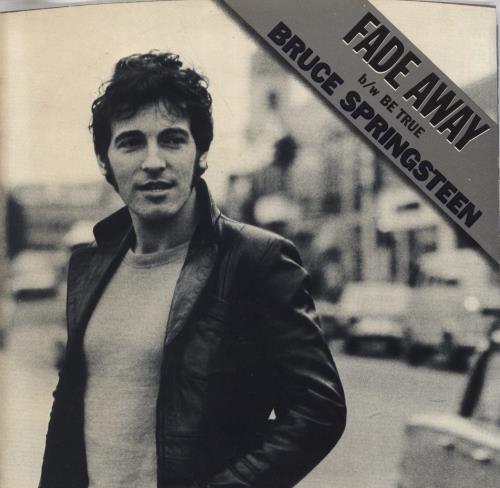
“Fade Away” is a 1980 song written and performed by Bruce Springsteen, accompanied by the E Street Band. It is contained on his album “The River”, and the second single released from it in the United States, “Fade Away” is “certainly among his most pessimistic and helpless depictions of life and love gone wrong.
E Street Steve Van Zandt has proclaimed “Fade Away” as one of his favorite Springsteen songs, but thinks that it is not played in band shows because it is too slow. Regardless, he says, “It’s just one of those funny, lost little gems, you know?” .
Bruce Springsteen and the E Street Band – “Fade Away” at Nassau Coliseum in Uniondale NY on December 31, 1980.
The song was recorded at The Power Station in New York in March to June 1980, one of the last songs to be recorded for the album. Musically and lyrically it is a slow, pained lament:
Well now, you say you’ve found another man, who does things to you that I can’t
And that no matter what I do, it’s all over now between me and you girl
But I can’t believe what you say
No, I can’t believe what you say …
it is was the second single taken from The River, released in February 1981 in the U.S. In the UK and Europe, “TheRiver” was released instead. “Fade Away” was not as successful as the previous single from the album, “Hungry Heart”, but still reached #20 . It was only performed sporadically on The River Tour,and not at all for nearly the first two months. The judgement behind its selection as the second single was questioned, considering the more radio-friendly songs on the record, and the choice was blamed for slowing down sales of the album. It was then dropped from Springsteen’s concert repertoire completely, only rematerializing for a handful of solo renditions on the 2005 Devils & Dust Tour.
Filmed at Madison Square Garden, New York, NY. 8-11-2009
The song was performed once on the Wrecking Ball Tour on July 20th, 2013 at King’s Hall in Belfast; Springsteen made reference on stage that it was Van Zandt’s favorite song. The song was played nightly during the North American leg of Springsteen’s 2016 River Tour, where The River was played in its entirety. When the tour reached Europe, the album presentation format of the tour was dropped, with the exception of a few shows. “Fade Away” has not been performed outside of the album format.
Meanwhile, Southside Johnny and the Asbury Jukes (old Van Zandt cohorts) had added “Fade Away” to his concerts from the 1980s on, and it would be included on his 1997 Spittin’ Fire live album.Southside’s renditions have often been of a slow, bluesy nature, accompanied only by bandmate Bobby Bandiera.
“Fade Away” live at Entertainment Centre, Brisbane, Australia, 26th February 2014.
It was finally given an E Street Band performance again at Stockholm Stadion on June 7th, 2009 during the European second leg of the Working on a Dream Tour; Springsteen made reference on stage to Van Zandt’s desire to hear it.
As Bruce Springsteen continues his sold-out Springsteen on Broadway run, he has continued to release live concerts from his archives.
Released a couple of weeks ago is Springsteen and the E Street Band live from Stockholm, Sweden on July 3rd, 1988. This concert was part of Tunnel of Love Express tour, which was of course supporting 1987’s album “Tunnel of Love”. What makes this concert significant, however, is that the first 90-minute set was broadcast to radio stations at the time, making it one of most known concerts in the Springsteen canon. “Chimes of Freedom” from the show was released on an EP of the same name. But the broadcast did not contain the full concert, which would continue for another set and three encores. Now, for the first time, the entire concert is being officially released, remixed from the multi-tracks.
Shortly after this tour, Springsteen would disband the E Street Band. Other than recording a couple of tracks for Springsteen’s first Greatest Hits album, the full group would not come back to together until 1999’s Reunion tour. The concert that has just been released is the final one from the tour: July 1st, 2000 at Madison Square Garden in New York City. Portions of this concert were included on the Live in New York City album released in March, 2001, but this is the first time you can officially hear the entire show. Unique tracks from this show include the closing number, “Blood Brothers,” which had never been performed on a tour before.
Perhaps to tie in with the concept of Springsteen on Broadway, another recent concert is from March 19th, 1996 in Belfast, Northern Ireland. Falling between the other two concerts released, this concert was is support of The Ghost of Tom Joad and features a solo, acoustic set from Springsteen. He had performed in this way before, but this was the first time he embarked on a full tour in the format. Many of his familiar songs were recast with new arrangements to sit alongside newer material.
In addition, Springsteen has also released the concert from December 8th, 1978 in Houston, Texas. This show first appeared in The Promise: Darkness on the Edge of Town boxset in 2010, but this is the first time it has been available separately. All proceeds from the sale of this concert will go to benefit MusiCares Hurricane Relief Fund.
All three newly released concerts have been mixed by Jon Altshiller and mastered by Adam Ayan at Gateway Mastering.
All the shows are offered in a variety of formats: Direct Stream Digital or DSD (with 64 times the sampling rate of CD), MP3, FLAC or Apple Lossless, HD-Audio (24 bit/192 kHz, FLAC-HD or ALAC-HD) and CD-R ($26.00). A CD-R plus MP3 package is also available for each.
All previous ten volumes of The Bruce Springsteen Archive Series are available at Springsteen’s official live store for download and physical purchase.
A special reminder: all titles are on sale today for Cyber Monday (25% off CDs, 50% off downloads)!
Bruce Springsteen has performed at just about every great venue on the planet: the Stone Pony, Madison Square Garden, the O2 Arena, the Hollywood Bowl, Red Rocks Amphitheater, football stadiums, state fairs, and now…Broadway?. On Tuesday, the 67-year-old icon began preview performances for his scheduled four-month run at the Walter Kerr Theatre, a 975-seat room on West 48th Street whose notable productions include Anton Chekhov’s The Seagull, Tony Kushner’s Angels in America: Millennium Approaches and Arthur Miller’s The Crucible.
The rumor mill can officially stop churning: Bruce Springsteen has made it to Broadway and we have our first round of first-hand accounts from what attendees say was a “magical, special” night.
The Boss’s four-month residency at the Walter Kerr Theatre in New York kicked off Tuesday night with its first preview show, and as you’d imagine, folks who made it to the very first “Springsteen on Broadway” performance were thrilled.
It was just Bruce on a very sparse stage with just a black grand piano, and a few acoustic guitars. The “set” was just a grey wall and a few of those metal touring cases that bands use on the road for their gear. The best parts of the show were when he sat at the piano and sang and talked. I’d never seen him do that before so it was really special.”
Clad in his usual black attire, Springsteen opened the show on a somber note, Springsteen dedicated the Tuesday show to fellow rocker Tom Petty, who died Monday, sending prayers to members of The Heartbreakers and Petty’s family, Otherwise it appears the rehearsal rumors are true, that Springsteen mixes in a set list of hits, played on guitar and piano, with stories in a theater small enough to feel like a once-in-a-lifetime experience for Boss diehards.
What follows is two hours of music and storytelling interlaced with a kind of warm intimacy. There are anecdotes that might serve as footnotes to his arena shows, and passages some might recognise from last year’s autobiography, but given new life here as if they were always meant to be performed,
Springsteen stuck to his script, sharing recollections and reading passages from his bestselling memoir, Born to Run, as well as performing some of his best-known songs, He kicked things off by discussing his childhood, and how he acquired his first guitar, which he paired with a performance of “Growin Up,” from his 1973 debut Greetings From Asbury Park, N.J. Others such as Dancing in the Dark and Thunder Road lying alongside quieter moments such as My Father’s House and The Promised Land. Many are reimagined for the occasion Growin’ Up, from Greetings from Asbury Park, NJ (1973), is spun out across several minutes, at one point taking on a kind of incantatory reverie that recalls Van Morrison’s Coney Island. Born in the USA, meanwhile, is recast as sour, lost-souled blues. “It is,” he reminds the crowd, “a protest song.”
He also shared the impact of reading veteran Ron Kovic’s memoir Born on the Fourth of July before performing his song inspired by it, “Born in the U.S.A.,”
Among the evening’s most arresting moments is the arrival on stage of Springsteen’s wife, singer-songwriter and E Street Band member Patti Scialfa. She accompanies him on Tougher Than the Rest and Brilliant Disguise, two songs from Tunnel of Love – the album he wrote in the wake of his split from his first wife Julianne Phillips. At an arena show these moments can be engulfed by the scale of the production, but here there’s a fragility and a new light cast on the songs and his relationship with Scialfa, as if he stands in her emotional shadow.
Setlist: Bruce Springsteen Walter Kerr Theatre, Broadway, New York – October 3rd, 2017 1. “Growin’ Up” 2. “My Hometown” 3. “My Father’s House” 4. “The Wish” 5. “Thunder Road” 6. “The Promised Land” 7. “Born in the U.S.A.” 8. “Tenth Avenue Freeze-Out” 9. “Tougher Than the Rest” 10. “Brilliant Disguise” 11. “The Ghost of Tom Joad” 12. “Long Walk Home” 13. “Dancing in the Dark” 14. “Land of Hope and Dreams” 15. “Born to Run”
Critics and press were invited to a performance next week: stay tuned for more reviews.




 The Fat Angel Sings